Joshua 17:6

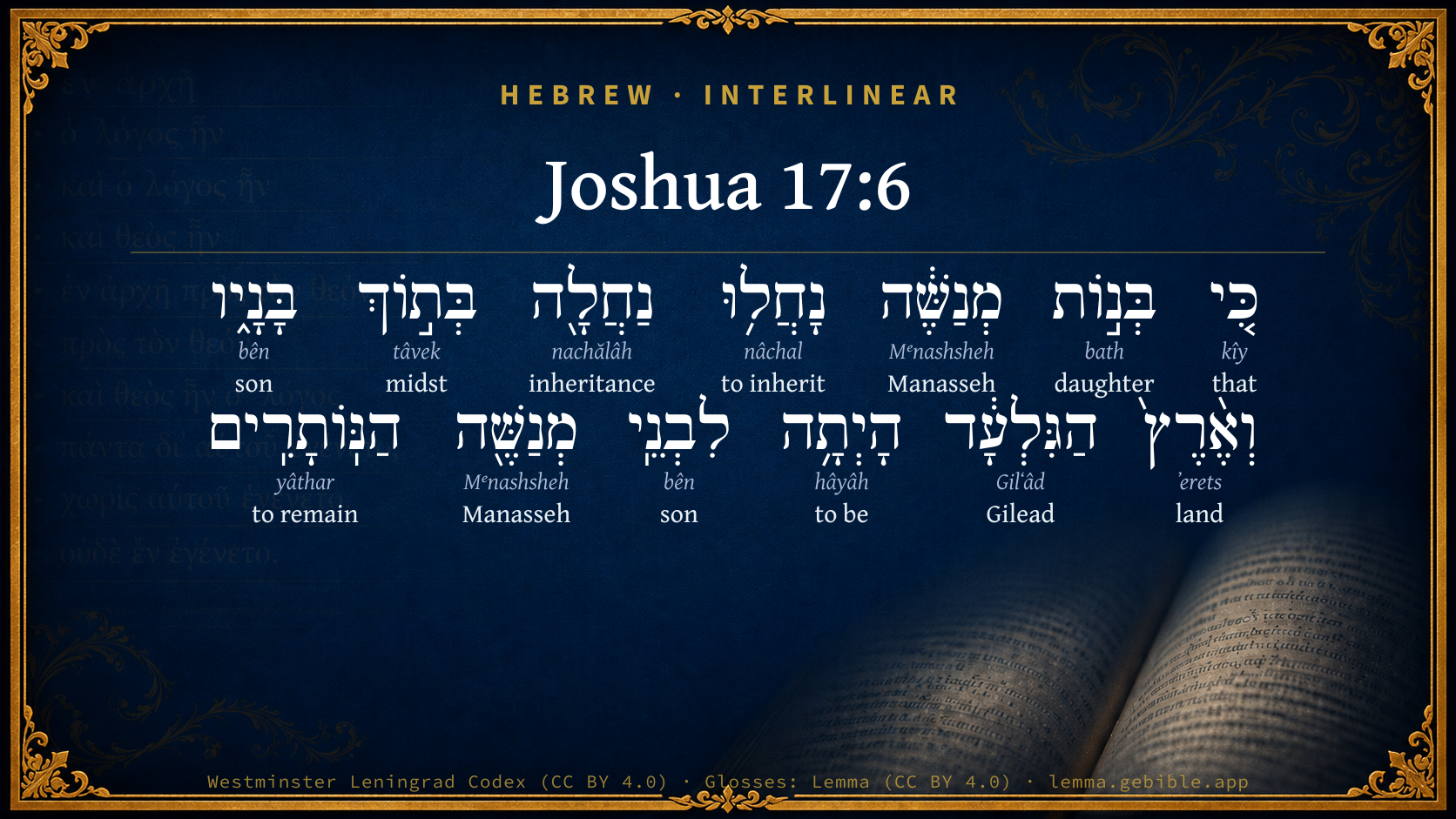
Hebrew (Westminster Leningrad Codex) Joshua 17:6 appears in the Hebrew Old Testament. The text above is from the Westminster Leningrad Codex. Each word links to its Strong’s number, a concise gloss, and parsing drawn from the Open Scriptures Hebrew Bible morphology. Click any word for its full Brown-Driver-Briggs (BDB) entry.
Download image
Cite this verse

Joshua 17:6 (World English Bible). Public Domain. Lemma interlinear Bible study tool, https://lemma.gebible.app/v/joshua/17/6.

Show BibTeX & RIS
BibTeX
RIS
English Translation
because the daughters of Manasseh had an inheritance among his sons. The land of Gilead belonged to the rest of the sons of Manasseh.
World English Bible · Public Domain
Download a study sheet

One document with this verse’s original text, its word-by-word gloss line, the meaning frame, cross-references with their text, attributed commentary, and full source and license credits — printable, and it pastes into notes with its structure intact.

This verse Autodidact and up

Study sheet (.html) Plain text (.txt)

A passage Seminary Student

Up to 50 verses in one chapter. A passage sheet keeps up to 6 commentary sources and 12 cross-references per verse, in the order this page ranks them, and says so on the sheet whenever that leaves anything out. Ask for a single verse and you get the Autodidact verse sheet above.

Everything on this page stays free to read, with no account — the sheet is a download of what is already on screen, not access to it.

Want to remove ads? Support Godless Engineer
Compare translations 3

The same verse in 3 English versions, stacked beneath the original-language interlinear above. Click any original word for its lexicon entry.

Each is an independent rendering of the whole verse — the interlinear is not word-aligned to these translations.

Highlighted words mark where these versions differ — a whole-verse word diff, not a word-by-word alignment.

  • World English Bible Public Domain
    because the daughters of Manasseh had an inheritance among his sons. The land of Gilead belonged to the rest of the sons of Manasseh.
  • King James Version Public Domain
    Because the daughters of Manasseh had an inheritance among his sons: and the rest of Manasseh's sons had the land of Gilead.
  • unfoldingWord Literal Text CC BY-SA 4.0
    For the daughters of Manasseh inherited an inheritance in the midst of his sons. And the land of the Gilead was for the remaining sons of Manasseh.

unfoldingWord Literal Text — © unfoldingWord, licensed CC BY-SA 4.0. Word-aligned USFM3 via Door43 (git.door43.org/unfoldingWord/en_ult).

Versions to compare (up to 4)

3 of 4 selected

Show all 18 translations

Every available English version of this verse, each an independent rendering of the whole verse.

  • World English Bible Public Domain
    because the daughters of Manasseh had an inheritance among his sons. The land of Gilead belonged to the rest of the sons of Manasseh.
  • Berean Standard Bible Public Domain
    because the daughters of Manasseh received an inheritance among his sons. And the land of Gilead belonged to the rest of the sons of Manasseh.
  • Majority Standard Bible Public Domain
    because the daughters of Manasseh received an inheritance among his sons. And the land of Gilead belonged to the rest of the sons of Manasseh.
  • King James Version Public Domain
    Because the daughters of Manasseh had an inheritance among his sons: and the rest of Manasseh's sons had the land of Gilead.
  • American Standard Version (1901) Public Domain
    because the daughters of Manasseh had an inheritance among his sons. And the land of Gilead belonged unto the rest of the sons of Manasseh.
  • Revised Version (1885) Public Domain
    because the daughters of Manasseh had an inheritance among his sons: and the land of Gilead belonged unto the rest of the sons of Manasseh.
  • Geneva Bible (1599) Public Domain
    Because the daughters of Manasseh did inherite among his sonnes: and Manassehs other sonnes had the land of Gilead.
  • Douay-Rheims (1899) Public Domain
    For the daughters of Manasses possessed inheritance in the midst of his sons. And the land of Galaad fell to the lot of the rest of the children of Manasses.
  • Young's Literal Translation Public Domain
    for the daughters of Manasseh have inherited an inheritance in the midst of his sons, and the land of Gilead hath been to the sons of Manasseh who are left.
  • Literal Standard Version CC BY-SA 4.0
    for the daughters of Manasseh have inherited an inheritance in the midst of his sons, and the land of Gilead has been for the sons of Manasseh who are left.
  • Unlocked Literal Bible CC BY-SA 4.0
    because the daughters of Manasseh received an inheritance along with his sons. The land of Gilead was assigned to the rest of the tribe of Manasseh.
  • unfoldingWord Literal Text CC BY-SA 4.0
    For the daughters of Manasseh inherited an inheritance in the midst of his sons. And the land of the Gilead was for the remaining sons of Manasseh.
  • Darby Bible Public Domain
    For the daughters of Manasseh received an inheritance among his sons; and the rest of Manasseh's sons had the land of Gilead.
  • World Messianic Bible Public Domain
    because the daughters of Manasseh had an inheritance among his sons. The land of Gilead belonged to the rest of the sons of Manasseh.
  • Webster's Bible Public Domain
    Because the daughters of Manasseh had an inheritance among his sons: and the rest of Manasseh's sons had the land of Gilead.
  • Free Bible Version CC BY-SA 4.0
    because the daughters of the tribe of Manasseh received an allocation along with the sons. (The land of Gilead had been allotted to the rest of the descendants of Manasseh).
  • Bible in Basic English Public Domain
    Because the daughters of Manasseh had a heritage among his sons, and the land of Gilead was the property of the other sons of Manasseh.
  • JPS Tanakh (1917) Public Domain
    because the daughters of Manasseh had an inheritance among his sons; and the land of Gilead belonged unto the rest of the sons of Manasseh.

Literal Standard Version (2020), Covenant Press — licensed CC BY-SA 4.0. Text via the HelloAO Bible API (eBible.org). Unlocked Literal Bible (unfoldingWord) — licensed CC BY-SA 4.0. Text via the HelloAO Bible API (eBible.org). unfoldingWord Literal Text — © unfoldingWord, licensed CC BY-SA 4.0. Word-aligned USFM3 via Door43 (git.door43.org/unfoldingWord/en_ult). Free Bible Version, Dr. Jonathan Gallagher — licensed CC BY-SA 4.0. Text via the HelloAO Bible API (eBible.org).

Word by word

More ways to search: Search by grammar → Find every occurrence → Compare this word →

Practice this passage: Drill this verse → Learn its vocabulary →

נָחֲל֥וּ
nâchal
H5157
“to inherit”
Verb, Qal, Perfect, 3rd Person, Common, Plural
Part of Speech
Verb
Stem
Qal
Form
Perfect
Person
3rd Person
Gender
Common
Number
Plural
Full BDB Definition

Origin: a primitive root

TWOT: 1342

to get as a possession, acquire, inherit, possess - (Qal) - to take possession, inherit - to have or get as a possession or property (figuratively) - to divide the land for a possession - to acquire (testimonies) (figuratively) - (Piel) to divide for a possession - (Hithpael) to possess oneself of - (Hiphil) - to give as a possession - to cause to inherit, give as an inheritance - (Hophal) to be allotted, be made to possess
  1. כִּ֚י kîy H3588 “that” Conjunction
  2. בְּנ֣וֹת bath H1323 “daughters of” Noun, Common, Feminine, Plural, Construct
  3. מְנַשֶּׁ֔ה Mᵉnashsheh H4519 “Manasseh” Noun, Proper
  4. נַחֲלָ֖ה nachălâh H5159 “inheritance” Noun, Common, Feminine, Singular, Absolute
  5. בְּת֣וֹךְ tâvek H8432 “in/at · midst of” Preposition + Noun, Common, Masculine, Singular, Construct
  6. בָּנָ֑יו bên H1121 “sons · his” Noun, Common, Masculine, Plural, Construct + Suffix, Personal, 3rd Person, Masculine, Singular
  7. וְאֶ֨רֶץ֙ ʼerets H776 “and · land of” Conjunction + Noun, Common, Both, Singular, Construct
  8. הַגִּלְעָ֔ד Gilʻâd H1568 “the · Gilead” Particle, Definite Article + Noun, Proper
  9. הָיְתָ֥ה hâyâh H1961 “to be” Verb, Qal, Perfect, 3rd Person, Feminine, Singular
  10. לִבְנֵֽי bên H1121 “to/for · sons of” Preposition + Noun, Common, Masculine, Plural, Construct
  11. מְנַשֶּׁ֖ה Mᵉnashsheh H4519 “Manasseh” Noun, Proper
  12. הַנּֽוֹתָרִֽים yâthar H3498 “the · remaining” Particle, Definite Article + Verb, Niphal, Participle Active, Masculine, Plural, Absolute

About this verse

These counts appear in no published source. They are computed here, from the morphology-tagged text and Lemma’s own curated glosses. What Lemma adds →

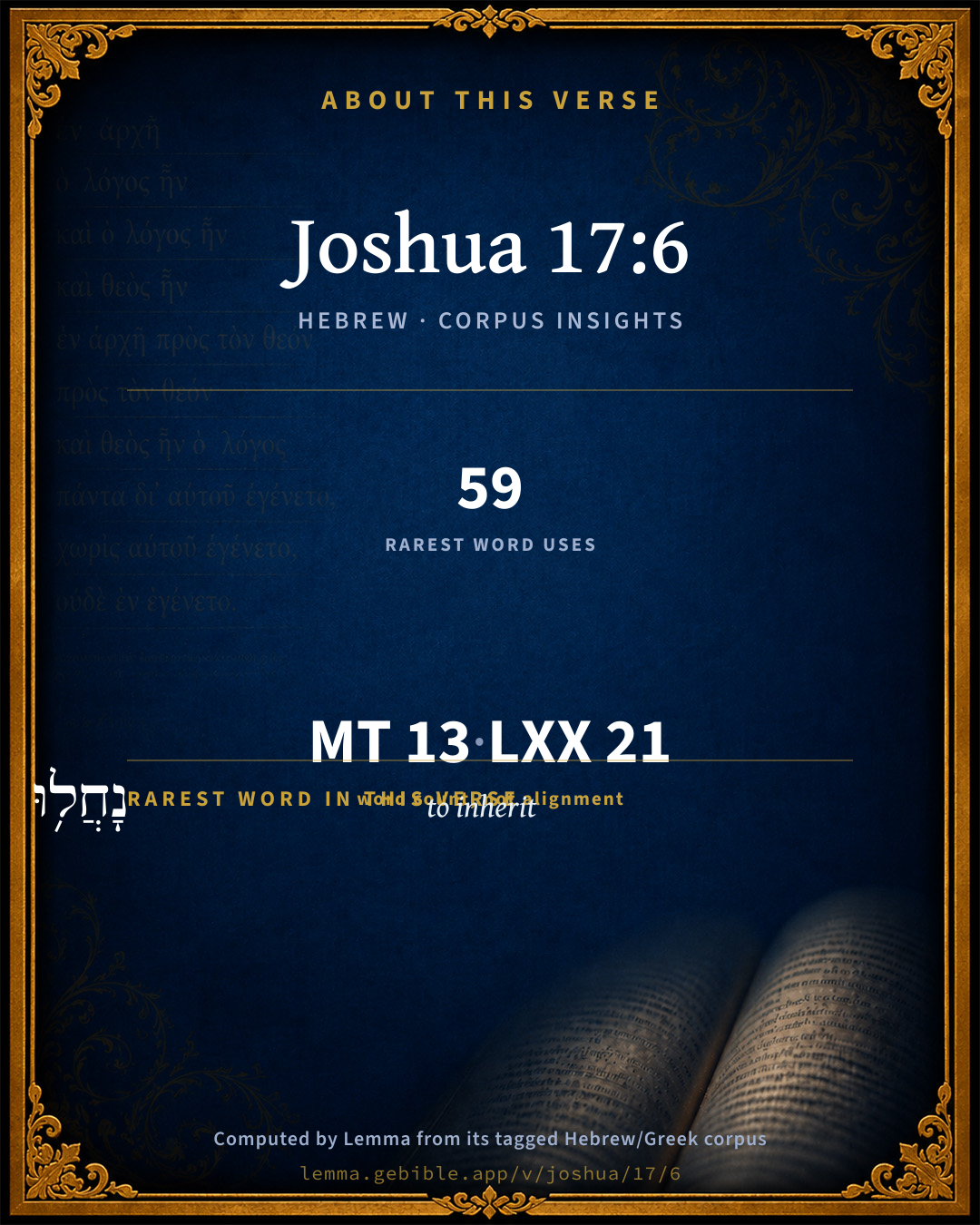
13
words
11
distinct lemmas
Historical
section

Shared distinctive vocabulary

נָחֲל֥וּ to inherit H5157 occurs in 57 verses of the Hebrew Bible. Also found in:

Grammatical profile

  • 3 verbs
  • 9 nouns
  • 1 conjunction

Verb forms

  • נָחֲל֥וּ Qal · Perfect
  • הָיְתָ֥ה Qal · Perfect
  • הַנּֽוֹתָרִֽים Niphal · Participle Active

Repetition

Words recur within this verse — often emphatic in Hebrew:

  • מְנַשֶּׁ֔ה Manasseh H4519 ×2
  • בָּנָ֑יו son H1121 ×2

Hebrew & Septuagint length

In English translation the verse runs 24 words from the Hebrew and 32 from the Septuagint (LXX English) — closely comparable.

A rough comparison of the two English renderings, which tokenize alike — not a word-level alignment.

Word counts can differ between the Hebrew and the Greek without any difference in meaning — e.g. the Hebrew direct-object marker אֵת has no separate Greek word, and Greek often adds the article ὁ.

In the original languages it is 13 Hebrew tokens and 21 Greek tokens — but the two are counted differently (Hebrew bundles its prefixes and suffixes into one token; the Greek is in lemma form), so that isn’t a like-for-like length.

Hebrew and Greek witnesses Masoretic Hebrew ↔ Greek Septuagint

The same verse in the two great witnesses to the Old Testament, shown verse-for-verse.

These are two independent witnesses, not word-aligned to each other, and the Septuagint is shown in lemma (dictionary) form.

Hebrew Joshua 17:6 Masoretic · Westminster Leningrad Codex

כִּ֚י בְּנ֣וֹת מְנַשֶּׁ֔ה נָחֲל֥וּ נַחֲלָ֖ה בְּת֣וֹךְ בָּנָ֑יו וְאֶ֨רֶץ֙ הַגִּלְעָ֔ד הָיְתָ֥ה לִבְנֵֽי מְנַשֶּׁ֖ה הַנּֽוֹתָרִֽים

because the daughters of Manasseh had an inheritance among his sons. The land of Gilead belonged to the rest of the sons of Manasseh.

World English Bible · Public Domain

Greek LXX Joshua 17:6 Septuagint · lemma form

ὅτι θυγάτηρ υἱός μανασσή κληρονομέω κλῆρος ἐν μέσος ὁ ἀδελφός αὐτός ὁ δέ γῆ γαλαάδ γίγνομαι ὁ υἱός μανασσή ὁ καταλείπω

For the daughters of the sons of Manasse inherited a portion in the midst of their brethren, and the land of Galaad was assigned to the remainder of the sons of Manasse.

LXX2012 (modern English Septuagint) · Public Domain

Hebrew: Westminster Leningrad Codex (CC BY 4.0). Greek: Septuagint (public domain); English from LXX2012 (modern English Septuagint) (Public Domain). How the Septuagint differs from the Hebrew →

Targum (Aramaic paraphrase)

1

The Targum is the ancient Jewish Aramaic paraphrase of the Hebrew Scriptures — an interpretive translation, not the Hebrew text itself. Onkelos (literal) and Pseudo-Jonathan (expansive) render the Torah, and Jonathan the Prophets. Coverage is partial: where no permissively-licensed English translation exists for a verse, only the Aramaic is shown. This is verse-level text, not a word-by-word alignment to the Hebrew.

  1. Targum Jonathan Prophets (Joshua–Malachi)
    אֲרֵי בְּנַת מְנַשֶׁה אַחֲסִינוּ אַחֲסָנָא בְּגוֹ בְנוֹהִי וְאַרְעָא גִלְעָד הֲוַת לִבְנֵי מְנַשֶׁה דְאִשְׁתָּאֲרוּ:

    (no public-domain English translation for this verse)

    Targum Jonathan — Aramaic: “Mikraot Gedolot” (public domain). English: “Sefaria Community Translation” (CC0 1.0 (public-domain dedication)); “London "Chaldee Paraphrase," 1871” (public domain). Text via Sefaria.

Commentary

Notes on Joshua 17:6 from classic Christian and Jewish commentators (each source and its license shown beneath its notes). The classic Christian expositions comment on the surrounding passage and are grouped to its opening verse, so a note may address several verses; the Jewish commentaries on the Tanakh (Rashi and others) are per-verse, so they appear only where the commentator wrote on this verse.

Lemma curates 59 commentaries, every one of them public domain or Creative Commons licensed, each selected and text-cleaned for this edition rather than reprinted as found. About our sources →

Trapp's Complete Commentary

John Trapp

Jos 17:6 Because the daughters of Manasseh had an inheritance among his sons: and the rest of Manasseh’s sons had the land of Gilead.

Ver. 6. Because the daughters of Manasseh.] Here was no Salic law to exclude them. In many women, besides their sex, there is nothing womanlike, or weak souls have no sexes; and women’s bodies are of a more exact composition, &c.

John Trapp, A Commentary or Exposition upon All the Books of the Old and New Testament (1647–1656) — public domain. Text from a community e-Sword module.

The Cambridge Bible for Schools and Colleges

gen. ed. J. J. S. Perowne

6. the rest of Manasseh’s sons] i.e. the descendants of Machir.

The Cambridge Bible for Schools and Colleges (gen. ed. J. J. S. Perowne; Cambridge University Press, 1878–1918) — public domain. Text from a community e-Sword module.

John Gill's Exposition

Because the daughters of Manasseh had an inheritance among his sons,.... Which occasioned such a number of portions; the daughters of Zelophehad are meant, who descended from Manasseh:

and the rest of Manasseh, some had the land of Gilead; that is, those besides the six families before expressed, namely, the two families of the Machirites and Gileadites, Num 26:29.

John Gill's Exposition of the Whole Bible (1746–1763) — public domain (CC PDM 1.0). Text via the HelloAO Bible API.

Matthew Poole's English Annotations

Among his sons, i.e. no less than the sons; so their sex was no bar to their inheritance.

Matthew Poole's English Annotations on the Holy Bible (1683–1685) — public domain. Text from a community e-Sword/MySword module.

The Pulpit Commentary

The rest of Manasseh"s sons. Namely, the descendants of Machir (see ver. 1). The ambiguity is due to the indefinite way in which "son" is used in Scripture. Thus the B"ne Israel, which we translate "children of Israel," is literally, "sons of Israel," or Jacob. So the sons of Manasseh, in like manner, are Manasseh"s descendants.

HOMILIES BY R. GLOVER Ver. 6. Woman"s rights.

This is rather a remarkable case. The family of Machir, one of the most warlike in Israel, had contributed more to the conquest of Gilead than any other, and there had been accordingly allotted to them a large share of it. It so happened that in one branch of the family there was not a single male among the children. Five women alone represented a warlike sire. They appeal to Moses, with an energy derived from their great ancestor, to prevent the passing of their property out of their hands. It is apparently the last cause which comes before Moses before his death. The great lawgiver takes occasion from it to make a general law applicable to all such cases. If there be a son left, then the son inherits; the daughter being supposed to find her provision in that of the husband she marries, and to be supported by her brother till she does so. But in the case of there being no brother, they were to inherit their father"s land, and marry in their own tribe, so that the tribe might still retain its possessions intact, and all families have maintenance for their representatives, even though male issue should fail. It falls to Joshua to apply the principles Moses laid down, and accordingly he gives the five ladies "an inheritance amongst the sons" of Manasseh. We do not suggest that Moses legislated in the spirit of the advanced theorists on woman"s rights; it would have been impossible for one so wise to legislate some thousands of years ahead of the general sentiments of mankind. But it is worth noting how ready Moses was to do justice by the weaker sex; and to pass a law, doubtless little to the mind of the rough men who would look enviously on women inheriting considerable estates. It raises the question how far Moses would have sanctioned the views of those who plead that men and women should stand on exactly equal platforms before the law. We can only briefly suggest the answer to this question. Every woman under the Mosaic legislation was more or less sufficiently provided for. The double portion of the firstborn was, by the usage of the East, assigned him chiefly that he might support his widowed mother and unmarried sisters. When marriage was universal, a temporary provision of this kind was all that was required. And where land was not wealth, but only the material out of which it could be gathered, we do not wonder at the law dividing the land (after the eldest son"s double portion) equally among the other sons. Wherever, on the other hand, no sons were left, then the daughters divided equally the property between them, subject to the restriction that they should marry within their own tribe. We may venture to suggest that the spirit of these laws would, in the altered circumstances of our country, be altogether in favour of the equal distribution of property between sons and daughters. The patriarchal system that gave the widow and the unmarried daughters an established home in the old family house which the elder brother inherited, and made their maintenance a charge upon the double birthright, has passed away; and it is no longer the case that sisters share whatever an elder son inherits. Marriage is neither so early nor so universal now. And in the multiplicity of remunerative pursuits open to men in our land there is no longer any special reason for restricting the inheritance of the land to those able personally to work upon it. Thus woman has less protection if unprovided for, less certainty of the resource of marriage; and man less need for special provisions in his favour. In these altered circumstances it is probable that what Moses ruled for the daughters of Zelophehad he would have expanded into a larger rule, and would have required invariably the equal division of all property amongst sons and daughters alike. If we are right in urging this, a few conclusions of practical moment emerge from it.

I Parents who, in their wills, make the shares of their sons much larger than those of their daughters, take a course which the spirit of Bible legislation forbids, and are guilty of grave injustice.

II The laws of every country ought, with especial care, to protect the property of women, as being the weaker parties in disputes and the likeliest, therefore, to suffer.

III A considerable improvement in the position of women would be ejected by the general adoption of such rules by parents and by states. Probably, if women in all directions found equal justice yielded them with men, the equality of legislative power and influence which some seek would be found superfluous. G.

The Pulpit Commentary (1880–1919), ed. H.D.M. Spence-Jones & Joseph S. Exell — public domain. Text from a community e-Sword module.

John Wesley's Explanatory Notes

The daughters - Not less than the son, so the sex was no bar to their inheritance.

John Wesley, Explanatory Notes Upon the Whole Bible (1754–1765) — public domain. Text via the GEBible commentary corpus.

Rashi

Rabbi Shlomo Yitzchaki (Rashi)

And the land of Gilod— that was on the other side of the Jordan belonged to the remaining sons of Menashe.

Rashi on the Tanakh — English translations: “The Judaica Press complete Tanach with Rashi, translated by A. J. Rosenberg” (CC BY 4.0); “Pentateuch with Rashi's commentary by M. Rosenbaum and A.M. Silbermann, 1929-1934” (public domain); “The Metsudah Tanach series, Lakewood, N.J” (CC BY 4.0); and “The Book of Joshua, Metsudah Publications, 1997” (CC BY 4.0). Text via Sefaria.

Lesson kit

Teaching starters — assembled from the data on this page, not authored interpretation. Every prompt links to the verse data it draws on. Edit before teaching.

Joshua, in the Historical, opens this verse with 13 words (11 distinct Hebrew lemmas). Its most distinctive word is nâchal (“to inherit”). A historical commentator’s framing appears above. Read the whole chapter for the surrounding context.

Discussion questions

  1. How does “to inherit” (nâchal) shape what this verse is saying?
  2. Exodus 23:30 shares the word «to inherit» with this verse. How do the two illuminate each other?
  3. “Manasseh” occurs 2× in this one verse. What is the effect of the repetition?
  4. These translations render this verse differently. What is at stake in choosing one wording over another?
  5. The verb «נָחֲל֥וּ» is Qal Perfect. How does its form color the action?
  6. Reading how Trapp's Complete Commentary and The Cambridge Bible for Schools and Colleges read this verse, where do the two commentators agree and where do they part?

Things to notice

Reading settings

Reading text

Shown beneath each verse's original-language words.

Old Testament
Old Testament edition

Read the OT as the Masoretic Hebrew (MT) or the Greek Septuagint (LXX).

English shown for the Greek Septuagint (in the Hebrew ↔ Greek comparison).

Comparing translations? Open the Compare panel on any verse page to stack up to four side by side.