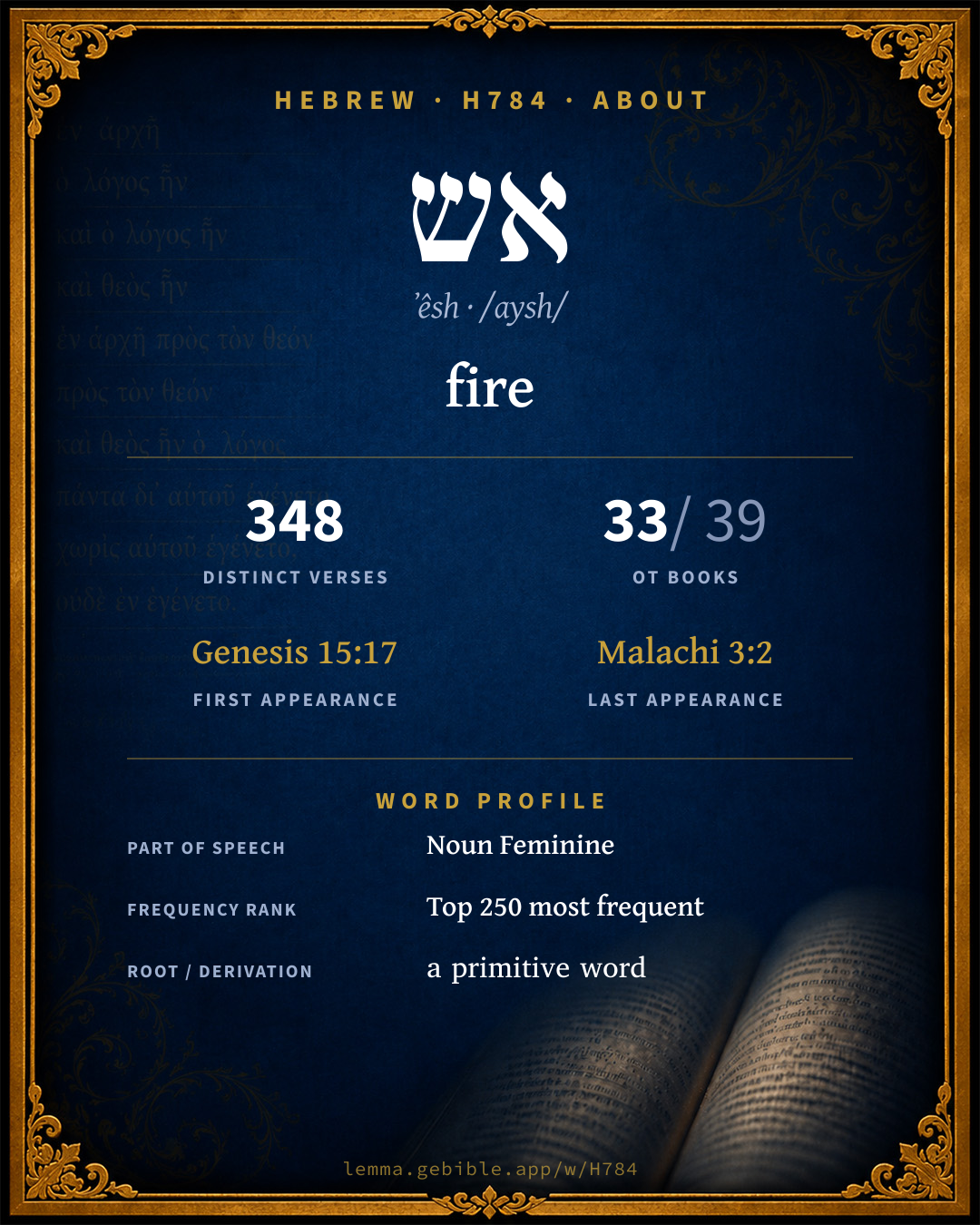
אֵשׁ
fire
‘fire’ is one of 6 main senses fuller range ↓
Full lexicon entry — Brown-Driver-Briggs (BDB)
From Brown-Driver-Briggs (BDB)
Where this word appears
See every Absolute-state word in the Hebrew Bible →
Grammar key — what these labels mean
Part of speech
- Noun
- A naming word — a person, place, thing, or idea.
Noun type
- Common
- A common noun — a general class of person, place, or thing (“king,” “city,” “water”), not a specific name.
State
- Absolute
- The independent form of a noun, not bound to a following word.
- Construct
- A noun bound to a following noun in a possessive / “of” relationship (the construct chain).
Gender
- Both
- Attested as both masculine and feminine.
Number
- Singular
- One.
Grammatical forms
- Noun, Common, Both, Singular, Absolute 352 times (93%)
- Noun, Common, Both, Singular, Construct 26 times (7%)
Parsed forms decoded from the imported morphology (morphhb / Westminster Leningrad Codex — WLC text public domain, morphhb tagging CC BY 4.0), counted across 378 parsed occurrences — not distinct verses.
Page 1 of 2 — showing verses 1–200 of 348 distinct verses where H784 appears, across 33 books. Click any verse to open its interlinear word-by-word view. Verse text shown in the World English Bible for context — . Each verse’s Hebrew form is shown with its reference; the English is not keyword-highlighted, since the data carries no word-level English alignment. Use “Compare translations” on any verse to read it across multiple English versions. This concordance covers the Hebrew Bible; Septuagint (Greek Old Testament) occurrences are not indexed here.
Genesis 4 verses
- Genesis 15:17 אֵ֔שׁ n c bs It came to pass that, when the sun went down, and it was dark, behold, a smoking furnace, and a flaming torch passed between these pieces.
- Genesis 19:24 וָ/אֵ֑שׁ conj + n c bs Then Yahweh rained on Sodom and on Gomorrah sulfur and fire from Yahweh out of the sky.
- Genesis 22:6 הָ/אֵ֖שׁ ptcl def.art + n c bs Abraham took the wood of the burnt offering and laid it on Isaac his son. He took in his hand the fire and the knife. They both went together.
- Genesis 22:7 הָ/אֵשׁ֙ ptcl def.art + n c bs Isaac spoke to Abraham his father, and said, "My father?" He said, "Here I am, my son." He said, "Here is the fire and the wood, but where is the lamb for a burnt offering?"
Exodus 18 verses
- Exodus 3:2 אֵ֖שׁ בָּ/אֵ֔שׁ n c bs prep det + n c bs The angel of Yahweh appeared to him in a flame of fire out of the midst of a bush. He looked, and behold, the bush burned with fire, and the bush was not consumed.
- Exodus 9:23 אֵ֖שׁ n c bs Moses stretched forth his rod toward the heavens, and Yahweh sent thunder, hail, and lightning flashed down to the earth. Yahweh rained hail on the land of Egypt.
- Exodus 9:24 וְ/אֵ֕שׁ conj + n c bs So there was very severe hail, and lightning mixed with the hail, such as had not been in all the land of Egypt since it became a nation.
- Exodus 12:8 אֵ֣שׁ n c bs They shall eat the flesh in that night, roasted with fire, and unleavened bread. They shall eat it with bitter herbs.
- Exodus 12:9 אֵ֔שׁ n c bs Don't eat it raw, nor boiled at all with water, but roasted with fire; with its head, its legs and its inner parts.
- Exodus 12:10 בָּ/אֵ֥שׁ prep det + n c bs You shall let nothing of it remain until the morning; but that which remains of it until the morning you shall burn with fire.
- Exodus 13:21 אֵ֖שׁ n c bs Yahweh went before them by day in a pillar of cloud, to lead them on their way, and by night in a pillar of fire, to give them light, that they might go by day and by night:
- Exodus 13:22 הָ/אֵ֖שׁ ptcl def.art + n c bs the pillar of cloud by day, and the pillar of fire by night, didn't depart from before the people.
- Exodus 14:24 אֵ֖שׁ n c bs It happened in the morning watch, that Yahweh looked out on the host of the Egyptians through the pillar of fire and of cloud, and confused the Egyptian army.
- Exodus 19:18 בָּ/אֵ֑שׁ prep det + n c bs Mount Sinai, the whole of it, smoked, because Yahweh descended on it in fire; and its smoke ascended like the smoke of a furnace, and the whole mountain quaked greatly.
- Exodus 22:6 אֵ֜שׁ n c bs "If fire breaks out, and catches in thorns so that the shocks of grain, or the standing grain, or the field are consumed; he who kindled the fire shall surely make restitution.
- Exodus 24:17 כְּ/אֵ֥שׁ prep + n c bs The appearance of the glory of Yahweh was like devouring fire on the top of the mountain in the eyes of the children of Israel.
- Exodus 29:14 בָּ/אֵ֔שׁ prep det + n c bs But the flesh of the bull, and its skin, and its dung, you shall burn with fire outside of the camp: it is a sin-offering.
- Exodus 29:34 בָּ/אֵ֔שׁ prep det + n c bs If anything of the flesh of the consecration, or of the bread, remains to the morning, then you shall burn the remainder with fire: it shall not be eaten, because it is holy.
- Exodus 32:20 בָּ/אֵ֔שׁ prep det + n c bs He took the calf which they had made, and burnt it with fire, ground it to powder, and scattered it on the water, and made the children of Israel drink of it.
- Exodus 32:24 בָ/אֵ֔שׁ prep det + n c bs I said to them, 'Whoever has any gold, let them take it off:' so they gave it me; and I threw it into the fire, and out came this calf."
- Exodus 35:3 אֵ֔שׁ n c bs You shall kindle no fire throughout your habitations on the Sabbath day.'"
- Exodus 40:38 וְ/אֵ֕שׁ conj + n c bs For the cloud of Yahweh was on the tent by day, and there was fire in the cloud by night, in the sight of all the house of Israel, throughout all their journeys.
Leviticus 30 verses
- Leviticus 1:7 אֵ֖שׁ הָ/אֵֽשׁ n c bs ptcl def.art + n c bs The sons of Aaron the priest shall put fire on the altar, and lay wood in order on the fire;
- Leviticus 1:8 הָ/אֵ֔שׁ ptcl def.art + n c bs and Aaron's sons, the priests, shall lay the pieces, the head, and the fat in order on the wood that is on the fire which is on the altar;
- Leviticus 1:12 הָ/אֵ֔שׁ ptcl def.art + n c bs He shall cut it into its pieces, with its head and its fat. The priest shall lay them in order on the wood that is on the fire which is on the altar,
- Leviticus 1:17 הָ/אֵ֑שׁ ptcl def.art + n c bs He shall tear it by its wings, but shall not divide it apart. The priest shall burn it on the altar, on the wood that is on the fire. It is a burnt offering, an offering made by fire, of a sweet savor to Yahweh.
- Leviticus 2:14 בָּ/אֵשׁ֙ prep det + n c bs "'If you offer a meal offering of first fruits to Yahweh, you shall offer for the meal offering of your first fruits grain in the ear parched with fire, bruised grain of the fresh ear.
- Leviticus 3:5 הָ/אֵ֑שׁ ptcl def.art + n c bs Aaron's sons shall burn it on the altar on the burnt offering, which is on the wood that is on the fire: it is an offering made by fire, of a sweet savor to Yahweh.
- Leviticus 4:12 בָּ/אֵ֑שׁ prep det + n c bs even the whole bull shall he carry forth outside the camp to a clean place, where the ashes are poured out, and burn it on wood with fire. Where the ashes are poured out it shall be burned.
- Leviticus 6:9 וְ/אֵ֥שׁ conj + n c bs cs "Command Aaron and his sons, saying, 'This is the law of the burnt offering: the burnt offering shall be on the hearth on the altar all night until the morning; and the fire of the altar shall be kept burning on it.
- Leviticus 6:10 הָ/אֵ֛שׁ ptcl def.art + n c bs The priest shall put on his linen garment, and he shall put on his linen breeches upon his body; and he shall remove the ashes from where the fire has consumed the burnt offering on the altar, and he shall put them beside the altar.
- Leviticus 6:12 וְ/הָ/אֵ֨שׁ conj + ptcl def.art + n c bs The fire on the altar shall be kept burning on it, it shall not go out; and the priest shall burn wood on it every morning: and he shall lay the burnt offering in order upon it, and shall burn on it the fat of the peace offerings.
- Leviticus 6:13 אֵ֗שׁ n c bs Fire shall be kept burning on the altar continually; it shall not go out.
- Leviticus 6:30 בָּ/אֵ֖שׁ prep det + n c bs No sin offering, of which any of the blood is brought into the Tent of Meeting to make atonement in the Holy Place, shall be eaten: it shall be burned with fire.
- Leviticus 7:17 בָּ/אֵ֖שׁ prep det + n c bs but what remains of the flesh of the sacrifice on the third day shall be burned with fire.
- Leviticus 7:19 בָּ/אֵ֖שׁ prep det + n c bs "'The flesh that touches any unclean thing shall not be eaten. It shall be burned with fire. As for the flesh, everyone who is clean may eat it;
- Leviticus 8:17 בָּ/אֵ֔שׁ prep det + n c bs But the bull, and its skin, and its flesh, and its dung, he burned with fire outside the camp; as Yahweh commanded Moses.
- Leviticus 8:32 בָּ/אֵ֖שׁ prep det + n c bs What remains of the flesh and of the bread you shall burn with fire.
- Leviticus 9:11 בָּ/אֵ֔שׁ prep det + n c bs The flesh and the skin he burned with fire outside the camp.
- Leviticus 9:24 אֵשׁ֙ n c bs There came forth fire from before Yahweh, and consumed the burnt offering and the fat upon the altar: and when all the people saw it, they shouted, and fell on their faces.
- Leviticus 10:1 אֵ֔שׁ אֵ֣שׁ n c bs n c bs Nadab and Abihu, the sons of Aaron, each took his censer, and put fire in it, and laid incense on it, and offered strange fire before Yahweh, which he had not commanded them.
- Leviticus 10:2 אֵ֛שׁ n c bs And fire came forth from before Yahweh, and devoured them, and they died before Yahweh.
- Leviticus 13:24 אֵ֑שׁ n c bs "Or when the body has a burn from fire on its skin, and the raw flesh of the burn becomes a bright spot, reddish-white, or white,
- Leviticus 13:52 בָּ/אֵ֖שׁ prep det + n c bs He shall burn the garment, whether the warp or the woof, in wool or in linen, or anything of skin, in which the plague is: for it is a destructive mildew. It shall be burned in the fire.
- Leviticus 13:55 בָּ/אֵ֖שׁ prep det + n c bs Then the priest shall examine it, after the plague is washed; and, behold, if the plague hasn't changed its color, and the plague hasn't spread, it is unclean; you shall burn it in the fire. It is a mildewed spot, whether the bareness is inside or outside.
- Leviticus 13:57 בָּ/אֵ֣שׁ prep det + n c bs and if it appears again in the garment, either in the warp, or in the woof, or in anything of skin, it is spreading. You shall burn with fire that in which the plague is.
- Leviticus 16:12 אֵ֞שׁ n c bs He shall take a censer full of coals of fire from off the altar before Yahweh, and two handfuls of sweet incense beaten small, and bring it within the veil:
- Leviticus 16:13 הָ/אֵ֖שׁ ptcl def.art + n c bs and he shall put the incense on the fire before Yahweh, that the cloud of the incense may cover the mercy seat that is on the testimony, so that he will not die.
- Leviticus 16:27 בָ/אֵ֔שׁ prep det + n c bs The bull for the sin offering, and the goat for the sin offering, whose blood was brought in to make atonement in the Holy Place, shall be carried forth outside the camp; and they shall burn their skins, their flesh, and their dung with fire.
- Leviticus 19:6 בָּ/אֵ֖שׁ prep det + n c bs It shall be eaten the same day you offer it, and on the next day: and if anything remains until the third day, it shall be burned with fire.
- Leviticus 20:14 בָּ/אֵ֞שׁ prep det + n c bs "'If a man takes a wife and her mother, it is wickedness: they shall be burned with fire, both he and they; that there may be no wickedness among you.
- Leviticus 21:9 בָּ/אֵ֖שׁ prep det + n c bs "'The daughter of any priest, if she profanes herself by playing the prostitute, she profanes her father: she shall be burned with fire.
Numbers 19 verses
- Numbers 3:4 אֵ֨שׁ n c bs Nadab and Abihu died before Yahweh, when they offered strange fire before Yahweh, in the wilderness of Sinai, and they had no children. Eleazar and Ithamar ministered in the priest's office in the presence of Aaron their father.
- Numbers 6:18 הָ/אֵ֔שׁ ptcl def.art + n c bs The Nazirite shall shave the head of his separation at the door of the Tent of Meeting, and shall take the hair of the head of his separation, and put it on the fire which is under the sacrifice of peace offerings.
- Numbers 9:15 אֵ֖שׁ n c bs On the day that the tabernacle was raised up, the cloud covered the tabernacle, even the Tent of the Testimony: and at evening it was over the tabernacle as it were the appearance of fire, until morning.
- Numbers 9:16 אֵ֖שׁ n c bs So it was continually. The cloud covered it, and the appearance of fire by night.
- Numbers 11:1 אֵ֣שׁ n c bs cs The people were as murmurers, [speaking] evil in the ears of Yahweh: and when Yahweh heard it, his anger was kindled; and the fire of Yahweh burnt among them, and devoured in the uttermost part of the camp.
- Numbers 11:2 הָ/אֵֽשׁ ptcl def.art + n c bs The people cried to Moses; and Moses prayed to Yahweh, and the fire abated.
- Numbers 11:3 אֵ֥שׁ n c bs cs The name of that place was called Taberah, because the fire of Yahweh burnt among them.
- Numbers 14:14 אֵ֖שׁ n c bs and they will tell it to the inhabitants of this land. They have heard that you Yahweh are in the midst of this people; for you Yahweh are seen face to face, and your cloud stands over them, and you go before them, in a pillar of cloud by day, and in a pillar of fire by night.
- Numbers 16:7 אֵ֡שׁ n c bs and put fire in them, and put incense on them before Yahweh tomorrow: and it shall be that the man whom Yahweh does choose, he [shall be] holy: you take too much on you, you sons of Levi.
- Numbers 16:18 אֵ֔שׁ n c bs They took every man his censer, and put fire in them, and laid incense thereon, and stood at the door of the tent of meeting with Moses and Aaron.
- Numbers 16:35 וְ/אֵ֥שׁ conj + n c bs Fire came forth from Yahweh, and devoured the two hundred fifty men who offered the incense.
- Numbers 16:37 הָ/אֵ֖שׁ ptcl def.art + n c bs Speak to Eleazar the son of Aaron the priest, that he take up the censers out of the burning, and scatter you the fire yonder; for they are holy,
- Numbers 16:46 אֵ֜שׁ n c bs Moses said to Aaron, Take your censer, and put fire therein from off the altar, and lay incense thereon, and carry it quickly to the congregation, and make atonement for them: for there is wrath gone out from Yahweh; the plague is begun.
- Numbers 18:9 הָ/אֵ֑שׁ ptcl def.art + n c bs This shall be your of the most holy things, [reserved] from the fire: every offering of theirs, even every meal-offering of theirs, and every sin-offering of theirs, and every trespass-offering of theirs, which they shall render to me, shall be most holy for you and for your sons.
- Numbers 21:28 אֵשׁ֙ n c bs For a fire is gone out of Heshbon, A flame from the city of Sihon: It has devoured Ar of Moab, The lords of the high places of the Arnon.
- Numbers 26:10 הָ/אֵ֗שׁ ptcl def.art + n c bs and the earth opened its mouth, and swallowed them up together with Korah, when that company died; what time the fire devoured two hundred fifty men, and they became a sign.
- Numbers 26:61 אֵשׁ n c bs Nadab and Abihu died, when they offered strange fire before Yahweh.
- Numbers 31:10 בָּ/אֵֽשׁ prep det + n c bs All their cities in the places in which they lived, and all their encampments, they burnt with fire.
- Numbers 31:23 בָ/אֵ֗שׁ בָ/אֵשׁ֙ בָּ/אֵ֖שׁ prep det + n c bs prep det + n c bs prep det + n c bs everything that may abide the fire, you shall make to go through the fire, and it shall be clean; nevertheless it shall be purified with the water for impurity: and all that doesn't withstand the fire you shall make to go through the water.
Deuteronomy 28 verses
- Deuteronomy 1:33 בָּ/אֵ֣שׁ prep det + n c bs who went before you in the way, to seek you out a place to pitch your tents in, in fire by night, to show you by what way you should go, and in the cloud by day.
- Deuteronomy 4:11 בָּ/אֵשׁ֙ prep det + n c bs You came near and stood under the mountain; and the mountain burned with fire to the heart of the sky, with darkness, cloud, and thick darkness.
- Deuteronomy 4:12 הָ/אֵ֑שׁ ptcl def.art + n c bs Yahweh spoke to you out of the midst of the fire: you heard the voice of words, but you saw no form; only [you heard] a voice.
- Deuteronomy 4:15 הָ/אֵֽשׁ ptcl def.art + n c bs Take therefore good heed to yourselves; for you saw no manner of form on the day that Yahweh spoke to you in Horeb out of the midst of the fire.
- Deuteronomy 4:24 אֵ֥שׁ n c bs For Yahweh your God is a devouring fire, a jealous God.
- Deuteronomy 4:33 הָ/אֵ֛שׁ ptcl def.art + n c bs Did ever a people hear the voice of God speaking out of the midst of the fire, as you have heard, and live?
- Deuteronomy 4:36 אִשּׁ֣/וֹ הָ/אֵֽשׁ n c bs cs + sfx pers 3ms ptcl def.art + n c bs Out of heaven he made you to hear his voice, that he might instruct you: and on earth he made you to see his great fire; and you heard his words out of the midst of the fire.
- Deuteronomy 5:4 הָ/אֵֽשׁ ptcl def.art + n c bs Yahweh spoke with you face to face on the mountain out of the midst of the fire,
- Deuteronomy 5:5 הָ/אֵ֔שׁ ptcl def.art + n c bs (I stood between Yahweh and you at that time, to show you the word of Yahweh: for you were afraid because of the fire, and didn't go up onto the mountain;) saying,
- Deuteronomy 5:22 הָ/אֵשׁ֙ ptcl def.art + n c bs These words Yahweh spoke to all your assembly on the mountain out of the midst of the fire, of the cloud, and of the thick darkness, with a great voice: and he added no more. He wrote them on two tables of stone, and gave them to me.
- Deuteronomy 5:23 בָּ/אֵ֑שׁ prep det + n c bs It happened, when you heard the voice out of the midst of the darkness, while the mountain was burning with fire, that you came near to me, even all the heads of your tribes, and your elders;
- Deuteronomy 5:24 הָ/אֵ֑שׁ ptcl def.art + n c bs and you said, Behold, Yahweh our God has shown us his glory and his greatness, and we have heard his voice out of the midst of the fire: we have seen this day that God does speak with man, and he lives.
- Deuteronomy 5:25 הָ/אֵ֥שׁ ptcl def.art + n c bs Now therefore why should we die? for this great fire will consume us: if we hear the voice of Yahweh our God any more, then we shall die.
- Deuteronomy 5:26 הָ/אֵ֛שׁ ptcl def.art + n c bs For who is there of all flesh, that has heard the voice of the living God speaking out of the midst of the fire, as we have, and lived?
- Deuteronomy 7:5 בָּ/אֵֽשׁ prep det + n c bs But thus shall you deal with them: you shall break down their altars, and dash in pieces their pillars, and hew down their Asherim, and burn their engraved images with fire.
- Deuteronomy 7:25 בָּ/אֵ֑שׁ prep det + n c bs The engraved images of their gods shall you burn with fire: you shall not covet the silver or the gold that is on them, nor take it to you, lest you be snared therein; for it is an abomination to Yahweh your God.
- Deuteronomy 9:3 אֵ֣שׁ n c bs Know therefore this day, that Yahweh your God is he who goes over before you as a devouring fire; he will destroy them, and he will bring them down before you: so shall you drive them out, and make them to perish quickly, as Yahweh has spoken to you.
- Deuteronomy 9:10 הָ/אֵ֖שׁ ptcl def.art + n c bs Yahweh delivered to me the two tables of stone written with the finger of God; and on them [was written] according to all the words, which Yahweh spoke with you on the mountain out of the midst of the fire in the day of the assembly.
- Deuteronomy 9:15 בָּ/אֵ֑שׁ prep det + n c bs So I turned and came down from the mountain, and the mountain was burning with fire: and the two tables of the covenant were in my two hands.
- Deuteronomy 9:21 בָּ/אֵשׁ֒ prep det + n c bs I took your sin, the calf which you had made, and burnt it with fire, and stamped it, grinding it very small, until it was as fine as dust: and I cast the dust of it into the brook that descended out of the mountain.
- Deuteronomy 10:4 הָ/אֵ֖שׁ ptcl def.art + n c bs He wrote on the tables, according to the first writing, the ten commandments, which Yahweh spoke to you on the mountain out of the midst of the fire in the day of the assembly: and Yahweh gave them to me.
- Deuteronomy 12:3 בָּ/אֵ֔שׁ prep det + n c bs and you shall break down their altars, and dash in pieces their pillars, and burn their Asherim with fire; and you shall cut down the engraved images of their gods; and you shall destroy their name out of that place.
- Deuteronomy 12:31 בָ/אֵ֖שׁ prep det + n c bs You shall not do so to Yahweh your God: for every abomination to Yahweh, which he hates, have they done to their gods; for even their sons and their daughters do they burn in the fire to their gods.
- Deuteronomy 13:16 בָ/אֵ֜שׁ prep det + n c bs You shall gather all the spoil of it into the midst of the street of it, and shall burn with fire the city, and all the spoil of it every whit, to Yahweh your God: and it shall be a heap forever; it shall not be built again.
- Deuteronomy 18:10 בָּ/אֵ֑שׁ prep det + n c bs There shall not be found with you anyone who makes his son or his daughter to pass through the fire, one who uses divination, one who practices sorcery, or an enchanter, or a sorcerer,
- Deuteronomy 18:16 הָ/אֵ֨שׁ ptcl def.art + n c bs according to all that you desired of Yahweh your God in Horeb in the day of the assembly, saying, Let me not hear again the voice of Yahweh my God, neither let me see this great fire any more, that I not die.
- Deuteronomy 32:22 אֵשׁ֙ n c bs For a fire is kindled in my anger, Burns to the lowest Sheol, Devours the earth with its increase, Sets on fire the foundations of the mountains.
- Deuteronomy 33:2 אֵ֥שׁ n c bs cs He said, Yahweh came from Sinai, Rose from Seir to them; He shined forth from Mount Paran, He came from the ten thousands of holy ones: At his right hand was a fiery law for them.
Joshua 8 verses
- Joshua 6:24 בָ/אֵ֖שׁ prep det + n c bs They burnt the city with fire, and all that was therein; only the silver, and the gold, and the vessels of brass and of iron, they put into the treasury of the house of Yahweh.
- Joshua 7:15 בָּ/אֵ֔שׁ prep det + n c bs It shall be, that he who is taken with the devoted thing shall be burnt with fire, he and all that he has; because he has transgressed the covenant of Yahweh, and because he has done folly in Israel.
- Joshua 7:25 בָּ/אֵ֔שׁ prep det + n c bs Joshua said, Why have you troubled us? Yahweh shall trouble you this day. All Israel stoned him with stones; and they burned them with fire, and stoned them with stones.
- Joshua 8:8 בָּ/אֵ֔שׁ prep det + n c bs It shall be, when you have seized on the city, that you shall set the city on fire; according to the word of Yahweh shall you do: behold, I have commanded you.
- Joshua 8:19 בָּ/אֵֽשׁ prep det + n c bs The ambush arose quickly out of their place, and they ran as soon as he had stretched out his hand, and entered into the city, and took it; and they hurried and set the city on fire.
- Joshua 11:6 בָּ/אֵֽשׁ prep det + n c bs Yahweh said to Joshua, Don't be afraid because of them; for tomorrow at this time will I deliver them up all slain before Israel: you shall hamstring their horses, and burn their chariots with fire.
- Joshua 11:9 בָּ/אֵֽשׁ prep det + n c bs Joshua did to them as Yahweh bade him: he hamstrung their horses, and burnt their chariots with fire.
- Joshua 11:11 בָּ/אֵֽשׁ prep det + n c bs They struck all the souls who were therein with the edge of the sword, utterly destroying them; there was none left who breathed: and he burnt Hazor with fire.
Judges 14 verses
- Judges 1:8 בָ/אֵֽשׁ prep det + n c bs The children of Judah fought against Jerusalem, and took it, and struck it with the edge of the sword, and set the city on fire.
- Judges 6:21 הָ/אֵ֜שׁ ptcl def.art + n c bs Then the angel of Yahweh put forth the end of the staff that was in his hand, and touched the flesh and the unleavened cakes; and there went up fire out of the rock, and consumed the flesh and the unleavened cakes; and the angel of Yahweh departed out of his sight.
- Judges 9:15 אֵשׁ֙ n c bs The bramble said to the trees, If in truth you anoint me king over you, then come and take refuge in my shade; and if not, let fire come out of the bramble, and devour the cedars of Lebanon.
- Judges 9:20 אֵשׁ֙ אֵ֜שׁ n c bs n c bs but if not, let fire come out from Abimelech, and devour the men of Shechem, and the house of Millo; and let fire come out from the men of Shechem, and from the house of Millo, and devour Abimelech.
- Judges 9:49 בָּ/אֵ֑שׁ prep det + n c bs All the people likewise cut down every man his bough, and followed Abimelech, and put them to the stronghold, and set the stronghold on fire on them; so that all the men of the tower of Shechem died also, about a thousand men and women.
- Judges 9:52 בָ/אֵֽשׁ prep det + n c bs Abimelech came to the tower, and fought against it, and drew near to the door of the tower to burn it with fire.
- Judges 12:1 בָּ/אֵֽשׁ prep det + n c bs The men of Ephraim were gathered together, and passed northward; and they said to Jephthah, Why did you pass over to fight against the children of Ammon, and didn't call us to go with you? we will burn your house on you with fire.
- Judges 14:15 בָּ/אֵ֑שׁ prep det + n c bs It happened on the seventh day, that they said to Samson's wife, Entice your husband, that he may declare to us the riddle, lest we burn you and your father's house with fire: have you called us to impoverish us? is it not [so]?
- Judges 15:5 אֵשׁ֙ n c bs When he had set the brands on fire, he let them go into the standing grain of the Philistines, and burnt up both the shocks and the standing grain, and also the olive groves.
- Judges 15:6 בָּ/אֵֽשׁ prep det + n c bs Then the Philistines said, Who has done this? They said, Samson, the son-in-law of the Timnite, because he has taken his wife, and given her to his companion. The Philistines came up, and burnt her and her father with fire.
- Judges 15:14 בָ/אֵ֔שׁ prep det + n c bs When he came to Lehi, the Philistines shouted as they met him: and the Spirit of Yahweh came mightily on him, and the ropes that were on his arms became as flax that was burnt with fire, and his bands dropped from off his hands.
- Judges 16:9 אֵ֔שׁ n c bs Now she had liers-in-wait abiding in the inner chamber. She said to him, The Philistines are on you, Samson. He broke the cords, as a string of tow is broken when it touches the fire. So his strength was not known.
- Judges 18:27 בָ/אֵֽשׁ prep det + n c bs They took that which Micah had made, and the priest whom he had, and came to Laish, to a people quiet and secure, and struck them with the edge of the sword; and they burnt the city with fire.
- Judges 20:48 בָ/אֵֽשׁ prep det + n c bs The men of Israel turned again on the children of Benjamin, and struck them with the edge of the sword, both the entire city, and the cattle, and all that they found: moreover all the cities which they found they set on fire.
1 Samuel 3 verses
- 1 Samuel 30:1 בָּ/אֵֽשׁ prep det + n c bs It happened, when David and his men were come to Ziklag on the third day, that the Amalekites had made a raid on the South, and on Ziklag, and had struck Ziklag, and burned it with fire,
- 1 Samuel 30:3 בָּ/אֵ֑שׁ prep det + n c bs When David and his men came to the city, behold, it was burned with fire; and their wives, and their sons, and their daughters, were taken captive.
- 1 Samuel 30:14 בָ/אֵֽשׁ prep det + n c bs We made a raid on the South of the Cherethites, and on that which belongs to Judah, and on the South of Caleb; and we burned Ziklag with fire.
2 Samuel 5 verses
- 2 Samuel 14:30 בָ/אֵ֑שׁ בָּ/אֵֽשׁ prep det + n c bs prep det + n c bs Therefore he said to his servants, Behold, Joab's field is near mine, and he has barley there; go and set it on fire. Absalom's servants set the field on fire.
- 2 Samuel 14:31 בָּ/אֵֽשׁ prep det + n c bs Then Joab arose, and came to Absalom to his house, and said to him, Why have your servants set my field on fire?
- 2 Samuel 22:9 וְ/אֵ֥שׁ conj + n c bs There went up a smoke out of his nostrils, Fire out of his mouth devoured: Coals were kindled by it.
- 2 Samuel 22:13 אֵֽשׁ n c bs At the brightness before him Coals of fire were kindled.
- 2 Samuel 23:7 וּ/בָ/אֵ֕שׁ conj + prep det + n c bs But the man who touches them Must be armed with iron and the staff of a spear: They shall be utterly burned with fire in [their] place
1 Kings 7 verses
- 1 Kings 9:16 בָּ/אֵ֔שׁ prep det + n c bs Pharaoh king of Egypt had gone up, and taken Gezer, and burnt it with fire, and slain the Canaanites who lived in the city, and given it for a portion to his daughter, Solomon's wife.
- 1 Kings 16:18 בָּ/אֵ֖שׁ prep det + n c bs It happened, when Zimri saw that the city was taken, that he went into the castle of the king's house, and burnt the king's house over him with fire, and died,
- 1 Kings 18:23 וְ/אֵ֖שׁ וְ/אֵ֖שׁ conj + n c bs conj + n c bs Let them therefore give us two bulls; and let them choose one bull for themselves, and cut it in pieces, and lay it on the wood, and put no fire under; and I will dress the other bull, and lay it on the wood, and put no fire under.
- 1 Kings 18:24 בָ/אֵ֖שׁ prep det + n c bs You call on the name of your god, and I will call on the name of Yahweh; and the God who answers by fire, let him be God." All the people answered, "It is well said."
- 1 Kings 18:25 וְ/אֵ֖שׁ conj + n c bs Elijah said to the prophets of Baal, "Choose one bull for yourselves, and dress it first; for you are many; and call on the name of your god, but put no fire under it."
- 1 Kings 18:38 אֵשׁ n c bs cs Then the fire of Yahweh fell, and consumed the burnt offering, and the wood, and the stones, and the dust, and licked up the water that was in the trench.
- 1 Kings 19:12 אֵ֔שׁ בָ/אֵ֖שׁ הָ/אֵ֔שׁ n c bs prep det + n c bs ptcl def.art + n c bs and after the earthquake a fire; but Yahweh was not in the fire: and after the fire a still small voice.
2 Kings 14 verses
- 2 Kings 1:10 אֵשׁ֙ אֵשׁ֙ n c bs n c bs Elijah answered to the captain of fifty, If I be a man of God, let fire come down from the sky, and consume you and your fifty. Fire came down from the sky, and consumed him and his fifty.
- 2 Kings 1:12 אֵשׁ֙ אֵשׁ n c bs n c bs cs Elijah answered them, If I be a man of God, let fire come down from the sky, and consume you and your fifty. The fire of God came down from the sky, and consumed him and his fifty.
- 2 Kings 1:14 אֵשׁ֙ n c bs Behold, fire came down from the sky, and consumed the two former captains of fifty with their fifties; but now let my life be precious in your sight.
- 2 Kings 2:11 אֵשׁ֙ אֵ֔שׁ n c bs n c bs It happened, as they still went on, and talked, that behold, [there appeared] a chariot of fire, and horses of fire, which parted them both apart; and Elijah went up by a whirlwind into heaven.
- 2 Kings 6:17 אֵ֖שׁ n c bs Elisha prayed, and said, Yahweh, Please open his eyes, that he may see. Yahweh opened the eyes of the young man; and he saw: and, behold, the mountain was full of horses and chariots of fire round about Elisha.
- 2 Kings 8:12 בָּ/אֵשׁ֙ prep det + n c bs Hazael said, Why weeps my lord? He answered, Because I know the evil that you will do to the children of Israel: their strongholds will you set on fire, and their young men will you kill with the sword, and will dash in pieces their little ones, and rip up their women with child.
- 2 Kings 16:3 בָּ/אֵ֔שׁ prep det + n c bs But he walked in the way of the kings of Israel, yes, and made his son to pass through the fire, according to the abominations of the nations, whom Yahweh cast out from before the children of Israel.
- 2 Kings 17:17 בָּ/אֵ֔שׁ prep det + n c bs They caused their sons and their daughters to pass through the fire, and used divination and enchantments, and sold themselves to do that which was evil in the sight of Yahweh, to provoke him to anger.
- 2 Kings 17:31 בָּ/אֵ֔שׁ prep det + n c bs and the Avvites made Nibhaz and Tartak; and the Sepharvites burnt their children in the fire to Adrammelech and Anammelech, the gods of Sepharvaim.
- 2 Kings 19:18 בָּ/אֵ֑שׁ prep det + n c bs and have cast their gods into the fire; for they were no gods, but the work of men's hands, wood and stone; therefore they have destroyed them.
- 2 Kings 21:6 בָּ/אֵ֔שׁ prep det + n c bs He made his son to pass through the fire, and practiced sorcery, and used enchantments, and dealt with those who had familiar spirits, and with wizards: he worked much evil in the sight of Yahweh, to provoke him to anger.
- 2 Kings 23:10 בָּ/אֵ֖שׁ prep det + n c bs He defiled Topheth, which is in the valley of the children of Hinnom, that no man might make his son or his daughter to pass through the fire to Molech.
- 2 Kings 23:11 בָּ/אֵֽשׁ prep det + n c bs He took away the horses that the kings of Judah had given to the sun, at the entrance of the house of Yahweh, by the chamber of Nathan-melech the chamberlain, which was in the precincts; and he burned the chariots of the sun with fire.
- 2 Kings 25:9 בָּ/אֵֽשׁ prep det + n c bs He burnt the house of Yahweh, and the king's house; and all the houses of Jerusalem, even every great house, burnt he with fire.
1 Chronicles 2 verses
- 1 Chronicles 14:12 בָּ/אֵֽשׁ prep det + n c bs They left their gods there; and David gave commandment, and they were burned with fire.
- 1 Chronicles 21:26 בָ/אֵשׁ֙ prep det + n c bs David built there an altar to Yahweh, and offered burnt offerings and peace-offerings, and called on Yahweh; and he answered him from the sky by fire on the altar of burnt offering.
2 Chronicles 6 verses
- 2 Chronicles 7:1 וְ/הָ/אֵ֗שׁ conj + ptcl def.art + n c bs Now when Solomon had made an end of praying, the fire came down from heaven, and consumed the burnt offering and the sacrifices; and the glory of Yahweh filled the house.
- 2 Chronicles 7:3 הָ/אֵ֔שׁ ptcl def.art + n c bs All the children of Israel looked on, when the fire came down, and the glory of Yahweh was on the house; and they bowed themselves with their faces to the ground on the pavement, and worshiped, and gave thanks to Yahweh, [saying], For he is good; for his loving kindness endures for ever.
- 2 Chronicles 28:3 בָּ/אֵ֔שׁ prep det + n c bs Moreover he burnt incense in the valley of the son of Hinnom, and burnt his children in the fire, according to the abominations of the nations whom Yahweh cast out before the children of Israel.
- 2 Chronicles 33:6 בָּ/אֵשׁ֙ prep det + n c bs He also made his children to pass through the fire in the valley of the son of Hinnom; and he practiced sorcery, and used enchantments, and practiced sorcery, and dealt with those who had familiar spirits, and with wizards: he worked much evil in the sight of Yahweh, to provoke him to anger.
- 2 Chronicles 35:13 בָּ/אֵ֖שׁ prep det + n c bs They roasted the Passover with fire according to the ordinance: and the holy offerings boiled they in pots, and in caldrons, and in pans, and carried them quickly to all the children of the people.
- 2 Chronicles 36:19 בָ/אֵ֔שׁ prep det + n c bs They burnt the house of God, and broke down the wall of Jerusalem, and burnt all the palaces of it with fire, and destroyed all the goodly vessels of it.
Nehemiah 6 verses
- Nehemiah 1:3 בָ/אֵֽשׁ prep det + n c bs They said to me, The remnant who are left of the captivity there in the province are in great affliction and reproach: the wall of Jerusalem also is broken down, and the gates of it are burned with fire.
- Nehemiah 2:3 בָ/אֵֽשׁ prep det + n c bs I said to the king, Let the king live forever: why should not my face be sad, when the city, the place of my fathers' tombs, lies waste, and the gates of it are consumed with fire?
- Nehemiah 2:13 בָ/אֵֽשׁ prep det + n c bs I went out by night by the valley gate, even toward the jackal's well, and to the dung gate, and viewed the walls of Jerusalem, which were broken down, and the gates of it were consumed with fire.
- Nehemiah 2:17 בָ/אֵ֑שׁ prep det + n c bs Then said I to them, You see the evil case that we are in, how Jerusalem lies waste, and the gates of it are burned with fire: come, and let us build up the wall of Jerusalem, that we be no more a reproach.
- Nehemiah 9:12 אֵשׁ֙ n c bs Moreover in a pillar of cloud you led them by day; and in a pillar of fire by night, to give them light in the way in which they should go.
- Nehemiah 9:19 הָ/אֵ֤שׁ ptcl def.art + n c bs yet you in your manifold mercies didn't forsake them in the wilderness: the pillar of cloud didn't depart from over them by day, to lead them in the way; neither the pillar of fire by night, to show them light, and the way in which they should go.
Job 8 verses
- Job 1:16 אֵ֣שׁ n c bs cs While he was still speaking, there also came another, and said, "The fire of God has fallen from the sky, and has burned up the sheep and the servants, and consumed them, and I alone have escaped to tell you."
- Job 15:34 וְ֝/אֵ֗שׁ conj + n c bs For the company of the godless shall be barren, And fire shall consume the tents of bribery.
- Job 18:5 אִשּֽׁ/וֹ n c bs cs + sfx pers 3ms "Yes, the light of the wicked shall be put out, The spark of his fire shall not shine.
- Job 20:26 אֵ֣שׁ n c bs All darkness is laid up for his treasures. An unfanned fire shall devour him. It shall consume that which is left in his tent.
- Job 22:20 אֵֽשׁ n c bs Saying, 'Surely those who rose up against us are cut off, The fire has consumed the remnant of them.'
- Job 28:5 אֵֽשׁ n c bs As for the earth, out of it comes bread; Underneath it is turned up as it were by fire.
- Job 31:12 אֵ֣שׁ n c bs For it is a fire that consumes to destruction, And would root out all my increase.
- Job 41:19 אֵ֝֗שׁ n c bs Out of his mouth go burning torches, Sparks of fire leap forth.
Psalms 27 verses
- Psalms 11:6 אֵ֣שׁ n c bs On the wicked he will rain blazing coals; Fire, sulfur, and scorching wind shall be the portion of their cup.
- Psalms 18:8 וְ/אֵשׁ conj + n c bs Smoke went out of his nostrils. Consuming fire came out of his mouth. Coals were kindled by it.
- Psalms 18:12 אֵֽשׁ n c bs At the brightness before him his thick clouds passed, Hailstones and coals of fire.
- Psalms 18:13 אֵֽשׁ n c bs Yahweh also thundered in the sky, The Most High uttered his voice: Hailstones and coals of fire.
- Psalms 21:9 אֵשׁ֮ אֵֽשׁ n c bs n c bs You will make them as a fiery furnace in the time of your anger. Yahweh will swallow them up in his wrath. The fire shall devour them.
- Psalms 29:7 אֵֽשׁ n c bs Yahweh's voice strikes with flashes of lightning.
- Psalms 39:3 אֵ֑שׁ n c bs My heart was hot within me. While I meditated, the fire burned: I spoke with my tongue:
- Psalms 46:9 בָּ/אֵֽשׁ prep det + n c bs He makes wars cease to the end of the earth. He breaks the bow, and shatters the spear. He burns the chariots in the fire.
- Psalms 50:3 אֵשׁ n c bs Our God comes, and does not keep silent. A fire devours before him. It is very tempestuous around him.
- Psalms 66:12 בָ/אֵ֥שׁ prep det + n c bs You allowed men to ride over our heads. We went through fire and through water, But you brought us to the place of abundance.
- Psalms 68:2 אֵ֑שׁ n c bs As smoke is driven away, So drive them away. As wax melts before the fire, So let the wicked perish at the presence of God.
- Psalms 74:7 בָ֭/אֵשׁ prep det + n c bs They have burned your sanctuary to the ground. They have profaned the dwelling-place of your Name.
- Psalms 78:14 אֵֽשׁ n c bs In the daytime he also led them with a cloud, And all night with a light of fire.
- Psalms 78:21 וְ֭/אֵשׁ conj + n c bs Therefore Yahweh heard, and was angry. A fire was kindled against Jacob, Anger also went up against Israel,
- Psalms 78:63 אֵ֑שׁ n c bs Fire devoured their young men; Their virgins had no wedding song.
- Psalms 79:5 אֵ֝֗שׁ n c bs How long, Yahweh? Will you be angry forever? Will your jealousy burn like fire?
- Psalms 80:16 בָ/אֵ֣שׁ prep det + n c bs It's burned with fire. It's cut down. They perish at your rebuke.
- Psalms 83:14 כְּ/אֵ֥שׁ prep + n c bs As the fire that burns the forest, As the flame that sets the mountains on fire,
- Psalms 89:46 אֵ֣שׁ n c bs How long, Yahweh? Will you hide yourself forever? Will your wrath burn like fire?
- Psalms 97:3 אֵ֭שׁ n c bs A fire goes before him, And burns up his adversaries on every side.
- Psalms 104:4 אֵ֣שׁ n c bs He makes his messengers winds; His servants flames of fire.
- Psalms 105:32 אֵ֖שׁ n c bs cs He gave them hail for rain, With lightning in their land.
- Psalms 105:39 וְ֝/אֵ֗שׁ conj + n c bs He spread a cloud for a covering, Fire to give light in the night.
- Psalms 106:18 אֵ֥שׁ n c bs A fire was kindled in their company. The flame burned up the wicked.
- Psalms 118:12 כְּ/אֵ֣שׁ prep + n c bs cs They surrounded me like bees. They are quenched like the burning thorns. In the name of Yahweh I cut them off.
- Psalms 140:10 בָּ/אֵ֥שׁ prep det + n c bs Let burning coals fall on them. Let them be thrown into the fire, Into miry pits, from where they never rise.
- Psalms 148:8 אֵ֣שׁ n c bs Lightning and hail, snow and clouds; Stormy wind, fulfilling his word;
Proverbs 5 verses
About this entry
At a glance — auto-summarized from this page’s data, not written by a person. Every figure links to its source below. This summary describes the numbers; it doesn’t interpret them.
The Hebrew noun אש centers on the idea of “fire.” The lexicon spreads it across several senses; see its full sense range. Spanning 348 verses in 33 books, it ranks among the common words of the Hebrew Bible. Debuting at Genesis 15:17, it then recurs through the corpus. Sharing its root, it stands alongside אש, אש and אשדת. Dig into 348-verse concordance and the renderings breakdown below.
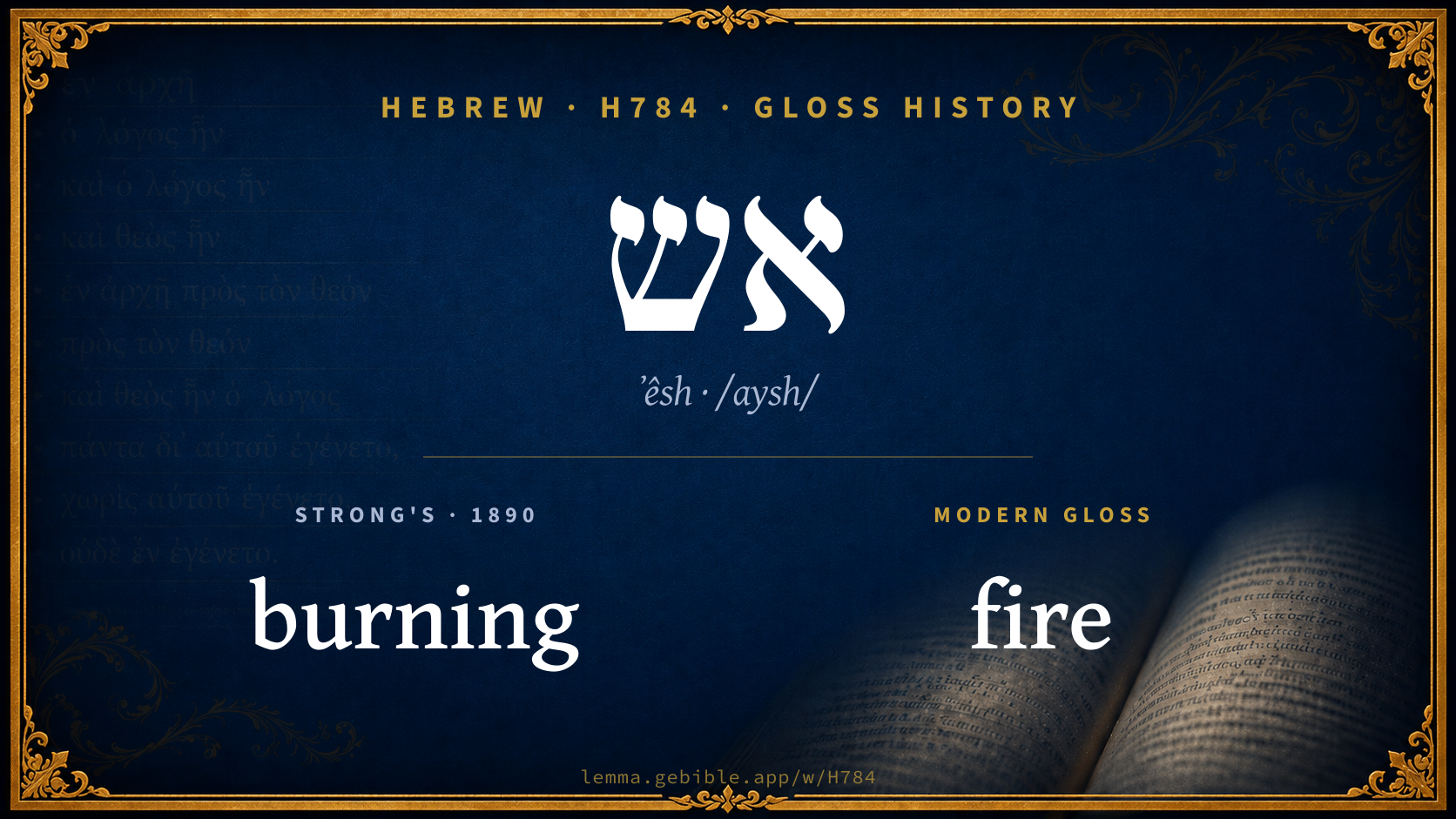
Gloss history
Strong's 1890 vs modern scholarship
About this word
Strong's H784 catalogs a Hebrew word from the Hebrew Old Testament.
These counts are not copied from any lexicon or concordance. They are computed here, from the morphology-tagged Hebrew Old Testament. What Lemma adds →
- 348
- distinct verses
- The word appears in 348 distinct verses.
- 33 / 39
- OT books
- The word appears in 33 of 39 Old Testament books.
- #131
- by frequency
- Top 250 most frequent Hebrew words (rank 131 of 8,640 Hebrew words by occurrence).
View all 348 occurrences in the concordance →
By section of the Old Testament
By traditional corpus
Conventional, traditional groupings — biblical authorship is debated, so this is a traditional corpus grouping, not an authorship claim. Each share is this word’s portion of its verses in that division of the Hebrew canon. Each figure is a share of the word’s 348 distinct verses.
- Prophets (Nevi'im) 189 verses · 54%
- Torah (Pentateuch) 99 verses · 28%
- Writings (Ketuvim) 60 verses · 17%
How translations render this word
Counts come from each version’s own published word-to-Strong’s tagging or interlinear alignment — an approximate guide to how each version renders this word, not a word-level alignment the data otherwise carries. Because each total is that version’s own tagged count, the per-version totals vary from one another and need not match the appearance or distinct-verse counts above. These counts may also differ from a printed concordance because Lemma counts each distinctly tagged rendering and does not collapse phrase taggings into a single head-word total. This is a fixed set of word-tagged versions (KJV, ASV, BSB, ULT) and does not change with the reading translation you choose elsewhere. Each version’s license is shown beside its name below (and on Sources).
- King James Version: Fire 321×, Like fire 7×, Let fire 5×
- American Standard Version: Fire 292×, Like fire 7×, Fires 3×
- Berean Standard Bible: Fire 244×, Like fire 10×, Fiery 7×
- unfoldingWord Literal Text: Fire 307×, Fire of 8×, Like fire 6×
King James Version Public Domain
Renders H784 across 378 tagged occurrences — most commonly:
Plus 32 renderings that appear only once — usually multi-word phrases or single function words the recovered tagging swept in, not distinct renderings. Not rendered by a distinct English word in 2 further occurrences.
American Standard Version Public Domain
Renders H784 across 379 tagged occurrences — most commonly:
Plus 55 renderings that appear only once — usually multi-word phrases or single function words the recovered tagging swept in, not distinct renderings.
Berean Standard Bible Public Domain
Renders H784 across 313 tagged occurrences — most commonly:
Plus other, less common renderings. Plus 20 renderings that appear only once — usually multi-word phrases or single function words the recovered tagging swept in, not distinct renderings. Not rendered by a distinct English word in 60 further occurrences.
unfoldingWord Literal Text CC BY-SA 4.0
Renders H784 across 368 tagged occurrences — most commonly:
Plus 27 renderings that appear only once — usually multi-word phrases or single function words the recovered tagging swept in, not distinct renderings.
Senses in the full BDB
What do BDB’s symbols mean?
BDB uses these scholarly abbreviations:
| Symbol | Meaning |
|---|---|
| 𝔊 | the Septuagint (the ancient Greek translation, LXX) |
| 𝔙 | the Vulgate (the Latin translation) |
| 𝔖 | the Syriac version (the Peshitta) |
| 𝔗 | the Targum (the Aramaic translation) |
| ψ | the Psalms |
| √ | root (the underlying root or stem) |
| ‖ | parallel passage (a synonymous or contrasted parallel) |
| † | the dagger: every passage where the word occurs is cited |
The 6 senses and sub-senses the full Brown-Driver-Briggs lexicon distinguishes for this word, in lexicon order (not ranked by frequency), with BDB’s own verbatim wording and sub-sense lettering. Shown in Hebrew script with BDB’s own scholarly abbreviations. The condensed entry is in the Lexicon Entry tab. See also the Forms in the corpus table below.
- 1. fire, of conflagration, e.g. in briers, endangering or destroying crops תֵּצֵא אֵשׁ וּמָֽצְאָה קֹצִים Ex 22:5 cf. 3:2 הַסְּנֶה בֹּעֵר בָּאֵשׁ (both E); more often of deliberate destruction by fire, especially שָׂרַף בָּאֵשׁ (בָּ c. qam. preton.) obj. golden calf Ex 32:20 (J), other idols Dt 7:5, 25, Asherim 12:3, chariots Jos 11:6, 9 2 K 23:11, house Ju 12:1; 14:15, tower 9:52, city-gates Ne 1:3; 2:3, 13, 17, city Jos 6:24 Ju 18:27 cf. Is 1:7 +; also שִׁלַּח אֵשׁ בְּ Am 1:4, 7, 10 +; שִׁלַּח אֶת־הָעִיר בָּאֵשׁ †Ju 1:8; 20:48 cf. 2 K 8:12; הִצִּית אֶת־הָעִיר בָּאֵשׁ Jos 8:8, 19 הצ׳ אֵשׁ ב׳ Je 17:27 +; cf. Ju 9:49 2 S 14:30, 31 (of field, cf. Ex 22:5 supr.). e.g. Exodus 22:5
- 2. of supernatural fire, attending theophany Ex 3:2; 19:18 (both JE) Dt 4:11, 12, 15, 33, 36 +; specif. עַמּוּד (הָ)אֵשׁ Ex 13:21, 22; 14:24 (all JE) Ne 9:12, 19 cf. Dt 1:33 (v. מַרְאֵה־אֵשׁ Nu 9:15, 16 P); of destructive fire from י׳ Nu 11:1, 2, 3 (J) 26:10 (P) Lv 10:2 (P); cf. א׳ אֹכֶלֶת in sim. of Yahweh’s glory Ex 24:17 (E) Dt 4:24; 9:3; v. also 1 K 18:24, 38 2 K 1:10(×2), 12(×2), 14 Jb 1:16 (perhaps lightning intended), cf. further of lightning Ex 9:23, 24 (JE) ψ 18:13, 14; 148:8 etc. e.g. Exodus 3:2
- 3. fire for cooking, roasting, parching, etc. צְלִי אֵשׁ roasted at a fire Ex 12:8, 9 (P) cf. Lv 2:14 2 Ch 35:13 Is 44:16, 19; of tinder for lighting fire Gn 22:6, 7 (E); of fire for melting (gold for the idolatrous calf) Ex 32:24; for refining Je 6:29, where read with Qr מֵאֵשׁ תַּם עֹפָֽרֶת; cf. Mal 3:2 (sim. of purifying work of messenger of cov’t). e.g. Exodus 12:8
- 4. especially of altar-fire Lv 1:7(×2); 6:2, 3, 5, 16 +; in offering incense Lv 10:1, also אֵשׁ זָרָה strange fire, i.e. an incense not commanded, offered presumptuously 10:1 Nu 3:4; 26:61; fire from י׳ consuming sacrifice (cf. 2 Lv 9:24 2 Ch 7:1, 3; of fire in child-sacrifice (usually (לְ) הֶעֱבִיר בֵּן בָּאֵשׁ) 2 K 16:3; 21:6 cf. 17:17; 23:10 2 Ch 33:6; also שׂרף בָּא׳ 2 K 17:31, בער בָּא׳ 2 Ch 28:3. e.g. Leviticus 1:7
- 5. fig. of Yahweh’s anger ψ 89:47 (sim.) cf. Na 1:6 La 2:4 אֵשׁ־עֶבְרָתִי Ez 21:36; 22:31; 38:19, אֵשׁ־קִנְאָתִי Ez 36:5; v. also Is 66:15 ψ 79:5 etc.; of word of י׳ Je 23:29; fig.of outbursting emotion ψ 39:4; of flagrant wickedness Is 9:17, etc. e.g. Psalms 89:47
- 6. in various combinations, לַפִּיד אֵשׁ Gn 15:17 (J) a torch of fire (cf. Di); לַבַּת־אֵשׁ Ex 3:2 flame of fire, לַהַב אֵשׁ Jo 2:5, לַפִּידֵי אֵשׁ (in sim.) Dn 10:6 cf. Zc 12:6, לַהֲבוֹת אֵשׁ ψ 29:7 לַהֲבֵי אֵשׁ Is 66:15 cf. א׳ לֶהָבוֹת ψ 105:32, נֹגַהּ א׳ לֶהָבָה Is 4:5 cf. Ho 7:6; שְׂבִיב אִשּׁוֹ spark of his fire Jb 18:5 cf. כִּידוֹדֵי אֵשׁ 41:11; תַּנּוּר אֵשׁ ψ 21:10 oven of fire, כִּיּוֹר אֵשׁ Zc 12:6; אוֹר אֵשׁ light of fire ψ 78:14; אֵשׁ לֹהֵט flaming fire ψ 104:4; לְשׁוֹן אֵשׁ Is 5:24 tongue of fire, גַּחֲלֵי אֵשׁ Ez 1:13 coals of fire, so 10:2, cf. רִשְׁפֵּי אֵשׁ Ct 8:6; on אַבְנֵי אֵשׁ Ez 28:14, 16 v. אֶבֶן; אֵשׁ דַּת Dt 33:2, lit. fire of a law, or fire was a law, but דָּת law is Pers. & late; read perhaps אֵשׁ [לַףִּ]דֹת cf. Ex 20:18 or אֵשׁ [יֹקֶ]דֶת cf. Is 65:5. e.g. Genesis 15:17
Senses from the full Brown-Driver-Briggs lexicon (Brown, Driver, Briggs; Oxford 1906 — public domain), digitized via Sefaria, supplemented by the OpenScriptures HebrewLexicon (CC BY 4.0). Full attribution on Sources.
Word origin
n.f. Ex 9:23 (m. Je 48:45; ψ 104·4; f. & m. Je 20:9; Jb 20:26) אֵשׁ ‘m.’ is dub.: Nu 16:18 read עָלֶיהָ for 2nd עֲלֵיהֶם (𝔊B); Je 20:9 v. Ges§ 132 d; 48:45 read (many MSS., Nu 21:28) יצאה; ψ 104:4 read perhaps (Ol) לֹהֵֽטָה׃ or (Kenn) וָלָֽהַט׃; Jb 20:26 v. Ges§ 145 u (or 121 b): cf. AlbrZAW xvi (1896), 63. fire (Assyrian išatu COTGloss, Syriac ܐܶܫܳܬܳܐ, እሳት deriv. from ii. אנשׁ,أَنَسَ, sociable, friendly element (MV Wetzst in De Psalmen, ed. 4, p. 888 LagBN 68 cf. انيسة, مانوسة), improb. especially in view of Assyrian; daghesh prob. secondary; cf. also Sta§ 189 b)—א׳ abs. Ex 9:24 +; cstr. Lv 6:2 + (seld.); †sf. אִשּׁוֹ Dt 4:36 Jb 18:5; אֶשְׁכֶם Is 50:11; אִשָּׁם Is 66:24;—
— Brown-Driver-Briggs (Oxford 1906, public domain), digitized via Sefaria, supplemented by the OpenScriptures HebrewLexicon (CC BY 4.0). See Sources.
Origin: a primitive word
Jastrow Dictionary
A second Hebrew/Aramaic lexicon for comparison, covering Aramaic and post-biblical (Talmudic, Targumic, Midrashic) usage that the biblical-Hebrew BDB does not. Matched by lemma rather than by Strong’s number, so a lemma may carry more than one Jastrow headword (shown separately below), and the entries cover usage well beyond the Bible.
אֵשׁ
- c. (b. h.;
- 1. fire. Sabb. 11ᵃ; a. e. כא׳ לנעורת as destructive as fire to the flax. Sot. 48ᵇ כא׳ בנעורת like fire among flax, i.e. inflaming the senses. Gen. R. s. 39 מבול של א׳ (v. מַבּוּל) destruction by fire.—Num. R. s. 2 end א׳ הדיוטית fire from outside of the sanctuary; a. fr.—Pl. אִשֹּׁות. Yoma 21ᵇ; a. fr.
- 2. fever, א׳ של עצמות. Gitt. 70ᵃ
A Dictionary of the Targumim, the Talmud Babli and Yerushalmi, and the Midrashic Literature (Marcus Jastrow; London, Luzac, 1903) — Public Domain. Digitized via Sefaria. Digitized via Sefaria. Full attribution on Sources.
Forms in the corpus
The 91 distinct written forms H784 takes in the Hebrew Bible, most frequent first — each parse links to that state’s occurrences in the concordance. Hebrew forms include their vowel points and cantillation, so a single lemma takes many written forms.
The 60 most common forms are shown; 31 rarer forms follow in the full concordance.
Same root — word family
Other BDB entries built from the same root as H784, grouped by Strong’s listed origin. These share a root / origin per the lexicon — not necessarily a shared meaning. Each links to that word’s own entry.
Derived from this word
- אש ʼêsh H785 fire
- אש ʼish H786 there is
- אשדת ʼeshdâth H799 fiery law
- אשה ʼeshshâh H800 fire
- אשיש ʼâshîysh H808 foundation
- אתון ʼattûwn H861 furnace
Compare all same-root words → Showing 4 of 7 — not the complete family. They share a root, not necessarily a meaning.
Septuagint verse parallels
This word appears in 321 verses that also exist in the Greek Old Testament (Septuagint), out of the 348 Hebrew verses it occurs in. You can read those verses in Greek by switching the Old Testament edition to the Septuagint.
Read these verses in the Septuagint
- Genesis 15:17
- Exodus 3:2
- Leviticus 1:7
- Numbers 3:4
- Deuteronomy 1:33
- Joshua 6:24
- Judges 1:8
- 1 Samuel 30:1
- 2 Samuel 14:30
- 1 Kings 9:16
- 2 Kings 1:10
- 1 Chronicles 14:12
This is a verse-level parallel only — the same verses exist in both the Hebrew and Greek Old Testaments. No word-level Hebrew↔Greek correspondence is claimed: the data carries no such alignment, so no Greek word is shown as this Hebrew word’s translation. Coverage is not total — the Septuagint omits the deuterocanon and renumbers the Psalms, so some Hebrew verses have no direct Greek parallel.