
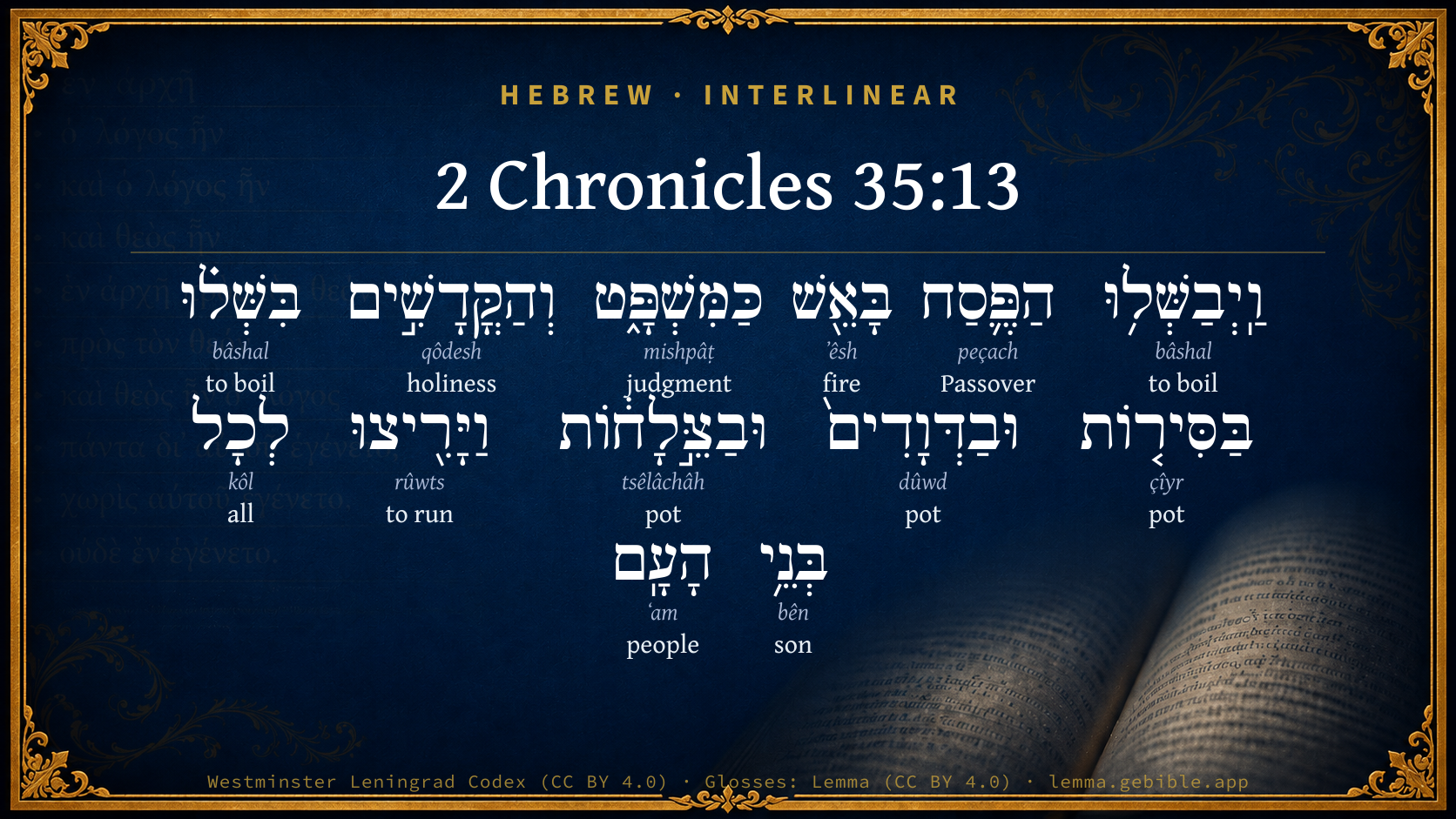
2 Chronicles 35:13

Hebrew (Westminster Leningrad Codex) 2 Chronicles 35:13 appears in the Hebrew Old Testament. The text above is from the Westminster Leningrad Codex. Each word links to its Strong’s number, a concise gloss, and parsing drawn from the Open Scriptures Hebrew Bible morphology. Click any word for its full Brown-Driver-Briggs (BDB) entry.
Download image
Cite this verse

2 Chronicles 35:13 (World English Bible). Public Domain. Lemma interlinear Bible study tool, https://lemma.gebible.app/v/2-chronicles/35/13.

Show BibTeX & RIS
BibTeX
RIS
English Translation
They roasted the Passover with fire according to the ordinance: and the holy offerings boiled they in pots, and in caldrons, and in pans, and carried them quickly to all the children of the people.
World English Bible · Public Domain
Highlights
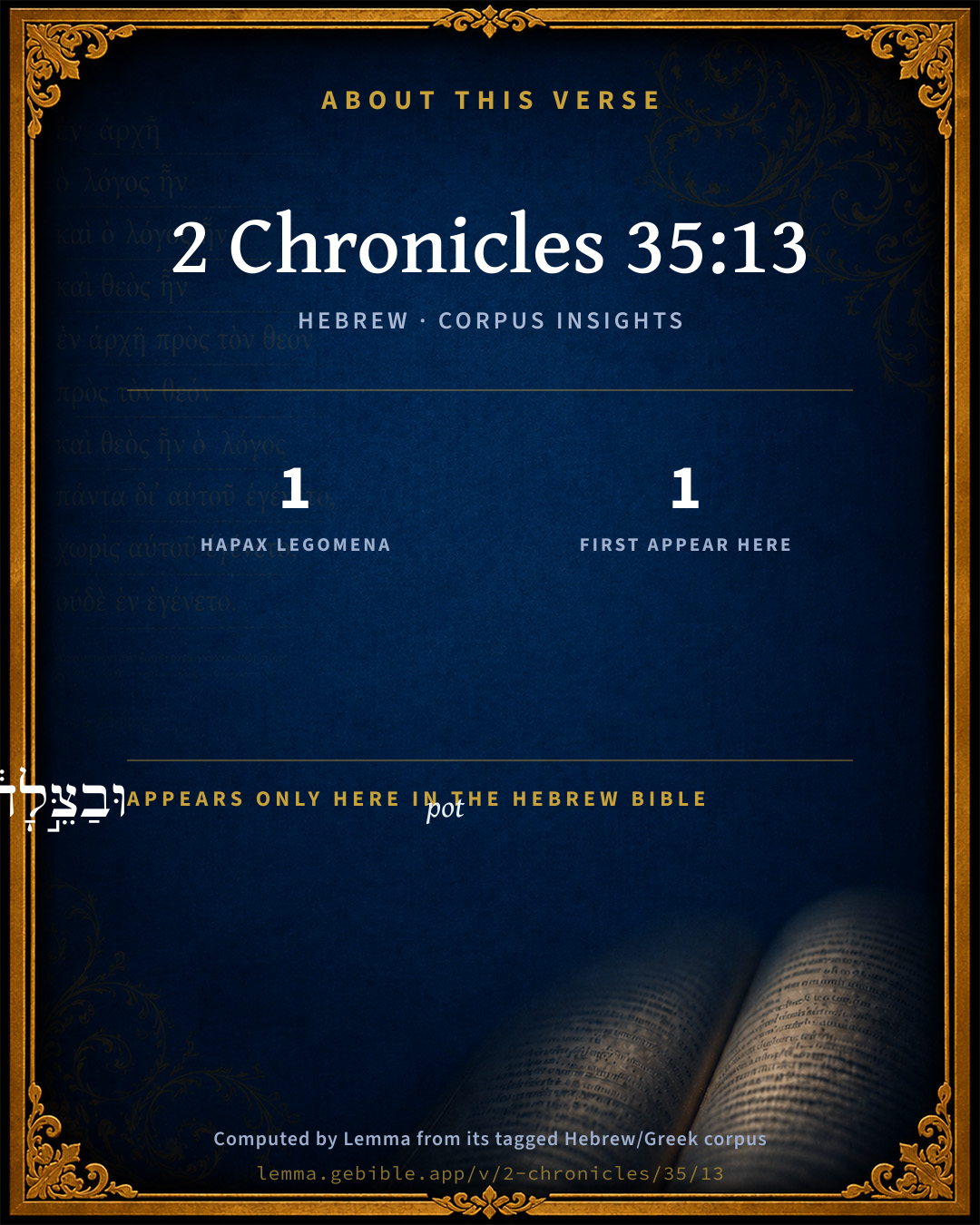
  • 1 hapax legomenon — only here in the Hebrew Bible
  • 1 first appearance in the Hebrew Bible
Full analysis ↓
Download a study sheet

One document with this verse’s original text, its word-by-word gloss line, the meaning frame, cross-references with their text, attributed commentary, and full source and license credits — printable, and it pastes into notes with its structure intact.

This verse Autodidact and up

Study sheet (.html) Plain text (.txt)

A passage Seminary Student

Up to 50 verses in one chapter. A passage sheet keeps up to 6 commentary sources and 12 cross-references per verse, in the order this page ranks them, and says so on the sheet whenever that leaves anything out. Ask for a single verse and you get the Autodidact verse sheet above.

Everything on this page stays free to read, with no account — the sheet is a download of what is already on screen, not access to it.

Want to remove ads? Support Godless Engineer
Compare translations 3

The same verse in 3 English versions, stacked beneath the original-language interlinear above. Click any original word for its lexicon entry.

Each is an independent rendering of the whole verse — the interlinear is not word-aligned to these translations.

Highlighted words mark where these versions differ — a whole-verse word diff, not a word-by-word alignment.

  • World English Bible Public Domain
    They roasted the Passover with fire according to the ordinance: and the holy offerings boiled they in pots, and in caldrons, and in pans, and carried them quickly to all the children of the people.
  • King James Version Public Domain
    And they roasted the passover with fire according to the ordinance: but the other holy offerings sod they in pots, and in caldrons, and in pans, and divided them speedily among all the people.
  • unfoldingWord Literal Text CC BY-SA 4.0
    And they cooked the Passover in fire according to the judgment. And the consecrated things they cooked in pots, and in kettles, and in pans, and they brought to all the sons of the people.

unfoldingWord Literal Text — © unfoldingWord, licensed CC BY-SA 4.0. Word-aligned USFM3 via Door43 (git.door43.org/unfoldingWord/en_ult).

Versions to compare (up to 4)

3 of 4 selected

Show all 18 translations

Every available English version of this verse, each an independent rendering of the whole verse.

  • World English Bible Public Domain
    They roasted the Passover with fire according to the ordinance: and the holy offerings boiled they in pots, and in caldrons, and in pans, and carried them quickly to all the children of the people.
  • Berean Standard Bible Public Domain
    They roasted the Passover animals on the fire according to the regulation, and they boiled the other holy offerings in pots, kettles, and bowls and quickly brought them to all the people.
  • Majority Standard Bible Public Domain
    They roasted the Passover animals on the fire according to the regulation, and they boiled the other holy offerings in pots, kettles, and bowls and quickly brought them to all the people.
  • King James Version Public Domain
    And they roasted the passover with fire according to the ordinance: but the other holy offerings sod they in pots, and in caldrons, and in pans, and divided them speedily among all the people.
  • American Standard Version (1901) Public Domain
    And they roasted the passover with fire according to the ordinance: and the holy offerings boiled they in pots, and in caldrons, and in pans, and carried them quickly to all the children of the people.
  • Revised Version (1885) Public Domain
    And they roasted the passover with fire according to the ordinance: and the holy offerings sod they in pots, and in caldrons, and in pans, and carried them quickly to all the children of the people.
  • Geneva Bible (1599) Public Domain
    And they rosted the Passeouer with fire, according to ye custome, but the sanctified things they sod in pots, pannes, and cauldrons, and distributed them quickely to all the people.
  • Douay-Rheims (1899) Public Domain
    And they roasted the phase with fire, according to that which is written in the law: but the victims of peace offerings they boiled in caldrons, and kettles, and pots, and they distributed them speedily among all the people.
  • Young's Literal Translation Public Domain
    And they cook the passover with fire, according to the ordinance, and the sanctified things they have cooked in pots, and in kettles, and in pans -- for all the sons of the people.
  • Literal Standard Version CC BY-SA 4.0
    And they cook the Passover with fire according to the ordinance, and they have cooked the sanctified things in pots, and in kettles, and in pans—for all the sons of the people.
  • Unlocked Literal Bible CC BY-SA 4.0
    They roasted the Passover lambs with fire following the instructions. As for the consecrated offerings, they boiled them in pots, cauldrons, and pans, and they quickly carried them to all the people.
  • unfoldingWord Literal Text CC BY-SA 4.0
    And they cooked the Passover in fire according to the judgment. And the consecrated things they cooked in pots, and in kettles, and in pans, and they brought to all the sons of the people.
  • Darby Bible Public Domain
    And they roasted the passover with fire according to the ordinance; and the consecrated things they boiled in pots and in cauldrons and in pans, and divided them speedily among all the children of the people.
  • World Messianic Bible Public Domain
    They roasted the Passover with fire according to the ordinance. They boiled the holy offerings in pots, in cauldrons, and in pans, and carried them quickly to all the children of the people.
  • Webster's Bible Public Domain
    And they roasted the passover with fire according to the ordinance: but the other holy offerings they boiled in pots, and in caldrons, and in pans, and divided them speedily among all the people.
  • Free Bible Version CC BY-SA 4.0
    They roasted the Passover sacrifices on the fire as required, and they boiled the holy offerings in pots, caldrons, and pans, and took them quickly to the lay people.
  • Bible in Basic English Public Domain
    And the Passover lamb was cooked over the fire, as it says in the law; and the holy offerings were cooked in pots and basins and vessels, and taken quickly to all the people.
  • JPS Tanakh (1917) Public Domain
    And they roasted the passover with fire according to the ordinance; and the holy offerings sod they in pots, and in caldrons, and in pans, and carried them quickly to all the children of the people.

Literal Standard Version (2020), Covenant Press — licensed CC BY-SA 4.0. Text via the HelloAO Bible API (eBible.org). Unlocked Literal Bible (unfoldingWord) — licensed CC BY-SA 4.0. Text via the HelloAO Bible API (eBible.org). unfoldingWord Literal Text — © unfoldingWord, licensed CC BY-SA 4.0. Word-aligned USFM3 via Door43 (git.door43.org/unfoldingWord/en_ult). Free Bible Version, Dr. Jonathan Gallagher — licensed CC BY-SA 4.0. Text via the HelloAO Bible API (eBible.org).

Word by word

More ways to search: Search by grammar → Find every occurrence → Compare this word →

Practice this passage: Drill this verse → Learn its vocabulary →

וּבַצֵּ֣לָח֔וֹת
tsêlâchâh
H6745
“and · in/at the · pots”
Conjunction + Preposition, Determined + Noun, Common, Feminine, Plural, Absolute
Part of Speech
Conjunction + Preposition + Noun
Type
Common
Gender
Feminine
Number
Plural
State
Absolute
Full BDB Definition

Origin: from H6743

TWOT: 1918a

cooking pot, pot
  1. וַֽיְבַשְּׁל֥וּ bâshal H1310 “and · to boil” Conjunction + Verb, Piel, Sequential Imperfect, 3rd Person, Masculine, Plural
  2. הַפֶּ֛סַח peçach H6453 “the · Passover” Particle, Definite Article + Noun, Common, Masculine, Singular, Absolute
  3. בָּאֵ֖שׁ ʼêsh H784 “in/at the · fire” Preposition, Determined + Noun, Common, Both, Singular, Absolute
  4. כַּמִּשְׁפָּ֑ט mishpâṭ H4941 “like/as the · judgment” Preposition, Determined + Noun, Common, Masculine, Singular, Absolute
  5. וְהַקֳּדָשִׁ֣ים qôdesh H6944 “and · the · holy things” Conjunction + Particle, Definite Article + Noun, Common, Masculine, Plural, Absolute
  6. בִּשְּׁל֗וּ bâshal H1310 “to boil” Verb, Piel, Perfect, 3rd Person, Common, Plural
  7. בַּסִּיר֤וֹת çîyr H5518 “in/at the · pots” Preposition, Determined + Noun, Common, Both, Plural, Absolute
  8. וּבַדְּוָדִים֙ dûwd H1731 “and · in/at the · pots” Conjunction + Preposition, Determined + Noun, Common, Masculine, Plural, Absolute
  9. וַיָּרִ֖יצוּ rûwts H7323 “and · to run” Conjunction + Verb, Hiphil, Sequential Imperfect, 3rd Person, Masculine, Plural
  10. לְכָל kôl H3605 “to/for · all of” Preposition + Noun, Common, Masculine, Singular, Construct
  11. בְּנֵ֥י bên H1121 “sons of” Noun, Common, Masculine, Plural, Construct
  12. הָעָֽם ʻam H5971 “the · people” Particle, Definite Article + Noun, Common, Masculine, Singular, Absolute

About this verse

These counts appear in no published source. They are computed here, from the morphology-tagged text and Lemma’s own curated glosses. What Lemma adds →

13
words
12
distinct lemmas
Historical
section

Notable vocabulary

1 hapax legomenon — a word that appears only here in the entire Hebrew Bible:

  • וּבַצֵּ֣לָח֔וֹת pot H6745

First appearance in Scripture

This word makes its first canonical appearance in the Hebrew Bible here:

  • וּבַצֵּ֣לָח֔וֹת pot H6745

Shared distinctive vocabulary

וּבַדְּוָדִים֙ pot H1731 occurs in 6 verses of the Hebrew Bible. Also found in:

Grammatical profile

  • 3 verbs
  • 10 nouns

Verb forms

  • וַֽיְבַשְּׁל֥וּ Piel · Sequential Imperfect
  • בִּשְּׁל֗וּ Piel · Perfect
  • וַיָּרִ֖יצוּ Hiphil · Sequential Imperfect

Repetition

A word recurs within this verse — often emphatic in Hebrew:

  • וַֽיְבַשְּׁל֥וּ to boil H1310 ×2

Hebrew & Septuagint length

In English translation the verse runs 35 words from the Hebrew and 44 from the Septuagint (LXX English) — closely comparable.

A rough comparison of the two English renderings, which tokenize alike — not a word-level alignment.

Word counts can differ between the Hebrew and the Greek without any difference in meaning — e.g. the Hebrew direct-object marker אֵת has no separate Greek word, and Greek often adds the article ὁ.

Cross-references

8

Topical passages linked to 2 Chronicles 35:13 in the Treasury of Scripture Knowledge — connected by theme and wording, ordered by reader-vote popularity; previews shown in the World English Bible.

  • Exodus 12:8–9 They shall eat the flesh in that night, roasted with fire, and unleavened bread. They shall eat it with bitter herbs.
  • 1 Samuel 2:13–15 The custom of the priests with the people was that when any man offered sacrifice, the priest's servant came, while the flesh was boiling, with a flesh-hook of three teeth in his hand;
  • Leviticus 6:28 But the earthen vessel in which it is boiled shall be broken; and if it is boiled in a brazen vessel, it shall be scoured, and rinsed in water.
  • Deuteronomy 16:7 You shall roast and eat it in the place which Yahweh your God shall choose: and you shall turn in the morning, and go to your tents.
  • Numbers 6:19 The priest shall take the boiled shoulder of the ram, and one unleavened cake out of the basket, and one unleavened wafer, and shall put them on the hands of the Nazirite, after he has shaved the head of his separation;
  • Psalms 22:14 I am poured out like water. All my bones are out of joint. My heart is like wax; It is melted within me.
  • Lamentations 1:12–13 Is it nothing to you, all you who pass by? Look, and see if there be any sorrow like my sorrow, which is brought on me, With which Yahweh has afflicted [me] in the day of his fierce anger.
  • Romans 12:11 not lagging in diligence; fervent in spirit; serving the Lord;

Cross-references courtesy of OpenBible.info (CC BY 4.0).

Hebrew and Greek witnesses Masoretic Hebrew ↔ Greek Septuagint

The same verse in the two great witnesses to the Old Testament, shown verse-for-verse.

These are two independent witnesses, not word-aligned to each other, and the Septuagint is shown in lemma (dictionary) form.

Hebrew 2 Chronicles 35:13 Masoretic · Westminster Leningrad Codex

וַֽיְבַשְּׁל֥וּ הַפֶּ֛סַח בָּאֵ֖שׁ כַּמִּשְׁפָּ֑ט וְהַקֳּדָשִׁ֣ים בִּשְּׁל֗וּ בַּסִּיר֤וֹת וּבַדְּוָדִים֙ וּבַצֵּ֣לָח֔וֹת וַיָּרִ֖יצוּ לְכָל בְּנֵ֥י הָעָֽם

They roasted the Passover with fire according to the ordinance: and the holy offerings boiled they in pots, and in caldrons, and in pans, and carried them quickly to all the children of the people.

World English Bible · Public Domain

Greek LXX 2 Chronicles 35:13 Septuagint · lemma form

καί ὀπτάω ὁ φασεχ ἐν πῦρ κατά ὁ κρίσις καί ὁ ἅγιος ἕψω ἐν ὁ χαλκείος καί ἐν ὁ λέβης καί εὐοδόω καί τρέχω πρός πᾶς ὁ υἱός ὁ λαός

And thus they did till the morning. And they roasted the passover with fire according to the ordinance; and boiled the holy pieces in copper vessels and caldrons, and the feast went on well, and they quickly served all the children of the people.

LXX2012 (modern English Septuagint) · Public Domain

Hebrew: Westminster Leningrad Codex (CC BY 4.0). Greek: Septuagint (public domain); English from LXX2012 (modern English Septuagint) (Public Domain). How the Septuagint differs from the Hebrew →

Commentary

Notes on 2 Chronicles 35:13 from classic Christian and Jewish commentators (each source and its license shown beneath its notes). The classic Christian expositions comment on the surrounding passage and are grouped to its opening verse, so a note may address several verses; the Jewish commentaries on the Tanakh (Rashi and others) are per-verse, so they appear only where the commentator wrote on this verse.

Lemma curates 59 commentaries, every one of them public domain or Creative Commons licensed, each selected and text-cleaned for this edition rather than reprinted as found. About our sources →

Trapp's Complete Commentary

John Trapp

2Ch 35:13 And they roasted the passover with fire according to the ordinance: but the [other] holy [offerings] sod they in pots, and in caldrons, and in pans, and divided [them] speedily among all the people.

Ver. 13. And they roasted the passover with fire.] To set forth Christ roasted for us in the fire of his Father’s fierce wrath. Area amorem illius, &c. By way of retribution, let us do as is prescribed in Heb 13:10-17.

And divided them speedily.] Heb., Made them run. Bis dat qui cito dat. He gives twice who gives quickly.

John Trapp, A Commentary or Exposition upon All the Books of the Old and New Testament (1647–1656) — public domain. Text from a community e-Sword module.

Joseph Benson's Commentary

2Ch 35:13-14. But the other holy offerings sod they in pots — Those from which the burnt-offerings were removed, (2Ch 35:12,) namely, the peace- offerings, part of which fell to the share of the offerer, who was Josiah, and, by his gift, to the people. Afterward they made ready — To wit, the paschal lambs, and their part of the peace-offerings.

Joseph Benson's Commentary on the Old and New Testaments (1811–1818) — public domain. Text from a community e-Sword module.

Tyndale Open Study Notes

Tyndale Open Resources

35:13 The Levites brought the food out quickly, observing the element of haste required in the Passover (Exod 12:11).

Tyndale Open Study Notes — © Tyndale Open Resources, licensed CC BY-SA 4.0. Text via the HelloAO Bible API.

Jamieson, Fausset & Brown

Robert Jamieson, A. R. Fausset & David Brown

they roasted the passover with fire according to the ordinance--(See Exo 12:7-9). This mode of preparation was prescribed by the law exclusively for the paschal lamb; the other offerings and thank offerings were cooked in pots, kettles, and pans (Sa1 2:14).

divided them speedily among the people--The haste was either owing to the multiplicity of the priests' business, or because the heat and flavor of the viands would have been otherwise diminished. Hence it appears that the meal consisted not of the paschal lambs alone, but of the meat of the thank offerings--for part of the flesh fell to the portion of the offerer, who, being in this instance, the king and the princes, were by them made over to the people, who were recommended to eat them the day they were offered, though not absolutely forbidden to do so on the next (Lev 7:15-18).

Jamieson, Fausset & Brown — Commentary Critical and Explanatory on the Whole Bible (1871) — public domain (CC PDM 1.0). Text via the HelloAO Bible API.

Ellicott's Commentary for English Readers

(13) According to the ordinance.—Exo_12:8-9.

Boasted with fire.—Cooked in the fire.

But the other holy offerings sod they . . . pans.—And the consecrated things they cooked in the pots, and in the caldrons, and in the pans.—“The consecrated things” are the oxen (2Ch_29:33). Their flesh was boiled or fried, and handed with all due haste by the Levites to the laity.

The author tells us here not only what was done on the evening of the fourteenth Nisan, the Passover proper, but also during the seven following days of the Feast of Mazzoth, or Unleavened Bread. On the Passover evening only the paschal lambs and kids would be eaten; the oxen were slain as peace offerings during the subsequent festivities (Deu_16:1-8), and furnished forth the sacrificial meals.

And divided them speedily . . . the people.—And brought them quickly to all the sons of the people, so that the meat did not get cold. (Comp. Gen_41:14.) This little touch of realism calls up a picture. We see the whole busy scene, the different groups of the people scattered here and there about the sacred court, and the Levites bringing them their portions of the savoury meat.

A Bible Commentary for English Readers, edited by Charles John Ellicott (1878–1897) — public domain. Text from a community e-Sword module.

The Cambridge Bible for Schools and Colleges

gen. ed. J. J. S. Perowne

13. the ordinance] Exo_12:9.

but the other holy offerings] R.V. and the holy offerings. The bullocks mentioned in 2Ch_35:7-9. They would not be slain on the Passover day itself, but on the days which immediately followed.

divided them speedily among all the people] R.V. carried them quickly to all the children of the people.

The Cambridge Bible for Schools and Colleges (gen. ed. J. J. S. Perowne; Cambridge University Press, 1878–1918) — public domain. Text from a community e-Sword module.

John Gill's Exposition

And they roasted the passover with fire, according to the ordinance,.... Of the Lord by Moses, Exo 12:8.

but the other holy offerings; which were the peace offerings:

sod they in pots, and in cauldrons, and pans; which was forbid to be done with the passover lamb, but might with the other sacrifices, which were to be eaten, Exo 12:9.

and divided them speedily among all the people; the parts which belonged to the offerer, who was the king; but he gave his part to the people, and therefore the Levites delivered them to them as soon as they could.

John Gill's Exposition of the Whole Bible (1746–1763) — public domain (CC PDM 1.0). Text via the HelloAO Bible API.

Haydock's Catholic Bible Commentary

Victims. Heb. and Sept. "but the holy offerings they boiled." See Ex. xii. 9. H.

George Leo Haydock (1774–1849), Haydock's Catholic Family Bible and Commentary, 1859 edition — public domain. Excludes Psalms (Douay-Rheims chapter numbering differs from Protestant) and Deuterocanonical books (Catholic canon only).

Matthew Poole's English Annotations

The other holy offerings; those from which the burnt offerings were removed, 2Ch 35:12, to wit, the peace-offerings, part of which fell to the share of the offerer, who was Josiah, and by his gift to the people.

Matthew Poole's English Annotations on the Holy Bible (1683–1685) — public domain. Text from a community e-Sword/MySword module.

The Pulpit Commentary

Roasted. (For the emphatic and repeated command to roast, Exo_12:8, Exo_12:9; Deu_16:7) Sod. The sodden or boiled offerings, peace offerings, were ordinarily eaten on the days of unleavened bread, and then particularly on the first and seventh. (Lev_23:4-8, etc.) Divided them speedily among all the people. The marginal rendering of the original, and the Revised Version rendering, carried them quickly, may be noted; nevertheless attention is invited, probably not so much to the speed or quickness in question, but to the fact that "all the people" were carefully attended to.

The Pulpit Commentary (1880–1919), ed. H.D.M. Spence-Jones & Joseph S. Exell — public domain. Text from a community e-Sword module.

unfoldingWord translationNotes

Door43 World Missions Community

General Information:

All instances of "they" and "themselves" refer to the Levites (2 Chronicles 35:10).

They roasted the Passover lambs with fire

"They cooked the Passover lambs over fires"

they boiled them in pots, cauldrons, and pans

"they cooked them in water in containers of different sizes"

They ... prepared offerings for themselves and for the priests

"They ... prepared the offerings that they would eat and the offerings that the priests would eat"

translationWords

consecrate

Aaron

burnt offering

unfoldingWord translationNotes — © Distant Shores Media and the Door43 World Missions Community, licensed CC BY-SA 4.0. Source: git.door43.org/Door43/en_tn.

Rashi

Rabbi Shlomo Yitzchaki (Rashi)

And they cooked the Passover sacrifice with fire according to the law Exod. 12:8): “Roasted with fire.”

and carried them quickly to all the members of the people [i.e.] the Levites [did this]; and after they had prepared for all Israel, the Levites prepared for themselves and for the priests, who did not have time to prepare.

Rashi on the Tanakh — English translations: “The Judaica Press complete Tanach with Rashi, translated by A. J. Rosenberg” (CC BY 4.0); “Pentateuch with Rashi's commentary by M. Rosenbaum and A.M. Silbermann, 1929-1934” (public domain); “The Metsudah Tanach series, Lakewood, N.J” (CC BY 4.0); and “The Book of Joshua, Metsudah Publications, 1997” (CC BY 4.0). Text via Sefaria.

Lesson kit

Teaching starters — assembled from the data on this page, not authored interpretation. Every prompt links to the verse data it draws on. Edit before teaching.

2 Chronicles, in the Historical, opens this verse with 13 words (12 distinct Hebrew lemmas). Its most distinctive word is tsêlâchâh (“pot”). A historical commentator’s framing appears above. Read the whole chapter for the surrounding context.

Discussion questions

  1. The word tsêlâchâh carries the sense “pot.” How does it shape the verse?
  2. This verse holds 1 word here found nowhere else in the Hebrew Bible. What might the rare word draw attention to?
  3. The word “pot” first appears here in Scripture. What is being introduced at this debut?
  4. 1 Samuel 2:14 shares the word «pot» with this verse. How do the two illuminate each other?
  5. “to boil” occurs 2× in this one verse. What is the effect of the repetition?
  6. The translations on this page render this verse differently — a whole-verse word diff, not a word-by-word alignment. What might account for the different wordings?
  7. The verb «וַֽיְבַשְּׁל֥וּ» is Piel Sequential Imperfect. How does its form color the action?
  8. Reading how Trapp's Complete Commentary and Joseph Benson's Commentary read this verse, where do the two commentators agree and where do they part?

Things to notice

  • 1 word in this verse appears nowhere else in the Hebrew Bible.
  • 1 word makes its first canonical appearance in Scripture here.
  • These translations choose different wording for 21 words in this verse.
  • “to boil” occurs 2× in this single verse.
  • 12 distinct Hebrew lemmas span 13 words in this verse.

Reading settings

Reading text

Shown beneath each verse's original-language words.

Old Testament
Old Testament edition

Read the OT as the Masoretic Hebrew (MT) or the Greek Septuagint (LXX).

English shown for the Greek Septuagint (in the Hebrew ↔ Greek comparison).

Comparing translations? Open the Compare panel on any verse page to stack up to four side by side.