Jeremiah 15:14

Hebrew (Westminster Leningrad Codex) Jeremiah 15:14 appears in the Hebrew Old Testament. The text above is from the Westminster Leningrad Codex. Each word links to its Strong’s number, a concise gloss, and parsing drawn from the Open Scriptures Hebrew Bible morphology. Click any word for its full Brown-Driver-Briggs (BDB) entry.
Download image
Cite this verse

Jeremiah 15:14 (World English Bible). Public Domain. Lemma interlinear Bible study tool, https://lemma.gebible.app/v/jeremiah/15/14.

Show BibTeX & RIS
BibTeX
RIS
English Translation
I will make [them] to pass with your enemies into a land which you don't know; for a fire is kindled in my anger, which shall burn on you.
World English Bible · Public Domain
Download a study sheet

One document with this verse’s original text, its word-by-word gloss line, the meaning frame, cross-references with their text, attributed commentary, and full source and license credits — printable, and it pastes into notes with its structure intact.

This verse Autodidact and up

Study sheet (.html) Plain text (.txt)

A passage Seminary Student

Up to 50 verses in one chapter. A passage sheet keeps up to 6 commentary sources and 12 cross-references per verse, in the order this page ranks them, and says so on the sheet whenever that leaves anything out. Ask for a single verse and you get the Autodidact verse sheet above.

Everything on this page stays free to read, with no account — the sheet is a download of what is already on screen, not access to it.

Want to remove ads? Support Godless Engineer
Compare translations 3

The same verse in 3 English versions, stacked beneath the original-language interlinear above. Click any original word for its lexicon entry.

Each is an independent rendering of the whole verse — the interlinear is not word-aligned to these translations.

Highlighted words mark where these versions differ — a whole-verse word diff, not a word-by-word alignment.

  • World English Bible Public Domain
    I will make [them] to pass with your enemies into a land which you don't know; for a fire is kindled in my anger, which shall burn on you.
  • King James Version Public Domain
    And I will make thee to pass with thine enemies into a land which thou knowest not: for a fire is kindled in mine anger, which shall burn upon you.
  • unfoldingWord Literal Text CC BY-SA 4.0
    Then I will cause your enemies to bring you into a land that you do not know, for a fire is kindled in my nose shall burn against you.”

unfoldingWord Literal Text — © unfoldingWord, licensed CC BY-SA 4.0. Word-aligned USFM3 via Door43 (git.door43.org/unfoldingWord/en_ult).

Versions to compare (up to 4)

3 of 4 selected

Show all 18 translations

Every available English version of this verse, each an independent rendering of the whole verse.

  • World English Bible Public Domain
    I will make [them] to pass with your enemies into a land which you don't know; for a fire is kindled in my anger, which shall burn on you.
  • Berean Standard Bible Public Domain
    Then I will enslave you to your enemies in a land you do not know, for My anger will kindle a fire that will burn against you.”
  • Majority Standard Bible Public Domain
    Then I will enslave you to your enemies in a land you do not know, for My anger will kindle a fire that will burn against you.”
  • King James Version Public Domain
    And I will make thee to pass with thine enemies into a land which thou knowest not: for a fire is kindled in mine anger, which shall burn upon you.
  • American Standard Version (1901) Public Domain
    And I will make `them' to pass with thine enemies into a land which thou knowest not; for a fire is kindled in mine anger, which shall burn upon you.
  • Revised Version (1885) Public Domain
    And I will make them to pass with thine enemies into a land which thou knowest not: for a fire is kindled in mine anger, which shall burn upon you.
  • Geneva Bible (1599) Public Domain
    And I wil make thee to go with thine enemies into a land that thou knowest not: for a fire is kindled in mine anger, which shall burne you.
  • Douay-Rheims (1899) Public Domain
    And I will bring thy enemies out of a land, which thou knowest not: for a fire is kindled in my rage, it shall burn upon you.
  • Young's Literal Translation Public Domain
    And I have caused thine enemies To pass over into the land -- Thou hast not known, For a fire hath been kindled in Mine anger, Against you it doth burn.
  • Literal Standard Version CC BY-SA 4.0
    And I have caused your enemies || To pass over into the land [that] You have not known, || For a fire has been kindled in My anger, || It burns against you.”
  • Unlocked Literal Bible CC BY-SA 4.0
    Then I will make you serve your enemies in a land that you do not know, for a fire will ignite, kindled in my wrath against you.”
  • unfoldingWord Literal Text CC BY-SA 4.0
    Then I will cause your enemies to bring you into a land that you do not know, for a fire is kindled in my nose shall burn against you.”
  • Darby Bible Public Domain
    and I will make [them] to pass with thine enemies into a land that thou knowest not: for a fire is kindled in mine anger; it shall burn upon you.
  • World Messianic Bible Public Domain
    I will make them to pass with your enemies into a land which you don’t know; for a fire is kindled in my anger, which will burn on you.”
  • Webster's Bible Public Domain
    And I will make thee to pass with thy enemies into a land which thou knowest not: for a fire is kindled in my anger, which shall burn upon you.
  • Free Bible Version CC BY-SA 4.0
    Then I will have your enemies make you their slaves in an unfamiliar country, because my anger will be like lighting a fire that will burn you up.
  • Bible in Basic English Public Domain
    They will go away with your haters into a land which is strange to you: for my wrath is on fire with a flame which will be burning on you.
  • JPS Tanakh (1917) Public Domain
    And I will make thee to pass with thine enemies into a land which thou knowest not; for a fire is kindled in My nostril, which shall burn upon you.'

Literal Standard Version (2020), Covenant Press — licensed CC BY-SA 4.0. Text via the HelloAO Bible API (eBible.org). Unlocked Literal Bible (unfoldingWord) — licensed CC BY-SA 4.0. Text via the HelloAO Bible API (eBible.org). unfoldingWord Literal Text — © unfoldingWord, licensed CC BY-SA 4.0. Word-aligned USFM3 via Door43 (git.door43.org/unfoldingWord/en_ult). Free Bible Version, Dr. Jonathan Gallagher — licensed CC BY-SA 4.0. Text via the HelloAO Bible API (eBible.org).

Word by word

More ways to search: Search by grammar → Find every occurrence → Compare this word →

Practice this passage: Drill this verse → Learn its vocabulary →

קָדְחָ֥ה
qâdach
H6919
“to kindle”
Verb, Qal, Perfect, 3rd Person, Feminine, Singular
Part of Speech
Verb
Stem
Qal
Form
Perfect
Person
3rd Person
Gender
Feminine
Number
Singular
Full BDB Definition

Origin: a primitive root to inflame

TWOT: 1987

to kindle, be kindled - (Qal) - to kindle - to be kindled
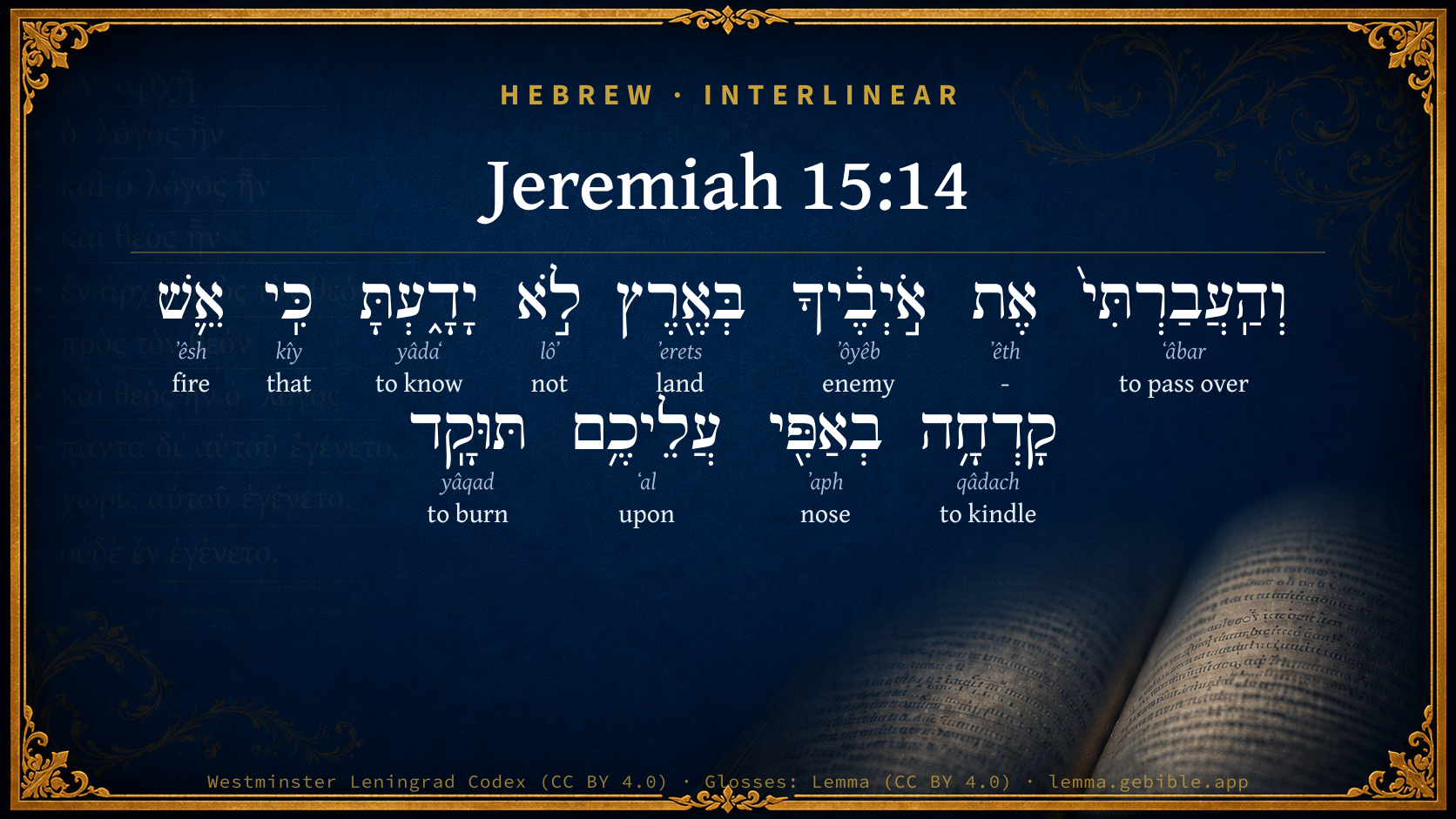
  1. וְהַֽעֲבַרְתִּי֙ ʻâbar H5674 “and · to pass over” Conjunction + Verb, Hiphil, Sequential Perfect, 1st Person, Common, Singular
  2. אֶת ʼêth H853 “-” Particle, Direct Object
  3. אֹ֣יְבֶ֔יךָ ʼôyêb H341 “enemy · you” Verb, Qal, Participle Active, Masculine, Plural, Construct + Suffix, Personal, 2nd Person, Masculine, Singular
  4. בְּאֶ֖רֶץ ʼerets H776 “in/at · land” Preposition + Noun, Common, Both, Singular, Absolute
  5. לֹ֣א lôʼ H3808 “not” Particle, Negative
  6. יָדָ֑עְתָּ yâdaʻ H3045 “to know” Verb, Qal, Perfect, 2nd Person, Masculine, Singular
  7. כִּֽי kîy H3588 “that” Conjunction
  8. אֵ֛שׁ ʼêsh H784 “fire” Noun, Common, Both, Singular, Absolute
  9. בְאַפִּ֖י ʼaph H639 “in/at · nose · my” Preposition + Noun, Common, Masculine, Singular, Construct + Suffix, Personal, 1st Person, Common, Singular
  10. עֲלֵיכֶ֥ם ʻal H5921 “upon · you” Preposition + Suffix, Personal, 2nd Person, Masculine, Plural
  11. תּוּקָֽד yâqad H3344 “to burn” Verb, Hophal, Imperfect, 3rd Person, Feminine, Singular

About this verse

These counts appear in no published source. They are computed here, from the morphology-tagged text and Lemma’s own curated glosses. What Lemma adds →

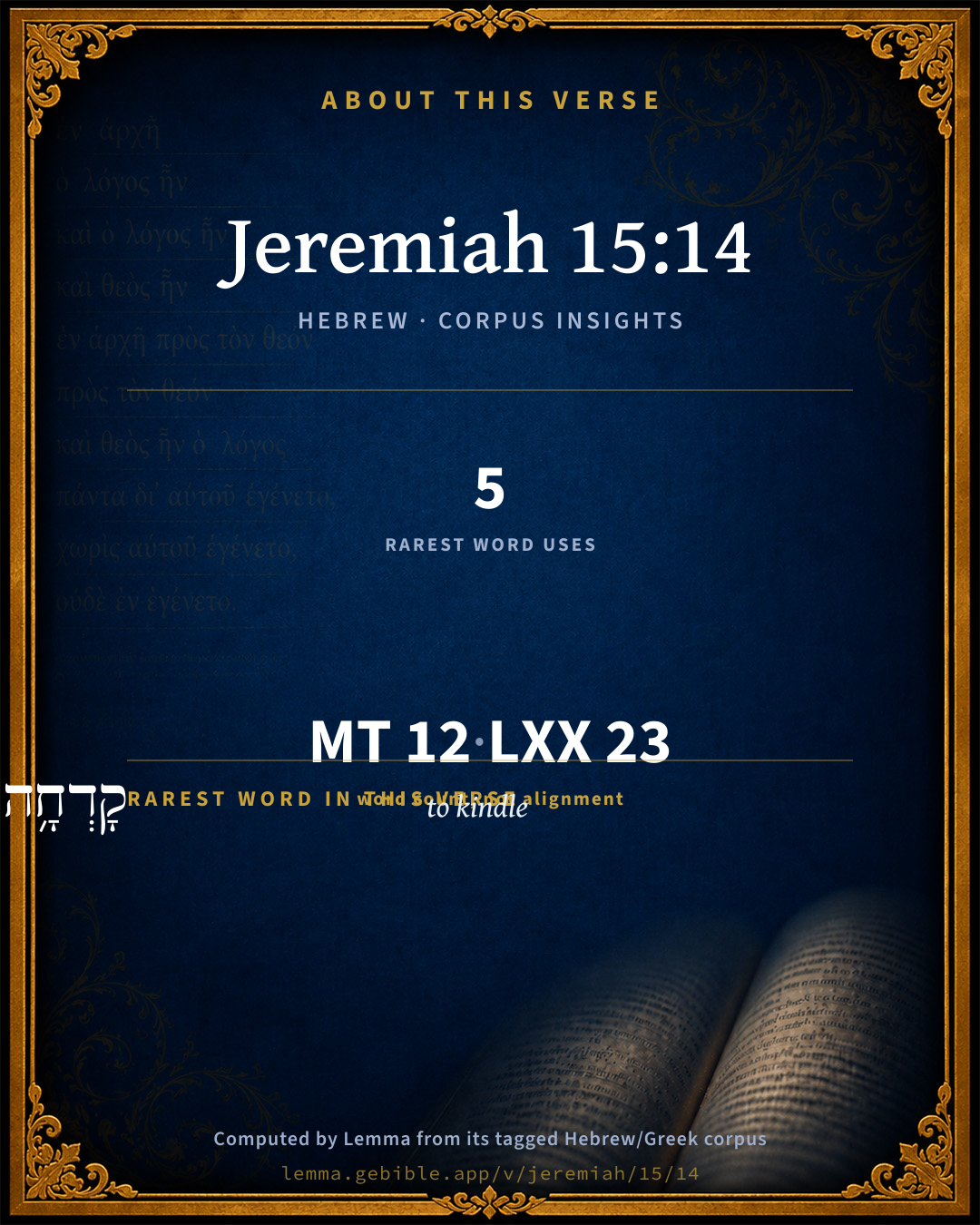
12
words
12
distinct lemmas
Prophets
section

Notable vocabulary

The rarest word here is קָדְחָ֥ה to kindle H6919 — appearing just 5 times in the whole Hebrew Bible.

Shared distinctive vocabulary

קָדְחָ֥ה to kindle H6919 occurs in 5 verses of the Hebrew Bible. Also found in:

Grammatical profile

  • 5 verbs
  • 3 nouns
  • 1 preposition
  • 1 conjunction
  • 2 particles

Verb forms

  • וְהַֽעֲבַרְתִּי֙ Hiphil · Sequential Perfect
  • אֹ֣יְבֶ֔יךָ Qal · Participle Active
  • יָדָ֑עְתָּ Qal · Perfect
  • קָדְחָ֥ה Qal · Perfect
  • תּוּקָֽד Hophal · Imperfect

Hebrew & Septuagint length

In the original languages it is 12 Hebrew tokens and 23 Greek tokens — but the two are counted differently (Hebrew bundles its prefixes and suffixes into one token; the Greek is in lemma form), so that isn’t a like-for-like length.

Cross-references

18

Topical passages linked to Jeremiah 15:14 in the Treasury of Scripture Knowledge — connected by theme and wording, ordered by reader-vote popularity; previews shown in the World English Bible.

  • Deuteronomy 32:22 For a fire is kindled in my anger, Burns to the lowest Sheol, Devours the earth with its increase, Sets on fire the foundations of the mountains.
  • Jeremiah 16:13 therefore will I cast you forth out of this land into the land that you have not known, neither you nor your fathers; and there shall you serve other gods day and night; for I will show you no favor.
  • Deuteronomy 28:36 Yahweh will bring you, and your king whom you shall set over you, to a nation that you have not known, you nor your fathers; and there shall you serve other gods, wood and stone.
  • Psalms 21:9 You will make them as a fiery furnace in the time of your anger. Yahweh will swallow them up in his wrath. The fire shall devour them.
  • Jeremiah 17:4 You, even of yourself, shall discontinue from your heritage that I gave you; and I will cause you to serve your enemies in the land which you don't know: for you have kindled a fire in my anger which shall burn forever.
  • Deuteronomy 28:64 Yahweh will scatter you among all peoples, from the one end of the earth even to the other end of the earth; and there you shall serve other gods, which you have not known, you nor your fathers, even wood and stone.
  • Leviticus 26:38–39 You will perish among the nations, and the land of your enemies will eat you up.
  • Deuteronomy 28:25 Yahweh will cause you to be struck before your enemies; you shall go out one way against them, and shall flee seven ways before them: and you shall be tossed back and forth among all the kingdoms of the earth.
  • Deuteronomy 29:23 [and that] the whole land of it is sulfur, and salt, [and] a burning, [that] it is not sown, nor bears, nor any grass grows therein, like the overthrow of Sodom and Gomorrah, Admah and Zeboiim, which Yahweh overthrew in his anger, and in his wrath:
  • Isaiah 42:25 Therefore he poured on him the fierceness of his anger, and the strength of battle; and it set him on fire round about, yet he didn't know; and it burned him, yet he didn't lay it to heart.
  • Isaiah 66:15–16 For, behold, Yahweh will come with fire, and his chariots shall be like the whirlwind; to render his anger with fierceness, and his rebuke with flames of fire.
  • Jeremiah 4:4 Circumcise yourselves to Yahweh, and take away the foreskins of your heart, you men of Judah and inhabitants of Jerusalem; lest my wrath go forth like fire, and burn so that none can quench it, because of the evil of your doings.
  • Jeremiah 14:18 If I go forth into the field, then, behold, the slain with the sword! and if I enter into the city, then, behold, those who are sick with famine! for both the prophet and the priest go about in the land, and have no knowledge.
  • Jeremiah 15:4 I will cause them to be tossed back and forth among all the kingdoms of the earth, because of Manasseh, the son of Hezekiah, king of Judah, for that which he did in Jerusalem.
  • Jeremiah 52:27 The king of Babylon struck them, and put them to death at Riblah in the land of Hamath. So Judah was carried away captive out of his land.
  • Amos 5:27 Therefore will I cause you to go into captivity beyond Damascus," says Yahweh, whose name is the God of hosts.
  • Nahum 1:5–6 The mountains quake before him, and the hills melt away. The earth trembles at his presence, yes, the world, and all who dwell in it.
  • Hebrews 12:29 for our God is a consuming fire.

Cross-references courtesy of OpenBible.info (CC BY 4.0).

Hebrew and Greek witnesses Masoretic Hebrew ↔ Greek Septuagint

The same verse in the two great witnesses to the Old Testament, shown verse-for-verse.

These are two independent witnesses, not word-aligned to each other, and the Septuagint is shown in lemma (dictionary) form.

Hebrew Jeremiah 15:14 Masoretic · Westminster Leningrad Codex

וְהַֽעֲבַרְתִּי֙ אֶת אֹ֣יְבֶ֔יךָ בְּאֶ֖רֶץ לֹ֣א יָדָ֑עְתָּ כִּֽי אֵ֛שׁ קָדְחָ֥ה בְאַפִּ֖י עֲלֵיכֶ֥ם תּוּקָֽד

I will make [them] to pass with your enemies into a land which you don't know; for a fire is kindled in my anger, which shall burn on you.

World English Bible · Public Domain

Greek LXX Structure differs

In the Septuagint, Jeremiah is about an eighth shorter than the Hebrew and arranges its material differently — the Oracles Against the Nations (Hebrew chapters 46–51) appear in the middle of the Greek book, after 25:13. Because the chapter and verse boundaries do not line up, a verse-for-verse comparison with the Hebrew is not shown.

A verse-for-verse comparison isn’t shown here because the chapters and verses don’t line up. Switch to the LXX edition with the MT / LXX toggle above to read the Greek directly.

On this verse, Jamieson, Fausset & Brown discusses the Septuagint’s reading. Read the note in Commentary ↓

Hebrew: Westminster Leningrad Codex (CC BY 4.0). Greek: Septuagint (public domain); English from a public-domain English Septuagint. How the Septuagint differs from the Hebrew →

Targum (Aramaic paraphrase)

1

The Targum is the ancient Jewish Aramaic paraphrase of the Hebrew Scriptures — an interpretive translation, not the Hebrew text itself. Onkelos (literal) and Pseudo-Jonathan (expansive) render the Torah, and Jonathan the Prophets. Coverage is partial: where no permissively-licensed English translation exists for a verse, only the Aramaic is shown. This is verse-level text, not a word-by-word alignment to the Hebrew.

  1. Targum Jonathan Prophets (Joshua–Malachi)
    וְתִשְׁתַּעְבְּדוּן לְבַעֲלֵי דְבָבֵיכוֹן בְּאַרְעָא דְלָא יְדַעְתּוּן אֲרֵי קִידוּם תַּקִיף כְּאֶשְׁתָּא נְפַק מִן קָדָמַי בִּרְגַז עֲלֵיכוֹן יֵחוֹל:

    (no public-domain English translation for this verse)

    Targum Jonathan — Aramaic: “Mikraot Gedolot” (public domain). English: “Sefaria Community Translation” (CC0 1.0 (public-domain dedication)); “London "Chaldee Paraphrase," 1871” (public domain). Text via Sefaria.

Commentary

Notes on Jeremiah 15:14 from classic Christian and Jewish commentators (each source and its license shown beneath its notes). The classic Christian expositions comment on the surrounding passage and are grouped to its opening verse, so a note may address several verses; the Jewish commentaries on the Tanakh (Rashi and others) are per-verse, so they appear only where the commentator wrote on this verse.

Lemma curates 59 commentaries, every one of them public domain or Creative Commons licensed, each selected and text-cleaned for this edition rather than reprinted as found. About our sources →

Trapp's Complete Commentary

John Trapp

Jer 15:14 And I will make [thee] to pass with thine enemies into a land [which] thou knowest not: for a fire is kindled in mine anger, [which] shall burn upon you.

Ver. 14. And I will make thee to pass with thine enemies.] Or, To serve thine enemies; for there is a double reading of the text.

John Trapp, A Commentary or Exposition upon All the Books of the Old and New Testament (1647–1656) — public domain. Text from a community e-Sword module.

Jamieson, Fausset & Brown

Robert Jamieson, A. R. Fausset & David Brown

thee--MAURER supplies "them," namely, "thy treasures." EICHORN, needlessly, from Syriac and the Septuagint, reads, "I will make thee to serve thine enemies"; a reading doubtless interpolated from Jer 17:4.

fire-- (Deu 32:22).

Jamieson, Fausset & Brown — Commentary Critical and Explanatory on the Whole Bible (1871) — public domain (CC PDM 1.0). Text via the HelloAO Bible API.

John Calvin's Commentaries

He pursues the same subject. He had said, that they would be exposed as a prey to their enemies, so that all their wealth would be plundered with impunity: he now adds, I will deliver you to the enemy, that is, I will give you into the hands of your enemies, that they may remove you ejsewhere. He afterwards mentions a circumstance, which must have rendered exile much worse; for when any one changes his place and is not led to a distance, the evil is more tolerable; but when any one is carried beyond the sea, or into distant lands, there is a much greater cause for sorrow, as there is no hope of return to one’s own country. Then despair increases the grief. Add to this, that not to hear of one’s native Iand, as though we were in another world, is also a bitter trial.

The Prophet then adds, Because fire has been kindled in my wrath, and against you it shall burn He means that God would be implacable until they were consumed; for his wrath had been kindled on account of their perverse wickedness.

Now all these things were foretold to them, that they might know that God would execute a just vengeance by making the Chaldeans their conquerors: for they might have thought that this happened by chance, according to what has been said by heathen writers, that the events of war are uncertain, that Mars is indifferent (Cicero in Epist) Thus they ascribe to chance whatever happens through God’s providence. That the Jews then might know that they were chastised by God’s hand and by his just vengeance, it was necessary that this should have been declared to them: and therefore he speaks now of the Chaldeans and then of God himself, whose agents the Chaldeans were, for they were guided by his hand. He said before, “Will iron break the iron from the north?” This we, have explained of the Chaldeans: but now he turns to God himself, the author of the calamity brought on the Jews: for the Chaldeans could have done nothing, except through his guidance and direction.

Hence he says, I will cause them to pass over to the enemy, even to a land which they know not And the reason which follows ought to have availed to check all their complaints. We indeed know how clamorous the Jews were, for they often accused God of cruelty, as it appears from many passages. The Prophet then, in order to restrain them, says, that the fire of God’s wrath had been kindled, and that it could not be extinguished, but would burn on them, that is, would entirely consume them. At the same time he condemns their obstinacy, for they allowed no place to God’s mercy, though often warned. They might indeed have pacified him, had they repented. Hence the Prophet here condemns their sottishhess; for they increased their judgment by a continued progress in their evil ways. He afterwards adds —

John Calvin's Commentaries (1540-1563) — public domain. Text from the Calvin Translation Society English edition (1840s-50s) via the Christian Classics Ethereal Library (ccel.org). Calvin's coverage is partial (roughly two-thirds of the Bible); uncommented books and verses are honest gaps, never fabricated. The 19th-century editor's footnotes and remarks are omitted so the notes are faithfully Calvin's own voice.

Ellicott's Commentary for English Readers

(14) I will make thee to pass with thine enemies . . .—The Hebrew text is probably corrupt, and a slight variation of the reading of one word brings the verse into harmony with the parallel passage of Jer_17:4, and gives a better meaning, I will make thee serve thine enemies in a land thou dost not know. As it stands without the pronoun “thee” in the Hebrew we may take it, with some commentators, as meaning, I will make them (the “treasures” of Jer_15:13) pass with thine enemies . . .

A fire is kindled in mine anger.—Another quotation from Deuteronomy (Deu_32:22).

A Bible Commentary for English Readers, edited by Charles John Ellicott (1878–1897) — public domain. Text from a community e-Sword module.

John Gill's Exposition

O Lord, thou knowest,.... All persons and things; he knew the prophet and his heart, and all that was in it; his innocence and integrity; all his afflictions, and what he met with from his enemies; and he knew them, and all their malicious designs against him:

remember me; with the favour which he bore to his own people, his covenant with him, his promises to him, and the word on which he had caused him to hope; because of his trials and troubles, he might seem to be forgotten by him:

and visit me; in mercy for good; and so the Targum adds,

"that thou mayest do well unto me:''

and revenge me of my persecutors; not so much for his own sake; unless this is to be attributed to his frailty and infirmity, to the warmth of his spirit, being a man of like passions with others; for private revenge ought not to be sought by good men, but for the sake of God and his glory, in whose cause he was engaged, and on whose account he was persecuted:

take me not away in thy longsuffering; while thou art bearing with others, do not take me away by death; or suffer them, whom thou dost forbear, to take me away, or give them an opportunity thereby so to do; or when thy longsuffering is at an end, do not involve me in the same calamity with them. The Targum is,

"do not give delay to my injury;''

or,

"length to my affliction;''

that is, do not delay to take vengeance on my persecutors; and to this sense Jarchi interprets it,

"do not take my cause, and leave it to thy longsuffering, but hasten and avenge me;''

and De Dieu proposes such a rendering of the words, "to thy longsuffering do not bring me" (q); and which sense is favoured by the Septuagint version:

know that for thy sake I have suffered rebuke; let it appear, and that even to mine enemies, that it is for thy sake that all this reproach is cast upon me; and all these afflictions are endured by me, by thy resentment of their carriage to me.

(q) "ne ad longanimitatem tuam adduc me", De Dieu; "nec me capias ad dilationem irae tua", Gussetius.

John Gill's Exposition of the Whole Bible (1746–1763) — public domain (CC PDM 1.0). Text via the HelloAO Bible API.

Albert Barnes' Notes on the Bible

Render, “And I will make thee serve thine enemies in a land thou knewest not.”

For a fire ... - See the marginal reference. The added words show that the punishment then predicted is about to be fulfilled.

Albert Barnes' Notes on the Bible (1834–1885) — public domain. Text from a community e-Sword/MySword module.

Haydock's Catholic Bible Commentary

Bring. Septuagint, "enslave thee to thy," &c. Chaldean, "thou shalt serve." (Haydock) --- They have read (Calmet) hahabadti. Hebrew has r instead of d, "I will make thee to pass with thine enemies into a," &c. (Protestants) (Haydock)

George Leo Haydock (1774–1849), Haydock's Catholic Family Bible and Commentary, 1859 edition — public domain. Excludes Psalms (Douay-Rheims chapter numbering differs from Protestant) and Deuterocanonical books (Catholic canon only).

Matthew Poole's English Annotations

As the former verse, so this also, must be understood, not of the prophet, for he was not carried into Babylon, but of the people, whose captivity is threatened in this place, and the cause of it declared, the wrath of the Lord against them for their sins, the effects of Which are compared to a fire which should burn them.

Matthew Poole's English Annotations on the Holy Bible (1683–1685) — public domain. Text from a community e-Sword/MySword module.

Lesson kit

Teaching starters — assembled from the data on this page, not authored interpretation. Every prompt links to the verse data it draws on. Edit before teaching.

Jeremiah, in the Prophets, opens this verse with 12 words (12 distinct Hebrew lemmas). Its most distinctive word is qâdach (“to kindle”). A historical commentator’s framing appears above. Read the whole chapter for the surrounding context.

Discussion questions

  1. What does “to kindle” (qâdach) contribute to the verse as a whole?
  2. Deuteronomy 32:22 shares the word «to kindle» with this verse. How do the two illuminate each other?
  3. The translations on this page render this verse differently — a whole-verse word diff, not a word-by-word alignment. What might account for the different wordings?
  4. The verb «וְהַֽעֲבַרְתִּי֙» is Hiphil Sequential Perfect. How does its form color the action?
  5. Reading how Trapp's Complete Commentary and Jamieson, Fausset & Brown read this verse, where do the two commentators agree and where do they part?

Things to notice

Reading settings

Reading text

Shown beneath each verse's original-language words.

Old Testament
Old Testament edition

Read the OT as the Masoretic Hebrew (MT) or the Greek Septuagint (LXX).

English shown for the Greek Septuagint (in the Hebrew ↔ Greek comparison).

Comparing translations? Open the Compare panel on any verse page to stack up to four side by side.