
Ezekiel 36:5

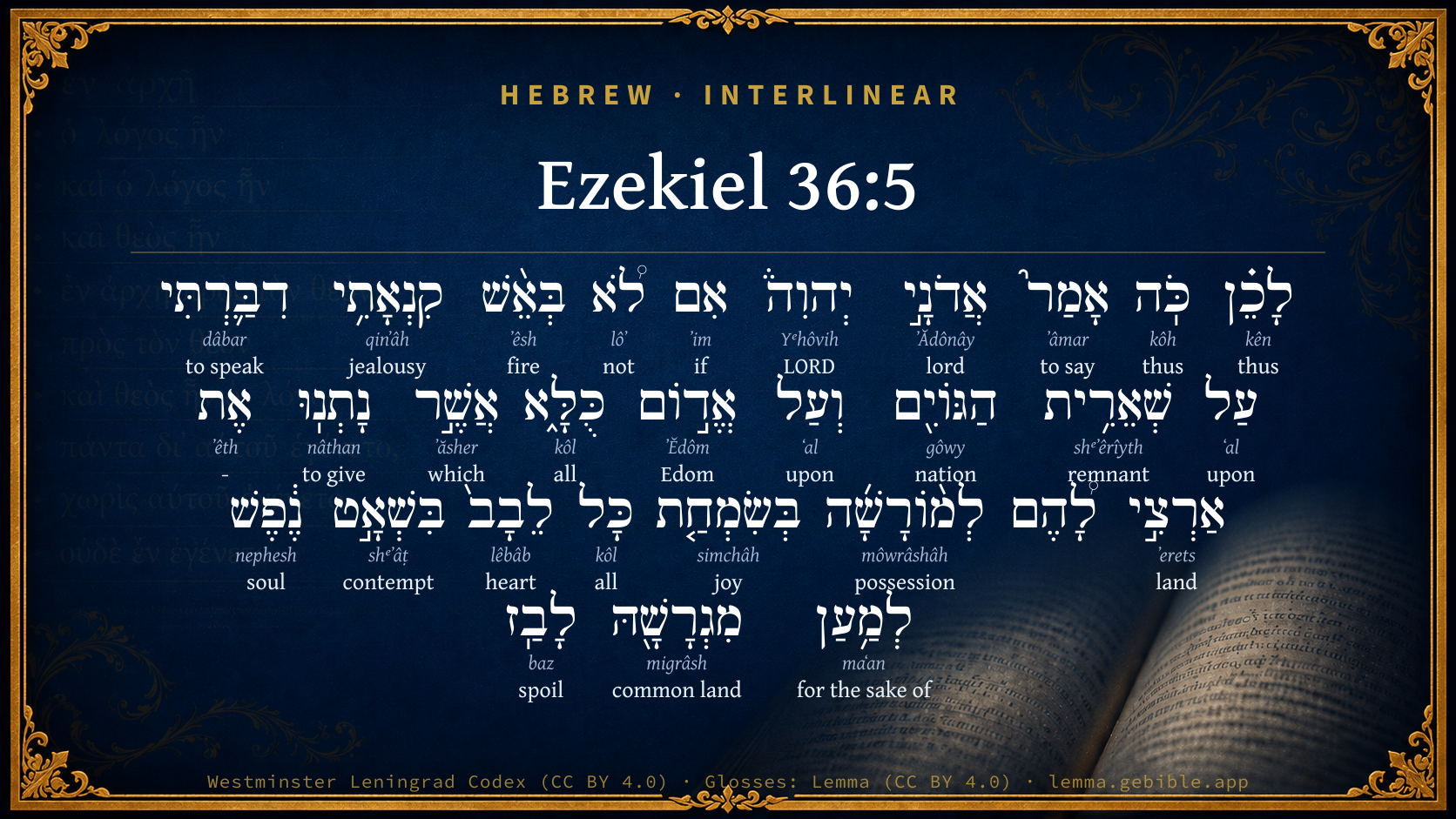
Hebrew (Westminster Leningrad Codex) Ezekiel 36:5 appears in the Hebrew Old Testament. The text above is from the Westminster Leningrad Codex. Each word links to its Strong’s number, a concise gloss, and parsing drawn from the Open Scriptures Hebrew Bible morphology. Click any word for its full Brown-Driver-Briggs (BDB) entry.
Download image
Cite this verse

Ezekiel 36:5 (World English Bible). Public Domain. Lemma interlinear Bible study tool, https://lemma.gebible.app/v/ezekiel/36/5.

Show BibTeX & RIS
BibTeX
RIS
English Translation
therefore thus says the Lord Yahweh: Surely in the fire of my jealousy have I spoken against the residue of the nations, and against all Edom, that have appointed my land to themselves for a possession with the joy of all their heart, with despite of soul, to cast it out for a prey.
World English Bible · Public Domain
Download a study sheet

One document with this verse’s original text, its word-by-word gloss line, the meaning frame, cross-references with their text, attributed commentary, and full source and license credits — printable, and it pastes into notes with its structure intact.

This verse Autodidact and up

Study sheet (.html) Plain text (.txt)

A passage Seminary Student

Up to 50 verses in one chapter. A passage sheet keeps up to 6 commentary sources and 12 cross-references per verse, in the order this page ranks them, and says so on the sheet whenever that leaves anything out. Ask for a single verse and you get the Autodidact verse sheet above.

Everything on this page stays free to read, with no account — the sheet is a download of what is already on screen, not access to it.

Want to remove ads? Support Godless Engineer
Compare translations 3

The same verse in 3 English versions, stacked beneath the original-language interlinear above. Click any original word for its lexicon entry.

Each is an independent rendering of the whole verse — the interlinear is not word-aligned to these translations.

Highlighted words mark where these versions differ — a whole-verse word diff, not a word-by-word alignment.

  • World English Bible Public Domain
    therefore thus says the Lord Yahweh: Surely in the fire of my jealousy have I spoken against the residue of the nations, and against all Edom, that have appointed my land to themselves for a possession with the joy of all their heart, with despite of soul, to cast it out for a prey.
  • King James Version Public Domain
    Therefore thus saith the Lord GOD; Surely in the fire of my jealousy have I spoken against the residue of the heathen, and against all Idumea, which have appointed my land into their possession with the joy of all their heart, with despiteful minds, to cast it out for a prey.
  • unfoldingWord Literal Text CC BY-SA 4.0
    therefore the Lord Yahweh says this: I have certainly spoken in the fire of my fury against the other nations, against Edom and all who took my land for themselves as a possession, against all those who had both joy in their heart and disdain in their spirit, as they seized my land that they might claim its pasturelands for themselves.’

unfoldingWord Literal Text — © unfoldingWord, licensed CC BY-SA 4.0. Word-aligned USFM3 via Door43 (git.door43.org/unfoldingWord/en_ult).

Versions to compare (up to 4)

3 of 4 selected

Show all 18 translations

Every available English version of this verse, each an independent rendering of the whole verse.

  • World English Bible Public Domain
    therefore thus says the Lord Yahweh: Surely in the fire of my jealousy have I spoken against the residue of the nations, and against all Edom, that have appointed my land to themselves for a possession with the joy of all their heart, with despite of soul, to cast it out for a prey.
  • Berean Standard Bible Public Domain
    Therefore this is what the Lord GOD says: Surely in My burning zeal I have spoken against the rest of the nations, and against all Edom, who took My land as their own possession with wholehearted joy and utter contempt, so that its pastureland became plunder.
  • Majority Standard Bible Public Domain
    Therefore this is what the Lord GOD says: Surely in My burning zeal I have spoken against the rest of the nations, and against all Edom, who took My land as their own possession with wholehearted joy and utter contempt, so that its pastureland became plunder.
  • King James Version Public Domain
    Therefore thus saith the Lord GOD; Surely in the fire of my jealousy have I spoken against the residue of the heathen, and against all Idumea, which have appointed my land into their possession with the joy of all their heart, with despiteful minds, to cast it out for a prey.
  • American Standard Version (1901) Public Domain
    therefore thus saith the Lord Jehovah: Surely in the fire of my jealousy have I spoken against the residue of the nations, and against all Edom, that have appointed my land unto themselves for a possession with the joy of all their heart, with despite of soul, to cast it out for a prey.
  • Revised Version (1885) Public Domain
    therefore thus saith the Lord GOD: Surely in the fire of my jealousy have I spoken against the residue of the nations, and against all Edom, which have appointed my land unto themselves for a possession with the joy of all their heart, with despite of soul, to cast it out for a prey:
  • Geneva Bible (1599) Public Domain
    Therefore thus saith the Lord God, Surely in the fire of mine indignation haue I spoken against the residue of the heathen, and against all Idumea, which haue taken my lande for their possession, with the ioy of all their heart, and with despitefull mindes to cast it out for a pray.
  • Douay-Rheims (1899) Public Domain
    Therefore thus saith the Lord God: In the fire of my zeal I have spoken of the rest of the nations, and of all Edom, who have taken my land to themselves, for an inheritance with joy, and with all the heart, and with the mind: and have cast it out to lay it waste.
  • Young's Literal Translation Public Domain
    Therefore, thus said the Lord Jehovah: Have I not, in the fire of My jealousy, Spoken against the remnant of the nations, And against Edom -- all of it, Who gave My land to themselves for a possession, With the joy of the whole heart -- with despite of soul, For the sake of casting it out for a prey?
  • Literal Standard Version CC BY-SA 4.0
    Therefore, thus said Lord YHWH: Have I not, in the fire of My jealousy, || Spoken against the remnant of the nations, || And against Edom—all of it, || Who gave My land to themselves for a possession, || With the joy of the whole heart—with despite of soul, || For the sake of casting it out for a prey?
  • Unlocked Literal Bible CC BY-SA 4.0
    therefore the Lord Yahweh says this: I have certainly spoken in the fire of my fury against the other nations, against Edom and all who took my land for themselves as a possession, against all those who had both joy in their heart and disdain in their spirit, as they seized my land that they might claim its pasturelands for themselves.'
  • unfoldingWord Literal Text CC BY-SA 4.0
    therefore the Lord Yahweh says this: I have certainly spoken in the fire of my fury against the other nations, against Edom and all who took my land for themselves as a possession, against all those who had both joy in their heart and disdain in their spirit, as they seized my land that they might claim its pasturelands for themselves.’
  • Darby Bible Public Domain
    -- therefore thus saith the Lord Jehovah: Surely in the fire of my jealousy have I spoken against the remnant of the nations, and against the whole of Edom, which have appointed my land unto themselves for a possession with the joy of all [their] heart, with despite of soul, to plunder it by pillage.
  • World Messianic Bible Public Domain
    therefore the Lord GOD says: “Surely in the fire of my jealousy I have spoken against the residue of the nations, and against all Edom, that have appointed my land to themselves for a possession with the joy of all their heart, with despite of soul, to cast it out for a prey.”’
  • Webster's Bible Public Domain
    Therefore thus saith the Lord GOD; Surely in the fire of my jealousy have I spoken against the residue of the heathen, and against all Edom, who have appointed my land into their possession with the joy of all their heart, with despiteful minds, to cast it out for a prey.
  • Free Bible Version CC BY-SA 4.0
    Yes, this is what the Lord God says: I have spoken passionately against these other nations, and against all the Edomites, who took over my country and made it theirs, happily celebrating as they looted the land and treated me with complete contempt.
  • Bible in Basic English Public Domain
    For this cause the Lord has said: Truly, in the heat of my bitter feeling I have said things against the rest of the nations and against all Edom, who have taken my land as a heritage for themselves with the joy of all their heart, and with bitter envy of soul have made attacks on it:
  • JPS Tanakh (1917) Public Domain
    therefore thus saith the Lord GOD: Surely in the fire of My jealousy have I spoken against the residue of the nations, and against all Edom, that have appointed My land unto themselves for a possession with the joy of all their heart, with disdain of soul, to cast it out for a prey;

Literal Standard Version (2020), Covenant Press — licensed CC BY-SA 4.0. Text via the HelloAO Bible API (eBible.org). Unlocked Literal Bible (unfoldingWord) — licensed CC BY-SA 4.0. Text via the HelloAO Bible API (eBible.org). unfoldingWord Literal Text — © unfoldingWord, licensed CC BY-SA 4.0. Word-aligned USFM3 via Door43 (git.door43.org/unfoldingWord/en_ult). Free Bible Version, Dr. Jonathan Gallagher — licensed CC BY-SA 4.0. Text via the HelloAO Bible API (eBible.org).

Word by word

More ways to search: Search by grammar → Find every occurrence → Compare this word →

Practice this passage: Drill this verse → Learn its vocabulary →

בִּשְׁאָ֣ט
shᵉʼâṭ
H7589
“in/at · contempt of”
Preposition + Noun, Common, Masculine, Singular, Construct
Part of Speech
Preposition + Noun
Type
Common
Gender
Masculine
Number
Singular
State
Construct
Full BDB Definition

Origin: from an unused root meaning to push aside

TWOT: 2345a

despite, contempt
  1. לָכֵ֗ן kên H3651 “to/for · thus” Preposition + Adverb
  2. כֹּֽה kôh H3541 “thus” Adverb
  3. אָמַר֮ ʼâmar H559 “to say” Verb, Qal, Perfect, 3rd Person, Masculine, Singular
  4. אֲדֹנָ֣י ʼĂdônây H136 “Lord · my” Noun, Common, Masculine, Plural, Construct + Suffix, Personal, 1st Person, Common, Singular
  5. יְהוִה֒ Yᵉhôvih H3069 “LORD” Noun, Proper
  6. אִם ʼim H518 “if” Conjunction
  7. לֹ֠א lôʼ H3808 “not” Particle, Negative
  8. בְּאֵ֨שׁ ʼêsh H784 “in/at · fire of” Preposition + Noun, Common, Both, Singular, Construct
  9. קִנְאָתִ֥י qinʼâh H7068 “jealousy · my” Noun, Common, Feminine, Singular, Construct + Suffix, Personal, 1st Person, Common, Singular
  10. דִבַּ֛רְתִּי dâbar H1696 “to speak” Verb, Piel, Perfect, 1st Person, Common, Singular
  11. עַל ʻal H5921 “upon” Preposition
  12. שְׁאֵרִ֥ית shᵉʼêrîyth H7611 “remnant of” Noun, Common, Feminine, Singular, Construct
  13. הַגּוֹיִ֖ם gôwy H1471 “the · nations” Particle, Definite Article + Noun, Common, Masculine, Plural, Absolute
  14. וְעַל ʻal H5921 “and · upon” Conjunction + Preposition
  15. אֱד֣וֹם ʼĔdôm H123 “Edom” Noun, Proper
  16. כֻּלָּ֑א kôl H3605 “all · her” Noun, Common, Masculine, Singular, Construct + Suffix, Personal, 3rd Person, Feminine, Singular
  17. אֲשֶׁ֣ר ʼăsher H834 “which” Particle, Relative
  18. נָתְנֽוּ nâthan H5414 “to give” Verb, Qal, Perfect, 3rd Person, Common, Plural
  19. אֶת ʼêth H853 “-” Particle, Direct Object
  20. אַרְצִ֣י ʼerets H776 “land · my” Noun, Common, Both, Singular, Construct + Suffix, Personal, 1st Person, Common, Singular
  21. לְמ֨וֹרָשָׁ֜ה môwrâshâh H4181 “to/for · possession” Preposition + Noun, Common, Feminine, Singular, Absolute
  22. בְּשִׂמְחַ֤ת simchâh H8057 “in/at · joy of” Preposition + Noun, Common, Feminine, Singular, Construct
  23. כָּל kôl H3605 “all of” Noun, Common, Masculine, Singular, Construct
  24. לֵבָב֙ lêbâb H3824 “heart” Noun, Common, Masculine, Singular, Absolute
  25. נֶ֔פֶשׁ nephesh H5315 “soul” Noun, Common, Both, Singular, Absolute
  26. לְמַ֥עַן maʻan H4616 “for the sake of” Preposition
  27. מִגְרָשָׁ֖הּ migrâsh H4054 “common land · her” Noun, Common, Masculine, Singular, Construct + Suffix, Personal, 3rd Person, Feminine, Singular
  28. לָבַֽז baz H957 “to/for · spoil” Preposition + Noun, Common, Masculine, Singular, Absolute

About this verse

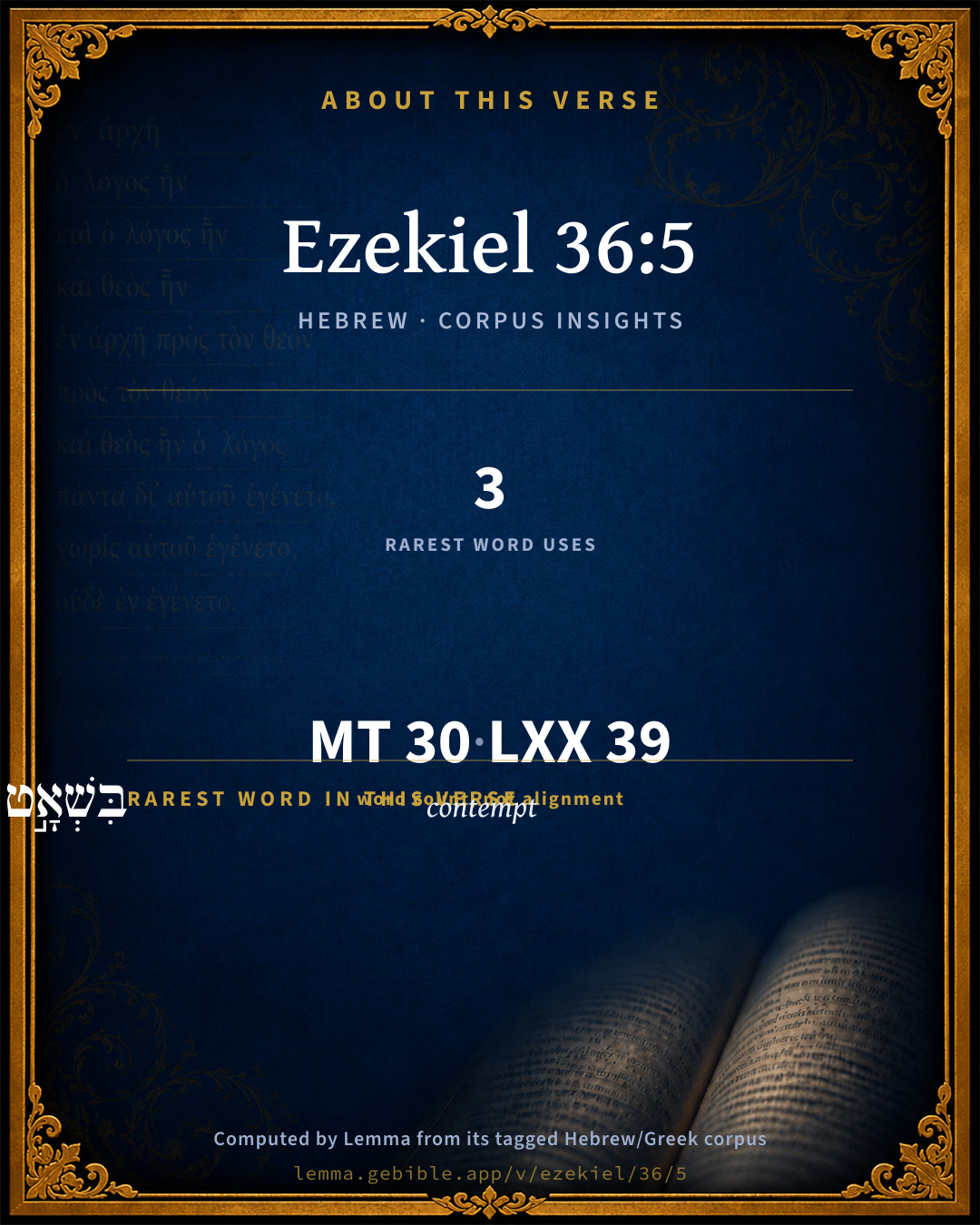
These counts appear in no published source. They are computed here, from the morphology-tagged text and Lemma’s own curated glosses. What Lemma adds →

30
words
27
distinct lemmas
Prophets
section

Notable vocabulary

The rarest word here is בִּשְׁאָ֣ט contempt H7589 — appearing just 3 times in the whole Hebrew Bible.

Shared distinctive vocabulary

בִּשְׁאָ֣ט contempt H7589 occurs in 3 verses of the Hebrew Bible. Also found in:

Grammatical profile

  • 3 verbs
  • 17 nouns
  • 4 prepositions
  • 1 conjunction
  • 2 adverbs
  • 3 particles

Verb forms

  • אָמַר֮ Qal · Perfect
  • דִבַּ֛רְתִּי Piel · Perfect
  • נָתְנֽוּ Qal · Perfect

Repetition

Words recur within this verse — often emphatic in Hebrew:

  • עַל upon H5921 ×2
  • כֻּלָּ֑א all H3605 ×2

Hebrew & Septuagint length

In English translation the verse runs 54 words from the Hebrew and 49 from the Septuagint (LXX English) — closely comparable.

A rough comparison of the two English renderings, which tokenize alike — not a word-level alignment.

Word counts can differ between the Hebrew and the Greek without any difference in meaning — e.g. the Hebrew direct-object marker אֵת has no separate Greek word, and Greek often adds the article ὁ.

In the original languages it is 30 Hebrew tokens and 39 Greek tokens — but the two are counted differently (Hebrew bundles its prefixes and suffixes into one token; the Greek is in lemma form), so that isn’t a like-for-like length.

Cross-references

26

Topical passages linked to Ezekiel 36:5 in the Treasury of Scripture Knowledge — connected by theme and wording, ordered by reader-vote popularity; previews shown in the World English Bible.

  • Ezekiel 36:3 therefore prophesy, and say, Thus says the Lord Yahweh: Because, even because they have made you desolate, and swallowed you up on every side, that you might be a possession to the residue of the nations, and you are taken up in the lips of talkers, and the evil report of the people;
  • Micah 7:8 Don't rejoice against me, my enemy. When I fall, I will arise. When I sit in darkness, Yahweh will be a light to me.
  • Deuteronomy 4:24 For Yahweh your God is a devouring fire, a jealous God.
  • Psalms 83:4–12 "Come," they say, "and let's destroy them as a nation, That the name of Israel may be remembered no more."
  • Psalms 137:7 Remember, Yahweh, against the children of Edom, The day of Jerusalem; Who said, "Raze it! Raze it even to its foundation!"
  • Jeremiah 25:9 behold, I will send and take all the families of the north, says Yahweh, and [I will send] to Nebuchadrezzar the king of Babylon, my servant, and will bring them against this land, and against the inhabitants of it, and against all these nations round about; and I will utterly destroy them, and make them an astonishment, and a hissing, and perpetual desolations.
  • Jeremiah 25:15–29 For thus says Yahweh, the God of Israel, to me: take this cup of the wine of wrath at my hand, and cause all the nations, to whom I send you, to drink it.
  • Ezekiel 38:19 For in my jealousy and in the fire of my wrath have I spoken, Surely in that day there shall be a great shaking in the land of Israel;
  • Zechariah 1:15 I am very angry with the nations that are at ease; for I was but a little displeased, but they added to the calamity."
  • Proverbs 17:5 Whoever mocks the poor reproaches his Maker. He who is glad at calamity shall not be unpunished.
  • Proverbs 24:17–18 Don't rejoice when your enemy falls. Don't let your heart be glad when he is overthrown;
  • Isaiah 34:1–17 Come near, you nations, to hear; and listen, you peoples: let the earth hear, and the fullness of it; the world, and all things that come forth from it.
  • Isaiah 63:1–6 Who is this who comes from Edom, with dyed garments from Bozrah? this who is glorious in his clothing, marching in the greatness of his strength? I who speak in righteousness, mighty to save.
  • Isaiah 66:15–16 For, behold, Yahweh will come with fire, and his chariots shall be like the whirlwind; to render his anger with fierceness, and his rebuke with flames of fire.
  • Jeremiah 49:1 Of the children of Ammon. Thus says Yahweh: Has Israel no sons? has he no heir? why then does Malcam possess Gad, and his people well in the cities of it?
  • Jeremiah 49:7–22 Of Edom. Thus says Yahweh of Hosts: Is wisdom no more in Teman? is counsel perished from the prudent? is their wisdom vanished?
  • Jeremiah 50:11 Because you are glad, because you rejoice, O you who plunder my heritage, because you are wanton as a heifer that treads out [the grain], and neigh as strong horses;
  • Lamentations 4:21 Rejoice and be glad, daughter of Edom, that dwell in the land of Uz: The cup shall pass through to you also; you shall be drunken, and shall make yourself naked.
  • Ezekiel 25:8–15 Thus says the Lord Yahweh: Because Moab and Seir say, Behold, the house of Judah is like all the nations;
  • Ezekiel 35:1–15 Moreover the word of Yahweh came to me, saying,
  • Amos 1:11–12 Thus says Yahweh: "For three transgressions of Edom, yes, for four, I will not turn away its punishment; Because he pursued his brother with the sword, And cast off all pity, And his anger raged continually, And he kept his wrath forever;
  • Obadiah 1:1–9 The vision of Obadiah. This is what the Lord Yahweh says about Edom. We have heard news from Yahweh, and an ambassador is sent among the nations, saying, "Arise, and let's rise up against her in battle.
  • Obadiah 1:12 But don't look down on your brother in the day of his disaster, and don't rejoice over the children of Judah in the day of their destruction. Don't speak proudly in the day of distress.
  • Zephaniah 2:8–10 I have heard the reproach of Moab, and the insults of the children of Ammon, with which they have reproached my people, and magnified themselves against their border.
  • Zephaniah 3:8 "Therefore wait for me," says Yahweh, "until the day that I rise up to the prey, for my determination is to gather the nations, that I may assemble the kingdoms, to pour on them my indignation, even all my fierce anger, for all the earth will be devoured with the fire of my jealousy.
  • Malachi 1:2–4 "I have loved you," says Yahweh. Yet you say, "How have you loved us?" "Wasn't Esau Jacob's brother?" says Yahweh, "Yet I loved Jacob;

Cross-references courtesy of OpenBible.info (CC BY 4.0).

Hebrew and Greek witnesses Masoretic Hebrew ↔ Greek Septuagint

The same verse in the two great witnesses to the Old Testament, shown verse-for-verse.

These are two independent witnesses, not word-aligned to each other, and the Septuagint is shown in lemma (dictionary) form.

Hebrew Ezekiel 36:5 Masoretic · Westminster Leningrad Codex

לָכֵ֗ן כֹּֽה אָמַר֮ אֲדֹנָ֣י יְהוִה֒ אִם לֹ֠א בְּאֵ֨שׁ קִנְאָתִ֥י דִבַּ֛רְתִּי עַל שְׁאֵרִ֥ית הַגּוֹיִ֖ם וְעַל אֱד֣וֹם כֻּלָּ֑א אֲשֶׁ֣ר נָתְנֽוּ אֶת אַרְצִ֣י לָ֠הֶם לְמ֨וֹרָשָׁ֜ה בְּשִׂמְחַ֤ת כָּל לֵבָב֙ בִּשְׁאָ֣ט נֶ֔פֶשׁ לְמַ֥עַן מִגְרָשָׁ֖הּ לָבַֽז

therefore thus says the Lord Yahweh: Surely in the fire of my jealousy have I spoken against the residue of the nations, and against all Edom, that have appointed my land to themselves for a possession with the joy of all their heart, with despite of soul, to cast it out for a prey.

World English Bible · Public Domain

Greek LXX Ezekiel 36:5 Septuagint · lemma form

διά οὗτος ὅδε λέγω κύριος κύριος εἰ μήν ἐν πῦρ θυμός ἐγώ λαλέω ἐπί ὁ λοιπός ἔθνος καί ἐπί ὁ ιδουμαία πᾶς ὅτι δίδωμι ὁ γῆ ἐγώ ἑαυτοῦ εἰς κατάσχεσις μετά εὐφροσύνη ἀτιμάζω ψυχή ὁ ἀπο ἀναἵζω ἐν προνομή

therefore, thus says the Lord; Verily in the fire of my wrath have I spoken against the rest of the nations, and against all Idumea, because they have appropriated my land to themselves for a possession with joy, disregarding the lives of the inhabitants, to destroy it by plunder:

LXX2012 (modern English Septuagint) · Public Domain

Hebrew: Westminster Leningrad Codex (CC BY 4.0). Greek: Septuagint (public domain); English from LXX2012 (modern English Septuagint) (Public Domain). How the Septuagint differs from the Hebrew →

Targum (Aramaic paraphrase)

1

The Targum is the ancient Jewish Aramaic paraphrase of the Hebrew Scriptures — an interpretive translation, not the Hebrew text itself. Onkelos (literal) and Pseudo-Jonathan (expansive) render the Torah, and Jonathan the Prophets. Coverage is partial: where no permissively-licensed English translation exists for a verse, only the Aramaic is shown. This is verse-level text, not a word-by-word alignment to the Hebrew.

  1. Targum Jonathan Prophets (Joshua–Malachi)
    בְּכֵן כִּדְנַן אֲמַר יְיָ אֱלֹהִים אִם לָא בְּאֵשַׁת פּוּרְעֲנוּתִי גְזָרֵית בְּמֵימְרִי עַל שְׁאֵרָא דְעַמְמַיָא וְעַל אֱדוֹמָאֵי כוּלְהוֹן דִיהַבוּ יַת אַרְעָא בֵּית שְׁכִנְתִּי לְהוֹן לִירוּתָא בְּחֶדְוַת כָּל לֵב בְּצִפּוּחַ נְפַשׁ בְּדִיל לְתָרְכוּתָהּ לְמִבְזָה:

    (no public-domain English translation for this verse)

    Targum Jonathan — Aramaic: “Mikraot Gedolot” (public domain). English: “Sefaria Community Translation” (CC0 1.0 (public-domain dedication)); “London "Chaldee Paraphrase," 1871” (public domain). Text via Sefaria.

Commentary

Notes on Ezekiel 36:5 from classic Christian and Jewish commentators (each source and its license shown beneath its notes). The classic Christian expositions comment on the surrounding passage and are grouped to its opening verse, so a note may address several verses; the Jewish commentaries on the Tanakh (Rashi and others) are per-verse, so they appear only where the commentator wrote on this verse.

Lemma curates 59 commentaries, every one of them public domain or Creative Commons licensed, each selected and text-cleaned for this edition rather than reprinted as found. About our sources →

Trapp's Complete Commentary

John Trapp

Eze 36:5 Therefore thus saith the Lord GOD; Surely in the fire of my jealousy have I spoken against the residue of the heathen, and against all Idumea, which have appointed my land into their possession with the joy of all [their] heart, with despiteful minds, to cast it out for a prey.

Ver. 5. Surely in the fire of my jealousy.] Jealousy is hot as hell; {Son 8:6} it is implacable, {Pro 6:34-35} and very vindictive. See Zec 1:14. {See Trapp on "Zec 1:14"} Here God swears he will be even with these Edomites.

Which have appointed my land.] This the Lord hath never done with, so ill be took it.

John Trapp, A Commentary or Exposition upon All the Books of the Old and New Testament (1647–1656) — public domain. Text from a community e-Sword module.

Geneva Bible (1599)

Geneva Bible translators

They appointed with themselves to have it, and therefore came with Nebuchadnezzar against Jerusalem for this purpose.

Geneva Bible (1599) marginal notes — public domain. Text via Bolls.life.

Jamieson, Fausset & Brown

Robert Jamieson, A. R. Fausset & David Brown

to cast it out for a prey--that is, to take the land for a prey, its inhabitants being cast out. Or the land is compared to a prey cast forth to wild beasts. FAIRBAIRN needlessly alters the Hebrew pointing and translates, "that they may plunder its pasturage."

Jamieson, Fausset & Brown — Commentary Critical and Explanatory on the Whole Bible (1871) — public domain (CC PDM 1.0). Text via the HelloAO Bible API.

Ellicott's Commentary for English Readers

(5) Idumea = Edom, as in Eze_35:15, where see Note. For “cast it out,” in the last clause of the verse, read, empty it out. The idea of casting out a land for a prey is incongruous, and the other sense is admissible.

A Bible Commentary for English Readers, edited by Charles John Ellicott (1878–1897) — public domain. Text from a community e-Sword module.

The Cambridge Bible for Schools and Colleges

gen. ed. J. J. S. Perowne

5. fire of my jealousy] “Jealousy” is injured self-consciousness; it is the reaction of Jehovah’s sense of himself against the injurious conduct of Edom and the nations in relation to him or that which is his, cf. my land.

to cast it out] The expression is difficult both in grammar (as Eze_17:9) and meaning. To take “cast it (the land) out” in the sense of cast out the inhabitants is not quite natural, though cf. Eze_24:6. The reading may be faulty.

The Cambridge Bible for Schools and Colleges (gen. ed. J. J. S. Perowne; Cambridge University Press, 1878–1918) — public domain. Text from a community e-Sword module.

John Gill's Exposition

Therefore thus saith the Lord God,.... Because these Heathens have acted such an unkind and cruel part to Israel:

surely in the fire of my jealousy have I spoken; in his fierce wrath and hot displeasure, resenting the ill usage of his people; hot with indignation against their enemies, having a fervent zeal for his own glory, and an affectionate concern for the good of his people. It is in the original text in the form of an oath, "if I have not spoken", &c. (g); let me be reckoned a liar, or not God; believe me that I have spoken, and in this warm manner; and have not only foretold in prophecy, and threatened the destruction of these nations, but have resolved and determined upon it in my own mind. So the Targum,

"if I have not in the fire of my vengeance decreed in my word:''

against the residue of the Heathen, and against all Idumea; or Edom; the Edomites, even all of them, who of all the Heathen were the most inveterate and implacable enemies of the Jews, though related to them, and are therefore particularly mentioned as the objects of the divine vengeance: the reason follows,

which have appointed my land into their possession; this land where his chosen people dwelt, and which he chose for them, and gave unto them; the land where he himself dwelt, and granted his presence; where his temple was, and he was worshipped. So the Targum,

"the land of the house of my majesty.''

Now this the Lord took ill at their hands, and resented, that they should lay out this land for themselves, and determine upon it as a possession and inheritance of theirs.

With the joy of all their heart, with despiteful minds, to cast it out for a prey; with the utmost joy they joined Nebuchadnezzar's army when he invaded the land of Judea and besieged Jerusalem, out of pure malice and spite to the people of the Jews, in order to eject them from the possession of their land, that it might become a prey to them; see Psa 137:7.

(g) "si non", Cocceius, Starckius; "sub. mentiar", Junius & Tremellius; "non ero Deus", Piscator.

John Gill's Exposition of the Whole Bible (1746–1763) — public domain (CC PDM 1.0). Text via the HelloAO Bible API.

Matthew Poole's English Annotations

Surely; in the Hebrew it is in the form of an oath.

In the fire; in my hot displeasure.

Spoken against; threatened ruin and desolation to all the nations that are and have been enemies to Israel.

Idumea; the land in which the Edomites dwelt; the Hebrew is Edom.

Have appointed my land; have given or delivered, helped to take the land from my people, and then left it in the hand of the Chaldeans, in hope it should be given back to them for their possession.

With the joy of all their heart; transported with joy; Jacob’s children put out, the heathen came in to possess the land, with rancorous minds, swelling with hatred, and from that acting with the utmost vigour to slay the inhabitants, that there might be no pretenders to the land, but that they might inherit it.

Matthew Poole's English Annotations on the Holy Bible (1683–1685) — public domain. Text from a community e-Sword/MySword module.

Whedon's Commentary on the Bible

Daniel D. Whedon

5. Jealousy — See notes Eze_5:12; Eze_23:25; compare Eze_38:19.

Idumea — Edom. (Compare Eze_35:15.)

Into their possession — Rather, with R.V., “Unto themselves for a possession.” (Compare Eze_35:10; Eze_35:15.)

With despiteful minds — Or, with contempt of soul.

To cast it out for a prey — A very difficult phrase. Toy reads, “that they might possess it as a prey.” From a Hebrew standpoint the Holy Land would become a prey and a castaway if ever the Edomites took possession of it, but perhaps it would be better to make a slight change and read, “in order to plunder its produce” (Hitzig).

Daniel D. Whedon (gen. ed.), Commentary on the Old and New Testaments (1874–1909) — public domain. Text from a community e-Sword module.

The Pulpit Commentary

Surely. alA the particle of adjuration, as in Eze_5:11 Eze_33:27 Eze_34:8 Eze_38:19. The fire of my jealousy. Zephaniah (Zep_1:18 Zep_3:8) uses the same phrase. Similar expressions occur Eze_21:31, "the fire of my wrath;" and Eze_38:19, "in my jealousy and in the fire of my wrath". (comp. Deu_4:24) Against all Idumea. Edom. As in Eze_35:15, so here, it is the wickedness, more especially of the Edomites, that excites the prophet"s indignation. They had not only concluded that Israel"s territory should be to them for a possession, but they had done so with the joy of all their heart, and with despiteful minds; or, with contempt of soul ; (comp. Eze_25:6, Eze_25:15) i.e. with deadly (Ewald) or hearty (Smend) contempt. "The temper of the Edomites," writes Plumptre, "might almost serve as the regulative instance of the form of evil for which Aristotle ("Eth. Nit.," 2, 7, 15) seems to have coined the word ejpicairekakia, the temper which rejoices in the ills that fall on others." The concluding clause, to cast it out for a prey, has been differently rendered.

(1) Regarding Hvrgmi as an infinitive after ml, "to spoil it," i.e. the land (Gesenius), "empty out" (Keil) or "drive out" (Ewald, Smend) its inhabitants (so as to get it) for a prey.

(2) Taking Hvrgmi as a noun, "for the sake of its possession for a prey" (Kliefoth), that their suburbs should be a prey" (Hengstenberg) "on account of its pasturage for a prey" (Schroder).

(3) Changing zbl into zbol "in order to plunder its produce" (Hitzig) or "pasturage" (Fairbairn).

The Pulpit Commentary (1880–1919), ed. H.D.M. Spence-Jones & Joseph S. Exell — public domain. Text from a community e-Sword module.

Rashi

Rabbi Shlomo Yitzchaki (Rashi)

because her expulsion was for plunder Because they saw her expulsion [as one] for plunder; that she was subjected to plunder.

Rashi on the Tanakh — English translations: “The Judaica Press complete Tanach with Rashi, translated by A. J. Rosenberg” (CC BY 4.0); “Pentateuch with Rashi's commentary by M. Rosenbaum and A.M. Silbermann, 1929-1934” (public domain); “The Metsudah Tanach series, Lakewood, N.J” (CC BY 4.0); and “The Book of Joshua, Metsudah Publications, 1997” (CC BY 4.0). Text via Sefaria.

Lesson kit

Teaching starters — assembled from the data on this page, not authored interpretation. Every prompt links to the verse data it draws on. Edit before teaching.

Ezekiel, in the Prophets, opens this verse with 30 words (27 distinct Hebrew lemmas). Its most distinctive word is shᵉʼâṭ (“contempt”). A historical commentator’s framing appears above. Read the whole chapter for the surrounding context.

Discussion questions

  1. What does “contempt” (shᵉʼâṭ) contribute to the verse as a whole?
  2. How does Ezekiel 25:6, which shares the word «contempt», read alongside this verse?
  3. What does the repetition of “upon” (2× in this one verse) do in this verse?
  4. The translations on this page render this verse differently — a whole-verse word diff, not a word-by-word alignment. What might account for the different wordings?
  5. «אָמַר֮» is a Qal Perfect verb. How does that grammatical form shape the action described?
  6. Compare how Trapp's Complete Commentary and Geneva Bible (1599) read this verse. Where do they agree or differ?

Things to notice

Reading settings

Reading text

Shown beneath each verse's original-language words.

Old Testament
Old Testament edition

Read the OT as the Masoretic Hebrew (MT) or the Greek Septuagint (LXX).

English shown for the Greek Septuagint (in the Hebrew ↔ Greek comparison).

Comparing translations? Open the Compare panel on any verse page to stack up to four side by side.