
Psalms 78:63

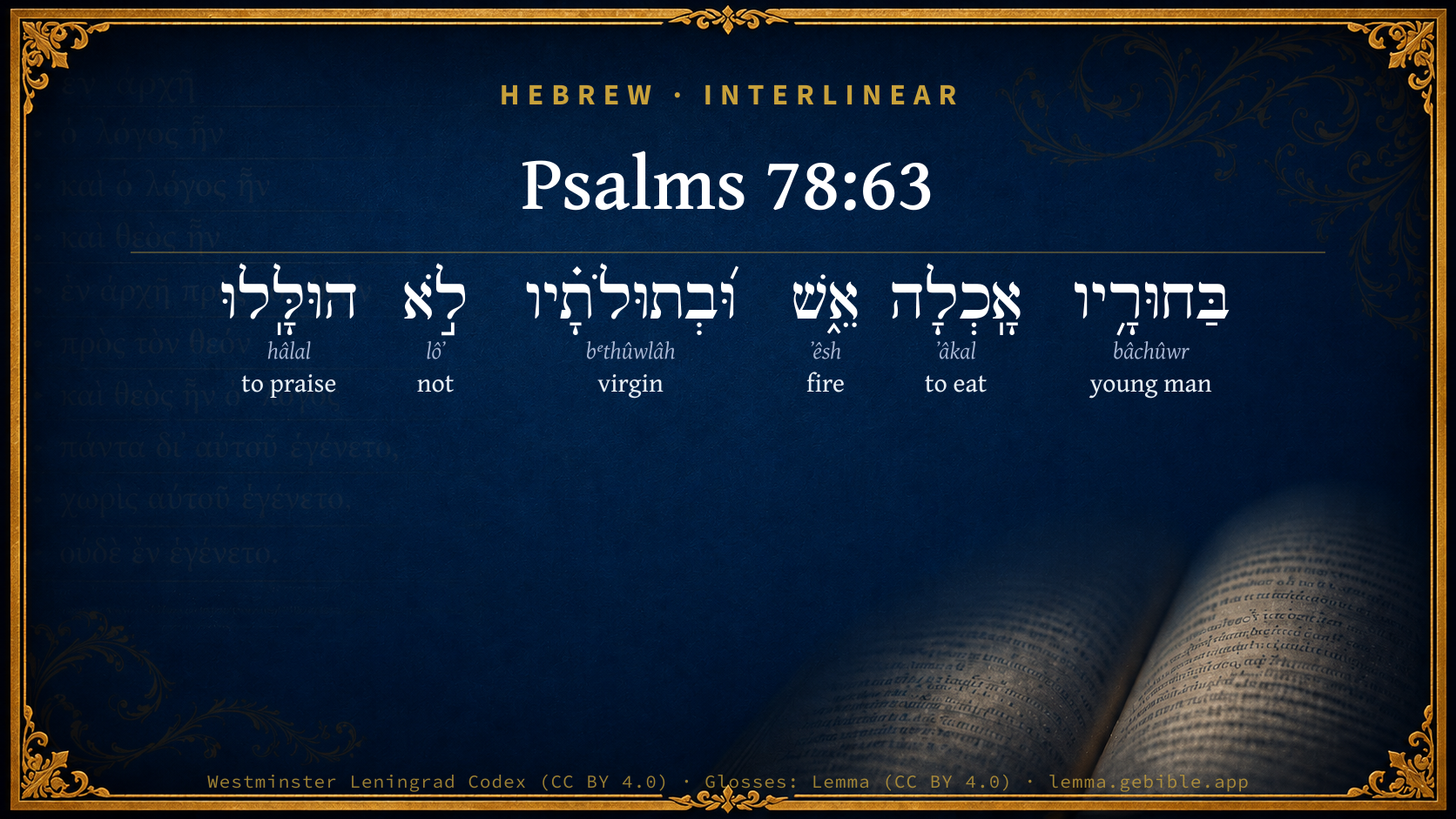
Hebrew (Westminster Leningrad Codex) Psalms 78:63 appears in the Hebrew Old Testament. The text above is from the Westminster Leningrad Codex. Each word links to its Strong’s number, a concise gloss, and parsing drawn from the Open Scriptures Hebrew Bible morphology. Click any word for its full Brown-Driver-Briggs (BDB) entry.
Download image
Cite this verse

Psalms 78:63 (World English Bible). Public Domain. Lemma interlinear Bible study tool, https://lemma.gebible.app/v/psalms/78/63.

Show BibTeX & RIS
BibTeX
RIS
English Translation
Fire devoured their young men; Their virgins had no wedding song.
World English Bible · Public Domain
Download a study sheet

One document with this verse’s original text, its word-by-word gloss line, the meaning frame, cross-references with their text, attributed commentary, and full source and license credits — printable, and it pastes into notes with its structure intact.

This verse Autodidact and up

Study sheet (.html) Plain text (.txt)

A passage Seminary Student

Up to 50 verses in one chapter. A passage sheet keeps up to 6 commentary sources and 12 cross-references per verse, in the order this page ranks them, and says so on the sheet whenever that leaves anything out. Ask for a single verse and you get the Autodidact verse sheet above.

Everything on this page stays free to read, with no account — the sheet is a download of what is already on screen, not access to it.

Want to remove ads? Support Godless Engineer
Compare translations 3

The same verse in 3 English versions, stacked beneath the original-language interlinear above. Click any original word for its lexicon entry.

Each is an independent rendering of the whole verse — the interlinear is not word-aligned to these translations.

Highlighted words mark where these versions differ — a whole-verse word diff, not a word-by-word alignment.

  • World English Bible Public Domain
    Fire devoured their young men; Their virgins had no wedding song.
  • King James Version Public Domain
    The fire consumed their young men; and their maidens were not given to marriage.
  • unfoldingWord Literal Text CC BY-SA 4.0
    Fire consumed his young men, and his virgins were not praised wedding songs.

unfoldingWord Literal Text — © unfoldingWord, licensed CC BY-SA 4.0. Word-aligned USFM3 via Door43 (git.door43.org/unfoldingWord/en_ult).

Versions to compare (up to 4)

3 of 4 selected

Show all 18 translations

Every available English version of this verse, each an independent rendering of the whole verse.

  • World English Bible Public Domain
    Fire devoured their young men; Their virgins had no wedding song.
  • Berean Standard Bible Public Domain
    Fire consumed His young men, and their maidens were left without wedding songs.
  • Majority Standard Bible Public Domain
    Fire consumed His young men, and their maidens were left without wedding songs.
  • King James Version Public Domain
    The fire consumed their young men; and their maidens were not given to marriage.
  • American Standard Version (1901) Public Domain
    Fire devoured their young men; And their virgins had no marriage-song.
  • Revised Version (1885) Public Domain
    Fire devoured their young men; and their maidens had no marriage-song.
  • Geneva Bible (1599) Public Domain
    The fire deuoured their chosen men, and their maides were not praised.
  • Douay-Rheims (1899) Public Domain
    Fire consumed their young men: and their maidens were not lamented.
  • Young's Literal Translation Public Domain
    His young men hath fire consumed, And His virgins have not been praised.
  • Literal Standard Version CC BY-SA 4.0
    Fire has consumed His young men, || And His virgins have not been praised.
  • Unlocked Literal Bible CC BY-SA 4.0
    Fire devoured their young men, and their young women had no wedding songs.
  • unfoldingWord Literal Text CC BY-SA 4.0
    Fire consumed his young men, and his virgins were not praised wedding songs.
  • Darby Bible Public Domain
    The fire consumed their young men, and their maidens were not praised in [nuptial] song;
  • World Messianic Bible Public Domain
    Fire devoured their young men. Their virgins had no wedding song.
  • Webster's Bible Public Domain
    The fire consumed their young men; and their maidens were not given to marriage.
  • Free Bible Version CC BY-SA 4.0
    Their young men were destroyed by fire; their young women had no wedding songs.
  • Bible in Basic English Public Domain
    Their young men were burned in the fire; and their virgins were not praised in the bride-song.
  • JPS Tanakh (1917) Public Domain
    Fire devoured their young men; and their virgins had no marriage-song.

Literal Standard Version (2020), Covenant Press — licensed CC BY-SA 4.0. Text via the HelloAO Bible API (eBible.org). Unlocked Literal Bible (unfoldingWord) — licensed CC BY-SA 4.0. Text via the HelloAO Bible API (eBible.org). unfoldingWord Literal Text — © unfoldingWord, licensed CC BY-SA 4.0. Word-aligned USFM3 via Door43 (git.door43.org/unfoldingWord/en_ult). Free Bible Version, Dr. Jonathan Gallagher — licensed CC BY-SA 4.0. Text via the HelloAO Bible API (eBible.org).

Word by word

More ways to search: Search by grammar → Find every occurrence → Compare this word →

Practice this passage: Drill this verse → Learn its vocabulary →

About this verse

These counts appear in no published source. They are computed here, from the morphology-tagged text and Lemma’s own curated glosses. What Lemma adds →

6
words
6
distinct lemmas
Wisdom
section

Shared distinctive vocabulary

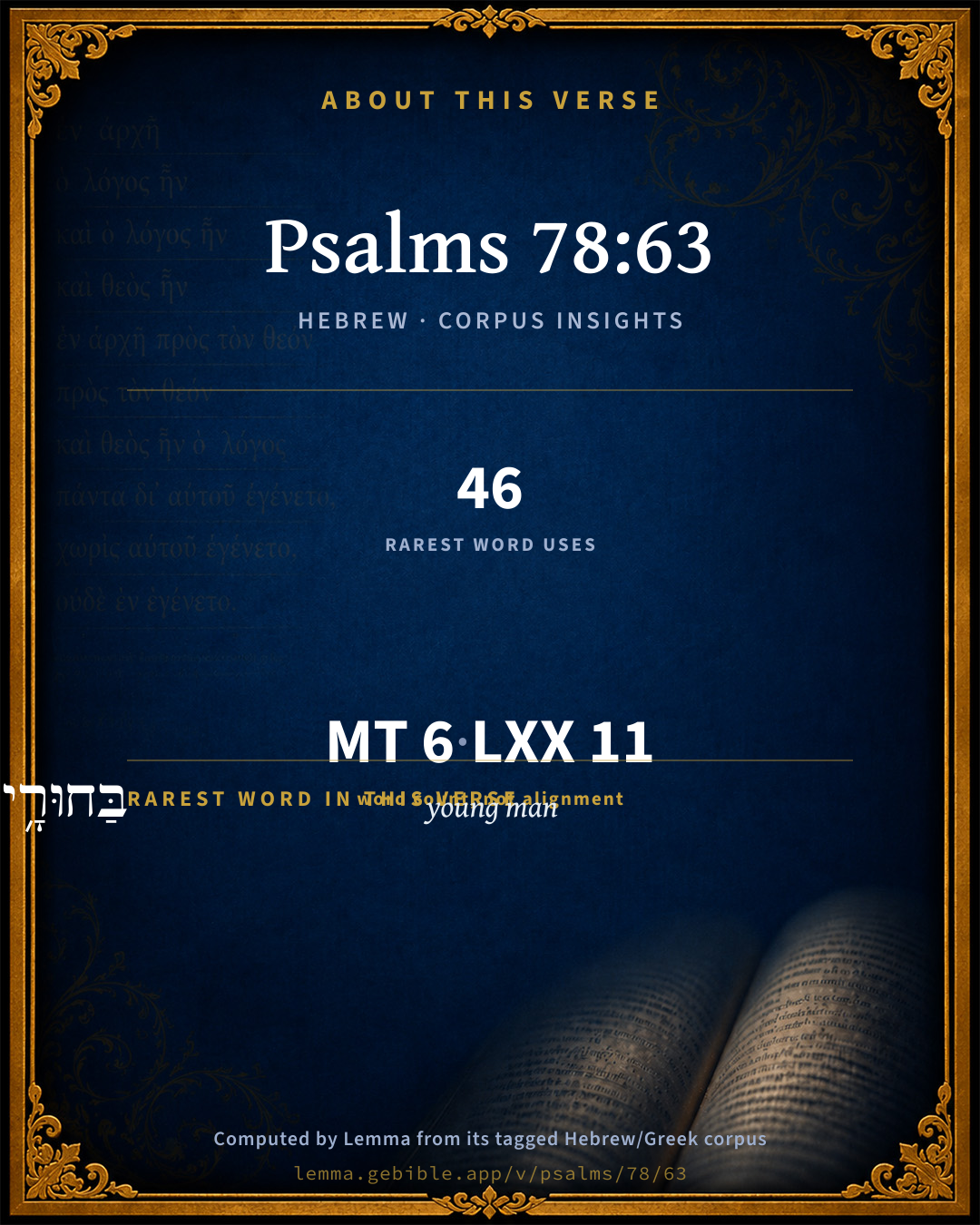
בַּחוּרָ֥יו young man H970 occurs in 45 verses of the Hebrew Bible. Also found in:

Grammatical profile

  • 2 verbs
  • 3 nouns
  • 1 particle

Verb forms

  • אָֽכְלָה Qal · Perfect
  • הוּלָּֽלוּ Pual · Perfect

Hebrew & Septuagint length

In English translation the verse runs 11 words from the Hebrew and 10 from the Septuagint (LXX English) — closely comparable.

A rough comparison of the two English renderings, which tokenize alike — not a word-level alignment.

Word counts can differ between the Hebrew and the Greek without any difference in meaning — e.g. the Hebrew direct-object marker אֵת has no separate Greek word, and Greek often adds the article ὁ.

In the original languages it is 6 Hebrew tokens and 11 Greek tokens — but the two are counted differently (Hebrew bundles its prefixes and suffixes into one token; the Greek is in lemma form), so that isn’t a like-for-like length.

Cross-references

8

Topical passages linked to Psalms 78:63 in the Treasury of Scripture Knowledge — connected by theme and wording, ordered by reader-vote popularity; previews shown in the World English Bible.

  • Jeremiah 7:34 Then will I cause to cease from the cities of Judah, and from the streets of Jerusalem, the voice of mirth and the voice of gladness, the voice of the bridegroom and the voice of the bride; for the land shall become a waste.
  • Jeremiah 16:9 For thus says Yahweh of Hosts, the God of Israel: Behold, I will cause to cease out of this place, before your eyes and in your days, the voice of mirth and the voice of gladness, the voice of the bridegroom and the voice of the bride.
  • Numbers 11:1 The people were as murmurers, [speaking] evil in the ears of Yahweh: and when Yahweh heard it, his anger was kindled; and the fire of Yahweh burnt among them, and devoured in the uttermost part of the camp.
  • Deuteronomy 29:20 Yahweh will not pardon him, but then the anger of Yahweh and his jealousy will smoke against that man, and all the curse that is written in this book shall lie on him, and Yahweh will blot out his name from under the sky.
  • Deuteronomy 32:22 For a fire is kindled in my anger, Burns to the lowest Sheol, Devours the earth with its increase, Sets on fire the foundations of the mountains.
  • Psalms 78:21 Therefore Yahweh heard, and was angry. A fire was kindled against Jacob, Anger also went up against Israel,
  • Isaiah 4:1 Seven women shall take hold of one man in that day, saying, "We will eat our own bread, and wear our own clothing: only let us be called by your name. Take away our reproach."
  • Jeremiah 25:10 Moreover I will take from them the voice of mirth and the voice of gladness, the voice of the bridegroom and the voice of the bride, the sound of the millstones, and the light of the lamp.

Cross-references courtesy of OpenBible.info (CC BY 4.0).

Hebrew and Greek witnesses Masoretic Hebrew ↔ Greek Septuagint

The same verse in the two great witnesses to the Old Testament, shown verse-for-verse.

You’re reading Greek Psalm 77 (Hebrew Psalm 78). The Septuagint counts the superscription, so verse numbers can differ from the Hebrew — chapter-level alignment, not verse-by-verse. Numbering follows Rahlfs.

These are two independent witnesses, not word-aligned to each other, and the Septuagint is shown in lemma (dictionary) form.

Hebrew Psalms 78:63 Masoretic · Westminster Leningrad Codex

בַּחוּרָ֥יו אָֽכְלָה אֵ֑שׁ וּ֝בְתוּלֹתָ֗יו לֹ֣א הוּלָּֽלוּ

Fire devoured their young men; Their virgins had no wedding song.

World English Bible · Public Domain

Greek LXX Greek Psalm 77:63 Septuagint · lemma form

ὁ νεανίσκος αὐτός καταἐσθίω πῦρ καί ὁ παρθένος αὐτός οὐ πενθέω

Fire devoured their young men; and their virgins mourned not.

LXX2012 (modern English Septuagint) · Public Domain

On this verse, Albert Barnes' Notes on the Bible discusses the Septuagint’s reading. Read the note in Commentary ↓

Hebrew: Westminster Leningrad Codex (CC BY 4.0). Greek: Septuagint (public domain); English from LXX2012 (modern English Septuagint) (Public Domain). How the Septuagint differs from the Hebrew →

Commentary

Notes on Psalms 78:63 from classic Christian and Jewish commentators (each source and its license shown beneath its notes). The classic Christian expositions comment on the surrounding passage and are grouped to its opening verse, so a note may address several verses; the Jewish commentaries on the Tanakh (Rashi and others) are per-verse, so they appear only where the commentator wrote on this verse.

Lemma curates 59 commentaries, every one of them public domain or Creative Commons licensed, each selected and text-cleaned for this edition rather than reprinted as found. About our sources →

Trapp's Complete Commentary

John Trapp

Psa 78:63 The fire consumed their young men; and their maidens were not given to marriage.

Ver. 63. The fire consumed] The fire of warlike force, which quickly licketh up all, and layeth waste.

And their maidens were not given in marriage] Heb. praised, as they were wont to be at their weddings with nuptial songs, and epithalamia , which the Hebrews call Hillulim, and the bridechamber, Beth-halulah, the house of praise.

John Trapp, A Commentary or Exposition upon All the Books of the Old and New Testament (1647–1656) — public domain. Text from a community e-Sword module.

J. A. Alexander on Psalms

Joseph Addison Alexander

63. (Psa 78:63) His youths (or chosen ones) the fire devoured, and his maidens were not praised. This may either mean that they attracted no attention on account of public troubles, or that they were not praised in nuptial songs, implying what is expressed in the text of the English Bible, to wit, that they were not given to marriage. The fire may be a figure for destructive war, as in Num 21:28. The pronoun (his) refers to Israel as a whole or an ideal person.

Joseph Addison Alexander, The Psalms Translated and Explained (1850) — public domain. Text from a community e-Sword module.

Geneva Bible (1599)

Geneva Bible translators

They had no marriage songs: that is, they were not married.

They were suddenly destroyed, 1 Sam. 4:10.

Geneva Bible (1599) marginal notes — public domain. Text via Bolls.life.

Adam Clarke's Commentary

Verse 63. Their maidens were not given to marriage.] הוללו hullalu, were not celebrated with marriage songs. It is considered a calamity in the east if a maiden arrives at the age of twelve years without being sought or given in marriage.

Adam Clarke's Commentary on the Bible (1810–1826) — public domain. Text from a community e-Sword/MySword module.

Ellicott's Commentary for English Readers

(63) Were not given.—See margin. The desolation and misery were marked by the absence of the glad nuptial song.

A Bible Commentary for English Readers, edited by Charles John Ellicott (1878–1897) — public domain. Text from a community e-Sword module.

The Cambridge Bible for Schools and Colleges

gen. ed. J. J. S. Perowne

63. Fire devoured their young men;

And their maidens had no marriage song. (R.V.)

The fire of war (Num_21:28) consumed the young men, so that the maidens remained unmarried.

The Cambridge Bible for Schools and Colleges (gen. ed. J. J. S. Perowne; Cambridge University Press, 1878–1918) — public domain. Text from a community e-Sword module.

John Gill's Exposition

Their priests fell by the sword,.... Hophni and Phinehas, the sons of Eli, and other priests; which shows the cruelty of the enemy, not to spare men unarmed, as the priests were; and the justice of God, which pursued these men, who were very wicked, and whose character and office could not secure them from divine wrath:

and their widows made no lamentation; for their husbands the priests, who fell by the sword; particularly the widow of Phinehas, who upon the news fell into labour, and as soon as she brought forth her child died, and while she lived took no notice of the death of her husband, nor lamented that, only that the ark of the Lord was taken, Sa1 4:19, and which might be the case of others; nor could they attend their funerals, or follow them to the grave with lamentations, they falling in battle; and such was their concern for the public loss, that their private sorrow was swallowed up in it. Some understand it of the disrespect and neglect of others, who came not to lament with them, and comfort them, as was usual: one of the Targums paraphrases the whole thus,

"at the time that the Philistines carried captive the ark of the Lord, the priests of Shiloh, Hophni, and Phinehas, fell by the sword; and at the time they brought their wives the news of it, they wept not, for they died even the same day.''

John Gill's Exposition of the Whole Bible (1746–1763) — public domain (CC PDM 1.0). Text via the HelloAO Bible API.

Albert Barnes' Notes on the Bible

The fire consumed their young men - Fire here may be regarded as an image of destructive war, as in Num 21:28 : “For there is a fire gone out of Heshbon, a flame from the city of Sihon: it hath consumed Ar of Moab,” etc. The idea here is, that the young people had been cut off in war.

And their maidens were not given to marriage - As the young people who would have entered into this relation were cut off in war. The margin here is praised; “The maidens were not praised.” This is in accordance with the Hebrew. The idea is, “Their virgins were not praised in nuptial songs;” that is, there were no marriage celebrations; no songs such as were usually composed on such occasions in praise of those who were brides. The Septuagint and the Latin Vulgate render this much less accurately, and much less beautifully, were not lamented.

Albert Barnes' Notes on the Bible (1834–1885) — public domain. Text from a community e-Sword/MySword module.

Matthew Poole's English Annotations

Because the young men who should have married them were slain. Heb. were not praised, to wit, with marriage songs, which was usual at marriage solemnities among the Jews, as appears from Jer 7:34; 16:9; 25:10.

Matthew Poole's English Annotations on the Holy Bible (1683–1685) — public domain. Text from a community e-Sword/MySword module.

The Treasury of David

Charles H. Spurgeon

Ver. 63. The fire consumed their young men. As fire slew Nadab and Abihu literally, so the fire of divine wrath fell on the sons of Eli, who defiled the sanctuary of the Lord, and the like fire, in the form of war, consumed the flower of the people.

And their maidens were not given to marriage. No nuptial hymn were sung, the bride lacked her bridegroom, the edge of the sword had cut the bands of their espousals, and left unmarried those who else had been extolled in hymns and congratulations. Thus Israel was brought very low, she could not find husbands for her maids, and therefore her state was not replenished; no young children clustered around parental knees. The nation had failed in its solemn task of instructing the young in the fear of Jehovah, and it was a fitting judgment that the very production of a posterity should be endangered.

Ver. 63. The fire consumed their young men. Fire here may be regarded as an image of destructive war, as in Nu 21:28. "For there is a fire gone out of Heshbon, a flame from the city of Sihon: it hath consumed Ar of Moab, "etc. Albert Barnes.

Ver. 63. (first clause). When religion is overthrown among God's people, let not the commonwealth think to stand: when God gave his glory unto the enemies' hand, "He gave his people over also unto the sword, and the fire consumed their young men." David Dickson.

Ver. 63. Not given in marriage. Not praised: viz. they had not been honoured with nuptial songs according to the custom of those times; see Jer 7:34 16:9 25:10. The meaning is, they had not been honourably married, because men were grown scarce by reason of the wars, Isa 4:1 Jer 21:22. Or, they had been married without any solemnity like poor bondwomen; or privately, as in the time of public calamities. John Diodati.

Charles H. Spurgeon's The Treasury of David (1869–1885) — public domain. Psalms only. Text from a community e-Sword/MySword module.

Whedon's Commentary on the Bible

Daniel D. Whedon

63. The fire consumed their young men—Literally, The fire ate their young men. Such was the severity of the battle. So the same word, Psa_27:2. No enemies of Israel were more cruel than the Philistines.

Their maidens were not given to marriage—Literally, Their maidens were not praised, or eulogized, as was the custom at their marriage. Bishop Mant versifies it:—

“No nuptial song their maidens praised.”

In oriental custom it is a great reproach for a maiden to remain unmarried after twelve or thirteen years of age. The slaughter of thirty thousand youth plunged the tribes in deep mourning.

Daniel D. Whedon (gen. ed.), Commentary on the Old and New Testaments (1874–1909) — public domain. Text from a community e-Sword module.

The Pulpit Commentary

The fire consumed their young men. The reference is not to such passages as Lev_10:2 Num_11:1 Num_16:35, where a literal fire seems to be spoken of, but rather to the fire of war, (Num_21:28 Isa_26:11 Jer_48:45) or more generally to the fire of the Divine anger. (Isa_10:16-18 Isa_47:14, etc.) And their maidens were not given to marriage; literally, were not praised in song; i.e. in the bridal song. The destruction of the young men, either in battle or in any other way, caused there to be more marriageable girls in Israel than there were husbands for. (comp. Isa_4:1)

The Pulpit Commentary (1880–1919), ed. H.D.M. Spence-Jones & Joseph S. Exell — public domain. Text from a community e-Sword module.

Rashi

Rabbi Shlomo Yitzchaki (Rashi)

Fire consumed his youths [The fire of] His wrath.

were not married Heb. לא הוללו. They were not married by being brought into a litter [under] a canopy because the youths died in battle.

הוּלָלוּ is an expression of nuptials (הִלוּלָא) in Aramaic. Our Sages, however, explained it in reference to Nadab and Abihu (Mid. Ps. 78:18), but I feel uncertain about explaining it that way because he already commenced with the Tabernacle of Shiloh.

Rashi on the Tanakh — English translations: “The Judaica Press complete Tanach with Rashi, translated by A. J. Rosenberg” (CC BY 4.0); “Pentateuch with Rashi's commentary by M. Rosenbaum and A.M. Silbermann, 1929-1934” (public domain); “The Metsudah Tanach series, Lakewood, N.J” (CC BY 4.0); and “The Book of Joshua, Metsudah Publications, 1997” (CC BY 4.0). Text via Sefaria.

Lesson kit

Teaching starters — assembled from the data on this page, not authored interpretation. Every prompt links to the verse data it draws on. Edit before teaching.

Psalms, in the Wisdom, opens this verse with 6 words (6 distinct Hebrew lemmas). Its most distinctive word is bâchûwr (“young man”). A historical commentator’s framing appears above. Read the whole chapter for the surrounding context.

Discussion questions

  1. The word bâchûwr carries the sense “young man.” How does it shape the verse?
  2. Deuteronomy 32:25 shares the word «young man» with this verse. How do the two illuminate each other?
  3. The translations on this page render this verse differently — a whole-verse word diff, not a word-by-word alignment. What might account for the different wordings?
  4. The verb «אָֽכְלָה» is Qal Perfect. How does its form color the action?
  5. Reading how Trapp's Complete Commentary and J. A. Alexander on Psalms read this verse, where do the two commentators agree and where do they part?

Things to notice

Reading settings

Reading text

Shown beneath each verse's original-language words.

Old Testament
Old Testament edition

Read the OT as the Masoretic Hebrew (MT) or the Greek Septuagint (LXX).

English shown for the Greek Septuagint (in the Hebrew ↔ Greek comparison).

Comparing translations? Open the Compare panel on any verse page to stack up to four side by side.