Nehemiah 9:12

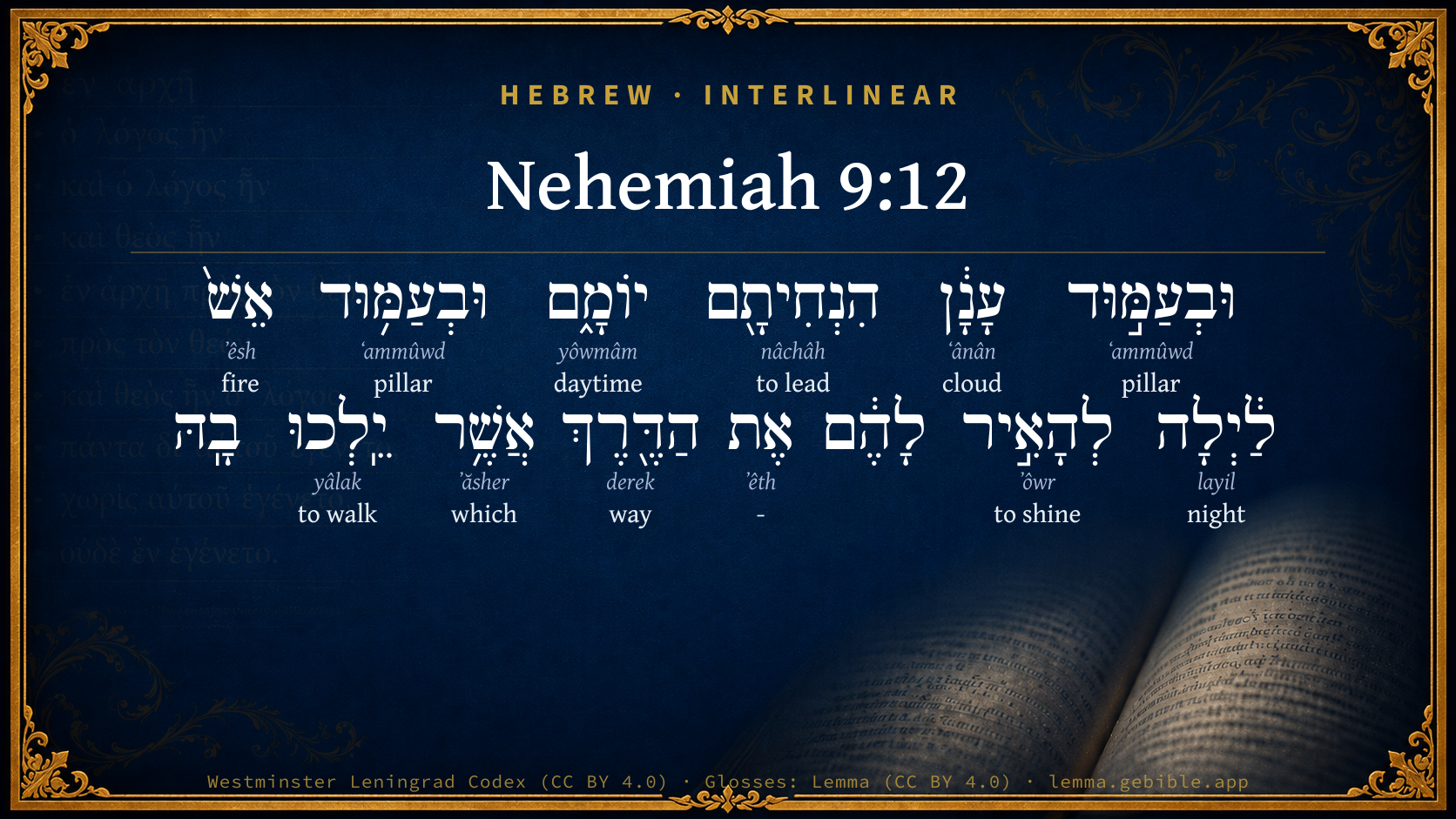
Hebrew (Westminster Leningrad Codex) Nehemiah 9:12 appears in the Hebrew Old Testament. The text above is from the Westminster Leningrad Codex. Each word links to its Strong’s number, a concise gloss, and parsing drawn from the Open Scriptures Hebrew Bible morphology. Click any word for its full Brown-Driver-Briggs (BDB) entry.
Download image
Cite this verse

Nehemiah 9:12 (World English Bible). Public Domain. Lemma interlinear Bible study tool, https://lemma.gebible.app/v/nehemiah/9/12.

Show BibTeX & RIS
BibTeX
RIS
English Translation
Moreover in a pillar of cloud you led them by day; and in a pillar of fire by night, to give them light in the way in which they should go.
World English Bible · Public Domain
Download a study sheet

One document with this verse’s original text, its word-by-word gloss line, the meaning frame, cross-references with their text, attributed commentary, and full source and license credits — printable, and it pastes into notes with its structure intact.

This verse Autodidact and up

Study sheet (.html) Plain text (.txt)

A passage Seminary Student

Up to 50 verses in one chapter. A passage sheet keeps up to 6 commentary sources and 12 cross-references per verse, in the order this page ranks them, and says so on the sheet whenever that leaves anything out. Ask for a single verse and you get the Autodidact verse sheet above.

Everything on this page stays free to read, with no account — the sheet is a download of what is already on screen, not access to it.

Want to remove ads? Support Godless Engineer
Compare translations 3

The same verse in 3 English versions, stacked beneath the original-language interlinear above. Click any original word for its lexicon entry.

Each is an independent rendering of the whole verse — the interlinear is not word-aligned to these translations.

Highlighted words mark where these versions differ — a whole-verse word diff, not a word-by-word alignment.

  • World English Bible Public Domain
    Moreover in a pillar of cloud you led them by day; and in a pillar of fire by night, to give them light in the way in which they should go.
  • King James Version Public Domain
    Moreover thou leddest them in the day by a cloudy pillar; and in the night by a pillar of fire, to give them light in the way wherein they should go.
  • unfoldingWord Literal Text CC BY-SA 4.0
    And you led them with a pillar of cloud by day, and with a pillar of fire by night to shine for them on the way in which they should go.

unfoldingWord Literal Text — © unfoldingWord, licensed CC BY-SA 4.0. Word-aligned USFM3 via Door43 (git.door43.org/unfoldingWord/en_ult).

Versions to compare (up to 4)

3 of 4 selected

Show all 18 translations

Every available English version of this verse, each an independent rendering of the whole verse.

  • World English Bible Public Domain
    Moreover in a pillar of cloud you led them by day; and in a pillar of fire by night, to give them light in the way in which they should go.
  • Berean Standard Bible Public Domain
    You led them with a pillar of cloud by day and a pillar of fire by night, to light for them the way in which they should travel.
  • Majority Standard Bible Public Domain
    You led them with a pillar of cloud by day and a pillar of fire by night, to light for them the way in which they should travel.
  • King James Version Public Domain
    Moreover thou leddest them in the day by a cloudy pillar; and in the night by a pillar of fire, to give them light in the way wherein they should go.
  • American Standard Version (1901) Public Domain
    Moreover in a pillar of cloud thou leddest them by day; and in a pillar of fire by night, to give them light in the way wherein they should go.
  • Revised Version (1885) Public Domain
    Moreover thou leddest them in a pillar of cloud by day; and in a pillar of fire by night, to give them light in the way wherein they should go.
  • Geneva Bible (1599) Public Domain
    And leddest them in the day with a pillar of a cloude, and in the night with a pillar of fire to giue them light in the way that they went.
  • Douay-Rheims (1899) Public Domain
    And in a pillar of a cloud thou wast their leader by day, and in a pillar of Are by night, that they might see the way by which they went.
  • Young's Literal Translation Public Domain
    And by a pillar of cloud Thou hast led them by day, and by a pillar of fire by night, to lighten to them the way in which they go.
  • Literal Standard Version CC BY-SA 4.0
    And by a pillar of cloud You have led them by day, || And by a pillar of fire by night, || To lighten to them the way in which they go.
  • Unlocked Literal Bible CC BY-SA 4.0
    You led them by a pillar of cloud during by day, and by a pillar of fire during the night to light the way for them to go.
  • unfoldingWord Literal Text CC BY-SA 4.0
    And you led them with a pillar of cloud by day, and with a pillar of fire by night to shine for them on the way in which they should go.
  • Darby Bible Public Domain
    And thou leddest them in the day by a pillar of cloud, and in the night by a pillar of fire, to give them light in the way wherein they should go.
  • World Messianic Bible Public Domain
    Moreover, in a pillar of cloud you led them by day; and in a pillar of fire by night, to give them light in the way in which they should go.
  • Webster's Bible Public Domain
    Moreover, thou leddest them in the day by a cloudy pillar; and in the night by a pillar of fire, to give them light in the way in which they should go.
  • Free Bible Version CC BY-SA 4.0
    You led them with a column of cloud during the day, and a column of fire at night, showing them the way which they should go.
  • Bible in Basic English Public Domain
    And you went before them by day in a pillar of cloud, and in a pillar of fire by night, to give them light on the way they were to go.
  • JPS Tanakh (1917) Public Domain
    Moreover in a pillar of cloud Thou didst lead them by day; and in a pillar of fire by night, to give them light in the way wherein they should go.

Literal Standard Version (2020), Covenant Press — licensed CC BY-SA 4.0. Text via the HelloAO Bible API (eBible.org). Unlocked Literal Bible (unfoldingWord) — licensed CC BY-SA 4.0. Text via the HelloAO Bible API (eBible.org). unfoldingWord Literal Text — © unfoldingWord, licensed CC BY-SA 4.0. Word-aligned USFM3 via Door43 (git.door43.org/unfoldingWord/en_ult). Free Bible Version, Dr. Jonathan Gallagher — licensed CC BY-SA 4.0. Text via the HelloAO Bible API (eBible.org).

Word by word

More ways to search: Search by grammar → Find every occurrence → Compare this word →

Practice this passage: Drill this verse → Learn its vocabulary →

הִנְחִיתָ֖ם
nâchâh
H5148
“to lead · them”
Verb, Hiphil, Perfect, 2nd Person, Masculine, Singular + Suffix, Personal, 3rd Person, Masculine, Plural
Part of Speech
Verb
Stem
Hiphil
Form
Perfect
Person
2nd Person
Gender
Masculine
Number
Singular
Full BDB Definition

Origin: a primitive root

TWOT: 1341

to lead, guide - (Qal) to lead, bring - (Hiphil) to lead, guide
  1. וּבְעַמּ֣וּד ʻammûwd H5982 “and · in/at · pillar of” Conjunction + Preposition + Noun, Common, Masculine, Singular, Construct
  2. עָנָ֔ן ʻânân H6051 “cloud” Noun, Common, Masculine, Singular, Absolute
  3. יוֹמָ֑ם yôwmâm H3119 “daytime” Adverb
  4. וּבְעַמּ֥וּד ʻammûwd H5982 “and · in/at · pillar of” Conjunction + Preposition + Noun, Common, Masculine, Singular, Construct
  5. אֵשׁ֙ ʼêsh H784 “fire” Noun, Common, Both, Singular, Absolute
  6. לַ֔יְלָה layil H3915 “night” Noun, Common, Masculine, Singular, Absolute
  7. לְהָאִ֣יר ʼôwr H215 “to shine” Preposition + Verb, Hiphil, Infinitive Construct
  8. אֶת ʼêth H853 “-” Particle, Direct Object
  9. הַדֶּ֖רֶךְ derek H1870 “the · way” Particle, Definite Article + Noun, Common, Both, Singular, Absolute
  10. אֲשֶׁ֥ר ʼăsher H834 “which” Particle, Relative
  11. יֵֽלְכוּ yâlak H3212 “to walk” Verb, Qal, Imperfect, 3rd Person, Masculine, Plural

About this verse

These counts appear in no published source. They are computed here, from the morphology-tagged text and Lemma’s own curated glosses. What Lemma adds →

14
words
11
distinct lemmas
Historical
section

Shared distinctive vocabulary

הִנְחִיתָ֖ם to lead H5148 occurs in 39 verses of the Hebrew Bible. Also found in:

Grammatical profile

  • 3 verbs
  • 6 nouns
  • 2 prepositions
  • 1 adverb
  • 2 particles

Verb forms

  • הִנְחִיתָ֖ם Hiphil · Perfect
  • לְהָאִ֣יר Hiphil · Infinitive Construct
  • יֵֽלְכוּ Qal · Imperfect

Repetition

A word recurs within this verse — often emphatic in Hebrew:

  • וּבְעַמּ֣וּד pillar H5982 ×2

Cross-references

7

Topical passages linked to Nehemiah 9:12 in the Treasury of Scripture Knowledge — connected by theme and wording, ordered by reader-vote popularity; previews shown in the World English Bible.

  • Exodus 13:21–22 Yahweh went before them by day in a pillar of cloud, to lead them on their way, and by night in a pillar of fire, to give them light, that they might go by day and by night:
  • Nehemiah 9:19 yet you in your manifold mercies didn't forsake them in the wilderness: the pillar of cloud didn't depart from over them by day, to lead them in the way; neither the pillar of fire by night, to show them light, and the way in which they should go.
  • Exodus 14:19–20 The angel of God, who went before the camp of Israel, moved and went behind them; and the pillar of cloud moved from before them, and stood behind them.
  • Psalms 78:14 In the daytime he also led them with a cloud, And all night with a light of fire.
  • Psalms 105:39 He spread a cloud for a covering, Fire to give light in the night.
  • Psalms 107:7 He led them also by a straight way, That they might go to a city to live in.
  • Psalms 143:8 Cause me to hear your loving kindness in the morning, For I trust in you. Cause me to know the way in which I should walk, For I lift up my soul to you.

Cross-references courtesy of OpenBible.info (CC BY 4.0).

Hebrew and Greek witnesses Masoretic Hebrew ↔ Greek Septuagint

The same verse in the two great witnesses to the Old Testament, shown verse-for-verse.

These are two independent witnesses, not word-aligned to each other, and the Septuagint is shown in lemma (dictionary) form.

Hebrew Nehemiah 9:12 Masoretic · Westminster Leningrad Codex

וּבְעַמּ֣וּד עָנָ֔ן הִנְחִיתָ֖ם יוֹמָ֑ם וּבְעַמּ֥וּד אֵשׁ֙ לַ֔יְלָה לְהָאִ֣יר לָהֶ֔ם אֶת הַדֶּ֖רֶךְ אֲשֶׁ֥ר יֵֽלְכוּ בָֽהּ

Moreover in a pillar of cloud you led them by day; and in a pillar of fire by night, to give them light in the way in which they should go.

World English Bible · Public Domain

Greek LXX Structure differs

The Septuagint has no separate book of Nehemiah. Its Greek text is the second half of Esdras B (2 Esdras), chapters 11–23; Ezra is the first half (1–10).

A verse-for-verse comparison isn’t shown here because the chapters and verses don’t line up. Switch to the LXX edition with the MT / LXX toggle above to read the Greek directly.

Hebrew: Westminster Leningrad Codex (CC BY 4.0). Greek: Septuagint (public domain); English from a public-domain English Septuagint. How the Septuagint differs from the Hebrew →

Commentary

Notes on Nehemiah 9:12 from classic Christian and Jewish commentators (each source and its license shown beneath its notes). The classic Christian expositions comment on the surrounding passage and are grouped to its opening verse, so a note may address several verses; the Jewish commentaries on the Tanakh (Rashi and others) are per-verse, so they appear only where the commentator wrote on this verse.

Lemma curates 59 commentaries, every one of them public domain or Creative Commons licensed, each selected and text-cleaned for this edition rather than reprinted as found. About our sources →

Trapp's Complete Commentary

John Trapp

Neh 9:12 Moreover thou leddest them in the day by a cloudy pillar; and in the night by a pillar of fire, to give them light in the way wherein they should go.

Ver. 12. Moreover thou leddest them by day, &c.] This pillar of a cloud was miraculously moved with such variation as God thought fit, for the guiding of their journeys; much better than did or could Vibilia, that heathen fiction.

And in the night by a pillar of fire] Though they did not usually journey in the night, yet sometimes they did; and then this pillar of fire was their guide. God is with his at all assays, and is all in all unto them, Psa 121:4; see Isa 4:5-6.

John Trapp, A Commentary or Exposition upon All the Books of the Old and New Testament (1647–1656) — public domain. Text from a community e-Sword module.

The Biblical Illustrator

Joseph S. Exell

Neh_9:12

Moreover Thou leddest them in the day by a cloudy pillar.

The pillars of cloud and fire

The people who for forty years followed that fire-cloud have left footprints in the sands of time which serve us as an alphabet of life. The march of the Israelites is an allegory of the life of man. Like a providence palpable to the very eyes of man, the fire-cloud indexed that will of God which it is the longing of true hearts in every age to fulfil. This fire-cloud suggests--

I. That mans life on earth is a divinely-conducted discipline. The Israelites emerged from Egypt a huge bee-swarm of humanity making for another hive. From the dark superstitions of life and the coarse immoralities of antiquity they went into the wilderness to learn the rudiments of life. Outside the sphere of mans natural resources Israel had to learn faith in the supernatural environment of man, Their wilderness journey was the drill of a nation destined to be the vehicle of Divine revelation to a world. Our life on earth is mainly a prolonged and various discipline, and its significance lies in the finally resulting manhood. The main matter is not how long it takes us to cross this strip of earth, or how much we have while we travel, but what the journey makes of us as regards the naked, moral character of us all. Very suggestive, if you will ponder, is Israels inability to comprehend the meaning of a great deal of their march. Why they should lie still, and why move, were not always plain. We cannot readily comprehend the zigzag ways of life. Looking at our things, and not at our soul, we sometimes seem to be moving in a very resultless way--marking time rather than marching. Said a good and active man whose work is his life, By this sickness I have lost a month. How so? Through every day of his life henceforth he will carry a reverent thoughtfulness of God, and in all his character there will be the tinge of a mellow tenderness, the results of that lost months meditative realisations. Was the month lost, then? God leads and leaves us not where we would like to be, but where we have need to be. There is wisdom in every stage of lifes march and countermarch. Lifes roughest mile is ordered of the Lord, and its darkest place is illuminated by the pillar of fire. It is wisdom to store the lessons of experience. Child-like, we forget the back lessons. The teachings of sorrows school are forgotten in the playground of our joyfulness.

II. That throughout our life-journey we follow a God we never see. That fire-bordered cloud was not God. The cathedral window ablaze with its mingled glories hides the sun, while it is at the same time a many-coloured witness of his living radiance. Life leaves room for doubt, and gives worldliness its chance. Herein lies much of our probation. Those tokens of God which are evidence of things not seen are frequently familiarised into comparative powerlessness over the soul.

1. Some of the Israelites sinned under the very shadow of the pillar of fire. The sentiments of reverence and wonder are in danger of exile from the mind.

2. Nature, with its transformations of the seasons.

3. The Sabbath.

4. The house of God.

5. Prayer; our prayers may become like the winding of our watches--acts we do, scarcely sure whether they are done or not. We often see most of God in the night of experience.

III. That protection which Gods presence insures to those that follow him. Over the sleeping camp the cloud lay like a golden warrior-shield. Yet how slowly was Israel trained to courage! Every new danger created a coward hubbub in the camp. Their foes could do them no harm; but their imaginations were terrible to them as an army with banners. Their minds were made nervous by their own delusions. The Parisians have exhibited what they call a Panorama of the War. Climbing what appears to be a kind of tower, you seem to see the country around Paris alive with the grim activities of war. Nearest the spectator are placed real cannon and the like, and these shade off into painted forms beyond so perfectly as to produce an illusion like that of the painter who attracted the quick-eyed birds to his painted grapes. The illusion is wonderful, and you can all but smell the gunpowder. But there is no movement--the soldiers are still as stones, the bursting shell remains in the act of explosion, and the flame-flash continues from the cannon-mouth. That breaks the spell. It is but picture, after all. Thus we go at times up the tower of apprehension, and see besieging armies of trouble. Near to us are some real objects of fear, and from them we go on to paint a long perspective of morbid fancies, until life seems ringed round with innumerable foes. After awhile we find it is mostly picture--the very painting of our fear. Let the chief anxiety of all be to follow the great Leader of lifes pilgrimage. (Samuel Gregory.)

The Biblical Illustrator, edited by Joseph S. Exell (c. 1880s–1900s) — public domain. Text from a community e-Sword module.

Tyndale Open Study Notes

Tyndale Open Resources

9:12-21 This prayer reminded the people of God’s miraculous direction of Israel in the wilderness (Exod 13:21-22), his personal appearance at Mount Sinai to reveal his covenant laws through Moses (see Exod 19–20), and his faithfulness in providing bread . . . and water (see Exod 16:4; 17:1-6). Despite all of that, Israel’s ancestors had been proud and stubborn and refused to obey (see Exod 32; Num 14:4). Yet in his grace, God remained faithful and had compassion (see Exod 34:6) and provided his Spirit to direct and teach them (cp. Exod 33:2; Num 11:17).

Tyndale Open Study Notes — © Tyndale Open Resources, licensed CC BY-SA 4.0. Text via the HelloAO Bible API.

Adam Clarke's Commentary

Verse 12. By a cloudy pillar] See the notes on the parallel passages, both here and in the other verses.

Adam Clarke's Commentary on the Bible (1810–1826) — public domain. Text from a community e-Sword/MySword module.

The Cambridge Bible for Schools and Colleges

gen. ed. J. J. S. Perowne

12–21. The Wilderness

12. in the day by a cloudy pillar] R.V. in a pillar of cloud by day.

in the night by a pillar of fire] R.V. in a pillar of fire by night. See for these words Exo_13:21-22; Num_14:14. And compare the poetical description in very similar words of Psa_78:14; Psa_105:39.

The Cambridge Bible for Schools and Colleges (gen. ed. J. J. S. Perowne; Cambridge University Press, 1878–1918) — public domain. Text from a community e-Sword module.

John Gill's Exposition

Moreover, thou leddest them in the day by a cloudy pillar,.... The Israelites, to shelter them from the heat of the sun in a dry and barren wilderness:

and in the night by a pillar of fire, to give them light in the way wherein they should go; through a trackless desert, see Exo 13:21.

John Gill's Exposition of the Whole Bible (1746–1763) — public domain (CC PDM 1.0). Text via the HelloAO Bible API.

The Pulpit Commentary

Vers. 12-21. Israel in the desert.

The people now recount the mercies of God to their fathers in the desert, and confess the sins of which they were guilty there. After deliverance from Egypt, the desert had to be passed before Canaan could be reached; and there the people were instructed and organised, tried and proved, disciplined and chastised, and thus prepared for orderly settlement as a nation in the promised land.

I THE DIVINE FAVOURS BY WHICH THEY WERE DISTINGUISHED.

1. Miraculous guidance (vers. 12, 19).

2. Miraculous provisions (vers. 15, 20, 21).

3. Miraculous legislation (vers. 13, 14).

(1) How the laws were given. Partly by the voice of God from Sinai (ver. 13), chiefly by the mediation of Moses (ver. 14).

(2) Of what, they consisted. In general they are described as "right judgments and true laws," etc. (vers. 13, 14). In particular, the institution of the Sabbath is mentioned (ver. 14) one of the greatest and best gifts of God to them.

1. The gift of God"s "good Spirit" (ver. 20). Reference may be made to the Spirit of God as given to Moses, and to the seventy elders, (Num_11:17, Num_11:25) or even Bezaleel and Aholiab. (Exo_35:31-35) But looking at such passages as Psa_51:11 Psa_143:10, it is quite as possible that the enlightening influence of the Spirit on the minds and hearts of the people in general may be referred to.

2. The command to enter Canaan. Ver. 15, where "promisedst them" (lit. "saidst to them") should probably be "commandedst them." The command, however, virtually included a renewed promise. God had "sworn to give them" it; now they are bid to go in and take possession of it; implying that God would give them possession if they obeyed his call.

II THE GROSS INIQUITIES BY WHICH THEY DISTINGUISHED THEMSELVES. Notwithstanding the wonderful manifestations of God amongst them, and his great kindness.

1. Proud and stubborn disobedience (vers. 16, 17).

2. Purpose to return to Egypt. (ver. 17; see Num_14:1-4) Just on the borders of the promised land they refused to advance into it, terrified by the report of most of the spies, and not exercising faith in his power who had wrought for them so mightily. Yea, they proposed to return to the land of bondage, and "appointed a captain to lead them thither.

3. Idolatry (ver. 18). A violation of the fundamental principle of their law.

III THE DIVINE FORBEARANCE, MERCY, AND CONSTANCY (vers. 17, 19, 20). They "wrought great provocations," and numbers of them were heavily punished; yea, all who came out of Egypt, except two, were forbidden to enter Canaan, and died in the wilderness; yet even these continued during their lives to enjoy Divine guidance and sustenance, so that "they lacked nothing." God showed himself "ready to pardon," etc. (ver. 17), and displayed his "manifold mercies," and did not forsake them. To the children he fulfilled the promises, the benefit of which the fathers had forfeited.

IV THE LONG DURATION OF HIS MIRACULOUS SUSTENANCE OF THEM (ver. 21). Lessons:

1. The goodness of God and the depravity of man. The history of Israel is full of both. So is all history. "The earth is full of the goodness of the Lord," and also full of human wickedness. Each is rendered more conspicuous by the other; and the contrast makes one appear more glorious, the other more hideous.

2. As, after deliverance from Egypt, the desert had to be traversed before Canaan could be enjoyed, so is it in the Christian life. This world is a desert in comparison with heaven, and the journey through it is difficult and perilous. But it lies between conversion and heaven, and must be crossed.

3. Through this desert, however, God conducts his people. He guides, provides, protects, instructs, governs, and thus trains and prepares them for the promised inheritance. This is our comfort amid all the discomforts and dangers of the journey.

4. In ordinary mercies the agency of God is as real as in the miraculous. Our food, drink, clothing, etc. are as truly his gifts as the manna, etc. which he bestowed on Israel. His power, wisdom, and goodness are as really displayed in them, and both more extensively and more marvellously.

5. Amongst God"s best gifts are his revelations of himself and his laws; his crowning gift is his Spirit. Under the Christian dispensation all these are far superior to the similar blessings vouchsafed to Israel. Our responsibilities are, therefore, greater; our moral and spiritual state should be far higher, our thankfulness more ardent.

6. We have a promise of a better inheritance than Canaan, with a command to journey steadily towards it; let us beware lest we come short of it through unbelief and disobedience.

The Pulpit Commentary (1880–1919), ed. H.D.M. Spence-Jones & Joseph S. Exell — public domain. Text from a community e-Sword module.

unfoldingWord translationNotes

Door43 World Missions Community

Connecting Statement:

In these verses, the Levites continue to praise Yahweh in the presence of the people of Israel.

You led them

Yahweh led the Israelites.

you came down

When God talks with his people, he is often described as "coming down" or "coming down from heaven." This is a descriptive way of saying that God appeared to that person. AT: "you appeared" or "you came down from heaven" (See: Idiom and Assumed Knowledge and Implicit Information)

righteous decrees and true laws, good statutes and commandments

Both of these double phrases describe the same thing, the law of Moses. (See: Parallelism)

translationWords

column

fire

light

Sinai

heaven

righteous

decree

true

law, laws

good

statute

command

unfoldingWord translationNotes — © Distant Shores Media and the Door43 World Missions Community, licensed CC BY-SA 4.0. Source: git.door43.org/Door43/en_tn.

Rashi

Rabbi Shlomo Yitzchaki (Rashi)

by day every day.

Rashi on the Tanakh — English translations: “The Judaica Press complete Tanach with Rashi, translated by A. J. Rosenberg” (CC BY 4.0); “Pentateuch with Rashi's commentary by M. Rosenbaum and A.M. Silbermann, 1929-1934” (public domain); “The Metsudah Tanach series, Lakewood, N.J” (CC BY 4.0); and “The Book of Joshua, Metsudah Publications, 1997” (CC BY 4.0). Text via Sefaria.

Lesson kit

Teaching starters — assembled from the data on this page, not authored interpretation. Every prompt links to the verse data it draws on. Edit before teaching.

Nehemiah, in the Historical, opens this verse with 14 words (11 distinct Hebrew lemmas). Its most distinctive word is nâchâh (“to lead”). A historical commentator’s framing appears above. Read the whole chapter for the surrounding context.

Discussion questions

  1. The word nâchâh carries the sense “to lead.” How does it shape the verse?
  2. How does Genesis 24:27, which shares the word «to lead», read alongside this verse?
  3. What does the repetition of “pillar” (2× in this one verse) do in this verse?
  4. These translations render this verse differently. What is at stake in choosing one wording over another?
  5. «הִנְחִיתָ֖ם» is a Hiphil Perfect verb. How does that grammatical form shape the action described?
  6. Compare how Trapp's Complete Commentary and The Biblical Illustrator read this verse. Where do they agree or differ?

Things to notice

Reading settings

Reading text

Shown beneath each verse's original-language words.

Old Testament
Old Testament edition

Read the OT as the Masoretic Hebrew (MT) or the Greek Septuagint (LXX).

English shown for the Greek Septuagint (in the Hebrew ↔ Greek comparison).

Comparing translations? Open the Compare panel on any verse page to stack up to four side by side.