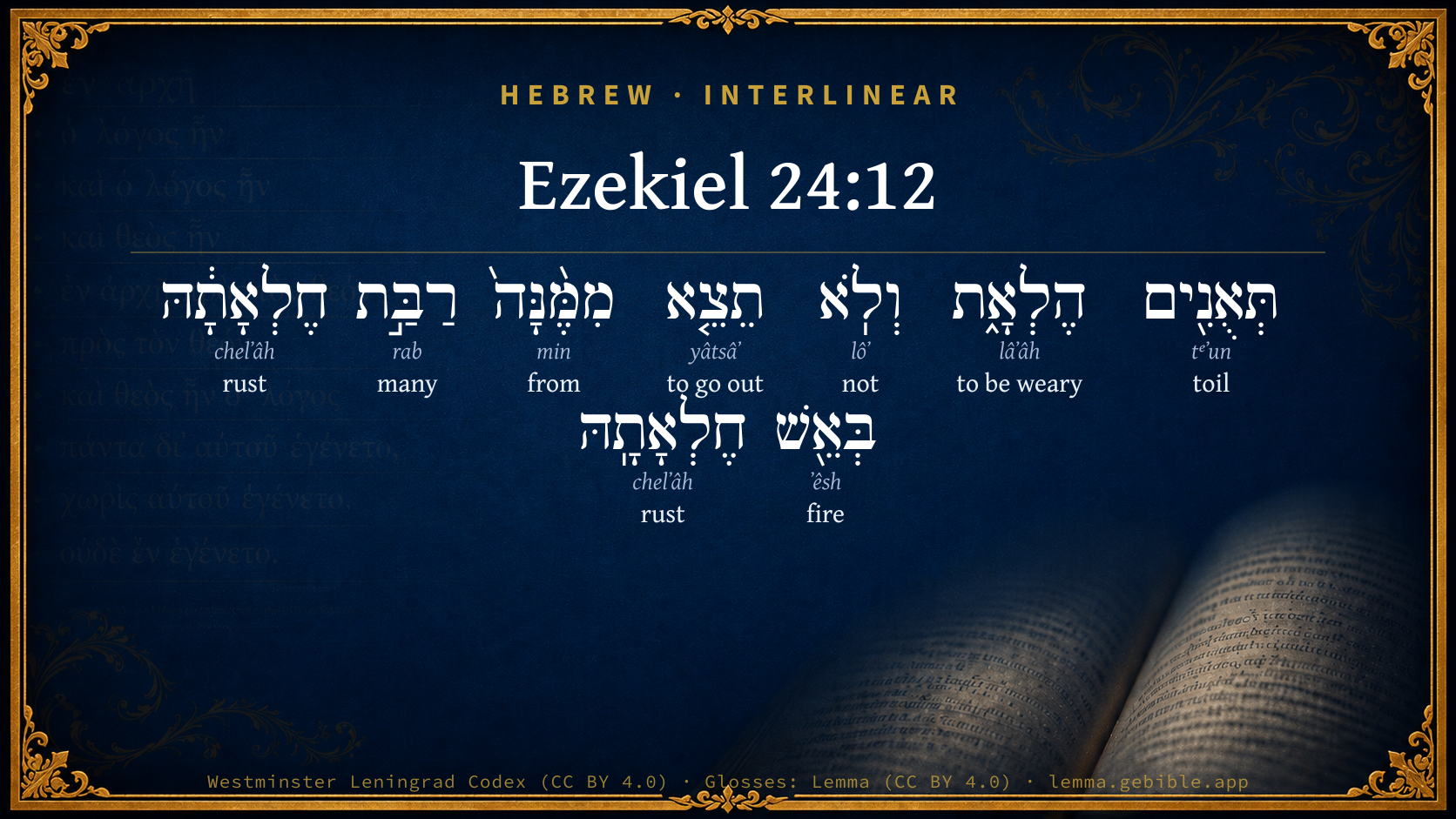
Ezekiel 24:12

Hebrew (Westminster Leningrad Codex) Ezekiel 24:12 appears in the Hebrew Old Testament. The text above is from the Westminster Leningrad Codex. Each word links to its Strong’s number, a concise gloss, and parsing drawn from the Open Scriptures Hebrew Bible morphology. Click any word for its full Brown-Driver-Briggs (BDB) entry.
Download image
Cite this verse

Ezekiel 24:12 (World English Bible). Public Domain. Lemma interlinear Bible study tool, https://lemma.gebible.app/v/ezekiel/24/12.

Show BibTeX & RIS
BibTeX
RIS
English Translation
She has wearied [herself] with toil; yet her great rust doesn't go forth out of her; her rust doesn't [go forth] by fire.
World English Bible · Public Domain
Highlights Full analysis ↓
Download a study sheet

One document with this verse’s original text, its word-by-word gloss line, the meaning frame, cross-references with their text, attributed commentary, and full source and license credits — printable, and it pastes into notes with its structure intact.

This verse Autodidact and up

Study sheet (.html) Plain text (.txt)

A passage Seminary Student

Up to 50 verses in one chapter. A passage sheet keeps up to 6 commentary sources and 12 cross-references per verse, in the order this page ranks them, and says so on the sheet whenever that leaves anything out. Ask for a single verse and you get the Autodidact verse sheet above.

Everything on this page stays free to read, with no account — the sheet is a download of what is already on screen, not access to it.

Want to remove ads? Support Godless Engineer
Compare translations 3

The same verse in 3 English versions, stacked beneath the original-language interlinear above. Click any original word for its lexicon entry.

Each is an independent rendering of the whole verse — the interlinear is not word-aligned to these translations.

Highlighted words mark where these versions differ — a whole-verse word diff, not a word-by-word alignment.

  • World English Bible Public Domain
    She has wearied [herself] with toil; yet her great rust doesn't go forth out of her; her rust doesn't [go forth] by fire.
  • King James Version Public Domain
    She hath wearied herself with lies, and her great scum went not forth out of her: her scum shall be in the fire.
  • unfoldingWord Literal Text CC BY-SA 4.0
    She has become weary because of toil, but her corrosion has not gone out of her by the fire.

unfoldingWord Literal Text — © unfoldingWord, licensed CC BY-SA 4.0. Word-aligned USFM3 via Door43 (git.door43.org/unfoldingWord/en_ult).

Versions to compare (up to 4)

3 of 4 selected

Show all 18 translations

Every available English version of this verse, each an independent rendering of the whole verse.

  • World English Bible Public Domain
    She has wearied [herself] with toil; yet her great rust doesn't go forth out of her; her rust doesn't [go forth] by fire.
  • Berean Standard Bible Public Domain
    It has frustrated every effort; its thick rust has not been removed, even by the fire.
  • Majority Standard Bible Public Domain
    It has frustrated every effort; its thick rust has not been removed, even by the fire.
  • King James Version Public Domain
    She hath wearied herself with lies, and her great scum went not forth out of her: her scum shall be in the fire.
  • American Standard Version (1901) Public Domain
    She hath wearied `herself' with toil; yet her great rust goeth not forth out of her; her rust `goeth not forth' by fire.
  • Revised Version (1885) Public Domain
    She hath wearied herself with toil: yet her great rust goeth not forth out of her; her rust goeth not forth by fire.
  • Geneva Bible (1599) Public Domain
    She hath wearied her selfe with lyes, and her great skomme went not out of her: therefore her skomme shall be consumed with fire.
  • Douay-Rheims (1899) Public Domain
    Great pains have been taken, and the great rust thereof is not gone out, not even by fire.
  • Young's Literal Translation Public Domain
    `With' sorrows she hath wearied herself, And the abundance of her scum goeth not out of her, In the fire `is' her scum.
  • Literal Standard Version CC BY-SA 4.0
    She has wearied herself [with] sorrows, || And the abundance of her scum does not go out of her, || Her scum [is] in the fire.
  • Unlocked Literal Bible CC BY-SA 4.0
    She has become weary because of toil, but her corrosion has not gone out of her by the fire.
  • unfoldingWord Literal Text CC BY-SA 4.0
    She has become weary because of toil, but her corrosion has not gone out of her by the fire.
  • Darby Bible Public Domain
    She hath exhausted [her] labours, yet her great rust goeth not forth out of her: let her rust be in the fire.
  • World Messianic Bible Public Domain
    She is weary with toil; yet her great rust, rust by fire, doesn’t leave her.
  • Webster's Bible Public Domain
    She hath wearied herself with lies, and her great scum went not forth out of her: her scum shall be in the fire.
  • Free Bible Version CC BY-SA 4.0
    So far it's been impossible to clean it —even fire couldn't burn out all its rust.
  • Bible in Basic English Public Domain
    I have made myself tired to no purpose: still all the waste which is in her has not come out, it has an evil smell.
  • JPS Tanakh (1917) Public Domain
    It hath wearied itself with toil; yet its great filth goeth not forth out of it, yea, its noisome filth.

Literal Standard Version (2020), Covenant Press — licensed CC BY-SA 4.0. Text via the HelloAO Bible API (eBible.org). Unlocked Literal Bible (unfoldingWord) — licensed CC BY-SA 4.0. Text via the HelloAO Bible API (eBible.org). unfoldingWord Literal Text — © unfoldingWord, licensed CC BY-SA 4.0. Word-aligned USFM3 via Door43 (git.door43.org/unfoldingWord/en_ult). Free Bible Version, Dr. Jonathan Gallagher — licensed CC BY-SA 4.0. Text via the HelloAO Bible API (eBible.org).

Word by word

More ways to search: Search by grammar → Find every occurrence → Compare this word →

Practice this passage: Drill this verse → Learn its vocabulary →

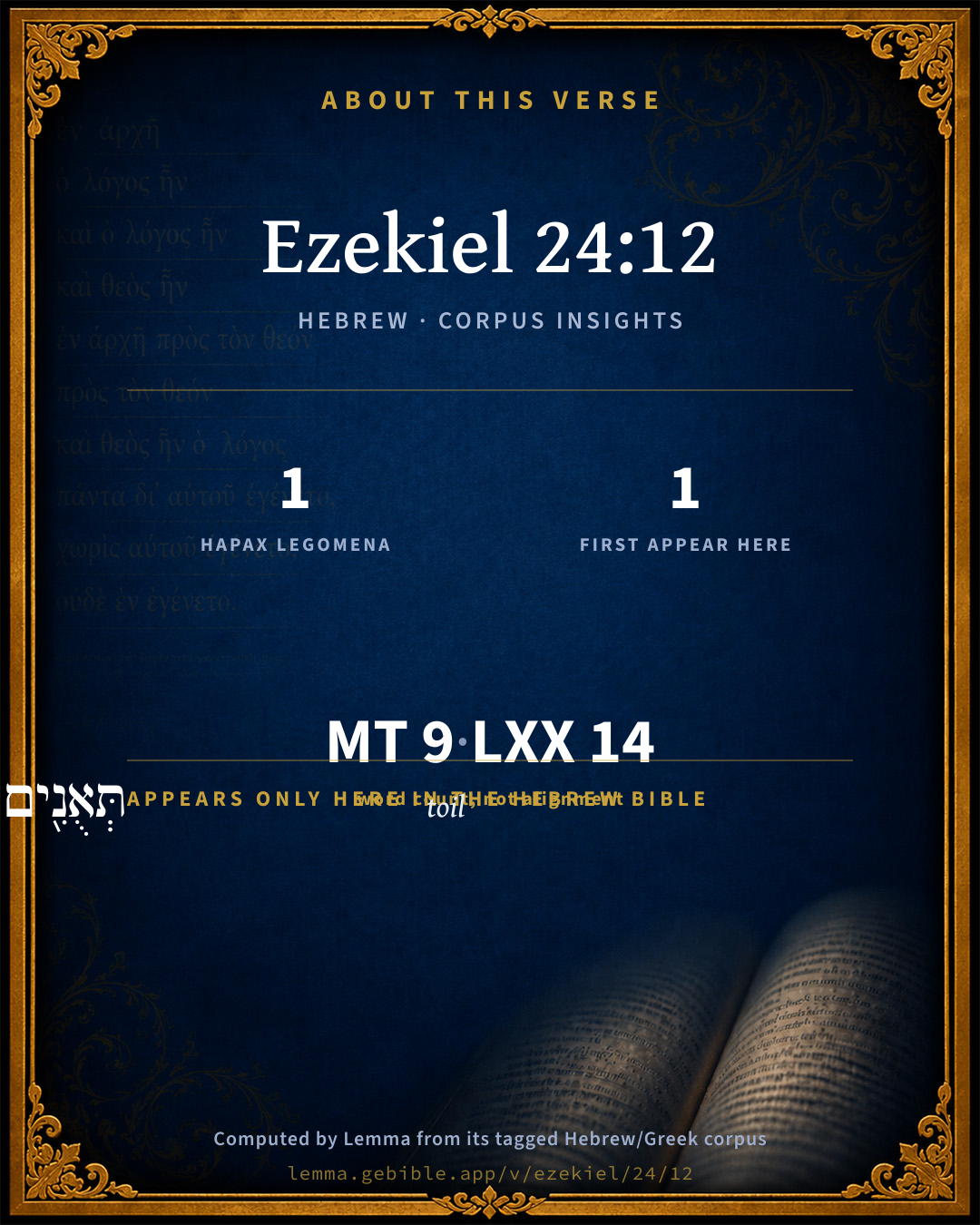
About this verse

These counts appear in no published source. They are computed here, from the morphology-tagged text and Lemma’s own curated glosses. What Lemma adds →

9
words
8
distinct lemmas
Prophets
section

Notable vocabulary

1 hapax legomenon — a word that appears only here in the entire Hebrew Bible:

  • תְּאֻנִ֖ים toil H8383

First appearance in Scripture

This word makes its first canonical appearance in the Hebrew Bible here:

  • תְּאֻנִ֖ים toil H8383

Shared distinctive vocabulary

חֶלְאָתָ֔הּ rust H2457 occurs in 3 verses of the Hebrew Bible. Also found in:

Grammatical profile

  • 2 verbs
  • 4 nouns
  • 1 adjective
  • 1 preposition
  • 1 particle

Verb forms

  • הֶלְאָ֑ת Hiphil · Perfect
  • תֵצֵ֤א Qal · Imperfect

Repetition

A word recurs within this verse — often emphatic in Hebrew:

  • חֶלְאָתָ֔הּ rust H2457 ×2

Hebrew & Septuagint length

In English translation the verse runs 23 words from the Hebrew and 10 from the Septuagint (LXX English) — the Septuagint runs noticeably shorter here. See the side-by-side →

A rough comparison of the two English renderings, which tokenize alike — not a word-level alignment.

Word counts can differ between the Hebrew and the Greek without any difference in meaning — e.g. the Hebrew direct-object marker אֵת has no separate Greek word, and Greek often adds the article ὁ.

In the original languages it is 9 Hebrew tokens and 14 Greek tokens — but the two are counted differently (Hebrew bundles its prefixes and suffixes into one token; the Greek is in lemma form), so that isn’t a like-for-like length.

Cross-references

17

Topical passages linked to Ezekiel 24:12 in the Treasury of Scripture Knowledge — connected by theme and wording, ordered by reader-vote popularity; previews shown in the World English Bible.

  • Jeremiah 5:3 O Yahweh, don't your eyes look on truth? you have stricken them, but they were not grieved; you have consumed them, but they have refused to receive correction: they have made their faces harder than a rock; they have refused to return.
  • Jeremiah 9:5 They will deceive everyone his neighbor, and will not speak the truth: they have taught their tongue to speak lies; they weary themselves to commit iniquity.
  • Jeremiah 2:13 For my people have committed two evils: they have forsaken me, the spring of living waters, and hewed them out cisterns, broken cisterns, that can hold no water.
  • Jeremiah 51:58 Thus says Yahweh of hosts: The broad walls of Babylon shall be utterly overthrown, and her high gates shall be burned with fire; and the peoples shall labor for vanity, and the nations for the fire; and they shall be weary.
  • Daniel 9:13–14 As it is written in the law of Moses, all this evil is come on us: yet have we not entreated the favor of Yahweh our God, that we should turn from our iniquities, and have discernment in your truth.
  • Habakkuk 2:13 Behold, isn't it of Yahweh of Hosts that the peoples labor for the fire, and the nations weary themselves for vanity?
  • Genesis 6:5–7 Yahweh saw that the wickedness of man was great in the earth, and that every imagination of the thoughts of his heart was only evil continually.
  • Genesis 8:21 Yahweh smelled the sweet savor. Yahweh said in his heart, "I will not again curse the ground any more for man's sake, because the imagination of man's heart is evil from his youth; neither will I ever again strike everything living, as I have done.
  • Isaiah 1:5 Why should you be beaten more, That you revolt more and more? The whole head is sick, And the whole heart faint.
  • Isaiah 47:13 You are wearied in the multitude of your counsels: let now the astrologers, the star-gazers, the monthly prognosticators, stand up, and save you from the things that shall come on you.
  • Isaiah 57:9–10 You went to the king with oil, and did increase your perfumes, and did send your ambassadors far off, and did debase yourself even to Sheol.
  • Jeremiah 10:14–15 Every man is become brutish [and is] without knowledge; every goldsmith is disappointed by his engraved image; for his molten image is falsehood, and there is no breath in them.
  • Jeremiah 44:16–17 As for the word that you have spoken to us in the name of Yahweh, we will not listen to you.
  • Ezekiel 24:6 Therefore thus says the Lord Yahweh: Woe to the bloody city, to the caldron whose rust is therein, and whose rust is not gone out of it! take out of it piece after piece; No lot is fallen on it.
  • Ezekiel 24:13 In your filthiness is lewdness: because I have cleansed you and you weren't cleansed, you shall not be cleansed from your filthiness any more, until I have caused my wrath toward you to rest.
  • Habakkuk 2:18–19 "What value does the engraved image have, that its maker has engraved it; the molten image, even the teacher of lies, that he who fashions its form trusts in it, to make mute idols?
  • Hosea 12:1 Ephraim feeds on wind, And chases the east wind. He continually multiplies lies and desolation. They make a covenant with Assyria, And oil is carried into Egypt.

Cross-references courtesy of OpenBible.info (CC BY 4.0).

Hebrew and Greek witnesses Masoretic Hebrew ↔ Greek Septuagint

The same verse in the two great witnesses to the Old Testament, shown verse-for-verse.

Here the Septuagint runs noticeably shorter than the Hebrew — LXX2012 (modern English Septuagint) 10 words vs World English Bible 23. A rough length comparison of the two English translations, not a word-level alignment — read both below.

These are two independent witnesses, not word-aligned to each other, and the Septuagint is shown in lemma (dictionary) form.

Hebrew Ezekiel 24:12 Masoretic · Westminster Leningrad Codex

תְּאֻנִ֖ים הֶלְאָ֑ת וְלֹֽא תֵצֵ֤א מִמֶּ֨נָּה֙ רַבַּ֣ת חֶלְאָתָ֔הּ בְּאֵ֖שׁ חֶלְאָתָֽהּ

She has wearied [herself] with toil; yet her great rust doesn't go forth out of her; her rust doesn't [go forth] by fire.

World English Bible · Public Domain

Greek LXX Ezekiel 24:12 Septuagint · lemma form

καί οὐ μή ἐκἔρχομαι ἐκ αὐτός πολύς ὁ ἰός αὐτός κατααἰσχύνω ὁ ἰός αὐτός

and her abundant scum may not come forth of her.

LXX2012 (modern English Septuagint) · Public Domain

On this verse, The Cambridge Bible for Schools and Colleges discusses the Septuagint’s reading. Read the note in Commentary ↓

Hebrew: Westminster Leningrad Codex (CC BY 4.0). Greek: Septuagint (public domain); English from LXX2012 (modern English Septuagint) (Public Domain). How the Septuagint differs from the Hebrew →

Targum (Aramaic paraphrase)

1

The Targum is the ancient Jewish Aramaic paraphrase of the Hebrew Scriptures — an interpretive translation, not the Hebrew text itself. Onkelos (literal) and Pseudo-Jonathan (expansive) render the Torah, and Jonathan the Prophets. Coverage is partial: where no permissively-licensed English translation exists for a verse, only the Aramaic is shown. This is verse-level text, not a word-by-word alignment to the Hebrew.

  1. Targum Jonathan Prophets (Joshua–Malachi)
    תִּסְקוֹפִין אִיתְמְלִיאַת וְלָא יִפְקוּן מִנָהּ עָבְדֵי בִישְׁתָּא בְּנוּרָא תִתּוֹקַד מִסַגִיוּת חוֹבָהָא:

    (no public-domain English translation for this verse)

    Targum Jonathan — Aramaic: “Mikraot Gedolot” (public domain). English: “Sefaria Community Translation” (CC0 1.0 (public-domain dedication)); “London "Chaldee Paraphrase," 1871” (public domain). Text via Sefaria.

Commentary

Notes on Ezekiel 24:12 from classic Christian and Jewish commentators (each source and its license shown beneath its notes). The classic Christian expositions comment on the surrounding passage and are grouped to its opening verse, so a note may address several verses; the Jewish commentaries on the Tanakh (Rashi and others) are per-verse, so they appear only where the commentator wrote on this verse.

Lemma curates 59 commentaries, every one of them public domain or Creative Commons licensed, each selected and text-cleaned for this edition rather than reprinted as found. About our sources →

Trapp's Complete Commentary

John Trapp

Eze 24:12 She hath wearied [herself] with lies, and her great scum went not forth out of her: her scum [shall be] in the fire.

Ver. 12. She hath wearied herself with lies.] With seeking and trusting to lying vanities, creature comforts. Others render it, She hath wearied me with lies - i.e., With false promises of amendment; others, Frustra sudatum est, Pains is taken with them to no purpose.

And her great scum went not forth out of her.] But is sodden into her partly, and partly sodden over into the fire. A godly man cleareth himself of sin, as spring water worketh itself clean; as the sea will endure no poisonous thing, but casteth it upon the shore; as the sweet water, made brackish by the coming in of the salt water, gets to be sweet again, so do God’s people work out brackish and sinful dispositions, &c. The good heart admitteth not the mixture of any sin; though sin may cleave to it as dross doth to silver, yet, like right wine or honey, as the scum ariseth, still it casteth it out; so here.

John Trapp, A Commentary or Exposition upon All the Books of the Old and New Testament (1647–1656) — public domain. Text from a community e-Sword module.

Joseph Benson's Commentary

Eze 24:12-14. She hath wearied herself with lies — Hebrew, תאנים, with vanities, or troubles; multiplying her idolatries, and seeking help sometimes from one idol and sometimes from another, but all in vain. The expression may also include the alliances the Jewish people entered into, and the various arts of policy they employed to avert their ruin, none of which were of any service to them: as if he had said, She has taken a great deal of pains, but to no purpose: her allies, their promises, their forces, their gods, all prove a lie to the house of Judah. Her great scum went not out of her, &c. — All the admonitions I gave her by my prophets, and my sundry chastisements and punishments of her sin, availed nothing to the purifying her from her idolatries and other wickedness; her scum shall be in the fire — The fire must consume her and her wickedness. In thy filthiness is lewdness — Thou hast shown thyself shameless and incorrigible in thine idolatries. Because I have purged thee, and thou wast not purged — I did what was requisite on my part to thy amendment, but thou refusedst to comply with those frequent calls and exhortations which I gave thee; and therefore my Spirit shall not strive with thee any longer with gentle methods, but I will proceed to execute my severest judgments upon thee, namely, by sending thee into captivity, and letting thee suffer all the calamities of it for a long season. According to thy doings shall they judge thee — According to thy deserts shall the Chaldeans, who are the ministers of my justice, punish thee.

Joseph Benson's Commentary on the Old and New Testaments (1811–1818) — public domain. Text from a community e-Sword module.

Geneva Bible (1599)

Geneva Bible translators

The city hath flattered herself in vain.

Geneva Bible (1599) marginal notes — public domain. Text via Bolls.life.

Jamieson, Fausset & Brown

Robert Jamieson, A. R. Fausset & David Brown

herself--rather, "she hath wearied Me out with lies"; or rather, "with vain labors" on My part to purify her without being obliged to have recourse to judgments (compare Isa 43:24; Mal 2:17) [MAURER]. However, English Version gives a good sense (compare Isa 47:13; Isa 57:10).

Jamieson, Fausset & Brown — Commentary Critical and Explanatory on the Whole Bible (1871) — public domain (CC PDM 1.0). Text via the HelloAO Bible API.

The Cambridge Bible for Schools and Colleges

gen. ed. J. J. S. Perowne

12. As the words stand they seem to read: she hath wearied my labours, and her great rust goeth not out from her; let her rust be in the fire! Previous efforts to purify Jerusalem have been in vain, her uncleanness will go out only by fire (Eze_24:13); cf. Isa_43:24. LXX. omits first clause, which might be a duplicate of words immediately preceding.

The Cambridge Bible for Schools and Colleges (gen. ed. J. J. S. Perowne; Cambridge University Press, 1878–1918) — public domain. Text from a community e-Sword module.

John Gill's Exposition

She hath wearied herself with lies,.... With serving idols, which were lying vanities; by trusting to the alliances of neighbouring nations, which deceived her; or by committing sin, in which there was no satisfaction; or it may be understood of wearying of God with their sins, and particularly with her lying promises of repentance and reformation:

and her great scum went not forth out of her; notwithstanding her promises; or notwithstanding the admonitions given, and the chastisements inflicted on her, yet she continued hardened in her sins, impenitent and unreformed:

her scum shall be in the fire; like a pot that boils over, its scum falls into the fire, and is consumed there; and in no other way, but by the fire of divine judgments, or the burning of the city, could the wickedness thereof be consumed. The Targum is,

"and they shall not go out of her that work iniquity; in the fire shall she be burnt, because of the multitude of her sins.''

John Gill's Exposition of the Whole Bible (1746–1763) — public domain (CC PDM 1.0). Text via the HelloAO Bible API.

Matthew Poole's English Annotations

She; the nation of the Jews, and the city Jerusalem.

Hath wearied; either her God, (so the French translation,) by her repeated sins, and pertinacy in them, as elsewhere, Isa 1:14; 7:13; 43:24; or wearied others, by injuries done against them; or, as we read it, herself, spent much time and taken great pains, laid out much treasure in making alliances for her security.

With lies: her allies, their promises, their forces, and their idols, on which these unhappy Jews relied, all prove a lie to the house of Judah.

Her great scum went not forth; she repented not, nor did she reform her ways.

Her scum, her unrepented sins, shall be in the fire, shall be punished in the fire that burns their city.

Matthew Poole's English Annotations on the Holy Bible (1683–1685) — public domain. Text from a community e-Sword/MySword module.

Whedon's Commentary on the Bible

Daniel D. Whedon

12. Wearied herself with lies — R.V., “with toil”; margin, “wearied me with toil.” Plumptre, “it [the caldron] is worn out with labors.” The meaning evidently is that all the previous efforts to cleanse Jerusalem have failed. Even the hottest fire seems unable to cleanse its foulness, and its destruction is the logical sequence.

Daniel D. Whedon (gen. ed.), Commentary on the Old and New Testaments (1874–1909) — public domain. Text from a community e-Sword module.

The Pulpit Commentary

She hath wearied herself with lies, etc.; better, it (keeping to the image of the cauldron) is worn out with labors; sc. with the pains taken to cleanse it, and yet the rust remains. The fire must burn, the retributive judgment must continue, till the work is done.

A weary task.

Jerusalem is represented as endeavoring to remove her own evil, but as growing weary in the fruitless task. The rust cannot be cleansed from the vessel.

I IT ACTS LIKE RUST.

1. It comes from a corroding agent. Temptation bites into the yielding soul like an acid.

2. It reveals an inferior character. Brass and iron become rusty under circumstances which leave gold and silver untarnished. Readiness to yield to temptation is a sign that there is base metal in the soul.

3. It corrupts the very substance of the soul. Rust on metal is not like moss on stone, a mere excrescence and parasite growth. It is formed from the metal itself; it is a portion of it disintegrated and mixed with an alien body. Sin breaks down the fabric of the soul-life, and wears it away in a slow death.

4. It tarnishes the beauty of the soul. Rust is like ingrained dirt on the bright surface of the metal. The rusty mirror no longer reflects light. The sin-stained soul has lost its luster and ceases to reflect the light of heaven.

II MEN TRY TO REMOVE THE RUST OF SIN. This is the task that the people of Jerusalem are supposed to have undertaken.

1. They turn from their past. The atmosphere which caused the rust is abandoned. The old days are to be forgotten; a new life is to be commenced.

2. They put their souls under discipline. The attempt is made to burn off the rust or to scour it away.

3. They offer compensation. New deeds of goodness are to supersede and atone for old deeds of sin.

4. They offer sacrifices of expiation. The history of religion is full of such sacrifices sacrifices which constitute a leading element in the Old Testament economy.

III THE ATTEMPT TO REMOVE THE RUST OF SIN IS A WEARY TASK.

1. New circumstances do not destroy old sins. Though the vessel be taken out of the damp atmosphere which first corroded it, it does not become bright. The rust is still on it. We may try to make amends in the future, but by such means we cannot get rid of the guilt and the consequences of the past.

2. Sin has eaten its way so deeply into the soul that no efforts of ours can remove it. It is not like dust that lies loosely on the surface; it has cut into our nature like rust. Our feeble self-discipline is ineffectual for removing so close-clinging an evil.

3. No compensation of good works nor expiatory sacrifices will remove this evil. "It is not possible that the blood of bulls and of goats should take away sin". (Heb_10:4) Such sacrifices can be but symbols at the best.

IV CHRIST HAS ACCOMPLISHED THIS WEARY TASK.

1. He has made the great atonement with God. He is the one true Sacrifice for sin. (Heb_10:14) Thus the way is now clear for the soul"s cleansing.

2. He removes the rust of sin from the soul. As "the Lamb of God that taketh away the sin of the world," Christ not only brings pardon, he produces purity. His mighty arm scours the rust off the soul.

3. This was a weary task for Christ. Even he found it no easy work. It required the humiliation of Bethlehem, the agony of Gethsemane, and the death of Calvary. Christ toiled, suffered, and grew weary unto death in the awful task. Yet he persevered to the end.

4. Christ invites us to abandon our useless, weary task and come to him for cleansing. It is especially to those who labor and are heavy laden with sin that he gives his great invitation. (Mat_11:28-30)

The Pulpit Commentary (1880–1919), ed. H.D.M. Spence-Jones & Joseph S. Exell — public domain. Text from a community e-Sword module.

John Wesley's Explanatory Notes

She - Jerusalem. With lies - Her allies, their promises, their forces, and their idols, all prove a lie to the house of Judah. Her scum - Her unrepented sins shall be punished in the fire that burns their city.

John Wesley, Explanatory Notes Upon the Whole Bible (1754–1765) — public domain. Text via the GEBible commentary corpus.

Rashi

Rabbi Shlomo Yitzchaki (Rashi)

With guile she wearied [Heb. תְּאֻנִים הֶלְאָת.] With pretext and guile, she wearied the poor. Therefore, the wicked in her midst will not leave her, but they will perish in the fire of her retribution.

Rashi on the Tanakh — English translations: “The Judaica Press complete Tanach with Rashi, translated by A. J. Rosenberg” (CC BY 4.0); “Pentateuch with Rashi's commentary by M. Rosenbaum and A.M. Silbermann, 1929-1934” (public domain); “The Metsudah Tanach series, Lakewood, N.J” (CC BY 4.0); and “The Book of Joshua, Metsudah Publications, 1997” (CC BY 4.0). Text via Sefaria.

Lesson kit

Teaching starters — assembled from the data on this page, not authored interpretation. Every prompt links to the verse data it draws on. Edit before teaching.

Ezekiel, in the Prophets, opens this verse with 9 words (8 distinct Hebrew lemmas). Its most distinctive word is tᵉʼun (“toil”). The Greek Septuagint runs shorter here. A historical commentator’s framing appears above. Read the whole chapter for the surrounding context.

Discussion questions

  1. How does “toil” (tᵉʼun) shape what this verse is saying?
  2. This verse holds 1 word here found nowhere else in the Hebrew Bible. What might the rare word draw attention to?
  3. The word “toil” first appears here in Scripture. What is being introduced at this debut?
  4. Ezekiel 24:6 shares the word «rust» with this verse. How do the two illuminate each other?
  5. “rust” occurs 2× in this one verse. What is the effect of the repetition?
  6. Compared with the Hebrew, the Septuagint runs shorter here. What questions does that raise?
  7. These translations render this verse differently. What is at stake in choosing one wording over another?
  8. The verb «הֶלְאָ֑ת» is Hiphil Perfect. How does its form color the action?

Things to notice

  • 1 word in this verse appears nowhere else in the Hebrew Bible.
  • 1 word makes its first canonical appearance in Scripture here.
  • This verse counts 9 Hebrew ↔ 14 Greek words.
  • These translations choose different wording for 18 words in this verse.
  • “rust” occurs 2× in this single verse.

Reading settings

Reading text

Shown beneath each verse's original-language words.

Old Testament
Old Testament edition

Read the OT as the Masoretic Hebrew (MT) or the Greek Septuagint (LXX).

English shown for the Greek Septuagint (in the Hebrew ↔ Greek comparison).

Comparing translations? Open the Compare panel on any verse page to stack up to four side by side.