Deuteronomy 4:11

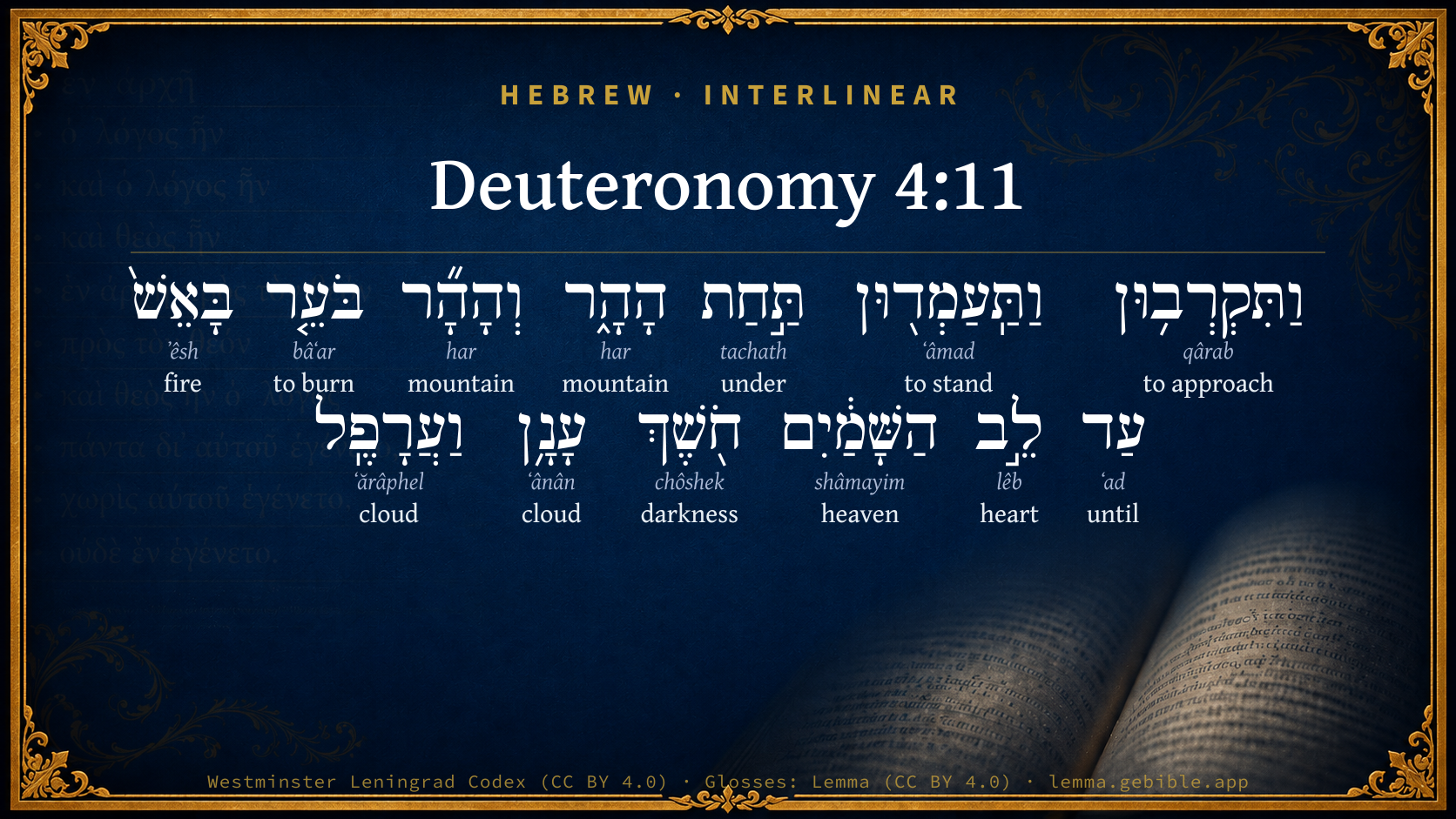
Hebrew (Westminster Leningrad Codex) Deuteronomy 4:11 appears in the Hebrew Old Testament. The text above is from the Westminster Leningrad Codex. Each word links to its Strong’s number, a concise gloss, and parsing drawn from the Open Scriptures Hebrew Bible morphology. Click any word for its full Brown-Driver-Briggs (BDB) entry.
Download image
Cite this verse

Deuteronomy 4:11 (World English Bible). Public Domain. Lemma interlinear Bible study tool, https://lemma.gebible.app/v/deuteronomy/4/11.

Show BibTeX & RIS
BibTeX
RIS
English Translation
You came near and stood under the mountain; and the mountain burned with fire to the heart of the sky, with darkness, cloud, and thick darkness.
World English Bible · Public Domain
Download a study sheet

One document with this verse’s original text, its word-by-word gloss line, the meaning frame, cross-references with their text, attributed commentary, and full source and license credits — printable, and it pastes into notes with its structure intact.

This verse Autodidact and up

Study sheet (.html) Plain text (.txt)

A passage Seminary Student

Up to 50 verses in one chapter. A passage sheet keeps up to 6 commentary sources and 12 cross-references per verse, in the order this page ranks them, and says so on the sheet whenever that leaves anything out. Ask for a single verse and you get the Autodidact verse sheet above.

Everything on this page stays free to read, with no account — the sheet is a download of what is already on screen, not access to it.

Want to remove ads? Support Godless Engineer
Compare translations 3

The same verse in 3 English versions, stacked beneath the original-language interlinear above. Click any original word for its lexicon entry.

Each is an independent rendering of the whole verse — the interlinear is not word-aligned to these translations.

Highlighted words mark where these versions differ — a whole-verse word diff, not a word-by-word alignment.

  • World English Bible Public Domain
    You came near and stood under the mountain; and the mountain burned with fire to the heart of the sky, with darkness, cloud, and thick darkness.
  • King James Version Public Domain
    And ye came near and stood under the mountain; and the mountain burned with fire unto the midst of heaven, with darkness, clouds, and thick darkness.
  • unfoldingWord Literal Text CC BY-SA 4.0
    And you approached and stood under the mountain. And the mountain burned with fire to the heart of the heavens, darkness, cloud, and gloom.

unfoldingWord Literal Text — © unfoldingWord, licensed CC BY-SA 4.0. Word-aligned USFM3 via Door43 (git.door43.org/unfoldingWord/en_ult).

Versions to compare (up to 4)

3 of 4 selected

Show all 18 translations

Every available English version of this verse, each an independent rendering of the whole verse.

  • World English Bible Public Domain
    You came near and stood under the mountain; and the mountain burned with fire to the heart of the sky, with darkness, cloud, and thick darkness.
  • Berean Standard Bible Public Domain
    You came near and stood at the base of the mountain, a mountain blazing with fire to the heavens, with black clouds and deep darkness.
  • Majority Standard Bible Public Domain
    You came near and stood at the base of the mountain, a mountain blazing with fire to the heavens, with black clouds and deep darkness.
  • King James Version Public Domain
    And ye came near and stood under the mountain; and the mountain burned with fire unto the midst of heaven, with darkness, clouds, and thick darkness.
  • American Standard Version (1901) Public Domain
    And ye came near and stood under the mountain; and the mountain burned with fire unto the heart of heaven, with darkness, cloud, and thick darkness.
  • Revised Version (1885) Public Domain
    And ye came near and stood under the mountain; and the mountain burned with fire unto the heart of heaven, with darkness, cloud, and thick darkness.
  • Geneva Bible (1599) Public Domain
    Then came you neere and stoode vnder the mountaine, and the mountaine burnt with fire vnto the mids of heauen, and there was darkenesse, cloudes and mist.
  • Douay-Rheims (1899) Public Domain
    And you came to the foot of the mount, which burned even unto heaven: and there was darkness, and a cloud and obscurity in it.
  • Young's Literal Translation Public Domain
    and ye draw near and stand under the mountain, and the mountain is burning with fire unto the heart of the heavens -- darkness, cloud, yea, thick darkness:
  • Literal Standard Version CC BY-SA 4.0
    and you draw near and stand under the mountain, and the mountain is burning with fire to the heart of the heavens, [with] darkness, cloud, and thick darkness,
  • Unlocked Literal Bible CC BY-SA 4.0
    You came near and stood at the foot of the mountain. The mountain burned with fire to the heart of heaven, with darkness, cloud, and thick darkness.
  • unfoldingWord Literal Text CC BY-SA 4.0
    And you approached and stood under the mountain. And the mountain burned with fire to the heart of the heavens, darkness, cloud, and gloom.
  • Darby Bible Public Domain
    And ye came near and stood under the mountain; and the mountain burned with fire to the heart of heaven, with darkness, clouds, and obscurity.
  • World Messianic Bible Public Domain
    You came near and stood under the mountain. The mountain burned with fire to the heart of the sky, with darkness, cloud, and thick darkness.
  • Webster's Bible Public Domain
    And ye came near and stood under the mountain; and the mountain burned with fire to the midst of heaven, with darkness, clouds, and thick darkness.
  • Free Bible Version CC BY-SA 4.0
    You gathered and stood at the foot of the mountain. The mountain was on fire, shooting out flames into the sky and producing thick dark clouds.
  • Bible in Basic English Public Domain
    And you came near, waiting at the foot of the mountain; and flames of fire went up from the mountain to the heart of heaven, with dark clouds, and all was black as night.
  • JPS Tanakh (1917) Public Domain
    And ye came near and stood under the mountain; and the mountain burned with fire unto the heart of heaven, with darkness, cloud, and thick darkness.

Literal Standard Version (2020), Covenant Press — licensed CC BY-SA 4.0. Text via the HelloAO Bible API (eBible.org). Unlocked Literal Bible (unfoldingWord) — licensed CC BY-SA 4.0. Text via the HelloAO Bible API (eBible.org). unfoldingWord Literal Text — © unfoldingWord, licensed CC BY-SA 4.0. Word-aligned USFM3 via Door43 (git.door43.org/unfoldingWord/en_ult). Free Bible Version, Dr. Jonathan Gallagher — licensed CC BY-SA 4.0. Text via the HelloAO Bible API (eBible.org).

Word by word

More ways to search: Search by grammar → Find every occurrence → Compare this word →

Practice this passage: Drill this verse → Learn its vocabulary →

וַעֲרָפֶֽל
ʻărâphel
H6205
“and · cloud”
Conjunction + Noun, Common, Masculine, Singular, Absolute
Part of Speech
Conjunction + Noun
Type
Common
Gender
Masculine
Number
Singular
State
Absolute
Full BDB Definition

Origin: probably from H6201

TWOT: 1701b

cloud, heavy or dark cloud, darkness, gross darkness, thick darkness
  1. וַתִּקְרְב֥וּן qârab H7126 “and · to approach” Conjunction + Verb, Qal, Sequential Imperfect, 2nd Person, Masculine, Plural + Suffix, n
  2. וַתַּֽעַמְד֖וּן ʻâmad H5975 “and · to stand” Conjunction + Verb, Qal, Sequential Imperfect, 2nd Person, Masculine, Plural + Suffix, n
  3. תַּ֣חַת tachath H8478 “under” Preposition
  4. הָהָ֑ר har H2022 “the · mountain” Particle, Definite Article + Noun, Common, Masculine, Singular, Absolute
  5. וְהָהָ֞ר har H2022 “and · the · mountain” Conjunction + Particle, Definite Article + Noun, Common, Masculine, Singular, Absolute
  6. בֹּעֵ֤ר bâʻar H1197 “burning” Verb, Qal, Participle Active, Masculine, Singular, Absolute
  7. בָּאֵשׁ֙ ʼêsh H784 “in/at the · fire” Preposition, Determined + Noun, Common, Both, Singular, Absolute
  8. עַד ʻad H5704 “until” Preposition
  9. לֵ֣ב lêb H3820 “heart of” Noun, Common, Masculine, Singular, Construct
  10. הַשָּׁמַ֔יִם shâmayim H8064 “the · heaven(s)” Particle, Definite Article + Noun, Common, Masculine, Plural, Absolute
  11. חֹ֖שֶׁךְ chôshek H2822 “darkness” Noun, Common, Masculine, Singular, Absolute
  12. עָנָ֥ן ʻânân H6051 “cloud” Noun, Common, Masculine, Singular, Absolute

About this verse

These counts appear in no published source. They are computed here, from the morphology-tagged text and Lemma’s own curated glosses. What Lemma adds →

13
words
12
distinct lemmas
Pentateuch
section

Notable vocabulary

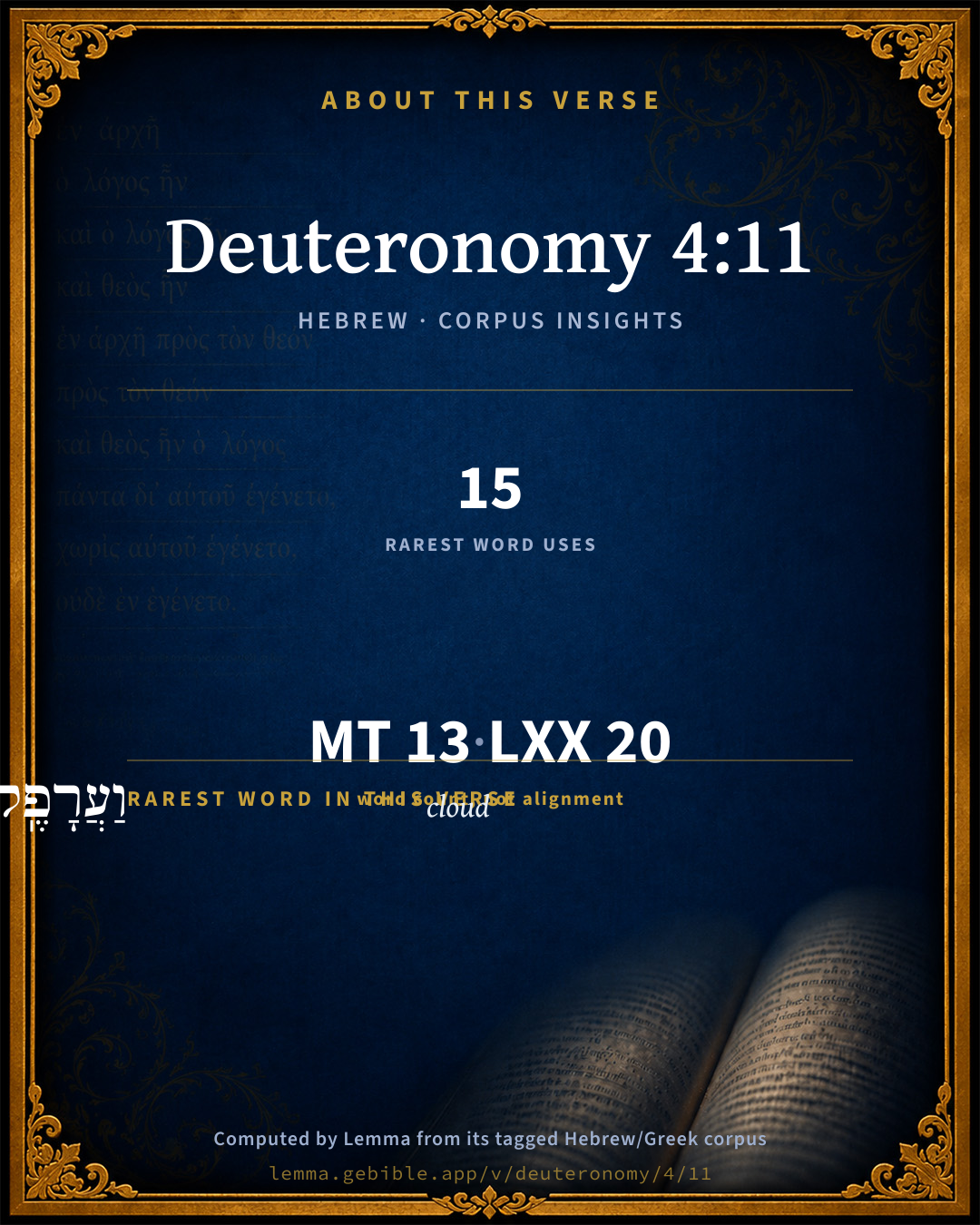
The rarest word here is וַעֲרָפֶֽל cloud H6205 — appearing just 15 times in the whole Hebrew Bible.

Shared distinctive vocabulary

וַעֲרָפֶֽל cloud H6205 occurs in 15 verses of the Hebrew Bible. Also found in:

Grammatical profile

  • 3 verbs
  • 8 nouns
  • 2 prepositions

Verb forms

  • וַתִּקְרְב֥וּן Qal · Sequential Imperfect
  • וַתַּֽעַמְד֖וּן Qal · Sequential Imperfect
  • בֹּעֵ֤ר Qal · Participle Active

Repetition

A word recurs within this verse — often emphatic in Hebrew:

  • הָהָ֑ר mountain H2022 ×2

Hebrew & Septuagint length

In English translation the verse runs 26 words from the Hebrew and 24 from the Septuagint (LXX English) — closely comparable.

A rough comparison of the two English renderings, which tokenize alike — not a word-level alignment.

Word counts can differ between the Hebrew and the Greek without any difference in meaning — e.g. the Hebrew direct-object marker אֵת has no separate Greek word, and Greek often adds the article ὁ.

In the original languages it is 13 Hebrew tokens and 20 Greek tokens — but the two are counted differently (Hebrew bundles its prefixes and suffixes into one token; the Greek is in lemma form), so that isn’t a like-for-like length.

Cross-references

4

Topical passages linked to Deuteronomy 4:11 in the Treasury of Scripture Knowledge — connected by theme and wording, ordered by reader-vote popularity; previews shown in the World English Bible.

  • Deuteronomy 5:23 It happened, when you heard the voice out of the midst of the darkness, while the mountain was burning with fire, that you came near to me, even all the heads of your tribes, and your elders;
  • Exodus 19:16–18 It happened on the third day, when it was morning, that there were thunders and lightnings, and a thick cloud on the mountain, and the sound of an exceedingly loud trumpet; and all the people who were in the camp trembled.
  • Hebrews 12:18–19 For you have not come to a mountain that might be touched, and that burned with fire, and to blackness, darkness, tempest,
  • Exodus 20:18–19 All the people perceived the thunderings, the lightnings, the sound of the trumpet, and the mountain smoking. When the people saw it, they trembled, and stayed at a distance.

Cross-references courtesy of OpenBible.info (CC BY 4.0).

Hebrew and Greek witnesses Masoretic Hebrew ↔ Greek Septuagint

The same verse in the two great witnesses to the Old Testament, shown verse-for-verse.

These are two independent witnesses, not word-aligned to each other, and the Septuagint is shown in lemma (dictionary) form.

Hebrew Deuteronomy 4:11 Masoretic · Westminster Leningrad Codex

וַתִּקְרְב֥וּן וַתַּֽעַמְד֖וּן תַּ֣חַת הָהָ֑ר וְהָהָ֞ר בֹּעֵ֤ר בָּאֵשׁ֙ עַד לֵ֣ב הַשָּׁמַ֔יִם חֹ֖שֶׁךְ עָנָ֥ן וַעֲרָפֶֽל

You came near and stood under the mountain; and the mountain burned with fire to the heart of the sky, with darkness, cloud, and thick darkness.

World English Bible · Public Domain

Greek LXX Deuteronomy 4:11 Septuagint · lemma form

καί προςἔρχομαι καί ἵστημι ὑπό ὁ ὄρος καί ὁ ὄρος καίω πῦρ ἕως ὁ οὐρανός σκότος γνόφος θύελλα φωνή μέγας

And you⌃ drew near and stood under the mountain; and the mountain burned with fire up to heaven: there was darkness, blackness, and tempest.

LXX2012 (modern English Septuagint) · Public Domain

On this verse, John Gill's Exposition discusses the Septuagint’s reading. Read the note in Commentary ↓

Hebrew: Westminster Leningrad Codex (CC BY 4.0). Greek: Septuagint (public domain); English from LXX2012 (modern English Septuagint) (Public Domain). How the Septuagint differs from the Hebrew →

Targum (Aramaic paraphrase)

2

The Targum is the ancient Jewish Aramaic paraphrase of the Hebrew Scriptures — an interpretive translation, not the Hebrew text itself. Onkelos (literal) and Pseudo-Jonathan (expansive) render the Torah, and Jonathan the Prophets. Coverage is partial: where no permissively-licensed English translation exists for a verse, only the Aramaic is shown. This is verse-level text, not a word-by-word alignment to the Hebrew.

  1. Targum Onkelos Torah (Genesis–Deuteronomy)
    וּקְרֶבְתּוּן וְקַמְתּוּן בְּשִׁפּוֹלֵי טוּרָא וְטוּרָא בָּעֵר בְּאֶשָׁתָא עַד צֵית שְׁמַיָא חֲשׁוֹכָא עֲנָנָא וַאֲמִיטְתָא

    (no public-domain English translation for this verse)

    Targum Onkelos — Aramaic: “Onkelos Genesis” (public domain); “Onkelos Exodus” (public domain); “Onkelos Leviticus” (public domain); “Onkelos Numbers” (public domain); “Onkelos Deuteronomy” (public domain). English: “Sefaria Community Translation” (CC0 1.0 (public-domain dedication)); “J.W. Etheridge. The Targums of Onkelos and Jonathan Ben Uzziel on the Pentateuch. London: Longmans, Green, 1862” (public domain). Text via Sefaria.

  2. Targum Pseudo-Jonathan Torah (Genesis–Deuteronomy)
    וְקָרֵיבְתּוּן וְקַמְתּוּן בְּשִׁפּוּלֵי טוּרָא וְטַוְורָא דָלִיק בְּאֵישָׁתָא וְשַׁלְהוֹבֵיהּ מָטֵי עַד צֵית שְׁמַיָא חֲשׁוֹכָא עֲנָנָא וְאַמִיטְתָא

    And you drew near, and stood at the lower part of the mount, and the mountain burned with fire, and its flame went up to the height of the heavens, with darkness, clouds, and shadows.

    Targum Pseudo-Jonathan — Aramaic: “Targum Jonathan on Genesis” (public domain); “Targum Jonathan on Exodus” (public domain); “Targum Jonathan on Leviticus” (public domain); “Targum Jonathan on Numbers” (public domain); “Targum Jonathan on Deuteronomy” (public domain). English: “The Targum of Jonathan ben Uzziel, trans. J. W. Etheridge, London, 1862” (public domain). Text via Sefaria.

Commentary

Notes on Deuteronomy 4:11 from classic Christian and Jewish commentators (each source and its license shown beneath its notes). The classic Christian expositions comment on the surrounding passage and are grouped to its opening verse, so a note may address several verses; the Jewish commentaries on the Tanakh (Rashi and others) are per-verse, so they appear only where the commentator wrote on this verse.

Lemma curates 59 commentaries, every one of them public domain or Creative Commons licensed, each selected and text-cleaned for this edition rather than reprinted as found. About our sources →

Joseph Benson's Commentary

Deu 4:11-12. The midst of heaven — Flaming up into the air, which is often called heaven. No similitude — No resemblance or representation of God, whereby either his essence, or properties, or actions were represented, such as were usual among the heathen.

Joseph Benson's Commentary on the Old and New Testaments (1811–1818) — public domain. Text from a community e-Sword module.

Tyndale Open Study Notes

Tyndale Open Resources

4:11 flames . . . clouds: In these contrasting displays of God’s presence (theophanies; see study note on 1:33), he revealed himself while also remaining hidden (see Exod 19:16-19).

Tyndale Open Study Notes — © Tyndale Open Resources, licensed CC BY-SA 4.0. Text via the HelloAO Bible API.

Geneva Bible (1599)

Geneva Bible translators

The Law was given with fearful miracles, to declare both that God was the author thereof, and also that no flesh was able to abide the rigor of the same.

Geneva Bible (1599) marginal notes — public domain. Text via Bolls.life.

Ellicott's Commentary for English Readers

(11) Darkness, clouds, and thick darkness.—The “blackness, and darkness, and tempest” of Heb_12:18.

A Bible Commentary for English Readers, edited by Charles John Ellicott (1878–1897) — public domain. Text from a community e-Sword module.

The Cambridge Bible for Schools and Colleges

gen. ed. J. J. S. Perowne

11. ye came near and stood under the mountain] E, Exo_19:17, took station in the nether part of the mount.

burned with fire] J, Exo_19:18, Mount Sinai was all on smoke … as the smoke of a furnace, and … quaked greatly, E, Exo_20:18, thunder, lightning, and mount smoking.

unto the heart of heaven] A characteristic deuteronomic addition; cp. Deu_1:28.

with darkness, cloud, and thick darkness] The accumulation is characteristic; cp. E, Exo_19:16, thick cloud; Exo_20:21, thick darkness; P, Exo_24:15 b, Exo_24:18 a, cloud.

The Cambridge Bible for Schools and Colleges (gen. ed. J. J. S. Perowne; Cambridge University Press, 1878–1918) — public domain. Text from a community e-Sword module.

John Gill's Exposition

And ye came near and stood under the mountain,.... At the foot of it, in the lower part of the mountain, as the Targum of Jonathan, and agrees with Exo 19:17.

and the mountain burnt with fire unto the midst of heaven; the flame and smoke went up into the middle of the air: with darkness, clouds, and thick darkness; which thick darkness was occasioned partly by the smoke, which went up like the smoke of a furnace, and partly by the thick clouds, which were on the mount, and covered the face of the heavens, which were black and tempestuous with them; the Septuagint renders it a "tempest", Exo 19:18, which denotes the obscurity of the law, and the terrors it works in the minds of men.

John Gill's Exposition of the Whole Bible (1746–1763) — public domain (CC PDM 1.0). Text via the HelloAO Bible API.

Matthew Poole's English Annotations

Flaming up into the air, which is oft called heaven; and the midst or the heart of it is not only that which is strictly and properly the middle part, but that which is within it, though but a little way, in which sense places or persons or things are said to be in the heart of the sea, Exo 15:8; Pro 23:34; Eze 28:2; and Christ in the heart of the earth, Mat 12:40.

Matthew Poole's English Annotations on the Holy Bible (1683–1685) — public domain. Text from a community e-Sword/MySword module.

The Pulpit Commentary

The mountain burned with fire unto the midst unto the heart of heaven; i.e. up to the Very skies; a rhetorical description of the mighty pillar of fire that blazed on Sinai, and betokened the presence of him whose symbol is fire. With darkness, clouds cloud, and thick darkness; underneath the fire was a cloud of deep darkness, out of which it blazed, the "thick cloud" of Exo_19:9, Exo_19:16, and the "smoke" out of which the lightnings flashed, and over which the glory of the Lord, like devouring fire, rested on the top of the mountain. (Exo_19:18 Exo_20:18 Exo_24:16, Exo_24:17)

Vers. 11-20. Israel"s peculiar relation to God.

This paragraph sets forth in earnest appeal the peculiar and distinctive relation to God in which Israel was placed. (For the precise details of the point in their history here referred to, see Ex 19; and for the application of several of the expressions used both here and there to believers in Christ under the Christian dispensation, see 1Pe_2:9) Here is a noble theme for the preacher Israel"s special relation to God, typical of and fulfilled in the present relation of Christian people to him.

I LET US STUDY THE PECULIAR RELATION OF ISRAEL TO GOD. "The Lord hath taken you, and brought you forth out of the iron furnace... to be unto him a people of inheritance," i.e. a purchased or acquired people. So in Exo_19:5, Exo_19:6. The Lord had called Abraham, had made promises to him and to his seed. These promises ran down through Isaac and Jacob and the twelve patriarchs. Now their descendants had become numerous enough to form a nation; as such they had been duly constituted, with this peculiar feature they were to be God"s nation. They had been freed by him, they were consecrated to him, and were being trained by and for him. Hence, as Kalisch remarks, every subject is as it were a priest, and every civil action assumes the sanctity of a religious function: idolatry was an offence against his sovereignty, and therefore punishable with death; so blasphemy, false prophecy, Sabbath-breaking, were visited with the like punishment. Disrespect to elders, disobedience to parents (they being the representatives of God) were visited with sore penalties. Hence, too, the whole land belonged to God. The people were but tenants, and in the year of jubilee land reverted to its former owner or his heirs. The Israelites were the subjects and servants of God alone. Slavery, therefore, though not peremptorily put down, was so regulated that the slave went out free in the seventh year; and if he did not desire the freedom, he was branded with an ignominious mark because he refused the immediate sovereignty of God. Now, this expression, "God"s nation," is the key wherewith to interpret many of the enactments which seem to us unintelligible, and many of the punishments which seem unusually severe. This truth, that Israel is the Lord"s people, runs through the Old Testament Scriptures, as will be seen if we note the varied names by which they are distinguished.

1. God"s son, his firstborn (Exo_4:22, Exo_4:23; Jer_3:4; Hos_11:1)

1. Firstfruits. (Jer_2:3)

2. The people of God (Psa_81:8-11; 2Sa_7:23, 2Sa_7:24)

3. God"s inheritance. (Deu_32:9)

4. The people. (Deu_33:29)

5. The chosen ones (Psa_33:12; Deu_7:6)

6. His flock (Jer_13:17; Psa_100:3)

7. The holy people (Deu_7:6; Jer_7:4)

8. The righteous people (Num_23:10; Exo_19:6)

9. The house or the family of God. (Isa_1:2)

10. A kingdom. (Psa_89:18)

Thus all Israelites were subjects of the same eternal, perfect King, all equal in dignity, rights, and duties. There was among them no institution resembling caste. All were equal in Heaven"s eye; all enjoyed scope for the development of their spiritual nature. The poorest herdsman might become a prophet, if filled with the Spirit of God. And the intended differential feature of the whole nation was given to it by the revealed character of its King, "Be ye holy; for I am holy." It is no wonder that a people, selected thus for such a close relationship to God, should be called in the text, "a people of inheritance." Not, indeed, in Israel alone, was there a theocratic form of government. The kings of Egypt, the monarchs of Persia and Thibet, pretended to rule as the representatives of the gods. Minos among the Cretans, Lycurgus the Lacedaemonian, Numa of Rome, and Mohammed, all pretended to have in some sort Divine authority; but these were only the mimicry of the true, and were all lacking in the supreme point to and for which Jehovah was educating Israel, even for "righteousness and true holiness." It is easy enough to win converts by a certain mimicry of the Divine. The early history of many a nation is laden with mythology, but the early history of Israel stands out in clear and startling distinction from that of other peoples, in the clearness with which they witness for the one living and true God, the accordance of their early records with known life and manners, and the clear and striking demand in their precepts for love and goodness, holiness and truth. This was at the time, and ever will be in the history of that age, the one bright spot amid the surrounding gloom. The people were "a peculiar treasure to God above all people.

II WHAT ISRAEL WAS DESIGNED TO BE AMONG THE NATIONS, CHRISTIAN PEOPLE ARE TO BE WHEREVER THEY ARE: a holy people unto the Lord their God. The Apostle Peter intimates this in the verse to which we referred at the outset. (see also Tit_2:14; Eph_2:10; 1Pe_1:15, 1Pe_1:16) There are many more passages in which believers are spoken of not only individually but collectively, as making up a family, a household, a city, a commonwealth. (Eph_2:12, Eph_2:19; Php_3:20, Greek) And there are four features which mark this new commonwealth, which correspond to those which marked that of the Hebrews.

1. The members of this Christian commonwealth are redeemed. (cf. 1Pe_1:18, 1Pe_1:19) From the curse of the Law, from the bondage of sin, believers have been redeemed by an offering of unspeakable value, even the precious blood of Christ.

1. Thus redeemed, they come to have such a knowledge of God as their God as the world has not and cannot have (Rom_8:15; Gal_4:5-7) They are redeemed out of a state of servitude into a state of sonship (cf. Joh_8:34-36)

2. They are redeemed to a life of close fellowship with God. (cf. Deu_4:7; 1Jn_1:1-3) They are at home in God.

3. They are redeemed to this close fellowship with God, that thereby they may become pure; and that in this life of purity they may "show forth the praises of him who hath called them out of darkness into his marvelous light." Not one of these four stages must be lost sight of; redeemed out of sin and servitude, into sonship, to fellowship, for holiness. Not one of these features must be left out; nor can the order in which we have put them be reversed or even transposed. The only mark by which the world can know God"s people istheir holiness. (Heb_12:14) It is not for naught that Scripture speaks of a great redemption. And no preacher preaches the gospel fully, who does not insist on its side of ethics as well as on its side of grace. And no professing Christian is worthy of the name he bears, who loses sight of holiness as the end to be attained, any more than he would be if he were to lose sight of the grace of God as that by which alone he can attain the end. How many of the controversies in the Church of God have arisen from an unequal perception of the varied truths of God"s holy gospel! Out of an inadequate view of the evil of sin and of its affront to God"s honor and government, many have felt but feebly the need of the Great Atoning Sacrifice, whereby the injured honor of the Law was vindicated and a redemption for man made possible! And then, on the other hand, through dwelling all but exclusively on the evil from which man is rescued, others have failed to insist sufficiently on the holiness for the sake of enabling him to attain which his rescue was effected at such a cost. Perhaps few preachers present in perfection an exactly balanced gospel. It is a doctrine according to godliness. Some decry doctrine because they see around them such a lack of godliness. But if we would have the godliness which is to illustrate the doctrine, we shall never secure the end by weakening the exhibition of the doctrine which, rightly used, will certainly lead to it. And not only do preachers need to take heed to both doctrine and practice, but private professors also. If we want the world to understand the value of the Christian religion as an object of revelation, we must show its power in a holy, personal life. If we want others to believe its doctrines to be superior to any other doctrines, we must show that the life it secures is superior to any other life. Thus must we be, like Israel, a peculiar people; showing to others that we have not been redeemed in vain. Be it ours to let our light so shine before men, that they may see our good works, and glorify our Father which is in heaven. Thus shall we show we are his people indeed.

The Pulpit Commentary (1880–1919), ed. H.D.M. Spence-Jones & Joseph S. Exell — public domain. Text from a community e-Sword module.

John Wesley's Explanatory Notes

The midst of heaven - Flaming up into the air, which is often called heaven.

John Wesley, Explanatory Notes Upon the Whole Bible (1754–1765) — public domain. Text via the GEBible commentary corpus.

unfoldingWord translationNotes

Door43 World Missions Community

General Information:

Moses continues to remind the Israelites of their history.

with fire to the heart of heaven

This is an idiom. "The heart of" means "the middle of" or "the innermost part of," and "heaven" here refers to the sky. AT: "with a fire that went up to the sky" (See: Idiom)

with darkness, cloud, and thick darkness

Here "thick darkness" describes the cloud. AT: "with a thick, dark cloud" (See: Hendiadys)

thick darkness

Another possible meaning is "heavy cloud."

translationWords

fire

heart

heaven

darkness

Yahweh

voice

word

unfoldingWord translationNotes — © Distant Shores Media and the Door43 World Missions Community, licensed CC BY-SA 4.0. Source: git.door43.org/Door43/en_tn.

Lesson kit

Teaching starters — assembled from the data on this page, not authored interpretation. Every prompt links to the verse data it draws on. Edit before teaching.

Deuteronomy, in the Pentateuch, opens this verse with 13 words (12 distinct Hebrew lemmas). Its most distinctive word is ʻărâphel (“cloud”). A historical commentator’s framing appears above. Read the whole chapter for the surrounding context.

Discussion questions

  1. The word ʻărâphel carries the sense “cloud.” How does it shape the verse?
  2. How does Exodus 20:21, which shares the word «cloud», read alongside this verse?
  3. What does the repetition of “mountain” (2× in this one verse) do in this verse?
  4. These translations render this verse differently; the difference is in the English rendering, not the original. What questions does that raise?
  5. «וַתִּקְרְב֥וּן» is a Qal Sequential Imperfect verb. How does that grammatical form shape the action described?
  6. Compare how Joseph Benson's Commentary and Tyndale Open Study Notes read this verse. Where do they agree or differ?

Things to notice

Reading settings

Reading text

Shown beneath each verse's original-language words.

Old Testament
Old Testament edition

Read the OT as the Masoretic Hebrew (MT) or the Greek Septuagint (LXX).

English shown for the Greek Septuagint (in the Hebrew ↔ Greek comparison).

Comparing translations? Open the Compare panel on any verse page to stack up to four side by side.