
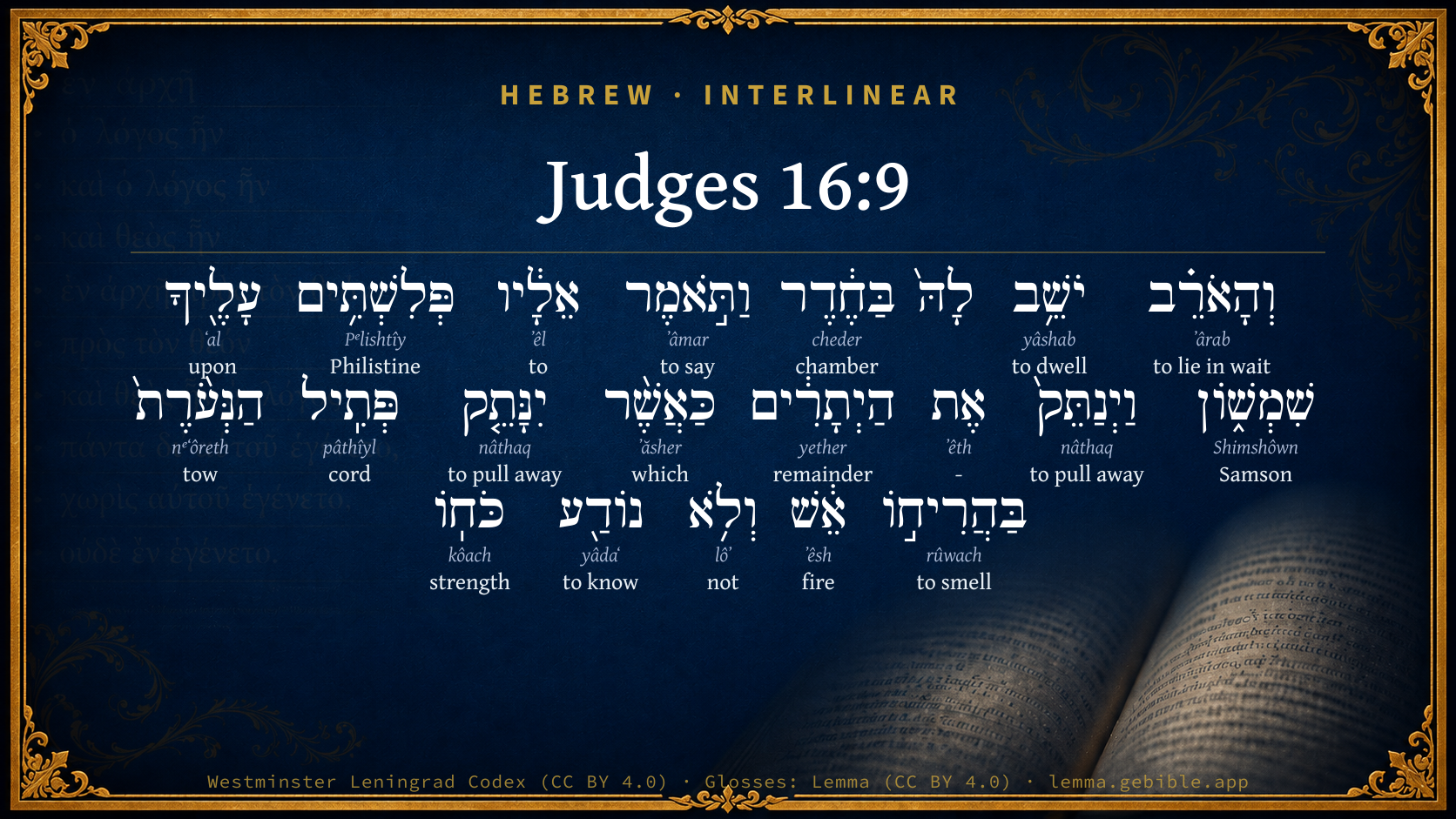
Judges 16:9

Hebrew (Westminster Leningrad Codex) Judges 16:9 appears in the Hebrew Old Testament. The text above is from the Westminster Leningrad Codex. Each word links to its Strong’s number, a concise gloss, and parsing drawn from the Open Scriptures Hebrew Bible morphology. Click any word for its full Brown-Driver-Briggs (BDB) entry.
Download image
Cite this verse

Judges 16:9 (World English Bible). Public Domain. Lemma interlinear Bible study tool, https://lemma.gebible.app/v/judges/16/9.

Show BibTeX & RIS
BibTeX
RIS
English Translation
Now she had liers-in-wait abiding in the inner chamber. She said to him, The Philistines are on you, Samson. He broke the cords, as a string of tow is broken when it touches the fire. So his strength was not known.
World English Bible · Public Domain
Highlights
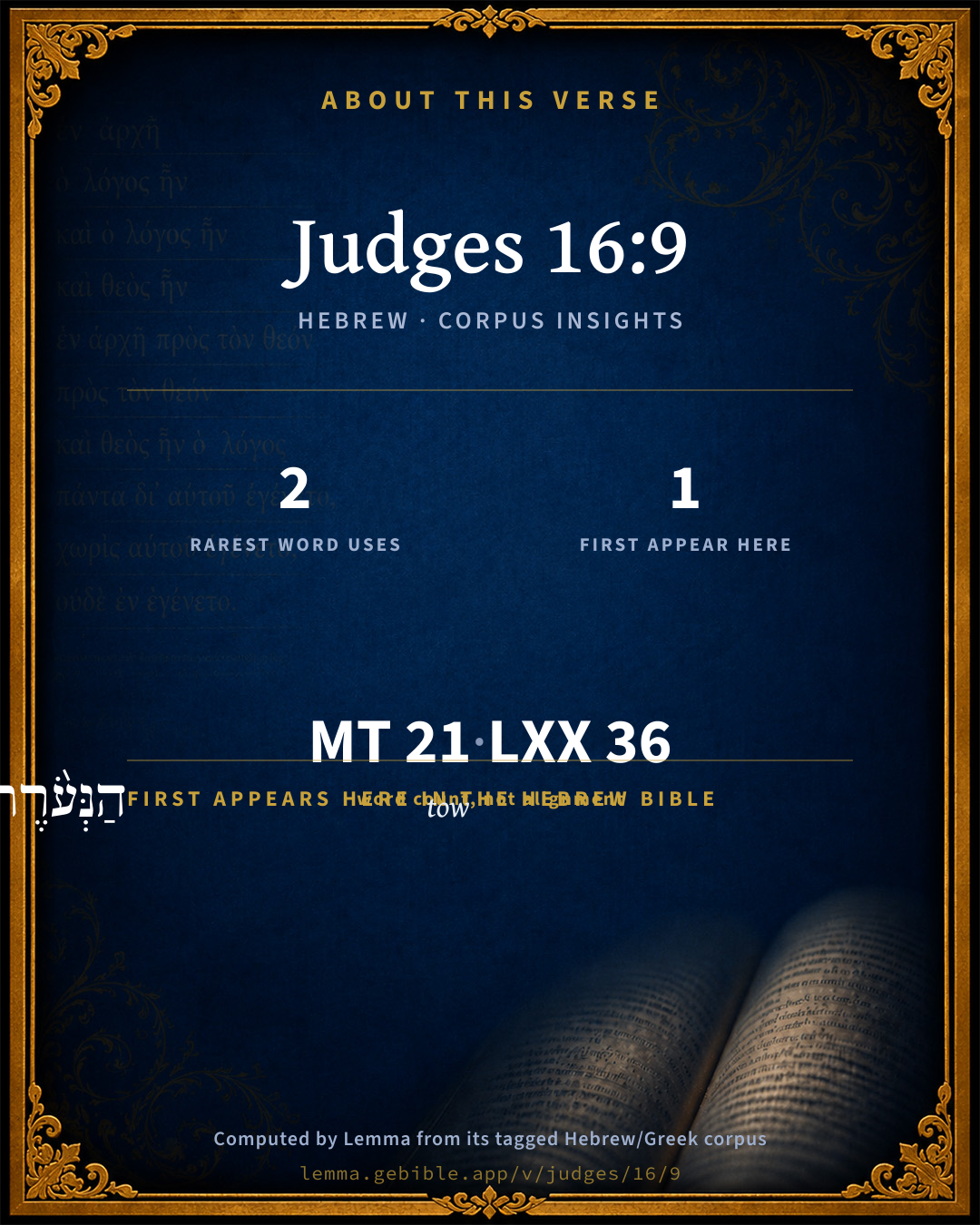
  • 1 first appearance in the Hebrew Bible
Full analysis ↓
Download a study sheet

One document with this verse’s original text, its word-by-word gloss line, the meaning frame, cross-references with their text, attributed commentary, and full source and license credits — printable, and it pastes into notes with its structure intact.

This verse Autodidact and up

Study sheet (.html) Plain text (.txt)

A passage Seminary Student

Up to 50 verses in one chapter. A passage sheet keeps up to 6 commentary sources and 12 cross-references per verse, in the order this page ranks them, and says so on the sheet whenever that leaves anything out. Ask for a single verse and you get the Autodidact verse sheet above.

Everything on this page stays free to read, with no account — the sheet is a download of what is already on screen, not access to it.

Want to remove ads? Support Godless Engineer
Compare translations 3

The same verse in 3 English versions, stacked beneath the original-language interlinear above. Click any original word for its lexicon entry.

Each is an independent rendering of the whole verse — the interlinear is not word-aligned to these translations.

Highlighted words mark where these versions differ — a whole-verse word diff, not a word-by-word alignment.

  • World English Bible Public Domain
    Now she had liers-in-wait abiding in the inner chamber. She said to him, The Philistines are on you, Samson. He broke the cords, as a string of tow is broken when it touches the fire. So his strength was not known.
  • King James Version Public Domain
    Now there were men lying in wait, abiding with her in the chamber. And she said unto him, The Philistines be upon thee, Samson. And he brake the withes, as a thread of tow is broken when it toucheth the fire. So his strength was not known.
  • unfoldingWord Literal Text CC BY-SA 4.0
    Now the ambush staying for her in the room. And she said to him, “The Philistines upon you, Samson!” But he broke the cords just as a string of flax is broken in its touching fire. So his strength was not known.

unfoldingWord Literal Text — © unfoldingWord, licensed CC BY-SA 4.0. Word-aligned USFM3 via Door43 (git.door43.org/unfoldingWord/en_ult).

Versions to compare (up to 4)

3 of 4 selected

Show all 18 translations

Every available English version of this verse, each an independent rendering of the whole verse.

  • World English Bible Public Domain
    Now she had liers-in-wait abiding in the inner chamber. She said to him, The Philistines are on you, Samson. He broke the cords, as a string of tow is broken when it touches the fire. So his strength was not known.
  • Berean Standard Bible Public Domain
    While the men were hidden in her room, she called out, “Samson, the Philistines are here!” But he snapped the bowstrings like a strand of yarn seared by a flame. So the source of his strength remained unknown.
  • Majority Standard Bible Public Domain
    While the men were hidden in her room, she called out, “Samson, the Philistines are here!” But he snapped the bowstrings like a strand of yarn seared by a flame. So the source of his strength remained unknown.
  • King James Version Public Domain
    Now there were men lying in wait, abiding with her in the chamber. And she said unto him, The Philistines be upon thee, Samson. And he brake the withes, as a thread of tow is broken when it toucheth the fire. So his strength was not known.
  • American Standard Version (1901) Public Domain
    Now she had liers-in-wait abiding in the inner chamber. And she said unto him, The Philistines are upon thee, Samson. And he brake the withes, as a string of tow is broken when it toucheth the fire. So his strength was not known.
  • Revised Version (1885) Public Domain
    Now she had liers in wait abiding in the inner chamber. And she said unto him, The Philistines be upon thee, Samson. And he brake the withes, as a string of tow is broken when it toucheth the fire. So his strength was not known.
  • Geneva Bible (1599) Public Domain
    (And she had men lying in wayte with her in the chamber) Then she said vnto him, The Philistims be vpon thee, Samson. And hee brake the cordes, as a threede of towe is broken, when it feeleth fire: so his strength was not knowen.
  • Douay-Rheims (1899) Public Domain
    Men lying privately in wait with her, and in the chamber expecting the event of the thing, and she cried out to him: The Philistines are upon thee, Samson. And he broke the bands, as a man would break a thread of tow twined with spittle, when it smelleth the fire: so it was not known wherein his strength Jay.
  • Young's Literal Translation Public Domain
    And the ambush is abiding with her in an inner chamber, and she saith unto him, `Philistines `are' upon thee, Samson;' and he breaketh the withs as a thread of tow is broken in its smelling fire, and his power hath not been known.
  • Literal Standard Version CC BY-SA 4.0
    And the ambush is abiding with her in an inner chamber, and she says to him, “Philistines [are] on you, Samson!” And he breaks the cords as a thread of tow is broken in its touching fire, and his power has not been known.
  • Unlocked Literal Bible CC BY-SA 4.0
    Now she had men hiding in secret, staying in her inner room. She said to him, “The Philistines are upon you, Samson!” But he broke the bowstrings like a thread of yarn when it touches the fire. So the secret of his strength was not discovered.
  • unfoldingWord Literal Text CC BY-SA 4.0
    Now the ambush staying for her in the room. And she said to him, “The Philistines upon you, Samson!” But he broke the cords just as a string of flax is broken in its touching fire. So his strength was not known.
  • Darby Bible Public Domain
    Now she had men lying in wait in an inner chamber. And she said to him, "The Philistines are upon you, Samson!" But he snapped the bowstrings, as a string of tow snaps when it touches the fire. So the secret of his strength was not known.
  • World Messianic Bible Public Domain
    Now she had an ambush waiting in the inner room. She said to him, “The Philistines are on you, Samson!” He broke the cords as a flax thread is broken when it touches the fire. So his strength was not known.
  • Webster's Bible Public Domain
    (Now there were men lying in wait, abiding with her in the chamber.) And she said to him, The Philistines are upon thee, Samson. And he broke the withs as a thread of tow is broken when it toucheth the fire. So his strength was not known.
  • Free Bible Version CC BY-SA 4.0
    Having arranged for men to hide in her bedroom ready to attack him, she shouted out, “Samson, the Philistines are here to get you!” But he snapped the bowstrings like a thread snaps when a flame touches it. So nobody found out where his strength came from.
  • Bible in Basic English Public Domain
    Now she had men waiting secretly in the inner room; and she said to him, The Philistines are on you, Samson. And the cords were broken by him as a twist of thread is broken when touched by a flame. So the secret of his strength did not come to light.
  • JPS Tanakh (1917) Public Domain
    Now she had liers-in-wait abiding in the inner chamber. And she said unto him: 'The Philistines are upon thee, Samson.' And he broke the bowstrings as a string of tow is broken when it toucheth the fire. So his strength was not known.

Literal Standard Version (2020), Covenant Press — licensed CC BY-SA 4.0. Text via the HelloAO Bible API (eBible.org). Unlocked Literal Bible (unfoldingWord) — licensed CC BY-SA 4.0. Text via the HelloAO Bible API (eBible.org). unfoldingWord Literal Text — © unfoldingWord, licensed CC BY-SA 4.0. Word-aligned USFM3 via Door43 (git.door43.org/unfoldingWord/en_ult). Free Bible Version, Dr. Jonathan Gallagher — licensed CC BY-SA 4.0. Text via the HelloAO Bible API (eBible.org).

Word by word

More ways to search: Search by grammar → Find every occurrence → Compare this word →

Practice this passage: Drill this verse → Learn its vocabulary →

הַנְּעֹ֨רֶת֙
nᵉʻôreth
H5296
“the · tow”
Particle, Definite Article + Noun, Common, Feminine, Singular, Absolute
Part of Speech
Particle + Noun
Type
Common
Gender
Feminine
Number
Singular
State
Absolute
Full BDB Definition

Origin: from H5287

TWOT: 1388b

a strand of flax, tow (as shaken from flax when beaten)
  1. וְהָאֹרֵ֗ב ʼârab H693 “and · the · lying in wait” Conjunction + Particle, Definite Article + Verb, Qal, Participle Active, Masculine, Singular, Absolute
  2. יֹשֵׁ֥ב yâshab H3427 “dwelling” Verb, Qal, Participle Active, Masculine, Singular, Absolute
  3. בַּחֶ֔דֶר cheder H2315 “in/at the · chamber” Preposition, Determined + Noun, Common, Masculine, Singular, Absolute
  4. וַתֹּ֣אמֶר ʼâmar H559 “and · to say” Conjunction + Verb, Qal, Sequential Imperfect, 3rd Person, Feminine, Singular
  5. אֵלָ֔יו ʼêl H413 “to · him” Preposition + Suffix, Personal, 3rd Person, Masculine, Singular
  6. פְּלִשְׁתִּ֥ים Pᵉlishtîy H6430 “Philistines” Noun, Gentilic, Masculine, Plural, Absolute
  7. עָלֶ֖יךָ ʻal H5921 “upon · you” Preposition + Suffix, Personal, 2nd Person, Masculine, Singular
  8. שִׁמְשׁ֑וֹן Shimshôwn H8123 “Samson” Noun, Proper
  9. וַיְנַתֵּק֙ nâthaq H5423 “and · to pull away” Conjunction + Verb, Piel, Sequential Imperfect, 3rd Person, Masculine, Singular
  10. אֶת ʼêth H853 “-” Particle, Direct Object
  11. הַיְתָרִ֔ים yether H3499 “the · remainders” Particle, Definite Article + Noun, Common, Masculine, Plural, Absolute
  12. כַּאֲשֶׁ֨ר ʼăsher H834 “like/as · which” Preposition + Particle, Relative
  13. יִנָּתֵ֤ק nâthaq H5423 “to pull away” Verb, Niphal, Imperfect, 3rd Person, Masculine, Singular
  14. פְּתִֽיל pâthîyl H6616 “cord of” Noun, Common, Masculine, Singular, Construct
  15. בַּהֲרִיח֣וֹ rûwach H7306 “in/at · to smell · him” Preposition + Verb, Hiphil, Infinitive Construct + Suffix, Personal, 3rd Person, Masculine, Singular
  16. אֵ֔שׁ ʼêsh H784 “fire” Noun, Common, Both, Singular, Absolute
  17. וְלֹ֥א lôʼ H3808 “and · not” Conjunction + Particle, Negative
  18. נוֹדַ֖ע yâdaʻ H3045 “to know” Verb, Niphal, Perfect, 3rd Person, Masculine, Singular
  19. כֹּחֽוֹ kôach H3581 “strength · his” Noun, Common, Masculine, Singular, Construct + Suffix, Personal, 3rd Person, Masculine, Singular

About this verse

These counts appear in no published source. They are computed here, from the morphology-tagged text and Lemma’s own curated glosses. What Lemma adds →

21
words
19
distinct lemmas
Historical
section

Notable vocabulary

The rarest word here is הַנְּעֹ֨רֶת֙ tow H5296 — appearing just 2 times in the whole Hebrew Bible.

First appearance in Scripture

This word makes its first canonical appearance in the Hebrew Bible here:

  • הַנְּעֹ֨רֶת֙ tow H5296

Shared distinctive vocabulary

הַנְּעֹ֨רֶת֙ tow H5296 occurs in 2 verses of the Hebrew Bible. Also found in:

Grammatical profile

  • 7 verbs
  • 8 nouns
  • 3 prepositions
  • 3 particles

Verb forms

  • וְהָאֹרֵ֗ב Qal · Participle Active
  • יֹשֵׁ֥ב Qal · Participle Active
  • וַתֹּ֣אמֶר Qal · Sequential Imperfect
  • וַיְנַתֵּק֙ Piel · Sequential Imperfect
  • יִנָּתֵ֤ק Niphal · Imperfect
  • בַּהֲרִיח֣וֹ Hiphil · Infinitive Construct
  • נוֹדַ֖ע Niphal · Perfect

Repetition

A word recurs within this verse — often emphatic in Hebrew:

  • וַיְנַתֵּק֙ to pull away H5423 ×2

Hebrew & Septuagint length

In English translation the verse runs 41 words from the Hebrew and 49 from the Septuagint (LXX English) — closely comparable.

A rough comparison of the two English renderings, which tokenize alike — not a word-level alignment.

Word counts can differ between the Hebrew and the Greek without any difference in meaning — e.g. the Hebrew direct-object marker אֵת has no separate Greek word, and Greek often adds the article ὁ.

In the original languages it is 21 Hebrew tokens and 36 Greek tokens — but the two are counted differently (Hebrew bundles its prefixes and suffixes into one token; the Greek is in lemma form), so that isn’t a like-for-like length.

Cross-references

1

Topical passages linked to Judges 16:9 in the Treasury of Scripture Knowledge — connected by theme and wording, ordered by reader-vote popularity; previews shown in the World English Bible.

  • Psalms 58:9 Before your pots can feel the heat of the thorns, He will sweep away the green and the burning alike.

Cross-references courtesy of OpenBible.info (CC BY 4.0).

Hebrew and Greek witnesses Masoretic Hebrew ↔ Greek Septuagint

The same verse in the two great witnesses to the Old Testament, shown verse-for-verse.

These are two independent witnesses, not word-aligned to each other, and the Septuagint is shown in lemma (dictionary) form.

Hebrew Judges 16:9 Masoretic · Westminster Leningrad Codex

וְהָאֹרֵ֗ב יֹשֵׁ֥ב לָהּ֙ בַּחֶ֔דֶר וַתֹּ֣אמֶר אֵלָ֔יו פְּלִשְׁתִּ֥ים עָלֶ֖יךָ שִׁמְשׁ֑וֹן וַיְנַתֵּק֙ אֶת הַיְתָרִ֔ים כַּאֲשֶׁ֨ר יִנָּתֵ֤ק פְּתִֽיל הַנְּעֹ֨רֶת֙ בַּהֲרִיח֣וֹ אֵ֔שׁ וְלֹ֥א נוֹדַ֖ע כֹּחֽוֹ

Now she had liers-in-wait abiding in the inner chamber. She said to him, The Philistines are on you, Samson. He broke the cords, as a string of tow is broken when it touches the fire. So his strength was not known.

World English Bible · Public Domain

Greek LXX Judges 16:9 Septuagint · lemma form

καί ὁ ἔνεδρον αὐτός καταἧμαι ἐν ὁ ταμιεῖον καί εἶπον αὐτός ἀλλόφυλος ἐπί σύ σαμψων καί διασπάω ὁ νευρά ὡς εἰ τις ἀποσπάω στρέμμα στιππύον ἐν ὁ ὀσφραίνομαι αὐτός πῦρ καί οὐ γιγνώσκω ὁ ἰσχύς αὐτός

And the liers in wait remained with her in the chamber; and she said to him, the Philistines are upon you, Sampson: and he broke the cords as if any one should break a thread of tow when it has touched the fire, and his strength was not known.

LXX2012 (modern English Septuagint) · Public Domain

Hebrew: Westminster Leningrad Codex (CC BY 4.0). Greek: Septuagint (public domain); English from LXX2012 (modern English Septuagint) (Public Domain). How the Septuagint differs from the Hebrew →

Targum (Aramaic paraphrase)

1

The Targum is the ancient Jewish Aramaic paraphrase of the Hebrew Scriptures — an interpretive translation, not the Hebrew text itself. Onkelos (literal) and Pseudo-Jonathan (expansive) render the Torah, and Jonathan the Prophets. Coverage is partial: where no permissively-licensed English translation exists for a verse, only the Aramaic is shown. This is verse-level text, not a word-by-word alignment to the Hebrew.

  1. Targum Jonathan Prophets (Joshua–Malachi)
    וּכְמָנָא יְתַב לָהּ בְּאִדְרוֹן בֵּית מִשְׁכְּבָא וַאֲמַרַת לֵיהּ פְּלִשְׁתָּאֵי אֲתוֹ עֲלָךְ שִׁמְשׁוֹן וּפְסַק יַת יְתָרַיָא כְּמָא דְמִתְפְּסַק חוּטָא דְכִתָּנָא דַאֲרַח בֵיהּ נוּרָא וְלָא אִתְיְדַע חֵילֵיהּ:

    (no public-domain English translation for this verse)

    Targum Jonathan — Aramaic: “Mikraot Gedolot” (public domain). English: “Sefaria Community Translation” (CC0 1.0 (public-domain dedication)); “London "Chaldee Paraphrase," 1871” (public domain). Text via Sefaria.

Commentary

Notes on Judges 16:9 from classic Christian and Jewish commentators (each source and its license shown beneath its notes). The classic Christian expositions comment on the surrounding passage and are grouped to its opening verse, so a note may address several verses; the Jewish commentaries on the Tanakh (Rashi and others) are per-verse, so they appear only where the commentator wrote on this verse.

Lemma curates 59 commentaries, every one of them public domain or Creative Commons licensed, each selected and text-cleaned for this edition rather than reprinted as found. About our sources →

Trapp's Complete Commentary

John Trapp

Jdg 16:9 Now [there were] men lying in wait, abiding with her in the chamber. And she said unto him, The Philistines [be] upon thee, Samson. And he brake the withs, as a thread of tow is broken when it toucheth the fire. So his strength was not known.

Ver. 9. Now there were men lying in wait.] But durst not for their ears show themselves, till the experiment should prove true, and they be sure to overcome him.

John Trapp, A Commentary or Exposition upon All the Books of the Old and New Testament (1647–1656) — public domain. Text from a community e-Sword module.

Joseph Benson's Commentary

Jdg 16:9. There were men abiding with her in the chamber — In some closet, probably, or adjoining room; for it cannot be well imagined, that they could be in the very same chamber without being discovered by Samson. It appears the Philistines were rather desirous of taking him alive than killing him. Probably they thought to employ him in some laborious works for the public, wherein his great strength might be of use to them, if they could but take him alive. Otherwise the liers in wait might have taken the opportunity of killing him while he was asleep, if their orders had not been to take him alive.

Joseph Benson's Commentary on the Old and New Testaments (1811–1818) — public domain. Text from a community e-Sword module.

Geneva Bible (1599)

Geneva Bible translators

Certain Philistines in a secret chamber.

When fire cometh near it.

Geneva Bible (1599) marginal notes — public domain. Text via Bolls.life.

Jamieson, Fausset & Brown

Robert Jamieson, A. R. Fausset & David Brown

there were men lying in wait, abiding . . . in the chamber--The Hebrew, literally rendered, is, "in the inner," or "most secret part of the house."

Jamieson, Fausset & Brown — Commentary Critical and Explanatory on the Whole Bible (1871) — public domain (CC PDM 1.0). Text via the HelloAO Bible API.

Adam Clarke's Commentary

Verse 9. Men lying in wait] They probably did not appear, as Samson immediately broke his bonds when this bad woman said, The Philistines be upon thee.

Adam Clarke's Commentary on the Bible (1810–1826) — public domain. Text from a community e-Sword/MySword module.

Ellicott's Commentary for English Readers

(9) Men lying in wait.—Literally, and the spy sat in the room for her, i.e., to help her. It is doubtful whether there was more than one spy, who could be easily concealed. It is implied that she bound Samson while he slept, as in Jdg_16:19.

When it toucheth the fire.—Literally, when it smelleth the fire. (See Note on Jdg_15:14.) So in Job_14:9 : “through the scent of water it will bud.” Of course the writer leaves us to infer that the spy or spies did not appear, seeing that the plan had failed.

A Bible Commentary for English Readers, edited by Charles John Ellicott (1878–1897) — public domain. Text from a community e-Sword module.

John Gill's Exposition

Now there were men lying in wait,.... Very likely some of the servants of the lords of the Philistines, who were placed privately on purpose, that when an opportunity offered, they might rush out, and fall upon Samson; Josephus (y) calls them soldiers:

abiding with her in the chamber; in a private part of it, or otherwise they could not be said to lie in wait; in it may mean near it; perhaps it was in the next apartment to hers, where they were set:

and she said unto him, the Philistines be upon thee, Samson; are just ready to fall upon thee, and seize thee; this she said to arouse him, and try whether he could break the withs or not, before she called in the men that lay in wait, and whether he had told her the truth or not:

and he brake the withs as a thread of tow is broken when it toucheth the fire; or "smells it" (z); as soon as it comes near it; a thread of tow or linen catches the fire presently, it being so weak that it cannot stand before the least force of it; so easily did the withs give way, and were broken, when Samson did but just stir himself, and move his arms:

so his strength was not known; by Delilah, nor by the Philistines; that is, where it lay, so as that it might be weakened; for otherwise it was known by the easy breaking of the withs.

(y) Antiqu. l. 5. c. 8. sect. 11. (z) "cum olfecerit", Drusius, so Piscator.

John Gill's Exposition of the Whole Bible (1746–1763) — public domain (CC PDM 1.0). Text via the HelloAO Bible API.

Haydock's Catholic Bible Commentary

Fire. Protestants, "and he brake the withs, as a thread of tow is broken when it toucheth the fire." (Haydock) --- Thus he played with her, never suspecting that the enemy was concealed so near. (Calmet)

George Leo Haydock (1774–1849), Haydock's Catholic Family Bible and Commentary, 1859 edition — public domain. Excludes Psalms (Douay-Rheims chapter numbering differs from Protestant) and Deuterocanonical books (Catholic canon only).

Matthew Poole's English Annotations

With her in the chamber; with her, i.e. in the same house, in a chamber, i.e. in a secret chamber within her call. Nor is it strange that they did not fall upon him in his sleep; partly because they feared to awake a sleeping lion; and partly because they expect an opportunity for doing their work more certainly, and with less danger.

Matthew Poole's English Annotations on the Holy Bible (1683–1685) — public domain. Text from a community e-Sword/MySword module.

Whedon's Commentary on the Bible

Daniel D. Whedon

9. Men lying in wait — Hebrew, the lier in wait. She had a spy lying in ambush in an adjoining apartment, ready to take care of the fettered giant when it became evident that he was helpless. It is not likely that she went so far as to betray her real purposes by having this spy rush out upon Samson when she uttered her alarm cry.

The Philistines be upon thee, Samson — This she uttered to awake him in fright, and see what he would do.

Daniel D. Whedon (gen. ed.), Commentary on the Old and New Testaments (1874–1909) — public domain. Text from a community e-Sword module.

The Pulpit Commentary

There were men lying in wait literally, and the liers in wait were abiding for her in the chamber. She had hid some three or four men in the chamber unknown to Samson, that they might be ready to fall upon him should his strength really have departed from him. The word for liers in wait is in the singular number, but is to be taken collectively, as in Jud_1:20:33, 36-38. In Jud_1:20:37 it is joined to a plural verb. It is to be presumed that through some concerted signal the liers in wait did not discover themselves.

The Pulpit Commentary (1880–1919), ed. H.D.M. Spence-Jones & Joseph S. Exell — public domain. Text from a community e-Sword module.

John Wesley's Explanatory Notes

With her - That is, in a secret chamber within her call. Nor is it strange that they did not fall upon him in his sleep, because they expected an opportunity for doing their work more certainly, and with less danger.

John Wesley, Explanatory Notes Upon the Whole Bible (1754–1765) — public domain. Text via the GEBible commentary corpus.

Rashi

Rabbi Shlomo Yitzchaki (Rashi)

The source of his strength was not revealed. It was not necessary for him to exert himself when he snapped them.

Rashi on the Tanakh — English translations: “The Judaica Press complete Tanach with Rashi, translated by A. J. Rosenberg” (CC BY 4.0); “Pentateuch with Rashi's commentary by M. Rosenbaum and A.M. Silbermann, 1929-1934” (public domain); “The Metsudah Tanach series, Lakewood, N.J” (CC BY 4.0); and “The Book of Joshua, Metsudah Publications, 1997” (CC BY 4.0). Text via Sefaria.

Lesson kit

Teaching starters — assembled from the data on this page, not authored interpretation. Every prompt links to the verse data it draws on. Edit before teaching.

Judges, in the Historical, opens this verse with 21 words (19 distinct Hebrew lemmas). Its most distinctive word is nᵉʻôreth (“tow”). A historical commentator’s framing appears above. Read the whole chapter for the surrounding context.

Discussion questions

  1. How does “tow” (nᵉʻôreth) shape what this verse is saying?
  2. The word “tow” first appears here in Scripture. What is being introduced at this debut?
  3. Isaiah 1:31 shares the word «tow» with this verse. How do the two illuminate each other?
  4. “to pull away” occurs 2× in this one verse. What is the effect of the repetition?
  5. These translations render this verse differently. What is at stake in choosing one wording over another?
  6. The verb «וְהָאֹרֵ֗ב» is Qal Participle Active. How does its form color the action?
  7. Reading how Trapp's Complete Commentary and Joseph Benson's Commentary read this verse, where do the two commentators agree and where do they part?

Things to notice

Reading settings

Reading text

Shown beneath each verse's original-language words.

Old Testament
Old Testament edition

Read the OT as the Masoretic Hebrew (MT) or the Greek Septuagint (LXX).

English shown for the Greek Septuagint (in the Hebrew ↔ Greek comparison).

Comparing translations? Open the Compare panel on any verse page to stack up to four side by side.