Numbers 16:37

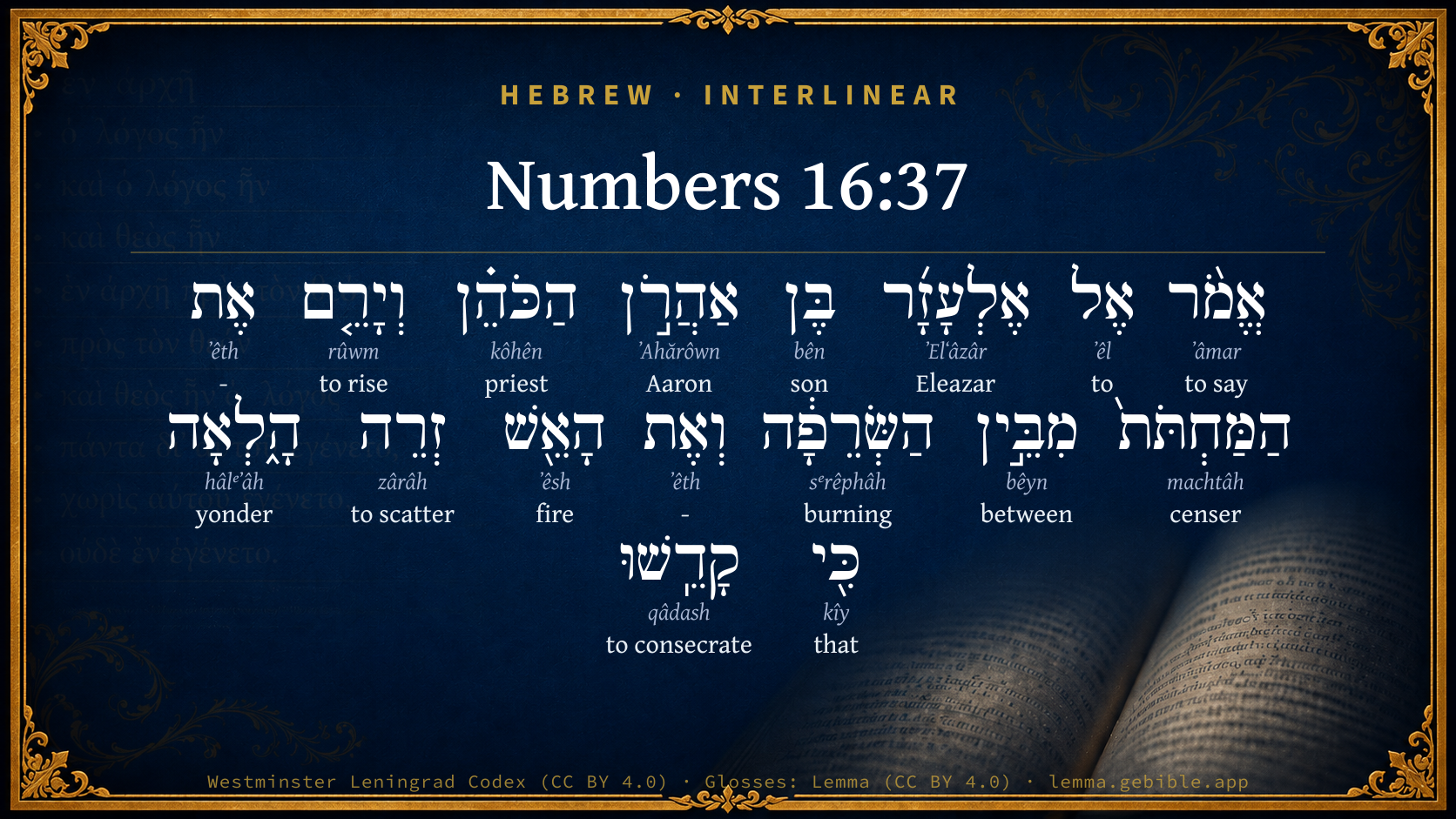
Hebrew (Westminster Leningrad Codex) Numbers 16:37 appears in the Hebrew Old Testament. The text above is from the Westminster Leningrad Codex. Each word links to its Strong’s number, a concise gloss, and parsing drawn from the Open Scriptures Hebrew Bible morphology. Click any word for its full Brown-Driver-Briggs (BDB) entry.
Download image
Cite this verse

Numbers 16:37 (World English Bible). Public Domain. Lemma interlinear Bible study tool, https://lemma.gebible.app/v/numbers/16/37.

Show BibTeX & RIS
BibTeX
RIS
English Translation
Speak to Eleazar the son of Aaron the priest, that he take up the censers out of the burning, and scatter you the fire yonder; for they are holy,
World English Bible · Public Domain
Download a study sheet

One document with this verse’s original text, its word-by-word gloss line, the meaning frame, cross-references with their text, attributed commentary, and full source and license credits — printable, and it pastes into notes with its structure intact.

This verse Autodidact and up

Study sheet (.html) Plain text (.txt)

A passage Seminary Student

Up to 50 verses in one chapter. A passage sheet keeps up to 6 commentary sources and 12 cross-references per verse, in the order this page ranks them, and says so on the sheet whenever that leaves anything out. Ask for a single verse and you get the Autodidact verse sheet above.

Everything on this page stays free to read, with no account — the sheet is a download of what is already on screen, not access to it.

Want to remove ads? Support Godless Engineer
Compare translations 3

The same verse in 3 English versions, stacked beneath the original-language interlinear above. Click any original word for its lexicon entry.

Each is an independent rendering of the whole verse — the interlinear is not word-aligned to these translations.

Highlighted words mark where these versions differ — a whole-verse word diff, not a word-by-word alignment.

  • World English Bible Public Domain
    Speak to Eleazar the son of Aaron the priest, that he take up the censers out of the burning, and scatter you the fire yonder; for they are holy,
  • King James Version Public Domain
    Speak unto Eleazar the son of Aaron the priest, that he take up the censers out of the burning, and scatter thou the fire yonder; for they are hallowed.
  • unfoldingWord Literal Text CC BY-SA 4.0
    “Say to Eleazar, the son of Aaron the priest, and he shall raise the censers from between the burning, and scatter the fire beyond, for they are holy.

unfoldingWord Literal Text — © unfoldingWord, licensed CC BY-SA 4.0. Word-aligned USFM3 via Door43 (git.door43.org/unfoldingWord/en_ult).

Versions to compare (up to 4)

3 of 4 selected

Show all 18 translations

Every available English version of this verse, each an independent rendering of the whole verse.

  • World English Bible Public Domain
    Speak to Eleazar the son of Aaron the priest, that he take up the censers out of the burning, and scatter you the fire yonder; for they are holy,
  • Berean Standard Bible Public Domain
    “Tell Eleazar son of Aaron the priest to remove the censers from the flames and to scatter the coals far away, because the censers are holy.
  • Majority Standard Bible Public Domain
    “Tell Eleazar son of Aaron the priest to remove the censers from the flames and to scatter the coals far away, because the censers are holy.
  • King James Version Public Domain
    Speak unto Eleazar the son of Aaron the priest, that he take up the censers out of the burning, and scatter thou the fire yonder; for they are hallowed.
  • American Standard Version (1901) Public Domain
    Speak unto Eleazar the son of Aaron the priest, that he take up the censers out of the burning, and scatter thou the fire yonder; for they are holy,
  • Revised Version (1885) Public Domain
    Speak unto Eleazar the son of Aaron the priest, that he take up the censers out of the burning, and scatter thou the fire yonder; for they are holy;
  • Geneva Bible (1599) Public Domain
    Speake vnto Eleazar, the sonne of Aaron the Priest, that he take vp the censers out of the burning, and scatter the fire beyond the altar: for they are halowed,
  • Douay-Rheims (1899) Public Domain
    Command Eleazar the son of Aaron the priest to take up the censers that lie in the burning, and to scatter the fire of one side and the other: because they are sanctified
  • Young's Literal Translation Public Domain
    `Say unto Eleazar son of Aaron the priest, and he lifteth up the censers from the midst of the burning, and the fire scatter thou yonder, for they have been hallowed,
  • Literal Standard Version CC BY-SA 4.0
    “Say to Eleazar son of Aaron the priest to lift up the censers from the midst of the burning and scatter the fire away, for they have been hallowed.
  • Unlocked Literal Bible CC BY-SA 4.0
    “Speak to Eleazar son of Aaron the priest and let him take up the censers out of the flames, for the censers are set apart to me. Then let him scatter the burning coals at a distance.
  • unfoldingWord Literal Text CC BY-SA 4.0
    “Say to Eleazar, the son of Aaron the priest, and he shall raise the censers from between the burning, and scatter the fire beyond, for they are holy.
  • Darby Bible Public Domain
    Speak to Eleazar the son of Aaron the priest, that he take up the censers out of the burning; and scatter the fire afar; for they are hallowed,
  • World Messianic Bible Public Domain
    “Speak to Eleazar the son of Aaron the priest, that he take up the censers out of the burning, and scatter the fire away from the camp; for they are holy,
  • Webster's Bible Public Domain
    Speak to Eleazar the son of Aaron the priest, that he take up the censers out of the burning, and scatter thou the fire yonder; for they are hallowed.
  • Free Bible Version CC BY-SA 4.0
    “Tell Eleazar, son of Aaron the priest, to collect the holy incense burners from among those who have been burned up, and scatter the coals used for the incense well away from the camp.
  • Bible in Basic English Public Domain
    Say to Eleazar, the son of Aaron the priest, that he is to take out of the flames the vessels with the perfumes in them, turning the fire out of them, for they are holy;
  • JPS Tanakh (1917) Public Domain
    (17-2) 'Speak unto Eleazar the son of Aaron the priest, that he take up the fire-pans out of the burning, and scatter thou the fire yonder; for they are become holy;

Literal Standard Version (2020), Covenant Press — licensed CC BY-SA 4.0. Text via the HelloAO Bible API (eBible.org). Unlocked Literal Bible (unfoldingWord) — licensed CC BY-SA 4.0. Text via the HelloAO Bible API (eBible.org). unfoldingWord Literal Text — © unfoldingWord, licensed CC BY-SA 4.0. Word-aligned USFM3 via Door43 (git.door43.org/unfoldingWord/en_ult). Free Bible Version, Dr. Jonathan Gallagher — licensed CC BY-SA 4.0. Text via the HelloAO Bible API (eBible.org).

Word by word

More ways to search: Search by grammar → Find every occurrence → Compare this word →

Practice this passage: Drill this verse → Learn its vocabulary →

הַשְּׂרֵפָ֔ה
sᵉrêphâh
H8316
“the · burning”
Particle, Definite Article + Noun, Common, Feminine, Singular, Absolute
Part of Speech
Particle + Noun
Type
Common
Gender
Feminine
Number
Singular
State
Absolute
Full BDB Definition

Origin: from H8313

TWOT: 2292c

burning
  1. אֱמֹ֨ר ʼâmar H559 “say” Verb, Qal, Imperative, 2nd Person, Masculine, Singular
  2. אֶל ʼêl H413 “to” Preposition
  3. אֶלְעָזָ֜ר ʼElʻâzâr H499 “Eleazar” Noun, Proper
  4. בֶּן bên H1121 “son of” Noun, Common, Masculine, Singular, Construct
  5. אַהֲרֹ֣ן ʼAhărôwn H175 “Aaron” Noun, Proper
  6. הַכֹּהֵ֗ן kôhên H3548 “the · priest” Particle, Definite Article + Noun, Common, Masculine, Singular, Absolute
  7. וְיָרֵ֤ם rûwm H7311 “and · to rise” Conjunction + Verb, Hiphil, Jussive, 3rd Person, Masculine, Singular
  8. אֶת ʼêth H853 “-” Particle, Direct Object
  9. הַמַּחְתֹּת֙ machtâh H4289 “the · censers” Particle, Definite Article + Noun, Common, Feminine, Plural, Absolute
  10. מִבֵּ֣ין bêyn H996 “from · between” Preposition + Preposition
  11. וְאֶת ʼêth H853 “and · -” Conjunction + Particle, Direct Object
  12. הָאֵ֖שׁ ʼêsh H784 “the · fire” Particle, Definite Article + Noun, Common, Both, Singular, Absolute
  13. זְרֵה zârâh H2219 “scatter” Verb, Qal, Imperative, 2nd Person, Masculine, Singular
  14. הָ֑לְאָה hâlᵉʼâh H1973 “yonder” Adverb
  15. כִּ֖י kîy H3588 “that” Conjunction
  16. קָדֵֽשׁוּ qâdash H6942 “to consecrate” Verb, Qal, Perfect, 3rd Person, Common, Plural

About this verse

These counts appear in no published source. They are computed here, from the morphology-tagged text and Lemma’s own curated glosses. What Lemma adds →

17
words
16
distinct lemmas
Pentateuch
section

Notable vocabulary

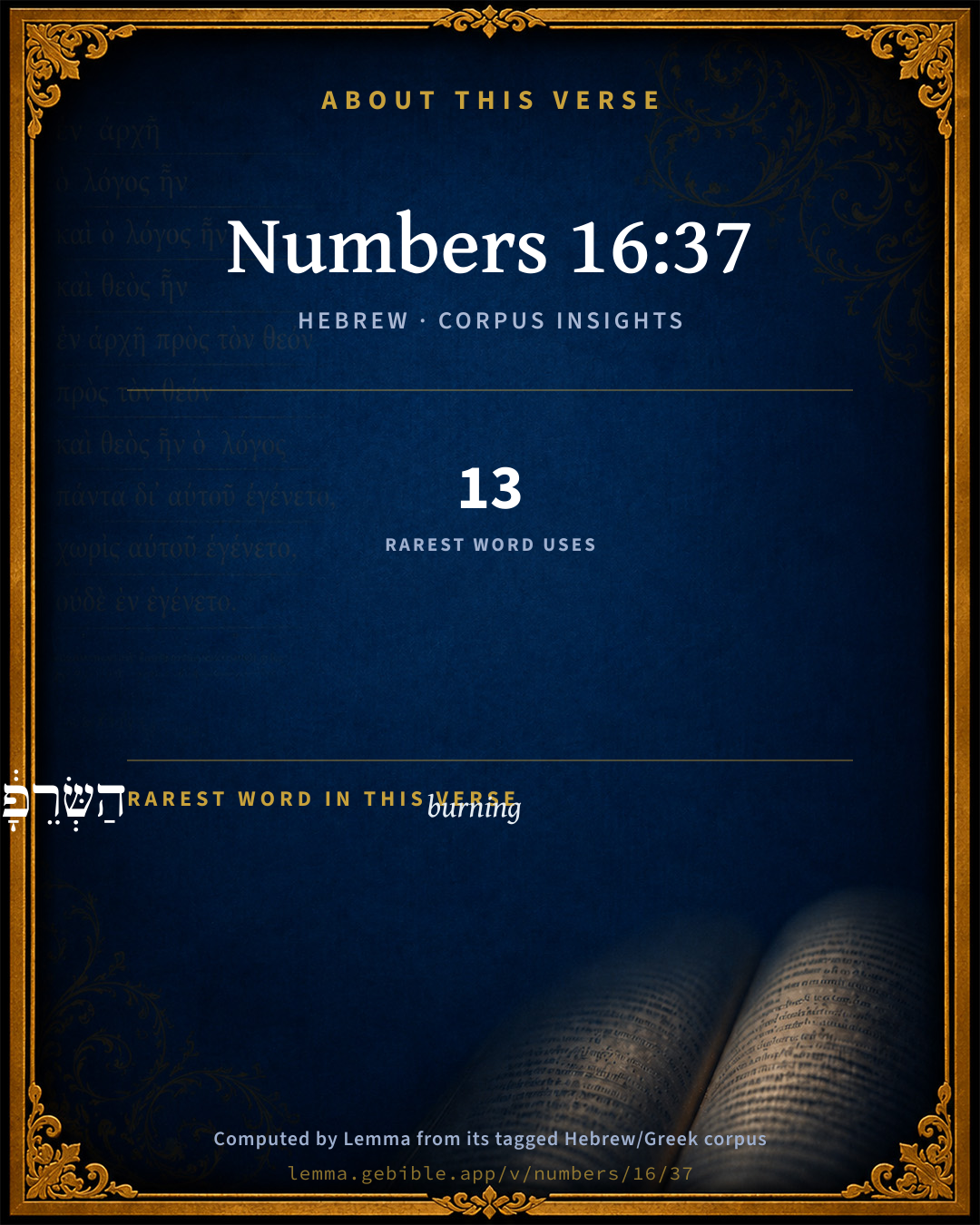
The rarest word here is הַשְּׂרֵפָ֔ה burning H8316 — appearing just 13 times in the whole Hebrew Bible.

Shared distinctive vocabulary

הַשְּׂרֵפָ֔ה burning H8316 occurs in 12 verses of the Hebrew Bible. Also found in:

Grammatical profile

  • 4 verbs
  • 7 nouns
  • 2 prepositions
  • 1 conjunction
  • 1 adverb
  • 2 particles

Verb forms

  • אֱמֹ֨ר Qal · Imperative
  • וְיָרֵ֤ם Hiphil · Jussive
  • זְרֵה Qal · Imperative
  • קָדֵֽשׁוּ Qal · Perfect

Hebrew & Septuagint length

In English translation the verse runs 29 words from the Hebrew and 37 from the Septuagint (LXX English) — closely comparable.

A rough comparison of the two English renderings, which tokenize alike — not a word-level alignment.

Word counts can differ between the Hebrew and the Greek without any difference in meaning — e.g. the Hebrew direct-object marker אֵת has no separate Greek word, and Greek often adds the article ὁ.

Cross-references

3

Topical passages linked to Numbers 16:37 in the Treasury of Scripture Knowledge — connected by theme and wording, ordered by reader-vote popularity; previews shown in the World English Bible.

  • Leviticus 27:28 "'Notwithstanding, no devoted thing, that a man shall devote to Yahweh of all that he has, whether of man or animal, or of the field of his possession, shall be sold or redeemed: every devoted thing is most holy to Yahweh.
  • Numbers 16:7 and put fire in them, and put incense on them before Yahweh tomorrow: and it shall be that the man whom Yahweh does choose, he [shall be] holy: you take too much on you, you sons of Levi.
  • Numbers 16:18 They took every man his censer, and put fire in them, and laid incense thereon, and stood at the door of the tent of meeting with Moses and Aaron.

Cross-references courtesy of OpenBible.info (CC BY 4.0).

Hebrew and Greek witnesses Masoretic Hebrew ↔ Greek Septuagint

The same verse in the two great witnesses to the Old Testament, shown verse-for-verse.

These are two independent witnesses, not word-aligned to each other, and the Septuagint is shown in lemma (dictionary) form.

Hebrew Numbers 16:37 Masoretic · Westminster Leningrad Codex

אֱמֹ֨ר אֶל אֶלְעָזָ֜ר בֶּן אַהֲרֹ֣ן הַכֹּהֵ֗ן וְיָרֵ֤ם אֶת הַמַּחְתֹּת֙ מִבֵּ֣ין הַשְּׂרֵפָ֔ה וְאֶת הָאֵ֖שׁ זְרֵה הָ֑לְאָה כִּ֖י קָדֵֽשׁוּ

Speak to Eleazar the son of Aaron the priest, that he take up the censers out of the burning, and scatter you the fire yonder; for they are holy,

World English Bible · Public Domain

Greek LXX Numbers 16:37 Septuagint · lemma form
and to Eleazar the son of Aaron the priest, Take up the brazen censers out of the midst of the men that have been burnt, and scatter the strange fire yonder, for they have sanctified the censers

LXX2012 (modern English Septuagint) · Public Domain

On this verse, The Pulpit Commentary discusses the Septuagint’s reading. Read the note in Commentary ↓

Hebrew: Westminster Leningrad Codex (CC BY 4.0). Greek: Septuagint (public domain); English from LXX2012 (modern English Septuagint) (Public Domain). How the Septuagint differs from the Hebrew →

Commentary

Notes on Numbers 16:37 from classic Christian and Jewish commentators (each source and its license shown beneath its notes). The classic Christian expositions comment on the surrounding passage and are grouped to its opening verse, so a note may address several verses; the Jewish commentaries on the Tanakh (Rashi and others) are per-verse, so they appear only where the commentator wrote on this verse.

Lemma curates 59 commentaries, every one of them public domain or Creative Commons licensed, each selected and text-cleaned for this edition rather than reprinted as found. About our sources →

Trapp's Complete Commentary

John Trapp

Num 16:37 Speak unto Eleazar the son of Aaron the priest, that he take up the censers out of the burning, and scatter thou the fire yonder; for they are hallowed.

Ver. 37. For they are hallowed.] And therefore may not be turned to any other use.

John Trapp, A Commentary or Exposition upon All the Books of the Old and New Testament (1647–1656) — public domain. Text from a community e-Sword module.

The Biblical Illustrator

Joseph S. Exell

Num_16:37-40

Take up the censers.

Divine economy

What God has kissed must not be lost; what God has consecrated must be preserved. The two hundred and fifty men may be burned up, the censers may be scorched, but they shall be turned to some use in the sanctuary. O thou great Economist, the very stones of Thy house are sacred to Thee; they are not sacred as magically consecrated, but they are sacred because Thou hast told men to seek in the quarries of the earth and in the forests of the land for stone and wood to put together to make a sanctuary for Thee; and once Thine, Thine for ever. The stones are dear to Thee, yea, the dust of Zion is more than the constellations of the sky. If we have given anything to the Cross, it is Gods; it will never be unholy. At the beginning of every year some men say, So much for Christ. They say, There it is; every penny is His, it will all go to His treasury. Such men can never be vexed and fretted by appeals, because they have given the money, and when they have spent all the money they say so, and God is as pleased with their not giving as with their giving, because they have given it all. They first set it apart, they consecrated it, they took it to the Cross and said, Jesus, this little handful is all Thine; help me to spend it aright. It is all gone, so when the next applicant comes and gets nothing, God is not displeased. So let us give ourselves to Christ; then every hair on our head is His, and will be numbered; all our outgoings and incomings, our downsittings and uprisings, will be of consequence to Heaven. Why? Not because of the detailed action, but because the life out of which all of that action came was itself baptized, made holy with the chrism of fire. (J. Parker, D. D.)

The Biblical Illustrator, edited by Joseph S. Exell (c. 1880s–1900s) — public domain. Text from a community e-Sword module.

Tyndale Open Study Notes

Tyndale Open Resources

16:37 Although the men who used the incense burners were wicked, the vessels themselves were holy and had to be treated with care and respect. The burning coals were also holy and had to be scattered so that they would not be used for any other purpose.

Tyndale Open Study Notes — © Tyndale Open Resources, licensed CC BY-SA 4.0. Text via the HelloAO Bible API.

Jamieson, Fausset & Brown

Robert Jamieson, A. R. Fausset & David Brown

Speak unto Eleazar--He was selected lest the high priest might contract defilement from going among the dead carcasses.

Jamieson, Fausset & Brown — Commentary Critical and Explanatory on the Whole Bible (1871) — public domain (CC PDM 1.0). Text via the HelloAO Bible API.

Adam Clarke's Commentary

Verse 37. The censers - are hallowed.] קדשו kadeshu, are consecrated, i. e., to the service of God though in this instance improperly employed.

Adam Clarke's Commentary on the Bible (1810–1826) — public domain. Text from a community e-Sword/MySword module.

Ellicott's Commentary for English Readers

(37) Speak unto Eleazar the son of Aaron . . . —Aaron was shortly to be employed in an act of sacerdotal ministration and intercession, for which he would have become disqualified had he been ceremonially defiled by contact with things pertaining to the dead.

A Bible Commentary for English Readers, edited by Charles John Ellicott (1878–1897) — public domain. Text from a community e-Sword module.

The Cambridge Bible for Schools and Colleges

gen. ed. J. J. S. Perowne

37. out of the burning] From the heap of burnt corpses.

for they are holy] These words probably belong to the next verse (see n. there). The fire-pans had previously been the private property of the 250 princes (see on Num_16:6); but when they had once been employed for a sacred purpose, and had been in contact with sacred incense, they had acquired (according to a very wide-spread Semitic notion) a new quality of sacredness, which made it dangerous and wrong to use them in future for secular purposes. For this Semitic idea cf. Num_19:21; Eze_44:19; Eze_46:20; Lev_6:27; Hag_2:12 f.; Isa_45:5; and see art. ‘Holiness’ in DB. ii.

The Cambridge Bible for Schools and Colleges (gen. ed. J. J. S. Perowne; Cambridge University Press, 1878–1918) — public domain. Text from a community e-Sword module.

John Gill's Exposition

Speak unto Eleazar the son of Aaron the priest,.... His eldest son, that was to succeed him as high priest, and who perhaps was upon the spot to see the issue of things; and who, rather than Aaron, is bid to do what follows, partly because Aaron was now officiating, burning incense, and that he might not be defiled with the dead bodies; and partly because it was more proper and decent for the son to do it than the father; and it may be also because it was for the further confirmation of the priesthood in the posterity of Aaron:

that he take up the censers out of the burning; either out from among the dead bodies burnt with fire from the Lord, or out of the burning of the incense in them; these were the censers of Korah and the two hundred fifty men with him:

and scatter thou the fire yonder; the fire that was in the censers; the incense burning in them was to be cast out and scattered here and there, or carried to some unclean place at a distance, as a token of the rejection of the services of these men: and thus the Lord answered the prayer of Moses, that he would not have respect to their offering, Num 16:15; if incense is intended there; though that seems to refer only to Dathan and Abiram, and not to these two hundred fifty men:

for they are hallowed, incense being offered in them before the Lord, and therefore were not to be made use of in common service.

John Gill's Exposition of the Whole Bible (1746–1763) — public domain (CC PDM 1.0). Text via the HelloAO Bible API.

Albert Barnes' Notes on the Bible

Aaron as High Priest and as one of those that offered incense Num 16:17, could not be defiled by going among the dead.

The censers were not to be used again for censers, nor the coals on them for kindling the incense to be offered before the Lord. Yet neither of them could fittingly be employed for common purposes. The censers therefore were beaten into plates for the altar; the coals were scattered at a distance.

Albert Barnes' Notes on the Bible (1834–1885) — public domain. Text from a community e-Sword/MySword module.

Matthew Poole's English Annotations

Unto Eleazar, rather than to Aaron, partly because the tronblesome part of the work was more proper for him, and partlly lest Aaron should be polluted by going amongst those dead carcasses; for it is probable this fire consumed them, as lightning somethnes doth others, by taking away their lives, and leaving their bodies dead upon the place.

Out of the burning, i.e. from among the dead bodies of those men who were burnt. Burning put for those who are burnt, as captivity for the captives, Num 21:1, and poverty for the poor, 2Ki 24:14.

The fire, i.e. the cinders or ashes which are left in or near their censers.

Yonder, i.e. far from the altar and sanctuary, into an unclean place, where the ashes were wont to be cast; by which God shows his rejection of their services.

They are hallowed; either,

1. By God’s appointment, because they were presented before the Lord by his express order, Num 16:16,17. Or,

2. By God’s just judgment, because they, together with the persons that used them, were accursed and devoted by God, and therefore were the Lord’s, and not to be employed in any profane or common use, as appears from Lev 27:28. But the first reason is the chief, and is rendered by God himself, Num 16:38.

Matthew Poole's English Annotations on the Holy Bible (1683–1685) — public domain. Text from a community e-Sword/MySword module.

Whedon's Commentary on the Bible

Daniel D. Whedon

THE MEMORIAL CENSERS, Num_16:36-40.

37. Out of the burning — From between the burning, that is, from the hands of the men that had been burned.

Scatter… the fire yonder — That is, empty the censers of the burning coals in a distant place, and not on the holy altar.

Hallowed — Because they had been brought before Jehovah, and hence when the rebels were slain their censers fell to him as articles under the anathema.

Daniel D. Whedon (gen. ed.), Commentary on the Old and New Testaments (1874–1909) — public domain. Text from a community e-Sword module.

The Pulpit Commentary

Speak unto Eleazar. This is the first time that any special duty is assigned to Eleazar, who was destined to succeed to the high-priesthood. We may suppose that he was sent instead of his father because the duty of gathering up the censers could hardly have been carried out without incurring legal defilement by contact with the dead. Out of the burning. Or, "out of the burnt." Septuagint, ek mesou twn katakekaumenwn . From amongst the charred and smouldering corpses. Scatter thou the fire yonder; for they are hallowed. The censers had been made holy even by that sacrilegious dedication, and must never revert to any common uses; for the same reason the live coals which still remained in them were to be emptied out in a separate place.

The Pulpit Commentary (1880–1919), ed. H.D.M. Spence-Jones & Joseph S. Exell — public domain. Text from a community e-Sword module.

John Wesley's Explanatory Notes

To Eleazer - Rather than to Aaron, partly because the troublesome part of the work was more proper for him, and partly lest Aaron should be polluted by going amongst those dead carcasses; for it is probable this fire consumed them, as lightning sometimes doth, others, by taking away their lives, and leaving their bodies dead upon the place. Out of the burning - From among the dead bodies of those men who were burnt. Yonder - Far from the altar and sanctuary, into an unclean place, where the ashes were wont to be cast: by which God shews his rejection on of their services. They are hallowed - By God's appointment, because they were presented before the Lord by his express order, ver. 16, 17.

John Wesley, Explanatory Notes Upon the Whole Bible (1754–1765) — public domain. Text via the GEBible commentary corpus.

Lesson kit

Teaching starters — assembled from the data on this page, not authored interpretation. Every prompt links to the verse data it draws on. Edit before teaching.

Numbers, in the Pentateuch, opens this verse with 17 words (16 distinct Hebrew lemmas). Its most distinctive word is sᵉrêphâh (“burning”). A historical commentator’s framing appears above. Read the whole chapter for the surrounding context.

Discussion questions

  1. How does “burning” (sᵉrêphâh) shape what this verse is saying?
  2. How does Genesis 11:3, which shares the word «burning», read alongside this verse?
  3. These translations render this verse differently. What is at stake in choosing one wording over another?
  4. «אֱמֹ֨ר» is a Qal Imperative verb. How does that grammatical form shape the action described?
  5. Compare how Trapp's Complete Commentary and The Biblical Illustrator read this verse. Where do they agree or differ?

Things to notice

Reading settings

Reading text

Shown beneath each verse's original-language words.

Old Testament
Old Testament edition

Read the OT as the Masoretic Hebrew (MT) or the Greek Septuagint (LXX).

English shown for the Greek Septuagint (in the Hebrew ↔ Greek comparison).

Comparing translations? Open the Compare panel on any verse page to stack up to four side by side.