
Exodus 13:22

Hebrew (Westminster Leningrad Codex) Exodus 13:22 appears in the Hebrew Old Testament. The text above is from the Westminster Leningrad Codex. Each word links to its Strong’s number, a concise gloss, and parsing drawn from the Open Scriptures Hebrew Bible morphology. Click any word for its full Brown-Driver-Briggs (BDB) entry.
Download image
Cite this verse

Exodus 13:22 (World English Bible). Public Domain. Lemma interlinear Bible study tool, https://lemma.gebible.app/v/exodus/13/22.

Show BibTeX & RIS
BibTeX
RIS
English Translation
the pillar of cloud by day, and the pillar of fire by night, didn't depart from before the people.
World English Bible · Public Domain
Highlights
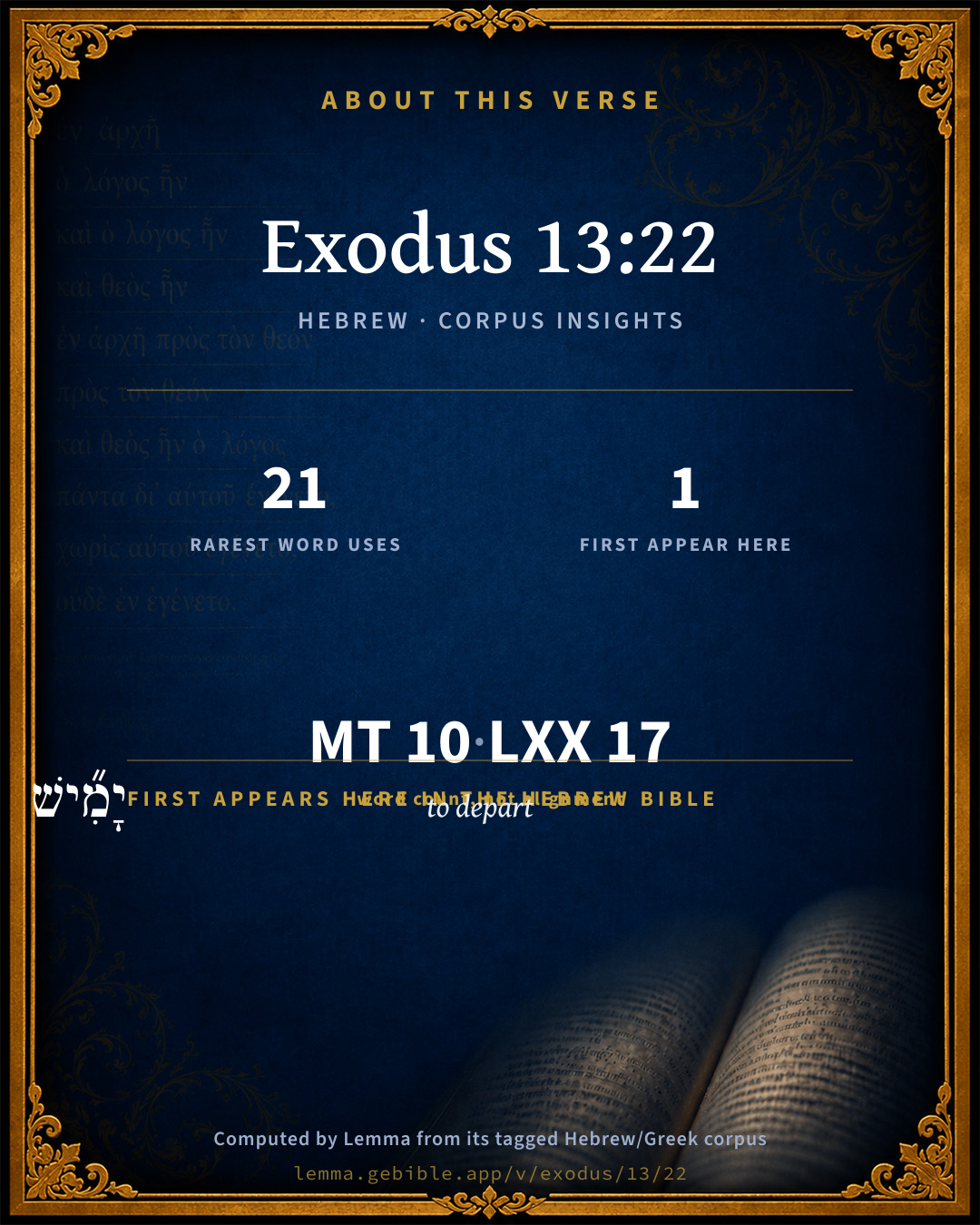
  • 1 first appearance in the Hebrew Bible
Full analysis ↓
Download a study sheet

One document with this verse’s original text, its word-by-word gloss line, the meaning frame, cross-references with their text, attributed commentary, and full source and license credits — printable, and it pastes into notes with its structure intact.

This verse Autodidact and up

Study sheet (.html) Plain text (.txt)

A passage Seminary Student

Up to 50 verses in one chapter. A passage sheet keeps up to 6 commentary sources and 12 cross-references per verse, in the order this page ranks them, and says so on the sheet whenever that leaves anything out. Ask for a single verse and you get the Autodidact verse sheet above.

Everything on this page stays free to read, with no account — the sheet is a download of what is already on screen, not access to it.

Want to remove ads? Support Godless Engineer
Compare translations 3

The same verse in 3 English versions, stacked beneath the original-language interlinear above. Click any original word for its lexicon entry.

Each is an independent rendering of the whole verse — the interlinear is not word-aligned to these translations.

Highlighted words mark where these versions differ — a whole-verse word diff, not a word-by-word alignment.

  • World English Bible Public Domain
    the pillar of cloud by day, and the pillar of fire by night, didn't depart from before the people.
  • King James Version Public Domain
    He took not away the pillar of the cloud by day, nor the pillar of fire by night, from before the people.
  • unfoldingWord Literal Text CC BY-SA 4.0
    He did not withdraw the daytime pillar of cloud or the nighttime pillar of fire from the face of the people.

unfoldingWord Literal Text — © unfoldingWord, licensed CC BY-SA 4.0. Word-aligned USFM3 via Door43 (git.door43.org/unfoldingWord/en_ult).

Versions to compare (up to 4)

3 of 4 selected

Show all 18 translations

Every available English version of this verse, each an independent rendering of the whole verse.

  • World English Bible Public Domain
    the pillar of cloud by day, and the pillar of fire by night, didn't depart from before the people.
  • Berean Standard Bible Public Domain
    Neither the pillar of cloud by day nor the pillar of fire by night left its place before the people.
  • Majority Standard Bible Public Domain
    Neither the pillar of cloud by day nor the pillar of fire by night left its place before the people.
  • King James Version Public Domain
    He took not away the pillar of the cloud by day, nor the pillar of fire by night, from before the people.
  • American Standard Version (1901) Public Domain
    the pillar of cloud by day, and the pillar of fire by night, departed not from before the people.
  • Revised Version (1885) Public Domain
    the pillar of cloud by day, and the pillar of fire by night, departed not from before the people.
  • Geneva Bible (1599) Public Domain
    He tooke not away the pillar of ye cloude by day, nor the pillar of fire by night from before the people.
  • Douay-Rheims (1899) Public Domain
    There never failed the pillar of the cloud by day, nor the pillar of fire by night, before the people.
  • Young's Literal Translation Public Domain
    He removeth not the pillar of the cloud by day, and the pillar of the fire by night, `from' before the people.
  • Literal Standard Version CC BY-SA 4.0
    He does not remove the pillar of the cloud by day, and the pillar of the fire by night, [from] before the people.
  • Unlocked Literal Bible CC BY-SA 4.0
    Yahweh did not take away from before the people the daytime pillar of cloud or the nighttime pillar of fire.
  • unfoldingWord Literal Text CC BY-SA 4.0
    He did not withdraw the daytime pillar of cloud or the nighttime pillar of fire from the face of the people.
  • Darby Bible Public Domain
    The pillar of the cloud did not remove [from] before the people by day, nor the pillar of fire by night.
  • World Messianic Bible Public Domain
    the pillar of cloud by day, and the pillar of fire by night, didn’t depart from before the people.
  • Webster's Bible Public Domain
    He took not away the pillar of the cloud by day, nor the pillar of fire by night, from before the people.
  • Free Bible Version CC BY-SA 4.0
    The pillar of cloud during the day and the pillar of fire at night were always in front of the people.
  • Bible in Basic English Public Domain
    The pillar of cloud went ever before them by day, and the pillar of fire by night.
  • JPS Tanakh (1917) Public Domain
    the pillar of cloud by day, and the pillar of fire by night, departed not from before the people.

Literal Standard Version (2020), Covenant Press — licensed CC BY-SA 4.0. Text via the HelloAO Bible API (eBible.org). Unlocked Literal Bible (unfoldingWord) — licensed CC BY-SA 4.0. Text via the HelloAO Bible API (eBible.org). unfoldingWord Literal Text — © unfoldingWord, licensed CC BY-SA 4.0. Word-aligned USFM3 via Door43 (git.door43.org/unfoldingWord/en_ult). Free Bible Version, Dr. Jonathan Gallagher — licensed CC BY-SA 4.0. Text via the HelloAO Bible API (eBible.org).

Word by word

More ways to search: Search by grammar → Find every occurrence → Compare this word →

Practice this passage: Drill this verse → Learn its vocabulary →

יָמִ֞ישׁ
mûwsh
H4185
“to depart”
Verb, Qal, Imperfect, 3rd Person, Masculine, Singular
Part of Speech
Verb
Stem
Qal
Form
Imperfect
Person
3rd Person
Gender
Masculine
Number
Singular
Full BDB Definition

Origin: a primitive root [perhaps rather the same as H4184 through the idea of receding by contact]

TWOT: 1167

to depart, remove - (Qal) - to depart - to remove - to be removed (of inanimate objects) - (Hiphil) to remove, depart
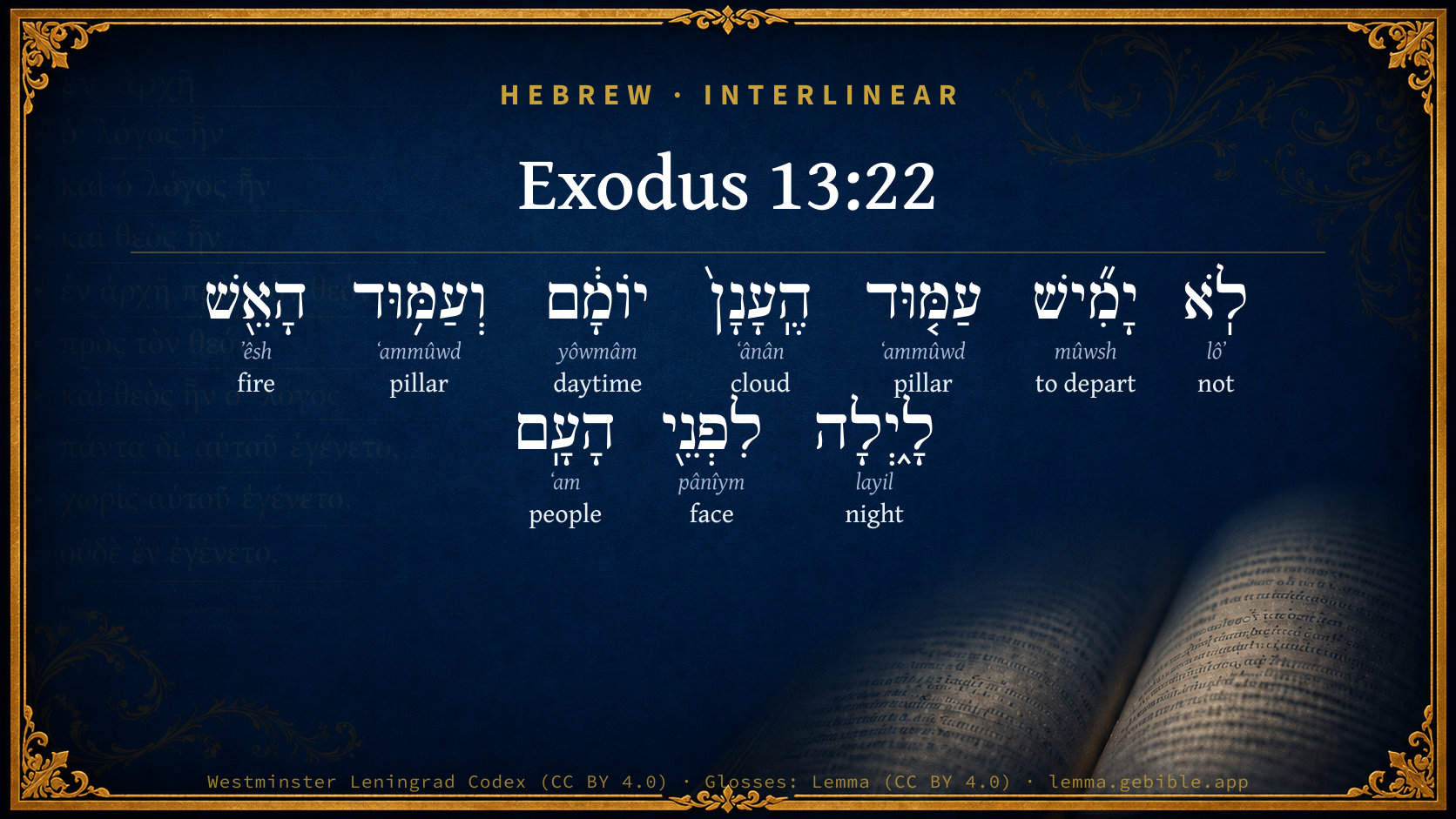
  1. לֹֽא lôʼ H3808 “not” Particle, Negative
  2. עַמּ֤וּד ʻammûwd H5982 “pillar of” Noun, Common, Masculine, Singular, Construct
  3. הֶֽעָנָן֙ ʻânân H6051 “the · cloud” Particle, Definite Article + Noun, Common, Masculine, Singular, Absolute
  4. יוֹמָ֔ם yôwmâm H3119 “daytime” Adverb
  5. וְעַמּ֥וּד ʻammûwd H5982 “and · pillar of” Conjunction + Noun, Common, Masculine, Singular, Construct
  6. הָאֵ֖שׁ ʼêsh H784 “the · fire” Particle, Definite Article + Noun, Common, Both, Singular, Absolute
  7. לָ֑יְלָה layil H3915 “night” Noun, Common, Masculine, Singular, Absolute
  8. לִפְנֵ֖י pânîym H6440 “to/for · face(s) of” Preposition + Noun, Common, Both, Plural, Construct
  9. הָעָֽם ʻam H5971 “the · people” Particle, Definite Article + Noun, Common, Masculine, Singular, Absolute

About this verse

These counts appear in no published source. They are computed here, from the morphology-tagged text and Lemma’s own curated glosses. What Lemma adds →

10
words
9
distinct lemmas
Pentateuch
section

Notable vocabulary

The rarest word here is יָמִ֞ישׁ to depart H4185 — appearing just 21 times in the whole Hebrew Bible.

First appearance in Scripture

This word makes its first canonical appearance in the Hebrew Bible here:

  • יָמִ֞ישׁ to depart H4185

Shared distinctive vocabulary

יָמִ֞ישׁ to depart H4185 occurs in 19 verses of the Hebrew Bible. Also found in:

Grammatical profile

  • 1 verb
  • 7 nouns
  • 1 adverb
  • 1 particle

Verb forms

  • יָמִ֞ישׁ Qal · Imperfect

Repetition

A word recurs within this verse — often emphatic in Hebrew:

  • עַמּ֤וּד pillar H5982 ×2

Hebrew & Septuagint length

In English translation the verse runs 19 words from the Hebrew and 20 from the Septuagint (LXX English) — closely comparable.

A rough comparison of the two English renderings, which tokenize alike — not a word-level alignment.

Word counts can differ between the Hebrew and the Greek without any difference in meaning — e.g. the Hebrew direct-object marker אֵת has no separate Greek word, and Greek often adds the article ὁ.

In the original languages it is 10 Hebrew tokens and 17 Greek tokens — but the two are counted differently (Hebrew bundles its prefixes and suffixes into one token; the Greek is in lemma form), so that isn’t a like-for-like length.

Cross-references

2

Topical passages linked to Exodus 13:22 in the Treasury of Scripture Knowledge — connected by theme and wording, ordered by reader-vote popularity; previews shown in the World English Bible.

  • Psalms 121:5–8 Yahweh is your keeper. Yahweh is your shade on your right hand.
  • Revelation 10:1 I saw a mighty angel coming down out of the sky, clothed with a cloud. A rainbow was on his head. His face was like the sun, and his feet like pillars of fire.

Cross-references courtesy of OpenBible.info (CC BY 4.0).

Hebrew and Greek witnesses Masoretic Hebrew ↔ Greek Septuagint

The same verse in the two great witnesses to the Old Testament, shown verse-for-verse.

These are two independent witnesses, not word-aligned to each other, and the Septuagint is shown in lemma (dictionary) form.

Hebrew Exodus 13:22 Masoretic · Westminster Leningrad Codex

לֹֽא יָמִ֞ישׁ עַמּ֤וּד הֶֽעָנָן֙ יוֹמָ֔ם וְעַמּ֥וּד הָאֵ֖שׁ לָ֑יְלָה לִפְנֵ֖י הָעָֽם

the pillar of cloud by day, and the pillar of fire by night, didn't depart from before the people.

World English Bible · Public Domain

Greek LXX Exodus 13:22 Septuagint · lemma form

οὐ ἐκλείπω ὁ στῦλος ὁ νεφέλη ἡμέρα καί ὁ στῦλος ὁ πῦρ νύξ ἐναντίον πᾶς ὁ λαός

And the pillar of cloud failed not by day, nor the pillar of fire by night, before all the people.

LXX2012 (modern English Septuagint) · Public Domain

Hebrew: Westminster Leningrad Codex (CC BY 4.0). Greek: Septuagint (public domain); English from LXX2012 (modern English Septuagint) (Public Domain). How the Septuagint differs from the Hebrew →

Targum (Aramaic paraphrase)

2

The Targum is the ancient Jewish Aramaic paraphrase of the Hebrew Scriptures — an interpretive translation, not the Hebrew text itself. Onkelos (literal) and Pseudo-Jonathan (expansive) render the Torah, and Jonathan the Prophets. Coverage is partial: where no permissively-licensed English translation exists for a verse, only the Aramaic is shown. This is verse-level text, not a word-by-word alignment to the Hebrew.

  1. Targum Onkelos Torah (Genesis–Deuteronomy)
    לָא יַעֲדֵי עַמוּדָא דַעֲנָנָא בִּימָמָא וְאַף לָא עַמוּדָא דְאֶשָׁתָא בְּלֵילְיָא קֳדָם עַמָא:

    (no public-domain English translation for this verse)

    Targum Onkelos — Aramaic: “Onkelos Genesis” (public domain); “Onkelos Exodus” (public domain); “Onkelos Leviticus” (public domain); “Onkelos Numbers” (public domain); “Onkelos Deuteronomy” (public domain). English: “Sefaria Community Translation” (CC0 1.0 (public-domain dedication)); “J.W. Etheridge. The Targums of Onkelos and Jonathan Ben Uzziel on the Pentateuch. London: Longmans, Green, 1862” (public domain). Text via Sefaria.

  2. Targum Pseudo-Jonathan Torah (Genesis–Deuteronomy)
    לָא עֲדֵי עֲמוּדָא דַעֲנָנָא בִּימָמָא וְעַמוּדָא דְאֵישָׁתָא בְלֵילְיָא לְמַדְבְּרָא קֳדָם עַמָא

    The column of the Cloud departed not by day, nor the column of fire by night, in leading on before the people.

    Targum Pseudo-Jonathan — Aramaic: “Targum Jonathan on Genesis” (public domain); “Targum Jonathan on Exodus” (public domain); “Targum Jonathan on Leviticus” (public domain); “Targum Jonathan on Numbers” (public domain); “Targum Jonathan on Deuteronomy” (public domain). English: “The Targum of Jonathan ben Uzziel, trans. J. W. Etheridge, London, 1862” (public domain). Text via Sefaria.

Commentary

Notes on Exodus 13:22 from classic Christian and Jewish commentators (each source and its license shown beneath its notes). The classic Christian expositions comment on the surrounding passage and are grouped to its opening verse, so a note may address several verses; the Jewish commentaries on the Tanakh (Rashi and others) are per-verse, so they appear only where the commentator wrote on this verse.

Lemma curates 59 commentaries, every one of them public domain or Creative Commons licensed, each selected and text-cleaned for this edition rather than reprinted as found. About our sources →

Trapp's Complete Commentary

John Trapp

Exo 13:22 He took not away the pillar of the cloud by day, nor the pillar of fire by night, [from] before the people.

Ver. 22. He took not away.] This is reckoned, as well it might, for a great mercy, by those holy Levites in Neh 9:19. The Romans’ Vibilia was but an imaginary deity; and her help in this kind a mere fancy.

John Trapp, A Commentary or Exposition upon All the Books of the Old and New Testament (1647–1656) — public domain. Text from a community e-Sword module.

Joseph Benson's Commentary

Exo 13:22. He took not away the pillar of the cloud — No, not when they seemed to have less occasion for it: it never left them until it brought them to the borders of Canaan. It was a cloud which the wind could not scatter. There was something spiritual in this pillar of cloud and fire. 1st, The children of Israel were baptized unto Moses in this cloud, 1Co 10:2. By coming under this cloud they signified their putting themselves under the conduct and command of Moses. Protection draws allegiance; this cloud was the badge of God’s protection, and so became the bond of their allegiance. Thus they were initiated, and admitted under that government, now when they were entering upon the wilderness. 2d, And it signifies the special conduct and protection which the church of Christ is under in this world.

Joseph Benson's Commentary on the Old and New Testaments (1811–1818) — public domain. Text from a community e-Sword module.

Adam Clarke's Commentary

Verse 22. He took not away the pillar of the cloud] Neither Jews nor Gentiles are agreed how long the cloud continued with the Israelites. It is very probable that it first visited them at Succoth, if it did not accompany them from Rameses; and that it continued with them till they came to the river Jordan, to pass over opposite to Jericho, for after that it appears that the ark alone was their guide, as it always marched at their head. See Jos 3:10-11, c. But others think that it went no farther with them than Mount Hor, and never appeared after the death of Aaron. We may safely assert that while it was indispensably necessary it continued with them, when it was not so it was removed. But it is worthy of remark that the ark of the covenant became its substitute. While a miracle was necessary, a miracle was granted when that was no longer necessary, then the testimony of the Lord deposited in the ark was deemed sufficient by Him who cannot err. So, under the Gospel dispensation, miracles were necessary at its first promulgation; but after that the canon of Scripture was completed, the new covenant having been made, ratified by the blood of the Lamb, and published by the Holy Spirit, then God withdrew generally those outward signs, leaving his word for a continual testimony, and sealing it on the souls of believers by the Spirit of truth.

It is also worthy of remark that the ancient heathen writers represent their gods, in their pretended manifestations to men, as always encompassed with a cloud; Homer and Virgil abound with examples of this kind: and is it not very probable that they borrowed this, as they did many other things in their mythologic theology, from the tradition of Jehovah guiding his people through the desert by means of the cloud, in and by which he repeatedly manifested himself?

1. EXTRAORDINARY manifestations and interpositions of providence and grace should be held in continual remembrance. We are liable to forget the hole of the pit whence we were digged, and the rock whence we were hewn. Prudence and piety will institute their anniversaries, that the merciful dealings of the Lord may never be forgotten. The passover and the feast of unleavened bread, by an annual commemoration, became standing proofs to the children of Israel of the Divine origin of their religion; and are supporting pillars of it to the present day. For when a fact is reported to have taken place, and certain rites or ceremonies have been instituted in order to commemorate it, which rites or ceremonies continue to be observed through succeeding ages, then the fact itself, no matter how remote the period of its occurrence may have been, has the utmost proofs of authenticity that it is possible for any fact to have; and such as every person pretending to reason and judgment is obliged to receive. On this ground the Mosaic religion, and the facts recorded in it, are indubitably proved; and the Christian religion and its facts, being commemorated in the same way, particularly by baptism and the Lord's Supper, stand on such a foundation of moral certainty as no other records in the universe can possibly boast. Reader, praise God for his ordinances; they are not only means of grace to thy soul, but standing irrefragable proofs of the truth of that religion which thou hast received as from HIM.

2. A serious public profession of the religion of Christ has in all ages of the Church been considered not only highly becoming, but indispensably necessary to salvation. He who consistently confesses Christ before men shall be confessed by him before God and his angels. A Jew wore his phylacteries on his forehead, on his hands, and round his garments, that he might have reverence in the sight of the heathen; he gloried in his law, and he exulted that Abraham was his father. Christian! with a zeal not less becoming, and more consistently supported, let the words of thy mouth, the acts of thy hands, and all thy goings, show that thou belongest unto God; that thou hast taken his Spirit for the guide of thy heart, his word for the rule of thy life, his people for thy companions, his heaven for thy inheritance, and himself for the portion of thy soul. And see that thou hold fast the truth, and that thou hold it in righteousness.

3. How merciful is God in the dispensations of his providence! He permits none to be tried above what he is able to bear, and he proportions the burden to the back that is to bear it. He led not the Israelites by the way of the Philistines, lest, seeing war, they should repent and be discouraged. Young converts are generally saved from severe spiritual conflicts and heavy temptations till they have acquired a habit of believing, are disciplined in the school of Christ, and instructed in the nature of the path in which they go, and the difficulties they may expect to find in it. They are informed that such things may take place, they are thus armed for the battle, and when trials do come they are not taken by surprise. God, the most merciful and kind God, "tempers even the blast to the shorn lamb." Trust in him therefore with all thy heart, and never lean to thy own understanding.

4. The providence and goodness of God are equally observable in the pillar of cloud and the pillar of fire. The former was the proof of his providential kindness by day; the latter, by night. Thus he adjusts the assistance of his grace and Spirit to the exigencies of his creatures, giving at some times, when peculiar trials require it, more particular manifestations of his mercy and goodness; but at all times, such evidences of his approbation as are sufficient to satisfy a pious faithful heart. It is true the pillar of fire was more observable in the night, because of the general darkness, than the pillar of cloud was by day; yet the latter was as convincing and as evident a proof of his presence, approbation, and protection as the former. It is the duty and interest of every sound believer in Christ to have the witness of God's Spirit in his soul at all times, that his spirit and ways please his Maker; but in seasons of peculiar difficulty he may expect the more sensible manifestations of God's goodness. A good man is a temple of the Holy Spirit; but he who has an unholy heart, and who lives an unrighteous life, though he may have an orthodox creed, is a hold of unclean spirits, and an abomination in the sight of the Lord. Reader, let not these observations be fruitless to thee. God gives thee his word and his Spirit, obey this word that thou grieve not this Spirit. The following figurative saying of a Jewish rabbin is worthy of regard: "God addresses Israel and says, My son, I give thee my lamp, give me thy lamp. If thou keep my lamp, I will keep thy lamp; but if thou quench my lamp, I will extinguish thy lamp:" i.e., I give thee my word and Spirit, give me thy heart and soul. If thou carefully attend to my word, and grieve not my Spirit. I will preserve thy soul alive; but if thou rebel against my word, and quench my Spirit, then thy light shall be put out, and thy soul's blessedness extinguished in everlasting darkness.

Adam Clarke's Commentary on the Bible (1810–1826) — public domain. Text from a community e-Sword/MySword module.

Ellicott's Commentary for English Readers

(22) He took not away.—Comp. Exo_40:38; Num_9:16; Num_10:34. The cloud probably disappeared at Abel-shittim (Num_33:49).

A Bible Commentary for English Readers, edited by Charles John Ellicott (1878–1897) — public domain. Text from a community e-Sword module.

The Cambridge Bible for Schools and Colleges

gen. ed. J. J. S. Perowne

22. departed not] The tense used expresses what was habitual (cf. Exo_33:7-11). The marg. is not necessary: cf. Exo_33:11 Heb.

The Cambridge Bible for Schools and Colleges (gen. ed. J. J. S. Perowne; Cambridge University Press, 1878–1918) — public domain. Text from a community e-Sword module.

John Gill's Exposition

He took not away the pillar of the cloud by day,.... It always appeared in the daytime, and was a guide and shelter:

nor the pillar of fire by night, from before the people; this continued till they came through the wilderness to the borders of the land of Canaan, when they needed it no longer, and then it left them; for when they passed over Jordan the ark went before them, Jos 3:6.

Next: Exodus Chapter 14

John Gill's Exposition of the Whole Bible (1746–1763) — public domain (CC PDM 1.0). Text via the HelloAO Bible API.

Haydock's Catholic Bible Commentary

Never. From the station of Etham; or, if we follow St. Jerome, from that of Socoth, or even from Ramesses, according to Bonfrere, till the passage of the Jordan, when the ark supplied its want, Josue iii. 11. This cloud assumed different appearances, as the exigencies of the Hebrews required. It was a figure of baptism; (1 Corinthians x. 1) the fire designated Jesus Christ, and the cloud the Holy Ghost. (St. Ambrose, de Sac. 6.) (Calmet)

George Leo Haydock (1774–1849), Haydock's Catholic Family Bible and Commentary, 1859 edition — public domain. Excludes Psalms (Douay-Rheims chapter numbering differs from Protestant) and Deuterocanonical books (Catholic canon only).

Matthew Poole's English Annotations

Whilst they continued in the wilderness, and had need of such direction.

Matthew Poole's English Annotations on the Holy Bible (1683–1685) — public domain. Text from a community e-Sword/MySword module.

The Pulpit Commentary

He took not away. The last distinct mention of the cloud is in Num_16:42, after the destruction of Korah, Dathan, and Abiram. There is perhaps a later allusion to it in Num_20:6. In Nehemiah it is said that "the pillar of the cloud departed not from them," so long as they were in the wilderness; (Neh_9:19) and the same is implied, though not formally stated, in Num_9:15-23. There is no mention of the pillar of the cloud as still with the Israelites in the Book of Joshua. Probably it was last seen on the journey from Beth-jesimoth to Abel-Shittim in the rich Jordan valley. (Num_33:49)

The Pulpit Commentary (1880–1919), ed. H.D.M. Spence-Jones & Joseph S. Exell — public domain. Text from a community e-Sword module.

John Wesley's Explanatory Notes

He took not away the pillar of the cloud, - No not when they seemed to have less occasion for it: it never left them 'till it brought them to the borders of Canaan. It was a cloud which the wind could not scatter. There was something spiritual in this pillar of cloud and fire.

1. The children of Israel were baptized unto Moses in this cloud, 1 Cor. x, 2. By coming under this cloud they signified their putting themselves under the conduct and command of Moses. Protection draws allegiance; this cloud was the badge of God's protection, and so became the bond of their allegiance. Thus they were initiated, and admitted under that government, now when they were entering upon the wilderness.

2. And it signifies the special conduct and protection which the church of Christ is under in this world.

John Wesley, Explanatory Notes Upon the Whole Bible (1754–1765) — public domain. Text via the GEBible commentary corpus.

Rashi

Rabbi Shlomo Yitzchaki (Rashi)

לא ימיש means He — the Holy One, blessed be He — did not let depart (did not remove) את עמוד הענן יומם ועמוד האש לילה THE PILLAR OF CLOUD BY DAY NOR THE PILLAR OF FIRE BY NIGHT. — This tells us (we may gather from this) that the pillar of cloud handed over the camp to the pillar of fire and the pillar of fire handed it over to the pillar of cloud — that before the one set the other rose (Shabbat 23b).

Rashi on the Tanakh — English translations: “The Judaica Press complete Tanach with Rashi, translated by A. J. Rosenberg” (CC BY 4.0); “Pentateuch with Rashi's commentary by M. Rosenbaum and A.M. Silbermann, 1929-1934” (public domain); “The Metsudah Tanach series, Lakewood, N.J” (CC BY 4.0); and “The Book of Joshua, Metsudah Publications, 1997” (CC BY 4.0). Text via Sefaria.

Lesson kit

Teaching starters — assembled from the data on this page, not authored interpretation. Every prompt links to the verse data it draws on. Edit before teaching.

Exodus, in the Pentateuch, opens this verse with 10 words (9 distinct Hebrew lemmas). Its most distinctive word is mûwsh (“to depart”). A historical commentator’s framing appears above. Read the whole chapter for the surrounding context.

Discussion questions

  1. How does “to depart” (mûwsh) shape what this verse is saying?
  2. The word “to depart” first appears here in Scripture. What is being introduced at this debut?
  3. Exodus 33:11 shares the word «to depart» with this verse. How do the two illuminate each other?
  4. “pillar” occurs 2× in this one verse. What is the effect of the repetition?
  5. These translations render this verse differently. What is at stake in choosing one wording over another?
  6. The verb «יָמִ֞ישׁ» is Qal Imperfect. How does its form color the action?
  7. Reading how Trapp's Complete Commentary and Joseph Benson's Commentary read this verse, where do the two commentators agree and where do they part?

Things to notice

Reading settings

Reading text

Shown beneath each verse's original-language words.

Old Testament
Old Testament edition

Read the OT as the Masoretic Hebrew (MT) or the Greek Septuagint (LXX).

English shown for the Greek Septuagint (in the Hebrew ↔ Greek comparison).

Comparing translations? Open the Compare panel on any verse page to stack up to four side by side.