Psalms 140:10

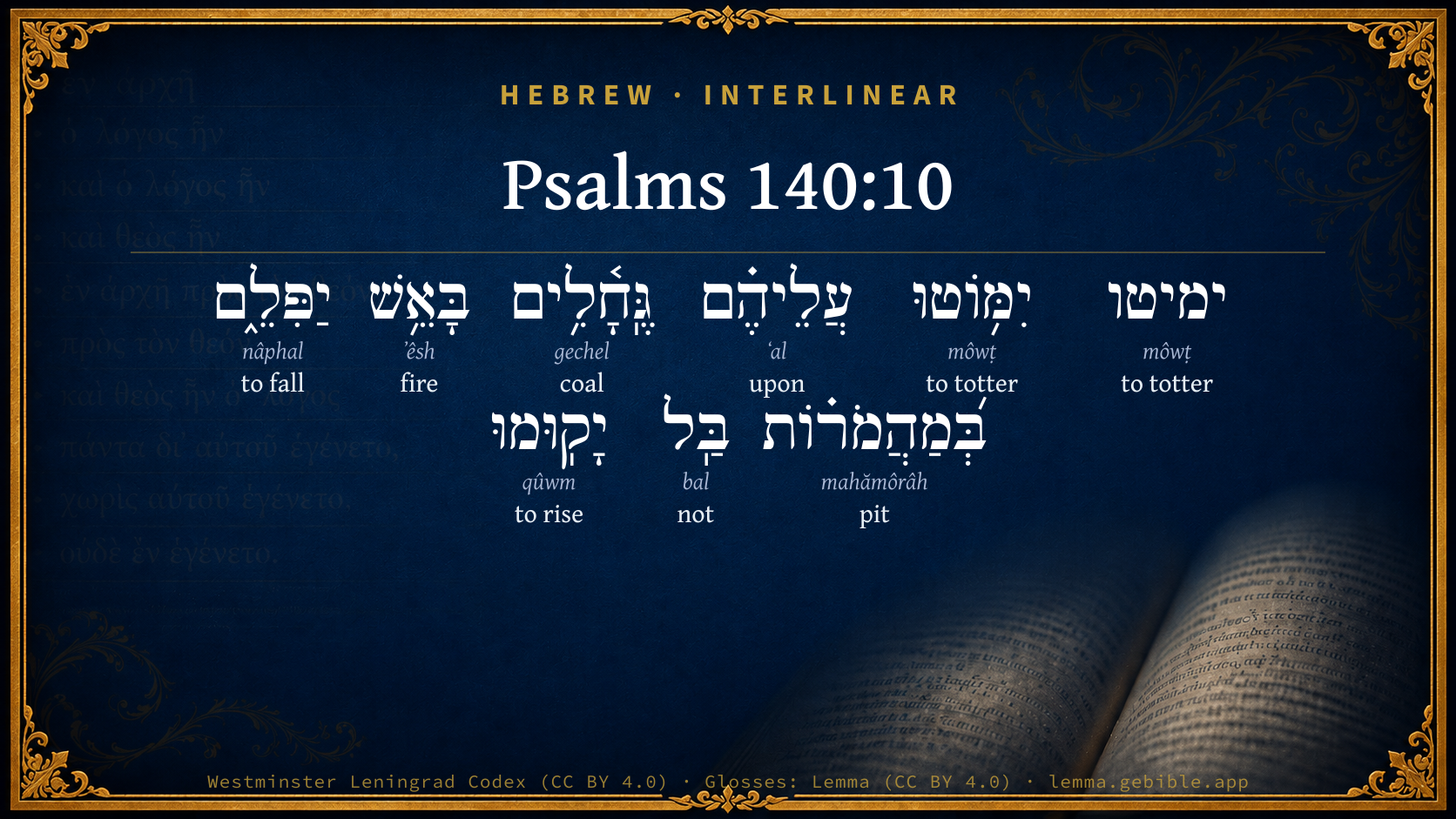
Hebrew (Westminster Leningrad Codex) Psalms 140:10 appears in the Hebrew Old Testament. The text above is from the Westminster Leningrad Codex. Each word links to its Strong’s number, a concise gloss, and parsing drawn from the Open Scriptures Hebrew Bible morphology. Click any word for its full Brown-Driver-Briggs (BDB) entry.
Download image
Cite this verse

Psalms 140:10 (World English Bible). Public Domain. Lemma interlinear Bible study tool, https://lemma.gebible.app/v/psalms/140/10.

Show BibTeX & RIS
BibTeX
RIS
English Translation
Let burning coals fall on them. Let them be thrown into the fire, Into miry pits, from where they never rise.
World English Bible · Public Domain
Highlights
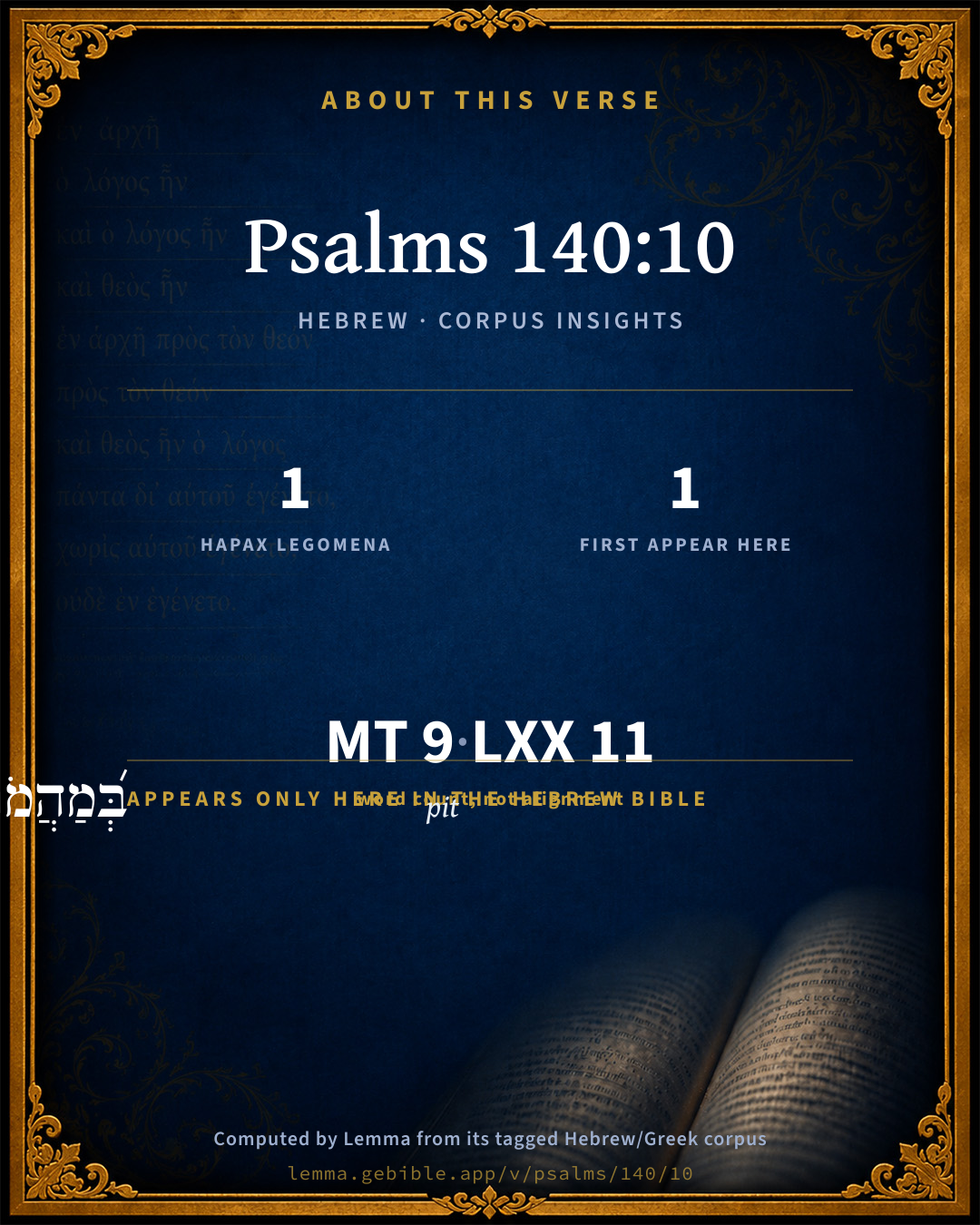
  • 1 hapax legomenon — only here in the Hebrew Bible
  • 1 first appearance in the Hebrew Bible
Full analysis ↓
Download a study sheet

One document with this verse’s original text, its word-by-word gloss line, the meaning frame, cross-references with their text, attributed commentary, and full source and license credits — printable, and it pastes into notes with its structure intact.

This verse Autodidact and up

Study sheet (.html) Plain text (.txt)

A passage Seminary Student

Up to 50 verses in one chapter. A passage sheet keeps up to 6 commentary sources and 12 cross-references per verse, in the order this page ranks them, and says so on the sheet whenever that leaves anything out. Ask for a single verse and you get the Autodidact verse sheet above.

Everything on this page stays free to read, with no account — the sheet is a download of what is already on screen, not access to it.

Want to remove ads? Support Godless Engineer
Compare translations 3

The same verse in 3 English versions, stacked beneath the original-language interlinear above. Click any original word for its lexicon entry.

Each is an independent rendering of the whole verse — the interlinear is not word-aligned to these translations.

Highlighted words mark where these versions differ — a whole-verse word diff, not a word-by-word alignment.

  • World English Bible Public Domain
    Let burning coals fall on them. Let them be thrown into the fire, Into miry pits, from where they never rise.
  • King James Version Public Domain
    Let burning coals fall upon them: let them be cast into the fire; into deep pits, that they rise not up again.
  • unfoldingWord Literal Text CC BY-SA 4.0
    Let burning coals fall on them; let him cast them into the fire, into pits, let them not rise up. ts\*

unfoldingWord Literal Text — © unfoldingWord, licensed CC BY-SA 4.0. Word-aligned USFM3 via Door43 (git.door43.org/unfoldingWord/en_ult).

Versions to compare (up to 4)

3 of 4 selected

Show all 18 translations

Every available English version of this verse, each an independent rendering of the whole verse.

  • World English Bible Public Domain
    Let burning coals fall on them. Let them be thrown into the fire, Into miry pits, from where they never rise.
  • Berean Standard Bible Public Domain
    May burning coals fall on them; may they be thrown into the fire, into the miry pits, never to rise again.
  • Majority Standard Bible Public Domain
    May burning coals fall on them; may they be thrown into the fire, into the miry pits, never to rise again.
  • King James Version Public Domain
    Let burning coals fall upon them: let them be cast into the fire; into deep pits, that they rise not up again.
  • American Standard Version (1901) Public Domain
    Let burning coals fall upon them: Let them be cast into the fire, Into deep pits, whence they shall not rise.
  • Revised Version (1885) Public Domain
    Let burning coals fall upon them: let them be cast into the fire; into deep pits, that they rise not up again.
  • Geneva Bible (1599) Public Domain
    Let coles fal vpon them: let him cast them into the fire, and into the deepe pits, that they rise not.
  • Douay-Rheims (1899) Public Domain
    Even there also shall thy hand lead me: and thy right hand shall hold me.
  • Young's Literal Translation Public Domain
    They cause to fall on themselves burning coals, Into fire He doth cast them, Into deep pits -- they arise not.
  • Literal Standard Version CC BY-SA 4.0
    They cause burning coals to fall on themselves, || He casts them into fire, || Into deep pits—they do not arise.
  • Unlocked Literal Bible CC BY-SA 4.0
    Let burning coals fall on them; throw them into the fire, into bottomless pits, never more to rise.
  • unfoldingWord Literal Text CC BY-SA 4.0
    Let burning coals fall on them; let him cast them into the fire, into pits, let them not rise up. ts\*
  • Darby Bible Public Domain
    Let burning coals fall on them; let them be cast into the fire; into deep waters, that they rise not up again.
  • World Messianic Bible Public Domain
    Let burning coals fall on them. Let them be thrown into the fire, into miry pits, from where they never rise.
  • Webster's Bible Public Domain
    \\140:9\\As for the head of those that encompass me, let the mischief of their own lips cover them.
  • Free Bible Version CC BY-SA 4.0
    Let burning coals rain down on them! Let them be thrown into the fire, or into bottomless pits, never to rise again.
  • Bible in Basic English Public Domain
    Let burning flames come down on them: let them be put into the fire, and into deep waters, so that they may not get up again.
  • JPS Tanakh (1917) Public Domain
    (140-11) Let burning coals fall upon them; let them be cast into the fire, into deep pits, that they rise not up again.

Literal Standard Version (2020), Covenant Press — licensed CC BY-SA 4.0. Text via the HelloAO Bible API (eBible.org). Unlocked Literal Bible (unfoldingWord) — licensed CC BY-SA 4.0. Text via the HelloAO Bible API (eBible.org). unfoldingWord Literal Text — © unfoldingWord, licensed CC BY-SA 4.0. Word-aligned USFM3 via Door43 (git.door43.org/unfoldingWord/en_ult). Free Bible Version, Dr. Jonathan Gallagher — licensed CC BY-SA 4.0. Text via the HelloAO Bible API (eBible.org).

Word by word

More ways to search: Search by grammar → Find every occurrence → Compare this word →

Practice this passage: Drill this verse → Learn its vocabulary →

בְּ֝מַהֲמֹר֗וֹת
mahămôrâh
H4113
“in/at · pits”
Preposition + Noun, Common, Feminine, Plural, Absolute
Part of Speech
Preposition + Noun
Type
Common
Gender
Feminine
Number
Plural
State
Absolute
Full BDB Definition

Origin: from an unused root of uncertain meaning

TWOT: 509a

a flood, a pit of water, watery pit
  1. ימיטו môwṭ H4131 “to totter” Verb, Hiphil, Jussive, 3rd Person, Masculine, Plural
  2. יִמּ֥וֹטוּ môwṭ H4131 “to totter” Verb, Niphal, Imperfect, 3rd Person, Masculine, Plural
  3. עֲלֵיהֶ֗ם ʻal H5921 “upon · them” Preposition + Suffix, Personal, 3rd Person, Masculine, Plural
  4. גֶּֽחָ֫לִ֥ים gechel H1513 “coals” Noun, Common, Both, Plural, Absolute
  5. בָּאֵ֥שׁ ʼêsh H784 “in/at the · fire” Preposition, Determined + Noun, Common, Both, Singular, Absolute
  6. יַפִּלֵ֑ם nâphal H5307 “to fall · them” Verb, Hiphil, Imperfect, 3rd Person, Masculine, Singular + Suffix, Personal, 3rd Person, Masculine, Plural
  7. בַּֽל bal H1077 “not” Particle, Negative
  8. יָקֽוּמוּ qûwm H6965 “to rise” Verb, Qal, Imperfect, 3rd Person, Masculine, Plural

About this verse

These counts appear in no published source. They are computed here, from the morphology-tagged text and Lemma’s own curated glosses. What Lemma adds →

9
words
8
distinct lemmas
Wisdom
section

Notable vocabulary

1 hapax legomenon — a word that appears only here in the entire Hebrew Bible:

  • בְּ֝מַהֲמֹר֗וֹת pit H4113

First appearance in Scripture

This word makes its first canonical appearance in the Hebrew Bible here:

  • בְּ֝מַהֲמֹר֗וֹת pit H4113

Shared distinctive vocabulary

גֶּֽחָ֫לִ֥ים coal H1513 occurs in 18 verses of the Hebrew Bible. Also found in:

Grammatical profile

  • 4 verbs
  • 3 nouns
  • 1 preposition
  • 1 particle

Verb forms

  • ימיטו Hiphil · Jussive
  • יִמּ֥וֹטוּ Niphal · Imperfect
  • יַפִּלֵ֑ם Hiphil · Imperfect
  • יָקֽוּמוּ Qal · Imperfect

Repetition

A word recurs within this verse — often emphatic in Hebrew:

  • ימיטו to totter H4131 ×2

Hebrew & Septuagint length

In English translation the verse runs 21 words from the Hebrew and 25 from the Septuagint (LXX English) — closely comparable.

A rough comparison of the two English renderings, which tokenize alike — not a word-level alignment.

Word counts can differ between the Hebrew and the Greek without any difference in meaning — e.g. the Hebrew direct-object marker אֵת has no separate Greek word, and Greek often adds the article ὁ.

In the original languages it is 9 Hebrew tokens and 11 Greek tokens — but the two are counted differently (Hebrew bundles its prefixes and suffixes into one token; the Greek is in lemma form), so that isn’t a like-for-like length.

Cross-references

15

Topical passages linked to Psalms 140:10 in the Treasury of Scripture Knowledge — connected by theme and wording, ordered by reader-vote popularity; previews shown in the World English Bible.

  • Psalms 11:6 On the wicked he will rain blazing coals; Fire, sulfur, and scorching wind shall be the portion of their cup.
  • Psalms 21:9 You will make them as a fiery furnace in the time of your anger. Yahweh will swallow them up in his wrath. The fire shall devour them.
  • Revelation 20:15 If anyone was not found written in the book of life, he was cast into the lake of fire.
  • Revelation 21:8 But for the cowardly, unbelieving, sinners, abominable, murderers, sexually immoral, sorcerers, idolaters, and all liars, their part is in the lake that burns with fire and sulfur, which is the second death."
  • Genesis 19:24 Then Yahweh rained on Sodom and on Gomorrah sulfur and fire from Yahweh out of the sky.
  • Exodus 9:23–24 Moses stretched forth his rod toward the heavens, and Yahweh sent thunder, hail, and lightning flashed down to the earth. Yahweh rained hail on the land of Egypt.
  • Psalms 18:13–14 Yahweh also thundered in the sky, The Most High uttered his voice: Hailstones and coals of fire.
  • Psalms 55:23 But you, God, will bring them down into the pit of destruction. Bloodthirsty and deceitful men shall not live out half their days, But I will trust in you.
  • Psalms 120:4 Sharp arrows of the mighty, With coals of juniper.
  • Proverbs 28:10 Whoever causes the upright to go astray in an evil way, He will fall into his own trap; But the blameless will inherit good.
  • Proverbs 28:17 A man who is tormented by life blood will be a fugitive until death; No one will support him.
  • Matthew 13:42 and will cast them into the furnace of fire. There will be weeping and the gnashing of teeth.
  • Matthew 13:50 and will cast them into the furnace of fire. There will be the weeping and the gnashing of teeth."
  • Revelation 16:8–9 The fourth poured out his bowl on the sun, and it was given to him to scorch men with fire.
  • Daniel 3:20–25 He commanded certain mighty men who were in his army to bind Shadrach, Meshach, and Abednego, [and] to cast them into the burning fiery furnace.

Cross-references courtesy of OpenBible.info (CC BY 4.0).

Hebrew and Greek witnesses Masoretic Hebrew ↔ Greek Septuagint

The same verse in the two great witnesses to the Old Testament, shown verse-for-verse.

You’re reading Greek Psalm 139 (Hebrew Psalm 140). The Septuagint counts the superscription, so verse numbers can differ from the Hebrew — chapter-level alignment, not verse-by-verse. Numbering follows Rahlfs.

These are two independent witnesses, not word-aligned to each other, and the Septuagint is shown in lemma (dictionary) form.

Hebrew Psalms 140:10 Masoretic · Westminster Leningrad Codex

ימיטו יִמּ֥וֹטוּ עֲלֵיהֶ֗ם גֶּֽחָ֫לִ֥ים בָּאֵ֥שׁ יַפִּלֵ֑ם בְּ֝מַהֲמֹר֗וֹת בַּֽל יָקֽוּמוּ

Let burning coals fall on them. Let them be thrown into the fire, Into miry pits, from where they never rise.

World English Bible · Public Domain

Greek LXX Greek Psalm 139:10 Septuagint · lemma form

ὁ κεφαλή ὁ κύκλωμα αὐτός κόπος ὁ χεῖλος αὐτός καλύπτω αὐτός

Coals of fire shall fall upon them on the earth; and you shall cast them down in afflictions: they shall not bear up under them.

LXX2012 (modern English Septuagint) · Public Domain

On this verse, Ellicott's Commentary for English Readers discusses the Septuagint’s reading. Read the note in Commentary ↓

Hebrew: Westminster Leningrad Codex (CC BY 4.0). Greek: Septuagint (public domain); English from LXX2012 (modern English Septuagint) (Public Domain). How the Septuagint differs from the Hebrew →

Commentary

Notes on Psalms 140:10 from classic Christian and Jewish commentators (each source and its license shown beneath its notes). The classic Christian expositions comment on the surrounding passage and are grouped to its opening verse, so a note may address several verses; the Jewish commentaries on the Tanakh (Rashi and others) are per-verse, so they appear only where the commentator wrote on this verse.

Lemma curates 59 commentaries, every one of them public domain or Creative Commons licensed, each selected and text-cleaned for this edition rather than reprinted as found. About our sources →

Trapp's Complete Commentary

John Trapp

Psa 140:10 Let burning coals fall upon them: let them be cast into the fire; into deep pits, that they rise not up again.

Ver. 10. Let burning coals fall upon them] Conflagrent ut corruant. Haec sunt non tam vota quam vaticinia.

John Trapp, A Commentary or Exposition upon All the Books of the Old and New Testament (1647–1656) — public domain. Text from a community e-Sword module.

J. A. Alexander on Psalms

Joseph Addison Alexander

11. (Psa 140:10) Coals shall be cast upon them; into the fire he shall make them fall, and into deep waters, (whence) they shall not rise. The first noun in Hebrew always means burning or live coals. See above, on Psa 18:12-13. Shall be cast is the keri or marginal reading, no doubt intended to relieve the harshness and obscurity of the reading in the text, they shall cast or shake, an indefinite or impersonal construction, really equivalent in meaning to the passive. In the second member of the sentence the action is ascribed to God himself. Deep waters answers to a single Hebrew word occurring only here, and by some supposed to mean deep pits or excavations. The first sense above given is founded on an Arabic analogy.

Joseph Addison Alexander, The Psalms Translated and Explained (1850) — public domain. Text from a community e-Sword module.

Tyndale Open Study Notes

Tyndale Open Resources

140:10 The psalmist wants fire to descend on his enemies, and he wants them thrown into pits so they can never attack again. The language foreshadows the New Testament teaching on hell (Matt 5:22, 29-30; 10:28; 18:9; Mark 9:43-47; Luke 12:5; Jas 3:6; 2 Pet 2:4).

Tyndale Open Study Notes — © Tyndale Open Resources, licensed CC BY-SA 4.0. Text via the HelloAO Bible API.

Geneva Bible (1599)

Geneva Bible translators

To wit, God: for David saw that they were reprobate, and that there was no hope of repentance in them.

Geneva Bible (1599) marginal notes — public domain. Text via Bolls.life.

Adam Clarke's Commentary

Verse 10. Let burning coals] The Chaldee considers this as spoken against Ahithophel, who was head of a conspiracy against David; and translates this verse thus: "Let coals from heaven fall upon them, precipitate them into the fire of hell, and into miry pits, from which they shall not have a resurrection to eternal life." This is a proof that the Jews did believe in a resurrection of the body, and an eternal life for that body, in the case of the righteous.

Adam Clarke's Commentary on the Bible (1810–1826) — public domain. Text from a community e-Sword/MySword module.

Ellicott's Commentary for English Readers

(10) In this verse too there is a grammatical difficulty, which the margin, “Let there fall on them,” instead of “Let them bring upon them,” does not remove, since the subject of the next verb is third person singular. The first verb is usually taken impersonally, as by the LXX., which version is actually to be followed in rendering coals of fire (literally, coals accompanied with fire, or, coals as fire), and we get the somewhat awkward, but intelligible—

“Let them bring upon them coals of fire;

Let him cast them into pits that they rise not again.’

But a very slight change gives a plain grammatical sentence with the subject carried on from the last verse:

“Let it (mischief) bring even upon themselves coals of fire;

Let it cast them into pits, so that they rise no more.”

(Burgess.)

The word “pits” is peculiar to the passage. Gesenius, deriving from a root meaning “to boil up,” renders, “whirlpools,” which, as in Psa_66:12, combines “water” with “fire,” as joint emblems of perils that cannot be escaped. But Symmachus, Theodotion, and Jerome render “ditches,” which is supported by a Rabbinical quotation, given by Delitzsch: “first of all they burned them in pits; when the flesh was consumed they collected the bones, and burned them in coffins.”

A Bible Commentary for English Readers, edited by Charles John Ellicott (1878–1897) — public domain. Text from a community e-Sword module.

The Cambridge Bible for Schools and Colleges

gen. ed. J. J. S. Perowne

10. Let the fate of Sodom overtake these defiant offenders! Possibly we should read, comparing Psa_11:6, May he rain hot coals upon them! may he cast them into the fire!

deep pits] A word of uncertain meaning, found here only. Some render whirlpools: cp. R.V. marg. floods. If they try to escape the fiery storm, may they be swept away by torrents!

that they rise not up again] Let their fall be final and irremediable (Psa_36:12), in contrast to that of the righteous, who falls to rise again (Pro_24:16).

The Cambridge Bible for Schools and Colleges (gen. ed. J. J. S. Perowne; Cambridge University Press, 1878–1918) — public domain. Text from a community e-Sword module.

John Gill's Exposition

Let burning coals fall upon them,.... From heaven, as the Targum, Aben Ezra, and Kimchi, by way of explanation; alluding to the burning of Sodom and Gomorrah with fire from thence: and may design both the terrible judgments of God in this life, and everlasting burnings in hell; so Jarchi interprets it of the coals of hell; see Psa 11:6;

let them be cast into the fire; into the fire of divine wrath, and have severe punishment inflicted on them in this world; and into the fire of hell hereafter, as the Targum, which is unquenchable and everlasting; and into which all wicked men, carnal professors, the followers of antichrist, the devil and his angels, will be cast: of the phrase of casting into hell, see Mat 5:29;

into deep pits, that they rise not up again; meaning either the grave, the pit of corruption; from whence the wicked will not rise to eternal life, as the Targum adds, for though they will rise again, it will be to everlasting shame and damnation, Dan 12:2; or else the pit of hell, the bottomless pit, from whence there will be no deliverance; where they must lie till the uttermost farthing is paid, and that will be for ever. Arama refers this to Korah, who was burnt and swallowed up, and rose not again in Israel.

John Gill's Exposition of the Whole Bible (1746–1763) — public domain (CC PDM 1.0). Text via the HelloAO Bible API.

Albert Barnes' Notes on the Bible

Let burning coals fall upon them - Let them be punished, “as if” burning coals were poured upon them. See Psa 11:6, note; Psa 18:12-13, notes; Psa 120:4, note.

Let them be cast into the fire - Punished as if they were cast into the fire and consumed.

Into deep pits, that they rise not up again - That they may utterly perish. This was one mode of punishing, by casting a man into a deep pit from which he could not escape, and leaving him to die, Gen 37:20, Gen 37:24; Psa 9:15; Psa 35:7; Jer 41:7.

Albert Barnes' Notes on the Bible (1834–1885) — public domain. Text from a community e-Sword/MySword module.

Matthew Poole's English Annotations

Burning coals; Divine vengeance, which is compared to coals of fire, as Psa 18:12, and elsewhere.

Rise not up again; either to my danger, or their own comfort.

Matthew Poole's English Annotations on the Holy Bible (1683–1685) — public domain. Text from a community e-Sword/MySword module.

The Treasury of David

Charles H. Spurgeon

Ver. 10. Let burning coals fall upon them. Then will they know that the scattering of the firebrands is not the sport they thought it to be. When hailstones and coals of fire descend upon them, how will they escape? Even the skies above the wicked are able to deal out vengeance upon them. Let them be cast into the fire. They have kindled the flames of strife, and it is fair that they should be cast therein. They have heated the furnace of slander seven times hotter than it was wont to be heated, and they shall be devoured therein. Who would have pitied Nebuchadnezzar if he had been thrown into his own burning fiery furnace? Into deep pits, that they rise not up again. They made those ditches or fosses for the godly, and it is meet that they should themselves fall into them and never escape. When a righteous man falls he rises again; but when the wicked man goes down "he falls like Lucifer, never to hope again." The Psalmist in this passage graphically depicts the Sodom of the wicked persecutor: fire falls upon him from heaven; the city blazes, and he is cast into the conflagration; the vale of Siddim is full of slime pits, and into these he is hurried. Extraordinary judgment overtakes the extraordinary offender: above, around, beneath, all is destruction. He would have consumed the righteous, and now he is consumed himself. So shall it be: so let it be.

Ver. 10. Let burning coals fall upon them, etc. The Psalmist seems here to allude to the destruction of the Sodomites. In these imprecations he considered his enemies as the enemies of God, rather than as his own; and lie thus cursed them, as knowing, in the quality of a prophet, that God himself had cursed them: and therefore these sorts of imprecations do not authorize other persons to curse their enemies. Thomas Fenton.

Ver. 10. Let burning coals full upon them, etc. An imprecation which (with the similar previous one, Ps 9:6, etc.) is a prophecy; and one which, while it has had no fulfilment in the case of David's enemies, or any persecutors of the church in times past, brings again vividly before the mind the fiery judgment of the Lord's coming, and the awful sentence already pronounced against "the beast and false prophet", the leaders of the confederation of the kings of the earth and their armies, then "gathered together to make war against him" "these were cast alive into the lake of fire burning with brimstone": Re 19:19-20. So before, Ps 55:15 63:9. William De Burgh.

Psalms 140:11*

Charles H. Spurgeon's The Treasury of David (1869–1885) — public domain. Psalms only. Text from a community e-Sword/MySword module.

Whedon's Commentary on the Bible

Daniel D. Whedon

10. Let burning coals fall upon them—The verb is declarative: “He shall cause coals of fire to fall,” etc., “coals” being taken figuratively, for great distress, as Pro_25:22, “Thou shalt heap coals of fire,” etc., meaning, “Thou wilt overwhelm him with shame and remorse for his enmity toward thee.”—Gesenius. Whether human instruments were employed, or only direct divine judgments, as Psa_11:6, (comp. Gen_19:24,) the result would be the same.

Deep pits—Many interpreters, ancient and modern, Jewish and Christian, understand water pits. R. Parchi, as quoted by Gesenius, understands “rivers flowing with strength and impetuosity.” The word indicates whirlpools or rapids—swift and noisy waters. The Septuagint and Vulgate have, “calamities.” The figurative sense of sudden and overwhelming calamities, such as they had plotted for the psalmist, must be admitted.

That they rise not up again— That they may never recover their stations of power and wealth, to outrage justice and derange society.

Daniel D. Whedon (gen. ed.), Commentary on the Old and New Testaments (1874–1909) — public domain. Text from a community e-Sword module.

The Pulpit Commentary

Let burning coals fall upon them, or, "burning coals shall be thrown upon them." Let them be cast (or, "they shall be cast") into the fire, into deep pits, that they rise not up again. The clauses are declaratory rather than optative. The psalmist sees the wrath of God poured out upon his enemies, who are at the same time God"s enemies they are cast into the fire prepared to receive the wicked and plunged into deep pits whence they find it impossible to extricate themselves.

The Pulpit Commentary (1880–1919), ed. H.D.M. Spence-Jones & Joseph S. Exell — public domain. Text from a community e-Sword module.

John Wesley's Explanatory Notes

Coals - Divine vengeance, which is compared to coals of fire.

John Wesley, Explanatory Notes Upon the Whole Bible (1754–1765) — public domain. Text via the GEBible commentary corpus.

Rashi

Rabbi Shlomo Yitzchaki (Rashi)

The numbers of those who surround me Armies of the number of the troops of Esau who plan to surround me, may the lies of their lips cover them. (I found.)

Rashi on the Tanakh — English translations: “The Judaica Press complete Tanach with Rashi, translated by A. J. Rosenberg” (CC BY 4.0); “Pentateuch with Rashi's commentary by M. Rosenbaum and A.M. Silbermann, 1929-1934” (public domain); “The Metsudah Tanach series, Lakewood, N.J” (CC BY 4.0); and “The Book of Joshua, Metsudah Publications, 1997” (CC BY 4.0). Text via Sefaria.

Lesson kit

Teaching starters — assembled from the data on this page, not authored interpretation. Every prompt links to the verse data it draws on. Edit before teaching.

Psalms, in the Wisdom, opens this verse with 9 words (8 distinct Hebrew lemmas). Its most distinctive word is mahămôrâh (“pit”). A historical commentator’s framing appears above. Read the whole chapter for the surrounding context.

Discussion questions

  1. How does “pit” (mahămôrâh) shape what this verse is saying?
  2. This verse holds 1 word here found nowhere else in the Hebrew Bible. What might the rare word draw attention to?
  3. The word “pit” first appears here in Scripture. What is being introduced at this debut?
  4. Leviticus 16:12 shares the word «coal» with this verse. How do the two illuminate each other?
  5. “to totter” occurs 2× in this one verse. What is the effect of the repetition?
  6. These translations render this verse differently. What is at stake in choosing one wording over another?
  7. The verb «ימיטו» is Hiphil Jussive. How does its form color the action?
  8. Reading how Trapp's Complete Commentary and J. A. Alexander on Psalms read this verse, where do the two commentators agree and where do they part?

Things to notice

  • 1 word in this verse appears nowhere else in the Hebrew Bible.
  • 1 word makes its first canonical appearance in Scripture here.
  • This verse counts 9 Hebrew ↔ 11 Greek words.
  • These translations choose different wording for 11 words in this verse.
  • “to totter” occurs 2× in this single verse.

Reading settings

Reading text

Shown beneath each verse's original-language words.

Old Testament
Old Testament edition

Read the OT as the Masoretic Hebrew (MT) or the Greek Septuagint (LXX).

English shown for the Greek Septuagint (in the Hebrew ↔ Greek comparison).

Comparing translations? Open the Compare panel on any verse page to stack up to four side by side.