
1 Kings 9:16

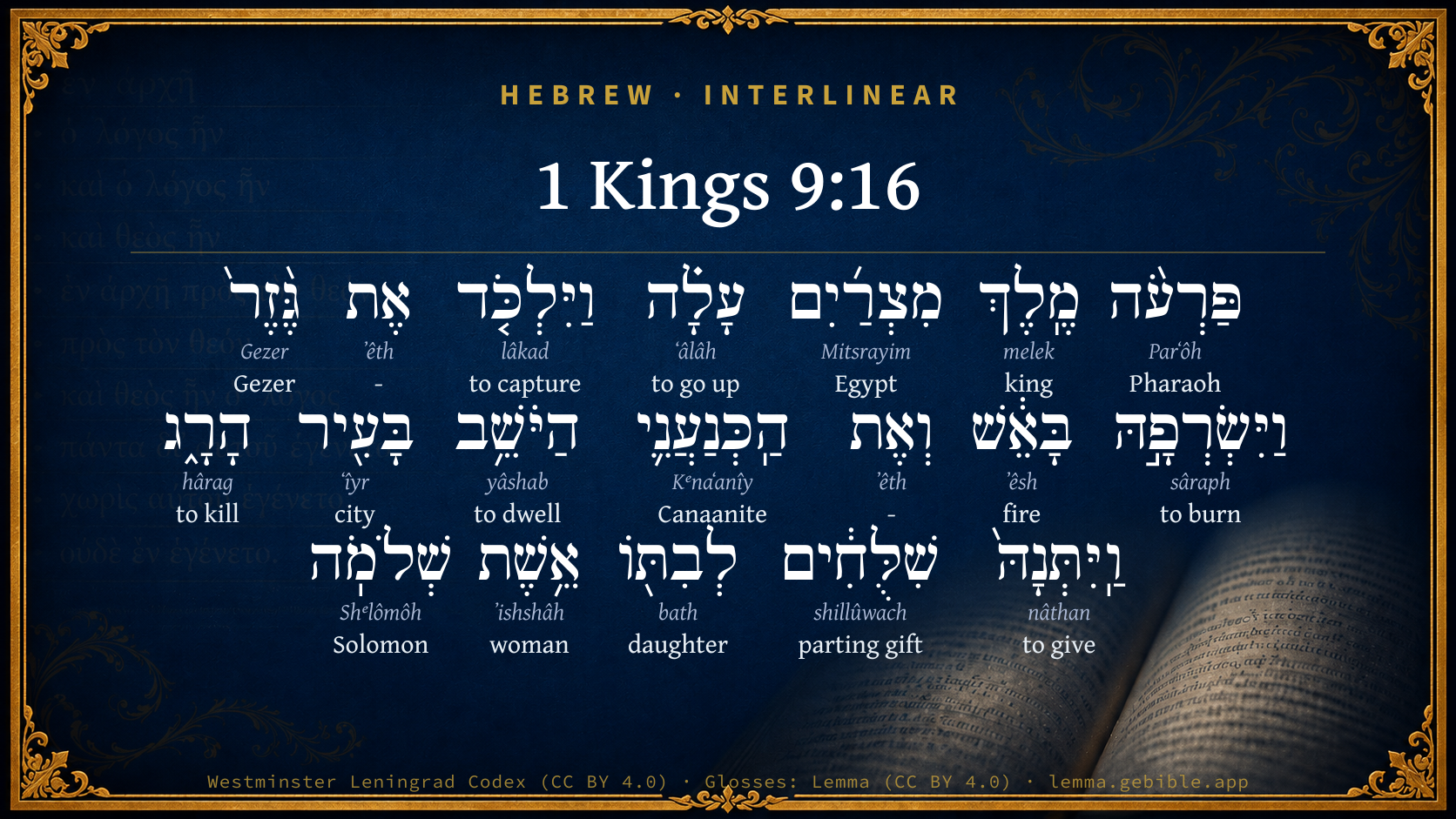
Hebrew (Westminster Leningrad Codex) 1 Kings 9:16 appears in the Hebrew Old Testament. The text above is from the Westminster Leningrad Codex. Each word links to its Strong’s number, a concise gloss, and parsing drawn from the Open Scriptures Hebrew Bible morphology. Click any word for its full Brown-Driver-Briggs (BDB) entry.
Download image
Cite this verse

1 Kings 9:16 (World English Bible). Public Domain. Lemma interlinear Bible study tool, https://lemma.gebible.app/v/1-kings/9/16.

Show BibTeX & RIS
BibTeX
RIS
English Translation
Pharaoh king of Egypt had gone up, and taken Gezer, and burnt it with fire, and slain the Canaanites who lived in the city, and given it for a portion to his daughter, Solomon's wife.
World English Bible · Public Domain
Download a study sheet

One document with this verse’s original text, its word-by-word gloss line, the meaning frame, cross-references with their text, attributed commentary, and full source and license credits — printable, and it pastes into notes with its structure intact.

This verse Autodidact and up

Study sheet (.html) Plain text (.txt)

A passage Seminary Student

Up to 50 verses in one chapter. A passage sheet keeps up to 6 commentary sources and 12 cross-references per verse, in the order this page ranks them, and says so on the sheet whenever that leaves anything out. Ask for a single verse and you get the Autodidact verse sheet above.

Everything on this page stays free to read, with no account — the sheet is a download of what is already on screen, not access to it.

Want to remove ads? Support Godless Engineer
Compare translations 3

The same verse in 3 English versions, stacked beneath the original-language interlinear above. Click any original word for its lexicon entry.

Each is an independent rendering of the whole verse — the interlinear is not word-aligned to these translations.

Highlighted words mark where these versions differ — a whole-verse word diff, not a word-by-word alignment.

  • World English Bible Public Domain
    Pharaoh king of Egypt had gone up, and taken Gezer, and burnt it with fire, and slain the Canaanites who lived in the city, and given it for a portion to his daughter, Solomon's wife.
  • King James Version Public Domain
    For Pharaoh king of Egypt had gone up, and taken Gezer, and burnt it with fire, and slain the Canaanites that dwelt in the city, and given it for a present unto his daughter, Solomon's wife.
  • unfoldingWord Literal Text CC BY-SA 4.0
    Pharaoh, the king of Egypt, had gone up and captured Gezer, and he had burned it with fire, and he had killed the Canaanite, the dweller of the city. And he had given it a dowry to his daughter, the wife of Solomon.

unfoldingWord Literal Text — © unfoldingWord, licensed CC BY-SA 4.0. Word-aligned USFM3 via Door43 (git.door43.org/unfoldingWord/en_ult).

Versions to compare (up to 4)

3 of 4 selected

Show all 18 translations

Every available English version of this verse, each an independent rendering of the whole verse.

  • World English Bible Public Domain
    Pharaoh king of Egypt had gone up, and taken Gezer, and burnt it with fire, and slain the Canaanites who lived in the city, and given it for a portion to his daughter, Solomon's wife.
  • Berean Standard Bible Public Domain
    Pharaoh king of Egypt had attacked and captured Gezer. He had set it on fire, killed the Canaanites who lived in the city, and given it as a dowry to his daughter, Solomon’s wife.
  • Majority Standard Bible Public Domain
    Pharaoh king of Egypt had attacked and captured Gezer. He had set it on fire, killed the Canaanites who lived in the city, and given it as a dowry to his daughter, Solomon’s wife.
  • King James Version Public Domain
    For Pharaoh king of Egypt had gone up, and taken Gezer, and burnt it with fire, and slain the Canaanites that dwelt in the city, and given it for a present unto his daughter, Solomon's wife.
  • American Standard Version (1901) Public Domain
    Pharaoh king of Egypt had gone up, and taken Gezer, and burnt it with fire, and slain the Canaanites that dwelt in the city, and given it for a portion unto his daughter, Solomon's wife.
  • Revised Version (1885) Public Domain
    Pharaoh king of Egypt had gone up, and taken Gezer, and burnt it with fire, and slain the Canaanites that dwelt in the city, and given it for a portion unto his daughter, Solomon’s wife.
  • Geneva Bible (1599) Public Domain
    Pharaoh King of Egypt had come vp, and taken Gezer, and burnt it with fire, and slew the Canaanites, that dwelt in the citie, and gaue it for a present vnto his daughter Salomons wife.
  • Douay-Rheims (1899) Public Domain
    Pharao the king of Egypt came up and took Gazer, and burnt it with fire: and slew the Chanaanite that dwelt in the city, and gave it for a dowry to his daughter, Solomon's wife.
  • Young's Literal Translation Public Domain
    (Pharaoh king of Egypt hath gone up and doth capture Gezer, and doth burn it with fire, and the Canaanite who is dwelling in the city he hath slain, and giveth it `with' presents to his daughter, wife of Solomon.)
  • Literal Standard Version CC BY-SA 4.0
    (Pharaoh king of Egypt has gone up and captures Gezer, and burns it with fire, and he has slain the Canaanite who is dwelling in the city, and gives it [as] presents to his daughter, wife of Solomon).
  • Unlocked Literal Bible CC BY-SA 4.0
    Pharaoh king of Egypt had gone up and taken Gezer. He burned it and killed the Canaanites in the city. Then Pharaoh gave the city to his daughter, Solomon's wife, as a wedding gift.
  • unfoldingWord Literal Text CC BY-SA 4.0
    Pharaoh, the king of Egypt, had gone up and captured Gezer, and he had burned it with fire, and he had killed the Canaanite, the dweller of the city. And he had given it a dowry to his daughter, the wife of Solomon.
  • Darby Bible Public Domain
    -- Pharaoh king of Egypt had gone up and taken Gezer, and burned it with fire, and slain the Canaanites that dwelt in the city, and given it as a dowry to his daughter, Solomon's wife.
  • World Messianic Bible Public Domain
    Pharaoh king of Egypt had gone up, taken Gezer, burned it with fire, killed the Canaanites who lived in the city, and given it for a wedding gift to his daughter, Solomon’s wife.
  • Webster's Bible Public Domain
    For Pharaoh king of Egypt had gone up, and taken Gezer, and burnt it with fire, and slain the Canaanites that dwelt in the city, and given it for a present to his daughter, Solomon's wife.
  • Free Bible Version CC BY-SA 4.0
    Pharaoh, king of Egypt, had attacked and captured Gezer. He had set it on fire, and killed the Canaanites living in the town. He had then given it as a wedding dowry to his daughter, Solomon's wife.
  • Bible in Basic English Public Domain
    Pharaoh, king of Egypt, came and took Gezer, burning it down and putting to death the Canaanites living in the town, and he gave it for a bride-offering to his daughter, Solomon's wife....
  • JPS Tanakh (1917) Public Domain
    Pharaoh king of Egypt had gone up, and taken Gezer, and burnt it with fire, and slain the Canaanites that dwelt in the city, and given it for a portion unto his daughter, Solomon's wife.

Literal Standard Version (2020), Covenant Press — licensed CC BY-SA 4.0. Text via the HelloAO Bible API (eBible.org). Unlocked Literal Bible (unfoldingWord) — licensed CC BY-SA 4.0. Text via the HelloAO Bible API (eBible.org). unfoldingWord Literal Text — © unfoldingWord, licensed CC BY-SA 4.0. Word-aligned USFM3 via Door43 (git.door43.org/unfoldingWord/en_ult). Free Bible Version, Dr. Jonathan Gallagher — licensed CC BY-SA 4.0. Text via the HelloAO Bible API (eBible.org).

Word by word

More ways to search: Search by grammar → Find every occurrence → Compare this word →

Practice this passage: Drill this verse → Learn its vocabulary →

שִׁלֻּחִ֔ים
shillûwach
H7964
“parting gifts”
Noun, Common, Masculine, Plural, Absolute
Part of Speech
Noun
Type
Common
Gender
Masculine
Number
Plural
State
Absolute
Full BDB Definition

Origin: from H7971

TWOT: 2394b

sending away, parting gift - sending away - parting gift
  1. פַּרְעֹ֨ה Parʻôh H6547 “Pharaoh” Noun, Proper
  2. מֶֽלֶךְ melek H4428 “king of” Noun, Common, Masculine, Singular, Construct
  3. מִצְרַ֜יִם Mitsrayim H4714 “Egypt” Noun, Proper
  4. עָלָ֗ה ʻâlâh H5927 “to go up” Verb, Qal, Perfect, 3rd Person, Masculine, Singular
  5. וַיִּלְכֹּ֤ד lâkad H3920 “and · to capture” Conjunction + Verb, Qal, Sequential Imperfect, 3rd Person, Masculine, Singular
  6. אֶת ʼêth H853 “-” Particle, Direct Object
  7. גֶּ֨זֶר֙ Gezer H1507 “Gezer” Noun, Proper
  8. וַיִּשְׂרְפָ֣הּ sâraph H8313 “and · to burn · her” Conjunction + Verb, Qal, Sequential Imperfect, 3rd Person, Masculine, Singular + Suffix, Personal, 3rd Person, Feminine, Singular
  9. בָּאֵ֔שׁ ʼêsh H784 “in/at the · fire” Preposition, Determined + Noun, Common, Both, Singular, Absolute
  10. וְאֶת ʼêth H853 “and · -” Conjunction + Particle, Direct Object
  11. הַֽכְּנַעֲנִ֛י Kᵉnaʻanîy H3669 “the · Canaanite” Particle, Definite Article + Noun, Gentilic, Masculine, Singular, Absolute
  12. הַיֹּשֵׁ֥ב yâshab H3427 “the · dwelling” Particle, Definite Article + Verb, Qal, Participle Active, Masculine, Singular, Absolute
  13. בָּעִ֖יר ʻîyr H5892 “in/at the · city” Preposition, Determined + Noun, Common, Feminine, Singular, Absolute
  14. הָרָ֑ג hârag H2026 “to kill” Verb, Qal, Perfect, 3rd Person, Masculine, Singular
  15. וַֽיִּתְּנָהּ֙ nâthan H5414 “and · to give · her” Conjunction + Verb, Qal, Sequential Imperfect, 3rd Person, Masculine, Singular + Suffix, Personal, 3rd Person, Feminine, Singular
  16. לְבִתּ֖וֹ bath H1323 “to/for · daughter · his” Preposition + Noun, Common, Feminine, Singular, Construct + Suffix, Personal, 3rd Person, Masculine, Singular
  17. אֵ֥שֶׁת ʼishshâh H802 “woman of” Noun, Common, Feminine, Singular, Construct
  18. שְׁלֹמֹֽה Shᵉlômôh H8010 “Solomon” Noun, Proper

About this verse

These counts appear in no published source. They are computed here, from the morphology-tagged text and Lemma’s own curated glosses. What Lemma adds →

19
words
18
distinct lemmas
Historical
section

Notable vocabulary

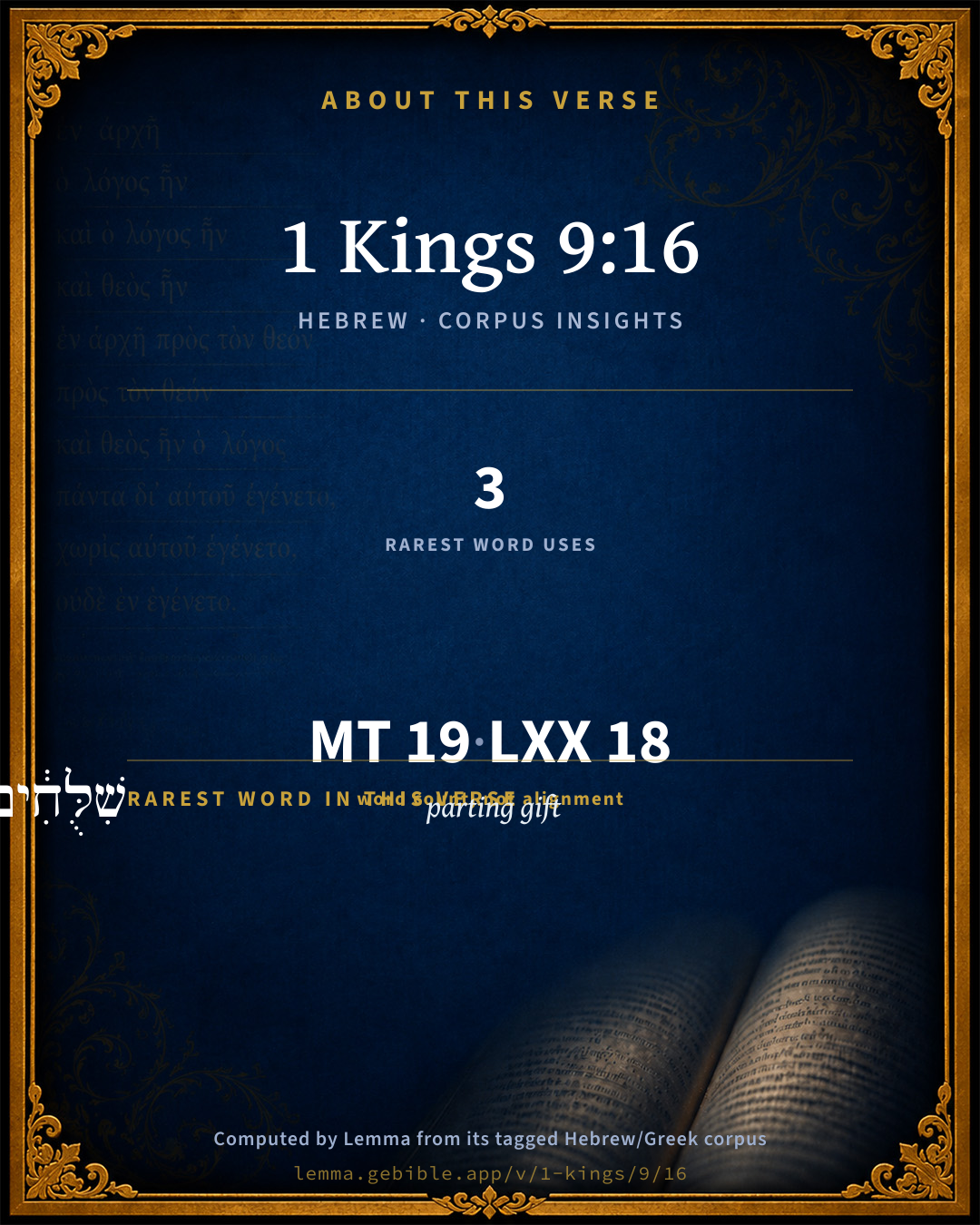
The rarest word here is שִׁלֻּחִ֔ים parting gift H7964 — appearing just 3 times in the whole Hebrew Bible.

Shared distinctive vocabulary

שִׁלֻּחִ֔ים parting gift H7964 occurs in 3 verses of the Hebrew Bible. Also found in:

Grammatical profile

  • 6 verbs
  • 11 nouns
  • 2 particles

Verb forms

  • עָלָ֗ה Qal · Perfect
  • וַיִּלְכֹּ֤ד Qal · Sequential Imperfect
  • וַיִּשְׂרְפָ֣הּ Qal · Sequential Imperfect
  • הַיֹּשֵׁ֥ב Qal · Participle Active
  • הָרָ֑ג Qal · Perfect
  • וַֽיִּתְּנָהּ֙ Qal · Sequential Imperfect

Hebrew & Septuagint length

In the original languages it is 19 Hebrew tokens and 18 Greek tokens — but the two are counted differently (Hebrew bundles its prefixes and suffixes into one token; the Greek is in lemma form), so that isn’t a like-for-like length.

Cross-references

4

Topical passages linked to 1 Kings 9:16 in the Treasury of Scripture Knowledge — connected by theme and wording, ordered by reader-vote popularity; previews shown in the World English Bible.

  • 1 Kings 3:1 Solomon made affinity with Pharaoh king of Egypt, and took Pharaoh's daughter, and brought her into the city of David, until he had made an end of building his own house, and the house of Yahweh, and the wall of Jerusalem round about.
  • Joshua 16:10 They didn't drive out the Canaanites who lived in Gezer: but the Canaanites dwell in the midst of Ephraim to this day, and are become servants to do forced labor.
  • 1 Kings 7:8 His house where he was to dwell, the other court within the porch, was of the like work. He made also a house for Pharaoh's daughter (whom Solomon had taken as wife), like this porch.
  • 1 Kings 9:24 But Pharaoh's daughter came up out of the city of David to her house which [Solomon] had built for her: then did he build Millo.

Cross-references courtesy of OpenBible.info (CC BY 4.0).

Hebrew and Greek witnesses Masoretic Hebrew ↔ Greek Septuagint

The same verse in the two great witnesses to the Old Testament, shown verse-for-verse.

These are two independent witnesses, not word-aligned to each other, and the Septuagint is shown in lemma (dictionary) form.

Hebrew 1 Kings 9:16 Masoretic · Westminster Leningrad Codex

פַּרְעֹ֨ה מֶֽלֶךְ מִצְרַ֜יִם עָלָ֗ה וַיִּלְכֹּ֤ד אֶת גֶּ֨זֶר֙ וַיִּשְׂרְפָ֣הּ בָּאֵ֔שׁ וְאֶת הַֽכְּנַעֲנִ֛י הַיֹּשֵׁ֥ב בָּעִ֖יר הָרָ֑ג וַֽיִּתְּנָהּ֙ שִׁלֻּחִ֔ים לְבִתּ֖וֹ אֵ֥שֶׁת שְׁלֹמֹֽה

Pharaoh king of Egypt had gone up, and taken Gezer, and burnt it with fire, and slain the Canaanites who lived in the city, and given it for a portion to his daughter, Solomon's wife.

World English Bible · Public Domain

Greek LXX 1 Kings 9:16 Septuagint · lemma form

καί ἀποστέλλω χιραμ ἐν ὁ ναῦς ὁ παῖς αὐτός ἀνήρ ναυτικός ἐλαύνω οἶδα θάλασσα μετά ὁ παῖς σαλωμών

No English rendering of this Greek verse — the small residue in the structurally divergent books.

On this verse, The Pulpit Commentary discusses the Septuagint’s reading. Read the note in Commentary ↓

Hebrew: Westminster Leningrad Codex (CC BY 4.0). Greek: Septuagint (public domain); English from a public-domain English Septuagint. How the Septuagint differs from the Hebrew →

Targum (Aramaic paraphrase)

1

The Targum is the ancient Jewish Aramaic paraphrase of the Hebrew Scriptures — an interpretive translation, not the Hebrew text itself. Onkelos (literal) and Pseudo-Jonathan (expansive) render the Torah, and Jonathan the Prophets. Coverage is partial: where no permissively-licensed English translation exists for a verse, only the Aramaic is shown. This is verse-level text, not a word-by-word alignment to the Hebrew.

  1. Targum Jonathan Prophets (Joshua–Malachi)
    פַּרְעֹה מַלְכָּא דְמִצְרַיִם סְלִיק וּכְבַשׁ יַת גֶזֶר וְאוֹקְדָהּ בְּנוּרָא וְיַת כְּנַעֲנָאָה דְיָתֵיב בְּקַרְתָּא קְטַל וִיהֲבָהּ מַתְנָן לִבְרַתֵּיהּ אִתַּת שְׁלֹמֹה:

    (no public-domain English translation for this verse)

    Targum Jonathan — Aramaic: “Mikraot Gedolot” (public domain). English: “Sefaria Community Translation” (CC0 1.0 (public-domain dedication)); “London "Chaldee Paraphrase," 1871” (public domain). Text via Sefaria.

Commentary

Notes on 1 Kings 9:16 from classic Christian and Jewish commentators (each source and its license shown beneath its notes). The classic Christian expositions comment on the surrounding passage and are grouped to its opening verse, so a note may address several verses; the Jewish commentaries on the Tanakh (Rashi and others) are per-verse, so they appear only where the commentator wrote on this verse.

Lemma curates 59 commentaries, every one of them public domain or Creative Commons licensed, each selected and text-cleaned for this edition rather than reprinted as found. About our sources →

Trapp's Complete Commentary

John Trapp

1Ki 9:16 [For] Pharaoh king of Egypt had gone up, and taken Gezer, and burnt it with fire, and slain the Canaanites that dwelt in the city, and given it [for] a present unto his daughter, Solomon’s wife.

Ver. 16. For Pharaoh king of Egypt, &c.] At the request, likely, of his son-in-law Solomon, who was busied in his buildings.

John Trapp, A Commentary or Exposition upon All the Books of the Old and New Testament (1647–1656) — public domain. Text from a community e-Sword module.

Joseph Benson's Commentary

1Ki 9:16. For Pharaoh had gone up and taken Gezer, &c., and slain the Canaanites — For the Israelites did not dispossess the Canaanites, but they continued to dwell in Gezer in Joshua’s time and after, Jos 16:10; Jdg 1:29. And, it seems, neither David nor Solomon expelled them, but only kept them under tribute; till Pharaoh, upon some provocation which is not recorded, extirpated them, and burned their city. This, Sir John Marsham thinks, was the first expedition which the Egyptians made out of their own country.

Joseph Benson's Commentary on the Old and New Testaments (1811–1818) — public domain. Text from a community e-Sword module.

Tyndale Open Study Notes

Tyndale Open Resources

9:16 Gezer, west of Jerusalem, was not previously occupied by Israelites. It was conquered by the Egyptian pharaoh and given to his daughter as a wedding gift when she married Solomon. An inscription in the Amon Temple in Tanis, apparently depicting a victory by the 21st dynasty Pharaoh Siamun (978–959 BC) against a Philistine campaign, suggests that Siamun was the pharaoh involved.

Tyndale Open Study Notes — © Tyndale Open Resources, licensed CC BY-SA 4.0. Text via the HelloAO Bible API.

Adam Clarke's Commentary

Verse 16. Pharaoh - had gone up, and taken Gezer] This city Joshua had taken from the Canaanites, Jos 10:33; Jos 12:12, and it was divided by lot to the tribe of Ephraim, and was intended to be one of the Levitical cities; but it appears that the Canaanites had retaken it, and kept possession till the days of Solomon, when his father-in-law, Pharaoh king of Egypt, retook it, and gave it to Solomon in dowry with his daughter.

Adam Clarke's Commentary on the Bible (1810–1826) — public domain. Text from a community e-Sword/MySword module.

Ellicott's Commentary for English Readers

(16) A present—that is, of course, a dowry, on her marriage with Solomon.

A Bible Commentary for English Readers, edited by Charles John Ellicott (1878–1897) — public domain. Text from a community e-Sword module.

The Cambridge Bible for Schools and Colleges

gen. ed. J. J. S. Perowne

16. For Pharaoh king of Egypt] See above on 1Ki_3:1.

and taken Gezer] This incursion was probably before Solomon had taken the king’s daughter to wife, though Josephus (Ant. viii. 6, i) says ‘he gave it to his daughter who had been married to Solomon.’ Philippson (die Israelitische Bibel) suggests that Solomon wishing to be rid of these Canaanites asked his father-in-law to undertake their extermination.

and given it for a present] By ‘present’ here is meant ‘a wedding-portion.’ The noun implies ‘a gift on sending away’ and the verb is found Jos_12:9, where Ibzan the judge is said to have ‘sent abroad’ (i.e. apparently, portioned out in marriage) his thirty daughters and to have taken in thirty others from abroad as wives for his sons. Though it appears to have been the more usual custom in the East for a husband to make presents to his wife’s family, yet we find that Caleb (Jdg_1:15) gave lands with his daughter when she was married to Othniel.

The Cambridge Bible for Schools and Colleges (gen. ed. J. J. S. Perowne; Cambridge University Press, 1878–1918) — public domain. Text from a community e-Sword module.

John Gill's Exposition

And Solomon built Gezer,.... Rebuilt it, it having been burnt, at least great part of it, by Pharaoh when he took it:

and Bethhoron the nether; and the upper also, Ch2 8:5, which belonged to the tribe of Ephraim, and were on the borders of it, between that and Benjamin, Jos 16:3.

John Gill's Exposition of the Whole Bible (1746–1763) — public domain (CC PDM 1.0). Text via the HelloAO Bible API.

Haydock's Catholic Bible Commentary

Wife. This custom distinguished princes from common people, who paid a dowry to their intended bride, 2 Machabees i. 14. Philadelphus gave hid daughter Bernice to Antiochus, of Syria, with an immense dowry, which caused her to be styled Phernophorus. The influence of these royal wives was more extensive than that of others of meaner birth, as we find in the daughter of Pharao, Jezabel, Athalia, &c. (Calmet)

George Leo Haydock (1774–1849), Haydock's Catholic Family Bible and Commentary, 1859 edition — public domain. Excludes Psalms (Douay-Rheims chapter numbering differs from Protestant) and Deuterocanonical books (Catholic canon only).

Matthew Poole's English Annotations

Not now, but long before this time, and presently after the marriage of his daughter, as is most probable; and it is here mentioned only as the occasion of Solomon’s building it. Possibly the Canaanites of this place had been guilty of some heinous crime; and because Solomon thought not fit to destroy them himself, he desired Pharaoh to do it for him, or Pharaoh might offer his service herein for his daughter’s advantage.

Matthew Poole's English Annotations on the Holy Bible (1683–1685) — public domain. Text from a community e-Sword/MySword module.

Whedon's Commentary on the Bible

Daniel D. Whedon

16. Pharaoh… had… taken Gezer — The date and circumstances of this conquest are wrapped in perfect mystery.

Canaanites that dwelt in the city — These had not been expelled in Joshua’s time. Jos_16:10.

A present unto his daughter — “Though in the East husbands generally pay for their wives, yet dower is given in some cases. Sargon gave Cilicia as a dowry with his daughter when he married her to Ambris, king of Tubal. Antiochus Soter gave his claims on Macedonia as a dowry to his step-daughter Phila when she married Antigonus Gonatas. Coele-Syria and Palestine were promised as dowry to Ptolemy Epiphanes when he married Cleopatra, sister of Antiochus the Great.” — Rawlinson.

Daniel D. Whedon (gen. ed.), Commentary on the Old and New Testaments (1874–1909) — public domain. Text from a community e-Sword module.

The Pulpit Commentary

For Pharaoh king of Egypt had gone up and taken Gezer and burnt it with fire The total destruction of the place and its inhabitants by fire and sword looks more like an act of vengeance for some grave offence than like ordinary warfare, and slain the Canaanites that dwelt in the city Though Gezer was allotted to Ephraim (Jos_16:3) and designated as a Levitical city (ib., 21:21), the Canaanite inhabitants had never been dispossessed (Jos_16:10; Lxx"canaanites and Perizzites;" (cf. Jud 1:29) and they would seem to have enjoyed a sort of independence, and given it for a present dotatio, dowry. It is the custom of the East for the husband to purchase his wife by a present (Gen_29:18; 2Sa_3:14, etc.) but in royal marriages a dowry was often given. "Sargon gave Cilicia as a dowry with his daughter.... Antiochus Soter gave his claims on Macedonia as a dowry to his step-daughter Phila, when she married Antigonus Gonatas. Coele-Syria and Palestine were promised as a dowry to Ptolemy Epiphanes, when he married Cleopatra, sister of Antiochus the Great," etc. (Rawlinson). Gezer being a wedding present, its conquest must have taken place years before the date to which the history is now brought down) unto his daughter, Solomon"s wife.

The Pulpit Commentary (1880–1919), ed. H.D.M. Spence-Jones & Joseph S. Exell — public domain. Text from a community e-Sword module.

Rashi

Rabbi Shlomo Yitzchaki (Rashi)

Present. A dowry.

Rashi on the Tanakh — English translations: “The Judaica Press complete Tanach with Rashi, translated by A. J. Rosenberg” (CC BY 4.0); “Pentateuch with Rashi's commentary by M. Rosenbaum and A.M. Silbermann, 1929-1934” (public domain); “The Metsudah Tanach series, Lakewood, N.J” (CC BY 4.0); and “The Book of Joshua, Metsudah Publications, 1997” (CC BY 4.0). Text via Sefaria.

Lesson kit

Teaching starters — assembled from the data on this page, not authored interpretation. Every prompt links to the verse data it draws on. Edit before teaching.

1 Kings, in the Historical, opens this verse with 19 words (18 distinct Hebrew lemmas). Its most distinctive word is shillûwach (“parting gift”). A historical commentator’s framing appears above. Read the whole chapter for the surrounding context.

Discussion questions

  1. The word shillûwach carries the sense “parting gift.” How does it shape the verse?
  2. How does Exodus 18:2, which shares the word «parting gift», read alongside this verse?
  3. These translations render this verse differently; the difference is in the English rendering, not the original. What questions does that raise?
  4. «עָלָ֗ה» is a Qal Perfect verb. How does that grammatical form shape the action described?
  5. Compare how Trapp's Complete Commentary and Joseph Benson's Commentary read this verse. Where do they agree or differ?

Things to notice

Reading settings

Reading text

Shown beneath each verse's original-language words.

Old Testament
Old Testament edition

Read the OT as the Masoretic Hebrew (MT) or the Greek Septuagint (LXX).

English shown for the Greek Septuagint (in the Hebrew ↔ Greek comparison).

Comparing translations? Open the Compare panel on any verse page to stack up to four side by side.