
Joshua 7:15

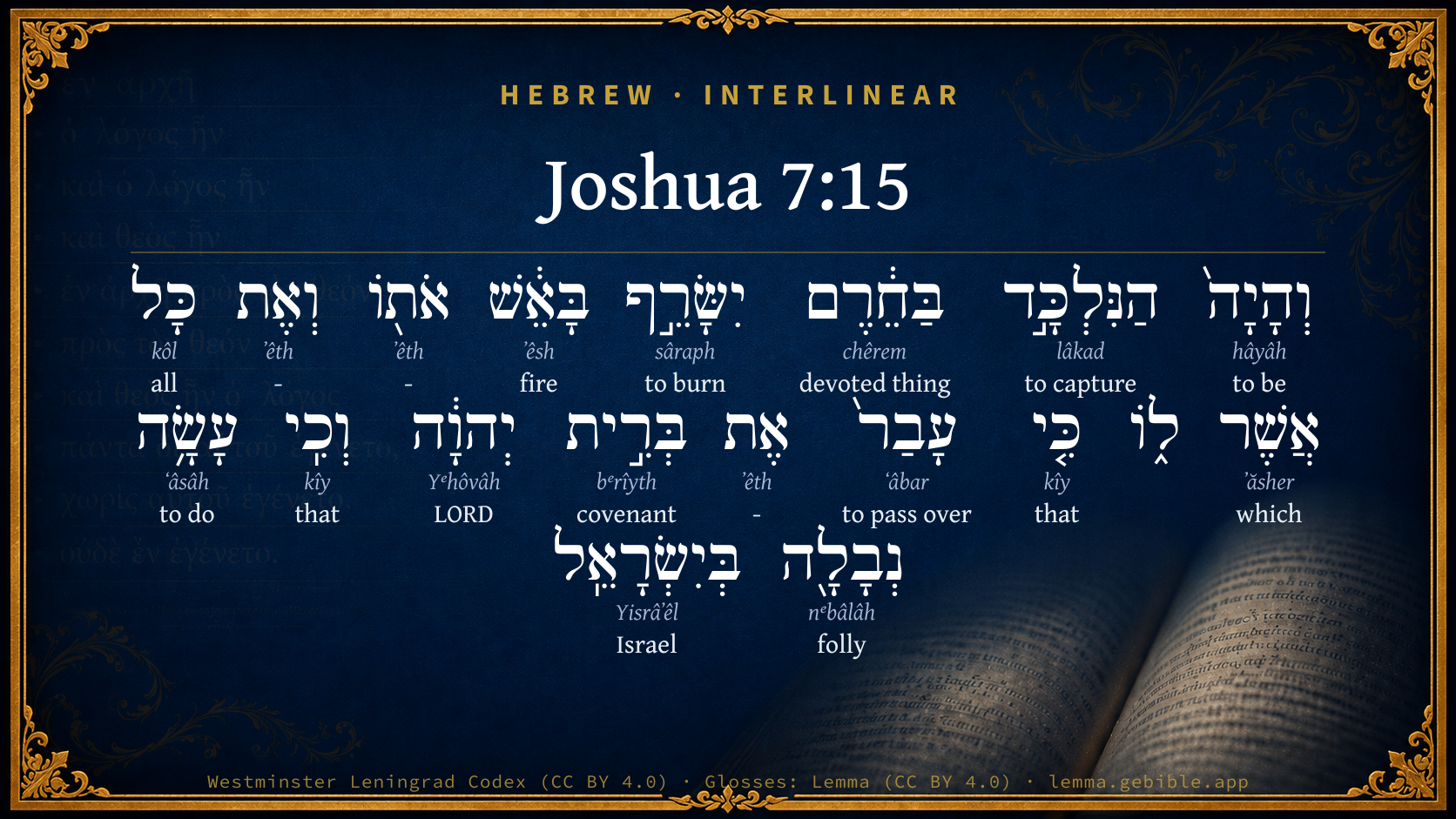
Hebrew (Westminster Leningrad Codex) Joshua 7:15 appears in the Hebrew Old Testament. The text above is from the Westminster Leningrad Codex. Each word links to its Strong’s number, a concise gloss, and parsing drawn from the Open Scriptures Hebrew Bible morphology. Click any word for its full Brown-Driver-Briggs (BDB) entry.
Download image
Cite this verse

Joshua 7:15 (World English Bible). Public Domain. Lemma interlinear Bible study tool, https://lemma.gebible.app/v/joshua/7/15.

Show BibTeX & RIS
BibTeX
RIS
English Translation
It shall be, that he who is taken with the devoted thing shall be burnt with fire, he and all that he has; because he has transgressed the covenant of Yahweh, and because he has done folly in Israel.
World English Bible · Public Domain
Download a study sheet

One document with this verse’s original text, its word-by-word gloss line, the meaning frame, cross-references with their text, attributed commentary, and full source and license credits — printable, and it pastes into notes with its structure intact.

This verse Autodidact and up

Study sheet (.html) Plain text (.txt)

A passage Seminary Student

Up to 50 verses in one chapter. A passage sheet keeps up to 6 commentary sources and 12 cross-references per verse, in the order this page ranks them, and says so on the sheet whenever that leaves anything out. Ask for a single verse and you get the Autodidact verse sheet above.

Everything on this page stays free to read, with no account — the sheet is a download of what is already on screen, not access to it.

Want to remove ads? Support Godless Engineer
Compare translations 3

The same verse in 3 English versions, stacked beneath the original-language interlinear above. Click any original word for its lexicon entry.

Each is an independent rendering of the whole verse — the interlinear is not word-aligned to these translations.

Highlighted words mark where these versions differ — a whole-verse word diff, not a word-by-word alignment.

  • World English Bible Public Domain
    It shall be, that he who is taken with the devoted thing shall be burnt with fire, he and all that he has; because he has transgressed the covenant of Yahweh, and because he has done folly in Israel.
  • King James Version Public Domain
    And it shall be, that he that is taken with the accursed thing shall be burnt with fire, he and all that he hath: because he hath transgressed the covenant of the LORD, and because he hath wrought folly in Israel.
  • unfoldingWord Literal Text CC BY-SA 4.0
    And it will happen, the one taken with the devoted thing shall be burned with fire, he and all that to him, because he has transgressed the covenant of Yahweh, and because he has done a disgraceful thing in Israel.’”

unfoldingWord Literal Text — © unfoldingWord, licensed CC BY-SA 4.0. Word-aligned USFM3 via Door43 (git.door43.org/unfoldingWord/en_ult).

Versions to compare (up to 4)

3 of 4 selected

Show all 18 translations

Every available English version of this verse, each an independent rendering of the whole verse.

  • World English Bible Public Domain
    It shall be, that he who is taken with the devoted thing shall be burnt with fire, he and all that he has; because he has transgressed the covenant of Yahweh, and because he has done folly in Israel.
  • Berean Standard Bible Public Domain
    The one who is caught with the things devoted to destruction must be burned, along with all that belongs to him, because he has transgressed the covenant of the LORD and committed an outrage in Israel.’”
  • Majority Standard Bible Public Domain
    The one who is caught with the things devoted to destruction must be burned, along with all that belongs to him, because he has transgressed the covenant of the LORD and committed an outrage in Israel.’”
  • King James Version Public Domain
    And it shall be, that he that is taken with the accursed thing shall be burnt with fire, he and all that he hath: because he hath transgressed the covenant of the LORD, and because he hath wrought folly in Israel.
  • American Standard Version (1901) Public Domain
    And it shall be, that he that is taken with the devoted thing shall be burnt with fire, he and all that he hath; because he hath transgressed the covenant of Jehovah, and because he hath wrought folly in Israel.
  • Revised Version (1885) Public Domain
    And it shall be, that he that is taken with the devoted thing shall be burnt with fire, he and all that he hath: because he hath transgressed the covenant of the LORD, and because he hath wrought folly in Israel.
  • Geneva Bible (1599) Public Domain
    And he that is taken with the excommunicate thing, shall be burnt with fire, hee, and all that he hath, because he hath transgressed the couenant of the Lord, and because he hath wrought folly in Israel.
  • Douay-Rheims (1899) Public Domain
    And whosoever he be that shall be found guilty of this fact, he shall be burnt with fire with all his substance, because he hath transgressed the covenant of the Lord, and hath done wickedness in Israel.
  • Young's Literal Translation Public Domain
    and it hath been, he who is captured with the devoted thing is burnt with fire, he and all that he hath, because he hath transgressed the covenant of Jehovah, and because he hath done folly in Israel.'
  • Literal Standard Version CC BY-SA 4.0
    and it has been, he who is captured with the devoted thing is burned with fire, he and all that he has, because he has transgressed the covenant of YHWH, and because he has done folly in Israel.”
  • Unlocked Literal Bible CC BY-SA 4.0
    It will happen that the one who is selected and who has those things that were set apart for destruction, he will be burned, he and all he has, because he has broken the covenant of Yahweh and because he has done a disgraceful thing in Israel.'”
  • unfoldingWord Literal Text CC BY-SA 4.0
    And it will happen, the one taken with the devoted thing shall be burned with fire, he and all that to him, because he has transgressed the covenant of Yahweh, and because he has done a disgraceful thing in Israel.’”
  • Darby Bible Public Domain
    And it shall be, that he who is taken with the accursed thing shall be burned with fire, he and all that he hath, because he hath transgressed the covenant of Jehovah, and because he hath wrought wickedness in Israel.
  • World Messianic Bible Public Domain
    It shall be, that he who is taken with the devoted thing shall be burned with fire, he and all that he has, because he has transgressed the LORD’s covenant, and because he has done a disgraceful thing in Israel.’”
  • Webster's Bible Public Domain
    And it shall be, that he that is taken with the accursed thing shall be burnt with fire, he and all that he hath: because he hath transgressed the covenant of the LORD, and because he hath wrought folly in Israel.
  • Free Bible Version CC BY-SA 4.0
    The one who is caught with what was set apart for destruction will be burned by fire, along with all that is his, for he broke the Lord's agreement and committed a terrible act in Israel.’”
  • Bible in Basic English Public Domain
    Then the man who is taken with the cursed thing is to be burned, with everything which is his; because he has gone against the agreement of the Lord and has done an act of shame in Israel.
  • JPS Tanakh (1917) Public Domain
    And it shall be that he that is taken with the devoted thing shall be burnt with fire, he and all that he hath; because he hath transgressed the covenant of the LORD, and because he hath wrought a wanton deed in Israel.'

Literal Standard Version (2020), Covenant Press — licensed CC BY-SA 4.0. Text via the HelloAO Bible API (eBible.org). Unlocked Literal Bible (unfoldingWord) — licensed CC BY-SA 4.0. Text via the HelloAO Bible API (eBible.org). unfoldingWord Literal Text — © unfoldingWord, licensed CC BY-SA 4.0. Word-aligned USFM3 via Door43 (git.door43.org/unfoldingWord/en_ult). Free Bible Version, Dr. Jonathan Gallagher — licensed CC BY-SA 4.0. Text via the HelloAO Bible API (eBible.org).

Word by word

More ways to search: Search by grammar → Find every occurrence → Compare this word →

Practice this passage: Drill this verse → Learn its vocabulary →

נְבָלָ֖ה
nᵉbâlâh
H5039
“folly”
Noun, Common, Feminine, Singular, Absolute
Part of Speech
Noun
Type
Common
Gender
Feminine
Number
Singular
State
Absolute
Full BDB Definition

Origin: from H5036

TWOT: 1285b

senselessness, folly - disgraceful folly - of immorality, profane actions - disgrace, contumely disgrace
  1. וְהָיָה֙ hâyâh H1961 “and · to be” Conjunction + Verb, Qal, Sequential Perfect, 3rd Person, Masculine, Singular
  2. הַנִּלְכָּ֣ד lâkad H3920 “the · capturing” Particle, Definite Article + Verb, Niphal, Participle Active, Masculine, Singular, Absolute
  3. בַּחֵ֔רֶם chêrem H2764 “in/at the · devoted thing” Preposition, Determined + Noun, Common, Masculine, Singular, Absolute
  4. יִשָּׂרֵ֣ף sâraph H8313 “to burn” Verb, Niphal, Imperfect, 3rd Person, Masculine, Singular
  5. בָּאֵ֔שׁ ʼêsh H784 “in/at the · fire” Preposition, Determined + Noun, Common, Both, Singular, Absolute
  6. אֹת֖וֹ ʼêth H853 “- · him” Particle, Direct Object + Suffix, Personal, 3rd Person, Masculine, Singular
  7. וְאֶת ʼêth H853 “and · -” Conjunction + Particle, Direct Object
  8. כָּל kôl H3605 “all of” Noun, Common, Masculine, Singular, Construct
  9. אֲשֶׁר ʼăsher H834 “which” Particle, Relative
  10. כִּ֤י kîy H3588 “that” Conjunction
  11. עָבַר֙ ʻâbar H5674 “to pass over” Verb, Qal, Perfect, 3rd Person, Masculine, Singular
  12. אֶת ʼêth H853 “-” Particle, Direct Object
  13. בְּרִ֣ית bᵉrîyth H1285 “covenant of” Noun, Common, Feminine, Singular, Construct
  14. יְהוָ֔ה Yᵉhôvâh H3068 “LORD” Noun, Proper
  15. וְכִֽי kîy H3588 “and · that” Conjunction + Conjunction
  16. עָשָׂ֥ה ʻâsâh H6213 “to do” Verb, Qal, Perfect, 3rd Person, Masculine, Singular
  17. בְּיִשְׂרָאֵֽל Yisrâʼêl H3478 “in/at · Israel” Preposition + Noun, Proper

About this verse

These counts appear in no published source. They are computed here, from the morphology-tagged text and Lemma’s own curated glosses. What Lemma adds →

19
words
15
distinct lemmas
Historical
section

Notable vocabulary

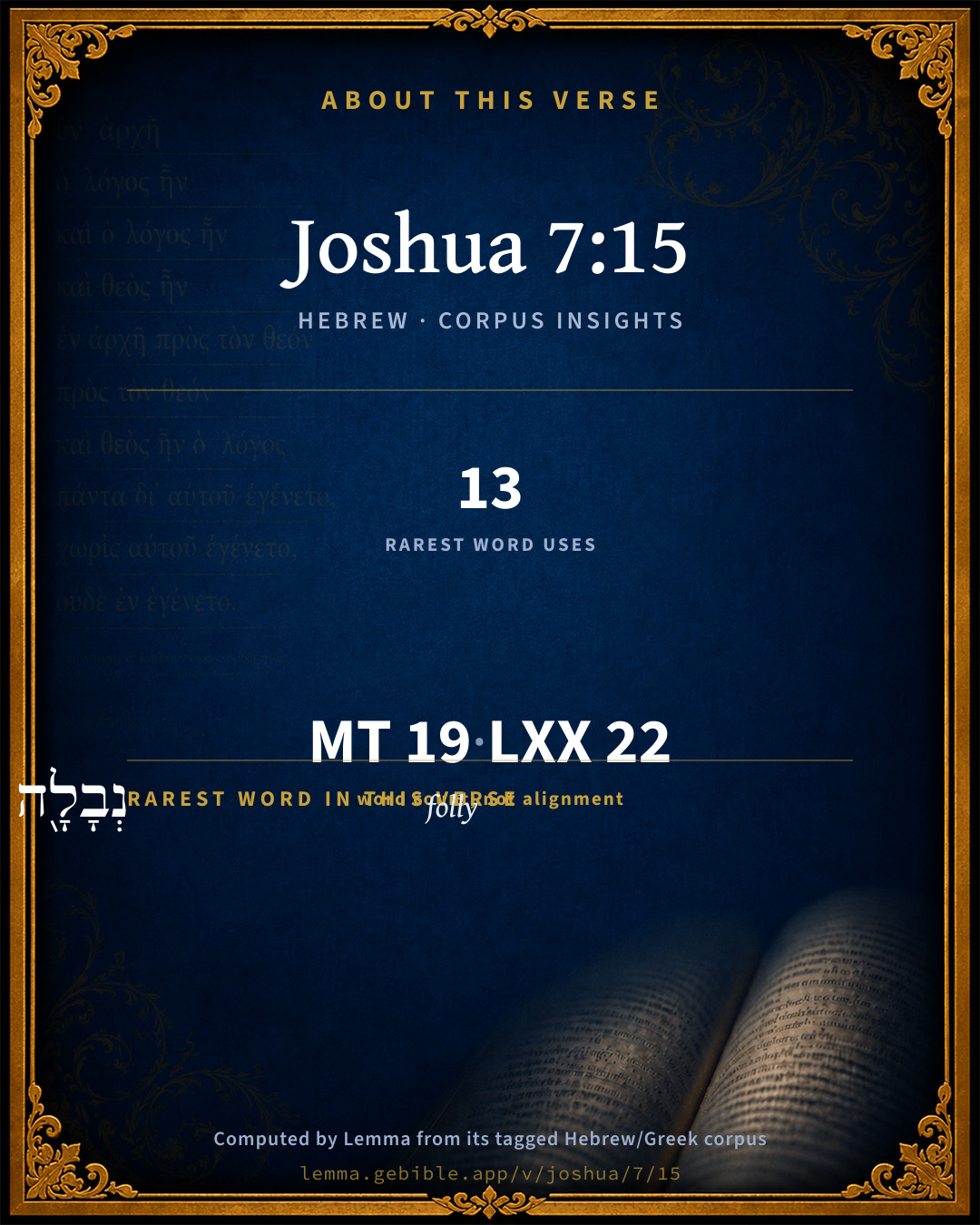
The rarest word here is נְבָלָ֖ה folly H5039 — appearing just 13 times in the whole Hebrew Bible.

Shared distinctive vocabulary

נְבָלָ֖ה folly H5039 occurs in 13 verses of the Hebrew Bible. Also found in:

Grammatical profile

  • 5 verbs
  • 7 nouns
  • 1 preposition
  • 2 conjunctions
  • 4 particles

Verb forms

  • וְהָיָה֙ Qal · Sequential Perfect
  • הַנִּלְכָּ֣ד Niphal · Participle Active
  • יִשָּׂרֵ֣ף Niphal · Imperfect
  • עָבַר֙ Qal · Perfect
  • עָשָׂ֥ה Qal · Perfect

Repetition

A word recurs within this verse — often emphatic in Hebrew:

  • כִּ֤י that H3588 ×2

Hebrew & Septuagint length

In English translation the verse runs 39 words from the Hebrew and 33 from the Septuagint (LXX English) — closely comparable.

A rough comparison of the two English renderings, which tokenize alike — not a word-level alignment.

Word counts can differ between the Hebrew and the Greek without any difference in meaning — e.g. the Hebrew direct-object marker אֵת has no separate Greek word, and Greek often adds the article ὁ.

In the original languages it is 19 Hebrew tokens and 22 Greek tokens — but the two are counted differently (Hebrew bundles its prefixes and suffixes into one token; the Greek is in lemma form), so that isn’t a like-for-like length.

Cross-references

8

Topical passages linked to Joshua 7:15 in the Treasury of Scripture Knowledge — connected by theme and wording, ordered by reader-vote popularity; previews shown in the World English Bible.

  • Genesis 34:7 The sons of Jacob came in from the field when they heard it. The men were grieved, and they were very angry, because he had done folly in Israel in lying with Jacob's daughter; which thing ought not to be done.
  • Judges 20:6 I took my concubine, and cut her in pieces, and sent her throughout all the country of the inheritance of Israel; for they have committed lewdness and folly in Israel.
  • 1 Samuel 14:38–39 Saul said, Draw near here, all you chiefs of the people; and know and see in which this sin has been this day.
  • Deuteronomy 13:15–16 you shall surely strike the inhabitants of that city with the edge of the sword, destroying it utterly, and all that is therein and the cattle of it, with the edge of the sword.
  • Joshua 7:25–26 Joshua said, Why have you troubled us? Yahweh shall trouble you this day. All Israel stoned him with stones; and they burned them with fire, and stoned them with stones.
  • Joshua 7:11 Israel has sinned; yes, they have even transgressed my covenant which I commanded them: yes, they have even taken of the devoted thing, and have also stolen, and dissembled also; and they have even put it among their own stuff.
  • 1 Samuel 26:21 Then said Saul, I have sinned: return, my son David; for I will no more do you harm, because my life was precious in your eyes this day: behold, I have played the fool, and have erred exceedingly.
  • 2 Samuel 13:13 I, where shall I carry my shame? and as for you, you will be as one of the fools in Israel. Now therefore, please speak to the king; for he will not withhold me from you.

Cross-references courtesy of OpenBible.info (CC BY 4.0).

Hebrew and Greek witnesses Masoretic Hebrew ↔ Greek Septuagint

The same verse in the two great witnesses to the Old Testament, shown verse-for-verse.

These are two independent witnesses, not word-aligned to each other, and the Septuagint is shown in lemma (dictionary) form.

Hebrew Joshua 7:15 Masoretic · Westminster Leningrad Codex

וְהָיָה֙ הַנִּלְכָּ֣ד בַּחֵ֔רֶם יִשָּׂרֵ֣ף בָּאֵ֔שׁ אֹת֖וֹ וְאֶת כָּל אֲשֶׁר ל֑וֹ כִּ֤י עָבַר֙ אֶת בְּרִ֣ית יְהוָ֔ה וְכִֽי עָשָׂ֥ה נְבָלָ֖ה בְּיִשְׂרָאֵֽל

It shall be, that he who is taken with the devoted thing shall be burnt with fire, he and all that he has; because he has transgressed the covenant of Yahweh, and because he has done folly in Israel.

World English Bible · Public Domain

Greek LXX Joshua 7:15 Septuagint · lemma form

καί ὅς ἄν ἐνδεικνύω κατακαίω ἐν πῦρ καί πᾶς ὅσος εἰμί αὐτός ὅτι παραβαίνω ὁ διαθήκη κύριος καί ποιέω ἀνόμημα ἐν ἰσραήλ

And the man who shall be pointed out, shall be burnt with fire, and all that he has; because he has transgressed the covenant of the Lord, and has wrought wickedness in Israel.

LXX2012 (modern English Septuagint) · Public Domain

On this verse, The Pulpit Commentary discusses the Septuagint’s reading. Read the note in Commentary ↓

Hebrew: Westminster Leningrad Codex (CC BY 4.0). Greek: Septuagint (public domain); English from LXX2012 (modern English Septuagint) (Public Domain). How the Septuagint differs from the Hebrew →

Targum (Aramaic paraphrase)

1

The Targum is the ancient Jewish Aramaic paraphrase of the Hebrew Scriptures — an interpretive translation, not the Hebrew text itself. Onkelos (literal) and Pseudo-Jonathan (expansive) render the Torah, and Jonathan the Prophets. Coverage is partial: where no permissively-licensed English translation exists for a verse, only the Aramaic is shown. This is verse-level text, not a word-by-word alignment to the Hebrew.

  1. Targum Jonathan Prophets (Joshua–Malachi)
    וִיהֵי דְיִתְאַחַד בְּחֶרְמָא יִתּוֹקַד בְּנוּרָא יָתֵיהּ וְכָל דִי לֵיהּ אֲרֵי עֲבַר עַל קְיָמָא דַייָ וַאֲרַי עֲבַד דְלָא כָשַׁר בְּיִשְׂרָאֵל:

    (no public-domain English translation for this verse)

    Targum Jonathan — Aramaic: “Mikraot Gedolot” (public domain). English: “Sefaria Community Translation” (CC0 1.0 (public-domain dedication)); “London "Chaldee Paraphrase," 1871” (public domain). Text via Sefaria.

Commentary

Notes on Joshua 7:15 from classic Christian and Jewish commentators (each source and its license shown beneath its notes). The classic Christian expositions comment on the surrounding passage and are grouped to its opening verse, so a note may address several verses; the Jewish commentaries on the Tanakh (Rashi and others) are per-verse, so they appear only where the commentator wrote on this verse.

Lemma curates 59 commentaries, every one of them public domain or Creative Commons licensed, each selected and text-cleaned for this edition rather than reprinted as found. About our sources →

Trapp's Complete Commentary

John Trapp

Jos 7:15 And it shall be, [that] he that is taken with the accursed thing shall be burnt with fire, he and all that he hath: because he hath transgressed the covenant of the LORD, and because he hath wrought folly in Israel.

Ver. 15. Shall be burnt with fire.] After that he is first stoned with stones as a presumptuous offender, {Num 15:30; Num 15:35} who is a kind of blasphemer, {Eze 20:37} and his sin such, as is not to be expiated by sacrifice.

He and all that he hath.] His children also, as part of his goods, and infected with the contagion of his sin. Besides, they owed a death to God, who might require that debt when and how he would; neither could there be any iniquity with the Lord, since his holy will is not only recta sed regula, right, but the rule of right: neither is it for silly men to reprehend what they cannot comprehend.

And because he hath wrought folly.] Or, Wickedness, which is folly in the abstract: like as righteousness is right-wiseness, and a righteous man a right-wise-man, as in our old English books we find it printed.

In Israel.] Quorum ingentia beneficia, ingentia flagitia, ingentia igitur supplicia: men’s offences are increased by their obligations.

John Trapp, A Commentary or Exposition upon All the Books of the Old and New Testament (1647–1656) — public domain. Text from a community e-Sword module.

Tyndale Open Study Notes

Tyndale Open Resources

7:15 God had commanded that all the stolen goods were to be destroyed by fire. Now they would be, because Achan and everything he had would be burned with fire. Breaking the covenant of the Lord was treason, a capital offense (e.g., Exod 22:20; Deut 4:25-27).

Tyndale Open Study Notes — © Tyndale Open Resources, licensed CC BY-SA 4.0. Text via the HelloAO Bible API.

Geneva Bible (1599)

Geneva Bible translators

That is found guilty, either by lots, or by the judgment of Urim, Num. 27:21.

Geneva Bible (1599) marginal notes — public domain. Text via Bolls.life.

The Cambridge Bible for Schools and Colleges

gen. ed. J. J. S. Perowne

15. shall be burnt with fire] Achan by his conduct had become cherem or devoted, and is so called in Jos_7:12, and everything devoted to punishment for the reparation of the Divine honour was to be burnt. Comp. Lev_20:14; Lev_21:9; Jos_6:24; 2Ki_23:16.

folly] Or, as in margin, wickedness; “and hath do sacrilege in Ysrael,” Wyclif.

The Cambridge Bible for Schools and Colleges (gen. ed. J. J. S. Perowne; Cambridge University Press, 1878–1918) — public domain. Text from a community e-Sword module.

John Gill's Exposition

And it shall be, that he that is taken with the accursed thing shall be burnt with fire,.... He that is taken by lot, and the accursed thing found with him, this should be the death, burning, one of the four capital punishments with the Jews: this was ordered in this case, because the city of Jericho, accursed or devoted, was burnt with fire, Jos 6:24,

he and all that he hath; the particulars of which are enumerated, Jos 7:24,

because he hath transgressed the covenant of the Lord; See Gill on Jos 7:11,

and because he hath wrought folly in Israel; as all sin and every transgression of the law is, and was the cause of Israel's turning their backs on their enemies; which, as Abarbinel says, was folly, and made the people of Israel look foolish, mean, and contemptible: the word has also the signification of a dead carcass, and may possibly have respect, to the thirty six men whose death he was the occasion of, Jos 7:5, and therefore justly ought to die himself.

John Gill's Exposition of the Whole Bible (1746–1763) — public domain (CC PDM 1.0). Text via the HelloAO Bible API.

Albert Barnes' Notes on the Bible

burnt with fire - i. e. after he had been put to death by stoning Jos 7:25; Lev 20:14.

Albert Barnes' Notes on the Bible (1834–1885) — public domain. Text from a community e-Sword/MySword module.

Matthew Poole's English Annotations

Burnt with fire, as persons and things accursed were to be. See Num 15:30,35; Deu 13:16. All that he hath; his children and goods, as is noted, Jos 7:24, according to the law, Deu 13:6.

He hath wrought folly; so sin is oft called in Scripture, as Gen 34:7; Jdg 20:6, &c., in opposition to the idle opinion of sinners, who commonly esteem it to be their wisdom and interest.

In Israel, i.e. among the church and people of God, who had such excellent laws to direct them, and such an all-sufficient and gracious God to provide for them, without any such indirect and unworthy practices.

Matthew Poole's English Annotations on the Holy Bible (1683–1685) — public domain. Text from a community e-Sword/MySword module.

Whedon's Commentary on the Bible

Daniel D. Whedon

15. He… shall be burnt with fire, he and all that he hath — As the anathema was to be executed by fire, and as the guilty man has made himself and all his possessions anathema, he is to be destroyed with fire. See note on Jos_7:24. The body, rendered lifeless by stoning, (Jos_7:25,) and not the living man, was to be burned. Burning alive is not found in the Mosaic law.

Wrought folly in Israel — Folly is a very appropriate name for sin, since every sin proceeds from real intellectual stupidity, short-sightedness, and fatuity, which the Greeks expressed by a word signifying missing the mark. In the eye of true reason the devil himself is a simpleton, and all his followers doltishly reject divine instruction, and stupidly go down to hell, imagining that God does not see their sins, and will not punish the guilty.

Daniel D. Whedon (gen. ed.), Commentary on the Old and New Testaments (1874–1909) — public domain. Text from a community e-Sword module.

The Pulpit Commentary

He that is taken with the accursed thing; or, according to Keil, "he on whom the ban falls." He and all that he hath (cf. ver. 24). The opinion that Achan"s family had in some way become participators in his sin would seem preferable to the idea that his sin had involved them in the ban. (see Deu_24:16, which qualifies Lev_26:39; so Hengstenberg, "History," p. 218) The destruction of their possessions is due to the fact that all the family had come under the ban. Folly hlbn used of the heart as well as the head. (cf. Gen_34:7 Deu_22:21 Jud_1:19:23, 24, 20:6 2Sa_13:12 Psa_14:1) The LXX render by anomhma , and the Vulgate by herae , but Theodotion renders by afrosunh .

The Pulpit Commentary (1880–1919), ed. H.D.M. Spence-Jones & Joseph S. Exell — public domain. Text from a community e-Sword module.

John Wesley's Explanatory Notes

Shall be burnt with fire - As persons and things accursed were to be. All that he hath - His children and goods, as is noted, ver. 24, according to the law, Deut. xiii, 16. Wrought folly - So sin is often called in scripture, in opposition to the idle opinion of sinners, who commonly esteem it to be their wisdom. In Israel - That is, among the church and people of God who had such excellent laws to direct them, and such an all-sufficient and gracious God to provide for them, without any such unworthy practices. It was sacrilege, it was invading God's rights, and converting to a private use that which was devoted to his glory, which was to be thus severely punished, for a warning to all people in all ages, to take heed how they rob God.

John Wesley, Explanatory Notes Upon the Whole Bible (1754–1765) — public domain. Text via the GEBible commentary corpus.

Rashi

Rabbi Shlomo Yitzchaki (Rashi)

Burned with fire. His tent and movable property [shall be burned].

He and all that he possesses. [This should be understood] according to the law explained below— he and his livestock [are put to death] by stoning. The zakeif accent, appearing over the word, בָּאֵשׁ indicates that the word בָּאֵשׁ (with fire) is separated from the word אוֹתוֹ, (he). We find other verses in which the accent divides the verse, such as, ‘אַחַרֵי דֶרֶך מְבוֹא הַשֶׁמֶשׁ’ (Far past the Jordan, the direction in which the sun sets). The word אַחַרֵי is separated from the word דֶרֶך by virtue of the [pashta] accent. Thus the interpretation of our verse is: He who is convicted [by the Ark] because of his taking of the condemned, shall be burned with fire, [which means] that which is fit to be burned [shall be burned], as is explained below.

He and all that he possesses. [This should be understood.] According to the law explained below. This is an abbreviated verse, and there is a similar verse to it: ‘Whoever strikes the Jebusites and reaches the tower.’ The verse does not explain what will be done to him, but in Sefer Divrei Ha Yomim, it is explained ‘that he will become a leader.’ Here too, it is not explained what will be done to him ‘and to all that he possesses,’ but everything is explained below.

Rashi on the Tanakh — English translations: “The Judaica Press complete Tanach with Rashi, translated by A. J. Rosenberg” (CC BY 4.0); “Pentateuch with Rashi's commentary by M. Rosenbaum and A.M. Silbermann, 1929-1934” (public domain); “The Metsudah Tanach series, Lakewood, N.J” (CC BY 4.0); and “The Book of Joshua, Metsudah Publications, 1997” (CC BY 4.0). Text via Sefaria.

Lesson kit

Teaching starters — assembled from the data on this page, not authored interpretation. Every prompt links to the verse data it draws on. Edit before teaching.

Joshua, in the Historical, opens this verse with 19 words (15 distinct Hebrew lemmas). Its most distinctive word is nᵉbâlâh (“folly”). A historical commentator’s framing appears above. Read the whole chapter for the surrounding context.

Discussion questions

  1. The word nᵉbâlâh carries the sense “folly.” How does it shape the verse?
  2. How does Genesis 34:7, which shares the word «folly», read alongside this verse?
  3. What does the repetition of “that” (2× in this one verse) do in this verse?
  4. The translations on this page render this verse differently — a whole-verse word diff, not a word-by-word alignment. What might account for the different wordings?
  5. «וְהָיָה֙» is a Qal Sequential Perfect verb. How does that grammatical form shape the action described?
  6. Compare how Trapp's Complete Commentary and Tyndale Open Study Notes read this verse. Where do they agree or differ?

Things to notice

Reading settings

Reading text

Shown beneath each verse's original-language words.

Old Testament
Old Testament edition

Read the OT as the Masoretic Hebrew (MT) or the Greek Septuagint (LXX).

English shown for the Greek Septuagint (in the Hebrew ↔ Greek comparison).

Comparing translations? Open the Compare panel on any verse page to stack up to four side by side.