
1 Chronicles 14:12

Hebrew (Westminster Leningrad Codex) 1 Chronicles 14:12 appears in the Hebrew Old Testament. The text above is from the Westminster Leningrad Codex. Each word links to its Strong’s number, a concise gloss, and parsing drawn from the Open Scriptures Hebrew Bible morphology. Click any word for its full Brown-Driver-Briggs (BDB) entry.
Download image
Cite this verse

1 Chronicles 14:12 (World English Bible). Public Domain. Lemma interlinear Bible study tool, https://lemma.gebible.app/v/1-chronicles/14/12.

Show BibTeX & RIS
BibTeX
RIS
English Translation
They left their gods there; and David gave commandment, and they were burned with fire.
World English Bible · Public Domain
Download a study sheet

One document with this verse’s original text, its word-by-word gloss line, the meaning frame, cross-references with their text, attributed commentary, and full source and license credits — printable, and it pastes into notes with its structure intact.

This verse Autodidact and up

Study sheet (.html) Plain text (.txt)

A passage Seminary Student

Up to 50 verses in one chapter. A passage sheet keeps up to 6 commentary sources and 12 cross-references per verse, in the order this page ranks them, and says so on the sheet whenever that leaves anything out. Ask for a single verse and you get the Autodidact verse sheet above.

Everything on this page stays free to read, with no account — the sheet is a download of what is already on screen, not access to it.

Want to remove ads? Support Godless Engineer
Compare translations 3

The same verse in 3 English versions, stacked beneath the original-language interlinear above. Click any original word for its lexicon entry.

Each is an independent rendering of the whole verse — the interlinear is not word-aligned to these translations.

Highlighted words mark where these versions differ — a whole-verse word diff, not a word-by-word alignment.

  • World English Bible Public Domain
    They left their gods there; and David gave commandment, and they were burned with fire.
  • King James Version Public Domain
    And when they had left their gods there, David gave a commandment, and they were burned with fire.
  • unfoldingWord Literal Text CC BY-SA 4.0
    And they abandoned their gods there, and David spoke, and they were burned with fire.

unfoldingWord Literal Text — © unfoldingWord, licensed CC BY-SA 4.0. Word-aligned USFM3 via Door43 (git.door43.org/unfoldingWord/en_ult).

Versions to compare (up to 4)

3 of 4 selected

Show all 18 translations

Every available English version of this verse, each an independent rendering of the whole verse.

  • World English Bible Public Domain
    They left their gods there; and David gave commandment, and they were burned with fire.
  • Berean Standard Bible Public Domain
    There the Philistines abandoned their gods, and David ordered that they be burned in the fire.
  • Majority Standard Bible Public Domain
    There the Philistines abandoned their gods, and David ordered that they be burned in the fire.
  • King James Version Public Domain
    And when they had left their gods there, David gave a commandment, and they were burned with fire.
  • American Standard Version (1901) Public Domain
    And they left their gods there; and David gave commandment, and they were burned with fire.
  • Revised Version (1885) Public Domain
    And they left their gods there; and David gave commandment, and they were burned with fire.
  • Geneva Bible (1599) Public Domain
    And there they had left their gods: and Dauid said, Let them euen be burnt with fire.
  • Douay-Rheims (1899) Public Domain
    And they left there their gods, and David commanded that they should be burnt.
  • Young's Literal Translation Public Domain
    And they leave there their gods, and David speaketh, and they are burnt with fire.
  • Literal Standard Version CC BY-SA 4.0
    And they leave their gods there, and David commands, and they are burned with fire.
  • Unlocked Literal Bible CC BY-SA 4.0
    The Philistines abandoned their gods there, and David gave an order that they should be burned.
  • unfoldingWord Literal Text CC BY-SA 4.0
    And they abandoned their gods there, and David spoke, and they were burned with fire.
  • Darby Bible Public Domain
    And they left their gods there; and David commanded, and they were burned with fire.
  • World Messianic Bible Public Domain
    They left their gods there; and David gave a command, and they were burned with fire.
  • Webster's Bible Public Domain
    And when they had left their gods there, David gave a commandment, and they were burned with fire.
  • Free Bible Version CC BY-SA 4.0
    The Philistines had left their gods behind, so David gave orders that they should be burned.
  • Bible in Basic English Public Domain
    And the Philistines did not take their images with them in their flight; and at David's orders they were burned with fire.
  • JPS Tanakh (1917) Public Domain
    And they left their gods there; and David gave commandment, and they were burned with fire.

Literal Standard Version (2020), Covenant Press — licensed CC BY-SA 4.0. Text via the HelloAO Bible API (eBible.org). Unlocked Literal Bible (unfoldingWord) — licensed CC BY-SA 4.0. Text via the HelloAO Bible API (eBible.org). unfoldingWord Literal Text — © unfoldingWord, licensed CC BY-SA 4.0. Word-aligned USFM3 via Door43 (git.door43.org/unfoldingWord/en_ult). Free Bible Version, Dr. Jonathan Gallagher — licensed CC BY-SA 4.0. Text via the HelloAO Bible API (eBible.org).

Word by word

More ways to search: Search by grammar → Find every occurrence → Compare this word →

Practice this passage: Drill this verse → Learn its vocabulary →

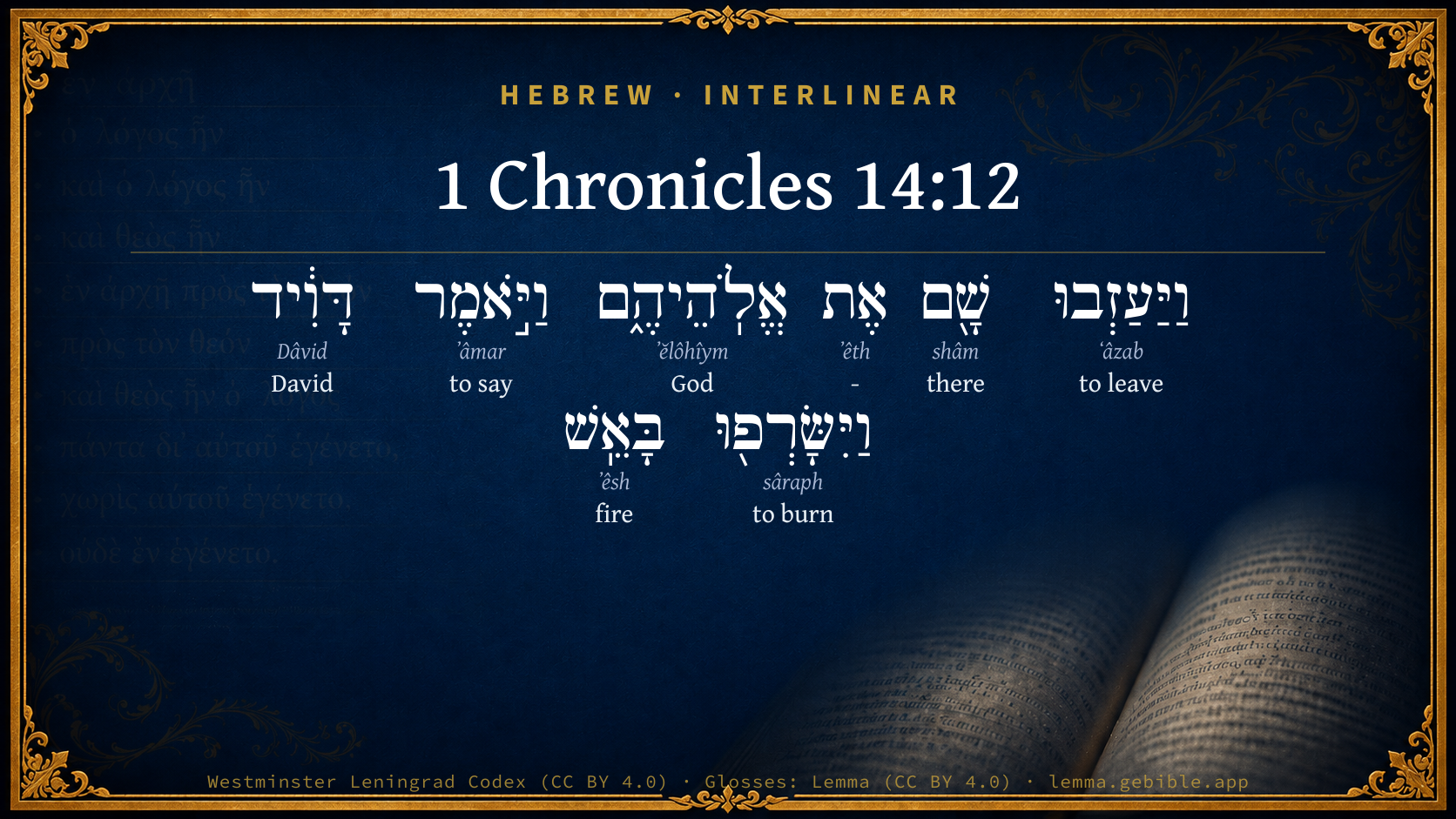
וַיִּשָּׂרְפ֖וּ
sâraph
H8313
“and · to burn”
Conjunction + Verb, Niphal, Sequential Imperfect, 3rd Person, Masculine, Plural
Part of Speech
Conjunction + Verb
Stem
Niphal
Form
Sequential Imperfect
Person
3rd Person
Gender
Masculine
Number
Plural
Full BDB Definition

Origin: a primitive root

TWOT: 2292

to burn - (Qal) to burn - (Niphal) to be burned - (Piel) burner, burning (participle) - (Pual) to be burnt up, be burned
  1. וַיַּעַזְבוּ ʻâzab H5800 “and · to leave” Conjunction + Verb, Qal, Sequential Imperfect, 3rd Person, Masculine, Plural
  2. שָׁ֖ם shâm H8033 “there” Adverb
  3. אֶת ʼêth H853 “-” Particle, Direct Object
  4. אֱלֹֽהֵיהֶ֑ם ʼĕlôhîym H430 “God(s) · their” Noun, Common, Masculine, Plural, Construct + Suffix, Personal, 3rd Person, Masculine, Plural
  5. וַיֹּ֣אמֶר ʼâmar H559 “and · to say” Conjunction + Verb, Qal, Sequential Imperfect, 3rd Person, Masculine, Singular
  6. דָּוִ֔יד Dâvid H1732 “David” Noun, Proper
  7. בָּאֵֽשׁ ʼêsh H784 “in/at the · fire” Preposition, Determined + Noun, Common, Both, Singular, Absolute

About this verse

These counts appear in no published source. They are computed here, from the morphology-tagged text and Lemma’s own curated glosses. What Lemma adds →

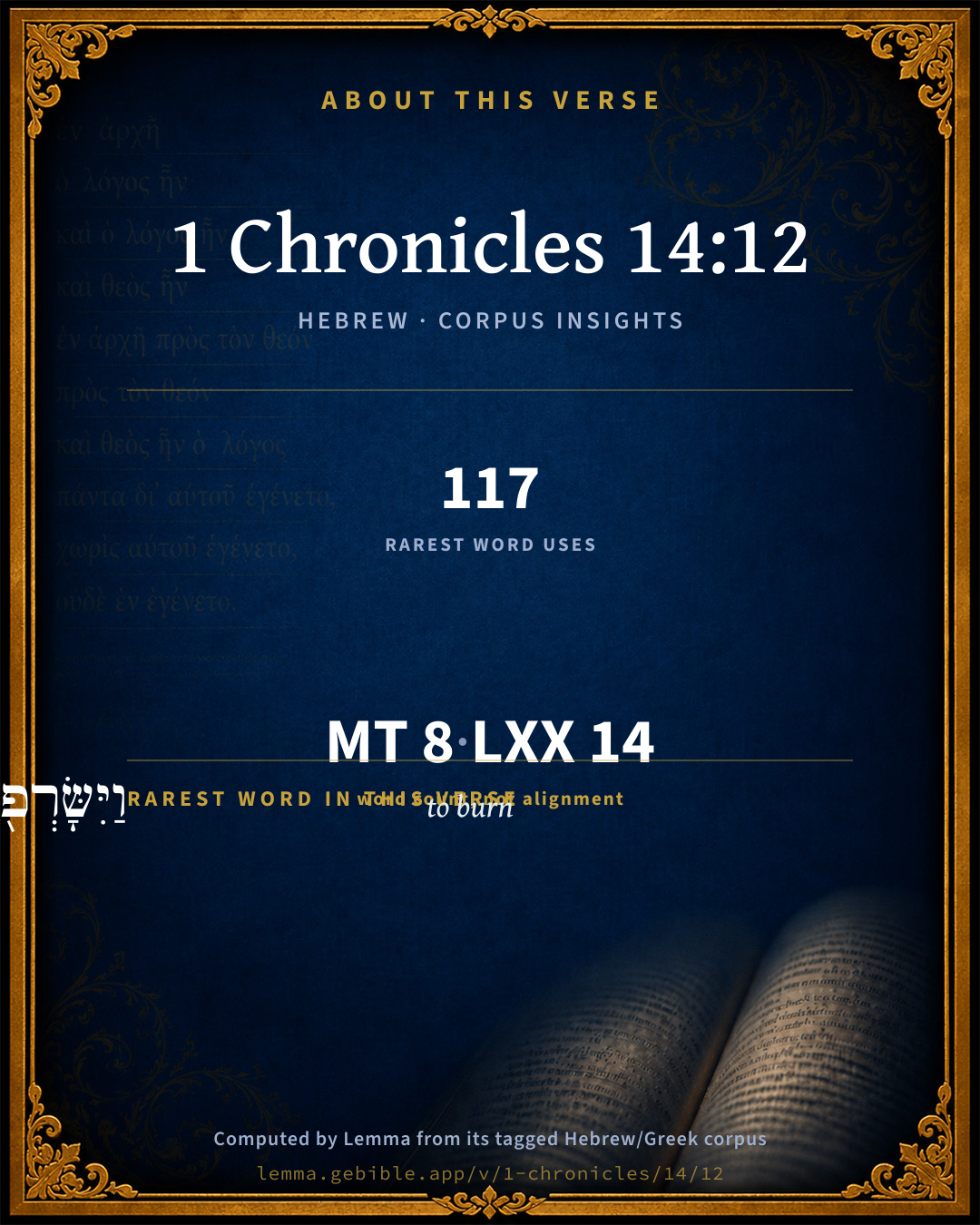
8
words
8
distinct lemmas
Historical
section

Grammatical profile

  • 3 verbs
  • 3 nouns
  • 1 adverb
  • 1 particle

Verb forms

  • וַיַּעַזְבוּ Qal · Sequential Imperfect
  • וַיֹּ֣אמֶר Qal · Sequential Imperfect
  • וַיִּשָּׂרְפ֖וּ Niphal · Sequential Imperfect

Hebrew & Septuagint length

In English translation the verse runs 15 words from the Hebrew and 16 from the Septuagint (LXX English) — closely comparable.

A rough comparison of the two English renderings, which tokenize alike — not a word-level alignment.

Word counts can differ between the Hebrew and the Greek without any difference in meaning — e.g. the Hebrew direct-object marker אֵת has no separate Greek word, and Greek often adds the article ὁ.

In the original languages it is 8 Hebrew tokens and 14 Greek tokens — but the two are counted differently (Hebrew bundles its prefixes and suffixes into one token; the Greek is in lemma form), so that isn’t a like-for-like length.

Cross-references

6

Topical passages linked to 1 Chronicles 14:12 in the Treasury of Scripture Knowledge — connected by theme and wording, ordered by reader-vote popularity; previews shown in the World English Bible.

  • Exodus 32:20 He took the calf which they had made, and burnt it with fire, ground it to powder, and scattered it on the water, and made the children of Israel drink of it.
  • 2 Kings 19:18 and have cast their gods into the fire; for they were no gods, but the work of men's hands, wood and stone; therefore they have destroyed them.
  • Deuteronomy 7:5 But thus shall you deal with them: you shall break down their altars, and dash in pieces their pillars, and hew down their Asherim, and burn their engraved images with fire.
  • Deuteronomy 7:25 The engraved images of their gods shall you burn with fire: you shall not covet the silver or the gold that is on them, nor take it to you, lest you be snared therein; for it is an abomination to Yahweh your God.
  • 1 Samuel 5:2–6 The Philistines took the ark of God, and brought it into the house of Dagon, and set it by Dagon.
  • Exodus 12:12 For I will go through the land of Egypt in that night, and will strike all the firstborn in the land of Egypt, both man and animal. Against all the gods of Egypt I will execute judgments: I am Yahweh.

Cross-references courtesy of OpenBible.info (CC BY 4.0).

Hebrew and Greek witnesses Masoretic Hebrew ↔ Greek Septuagint

The same verse in the two great witnesses to the Old Testament, shown verse-for-verse.

These are two independent witnesses, not word-aligned to each other, and the Septuagint is shown in lemma (dictionary) form.

Hebrew 1 Chronicles 14:12 Masoretic · Westminster Leningrad Codex

וַיַּעַזְבוּ שָׁ֖ם אֶת אֱלֹֽהֵיהֶ֑ם וַיֹּ֣אמֶר דָּוִ֔יד וַיִּשָּׂרְפ֖וּ בָּאֵֽשׁ

They left their gods there; and David gave commandment, and they were burned with fire.

World English Bible · Public Domain

Greek LXX 1 Chronicles 14:12 Septuagint · lemma form

καί ἐν καταλείπω ἐκεῖ ὁ θεός αὐτός καί εἶπον δαυίδ κατακαίω αὐτός ἐν πῦρ

And the Philistines left their gods there; and David gave orders to burn them with fire.

LXX2012 (modern English Septuagint) · Public Domain

Hebrew: Westminster Leningrad Codex (CC BY 4.0). Greek: Septuagint (public domain); English from LXX2012 (modern English Septuagint) (Public Domain). How the Septuagint differs from the Hebrew →

Commentary

Notes on 1 Chronicles 14:12 from classic Christian and Jewish commentators (each source and its license shown beneath its notes). The classic Christian expositions comment on the surrounding passage and are grouped to its opening verse, so a note may address several verses; the Jewish commentaries on the Tanakh (Rashi and others) are per-verse, so they appear only where the commentator wrote on this verse.

Lemma curates 59 commentaries, every one of them public domain or Creative Commons licensed, each selected and text-cleaned for this edition rather than reprinted as found. About our sources →

Trapp's Complete Commentary

John Trapp

1Ch 14:12 And when they had left their gods there, David gave a commandment, and they were burned with fire.

Ver. 12. And when they had left their gods there.] Their terricula bogey gods. They were now in a great fright.

John Trapp, A Commentary or Exposition upon All the Books of the Old and New Testament (1647–1656) — public domain. Text from a community e-Sword module.

Tyndale Open Study Notes

Tyndale Open Resources

14:12 David’s orders to burn the Philistine idols conformed to God’s instructions (Deut 7:5).

Tyndale Open Study Notes — © Tyndale Open Resources, licensed CC BY-SA 4.0. Text via the HelloAO Bible API.

Jamieson, Fausset & Brown

Robert Jamieson, A. R. Fausset & David Brown

when they had left their gods--(See on Sa2 5:21).

Jamieson, Fausset & Brown — Commentary Critical and Explanatory on the Whole Bible (1871) — public domain (CC PDM 1.0). Text via the HelloAO Bible API.

Ellicott's Commentary for English Readers

(12) And when they had left their gods there.—Samuel, “their images.” Our word is explanatory.

David gave a commandment, and they were burned with fire.—Samuel, “And David and his men carried them off” (Heb.). The two statements are not incompatible, and may both have existed in the same original text. The chronicler is careful to record David’s compliance with the law of Deu_7:25.

A Bible Commentary for English Readers, edited by Charles John Ellicott (1878–1897) — public domain. Text from a community e-Sword module.

The Cambridge Bible for Schools and Colleges

gen. ed. J. J. S. Perowne

12. And when they had left their gods there, David etc.] R.V. And they left their gods there; and David etc.

David gave a commandment, and they were burnt] In 2Sa_5:21 (R.V.) David and his men took them away. The Law (Deu_7:5; Deu_7:25) enjoined that graven images were to be burnt with fire.

The Cambridge Bible for Schools and Colleges (gen. ed. J. J. S. Perowne; Cambridge University Press, 1878–1918) — public domain. Text from a community e-Sword module.

Albert Barnes' Notes on the Bible

When they had left their gods there - The practice of carrying images of the gods to battle was common among the nations of antiquity, and arose from the belief that there was virtue in the images themselves, and that military success would be obtained by means of them.

Albert Barnes' Notes on the Bible (1834–1885) — public domain. Text from a community e-Sword/MySword module.

Haydock's Catholic Bible Commentary

Burnt, conformably to Deuteronomy vii. 25. These idols were commonly made of wood, and covered with plates of gold, &c. The Philistines took them along with them to battle, as the Hebrews carried the ark on many occasions. The Greeks, at the siege of Troy, had their gods on board their vessels; (Homer, Iliad ix.) and the Romans had theirs on their ensigns, in their wars.

George Leo Haydock (1774–1849), Haydock's Catholic Family Bible and Commentary, 1859 edition — public domain. Excludes Psalms (Douay-Rheims chapter numbering differs from Protestant) and Deuterocanonical books (Catholic canon only).

The Pulpit Commentary

And when they had left their gods there. The parallel translates more literally, "And there they left," as we might also do here; and goes on to read" their images," in place of "their gods", (2Sa_5:21) These they burned with fire, according to the command of Deu_7:5, Deu_7:25.

Hatred of idolatry.

The conduct of David, in directing that the idols of the Philistines should be "burned with fire," arose from the fervour of his religious feelings and his contempt for idolatrous usages. It must always be berne in mind, in reading of the warn between Israel and Philistia, that these, like other wars recorded in Old Testament history, were more social and religious than political. Isolated from surrounding nations, the people of Israel were providentially appointed to be witnesses to the one true God. Hence their repugnance to and hatred of polytheism in all its offensive and degrading manifestations.

I IDOLATRY IS DISHONOURING TO GOD. It is the substitution of God"s work for himself. Idolaters "worship and serve the creature more than the Creator, who is blessed for ever." Whether adoration be paid to the handiwork of the great Maker of all or to the workmanship of men"s own hands, God is robbed of the reverence and service which are due to him alone.

II IDOLATRY m UNREASONABLE AND VAIN. How strikingly is this portrayed in the hundred and fifteenth psalm! have mouths, but they speak not," etc.; "They that make them are like unto them; so is every one that trusteth in them." It is the absurd and superstitious confidence that men have placed in idols which has rendered religion the laughing-stock of the thoughtless and superficial.

III IDOLATRY IS DEGRADING AND DEBASING TO THOSE WHO PRACTISE IT. History abounds with proofs of this. The greater the hold which idolatry has over a nation, and the more cruel, sensuous, and capricious are the deities worshipped, the more degraded is the moral condition of the community. We know well how sunk were the Philistines and their neighbours, by reason of their religion, in the depths of vice and sin.

IV IDOLATRY IS DOOMED TO PERISH AND TO GIVE PLACE TO A PURER AND NOBLER FAITH. David"s "rough and ready" method of dealing with the Philistine "gods" was natural to his impulsive disposition. We are assured by inspired predictions that the time shall come when the idolatrous peoples, illumined by the rays of the gospel, shall of their own accord "cast their idols to the moles and to the bats." So far from the abolition of idolatry being the precursor to universal irreligion, we have every reason to believe that upon the ruins of heathenism shall be reared the stately and holy temple of Christianity, in which an enlightened and regenerated race shall offer unceasing adorations to the one God, the Father of our Lord Jesus Christ, and the Saviour of all men. T.

Loyalty to the one God.

It is noted that, in the excitement of their defeat the Philistines left behind them their idol-images, and that, as a wise and prudent act as well as a truly religious one, David had them all destroyed by fire. This at once made a public testimony of their vanity and helplessness, and prevented their exerting any evil influence on David"s own people, whose history shows that they were very sensitive to the attractions of idolatry. "The practice of carrying images of the gods to battle was common among the nations of antiquity, and arose from the belief that there was virtue in the images themselves, and that military success would be obtained by means of them. A similar belief seems to have induced the Israelites to carry the ark of the covenant with them to battle in the days of Eli." Comparing this passage with the answering one in 2Sa_5:21, margin, we may assume that the images were carried as trophies to Jerusalem, and, after being exhibited there, were destroyed by fire. David"s loyalty to the one God was shown in the vigorous destruction of these rival gods. This, however, must not be confounded with religious persecution. David had a recognized right to deal as he pleased with the spoils of battle; and he was in no way bound to recognize the sanctity which the Philistines might be pleased to attach to their idol-figures. Distinguish between the destruction of idol-figures and the persecution of idol-worshippers. Man is not alone. He has often to act for others, for the family, the class, or the nation. In this way David acted on this occasion. Show what idol-gods may be about now, within reach of our children, etc. We do not call them idols, but they are such if they attract and draw away from God, or push him out of his rightful place first in heart and lip and life.

I MAN MAY NOT INTERFERE WITH HIS NEIGHBOUR"S RELIGION. That is, not in any physical way. He may by moral forces by argument, by persuasion, but not by force, in either private spheres of social life or public spheres of law and magistracy. And yet it has taken all the Christian ages to get this truth taught to men, and it is only half learned yet. A modern preacher says, "What a blunder persecution for religious convictions is! Has there ever been a disability put upon religious belief, has there ever been a persecution short of absolute extermination, that has not strengthened the faith it was meant to discourage? Persecution drives men in upon their convictions makes them hold more firmly by their principles." Yet we must as clearly see that we are held responsible for our neighbour"s religion, so far as the use of moral forces is concerned. The sense of this responsibility is the impulse of all missionary labour. We must preach Christ"s kingdom, and with all moral suasion "compel them to come in.

II MAN MAY KEEP HIS NEIGHBOUR"S RELIGION FROM INTERFERING WITH HIS. And in resisting he may find it necessary to use physical forces. David would not have been justified in going to Philistia and burning other people"s idols. Had he done so, he would have been very properly resisted. But when these idols were left behind, as the spoil of the victors, he was quite justified in destroying them, and so preventing them from becoming a snare to his people.

Apply to the agencies of moral and religious mischief in our day, such as evil literature, self-indulgent pleasures, infidel maxims, etc. We are bound in our loyalty to God to keep these away to take them and burn them, if need be, and so keep them away from our children and our servants. We should realize that, if the day of idolatrous images is passed, things artistic things, symbolic things, literary things may and often do become the most fascinating and degrading idol-forces. R.T.

The Pulpit Commentary (1880–1919), ed. H.D.M. Spence-Jones & Joseph S. Exell — public domain. Text from a community e-Sword module.

Lesson kit

Teaching starters — assembled from the data on this page, not authored interpretation. Every prompt links to the verse data it draws on. Edit before teaching.

1 Chronicles, in the Historical, opens this verse with 8 words (8 distinct Hebrew lemmas). Its most distinctive word is sâraph (“to burn”). A historical commentator’s framing appears above. Read the whole chapter for the surrounding context.

Discussion questions

  1. How does “to burn” (sâraph) shape what this verse is saying?
  2. How does Exodus 32:20, which shares this passage’s theme, read alongside this verse?
  3. These translations render this verse differently. What is at stake in choosing one wording over another?
  4. «וַיַּעַזְבוּ» is a Qal Sequential Imperfect verb. How does that grammatical form shape the action described?
  5. Compare how Trapp's Complete Commentary and Tyndale Open Study Notes read this verse. Where do they agree or differ?

Things to notice

Reading settings

Reading text

Shown beneath each verse's original-language words.

Old Testament
Old Testament edition

Read the OT as the Masoretic Hebrew (MT) or the Greek Septuagint (LXX).

English shown for the Greek Septuagint (in the Hebrew ↔ Greek comparison).

Comparing translations? Open the Compare panel on any verse page to stack up to four side by side.