
Judges 6:21

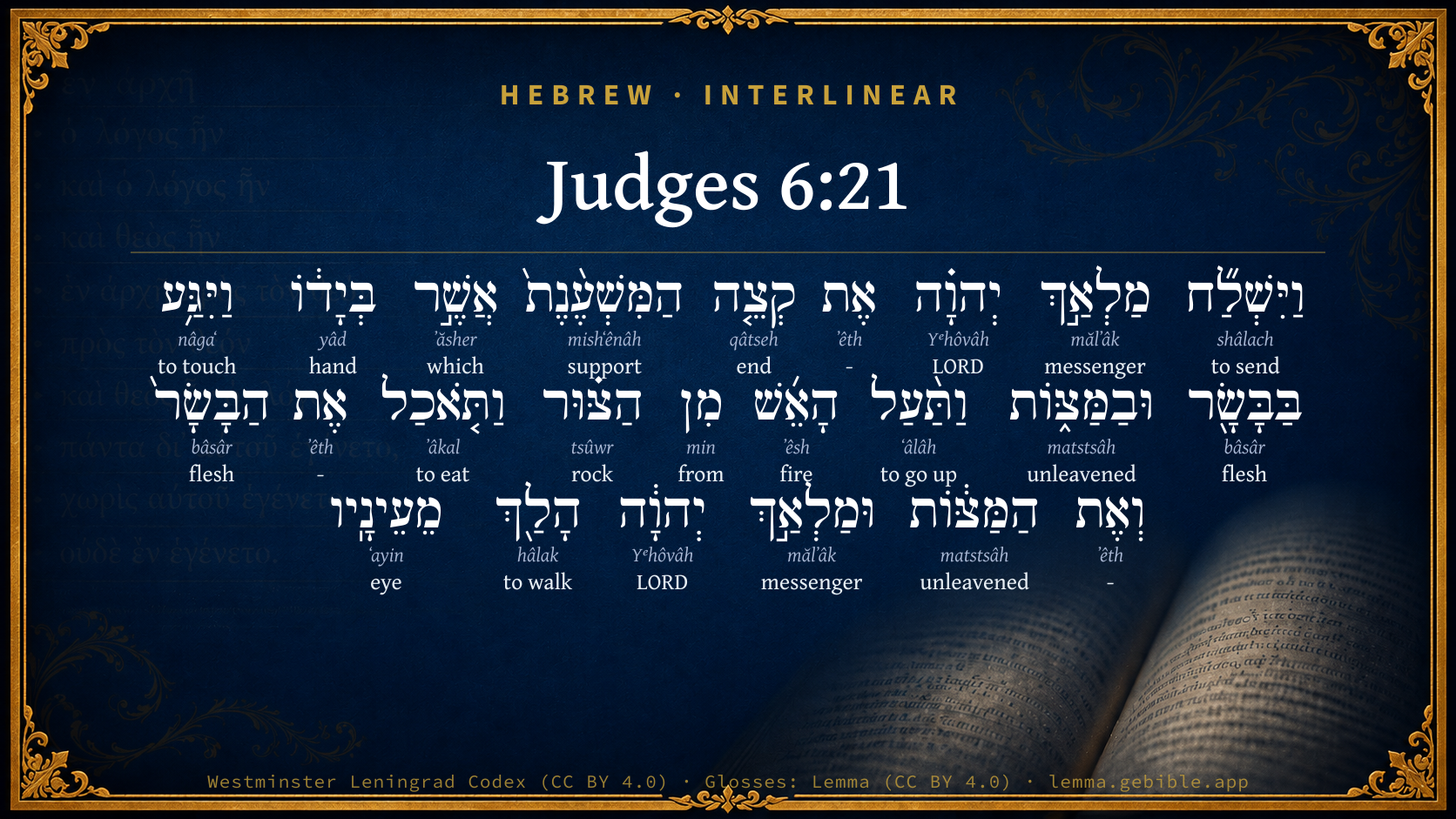
Hebrew (Westminster Leningrad Codex) Judges 6:21 appears in the Hebrew Old Testament. The text above is from the Westminster Leningrad Codex. Each word links to its Strong’s number, a concise gloss, and parsing drawn from the Open Scriptures Hebrew Bible morphology. Click any word for its full Brown-Driver-Briggs (BDB) entry.
Download image
Cite this verse

Judges 6:21 (World English Bible). Public Domain. Lemma interlinear Bible study tool, https://lemma.gebible.app/v/judges/6/21.

Show BibTeX & RIS
BibTeX
RIS
English Translation
Then the angel of Yahweh put forth the end of the staff that was in his hand, and touched the flesh and the unleavened cakes; and there went up fire out of the rock, and consumed the flesh and the unleavened cakes; and the angel of Yahweh departed out of his sight.
World English Bible · Public Domain
Download a study sheet

One document with this verse’s original text, its word-by-word gloss line, the meaning frame, cross-references with their text, attributed commentary, and full source and license credits — printable, and it pastes into notes with its structure intact.

This verse Autodidact and up

Study sheet (.html) Plain text (.txt)

A passage Seminary Student

Up to 50 verses in one chapter. A passage sheet keeps up to 6 commentary sources and 12 cross-references per verse, in the order this page ranks them, and says so on the sheet whenever that leaves anything out. Ask for a single verse and you get the Autodidact verse sheet above.

Everything on this page stays free to read, with no account — the sheet is a download of what is already on screen, not access to it.

Want to remove ads? Support Godless Engineer
Compare translations 3

The same verse in 3 English versions, stacked beneath the original-language interlinear above. Click any original word for its lexicon entry.

Each is an independent rendering of the whole verse — the interlinear is not word-aligned to these translations.

Highlighted words mark where these versions differ — a whole-verse word diff, not a word-by-word alignment.

  • World English Bible Public Domain
    Then the angel of Yahweh put forth the end of the staff that was in his hand, and touched the flesh and the unleavened cakes; and there went up fire out of the rock, and consumed the flesh and the unleavened cakes; and the angel of Yahweh departed out of his sight.
  • King James Version Public Domain
    Then the angel of the LORD put forth the end of the staff that was in his hand, and touched the flesh and the unleavened cakes; and there rose up fire out of the rock, and consumed the flesh and the unleavened cakes. Then the angel of the LORD departed out of his sight.
  • unfoldingWord Literal Text CC BY-SA 4.0
    Then the angel of Yahweh stretched out the end of the staff that in his hand. And he touched upon the meat and upon the unleavened bread, and fire came up from the rock and consumed the meat and the unleavened bread. Then the angel of Yahweh went from his eyes.

unfoldingWord Literal Text — © unfoldingWord, licensed CC BY-SA 4.0. Word-aligned USFM3 via Door43 (git.door43.org/unfoldingWord/en_ult).

Versions to compare (up to 4)

3 of 4 selected

Show all 18 translations

Every available English version of this verse, each an independent rendering of the whole verse.

  • World English Bible Public Domain
    Then the angel of Yahweh put forth the end of the staff that was in his hand, and touched the flesh and the unleavened cakes; and there went up fire out of the rock, and consumed the flesh and the unleavened cakes; and the angel of Yahweh departed out of his sight.
  • Berean Standard Bible Public Domain
    Then the angel of the LORD extended the tip of the staff that was in his hand and touched the meat and the unleavened bread. And fire flared from the rock and consumed the meat and the unleavened bread. Then the angel of the LORD vanished from his sight.
  • Majority Standard Bible Public Domain
    Then the angel of the LORD extended the tip of the staff that was in his hand and touched the meat and the unleavened bread. And fire flared from the rock and consumed the meat and the unleavened bread. Then the angel of the LORD vanished from his sight.
  • King James Version Public Domain
    Then the angel of the LORD put forth the end of the staff that was in his hand, and touched the flesh and the unleavened cakes; and there rose up fire out of the rock, and consumed the flesh and the unleavened cakes. Then the angel of the LORD departed out of his sight.
  • American Standard Version (1901) Public Domain
    Then the angel of Jehovah put forth the end of the staff that was in his hand, and touched the flesh and the unleavened cakes; and there went up fire out of the rock, and consumed the flesh and the unleavened cakes; and the angel of Jehovah departed out of his sight.
  • Revised Version (1885) Public Domain
    Then the angel of the LORD put forth the end of the staff that was in his hand, and touched the flesh and the unleavened cakes; and there went up fire out of the rock, and consumed the flesh and the unleavened cakes; and the angel of the LORD departed out of his sight.
  • Geneva Bible (1599) Public Domain
    Then the Angell of the Lord put forth the ende of the staffe that he had in his hand, and touched the flesh and the vnleauened bread: and there arose vp fire out of the stone, and consumed the flesh and the vnleauened bread: so the Angel of the Lord departed out of his sight.
  • Douay-Rheims (1899) Public Domain
    And the angel of the Lord said to him: Take the flesh and the unleavened loaves, and lay them upon that rock, and pour out the broth thereon. And when he had done so,
  • Young's Literal Translation Public Domain
    And the messenger of Jehovah putteth forth the end of the staff which `is' in His hand, and cometh against the flesh, and against the unleavened things, and the fire goeth up out of the rock and consumeth the flesh and the unleavened things -- and the messenger of Jehovah hath gone from his eyes.
  • Literal Standard Version CC BY-SA 4.0
    And the Messenger of YHWH puts forth the end of the staff which [is] in His hand, and comes against the flesh, and against the unleavened things, and the fire goes up out of the rock and consumes the flesh and the unleavened things—and the Messenger of YHWH has gone from his eyes.
  • Unlocked Literal Bible CC BY-SA 4.0
    Then the angel of Yahweh reached out with the end of the staff in his hand. With it he touched the flesh and the unleavened bread; a fire went up out of the rock and consumed the meat and the unleavened bread. Then the angel of Yahweh went away and Gideon could no longer see him.
  • unfoldingWord Literal Text CC BY-SA 4.0
    Then the angel of Yahweh stretched out the end of the staff that in his hand. And he touched upon the meat and upon the unleavened bread, and fire came up from the rock and consumed the meat and the unleavened bread. Then the angel of Yahweh went from his eyes.
  • Darby Bible Public Domain
    Then the angel of the LORD reached out the tip of the staff that was in his hand, and touched the meat and the unleavened cakes; and there sprang up fire from the rock and consumed the flesh and the unleavened cakes; and the angel of the LORD vanished from his sight.
  • World Messianic Bible Public Domain
    Then the LORD’s angel stretched out the end of the staff that was in his hand, and touched the meat and the unleavened cakes; and fire went up out of the rock and consumed the meat and the unleavened cakes. Then the LORD’s angel departed out of his sight.
  • Webster's Bible Public Domain
    Then the angel of the LORD put forth the end of the staff that was in his hand, and touched the flesh and the unleavened cakes; and there rose fire out of the rock, and consumed the flesh and the unleavened cakes. Then the angel of the LORD departed from his sight.
  • Free Bible Version CC BY-SA 4.0
    The angel of the Lord held out the staff he was holding and touched the meat and unleavened bread with the tip. Fire flamed from the rock and burned up the meat and unleavened bread. Then the angel vanished.
  • Bible in Basic English Public Domain
    Then the angel of the Lord put out the stick which was in his hand, touching the meat and the cakes with the end of it; and a flame came up out of the rock, burning up the meat and the cakes: and the angel of the Lord was seen no longer.
  • JPS Tanakh (1917) Public Domain
    Then the angel of the LORD put forth the end of the staff that was in his hand, and touched the flesh and the unleavened cakes; and there went up fire out of the rock, and consumed the flesh and the unleavened cakes; and the angel of the LORD departed out of his sight.

Literal Standard Version (2020), Covenant Press — licensed CC BY-SA 4.0. Text via the HelloAO Bible API (eBible.org). Unlocked Literal Bible (unfoldingWord) — licensed CC BY-SA 4.0. Text via the HelloAO Bible API (eBible.org). unfoldingWord Literal Text — © unfoldingWord, licensed CC BY-SA 4.0. Word-aligned USFM3 via Door43 (git.door43.org/unfoldingWord/en_ult). Free Bible Version, Dr. Jonathan Gallagher — licensed CC BY-SA 4.0. Text via the HelloAO Bible API (eBible.org).

Word by word

More ways to search: Search by grammar → Find every occurrence → Compare this word →

Practice this passage: Drill this verse → Learn its vocabulary →

הַמִּשְׁעֶ֨נֶת֙
mishʻênâh
H4938
“the · support”
Particle, Definite Article + Noun, Common, Feminine, Singular, Absolute
Part of Speech
Particle + Noun
Type
Common
Gender
Feminine
Number
Singular
State
Absolute
Full BDB Definition

Origin: from H4937

TWOT: 2434c , 2434d

support (of every kind), staff
  1. וַיִּשְׁלַ֞ח shâlach H7971 “and · to send” Conjunction + Verb, Qal, Sequential Imperfect, 3rd Person, Masculine, Singular
  2. מַלְאַ֣ךְ mălʼâk H4397 “messenger of” Noun, Common, Masculine, Singular, Construct
  3. יְהוָ֗ה Yᵉhôvâh H3068 “LORD” Noun, Proper
  4. אֶת ʼêth H853 “-” Particle, Direct Object
  5. קְצֵ֤ה qâtseh H7097 “end of” Noun, Common, Both, Singular, Construct
  6. אֲשֶׁ֣ר ʼăsher H834 “which” Particle, Relative
  7. בְּיָד֔וֹ yâd H3027 “in/at · hand · his” Preposition + Noun, Common, Both, Singular, Construct + Suffix, Personal, 3rd Person, Masculine, Singular
  8. וַיִּגַּ֥ע nâgaʻ H5060 “and · to touch” Conjunction + Verb, Qal, Sequential Imperfect, 3rd Person, Masculine, Singular
  9. בַּבָּשָׂ֖ר bâsâr H1320 “in/at the · flesh” Preposition, Determined + Noun, Common, Masculine, Singular, Absolute
  10. וּבַמַּצּ֑וֹת matstsâh H4682 “and · in/at the · unleavened bread” Conjunction + Preposition, Determined + Noun, Common, Feminine, Plural, Absolute
  11. וַתַּ֨עַל ʻâlâh H5927 “and · to go up” Conjunction + Verb, Qal, Sequential Imperfect, 3rd Person, Feminine, Singular
  12. הָאֵ֜שׁ ʼêsh H784 “the · fire” Particle, Definite Article + Noun, Common, Both, Singular, Absolute
  13. מִן min H4480 “from” Preposition
  14. הַצּ֗וּר tsûwr H6697 “the · rock” Particle, Definite Article + Noun, Common, Masculine, Singular, Absolute
  15. וַתֹּ֤אכַל ʼâkal H398 “and · to eat” Conjunction + Verb, Qal, Sequential Imperfect, 3rd Person, Feminine, Singular
  16. אֶת ʼêth H853 “-” Particle, Direct Object
  17. הַבָּשָׂר֙ bâsâr H1320 “the · flesh” Particle, Definite Article + Noun, Common, Masculine, Singular, Absolute
  18. וְאֶת ʼêth H853 “and · -” Conjunction + Particle, Direct Object
  19. הַמַּצּ֔וֹת matstsâh H4682 “the · unleavened bread” Particle, Definite Article + Noun, Common, Feminine, Plural, Absolute
  20. וּמַלְאַ֣ךְ mălʼâk H4397 “and · messenger of” Conjunction + Noun, Common, Masculine, Singular, Construct
  21. יְהוָ֔ה Yᵉhôvâh H3068 “LORD” Noun, Proper
  22. הָלַ֖ךְ hâlak H1980 “to walk” Verb, Qal, Perfect, 3rd Person, Masculine, Singular
  23. מֵעֵינָֽיו ʻayin H5869 “from · eyes · his” Preposition + Noun, Common, Both, Plural, Construct + Suffix, Personal, 3rd Person, Masculine, Singular

About this verse

These counts appear in no published source. They are computed here, from the morphology-tagged text and Lemma’s own curated glosses. What Lemma adds →

24
words
18
distinct lemmas
Historical
section

Notable vocabulary

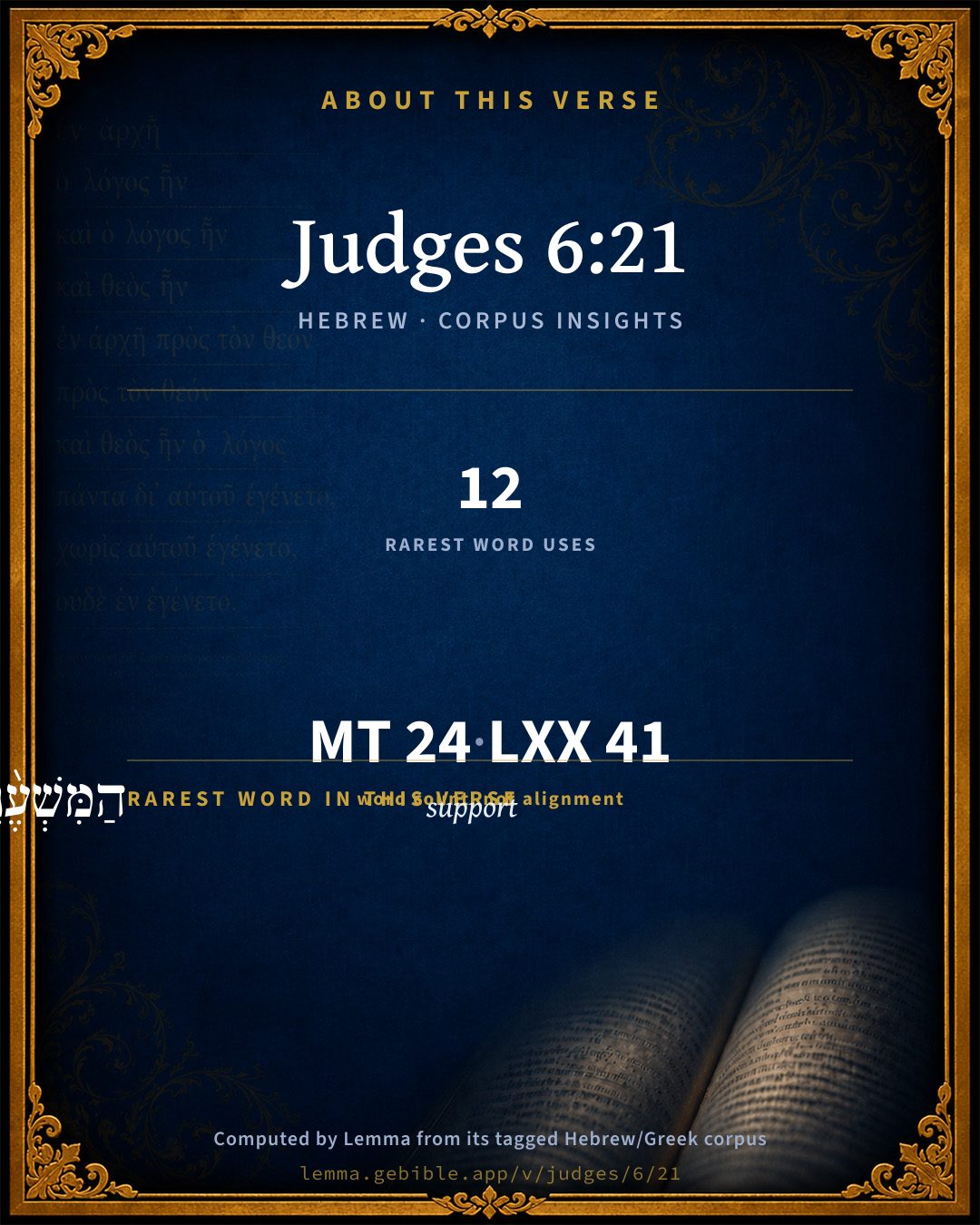
The rarest word here is הַמִּשְׁעֶ֨נֶת֙ support H4938 — appearing just 12 times in the whole Hebrew Bible.

Shared distinctive vocabulary

הַמִּשְׁעֶ֨נֶת֙ support H4938 occurs in 11 verses of the Hebrew Bible. Also found in:

Grammatical profile

  • 5 verbs
  • 14 nouns
  • 1 preposition
  • 4 particles

Verb forms

  • וַיִּשְׁלַ֞ח Qal · Sequential Imperfect
  • וַיִּגַּ֥ע Qal · Sequential Imperfect
  • וַתַּ֨עַל Qal · Sequential Imperfect
  • וַתֹּ֤אכַל Qal · Sequential Imperfect
  • הָלַ֖ךְ Qal · Perfect

Repetition

Words recur within this verse — often emphatic in Hebrew:

  • מַלְאַ֣ךְ messenger H4397 ×2
  • יְהוָ֗ה LORD H3068 ×2
  • בַּבָּשָׂ֖ר flesh H1320 ×2
  • וּבַמַּצּ֑וֹת unleavened H4682 ×2

Hebrew & Septuagint length

In English translation the verse runs 52 words from the Hebrew and 52 from the Septuagint (LXX English) — the same length.

A rough comparison of the two English renderings, which tokenize alike — not a word-level alignment.

Word counts can differ between the Hebrew and the Greek without any difference in meaning — e.g. the Hebrew direct-object marker אֵת has no separate Greek word, and Greek often adds the article ὁ.

In the original languages it is 24 Hebrew tokens and 41 Greek tokens — but the two are counted differently (Hebrew bundles its prefixes and suffixes into one token; the Greek is in lemma form), so that isn’t a like-for-like length.

Cross-references

5

Topical passages linked to Judges 6:21 in the Treasury of Scripture Knowledge — connected by theme and wording, ordered by reader-vote popularity; previews shown in the World English Bible.

  • Leviticus 9:24 There came forth fire from before Yahweh, and consumed the burnt offering and the fat upon the altar: and when all the people saw it, they shouted, and fell on their faces.
  • 1 Kings 18:38 Then the fire of Yahweh fell, and consumed the burnt offering, and the wood, and the stones, and the dust, and licked up the water that was in the trench.
  • 2 Chronicles 7:1 Now when Solomon had made an end of praying, the fire came down from heaven, and consumed the burnt offering and the sacrifices; and the glory of Yahweh filled the house.
  • 1 Chronicles 21:26 David built there an altar to Yahweh, and offered burnt offerings and peace-offerings, and called on Yahweh; and he answered him from the sky by fire on the altar of burnt offering.
  • Judges 13:20 For it happened, when the flame went up toward the sky from off the altar, that the angel of Yahweh ascended in the flame of the altar: and Manoah and his wife looked on; and they fell on their faces to the ground.

Cross-references courtesy of OpenBible.info (CC BY 4.0).

Hebrew and Greek witnesses Masoretic Hebrew ↔ Greek Septuagint

The same verse in the two great witnesses to the Old Testament, shown verse-for-verse.

These are two independent witnesses, not word-aligned to each other, and the Septuagint is shown in lemma (dictionary) form.

Hebrew Judges 6:21 Masoretic · Westminster Leningrad Codex

וַיִּשְׁלַ֞ח מַלְאַ֣ךְ יְהוָ֗ה אֶת קְצֵ֤ה הַמִּשְׁעֶ֨נֶת֙ אֲשֶׁ֣ר בְּיָד֔וֹ וַיִּגַּ֥ע בַּבָּשָׂ֖ר וּבַמַּצּ֑וֹת וַתַּ֨עַל הָאֵ֜שׁ מִן הַצּ֗וּר וַתֹּ֤אכַל אֶת הַבָּשָׂר֙ וְאֶת הַמַּצּ֔וֹת וּמַלְאַ֣ךְ יְהוָ֔ה הָלַ֖ךְ מֵעֵינָֽיו

Then the angel of Yahweh put forth the end of the staff that was in his hand, and touched the flesh and the unleavened cakes; and there went up fire out of the rock, and consumed the flesh and the unleavened cakes; and the angel of Yahweh departed out of his sight.

World English Bible · Public Domain

Greek LXX Judges 6:21 Septuagint · lemma form

καί ἐκτείνω ὁ ἄγγελος κύριος ὁ ἄκρος ὁ ῥάβδος ὁ ἐν χείρ αὐτός καί ἅπτομαι ὁ κρέας καί ὁ ἄζυμος καί ἀναβαίνω πῦρ ἐκ ὁ πέτρα καί καταἐσθίω ὁ κρέας καί ὁ ἄζυμος καί ὁ ἄγγελος κύριος πορεύομαι ἀπό ὀφθαλμός αὐτός

And the angel of the Lord stretched out the end of the rod that was in his hand, and touched the flesh and the unleavened bread; and fire came up out of the rock, and consumed the flesh and the unleavened bread, and the angel of the Lord vanished from his sight.

LXX2012 (modern English Septuagint) · Public Domain

Hebrew: Westminster Leningrad Codex (CC BY 4.0). Greek: Septuagint (public domain); English from LXX2012 (modern English Septuagint) (Public Domain). How the Septuagint differs from the Hebrew →

Targum (Aramaic paraphrase)

1

The Targum is the ancient Jewish Aramaic paraphrase of the Hebrew Scriptures — an interpretive translation, not the Hebrew text itself. Onkelos (literal) and Pseudo-Jonathan (expansive) render the Torah, and Jonathan the Prophets. Coverage is partial: where no permissively-licensed English translation exists for a verse, only the Aramaic is shown. This is verse-level text, not a word-by-word alignment to the Hebrew.

  1. Targum Jonathan Prophets (Joshua–Malachi)
    וְאוֹשֵׁיט מַלְאָכָא דַייָ יַת רֵישׁ שׁוֹטִיתָא דְבִידֵיהּ וְקָרֵיב בְּבִסְרָא וּבְפַּטִירָא וּסְלֵיקַת אֶשְׁתָּא מִן טִנָרָא וְאַכְלַת יַת בִּסְרָא וְיַת פַּטִירָא וּמַלְאָכָא דַייָ אִסְתַּלֵק מִלְקֳבֵיל עֵינוֹהִי:

    (no public-domain English translation for this verse)

    Targum Jonathan — Aramaic: “Mikraot Gedolot” (public domain). English: “Sefaria Community Translation” (CC0 1.0 (public-domain dedication)); “London "Chaldee Paraphrase," 1871” (public domain). Text via Sefaria.

Commentary

Notes on Judges 6:21 from classic Christian and Jewish commentators (each source and its license shown beneath its notes). The classic Christian expositions comment on the surrounding passage and are grouped to its opening verse, so a note may address several verses; the Jewish commentaries on the Tanakh (Rashi and others) are per-verse, so they appear only where the commentator wrote on this verse.

Lemma curates 59 commentaries, every one of them public domain or Creative Commons licensed, each selected and text-cleaned for this edition rather than reprinted as found. About our sources →

Trapp's Complete Commentary

John Trapp

Jdg 6:21 Then the angel of the LORD put forth the end of the staff that [was] in his hand, and touched the flesh and the unleavened cakes; and there rose up fire out of the rock, and consumed the flesh and the unleavened cakes. Then the angel of the LORD departed out of his sight.

Ver. 21. And there rose up fire out of the rock.] Here was a sign that the Midianites should be destroyed without man’s labour. Christ, as he is Piorum rupes, a rock of refuge to the godly, so he is Reorum scopulus, a rock of revenge to dash the impenitent to pieces, as Valerius Maximus saith of the tribunal of L. Cassius, a rock sending out fire, as here. {a}

{a} As once water came out of a rock. {Exo 17:6}

John Trapp, A Commentary or Exposition upon All the Books of the Old and New Testament (1647–1656) — public domain. Text from a community e-Sword module.

Joseph Benson's Commentary

Jdg 6:21-24. There rose up fire out of the rock, and consumed the flesh — By which he showed himself not to be a man that needed such provisions, but the Son of God; and by this instance of his omnipotency, gave him assurance that he both could and would consume the Midianites. Alas, O Lord God — I am an undone man: I must die, and that speedily; for that he feared, (Jdg 6:23,) according to the common opinion in that case. The Lord said unto him — Perhaps by an audible voice, for it does not seem as if the angel spoke these words; Peace be to thee — Thou shalt receive no hurt by this vision, but only peace; that is, all the blessings needful for thy own happiness, and for the present work. Gideon built an altar there — On the top of the rock, as is evident from Jdg 6:26, where that which is here expressed only in general, is more particularly described. Jehovah-shalom — That is, the Lord’s peace; the sign or witness of God’s speaking peace to me, and to his people: or the place where he spake peace to me, when I expected nothing but destruction.

Joseph Benson's Commentary on the Old and New Testaments (1811–1818) — public domain. Text from a community e-Sword module.

Geneva Bible (1599)

Geneva Bible translators

By the power of God only, as in the sacrifice of [Elijah], 1 Kings 18:38.

Geneva Bible (1599) marginal notes — public domain. Text via Bolls.life.

Adam Clarke's Commentary

Verse 21. The angel - put forth the end of the staff] He appeared like a traveller with a staff in his hand; this he put forth, and having touched the flesh, fire rose out of the rock and consumed it. Here was the most evident proof of supernatural agency.

Then the angel - departed out of his sight.] Though the angel vanished out of his sight, yet God continued to converse with him either by secret inspiration in his own heart, or by an audible voice.

Adam Clarke's Commentary on the Bible (1810–1826) — public domain. Text from a community e-Sword/MySword module.

Ellicott's Commentary for English Readers

(21) The staff that was in his hand.—The ordinary accompaniment of an Eastern traveller (Gen_32:10; Mat_10:10).

There rose up fire.—The common sign of God’s presence and of His acceptance of an offering. (See Lev_9:24; 1Ki_18:24; 1Ch_21:26; 2Ch_7:1.) Water is brought out of the rock for the blessing of man, and fire to show the presence of God.

Departed.—It is not said, as in Jdg_13:20, that he ascended in the flame.

A Bible Commentary for English Readers, edited by Charles John Ellicott (1878–1897) — public domain. Text from a community e-Sword module.

The Cambridge Bible for Schools and Colleges

gen. ed. J. J. S. Perowne

21. fire … and consumed] The food intended for a meal is converted into a sacrifice, and supernatural fire betokens the divine acceptance; cf. Jdg_13:20, 1Ki_18:38, 2Ch_7:1, Lev_9:24, 2Ma_2:10.

and the angel of the Lord departed] But in Jdg_6:23 Jehovah is still present and speaks to Gideon. Perhaps some distinction was felt at this point between Jehovah and the Angel of Jehovah; the partial manifestation was withdrawn, Jehovah Himself remained. Moore’s suggestion that these words were inserted on the analogy of Jdg_13:20 seems hardly necessary.

The Cambridge Bible for Schools and Colleges (gen. ed. J. J. S. Perowne; Cambridge University Press, 1878–1918) — public domain. Text from a community e-Sword module.

John Gill's Exposition

And when Gideon perceived he was an angel of the Lord,.... By the miracle wrought, and the manner of his departure:

Gideon said, alas! O Lord God; woe to me, what will become of me, or befall me, I shall surely die:

for because I have seen an angel of the Lord face to face; and whom he had reason to believe was the Lord himself, a divine Person, by the miracle wrought; and it was a commonly received notion even among good men, in those times, that the Lord was not to be seen by them and live, as appears from Jacob, Manoah, and others; at least the appearance of a divine Person, and even of any messenger from heaven, was startling, surprising, and frightful to them; which arose from a sense they had of the divine Being, and of their own sinfulness and frailty.

John Gill's Exposition of the Whole Bible (1746–1763) — public domain (CC PDM 1.0). Text via the HelloAO Bible API.

Matthew Poole's English Annotations

By these things he showed himself to be no man that needed such provisions, but a true angel of God, or the Son of God; and by this instance of his omnipotency, gave the assurance that he both could and would consume the Midianites.

Matthew Poole's English Annotations on the Holy Bible (1683–1685) — public domain. Text from a community e-Sword/MySword module.

Whedon's Commentary on the Bible

Daniel D. Whedon

21. The staff that was in his hand — Hitherto the Angel had appeared like a wayfaring man.

Fire out of the rock — Most startling and impressive miracle, showing beyond all possibility of doubt that this was indeed Jehovah’s Angel.

Departed out of his sight — Vanished. “The expression does not warrant the assumption that time Angel ascended to heaven in this instance, as in Jdg_13:20, in time flame of the sacrifice.” — Keil.

Daniel D. Whedon (gen. ed.), Commentary on the Old and New Testaments (1874–1909) — public domain. Text from a community e-Sword module.

The Pulpit Commentary

There rose up fire, etc. The consuming of the sacrifice by fire from heaven was the token of its being accepted. (cf. Jud_1:13:20, 23 1Ki_18:23, 1Ki_18:33, 38 1Ch_21:26) The angel of the Lord departed, etc. In the very similar case of the angel who appeared to Manoah, (Jud 13:15-20) the angel ascended in the flame of the altar. It is probable that he did so in the present instance, though it is not expressly stated how he disappeared. (cf. Act_8:39)

The Pulpit Commentary (1880–1919), ed. H.D.M. Spence-Jones & Joseph S. Exell — public domain. Text from a community e-Sword module.

John Wesley's Explanatory Notes

Consumed the flesh - By which, he shewed himself to be no man that needed such provisions, but the Son of God; and by this instance of his omnipotency, gave him assurance, that he both could, and would consume the Midianites.

John Wesley, Explanatory Notes Upon the Whole Bible (1754–1765) — public domain. Text via the GEBible commentary corpus.

Scofield Reference Notes

C. I. Scofield

angel

(See Scofield "Heb 1:4").

The Scofield Reference Bible (1917 edition), notes by C. I. Scofield — public domain. Text from a community e-Sword module.

unfoldingWord translationNotes

Door43 World Missions Community

angel of Yahweh

In Jdg 6:11-24 Yahweh appears to Gideon in the form of an angel. See how you translated this in Judges 6:11.

went away

"disappeared"

translationWords

angel

Yahweh

staff

hand

flesh

unleavened bread

fire

consume

Gideon

unfoldingWord translationNotes — © Distant Shores Media and the Door43 World Missions Community, licensed CC BY-SA 4.0. Source: git.door43.org/Door43/en_tn.

Lesson kit

Teaching starters — assembled from the data on this page, not authored interpretation. Every prompt links to the verse data it draws on. Edit before teaching.

Judges, in the Historical, opens this verse with 24 words (18 distinct Hebrew lemmas). Its most distinctive word is mishʻênâh (“support”). A historical commentator’s framing appears above. Read the whole chapter for the surrounding context.

Discussion questions

  1. What does “support” (mishʻênâh) contribute to the verse as a whole?
  2. How does Exodus 21:19, which shares the word «support», read alongside this verse?
  3. What does the repetition of “messenger” (2× in this one verse) do in this verse?
  4. These translations render this verse differently; the difference is in the English rendering, not the original. What questions does that raise?
  5. «וַיִּשְׁלַ֞ח» is a Qal Sequential Imperfect verb. How does that grammatical form shape the action described?
  6. Compare how Trapp's Complete Commentary and Joseph Benson's Commentary read this verse. Where do they agree or differ?

Things to notice

Reading settings

Reading text

Shown beneath each verse's original-language words.

Old Testament
Old Testament edition

Read the OT as the Masoretic Hebrew (MT) or the Greek Septuagint (LXX).

English shown for the Greek Septuagint (in the Hebrew ↔ Greek comparison).

Comparing translations? Open the Compare panel on any verse page to stack up to four side by side.