
1 Kings 18:23

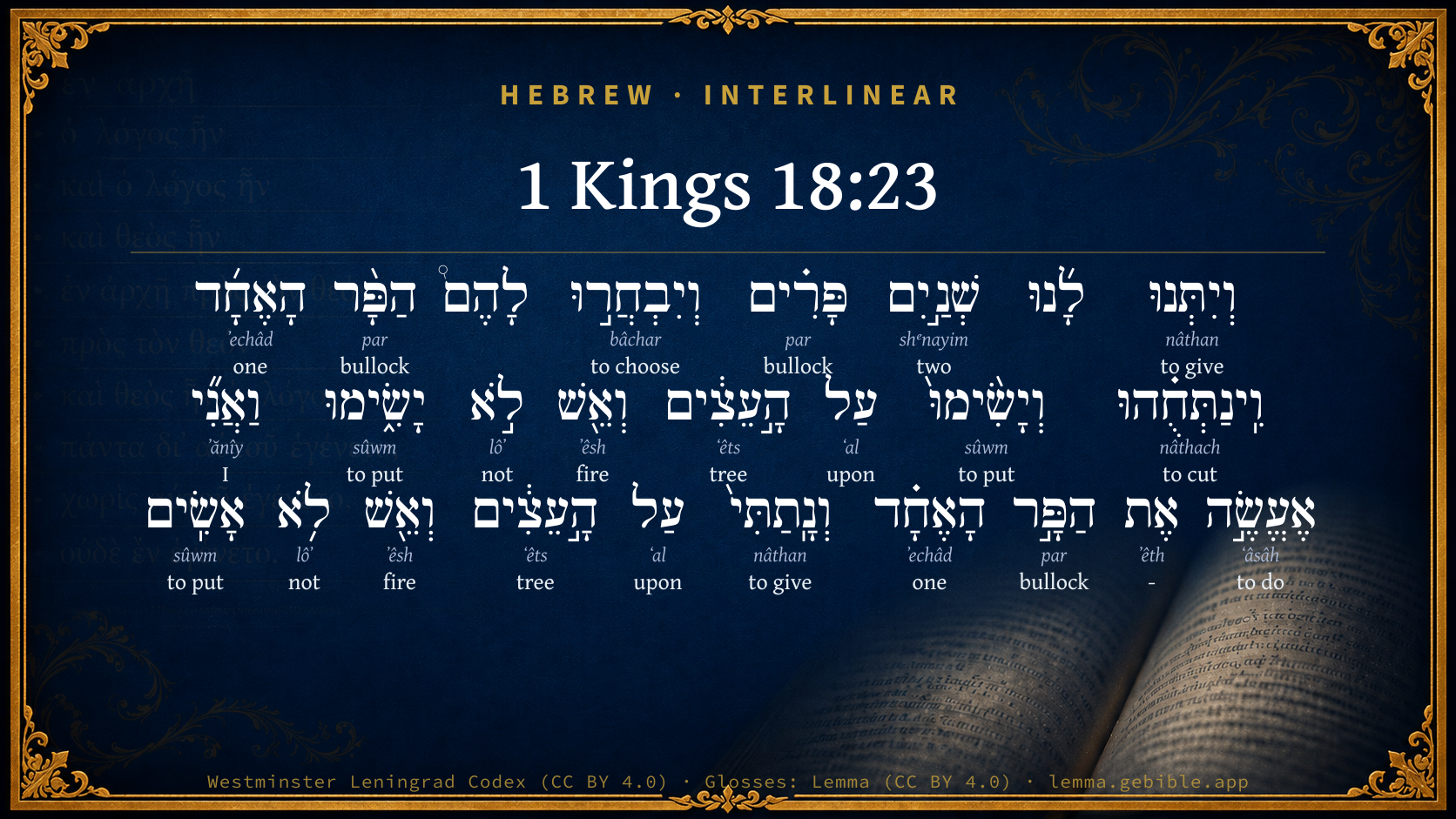
Hebrew (Westminster Leningrad Codex) 1 Kings 18:23 appears in the Hebrew Old Testament. The text above is from the Westminster Leningrad Codex. Each word links to its Strong’s number, a concise gloss, and parsing drawn from the Open Scriptures Hebrew Bible morphology. Click any word for its full Brown-Driver-Briggs (BDB) entry.
Download image
Cite this verse

1 Kings 18:23 (World English Bible). Public Domain. Lemma interlinear Bible study tool, https://lemma.gebible.app/v/1-kings/18/23.

Show BibTeX & RIS
BibTeX
RIS
English Translation
Let them therefore give us two bulls; and let them choose one bull for themselves, and cut it in pieces, and lay it on the wood, and put no fire under; and I will dress the other bull, and lay it on the wood, and put no fire under.
World English Bible · Public Domain
Download a study sheet

One document with this verse’s original text, its word-by-word gloss line, the meaning frame, cross-references with their text, attributed commentary, and full source and license credits — printable, and it pastes into notes with its structure intact.

This verse Autodidact and up

Study sheet (.html) Plain text (.txt)

A passage Seminary Student

Up to 50 verses in one chapter. A passage sheet keeps up to 6 commentary sources and 12 cross-references per verse, in the order this page ranks them, and says so on the sheet whenever that leaves anything out. Ask for a single verse and you get the Autodidact verse sheet above.

Everything on this page stays free to read, with no account — the sheet is a download of what is already on screen, not access to it.

Want to remove ads? Support Godless Engineer
Compare translations 3

The same verse in 3 English versions, stacked beneath the original-language interlinear above. Click any original word for its lexicon entry.

Each is an independent rendering of the whole verse — the interlinear is not word-aligned to these translations.

Highlighted words mark where these versions differ — a whole-verse word diff, not a word-by-word alignment.

  • World English Bible Public Domain
    Let them therefore give us two bulls; and let them choose one bull for themselves, and cut it in pieces, and lay it on the wood, and put no fire under; and I will dress the other bull, and lay it on the wood, and put no fire under.
  • King James Version Public Domain
    Let them therefore give us two bullocks; and let them choose one bullock for themselves, and cut it in pieces, and lay it on wood, and put no fire under: and I will dress the other bullock, and lay it on wood, and put no fire under:
  • unfoldingWord Literal Text CC BY-SA 4.0
    Now let them give two bulls to us, and let them choose for themselves one bull, and let them cut it up. And let them set on the wood, but let them not set a fire. And I, I will prepare one bull, and I will put on the wood, but I will not set a fire.

unfoldingWord Literal Text — © unfoldingWord, licensed CC BY-SA 4.0. Word-aligned USFM3 via Door43 (git.door43.org/unfoldingWord/en_ult).

Versions to compare (up to 4)

3 of 4 selected

Show all 18 translations

Every available English version of this verse, each an independent rendering of the whole verse.

  • World English Bible Public Domain
    Let them therefore give us two bulls; and let them choose one bull for themselves, and cut it in pieces, and lay it on the wood, and put no fire under; and I will dress the other bull, and lay it on the wood, and put no fire under.
  • Berean Standard Bible Public Domain
    Get two bulls for us. Let the prophets of Baal choose one bull for themselves, cut it into pieces, and place it on the wood but not light the fire. And I will prepare the other bull and place it on the wood but not light the fire.
  • Majority Standard Bible Public Domain
    Get two bulls for us. Let the prophets of Baal choose one bull for themselves, cut it into pieces, and place it on the wood but not light the fire. And I will prepare the other bull and place it on the wood but not light the fire.
  • King James Version Public Domain
    Let them therefore give us two bullocks; and let them choose one bullock for themselves, and cut it in pieces, and lay it on wood, and put no fire under: and I will dress the other bullock, and lay it on wood, and put no fire under:
  • American Standard Version (1901) Public Domain
    Let them therefore give us two bullocks; and let them choose one bullock for themselves, and cut it in pieces, and lay it on the wood, and put no fire under; and I will dress the other bullock, and lay it on the wood, and put no fire under.
  • Revised Version (1885) Public Domain
    Let them therefore give us two bullocks; and let them choose one bullock for themselves, and cut it in pieces, and lay it on the wood, and put no fire under: and I will dress the other bullock, and lay it on the wood, and put no fire under.
  • Geneva Bible (1599) Public Domain
    Let them therefore giue vs two bullockes, and let them chuse the one, and cut him in pieces, and lay him on the wood, but put no fire vnder, and I will prepare the other bullocke, and lay him on the wood, and will put no fire vnder.
  • Douay-Rheims (1899) Public Domain
    Let two bullocks be given us, and let them choose one bullock for themselves, and cut it in pieces and lay it upon wood, but put no fire under: and I will dress the other bullock, and lay it on wood, and put no fire under it.
  • Young's Literal Translation Public Domain
    and let them give to us two bullocks, and they choose for themselves the one bullock, and cut it in pieces, and place `it' on the wood, and place no fire; and I -- I prepare the other bullock, and have put `it' on the wood, and fire I do not place; --
  • Literal Standard Version CC BY-SA 4.0
    and let them give two bullocks to us, and they choose one bullock for themselves, and cut it in pieces, and place [it] on the wood, and place no fire; and I prepare the other bullock, and have put [it] on the wood, and I do not place fire—
  • Unlocked Literal Bible CC BY-SA 4.0
    So let them give us two bulls. Let them choose one bull for themselves and cut it in pieces, and lay it on the wood, but put no fire under it. Then I will prepare the other bull and lay it on the wood, and put no fire under it.
  • unfoldingWord Literal Text CC BY-SA 4.0
    Now let them give two bulls to us, and let them choose for themselves one bull, and let them cut it up. And let them set on the wood, but let them not set a fire. And I, I will prepare one bull, and I will put on the wood, but I will not set a fire.
  • Darby Bible Public Domain
    Let them therefore give us two bullocks: and let them choose one bullock for themselves, and cut it in pieces, and put it on the wood, and put no fire; and I will sacrifice the other bullock, and put it on the wood, and put no fire.
  • World Messianic Bible Public Domain
    Let them therefore give us two bulls; and let them choose one bull for themselves, and cut it in pieces, and lay it on the wood, and put no fire under; and I will dress the other bull, and lay it on the wood, and put no fire under it.
  • Webster's Bible Public Domain
    Let them therefore give us two bullocks; and let them choose one bullock for themselves, and cut it in pieces, and lay it on wood, and put no fire under: and I will dress the other bullock, and lay it on wood, and put no fire under:
  • Free Bible Version CC BY-SA 4.0
    Provide us with two bulls. Let the prophets of Baal choose for themselves the one they want, and have them cut it into pieces and place it on the firewood. But don't set fire to it. I will prepare the other bull and place it on the firewood but I won't set fire to it.
  • Bible in Basic English Public Domain
    Now, let them give us two oxen; and let them take one for themselves, and have it cut up, and put it on the wood, but put no fire under it; I will get the other ox ready, and put it on the wood, and put no fire under it.
  • JPS Tanakh (1917) Public Domain
    Let them therefore give us two bullocks; and let them choose one bullock for themselves, and cut it in pieces, and lay it on the wood, and put no fire under; and I will dress the other bullock, and lay it on the wood, and put no fire under.

Literal Standard Version (2020), Covenant Press — licensed CC BY-SA 4.0. Text via the HelloAO Bible API (eBible.org). Unlocked Literal Bible (unfoldingWord) — licensed CC BY-SA 4.0. Text via the HelloAO Bible API (eBible.org). unfoldingWord Literal Text — © unfoldingWord, licensed CC BY-SA 4.0. Word-aligned USFM3 via Door43 (git.door43.org/unfoldingWord/en_ult). Free Bible Version, Dr. Jonathan Gallagher — licensed CC BY-SA 4.0. Text via the HelloAO Bible API (eBible.org).

Word by word

More ways to search: Search by grammar → Find every occurrence → Compare this word →

Practice this passage: Drill this verse → Learn its vocabulary →

וִֽינַתְּחֻ֗הוּ
nâthach
H5408
“and · to cut · him”
Conjunction + Verb, Piel, Jussive, 3rd Person, Masculine, Plural + Suffix, Personal, 3rd Person, Masculine, Singular
Part of Speech
Conjunction + Verb
Stem
Piel
Form
Jussive
Person
3rd Person
Gender
Masculine
Number
Plural
Full BDB Definition

Origin: a primitive root

TWOT: 1441

to cut, cut up, cut in pieces, divide - (Piel) to cut up, cut in pieces, divide by joints
  1. וְיִתְּנוּ nâthan H5414 “and · to give” Conjunction + Verb, Qal, Jussive, 3rd Person, Masculine, Plural
  2. שְׁנַ֣יִם shᵉnayim H8147 “two” Adjective, Cardinal number, Masculine, Dual, Absolute
  3. פָּרִ֗ים par H6499 “bullocks” Noun, Common, Masculine, Plural, Absolute
  4. וְיִבְחֲר֣וּ bâchar H977 “and · to choose” Conjunction + Verb, Qal, Jussive, 3rd Person, Masculine, Plural
  5. הַפָּ֨ר par H6499 “the · bullock” Particle, Definite Article + Noun, Common, Masculine, Singular, Absolute
  6. הָאֶחָ֜ד ʼechâd H259 “the · one” Particle, Definite Article + Adjective, Cardinal number, Masculine, Singular, Absolute
  7. וְיָשִׂ֨ימוּ֙ sûwm H7760 “and · to put” Conjunction + Verb, Qal, Jussive, 3rd Person, Masculine, Plural
  8. עַל ʻal H5921 “upon” Preposition
  9. הָ֣עֵצִ֔ים ʻêts H6086 “the · trees” Particle, Definite Article + Noun, Common, Masculine, Plural, Absolute
  10. וְאֵ֖שׁ ʼêsh H784 “and · fire” Conjunction + Noun, Common, Both, Singular, Absolute
  11. לֹ֣א lôʼ H3808 “not” Particle, Negative
  12. יָשִׂ֑ימוּ sûwm H7760 “to put” Verb, Qal, Imperfect, 3rd Person, Masculine, Plural
  13. וַאֲנִ֞י ʼănîy H589 “and · I” Conjunction + Pronoun, Personal, 1st Person, Common, Singular
  14. אֶעֱשֶׂ֣ה ʻâsâh H6213 “to do” Verb, Qal, Imperfect, 1st Person, Common, Singular
  15. אֶת ʼêth H853 “-” Particle, Direct Object
  16. הַפָּ֣ר par H6499 “the · bullock” Particle, Definite Article + Noun, Common, Masculine, Singular, Absolute
  17. הָאֶחָ֗ד ʼechâd H259 “the · one” Particle, Definite Article + Adjective, Cardinal number, Masculine, Singular, Absolute
  18. וְנָֽתַתִּי֙ nâthan H5414 “and · to give” Conjunction + Verb, Qal, Sequential Perfect, 1st Person, Common, Singular
  19. עַל ʻal H5921 “upon” Preposition
  20. הָ֣עֵצִ֔ים ʻêts H6086 “the · trees” Particle, Definite Article + Noun, Common, Masculine, Plural, Absolute
  21. וְאֵ֖שׁ ʼêsh H784 “and · fire” Conjunction + Noun, Common, Both, Singular, Absolute
  22. לֹ֥א lôʼ H3808 “not” Particle, Negative
  23. אָשִֽׂים sûwm H7760 “to put” Verb, Qal, Imperfect, 1st Person, Common, Singular

About this verse

These counts appear in no published source. They are computed here, from the morphology-tagged text and Lemma’s own curated glosses. What Lemma adds →

26
words
14
distinct lemmas
Historical
section

Notable vocabulary

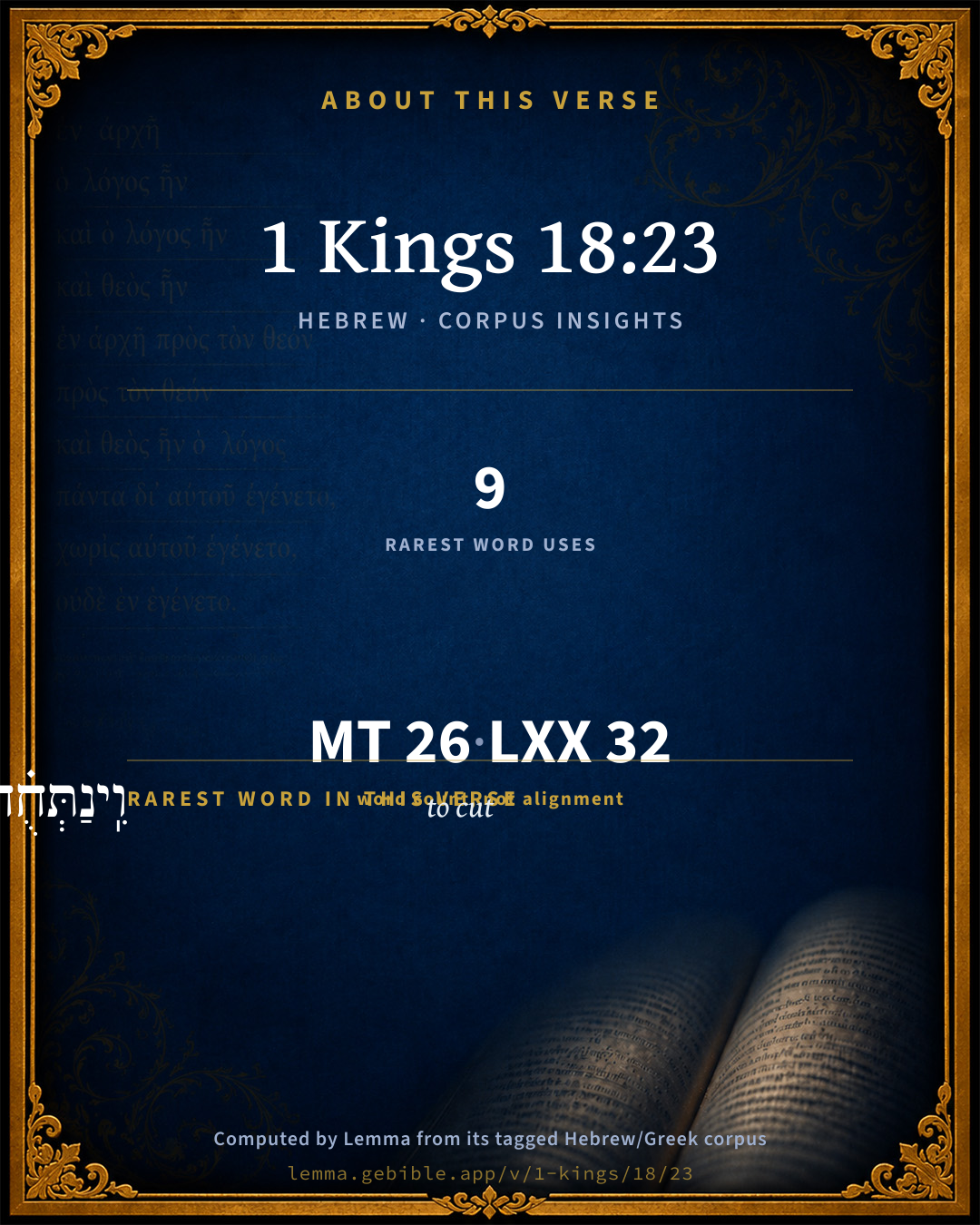
The rarest word here is וִֽינַתְּחֻ֗הוּ to cut H5408 — appearing just 9 times in the whole Hebrew Bible.

Shared distinctive vocabulary

וִֽינַתְּחֻ֗הוּ to cut H5408 occurs in 9 verses of the Hebrew Bible. Also found in:

Grammatical profile

  • 8 verbs
  • 7 nouns
  • 3 adjectives
  • 1 pronoun
  • 4 prepositions
  • 3 particles

Verb forms

  • וְיִתְּנוּ Qal · Jussive
  • וְיִבְחֲר֣וּ Qal · Jussive
  • וִֽינַתְּחֻ֗הוּ Piel · Jussive
  • וְיָשִׂ֨ימוּ֙ Qal · Jussive
  • יָשִׂ֑ימוּ Qal · Imperfect
  • אֶעֱשֶׂ֣ה Qal · Imperfect
  • וְנָֽתַתִּי֙ Qal · Sequential Perfect
  • אָשִֽׂים Qal · Imperfect

Repetition

Words recur within this verse — often emphatic in Hebrew:

  • פָּרִ֗ים bullock H6499 ×3
  • וְיָשִׂ֨ימוּ֙ to put H7760 ×3
  • וְיִתְּנוּ to give H5414 ×2
  • הָאֶחָ֜ד one H259 ×2
  • עַל upon H5921 ×2
  • הָ֣עֵצִ֔ים tree H6086 ×2
  • וְאֵ֖שׁ fire H784 ×2
  • לֹ֣א not H3808 ×2

Hebrew & Septuagint length

In English translation the verse runs 49 words from the Hebrew and 43 from the Septuagint (LXX English) — closely comparable.

A rough comparison of the two English renderings, which tokenize alike — not a word-level alignment.

Word counts can differ between the Hebrew and the Greek without any difference in meaning — e.g. the Hebrew direct-object marker אֵת has no separate Greek word, and Greek often adds the article ὁ.

In the original languages it is 26 Hebrew tokens and 32 Greek tokens — but the two are counted differently (Hebrew bundles its prefixes and suffixes into one token; the Greek is in lemma form), so that isn’t a like-for-like length.

Hebrew and Greek witnesses Masoretic Hebrew ↔ Greek Septuagint

The same verse in the two great witnesses to the Old Testament, shown verse-for-verse.

These are two independent witnesses, not word-aligned to each other, and the Septuagint is shown in lemma (dictionary) form.

Hebrew 1 Kings 18:23 Masoretic · Westminster Leningrad Codex

וְיִתְּנוּ לָ֜נוּ שְׁנַ֣יִם פָּרִ֗ים וְיִבְחֲר֣וּ לָהֶם֩ הַפָּ֨ר הָאֶחָ֜ד וִֽינַתְּחֻ֗הוּ וְיָשִׂ֨ימוּ֙ עַל הָ֣עֵצִ֔ים וְאֵ֖שׁ לֹ֣א יָשִׂ֑ימוּ וַאֲנִ֞י אֶעֱשֶׂ֣ה אֶת הַפָּ֣ר הָאֶחָ֗ד וְנָֽתַתִּי֙ עַל הָ֣עֵצִ֔ים וְאֵ֖שׁ לֹ֥א אָשִֽׂים

Let them therefore give us two bulls; and let them choose one bull for themselves, and cut it in pieces, and lay it on the wood, and put no fire under; and I will dress the other bull, and lay it on the wood, and put no fire under.

World English Bible · Public Domain

Greek LXX 1 Kings 18:23 Septuagint · lemma form

δίδωμι ἐγώ δύο βοῦς καί ἐκλέγω ἑαυτοῦ ὁ εἷς καί μελίζω καί ἐπιτίθημι ἐπί ὁ ξύλον καί πῦρ μή ἐπιτίθημι καί ἐγώ ποιέω ὁ βοῦς ὁ ἄλλος καί πῦρ οὐ μή ἐπιτίθημι

Let them give us two oxen, and let them choose one for themselves, and cut it in pieces, and lay it on the wood, and put no fire on the wood: and I will dress the other bullock, and put on no fire.

LXX2012 (modern English Septuagint) · Public Domain

On this verse, The Cambridge Bible for Schools and Colleges discusses the Septuagint’s reading. Read the note in Commentary ↓

Hebrew: Westminster Leningrad Codex (CC BY 4.0). Greek: Septuagint (public domain); English from LXX2012 (modern English Septuagint) (Public Domain). How the Septuagint differs from the Hebrew →

Targum (Aramaic paraphrase)

1

The Targum is the ancient Jewish Aramaic paraphrase of the Hebrew Scriptures — an interpretive translation, not the Hebrew text itself. Onkelos (literal) and Pseudo-Jonathan (expansive) render the Torah, and Jonathan the Prophets. Coverage is partial: where no permissively-licensed English translation exists for a verse, only the Aramaic is shown. This is verse-level text, not a word-by-word alignment to the Hebrew.

  1. Targum Jonathan Prophets (Joshua–Malachi)
    וְיִתְיַהֲבוּן לָנָא תְּרֵין תּוֹרִין וְיִבְחֲרוּן לְהוֹן תּוֹרָא חַד וִיהַדְמוּנֵיהּ וִישַׁווּן עַל אָעַיָא וְאֶשְׁתָּא לָא יְשַׁווּן וַאֲנָא אַעְבֵּיר יַת תּוֹרָא חַד וְאֶתֵּן עַל אָעַיָא וְאֶשְׁתָּא לָא אֲשַׁוֵי:

    (no public-domain English translation for this verse)

    Targum Jonathan — Aramaic: “Mikraot Gedolot” (public domain). English: “Sefaria Community Translation” (CC0 1.0 (public-domain dedication)); “London "Chaldee Paraphrase," 1871” (public domain). Text via Sefaria.

Commentary

Notes on 1 Kings 18:23 from classic Christian and Jewish commentators (each source and its license shown beneath its notes). The classic Christian expositions comment on the surrounding passage and are grouped to its opening verse, so a note may address several verses; the Jewish commentaries on the Tanakh (Rashi and others) are per-verse, so they appear only where the commentator wrote on this verse.

Lemma curates 59 commentaries, every one of them public domain or Creative Commons licensed, each selected and text-cleaned for this edition rather than reprinted as found. About our sources →

Trapp's Complete Commentary

John Trapp

1Ki 18:23 Let them therefore give us two bullocks; and let them choose one bullock for themselves, and cut it in pieces, and lay [it] on wood, and put no fire [under]: and I will dress the other bullock, and lay [it] on wood, and put no fire [under]:

Ver. 23. And cut it in pieces, and lay it on the wood.] After the manner of sacrifices. And thus should Abraham have done by Isaac, if he had not been hindered from heaven: a very great trial.

John Trapp, A Commentary or Exposition upon All the Books of the Old and New Testament (1647–1656) — public domain. Text from a community e-Sword module.

Joseph Benson's Commentary

1Ki 18:23. Let them therefore give us two bullocks — He proposes to decide the controversy, not by God’s word, because that was either despised and rejected, or grossly neglected, and therefore unknown and of no authority with the king or people; but by a miracle, to the evidence of which all that had common sense must needs submit.

Joseph Benson's Commentary on the Old and New Testaments (1811–1818) — public domain. Text from a community e-Sword module.

Tyndale Open Study Notes

Tyndale Open Resources

18:23-24 The Lord’s presence was attested by fire (Exod 9:23; 19:18; 40:38; Deut 4:24; 2 Chr 7:1; Isa 66:15; Amos 7:4), which could have been lightning (cp. Ps 18:12-13; Ezek 1:13-14; Zech 9:14). The contest would demonstrate whether the Canaanite storm-god Baal or the God of Israel was the true God; only the true God could set fire to the wood (cp. Lev 9:24).

Tyndale Open Study Notes — © Tyndale Open Resources, licensed CC BY-SA 4.0. Text via the HelloAO Bible API.

The Cambridge Bible for Schools and Colleges

gen. ed. J. J. S. Perowne

23. Let them therefore give us] i.e. Let there be given unto us. Let there be provided, for the trial which I am about to propose.

and let them choose one] Elijah yields place to them because of their greater number. So 1Ki_18:25 ‘for ye are many.’

cut it in pieces] This was a part of the duty of the offerer of a burnt-offering. See Lev_1:6; ‘he shall flay the burnt offering and cut it into his pieces.’

and I will dress the other bullock] The Hebrew uses for ‘dress’ the verb עשׂה = to make, which, in connexions like this, = ‘to make ready’ a victim for sacrifice. The same word is used Psa_66:15 ‘I will offer bullocks with goats,’ also Exo_29:36; Exo_29:38-39; Exo_29:41. The LXX. translates by καὶ ἐγὼ ποιήσω τὸν βοῦν τὸν ἄλλον, a sentence from which we may see in what way ποιεῖν came to be used of sacrifice. But by itself ποιεῖν can no more mean ‘to sacrifice’ than could the English verb ‘make.’ The object, the victim, must always be expressed. The same word is employed again in 1Ki_18:25-26.

and lay it on wood] The LXX. omits these words.

no fire under] Deceit was largely practised in the heathen temples and sacrifices represented as miraculously consumed, for the accomplishment of which preparation was made in the ground beneath the altar.

The Cambridge Bible for Schools and Colleges (gen. ed. J. J. S. Perowne; Cambridge University Press, 1878–1918) — public domain. Text from a community e-Sword module.

John Gill's Exposition

And Elijah said unto the prophets of Baal,.... Who agreed to this proposal, though not expressed; or they signified it by their silence. Ben Gersom thinks they agreed to it, because that, according to their belief, Baal was Mars, and in the sign of Aries, one of the fiery planets, and therefore fancied he could send down fire on their sacrifice; but Abarbinel is of opinion that it was the sun they worshipped, under the name of Baal, the great luminary which presides over the element of fire, and therefore had power to cause it to descend; and if not, they agreed to it, he thinks, for three reasons; one was necessity, they could not refuse, after the people had approved of it, lest they should rise upon them, and stone them; and another was, that Elijah proposed to offer without the temple, contrary to the law of his God, and therefore concluded he would not answer him by fire, and so they should be upon a par with him; and the third was, that they thought they should offer their bullocks together, so that, if fire descended, it would come upon them both, and then the dispute would be, whether his God, or their god, sent it; and so no proof could be made who was God, nor the matter in controversy decided:

choose you one bullock for yourselves, and dress it first; for ye are many; therefore in civility to them gave the choice of the bullock and the altar first, he being one and they many:

and call on the name of your gods, but put no fire under; under the wood on which was the sacrifice cut in pieces; and when they had so done, then they were to call on their gods to cause fire to descend upon it.

John Gill's Exposition of the Whole Bible (1746–1763) — public domain (CC PDM 1.0). Text via the HelloAO Bible API.

Matthew Poole's English Annotations

He attempts the decision of this controversy, not by God’s word, which was either rejected, or despised, or grossly neglected by the generality of that people; but by a miracle, to which all that had common sense must needs submit.

Let them choose one bullock for themselves, which they judge best and fittest for their purpose.

Matthew Poole's English Annotations on the Holy Bible (1683–1685) — public domain. Text from a community e-Sword/MySword module.

The Pulpit Commentary

Let them therefore give us two bullocks; and let them choose one bullock for themselves, and cut it in pieces same word (Exo_29:17; Lev_1:6, Lev_1:12; Jud_1:20:6) and lay it on wood Heb. the woods , and put no fire under Heb. and fire they shall not set to: and I win dress Heb. make, hc; ; like poiein in the LXX, is constantly used in a sacrificial sense = offer. Cf. Exo_29:36, Exo_29:38, Exo_29:41; Lev_9:7 Lev_15:15; Jud_1:6:19, etc. This is to be remembered ininterpreting our Lord"s touto poieite k.t.l. (Luk_22:19) the other bullock, and lay it on wood the wood, and put no fire under and fire I will not set to:

The Pulpit Commentary (1880–1919), ed. H.D.M. Spence-Jones & Joseph S. Exell — public domain. Text from a community e-Sword module.

John Wesley's Explanatory Notes

Let then, &c. - To put this controversy to a short issue.

John Wesley, Explanatory Notes Upon the Whole Bible (1754–1765) — public domain. Text via the GEBible commentary corpus.

Lesson kit

Teaching starters — assembled from the data on this page, not authored interpretation. Every prompt links to the verse data it draws on. Edit before teaching.

1 Kings, in the Historical, opens this verse with 26 words (14 distinct Hebrew lemmas). Its most distinctive word is nâthach (“to cut”). A historical commentator’s framing appears above. Read the whole chapter for the surrounding context.

Discussion questions

  1. How does “to cut” (nâthach) shape what this verse is saying?
  2. How does Exodus 29:17, which shares the word «to cut», read alongside this verse?
  3. What does the repetition of “bullock” (3× in this one verse) do in this verse?
  4. These translations render this verse differently; the difference is in the English rendering, not the original. What questions does that raise?
  5. «וְיִתְּנוּ» is a Qal Jussive verb. How does that grammatical form shape the action described?
  6. Compare how Trapp's Complete Commentary and Joseph Benson's Commentary read this verse. Where do they agree or differ?

Things to notice

Reading settings

Reading text

Shown beneath each verse's original-language words.

Old Testament
Old Testament edition

Read the OT as the Masoretic Hebrew (MT) or the Greek Septuagint (LXX).

English shown for the Greek Septuagint (in the Hebrew ↔ Greek comparison).

Comparing translations? Open the Compare panel on any verse page to stack up to four side by side.