
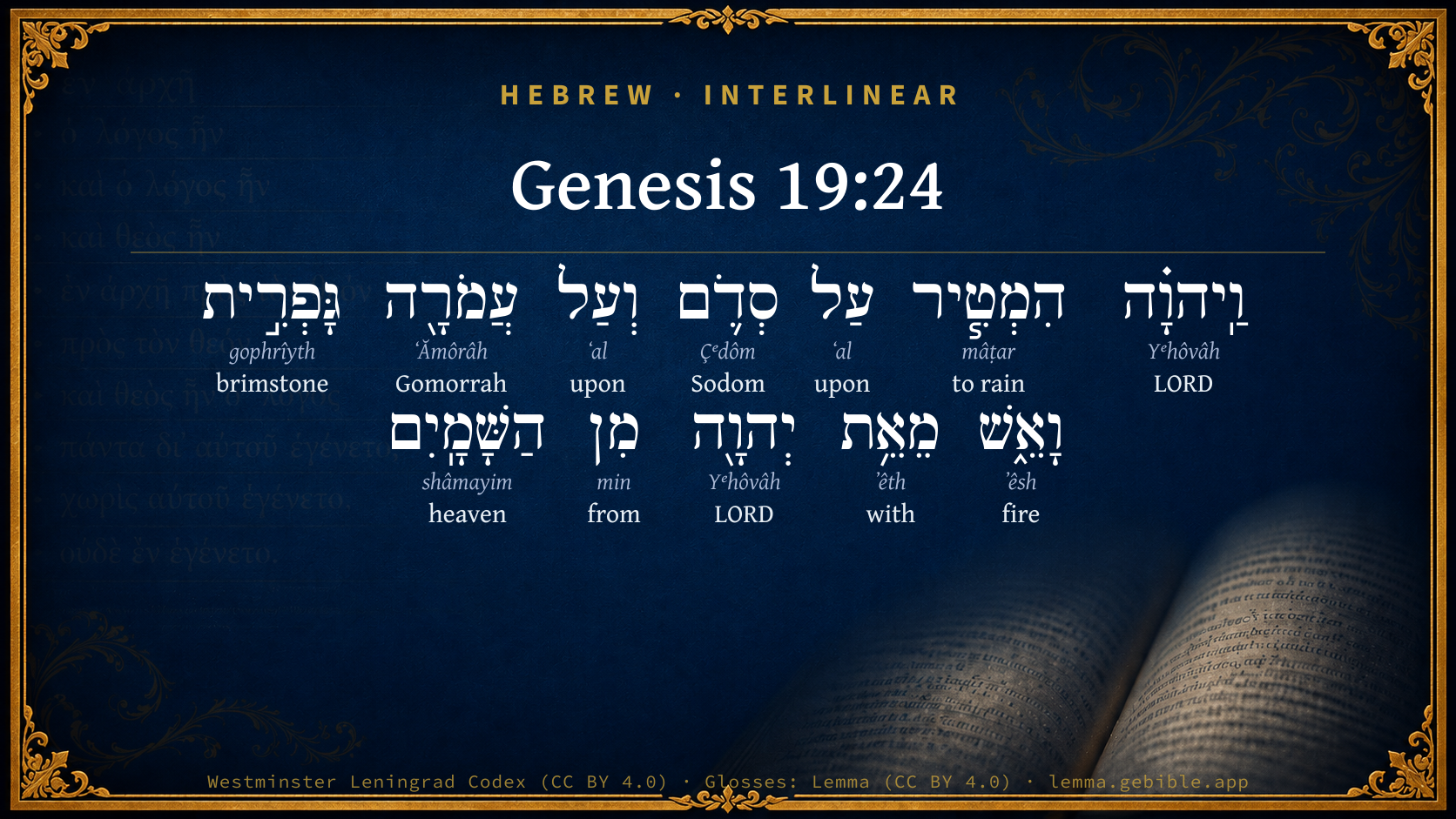
Genesis 19:24

Hebrew (Westminster Leningrad Codex) Genesis 19:24 appears in the Hebrew Old Testament. The text above is from the Westminster Leningrad Codex. Each word links to its Strong’s number, a concise gloss, and parsing drawn from the Open Scriptures Hebrew Bible morphology. Click any word for its full Brown-Driver-Briggs (BDB) entry.
Download image
Cite this verse

Genesis 19:24 (World English Bible). Public Domain. Lemma interlinear Bible study tool, https://lemma.gebible.app/v/genesis/19/24.

Show BibTeX & RIS
BibTeX
RIS
English Translation
Then Yahweh rained on Sodom and on Gomorrah sulfur and fire from Yahweh out of the sky.
World English Bible · Public Domain
Highlights
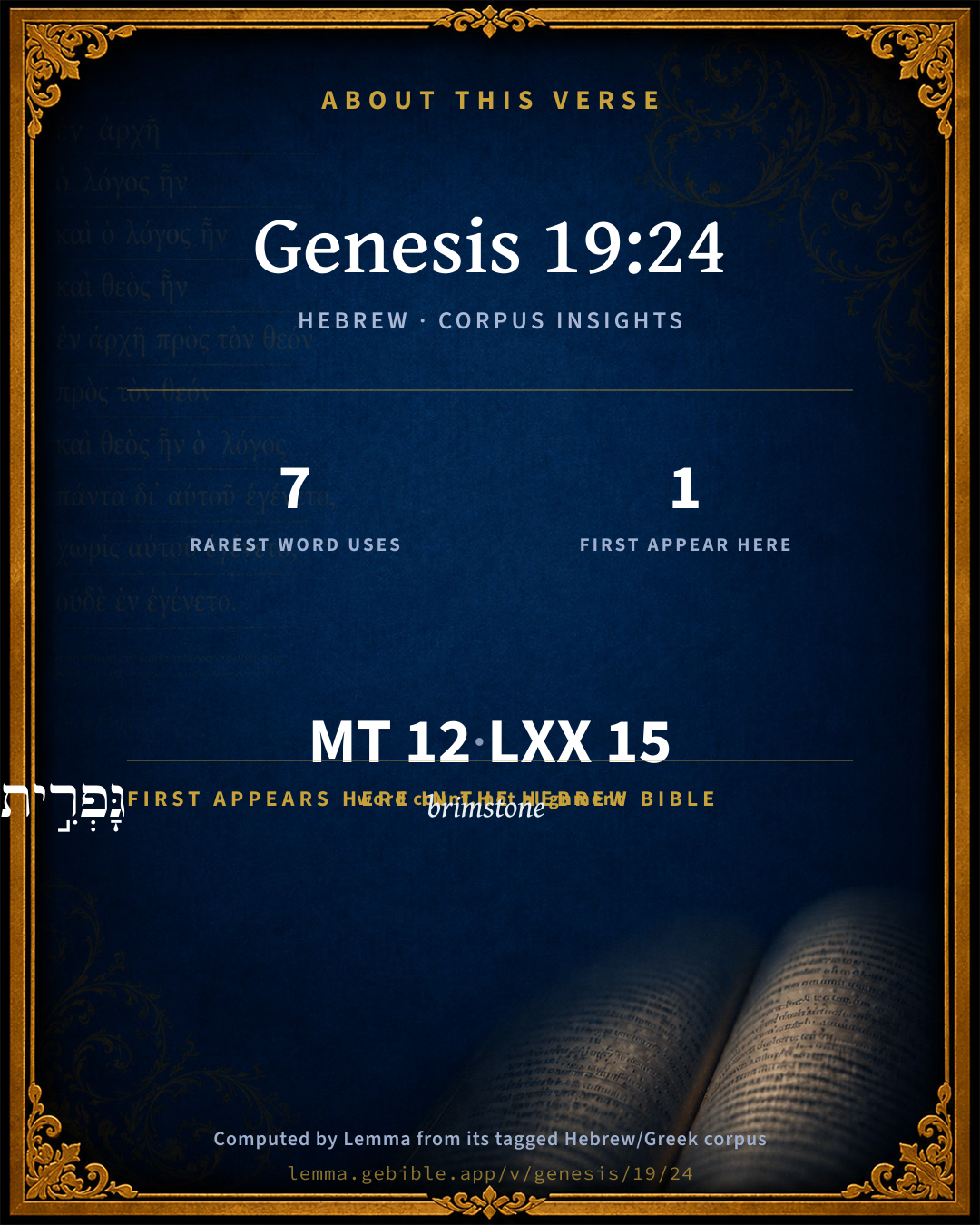
  • 1 first appearance in the Hebrew Bible
Full analysis ↓
Download a study sheet

One document with this verse’s original text, its word-by-word gloss line, the meaning frame, cross-references with their text, attributed commentary, and full source and license credits — printable, and it pastes into notes with its structure intact.

This verse Autodidact and up

Study sheet (.html) Plain text (.txt)

A passage Seminary Student

Up to 50 verses in one chapter. A passage sheet keeps up to 6 commentary sources and 12 cross-references per verse, in the order this page ranks them, and says so on the sheet whenever that leaves anything out. Ask for a single verse and you get the Autodidact verse sheet above.

Everything on this page stays free to read, with no account — the sheet is a download of what is already on screen, not access to it.

Want to remove ads? Support Godless Engineer
Compare translations 3

The same verse in 3 English versions, stacked beneath the original-language interlinear above. Click any original word for its lexicon entry.

Each is an independent rendering of the whole verse — the interlinear is not word-aligned to these translations.

Highlighted words mark where these versions differ — a whole-verse word diff, not a word-by-word alignment.

  • World English Bible Public Domain
    Then Yahweh rained on Sodom and on Gomorrah sulfur and fire from Yahweh out of the sky.
  • King James Version Public Domain
    Then the LORD rained upon Sodom and upon Gomorrah brimstone and fire from the LORD out of heaven;
  • unfoldingWord Literal Text CC BY-SA 4.0
    Then Yahweh rained down on Sodom and Gomorrah brimstone and fire from Yahweh out of the heavens,

unfoldingWord Literal Text — © unfoldingWord, licensed CC BY-SA 4.0. Word-aligned USFM3 via Door43 (git.door43.org/unfoldingWord/en_ult).

Versions to compare (up to 4)

3 of 4 selected

Show all 18 translations

Every available English version of this verse, each an independent rendering of the whole verse.

  • World English Bible Public Domain
    Then Yahweh rained on Sodom and on Gomorrah sulfur and fire from Yahweh out of the sky.
  • Berean Standard Bible Public Domain
    Then the LORD rained down sulfur and fire on Sodom and Gomorrah—from the LORD out of the heavens.
  • Majority Standard Bible Public Domain
    Then the LORD rained down sulfur and fire on Sodom and Gomorrah—from the LORD out of the heavens.
  • King James Version Public Domain
    Then the LORD rained upon Sodom and upon Gomorrah brimstone and fire from the LORD out of heaven;
  • American Standard Version (1901) Public Domain
    Then Jehovah rained upon Sodom and upon Gomorrah brimstone and fire from Jehovah out of heaven;
  • Revised Version (1885) Public Domain
    Then the LORD rained upon Sodom and upon Gomorrah brimstone and fire from the LORD out of heaven;
  • Geneva Bible (1599) Public Domain
    Then the Lord rained vpon Sodom and vpon Gomorah brimstone, and fire from the Lord out of heauen,
  • Douay-Rheims (1899) Public Domain
    And the Lord rained upon Sodom and Gomorrha brimstone and fire from the Lord out of heaven.
  • Young's Literal Translation Public Domain
    and Jehovah hath rained upon Sodom and upon Gomorrah brimstone and fire from Jehovah, from the heavens;
  • Literal Standard Version CC BY-SA 4.0
    and YHWH has rained on Sodom and on Gomorrah brimstone and fire from YHWH, from the heavens;
  • Unlocked Literal Bible CC BY-SA 4.0
    Then Yahweh rained down upon Sodom and Gomorrah sulfur and fire from Yahweh out of the sky.
  • unfoldingWord Literal Text CC BY-SA 4.0
    Then Yahweh rained down on Sodom and Gomorrah brimstone and fire from Yahweh out of the heavens,
  • Darby Bible Public Domain
    And Jehovah rained on Sodom and Gomorrah brimstone and fire from Jehovah out of heaven,
  • World Messianic Bible Public Domain
    Then the LORD rained on Sodom and on Gomorrah sulfur and fire from the LORD out of the sky.
  • Webster's Bible Public Domain
    Then the LORD rained upon Sodom and upon Gomorrah brimstone and fire from the LORD out of heaven;
  • Free Bible Version CC BY-SA 4.0
    Then the Lord rained down fire and burning sulfur from the sky on Sodom and Gomorrah.
  • Bible in Basic English Public Domain
    Then the Lord sent fire and flaming smoke raining down from heaven on Sodom and Gomorrah.
  • JPS Tanakh (1917) Public Domain
    Then the LORD caused to rain upon Sodom and upon Gomorrah brimstone and fire from the LORD out of heaven;

Literal Standard Version (2020), Covenant Press — licensed CC BY-SA 4.0. Text via the HelloAO Bible API (eBible.org). Unlocked Literal Bible (unfoldingWord) — licensed CC BY-SA 4.0. Text via the HelloAO Bible API (eBible.org). unfoldingWord Literal Text — © unfoldingWord, licensed CC BY-SA 4.0. Word-aligned USFM3 via Door43 (git.door43.org/unfoldingWord/en_ult). Free Bible Version, Dr. Jonathan Gallagher — licensed CC BY-SA 4.0. Text via the HelloAO Bible API (eBible.org).

Word by word

More ways to search: Search by grammar → Find every occurrence → Compare this word →

Practice this passage: Drill this verse → Learn its vocabulary →

About this verse

These counts appear in no published source. They are computed here, from the morphology-tagged text and Lemma’s own curated glosses. What Lemma adds →

12
words
10
distinct lemmas
Pentateuch
section

Notable vocabulary

The rarest word here is גָּפְרִ֣ית brimstone H1614 — appearing just 7 times in the whole Hebrew Bible.

First appearance in Scripture

This word makes its first canonical appearance in the Hebrew Bible here:

  • גָּפְרִ֣ית brimstone H1614

Shared distinctive vocabulary

גָּפְרִ֣ית brimstone H1614 occurs in 7 verses of the Hebrew Bible. Also found in:

Grammatical profile

  • 1 verb
  • 7 nouns
  • 4 prepositions

Verb forms

  • הִמְטִ֧יר Hiphil · Perfect

Repetition

Words recur within this verse — often emphatic in Hebrew:

  • וַֽיהוָ֗ה LORD H3068 ×2
  • עַל upon H5921 ×2

Hebrew & Septuagint length

In English translation the verse runs 17 words from the Hebrew and 17 from the Septuagint (LXX English) — the same length.

A rough comparison of the two English renderings, which tokenize alike — not a word-level alignment.

Word counts can differ between the Hebrew and the Greek without any difference in meaning — e.g. the Hebrew direct-object marker אֵת has no separate Greek word, and Greek often adds the article ὁ.

In the original languages it is 12 Hebrew tokens and 15 Greek tokens — but the two are counted differently (Hebrew bundles its prefixes and suffixes into one token; the Greek is in lemma form), so that isn’t a like-for-like length.

Cross-references

17

Topical passages linked to Genesis 19:24 in the Treasury of Scripture Knowledge — connected by theme and wording, ordered by reader-vote popularity; previews shown in the World English Bible.

  • Deuteronomy 29:23 [and that] the whole land of it is sulfur, and salt, [and] a burning, [that] it is not sown, nor bears, nor any grass grows therein, like the overthrow of Sodom and Gomorrah, Admah and Zeboiim, which Yahweh overthrew in his anger, and in his wrath:
  • Isaiah 13:19 Babylon, the glory of kingdoms, the beauty of the Chaldeans' pride, shall be as when God overthrew Sodom and Gomorrah.
  • 2 Peter 2:6 and turning the cities of Sodom and Gomorrah into ashes, condemned them to destruction, having made them an example to those who would live ungodly;
  • Jude 1:7 Even as Sodom and Gomorrah, and the cities around them, having, in the same way as these, given themselves over to sexual immorality and gone after strange flesh, are set forth as an example, suffering the punishment of eternal fire.
  • Amos 4:11 "I have overthrown some of you, As when God overthrew Sodom and Gomorrah, And you were like a burning stick plucked out of the fire; Yet you haven't returned to me," says Yahweh.
  • Jeremiah 20:16 Let that man be as the cities which Yahweh overthrew, and didn't repent: and let him hear a cry in the morning, and shouting at noontime;
  • Jeremiah 50:40 As when God overthrew Sodom and Gomorrah and the neighbor cities of it, says Yahweh, so shall no man dwell there, neither shall any son of man sojourn therein.
  • Ezekiel 16:49–50 Behold, this was the iniquity of your sister Sodom: pride, fullness of bread, and prosperous ease was in her and in her daughters; neither did she strengthen the hand of the poor and needy.
  • Hosea 11:8 "How can I give you up, Ephraim? How can I hand you over, Israel? How can I make you like Admah? How can I make you like Zeboiim? My heart is turned within me, My compassion is aroused.
  • Job 18:15 There shall dwell in his tent that which is none of his. Sulfur shall be scattered on his habitation.
  • Psalms 11:6 On the wicked he will rain blazing coals; Fire, sulfur, and scorching wind shall be the portion of their cup.
  • Lamentations 4:6 For the iniquity of the daughter of my people is greater than the sin of Sodom, That was overthrown as in a moment, and no hands were laid on her.
  • Zephaniah 2:9 Therefore as I live, says Yahweh of Hosts, the God of Israel, surely Moab will be as Sodom, and the children of Ammon as Gomorrah, a possession of nettles, and salt pits, and a perpetual desolation. The remnant of my people will plunder them, and the survivors of my nation will inherit them.
  • Luke 17:28–29 Likewise, even as it happened in the days of Lot: they ate, they drank, they bought, they sold, they planted, they built;
  • Isaiah 1:9 Unless Yahweh of hosts had left to us a very small remnant, We would have been as Sodom; We would have been like Gomorrah.
  • Jeremiah 49:18 As in the overthrow of Sodom and Gomorrah and the neighbor cities of it, says Yahweh, no man shall dwell there, neither shall any son of man sojourn therein.
  • Matthew 11:23–24 You, Capernaum, who are exalted to Heaven, you will go down to Hades. For if the mighty works had been done in Sodom which were done in you, it would have remained until this day.

Cross-references courtesy of OpenBible.info (CC BY 4.0).

Hebrew and Greek witnesses Masoretic Hebrew ↔ Greek Septuagint

The same verse in the two great witnesses to the Old Testament, shown verse-for-verse.

These are two independent witnesses, not word-aligned to each other, and the Septuagint is shown in lemma (dictionary) form.

Hebrew Genesis 19:24 Masoretic · Westminster Leningrad Codex

וַֽיהוָ֗ה הִמְטִ֧יר עַל סְדֹ֛ם וְעַל עֲמֹרָ֖ה גָּפְרִ֣ית וָאֵ֑שׁ מֵאֵ֥ת יְהוָ֖ה מִן הַשָּׁמָֽיִם

Then Yahweh rained on Sodom and on Gomorrah sulfur and fire from Yahweh out of the sky.

World English Bible · Public Domain

Greek LXX Genesis 19:24 Septuagint · lemma form

καί κύριος βρέχω ἐπί σοδομα καί γομορρα θεῖος καί πῦρ παρά κύριος ἐκ ὁ οὐρανός

And the Lord rained on Sodom and Gomorrha brimstone and fire from the Lord out of heaven.

LXX2012 (modern English Septuagint) · Public Domain

On this verse, The Pulpit Commentary discusses the Septuagint’s reading. Read the note in Commentary ↓

Hebrew: Westminster Leningrad Codex (CC BY 4.0). Greek: Septuagint (public domain); English from LXX2012 (modern English Septuagint) (Public Domain). How the Septuagint differs from the Hebrew →

Targum (Aramaic paraphrase)

2

The Targum is the ancient Jewish Aramaic paraphrase of the Hebrew Scriptures — an interpretive translation, not the Hebrew text itself. Onkelos (literal) and Pseudo-Jonathan (expansive) render the Torah, and Jonathan the Prophets. Coverage is partial: where no permissively-licensed English translation exists for a verse, only the Aramaic is shown. This is verse-level text, not a word-by-word alignment to the Hebrew.

  1. Targum Onkelos Torah (Genesis–Deuteronomy)
    וַיְיָ אַמְטַר עַל סְדוֹם וְעַל עֲמוֹרָה גָּפְרֵיתָא וְאֶשָּׁתָא מִן קֳדָם יְיָ מִן שְׁמַיָּא

    (no public-domain English translation for this verse)

    Targum Onkelos — Aramaic: “Onkelos Genesis” (public domain); “Onkelos Exodus” (public domain); “Onkelos Leviticus” (public domain); “Onkelos Numbers” (public domain); “Onkelos Deuteronomy” (public domain). English: “Sefaria Community Translation” (CC0 1.0 (public-domain dedication)); “J.W. Etheridge. The Targums of Onkelos and Jonathan Ben Uzziel on the Pentateuch. London: Longmans, Green, 1862” (public domain). Text via Sefaria.

  2. Targum Pseudo-Jonathan Torah (Genesis–Deuteronomy)
    וּמֵימְרָא דַיְיָ אָחִית מִיטְרִין דְרַעֲוָא עַל סְדוֹם וְעַל עֲמוֹרָה עַל מְנַת דְיַעַבְדוּן תְּתוּבָא וְלָא עָבְדוּ אֲרוּם אָמְרוּ לָא גְלֵי קֳדָם יְיָ עוּבְדִין בִּישַׁיָא הָא בְּכֵן נַחְתוּ עֲלֵיהוֹן כִּבְרֵיתָא וְאֵשָׁא מִן קֳדָם מֵימְרָא דַיְיָ מִן שְׁמַיָא

    And the Word of the Lord had caused showers of favour to descend upon Sedom and Amorah, to the intent that they might work repentance, but they did it not: so that they said, Wickedness is not manifest before the Lord. Behold, then, there are now sent down upon them sulphur and fire from before the Word of the Lord from Heaven.

    Targum Pseudo-Jonathan — Aramaic: “Targum Jonathan on Genesis” (public domain); “Targum Jonathan on Exodus” (public domain); “Targum Jonathan on Leviticus” (public domain); “Targum Jonathan on Numbers” (public domain); “Targum Jonathan on Deuteronomy” (public domain). English: “The Targum of Jonathan ben Uzziel, trans. J. W. Etheridge, London, 1862” (public domain). Text via Sefaria.

Commentary

Notes on Genesis 19:24 from classic Christian and Jewish commentators (each source and its license shown beneath its notes). The classic Christian expositions comment on the surrounding passage and are grouped to its opening verse, so a note may address several verses; the Jewish commentaries on the Tanakh (Rashi and others) are per-verse, so they appear only where the commentator wrote on this verse.

Lemma curates 59 commentaries, every one of them public domain or Creative Commons licensed, each selected and text-cleaned for this edition rather than reprinted as found. About our sources →

Matthew Henry's Commentary

Then, when Lot had got safely into Zoar, then this ruin came; for good men are taken away from the evil to come. Then, when the sun had risen bright and clear, promising a fair day, then this storm arose, to show that it was not from natural causes. Concerning this destruction observe, 1. God was the immediate author of it. It was destruction from the Almighty: The Lord rained - from the Lord (Gen 19:24), that is, God from himself, by his own immediate power, and not in the common course of nature. Or, God the Son from God the Father; for the Father has committed all judgment to the Son. Note, He that is the Saviour will be the destroyer of those that reject the salvation. 2. It was a strange punishment, Job 31:3. Never was the like before nor since. Hell was rained from heaven upon them. Fire, and brimstone, and a horrible tempest, were the portion of their cup (Psa 11:6); not a flash of lightning, which is destructive enough when God gives it commission, but a shower of lightning. Brimstone was scattered upon their habitation (Job 18:15), and then the fire soon fastened upon them. God could have drowned them, as he did the old world; but he would show that he has many arrows in his quiver, fire as well as water. 3. It was a judgment that laid all waste: It overthrew the cities, and destroyed all the inhabitants of them, the plain, and all that grew upon the ground, Gen 19:25. It was an utter ruin, and irreparable. That fruitful valley remains to this day a great lake, or dead sea; it is called the Salt Sea, Num 34:12. Travellers say that it is about thirty miles long and ten miles broad; it has no living creature in it; it is not moved by the wind; the smell of it is offensive; things do not easily sink in it. The Greeks call it Asphaltites, from a sort of pitch which it casts up. Jordan falls into it, and is lost there. 4. It was a punishment that answered to their sin. Burning lusts against nature were justly punished with this preternatural burning. Those that went after strange flesh were destroyed by strange fire, Jde 1:7. They persecuted the angels with their rabble, and made Lot afraid; and now God persecuted them with his tempest, and made them afraid with his storm, Psa 83:15. 5. It was designed for a standing revelation of the wrath of God against sin and sinners in all ages. It is, accordingly, often referred to in the scripture, and made a pattern of the ruin of Israel (Deu 29:23), of Babylon (Isa 13:19), of Edom (Jer 49:18), of Moab and Ammon, Zep 2:9. Nay, it was typical of the vengeance of eternal fire (Jde 1:7), and the ruin of all that live ungodly (Pe2 2:6), especially that despise the gospel, Mat 10:15. It is in allusion to this destruction that the place of the damned is often represented by a lake that burns, as Sodom did, with fire and brimstone. Let us learn from it, (1.) The evil of sin, and the hurtful nature of it. Iniquity tends to ruin. (2.) The terrors of the Lord. See what a fearful thing it is to fall into the hands of the living God!

Matthew Henry's Commentary on the Whole Bible (1708–1710) — public domain (CC PDM 1.0). Text via the HelloAO Bible API.

Trapp's Complete Commentary

John Trapp

Gen 19:24 Then the LORD rained upon Sodom and upon Gomorrah brimstone and fire from the LORD out of heaven;

Ver. 24. Then the Lord rained, &c.] Lot was no sooner taken out of Sodom, but Sodom was soon taken out of the world. The wicked are reprieved for the sake of the godly, and, but for them would suddenly be ruined. {Isa 30:33}

Rained upon Sodom, &c.] Rained, not sprinkled; and not fire only, but brimstone and fire for increase of torment, and for a hell above ground, and aforehand. {Jdg 1:7} Hot fire they had for their burning lusts; and stinking brimstone for their stinking brutishness. Charles II, king of Navarre, was much given to sensual pleasures, which so wasted his spirits, that in his old age, he fell into a kind of lethargy. To comfort his benumbed joints, he was bound and sewed up naked in a sheet, steeped in boiling aqua vitae :the surgeon, having made an end of sewing him, and wanting a knife to cut off the thread, took a wax candle that stood lighted by him. But the flame, running down by the thread, caught hold on the sheet; which, according to the nature of the aqua vitae , burned with that vehemency, that the miserable king ended his days in the fire. {a}

{a} Heyl., Geog. p. 42.

John Trapp, A Commentary or Exposition upon All the Books of the Old and New Testament (1647–1656) — public domain. Text from a community e-Sword module.

The Biblical Illustrator

Joseph S. Exell

Gen_19:24-25

Then the Lord rained upon Sodom and upon Gomorrah brimstone and fire from the Lord out of heaven--

The destruction of Sodom

I.

DIVINE JUDGMENT IS DISCRIMINATIVE.

The Scripture will not have us fall into the belief that there is no radical difference between the good and the evil. It would have us know that they are as unlike as the wheat and the chaff. Divine judgments are a winnowing-fan to separate the two. If the sifting and winnowing process which goes on in this world is only partially accomplished, yet it is carried far enough to let us know that some time it will be completed.

II. DIVINE JUDGMENT, THOUGH LONG DELAYED, IS AT LAST PRECIPITATED BY PRESUMPTUOUS SINS. The men of Sodom, lusting after Gods messengers, launched upon themselves the fire and brimstone. They hastened and fixed the citys doom. No doubt, Gods judgments are exactly timed. The hour and minute of visitation are determined. But the timing has been done by One who foreknows the moral history of men. He has set a bound for human iniquity. It cannot be passed. He knows at what hour it will be reached. Until that hour judgment impends; then it falls. Let Joab escape punishment for the murder of Abner, and, so far from coming to repentance, he will be found reddening his hand with the blood of Amasa. Yet his second crime hastens on the time when the horns of the altar will not be for him a sanctuary of refuge. Let Napoleon

III. succeed in his transcendent crime of founding the Second Empire in France, and thereafter he will despise the will of the people, in destroying the freedom of the press, and will hasten the hour of doom by all the surprising splendours and follies of the Imperial court at Compiegne. The Bible reiterates the lesson for all rulers, all governments, all individuals: that a limit of transgression has been fixed, beyond which judgment waits. Presumptuous sins, therefore, hasten the hour of judgment.

III. AMONG PRESUMPTUOUS SINS WE MUST NUMBER DISOBEDIENCE TO THE LORDS DIRECT COMMAND. This was the sin of Lots wife. No doubt she loved Sodom.

IV. DIVINE JUDGMENT, WHICH IS PRECIPITATED BY ACTS OF PRESUMPTUOUS SIN, IS SOMETIMES AVERTED FOR THE SAKE OF THE RIGHTEOUS. What would have been realized in Sodom, had ten righteous men dwelt there, was done in Zoar when Lot and his two daughters made it a place of refuge. The little city of Zoar was saved for-their-sake. A leaven of goodness saved it.

V. THE DIVINE JUDGMENTS OF THIS WORLD ARE NOT FINAL. We might be inclined to say, in the case of Sodom and Gomorrah, that their wickedness was sufficiently punished. The sweeping tempest of fire did its strange work throughly, but our Lord has left some sobering words (Mat_10:15) to teach that this sudden, awful event was not the day of judgment for Sodom. In that day it shall be more tolerable for the land of Sodom and Gomorrah than for some who, despising the sin of the Sodomites, have yet sinned against greater light. (W. G. Sperry.)

The destruction of the cities of the plain

I. IT WAS SUDDEN.

1. AS regards the object of it.

2. Not as regards the Author of it.

II. IT WAS THE DIRECT ACT OF GOD.

1. The destruction was predicted.

2. The destruction was, in its nature, extraordinary.

III. IT WAS COMPLETE. Utter ruin, and absolutely without remedy. Learn:

1. That Gods judgments, though deserved, tarry long.

2. That without timely repentance, His judgments are sure to fall. (T. H.Leale.)

The overthrow of Sodom

The brimstone of the Authorized Version is probably rather some form of bituminous matter which could be carried into the air by such an escape of gas, and a thick saline mud would accompany the eruption, encrusting anything it reached. Subsidence would follow the ejection of quantities of such matter; and hence the word overthrew, which seems inappropriate to a mere conflagration, would be explained. But, however this may be, we have to recognize a supernatural element in the starting of the train of natural causes as well as in the timing of the catastrophe, and a Divine purpose of retribution, which turns the catastrophe, however effected, into a judgment. So regarded, the event has a double meaning.

1. In the first place, it is a revelation of an element in the Divine character and of a feature in the Divine Government. To the men of that time, it might be a warning. To Abraham, and through him to his descendants, and through them to us, it preaches a truth very unwelcome to many in this day--that there is in God that which constrains Him to hate, fight against, andpunish evil. The temper of this generation turns away from such thoughts, and, in the name of the truth that God is love, would fain obliterate the truth that He does and will punish. But if the punitive element be suppressed, and that in God which makes it necessary ignored or weakened, the end will be a God who has not force enough to love, but only weakly to indulge. If He does not hate and punish, He does not pardon. For the sake of the love of God, we must hold firm by the belief in the judgments of God. The God who destroyed Sodom is not merely the God of an earlier antiquated creed. Is He the God of the Jews only? Is He not also of the Gentiles? Yes, of the Gentiles also. Again this event is a prophecy. So our Lord has employed it; and much of the imagery in which the last judgment is represented is directly drawn from this narrative. So far from this story showing to us only the superstitions of a form of belief which we have long outgrown, its deepest meaning lies far ahead, and closes the history of man on the earth. We know from the lips which cannot lie, that the appalling suddenness of that destruction foreshadows the swiftness of the coming of that last day of the Lord. We know that in literality some of the physical features shall be reproduced; for the fire which shall burn up the world and all its works is no figure, nor is it proclaimed only by such non-authoritative voices as those of Jesus and His apostles, but also by the modern possessors of infallible certitude--the men of science. We know that that day shall be a day of retribution. We know, too, that the crime of Sodom, foul and unnatural as it was, is not the darkest, but that its inhabitants (who have to face that judgment too) will find their doom more tolerable, and their sins lighter than some who have had high places in the church, than the Pharisees and wise men who have not taken Christ for their Saviour. (A. Maclaren, D. D.)

Lessons from the destruction of Sodom

I. WHAT AN EVIL IS SENSUAL AND SEXUAL POLLUTION. It is remarkable that God has severely punished the cities most chargeable with these sins. Lucknow is said to be the Sodom of India, and it has of late been terribly punished, although through the instrumentality of hands many of them unclean themselves. Some of the cities in the West Indies and South America, which have been destroyed by earthquake, were peculiarly stained by such pollutions; and if accounts be true, Cuba, on this principle, may well stand in awe of the judgments of God. Of all the cities on the continent, the two which have suffered most in war have been its two most licentious cities, namely, Vienna and Paris.

II. How MUCH STILL DEPENDS UPON A FEW IN A LARGE CITY, AS WELL AS IN A COUNTRY. Ye are the salt of the earth. Even Omnipotence pauses, in its path of just vengeance, till the righteous are out of its way (Gen_19:22). Let the thought that there are still so few righteous in the earth exert a humbling influence on our minds. We know not what is Gods required proportion now, it was in Sodoms day tens to tens of thousands; perhaps it is so still, and how serious the question. Is it because the required proportion of righteous is found, or is it out of mere forbearance that God does not arise terribly to punish the world, and how long, if it be mere forbearance, may this forbearance last?

III. LET US FLEE TO THE ZOAR OF CHRIST. (G. Gilfillan.)

Destruction a moral necessity

To find out whether the judgment is right we must find out the moral conditions which called it forth. And first, it is important to observe that this judgment was preceded by an inquiry of the most unquestionable completeness and authority. Hear this Gen_18:20-21). You see, therefore, that we are only following the Lords own example, in asking for information as to moral conditions. It is, then, deeply satisfactory to know that the judgment was preceded by inquiry. In the next place, the revelation made respecting the moral condition of Sodom is appalling and revolting, beyond the power of words to describe. Let us put the case before ourselves in this way: Given a city that is full of corruption, which may not be so much as named; every home a den of unclean beasts; every imagination debauched and drunk with iniquity; every tongue an empoisoned instrument; purity, love, honour, peace, forgotten or detested words; judgment deposed, righteousness banished, the sanctuary abandoned, the altar destroyed; every child taught the tricks and speech of imps; prizes offered for the discovery of some deeper depth of iniquity or new way of serving the devil;--given such a city, to know what is best to be done with it? Remonstrate with it? Absurd! Threaten it? Feeble! What then? Rain fire and brimstone upon it? Yes! Conscience says Yes; Justice says Yes; concern for other cities says Yes; nothing but fire will disinfect so foul an air, nothing but burning brimstone should succeed the cup of devils. Just as we grasp the moral condition with which God had to deal do we see that fire alone could meet wickedness so wicked or insanity so mad. This view is important not only historically as regards Sodom, but prospectively as regards a still greater judgment. This is no local tragedy. The fire and brimstone are still in the power of God; not a spark has been lost; it is true to-day and for ever that our God is a consuming fire! (J. Parker, D. D.)

The probable physical causes of the destruction of the cities of the plain

With reference to the causes of the destruction of the cities, these are soclearly stated in a perfectly unconscious and incidental manner in Gen_19:1-38., that I think no geologist, on comparing the narrative with the structure of the district, can hesitate as to the nature of the phenomena which were presented to the observation of the narrator, Nor is there any reason to suppose that the history is compounded of two narratives giving different views as to the cause of the catastrophe. On the contrary, the story has all the internal evidence of being a record of the observations of intelligent eye-witnesses, who reported the appearances observed without concerning themselves as to their proximate causes or natural probability. We learn from the narrative that the destruction was sudden and unexpected, that it was caused by brimstone and fire, that these were rained down from the sky, that a dense column of smoke ascended to a great height like the smoke of a furnace or lime-kiln, and that along with, or immediately after the fire, there was an emission of brine or saline mud, capable of encrusting bodies (as that of Lots wife), so that they appeared as mounds (not pillars) of salt. The only point in the statements in regard to which there can be doubt, is the substance intended by the Hebrew word translated brimstone. It may mean sulphur, of which there is abundance in some of the Dead Sea depths; but there is reason to suspect that, as used here, it may rather denote pitch, since it is derived from the same root with Gopher, the Hebrew name, apparently, of the cypress and other resinous woods. It is scarcely necessary to say that the circumstances above referred to are not those of a volcanic eruption, and there is no mention of any earthquake, which, if it occurred, must in the judgment of the narrator have been altogether a subordinate feature. Nor is an earthquake necessarily implied in the expression overthrown, used in Deu_29:1-29. Still, as we shall see, more or less tremor of the ground very probably occurred, and might have impressed itself on traditions of the event, especially as the district is subject to earthquakes, though it is not mentioned in theological narrative. The description is that of a bitumen or petroleum eruption, similar to those which, on a small scale, have been so destructive in the regions of Canada and the United States of America. They arise from the existence of reservoirs of compressed inflammable gas, along with petroleum and water, existing at considerable depths below the surface. When these are penetrated, as by a well or borehole, the gas escapes with explosive force, carrying petroleum with it, and when both have been ignited the petroleum rains down in burning showers and floats in flames over the ejected water, while a dense smoke towers high into the air, and the in-rushing draft may produce a vortex, carrying it upward to a still greater height, and distributing still more widely the burning material, which is almost inextinguishable and most destructive to life and to buildings. We have thus only to suppose that, at the time in question, reservoirs of condensed gas and petroleum existed under the plain of Siddim, and that these were suddenly discharged, either by their own accumulated pressure, or by an earthquake shock fracturing the overlying beds, when the phenomena described by the writer in Genesis would occur, and after the eruption the site would be covered with saline and sulphurous deposit, while many of the sources of petroleum previously existing might be permanently dried up. In connection with this there might be subsidence of the ground over the now exhausted reservoirs, and this might give rise to the idea of the submergence of the cities. It is to be observed, however, that the parenthetic statement in Gen_14:1-24, which is the Salt Sea, does not certainly mean under the sea, and that it relates not to the cities themselves but to the plain where the battle recorded in the chapter was fought at a time previous to to the eruption. It is also to be noted that this particular locality is precisely the one which, as previously stated, may on other grounds be supposed to have subsided, and that this subsidence having occurred subsequently may have rendered less intelligible the march of the invading army to later readers, and this may have required to be mentioned. It seems difficult to imagine that anything except the real occurrence of such an event could have given origin to the narrative. No one unacquainted with the structure of the district and the probability of the bitumen eruptions in connection with this structure, would be likely to imagine the raining of burning pitch from the sky, with the attendant phenomena stated so simply and without any appearance of exaggeration, and with the evident intention to dwell on the spiritual and moral significance of the event, while giving just as much of the physical features as was essential to this purpose. It may be added here that in Isa_34:9-10, there is a graphic description of a bitumen eruption, which may possibly be based on the history now under consideration, though used figuratively to illustrate the doom of Idumea. In thus directing attention to the physical phenomena attendant on the destruction of the cities of the plain, I do not desire to detract from the providential character of the catastrophe, or from the lessons which it teaches, and which have pervaded the religion and literature of the world ever since it occurred. I merely wish to show that there is nothing in the narrative comparable with the wild myths and fanciful conjectures sometimes associated with it, and that its author has described it in an intelligent manner, appearances which he must have seen or which were described to him by competent witnesses. I wish also to indicate that the statements made are m accordance with the structure and possibilities of the district as now understood after its scientific exploration. From a scientific point of view it is an almost vague description of a natural phenomena of much interest and very rare occurrence. Nor do I desire to he understood as asserting that Sodom and its companion cities were unique in the facilities of destruction afforded by their situation. They were no doubt so placed as to be specially subject to one particular kind of overthrow. But it may be safely said that there is no city in the world which is not equally, though perhaps by other agencies, within the reach of Divine power exercised through the energies of nature, should it be found to be destitute of ten righteous men. So that the conclusion still holds--except ye repent ye shall all likewise perish. (Sir J. William Dawson.)

The destruction of Sodom by God through natural agencies

A man goes now to the scene of the destruction of Sodom and Gomorrah, and tries to establish the fact that it was nothing but a natural volcanic eruption; and by getting rid of the supernatural agency he thinks he has got rid of God Himself. Another goes to the same place, and in his zeal for the supernatural wishes to make out that the veracity of the Bible depends on this kind of occurrence never having happened before. Do we mean, then, that only the marvellous incidents of nature--the fall of a Sodom and Gomorrah taking place at an appointed time--only the positive miracles, are Gods doing, and not the common-place events of every-day life? Nay, God holds all the powers of nature in His hand; small events may be so directed by Him that we shall think them accident; but for all this it is no less certain that the most trifling act of every-day life is directed by Him. What we have to say is this: we agree with the supernaturalist in saying that God did it; we agree with the rationalist in saying that it was done by natural means. The natural is the work of God. (F. W. Robertson, M. A.)

Site of the cities of the plain

The question of the site of the cities of the plain is one that cannot be decided with certainty. The prevalent view is, that they were at the southern end of the sea. The correspondence of the names Usdum, Amra, and Zoghal to Sodom, Gomorrah, and Zoar, adds weight to this view. Then there is the existence of the salt mountain above alluded to. On the other hand the passage in Gen_13:10-12, tends to the conclusion that the plain was to the north of the Dead Sea. Mr. Grove, in the Bible Dictionary, points out that the mention of the Jordan confirms this: for the Jordan ceases where it enters the Dead Sea, and can have no existence south of that point; and on a review of the whole argument he says: It thus appears that on the situation of Sodom no satisfactory conclusion can at present be come to. On the one hand the narrative of Genesis seems to state positively that it lay at the northern end of the Dead Sea. On the other hand the long continued tradition and the names of existing spots seem to pronounce with almost equal positiveness that it was at its southern end. Canon Tristram, in his Natural History of the Bible, speaks of the great Jordan valley and Dead Sea basin as the most remarkable geological part of the Holy Land. He holds with M. Lartet that the Dead Sea is the basin of an old inland sea, larger, indeed, than the present lake, but which has had no connection with the Red Sea since the continent assumed its present form. He mentions that bitumen is sometimes found in large masses floating on the surface of the Dead Sea, especially after earthquakes; and that there are many hot springs and sulphur springs both on the shores of the Dead Sea and also in its basin, some of which deposit sulphur largely on the rocks around. Most of these hot springs are strongly mineral. With reference to the site of the cities, he thinks it evident on geological grounds that the catastrophe which overthrew Sodom and Gomorrah can no more be ascribed to an ordinary volcanic eruption than can the fire and blackness of Mount Sinai. Those cities were not situated where the Dead Sea now is, nor were they swallowed up by it; but standing in the ciccar, i.e., the plain of Jordan, and probably somewhere between Jericho and the north end of the lake, they were destroyed by brimstone and fire rained down upon them by a special interposition of Divine power. The materials for the fire were at hand in the sulphur abounding near and the bitumen with which, dug from the pits of the plain, the houses were probably constructed, or cemented. (W. S. Smith, B. D.)

The Biblical Illustrator, edited by Joseph S. Exell (c. 1880s–1900s) — public domain. Text from a community e-Sword module.

Joseph Benson's Commentary

Gen 19:24. Then the Lord rained, from the Lord — The Son, who had conversed with Abraham, from the Father, for the Father has committed all judgment to the Son. He that is they Saviour will be the destroyer of those that reject the salvation.

Joseph Benson's Commentary on the Old and New Testaments (1811–1818) — public domain. Text from a community e-Sword module.

Jamieson, Fausset & Brown

Robert Jamieson, A. R. Fausset & David Brown

Then the Lord rained . . . brimstone and fire from . . . heaven--God, in accomplishing His purposes, acts immediately or mediately through the agency of means; and there are strong grounds for believing that it was in the latter way He effected the overthrow of the cities of the plain--that it was, in fact, by a volcanic eruption. The raining down of fire and brimstone from heaven is perfectly accordant with this idea since those very substances, being raised into the air by the force of the volcano, would fall in a fiery shower on the surrounding region. This view seems countenanced by Job [Job 1:16; Job 18:15]. Whether it was miraculously produced, or the natural operation employed by God, it is not of much consequence to determine: it was a divine judgment, foretold and designed for the punishment of those who were sinners exceedingly.

Jamieson, Fausset & Brown — Commentary Critical and Explanatory on the Whole Bible (1871) — public domain (CC PDM 1.0). Text via the HelloAO Bible API.

Adam Clarke's Commentary

Verse 24. The Lord rained - brimstone and fire from the Lord] As all judgment is committed to the Son of God, many of the primitive fathers and several modern divines have supposed that the words ויהוה vaihovah and מאת יהוה meeth Yehovah imply, Jehovah the Son raining brimstone and fire from Jehovah the Father; and that this place affords no mean proof of the proper Divinity of our blessed Redeemer. It may be so; but though the point is sufficiently established elsewhere, it does not appear to me to be plainly indicated here. And it is always better on a subject of this kind not to have recourse to proofs which require proofs to confirm them. It must however be granted that two persons mentioned as Jehovah in one verse, is both a strange and curious circumstance; and it will appear more remarkable when we consider that the person called Jehovah, who conversed with Abraham, (see chap. xviii.,) and sent those two angels to bring Lot and his family out of this devoted place, and seems himself after he left off talking with Abraham to have ascended to heaven, Ge 19:33, does not any more appear on this occasion till we hear that JEHOVAH rained upon Sodom and Gomorrah brimstone and fire from JEHOVAH out of heaven. This certainly gives much countenance to the opinion referred to above, though still it may fall short of positive proof.

Brimstone and fire. - The word גפרית gophrith, which we translate brimstone, is of very uncertain derivation. It is evidently used metaphorically, to point out the utmost degrees of punishment executed on the most flagitious criminals, in De 29:23; Job 18:15; Ps 11:6; Isa 34:9; Eze 38:22. And as hell, or an everlasting separation from God and the glory of his power, is the utmost punishment that can be inflicted on sinners, hence brimstone and fire are used in Scripture to signify the torments in that place of punishment. See Isa 30:33; Re 14:10; Re 19:20; Re 20:10; Re 21:8. We may safely suppose that it was quite possible that a shower of nitrous particles might have been precipitated from the atmosphere, here, as in many other places, called heaven, which, by the action of fire or the electric fluid, would be immediately ignited, and so consume the cities; and, as we have already seen that the plains about Sodom and Gomorrah abounded with asphaltus or bitumen pits, (see Ge 14:10,) that what is particularly meant here in reference to the plain is the setting fire to this vast store of inflammable matter by the agency of lightning or the electric fluid; and this, in the most natural and literal manner, accounts for the whole plain being burnt up, as that plain abounded with this bituminous substance; and thus we find three agents employed in the total ruin of these cities, and all the circumjacent plain:

1. Innumerable nitrous particles precipitated from the atmosphere.

2. The vast quantity of asphaltus or bitumen which abounded in that country: and,

3. Lightning or the electric spark, which ignited the nitre and bitumen, and thus consumed both the cities and the plain or champaign country in which they were situated.

Adam Clarke's Commentary on the Bible (1810–1826) — public domain. Text from a community e-Sword/MySword module.

John Calvin's Commentaries

24. Then the Lord rained. Moses here succinctly relates in very unostentatious language, the destruction of Sodom and of the other cities. The atrocity of the case might well demand a much more copious narration, expressed in tragic terms; but Moses, according to his manner, simply recites the judgment of God, which no words would be sufficiently vehement to describe, and then leaves the subject to the meditation of his readers. It is therefore our duty to concentrate all our thoughts on that terrible vengeance, the bare mention of which, as it did not take place without so mighty concussion of heaven and earth, ought justly to make us tremble; and therefore it is so frequently mentioned in the Scriptures. And it was not the will of God that those cities should be simply swallowed up by an earthquake; but in order to render the example of his judgment the more conspicuous, he hurled fire and brimstone upon them out of heaven. To this point belongs what Moses says, that the Lord rained fire from the Lord. The repetition is emphatical, because the Lord did not then cause it to rain, in the ordinary course of nature; but, as if with a stretched out hand, he openly fulminated in a manner to which he was not accustomed, for the purpose of making it sufficiently plain, that this rain of fire and brimstone was produced by no natural causes. It is indeed true, that the air is never agitated by chance; and that God is to be acknowledged as the Author of even the least shower of rain; and it is impossible to excuse the profane subtlety of Aristotle, who, when he disputes so acutely concerning second causes, in his Book on Meteors, buries God himself in profound silence. Moses, however, here expressly commends to us the extraordinary work of God; in order that we may know that Sodom was not destroyed without a manifest miracle. The proof which the ancients have endeavored to derive, from this testimony, for the Deity of Christ, is by no means conclusive: and they are angry, in my judgment, without cause, who severely censure the Jews, because they do not admit this kind of evidence. I confess, indeed, that God always acts by the hand of his Son, and have no doubt that the Son presided over an example of vengeance so memorable; but I say, they reason inconclusively, who hence elicit a plurality of Persons, whereas the design of Moses was to raise the minds of the readers to a more lively contemplation of the hand of God. And as it is often asked, from this passage, ‘What had infants done, to deserve to be swallowed up in the same destruction with their parents?’ the solution of the question is easy; namely, that the human race is in the hand of God, so that he may devote whom he will to destruction, and may follow whom he will with his mercy. Again, whatever we are not able to comprehend by the limited measure of our understanding, ought to be submitted to his secret judgment. Lastly, the whole of that seed was accursed and execrable so that God could not justly have spared, even the least.

John Calvin's Commentaries (1540-1563) — public domain. Text from the Calvin Translation Society English edition (1840s-50s) via the Christian Classics Ethereal Library (ccel.org). Calvin's coverage is partial (roughly two-thirds of the Bible); uncommented books and verses are honest gaps, never fabricated. The 19th-century editor's footnotes and remarks are omitted so the notes are faithfully Calvin's own voice.

Ellicott's Commentary for English Readers

(24) The Lord (Jehovah) rained . . . from the Lord (from Jehovah).—Many commentators, following the Council of Sirmium, see in this repetition of the name of Jehovah an indication of the Holy Trinity, as though God the Son rained down fire from God the Father. More correctly Calvin takes it as an emphatic reiteration of its being Jehovah’s act. Jehovah had mysteriously manifested Himself upon earth by the visit of the three angels to Abraham, but His activity on earth is one with His willing in heaven.

Brimstone and fire.—Though God used natural agencies in the destruction of the Ciccar cities, yet what was in itself a catastrophe of nature became miraculous by the circumstances which surrounded it. It was thus made the means not merely of executing the Divine justice, of strengthening Abraham’s faith, and of warning Lot, but also of giving moral and religious instruction throughout all time. Seen by its light, events of history, for which sufficient secondary causes may be discovered, are nevertheless shown to be direct manifestations of the Divine justice, and to have moral causes as their real basis. We lose the benefit of the teaching of the Bible if we suppose that the events recorded there were different in kind from those which take place now. A certain limited number of events were so; but of most it is simply the curtain that is drawn back, and we see God’s presence no longer veiled, as with us, but openly revealed. As for the catastrophe itself, it was not a mere thunderstorm which set the earth, saturated with naphtha, on fire; but, in a region where earthquakes are still common, there was apparently an outburst of volcanic violence, casting forth blazing bitumen and brimstone. This falling down upon the houses, and upon the soil charged with combustible matter, caused a conflagration so sudden and widespread that few or none could escape. Sulphur and nitre are still found as natural products on the shores of the Dead Sea.

A Bible Commentary for English Readers, edited by Charles John Ellicott (1878–1897) — public domain. Text from a community e-Sword module.

The Cambridge Bible for Schools and Colleges

gen. ed. J. J. S. Perowne

24–29. The Destruction of Sodom and Gomorrah, &c.

24. Then the Lord, &c.] The destruction of the cities of the Plain is an event to which frequent allusion is made in Holy Scripture. The impressive features of the Dead Sea must have continually lent force to the terrible tradition of an overthrow in times of remote antiquity. The barrenness of the soil, the absence of life in the water, the deposits of salt, of bitumen, and of sulphur, helped to connect a region, which was within sight of Jerusalem, with the thought of a judicial visitation by Jehovah, more terrible in character, if less in magnitude, than the Deluge itself. For the prophetic use of this catastrophe, see especially Deu_29:23. Cf. Jer_20:16; Jer_23:14; Jer_49:18; Jer_50:40; Lam_4:6; Amo_4:11; Zep_2:9. In the N.T. see Luk_17:29; 2Pe_2:6; Jdg_1:7.

brimstone and fire] It is unreasonable to subject the description of this overthrow to the close scrutiny of modern science. Geologists now tell us that, within recent geological periods, there is no sign of volcanic activity in the Dead Sea region. If, therefore, as is assumed, the cities of the Plain lay in the Dead Sea valley, their overthrow was not occasioned by lava or burning ashes, like Pompeii, or Herculaneum, or St Pierre. It has been contended, and is not beyond the bounds of probability, that an earthquake, causing a sudden subsidence of the crust and accompanied by great fissures in the earth, caused the overthrow of buildings, and released great masses of bitumen, sulphur, &c., which are to be found in large quantities in that locality. The spontaneous combustion of escaping gas, the ignition of great masses of bituminous material, combined with the outflow of steam and hot water, would then have enveloped the whole country in dense smoke, and would have seemed to drop brimstone and fire from the sky. This line of explanation would also assume that the depression of the earth’s surface led to the subsequent submergence of the four ruined cities beneath the waters of the Dead Sea; the lower end of which is exceedingly shallow. A careful scientific investigation of the whole question was undertaken by Blanckenhorn, the results of which are contained in the Z.D.P.V. 1896, p. 58, 1898, p. 78.

There is, however, in the Biblical story, no mention of an earthquake. The events recorded evidently refer to a catastrophe, the tradition of which was handed down by the early Hebrews, and popularly localized in the bare and terrible features of the Dead Sea scenery.

from the Lord out of heaven] The words “from the Lord” come in very strangely after “the Lord rained.” Cf. Mic_5:7, “as dew from the Lord.” For “out of heaven,” cf. 2Ki_1:12; Job_1:16.

The Cambridge Bible for Schools and Colleges (gen. ed. J. J. S. Perowne; Cambridge University Press, 1878–1918) — public domain. Text from a community e-Sword module.

John Gill's Exposition

And he overthrew those cities,.... Of Sodom, Gomorrah, Admah, and Zeboiim: very probably at the same time that this fiery tempest was in the heavens, there was an earthquake which overthrew the cities; and so Strabo (h) makes the lake, which is now the place where they stood, to be owing to earthquakes and eruptions of fire, and of hot bituminous and sulphurous waters; and says nothing of fire from heaven, which yet Tacitus and Solinus do, being unacquainted with the sacred history:

and all the plain; the plain of Jordan, and the cities on it, all but Zoar; not all the five cities, as Josephus (i): Egesippus (k) and other authors mistake, only the four above mentioned. Strabo (l) speaks of thirteen cities being formerly upon this spot, of which Sodom was the metropolis:

and all the inhabitants of the cities; none were spared, all were destroyed, but Lot, his wife, and two daughters:

and that which grew upon the ground; the trees, herbs, and plants; these were all turned up by the earthquake, and burnt with fire from heaven: Tacitus, in his account of this conflagration, says,"the fields, which were formerly fruitful, and inhabited by many cities, were burnt up with lightning; and there are traces (he adds) yet remain; the earth itself looks torrid, and has lost its fruitful virtue; for whatsoever grows up of itself, or is sown and rises up in the plant or flower, or grows up to its usual species, becomes black and empty, and vanishes into ashes.''The place where those cities stood is now a lake, and is sometimes called the salt sea, Gen 14:3; and sometimes the dead sea, because it is said, no creature can live in it; and sometimes called the Lake Asphaltites, from its bituminous and pitchy quality: though Reland (o) has attempted to confute the notion that the cities of Sodom, &c. stood where this lake now is: and the many things that have been reported of this lake and parts adjacent, by various historians, supposed to be of good credit, are by modern travellers exploded (p); as those of no living creature being bred in it; of bodies not sinking in it; and of birds being unable to fly over it; and of the cities appearing under water in a clear day; and of the apples of Sodom, which look beautiful to the eye, but when touched fall into ashes; many of which Josephus (q) himself relates: indeed, Ludovicus Vartomanus (r), a traveller in those parts in the beginning of the sixteenth century, says,"there yet remain the ruins of the destroyed city, as a witness of God's wrath; we may affirm, there are three cities, and each of them situated on the decline of three hills, and the ruins appear about the height of three or four cubits; there is yet seen, I scarce know what, something like blood, or rather like red wax mixed with earth:''and our countryman Mr. Sandys (s), though he questions some of the above things before related, especially concerning the apples, yet says,"not far from thence grows a tree whose fruit is like a green walnut, which he saw, and which they say never ripens.''This lake of Sodom, according to Josephus (t), is five hundred and eighty furlongs in length unto Zoar, and one hundred fifty broad; but, according to modern accounts, it is twenty four leagues in length, and six or seven in breadth (u); the Arabic geographer (w) says, it is sixty miles in length, and twelve in breadth; it is now called by the Arabs, Bahar Louth, Lot's lake.

(h) Geograph. l. 16. p. 526. (i) De Bello Jud. l. 4. c. 8. sect. 4. (k) De excidio urb. l. 4. c. 18. (l) Ut supra. (Geograph. l. 16. p. 526.) (o) Palestina illustrata, tom. 1. l. 1. c. 38. p. 254, &c. (p) Vid. Universal History, vol. 2. p. 421, &c. See Egmont and Heyman's Travels, vol. 1. p. 341. (q) De Bello Jud. l. 4. c. 8. sect. 4. (r) Navigat. l. 1. c. 10. (s) Travels, l. 3. p. 110, 111. Ed. 5. (t) Ut supra. (De Bello Jud. l. 4. c. 8. sect. 4.) (u) Universal History, ib. p. 424. See Egmont, &c. ib, p. 342. (w) Scherif Ibn Idris, apud Reland. ib. p. 249.

John Gill's Exposition of the Whole Bible (1746–1763) — public domain (CC PDM 1.0). Text via the HelloAO Bible API.

Haydock's Catholic Bible Commentary

The Lord rained...from the Lord, in a miraculous manner. Sodom and the other cities did not perish by earthquakes and other natural causes only, but by the divine wrath exerting itself in a visible manner. Here is an insinuation of a plurality of persons in God, as the C.[Council?] of Sirmich declares, c.[canon?] 14. --- And Gomorrha, and the other towns which were not so large, nor perhaps so infamous. --- Brimstone and fire; to denote the bad odour and violence of their disorders. (Menochius)

George Leo Haydock (1774–1849), Haydock's Catholic Family Bible and Commentary, 1859 edition — public domain. Excludes Psalms (Douay-Rheims chapter numbering differs from Protestant) and Deuterocanonical books (Catholic canon only).

Matthew Poole's English Annotations

And the neighbouring cities, Admah and Zeboim, as appears from Deu 29:23; Jer 49:18; Hos 11:8.

Brimstone is added to the

fire, either to convey and carry down the fire, which in itself is light and apt to ascend; or to increase it, Isa 30:33; or to represent the noisomeness of their lusts.

From the Lord, i.e. from himself; the noun put for the pronoun, as Gen 1:27; 2Ch 7:2. But here it is emphatically so expressed, either,

1. To signify that it proceeded not from natural causes, but from the immediate hand of God. Or,

2. To note the plurality of persons in the Godhead, God the Son, who now appeared upon the earth, rained from God his Father in heaven, both concurring in this act, as indeed all outward actions are common to all the persons of the Trinity.

Matthew Poole's English Annotations on the Holy Bible (1683–1685) — public domain. Text from a community e-Sword/MySword module.

Whedon's Commentary on the Bible

Daniel D. Whedon

DESTRUCTION OF SODOM AND GOMORRAH, 24-28.

This account of the overthrow of the cities of the plain is brief, but graphic. Four things are succinctly told: 1) The means of destruction — fire and brimstone from heaven. 2) The effect — utter ruin of the cities, inhabitants, and vegetation. 3) Lot’s wife perishing. 4) The appearance of the country after the destruction, as seen by Abraham — like “the smoke of a furnace.”

It is scarcely necessary to repeat here the various speculations and controversies touching the sites of the “cities of the plain,” (see on chapter 14:3,) the possible causes of their destruction, and the present configuration of the Dead Sea. On these subjects the reader must consult the special treatises, and the Biblical Dictionaries. See especially McClintock and Strong’s Cyclopaedia, articles Dead Sea, Gomorrah, Sodom, Siddim, and Zoar.

It has been supposed that the Jordan once flowed southwards through the Arabian Ghor, and emptied into the Red Sea through the Gulf of Akabah. But it is now generally conceded that this salt lake, now nearly 1,300 feet lower than the Mediterranean, and over 1,300 feet lower than the Red Sea, never communicated with the latter, but must have existed long before the age of Abraham. But very probably this ancient lake, which received the waters of the Jordan and many other streams, was very much smaller than the present Dead Sea. This latter, doubtless, covers much surface which was anciently a luxuriant plain. According to Major Wilson, of the Palestine Exploration Fund, “the basin of the Dead Sea has been formed without any influence from, or communication with, the ocean; whence it follows that the lake has never been any thing but a reservoir for the rainfall, the saltness of which originally proceeded from the environs of the lake, and has greatly increased under the influence of incessant evaporation. At a later date volcanic eruptions have taken place to the north-east and east of the Dead Sea, and the last phenomena which affected its basin were the hot and mineral springs and bituminous eruptions which often accompany and follow volcanic action.” It is the province of scientific research to bring to light all that can be ascertained as to the geological formation of this mysterious gulf. The destruction of the cities of Sodom and Gomorrah was, according to the obvious import of our narrative, miraculous. See the exposition below.

24. The Lord rained… from the Lord — The divine names here used are JEHOVAH. Jehovah sent rain, or caused it to rain, (המשׂיר,) from Jehovah out of the heavens. Naturally enough have divines discerned in this peculiar statement the idea of some mysterious interaction of Jehovah and his angel. No doubt the truth is, as many put it, that “the Lord rained from himself;” but it is also true that in that mysterious SELFHOOD there are distinguishable powers and forms of self-manifestation, and these are profoundly intimated in such passages as this, and those that speak of the angel of Jehovah. See on Gen_16:7. Such intimations are not to be pressed as proofs of the divine Trinity, but may be properly regarded as inspired adumbrations of a plurality of persons in the unity of God.

Brimstone and fire — These are expressly said to have been rained out of heaven, and the circumstances amply detailed in this and the preceding chapters and the whole context, set forth the manner of the event as miraculous. But we may well believe that in this event, as in the plagues of Egypt, God used natural agencies to accomplish his will. “We know,” says Dr. E. Robinson, “that the country is subject to earthquakes, and exhibits also frequent traces of volcanic action.… Perhaps both causes were at work; for volcanic action and earthquakes go hand in hand; and the accompanying electric discharges usually cause lightnings to play and thunders to roll. In this way we have all the phenomena which the most literal interpretation of the sacred records can demand. Further, if we may suppose that before this catastrophe the bitumen had become accumulated around the sources; and had, perhaps, formed strata spreading for some distance upon the plain; that possibly these strata in some parts extended under the soil, and might thus easily approach the vicinity of the cities, then the kindling of such a mass of combustible materials, through volcanic action or by lightning from heaven, would cause a conflagration sufficient not only to engulf the cities, but also to destroy the surface of the plain, so that ‘the smoke of the country would go up as the smoke of a furnace,’ and the sea, rushing in, would convert it into a tract of waters.” — Biblical Researches, vol. ii, p. 190.

Daniel D. Whedon (gen. ed.), Commentary on the Old and New Testaments (1874–1909) — public domain. Text from a community e-Sword module.

The Pulpit Commentary

Then the Lord rained literally, and Jehovah caused it to rain; kairiov ebrexe (LXX), which latter term is adopted by Luke in describing this event (Gen_17:2-9) upon Sodom and upon Gomorrah and also upon Admah and Zeboim, (Hos_11:8) Bela, or Zoar, of the five cities of the Jordan circle (Gen_14:2, Gen_14:8) being exempted brimstone and fire tyripG properly pitch, though the name was afterwards transferred to other inflammable materials (Gesenius); vaew; and fire, which, though sometimes used of lightning, as in 1Ki_18:38; 2Ki_1:10, 2Ki_1:12, 2Ki_1:14; Job_1:16, may here describe a different sort of igneous agency. Whether this Divinely-sent rain was "burning pitch" (Keil) of lightning which ignited the bituminous soil (Clericus), or a volcanic eruption which overwhelmed all the region (Lynch, Kitto), it was clearly miraculous in its nature, and designed as a solemn punitive infliction on the cities of the plainfrom the Lordi.e. Jehovah (the Son) rained down from Jehovah (the Father), as if suggesting a distinction of persons in the Godhead (Justin Martyr, Tertullian, Athanasius, et alii, Delitzsch, Lunge, Wordsworth); otherwise the phrase is regarded as "an elegancy of speech" (Aben Ezra), "an emphatic repetition" (Calvin), a more exact characterization of the storm (Clericus, Rosenm as being out of heaven.

Ver. 24.

The judgment of fire.

I THE DELIVERANCE OF LOT.

1. Mercifully warned. The intimation conveyed by the angels was

(1) Explicit; the city was to be destroyed. The cry for vengeance could no longer be resisted. The cup of its iniquity was full.

(2) Emphatic; there was no dubiety about the announcement. Already the doom had been decreed, and they had come to be the ministers of its execution.

(3) Merciful; it was designed to secure the escape of himself and friends from the impending overthrow. "Whatsoever thou hast, bring them out of this place.

(4) Timely; there was still ample opportunity for not only getting clear out of the perilous region himself, but for alarming his daughters" intended husbands. So are sinners warned clearly, expressly, graciously, and opportunely in the gospel to flee from the wrath to come, to escape from the city of destruction.

2. Urgently hastened. Notwithstanding the angel s warning, it is obvious that Lot trifled, probably from a latent apprehension that there was plenty of time, if not from any secret dubiety as to the need for the celestial exhortation; and so do sinners dally yet with the solemn announcement of the gospel, which necessitates that they Be vehemently pressed, like Lot, with

(1) Earnest admonition. "Arise!" "Up!" "Get thee out of this place!

(2) Serious caution, "Lest thou be consumed in the iniquity of the city.

1. Graciously assisted. Even the urgency displayed by the angels would not have sufficed to rescue Lot, had they not extended to him and his worldly-minded partner a helping hand. Hankering after Sodom, perhaps thinking of the wealth they had to leave, the good man and his wife still lingered, and were at last only dragged forth by main force beyond the precincts of the doomed city. It reminds us that few, probably none, would ever escape from the city of destruction if Divine grace were not practically to lay hold of them and drag them forth; and even this Divine grace would not do unless the Lord were specially merciful to them, as he was to Lot.

2. Minutely directed. To the further prosecution of their journey they were not left without most careful instructions as to how they might secure their safety; and neither are awakened sinners, who have-been aroused to see their peril and to start upon the way of life, permitted to struggle on without celestial guidance as to how to make their calling and election sure. Like the fleeing Lot and his wife, they are counseled

(1) to be in earnest, seeing it is their life for which they flee;

(2) to beware of backsliding, since he who looketh back is not fit for the kingdom of God;

(3) to indulge in no delay, since so long as one continues in the plain of his natural condition he stands in imminent peril; and

(4) to persevere until he reaches the mount of salvation in Jesus Christ.

II THE OVERTHROW OF SODOM.

1. Supernatural. Whatever the natural forces employed in the destruction of the fair cities of the Jordan circle, their employment with such severity and at such a time, viz., precisely at the moment when the moral degradation of the people showed them to be ripe for judgment, was a signal demonstration of the miraculous character of the catastrophe; as indeed the narrative alleges it to have been a phenomenon altogether, out of the common course of events: "Jehovah rained down fire from Jehovah.

2. Unexpected. It does not appear that the inhabitants of Sodom generally were warned of the approaching fire-storm, though, if Lot"s sons-in-law may be accepted as an indication of the temper in which the people at that time were, any such announcement would only have been listened to with mocking incredulity. So was it in the days of Noah; (Mat_24:38) so will it be in the end of the world. (2Pe_3:3, 2Pe_3:4)

3. Complete. The cities with their inhabitants, the fields with their vegetation, were engulfed in the sulfurous baptism and "turned into ashes." As overwhelming in its kind, though not as sweeping in its extent, as had been the previous submergence of the world by a flood of water, the devastation sent upon the fair Pentapolis of the Jordan circle was a ghastly shadow and premonition of that vengeance of eternal fire which shall yet devour the ungodly. (2Th_1:8)

4. Righteous. It was a just judgment which had been richly merited, as the visit of the angels had convincingly demonstrated. Indeed that previous unveiling of the filthiness of Sodom which had taken place may be viewed as having been designed to supply a visible justification of the righteousness of the great Judge in consigning them to so disastrous an overthrow. And so before the infliction of the great day of wrath upon the impenitent and the ungodly there will be a revelation of the secret characters of all hearts and lives, that "thou mightest be justified when thou speakest, and be clear when thou judgest". (Psa_51:3)

5. Public. In particular, besides being experienced by the unhappy sufferers and observed by the trembling fugitives who had sought refuge in Zoar, it was witnessed by Abraham, who gat him up early, and, looking towards Sodom, saw the smoke of the country ascending like the smoke of a furnace to heaven a fit emblem of the terrible publicity which will invest the final judgment of a sinful world (Mat_25:31-46; 2Th_1:7-10; Rev_18:9)

III THE FATE OF LOT"S WIFE.

1. Intensely melancholy. Overtaken by the sulfurous storm, she was transfixed where she stood, and in a moment after wrapped in a sheet of saline incrustation. Affecting in itself, her doom was rendered all the more impressive from the circumstance that she had so nearly escaped. Alas, nearly saved means wholly lost!

1. Truly deserved. Contrary to the angel"s instructions, she had looked behind. Thus she had brought her tragic fate upon herself. Obedience

2. would have saved her; disobedience proved her ruin, Whether she was lost eternally it is not safe to say, but her temporal destruction had been righteously incurred.

3. Solemnly suggestive. It was doubtless designed to teach many lessons, such as the danger of disobedience, the folly of delay, the severity of the Divine judgments, and the intensity of the Divine displeasure against sin.

Lessons:

1. The difficulty of saving a good man. (1Pe_4:18)

2. The ability of God to punish sin. (Heb_10:31)

3. The danger of looking back. (Heb_10:26, Heb_10:27, Heb_10:38)

4. The possibility of being nearly saved, yet wholly lost. (Mar_12:34)

The Pulpit Commentary (1880–1919), ed. H.D.M. Spence-Jones & Joseph S. Exell — public domain. Text from a community e-Sword module.

John Wesley's Explanatory Notes

Then the Lord rained - from the Lord - God the Son, from God the Father, for the Father has committed all judgment to the Son. He that is the saviour will be the destroyer of those that reject the salvation.

John Wesley, Explanatory Notes Upon the Whole Bible (1754–1765) — public domain. Text via the GEBible commentary corpus.

Rashi

Rabbi Shlomo Yitzchaki (Rashi)

וה' המטיר AND THE LORD CAUSED TO RAIN — Wherever it is said 'וה “And the Lord”, it means He and His Celestial Court (Genesis Rabbah 51:2).

המטיר על סדום HE CAUSED IT TO RAIN ON SODOM — When the morning broke), as it is said, (v. 15) “And when the morning dawned”, i. e. the time when the moon is in the sky together with the sun. As some of them worshipped the sun and others the moon, the Holy One, blessed be He, said, “If I punish them by day, the moon-worshippers may say, “If it had taken place at night when the moon rules we would not have been destroyed.” And if I punish them by night the sun-worshippers may say, “If it had taken place at day time when the sun rules we would not have been destroyed.” For this reason it is written, “And when the morning dawned” — He punished them at that time when both moon and sun are ruling (Genesis Rabbah 50:12).

המטיר גפרית ואש HE RAINED BRIMSTONE AND FIRE — At first it was rain (מטר) to see whether they would repent and this was then turned into brimstone and fire (Midrash Tanchuma, Beshalach 15).

'מאת ה FROM THE LORD — This is the Scriptural way of speaking (the Lord rained … from the Lord); e. g., (4:23) “Ye wives of Lamech” and he did not say “my wives”. Thus, too, did David say, (1 Kings 1:33) “Take with you the servants of your lord” and he did not say, “my servants” and so, too, did Ahasuerus say, (Ester 8:8) “in the king’s name” and did not say, “in my name”. So, also, here: “From the Lord” and He did not say, “from Him” (Genesis Rabbah 51:2).

מן השמים FROM HEAVEN — The text (Job 36:31) refers to this: “For by them (the heavens; see the preceding verses) He judges the peoples etc.” When God is about to punish mankind He brings upon them fire from heaven, just as He did to Sodom (cf. 5:32 of the same chapter); and when he caused the Manna to fall it was also from heaven (cf. the second half of 5:31) as it is said, (Exodus 16:4) “Behold I will rain bread from heaven for you” (Midrash Tanchuma, Vayera 10).

Rashi on the Tanakh — English translations: “The Judaica Press complete Tanach with Rashi, translated by A. J. Rosenberg” (CC BY 4.0); “Pentateuch with Rashi's commentary by M. Rosenbaum and A.M. Silbermann, 1929-1934” (public domain); “The Metsudah Tanach series, Lakewood, N.J” (CC BY 4.0); and “The Book of Joshua, Metsudah Publications, 1997” (CC BY 4.0). Text via Sefaria.

Ramban (Nachmanides)

Rabbi Moshe ben Nachman (Ramban / Nachmanides)

AND THE ETERNAL CAUSED TO RAIN UPON SODOM (AND UPON GOMORRAH BRIMSTONE AND FIRE FROM THE ETERNAL OF HEAVEN). Rashi wrote: “Wherever it is said, And the Eternal it means Him and His Celestial Court. From the Eternal. It is not written ‘from Him,’ [with the pronoun ‘Him’ replacing the noun ‘Eternal’ in the second part of the verse, for] this is the Scriptural way of speaking. For example, Ye wives of Lamech, and he did not say ‘my wives.’ And David also said, Take you the servants of your lord, and he did not say, ‘my servants.’ Ahaseurus also said, Write ye… in the name of the king, and he did not say, ‘in my name.’”Now I wonder about the Rabbi, Note 139. who wrote down conflicting opinions and made them alike for there is a division of opinion on this matter in Bereshith Rabbah. And there is yet a third opinion: “Aba Chilfi, the son of Rabbi Simki, said in the name of Rabbi Yehudah the son of Rabbi Simon: ‘And the Eternal caused to rain upon Sodom — this refers to the angel Gabriel. From the Eternal out of heaven — this refers to the Holy One, blessed be He.’ Rabbi Eleazar said, ‘Wherever it says, And the Eternal, it means Him and His Celestial Court.’ Rabbi Yitzchak said, ‘We find in the Torah, Prophets, and Writings, that a person mentions his name twice. In the Torah, And Lamech said to his wives, etc.’” Thus there are three conflicting opinions here. Rabbi Yehudah the son of Rabbi Simon ascribes the first Divine Name mentioned in the verse as referring to Gabriel as he was the messenger sent to destroy the city, it being a case of the deputy being referred to by the name of Him Who sent him. And Rabbi Eleazar said that He and His Celestial Court agreed on the judgment, and it was from Him that the brimstone and fire came. And Rabbi Yitzchak said that it is the Scriptural way of speaking.Now if you will understand what I have written above, you will know the intent of the Sages’ expression, “He and His Celestial Court,” and then the plain meaning of the verse will be clear to you. In a similar manner is the verse, That they may keep the way of the Eternal… to the end that the Eternal may bring… He did not say, “that they may keep My way… to the end that I may bring.” Likewise: Because the cry concerning them is great before the face of the Eternal, and the Eternal hath sent us. And similarly: And it came to pass, when G-d destroyed… that G-d remembered.

Ramban (Nachmanides) on the Tanakh — English translation: “Commentary on the Torah by Ramban (Nachmanides). Translated and annotated by Charles B. Chavel. New York, Shilo Pub. House, 1971-1976” (CC BY 4.0). Text via Sefaria.

Radak

Rabbi David Kimhi (Radak)

'וה, the angel now is called by the name of his Master, G’d. We already referred to this phenomenon in 18,3

מאת ה' מן השמים, what is meant is that the origin of this lethal rain was very high up in the sky.

Radak on the Tanakh — English translations: “Sefaria Community Translation” (CC0 1.0 (public-domain dedication)); “Eliyahu Munk, HaChut Hameshulash” (CC BY 4.0); “Rabbi Mike Feuer, Jerusalem Anthology” (CC BY 4.0); and “R. David Kimhi on the first book of Psalms, Translated by R.G. Finch, London, 1919” (public domain). Text via Sefaria.

Lesson kit

Teaching starters — assembled from the data on this page, not authored interpretation. Every prompt links to the verse data it draws on. Edit before teaching.

Genesis, in the Pentateuch, opens this verse with 12 words (10 distinct Hebrew lemmas). Its most distinctive word is gophrîyth (“brimstone”). A historical commentator’s framing appears above. Read the whole chapter for the surrounding context.

Discussion questions

  1. How does “brimstone” (gophrîyth) shape what this verse is saying?
  2. The word “brimstone” first appears here in Scripture. What is being introduced at this debut?
  3. Deuteronomy 29:23 shares the word «brimstone» with this verse. How do the two illuminate each other?
  4. “LORD” occurs 2× in this one verse. What is the effect of the repetition?
  5. These translations render this verse differently; the difference is in the English rendering, not the original. What questions does that raise?
  6. The verb «הִמְטִ֧יר» is Hiphil Perfect. How does its form color the action?
  7. Reading how Matthew Henry's Commentary and Trapp's Complete Commentary read this verse, where do the two commentators agree and where do they part?

Things to notice

Reading settings

Reading text

Shown beneath each verse's original-language words.

Old Testament
Old Testament edition

Read the OT as the Masoretic Hebrew (MT) or the Greek Septuagint (LXX).

English shown for the Greek Septuagint (in the Hebrew ↔ Greek comparison).

Comparing translations? Open the Compare panel on any verse page to stack up to four side by side.