
Psalms 105:39

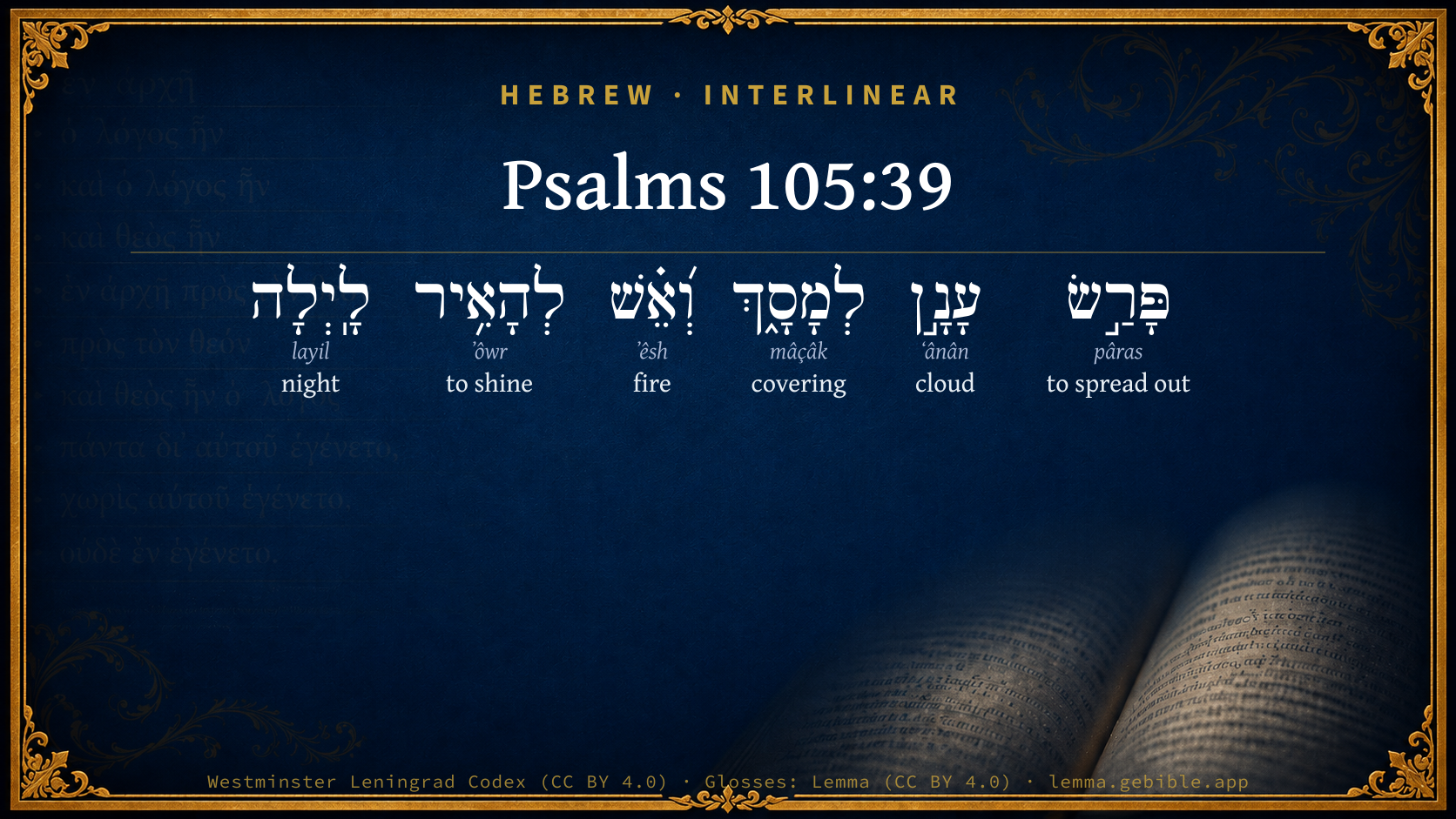
Hebrew (Westminster Leningrad Codex) Psalms 105:39 appears in the Hebrew Old Testament. The text above is from the Westminster Leningrad Codex. Each word links to its Strong’s number, a concise gloss, and parsing drawn from the Open Scriptures Hebrew Bible morphology. Click any word for its full Brown-Driver-Briggs (BDB) entry.
Download image
Cite this verse

Psalms 105:39 (World English Bible). Public Domain. Lemma interlinear Bible study tool, https://lemma.gebible.app/v/psalms/105/39.

Show BibTeX & RIS
BibTeX
RIS
English Translation
He spread a cloud for a covering, Fire to give light in the night.
World English Bible · Public Domain
Download a study sheet

One document with this verse’s original text, its word-by-word gloss line, the meaning frame, cross-references with their text, attributed commentary, and full source and license credits — printable, and it pastes into notes with its structure intact.

This verse Autodidact and up

Study sheet (.html) Plain text (.txt)

A passage Seminary Student

Up to 50 verses in one chapter. A passage sheet keeps up to 6 commentary sources and 12 cross-references per verse, in the order this page ranks them, and says so on the sheet whenever that leaves anything out. Ask for a single verse and you get the Autodidact verse sheet above.

Everything on this page stays free to read, with no account — the sheet is a download of what is already on screen, not access to it.

Want to remove ads? Support Godless Engineer
Compare translations 3

The same verse in 3 English versions, stacked beneath the original-language interlinear above. Click any original word for its lexicon entry.

Each is an independent rendering of the whole verse — the interlinear is not word-aligned to these translations.

Highlighted words mark where these versions differ — a whole-verse word diff, not a word-by-word alignment.

  • World English Bible Public Domain
    He spread a cloud for a covering, Fire to give light in the night.
  • King James Version Public Domain
    He spread a cloud for a covering; and fire to give light in the night.
  • unfoldingWord Literal Text CC BY-SA 4.0
    He spread a cloud for a covering and fire to light up the night.

unfoldingWord Literal Text — © unfoldingWord, licensed CC BY-SA 4.0. Word-aligned USFM3 via Door43 (git.door43.org/unfoldingWord/en_ult).

Versions to compare (up to 4)

3 of 4 selected

Show all 18 translations

Every available English version of this verse, each an independent rendering of the whole verse.

  • World English Bible Public Domain
    He spread a cloud for a covering, Fire to give light in the night.
  • Berean Standard Bible Public Domain
    He spread a cloud as a covering and a fire to light up the night.
  • Majority Standard Bible Public Domain
    He spread a cloud as a covering and a fire to light up the night.
  • King James Version Public Domain
    He spread a cloud for a covering; and fire to give light in the night.
  • American Standard Version (1901) Public Domain
    He spread a cloud for a covering, And fire to give light in the night.
  • Revised Version (1885) Public Domain
    He spread a cloud for a covering; and fire to give light in the night.
  • Geneva Bible (1599) Public Domain
    He spred a cloude to be a couering, and fire to giue light in the night.
  • Douay-Rheims (1899) Public Domain
    He spread a cloud for their protection, and fire to give them light in the night.
  • Young's Literal Translation Public Domain
    He hath spread a cloud for a covering, And fire to enlighten the night.
  • Literal Standard Version CC BY-SA 4.0
    He has spread a cloud for a covering, || And fire to enlighten the night.
  • Unlocked Literal Bible CC BY-SA 4.0
    He spread a cloud for a covering and made a fire to light up the night.
  • unfoldingWord Literal Text CC BY-SA 4.0
    He spread a cloud for a covering and fire to light up the night.
  • Darby Bible Public Domain
    He spread a cloud for a covering, and fire to give light in the night.
  • World Messianic Bible Public Domain
    He spread a cloud for a covering, fire to give light in the night.
  • Webster's Bible Public Domain
    He spread a cloud for a covering; and fire to give light in the night.
  • Free Bible Version CC BY-SA 4.0
    He spread a cloud above them as a covering, and at night a fire to give them light.
  • Bible in Basic English Public Domain
    A cloud was stretched over them for a cover; and he sent fire to give light in the night.
  • JPS Tanakh (1917) Public Domain
    He spread a cloud for a screen; and fire to give light in the night.

Literal Standard Version (2020), Covenant Press — licensed CC BY-SA 4.0. Text via the HelloAO Bible API (eBible.org). Unlocked Literal Bible (unfoldingWord) — licensed CC BY-SA 4.0. Text via the HelloAO Bible API (eBible.org). unfoldingWord Literal Text — © unfoldingWord, licensed CC BY-SA 4.0. Word-aligned USFM3 via Door43 (git.door43.org/unfoldingWord/en_ult). Free Bible Version, Dr. Jonathan Gallagher — licensed CC BY-SA 4.0. Text via the HelloAO Bible API (eBible.org).

Word by word

More ways to search: Search by grammar → Find every occurrence → Compare this word →

Practice this passage: Drill this verse → Learn its vocabulary →

About this verse

These counts appear in no published source. They are computed here, from the morphology-tagged text and Lemma’s own curated glosses. What Lemma adds →

6
words
6
distinct lemmas
Wisdom
section

Notable vocabulary

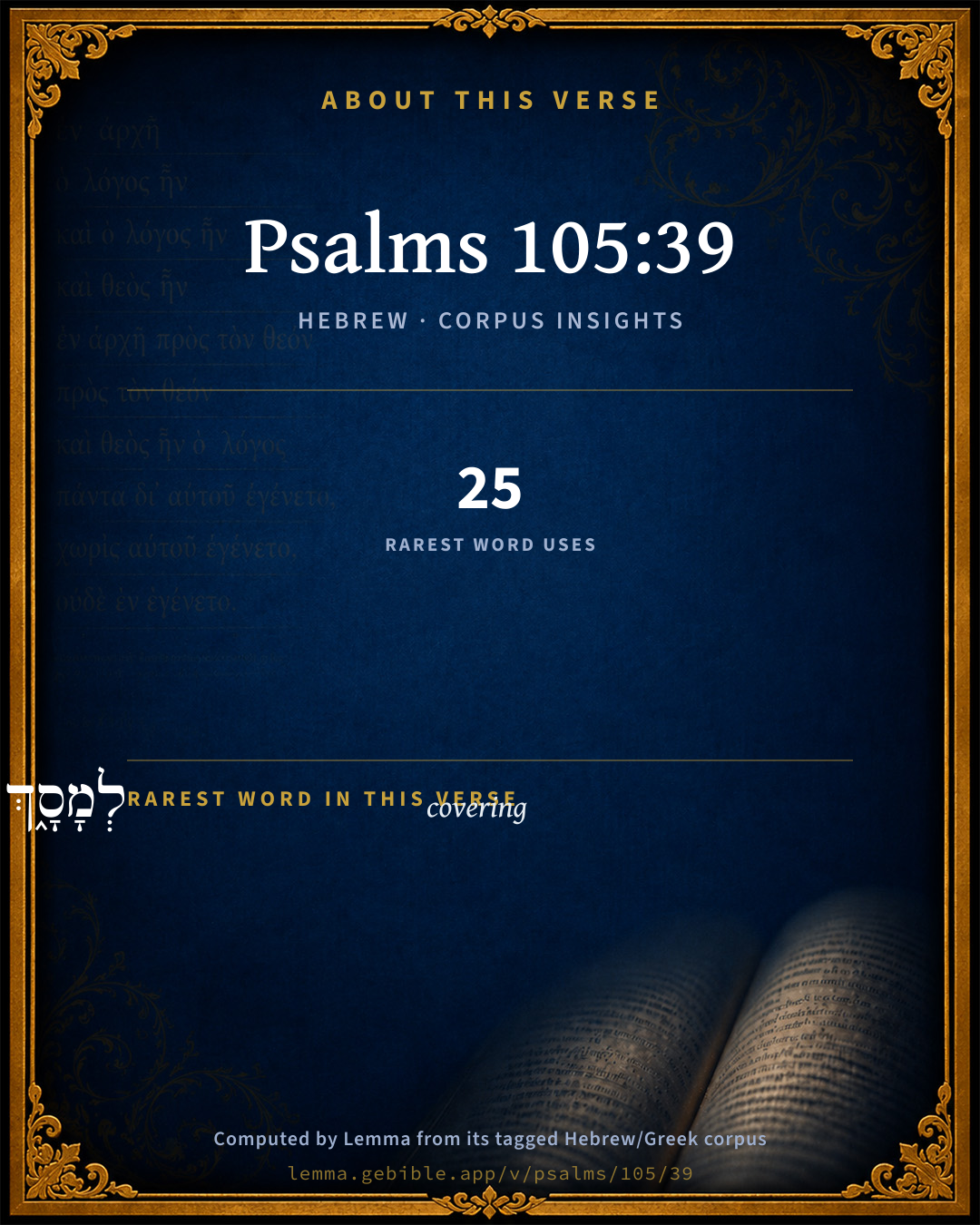
The rarest word here is לְמָסָ֑ךְ covering H4539 — appearing just 25 times in the whole Hebrew Bible.

Shared distinctive vocabulary

לְמָסָ֑ךְ covering H4539 occurs in 25 verses of the Hebrew Bible. Also found in:

Grammatical profile

  • 2 verbs
  • 4 nouns

Verb forms

  • פָּרַ֣שׂ Qal · Perfect
  • לְהָאִ֥יר Hiphil · Infinitive Construct

Hebrew & Septuagint length

In English translation the verse runs 14 words from the Hebrew and 18 from the Septuagint (LXX English) — closely comparable.

A rough comparison of the two English renderings, which tokenize alike — not a word-level alignment.

Word counts can differ between the Hebrew and the Greek without any difference in meaning — e.g. the Hebrew direct-object marker אֵת has no separate Greek word, and Greek often adds the article ὁ.

Cross-references

8

Topical passages linked to Psalms 105:39 in the Treasury of Scripture Knowledge — connected by theme and wording, ordered by reader-vote popularity; previews shown in the World English Bible.

  • Nehemiah 9:12 Moreover in a pillar of cloud you led them by day; and in a pillar of fire by night, to give them light in the way in which they should go.
  • Psalms 78:14 In the daytime he also led them with a cloud, And all night with a light of fire.
  • Isaiah 4:5 Yahweh will create over the whole habitation of Mount Zion, and over her assemblies, a cloud and smoke by day, and the shining of a flaming fire by night; for over all the glory will be a canopy.
  • Exodus 13:21–22 Yahweh went before them by day in a pillar of cloud, to lead them on their way, and by night in a pillar of fire, to give them light, that they might go by day and by night:
  • Exodus 14:24 It happened in the morning watch, that Yahweh looked out on the host of the Egyptians through the pillar of fire and of cloud, and confused the Egyptian army.
  • Nehemiah 9:19 yet you in your manifold mercies didn't forsake them in the wilderness: the pillar of cloud didn't depart from over them by day, to lead them in the way; neither the pillar of fire by night, to show them light, and the way in which they should go.
  • Numbers 9:15–22 On the day that the tabernacle was raised up, the cloud covered the tabernacle, even the Tent of the Testimony: and at evening it was over the tabernacle as it were the appearance of fire, until morning.
  • 1 Corinthians 10:1–2 Now I would not have you ignorant, brothers, that our fathers were all under the cloud, and all passed through the sea;

Cross-references courtesy of OpenBible.info (CC BY 4.0).

Hebrew and Greek witnesses Masoretic Hebrew ↔ Greek Septuagint

The same verse in the two great witnesses to the Old Testament, shown verse-for-verse.

You’re reading Greek Psalm 104 (Hebrew Psalm 105). The Septuagint counts the superscription, so verse numbers can differ from the Hebrew — chapter-level alignment, not verse-by-verse. Numbering follows Rahlfs.

These are two independent witnesses, not word-aligned to each other, and the Septuagint is shown in lemma (dictionary) form.

Hebrew Psalms 105:39 Masoretic · Westminster Leningrad Codex

פָּרַ֣שׂ עָנָ֣ן לְמָסָ֑ךְ וְ֝אֵ֗שׁ לְהָאִ֥יר לָֽיְלָה

He spread a cloud for a covering, Fire to give light in the night.

World English Bible · Public Domain

Greek LXX Greek Psalm 104:39 Septuagint · lemma form

διαπετάζω νεφέλη εἰς σκέπης αὐτός καί πῦρ ὁ φωτίζω αὐτός ὁ νύξ

He spread out a cloud for a covering to them, and fire to give them light by night.

LXX2012 (modern English Septuagint) · Public Domain

On this verse, Keil & Delitzsch discusses the Septuagint’s reading. Read the note in Commentary ↓

Hebrew: Westminster Leningrad Codex (CC BY 4.0). Greek: Septuagint (public domain); English from LXX2012 (modern English Septuagint) (Public Domain). How the Septuagint differs from the Hebrew →

Commentary

Notes on Psalms 105:39 from classic Christian and Jewish commentators (each source and its license shown beneath its notes). The classic Christian expositions comment on the surrounding passage and are grouped to its opening verse, so a note may address several verses; the Jewish commentaries on the Tanakh (Rashi and others) are per-verse, so they appear only where the commentator wrote on this verse.

Lemma curates 59 commentaries, every one of them public domain or Creative Commons licensed, each selected and text-cleaned for this edition rather than reprinted as found. About our sources →

Trapp's Complete Commentary

John Trapp

Psa 105:39 He spread a cloud for a covering; and fire to give light in the night.

Ver. 39. He spread a cloud] It must needs be a very large one that could cover such an army from the extraordinary heats there; for the deserts of Arabia are extreme hot, both by reason of the climate and also of the sand’s reflecting the sunbeams. So still upon all the glory (the Church) shall be a covering, Isa 4:5.

And fire to give light, &c.] A fiery pillar against the error, terror, and danger of the darkness. See Neh 9:19.

John Trapp, A Commentary or Exposition upon All the Books of the Old and New Testament (1647–1656) — public domain. Text from a community e-Sword module.

Whedon's Commentary on the Bible

Daniel D. Whedon

39. He spread a cloud for a covering—The “cloud” was for a screen from the sun’s heat by day, and for a light by night, and to indicate the times and directions of their marches. It was the standing symbol of God’s presence and protection. See note on Psa_78:14, and compare Exo_13:21-22; Neh_9:12. Having reviewed the history of the exodus, the psalmist opens, in Psa_105:39-41, a rapid survey of the wilderness life, which he sums up in the three miraculous wonders—the cloud, food, and the supply of water.

Daniel D. Whedon (gen. ed.), Commentary on the Old and New Testaments (1874–1909) — public domain. Text from a community e-Sword module.

Keil & Delitzsch

C. F. Keil & F. Delitzsch

Now follows the miraculous guidance through the desert to the taking possession of Canaan. The fact that the cloud (ענן, root ען, to meet, to present itself to view, whence the Arabic ‛ănăn, the visible outward side of the vault of heaven) by day, and becoming like fire by night, was their guide (Exo 13:21), is left out of consideration in Psa 105:39. With למסך we are not to associate the idea of a covering against foes, Exo 14:19., but of a covering from the smiting sun, for פּרשׁ (Exo 40:19), as in Isa 4:5., points to the idea of a canopy. In connection with the sending of the quails the tempting character of the desire is only momentarily dwelt upon, the greater emphasis is laid on the omnipotence of the divine goodness which responded to it. שׁאלוּ is to be read instead of שׁאל, the w before w having been overlooked; and the Kerמ writes and points שׂליו (like סתיו, עניו) in order to secure the correct pronunciation, after the analogy of the plural termination יו-. The bread of heaven (Psa 78:24.) is the manna. In Psa 105:41 the giving of water out of the rock at Rephidim and at Kadesh are brought together; the expression corresponds better to the former instance (Exo 17:6, cf. Num 20:11). הלכוּ refers to the waters, and נהר for כּנּהרות, Psa 78:16, is, as in Psa 22:14, an equation instead of a comparison. In this miraculous escort the patriarchal promise moves on towards its fulfilment; the holy word of promise, and the stedfast, proved faith of Abraham - these were the two motives. The second את is, like the first, a sign of the object, not a preposition (lxx, Targum), in connection with which Psa 105:42 would be a continuation of Psa 105:42, dragging on without any parallelism. Joy and exulting are mentioned as the mood of the redeemed ones with reference to the festive joy displayed at the Red Sea and at Sinai. By Psa 105:43 one is reminded of the same descriptions of the antitype in Isaiah, Isa 35:10; Isa 51:11; Isa 55:12, just as Psa 105:41 recalls Isa 48:21. "The lands of the heathen" are the territories of the tribes of Canaan. עמל is equivalent to יגיע in Isa 45:14 : the cultivated ground, the habitable cities, and the accumulated treasures. Israel entered upon the inheritance of these peoples in every direction. As an independent people upon ground that is theirs by inheritance, keeping the revealed law of their God, was Israel to exhibit the pattern of a holy nation moulded after the divine will; and, as the beginning of the Psalm shows, to unite the peoples to themselves and their God, the God of redemption, by the proclamation of the redemption which has fallen to their own lot.

Keil & Delitzsch — Biblical Commentary on the Old Testament (1861–1891) — public domain (CC PDM 1.0). Text via the HelloAO Bible API. (Old Testament only.)

J. A. Alexander on Psalms

Joseph Addison Alexander

39. (Psa 105:39) He spread a cloud for a covering, and fire to give, light by night. See above, on Psa 78:14. The poetical description of the cloud as covering the host is derived from the statement that "the cloud of Jehovah was over (or above) them by day," Num 10:34. Compare Num 9:16, Neh 9:12, Isa 4:5-6.

Joseph Addison Alexander, The Psalms Translated and Explained (1850) — public domain. Text from a community e-Sword module.

Tyndale Open Study Notes

Tyndale Open Resources

105:39 The Lord’s presence was as evident to all as a fire in the darkness (Exod 13:22).

Tyndale Open Study Notes — © Tyndale Open Resources, licensed CC BY-SA 4.0. Text via the HelloAO Bible API.

John Calvin's Commentaries

39. He spread out a cloud for a covering The Psalmist enumerates certain miracles by which God continued his grace towards his people in the wilderness. This order is worthy of notice; for it was no small confirmation which was added to that incomparable work of redemption, when God ceased not to show himself the guide of their journey. Accordingly, after they had passed through the Red Sea, he spread a cloud over them by day to protect them from the heat of the sun; and during the night, he gave them light by a pillar of fire, that even in the midst of the darkness they might have a bright token of his presence. This continued display of his goodness was surely an unquestionable proof of his perpetual love, an open demonstration that he had adopted the children of Abraham, to foster them under his protection even to the end. What follows concerning quails, is introduced for a different purpose than that for which reference is made to the same fact in Psalm 78:26. In that passage, God’s bringing in an abundance of quails is ascribed rather to his wrath than to his beneficence, that the people might satiate the flesh; and we have seen in the exposition of that place, that this is mentioned as a matter of reproach to them. But in the text before us, passing over their ingratitude, the prophet celebrates the unremitting exercise of the divine loving-kindness towards them. Some, however, may be rather inclined to take the word ask in a bad sense, because the people besought not God with humility, but through their impatience proceeded at once to murmuring, or rather arrogantly spake against him. Thus taken, the passage, by way of amplification, would mean that God, departing from his own right, humoured even their unhallowed lust. As, however, their fault is not here mentioned, let us rest in that meaning which is the most simple, namely, that the blessings by which God ratified the redemption which he had wrought are here clustered together. It next follows, that they were filled with the bread of heaven This appellation, as we have seen elsewhere, is given to the manna by way of eminence. The natural way in which the food which we eat is obtained is from the ground; but God then opened his hand more widely to the Jews, and fed them even from heaven. As it was not enough for them to be refreshed with food when they were hungry, unless they were also supplied with drink, it is added, that the rock was opened, and that the waters flowed from it through the dry places, or the desert.

John Calvin's Commentaries (1540-1563) — public domain. Text from the Calvin Translation Society English edition (1840s-50s) via the Christian Classics Ethereal Library (ccel.org). Calvin's coverage is partial (roughly two-thirds of the Bible); uncommented books and verses are honest gaps, never fabricated. The 19th-century editor's footnotes and remarks are omitted so the notes are faithfully Calvin's own voice.

Ellicott's Commentary for English Readers

(39) Cloud.—As in Isa_4:5. The reason assigned for the cloud in the historical books is lost sight of. Instead of a pillar marking the line of march, or as a protection against the pursuing foe, it is a canopy for protection from the sun. Sir Walter Scott expresses the same idea in Rebecca’s hymn.

A Bible Commentary for English Readers, edited by Charles John Ellicott (1878–1897) — public domain. Text from a community e-Sword module.

The Cambridge Bible for Schools and Colleges

gen. ed. J. J. S. Perowne

39. Exo_13:21-22; Exo_14:19-20. But here the cloud is regarded as a canopy to shelter them from the burning rays of the sun in the desert, rather than as a protection from the Egyptians. Cp. Isa_4:5-6.

The Cambridge Bible for Schools and Colleges (gen. ed. J. J. S. Perowne; Cambridge University Press, 1878–1918) — public domain. Text from a community e-Sword module.

John Gill's Exposition

The people asked, and he brought quails,.... The Targum is,

"they asked flesh, and he brought quails,''

or pheasants; some render it partridges, others locusts: that is, the people of Israel asked flesh of the Lord, and he gave them quails; which he did twice, first at the same time the manna was first given, Exo 16:13, and some years after that a second time, when the wrath of God came upon them and slew them while their meat was in their mouths, Num 11:31, it is the first time that is here referred to, since it is mentioned among the benefits and blessings bestowed upon them; this was typical of the spiritual meat believers eat of, even the flesh of Christ, whose flesh is meat indeed. The quail was a fat and fleshy bird, delicious food, sent from heaven in the evening; so Christ came from heaven in the evening of the world, and gave his flesh for the life of his people, and on which they live by faith.

And satisfied them with the bread of heaven: the manna, called the corn of heaven; a type of Christ the hidden manna, who is soul satisfying food to believers; See Gill on Psa 78:24; see Gill on Psa 78:25.

John Gill's Exposition of the Whole Bible (1746–1763) — public domain (CC PDM 1.0). Text via the HelloAO Bible API.

Albert Barnes' Notes on the Bible

He spread a cloud for a covering - See the notes at Psa 78:14. In Num 10:34; it is said that “the cloud of the Lord was upon them by day,” and from this seems to have been derived the idea of its “covering” them, as if it were a protection from the heat in the desert.

Albert Barnes' Notes on the Bible (1834–1885) — public domain. Text from a community e-Sword/MySword module.

Matthew Poole's English Annotations

For a covering, to protect them from the heat of the sun, which in that hot and open country had otherwise been intolerable to them, especially in so long a journey.

Matthew Poole's English Annotations on the Holy Bible (1683–1685) — public domain. Text from a community e-Sword/MySword module.

The Treasury of David

Charles H. Spurgeon

Ver. 39. He spread a cloud for a covering. Never people were so favoured. What would not travellers in the desert now give for such a canopy? The sun could not scorch them with its burning ray; their whole camp was screened like a king in his pavilion. Nothing seemed to be too good for God to give his chosen nation, their comfort was studied in every way.

And fire to give light in the night. While cities were swathed in darkness, their town of tents enjoyed a light which modern art with all its appliances cannot equal. God himself was their sun and shield, their glory and their defence. Could they be unbelieving while so graciously shaded, or rebellious while they walked at midnight in such a light? Alas, the tale of their sin is as extraordinary as this story of His love; but this Psalm selects the happier theme and dwells only upon covenant love and faithfulness. O give thanks unto the Lord for he is good. We, too, have found the Lord all this to us, for he has been our sun and shield, and has preserved us alike from the perils of joys and the evils of grief;

"He hath been my joy in woe,

Cheered my heart when it was low;

And with warnings softly sad

Calmed my heart when it was glad."

So has the promise been fulfilled to us, "the sun shall not hurt thee by day, nor the moon by night."

Ver. 39. In the army of Alexander the Great, the march was begun by a great beacon being set upon a pole as a signal from head quarters, so that "the fire was seen at night, the smoke in the daytime; "and the plan is still found in use amongst the caravans of Arabia. It is probable enough, in that unchanging land, that such may have been the custom at the time of the Exodus, and that God taught the people by parable in this wise, as well as by fact, that he was their true leader, and heaven the general pavilion, whence the order of march was enjoined. Neale and Littledale.

Ver. 39.

When Israel, of the Lord beloved,

Out of the land of bondage came,

Her father's God before her moved,

An awful guide in smoke and flame.

By day, along the astonished lands,

The cloudy pillar glided slow;

By night, Arabia's crimson sands

Returned the fiery column's glow.

There rose the choral hymn of praise,

And trump and timbrel answered keen,

And Zion's daughters poured their lays,

With priest's and warrior's voice between.

But present still, though now unseen,

When brightly shines the prosperous day,

Be thoughts of Thee a cloudy screen,

To temper the deceitful ray!

And oh, when stoops on Judah's path,

In shade and storm, the frequent night,

Be Thoulong suffering, slow to wrath

A burning and a shining light. Sir Walter Scott, 1771-1832.

Ver. 39.

1. A dark cloud of providence is the guide of the people of God by day.

2. A bright cloud of promises is their guide by night. G.R.

Ver. 39. The Lord's goodness exemplified in our varying conditions.

1. For prosperitya cloud.

2. For adversitya light. A good text would be found in "light in the night."

Psalms 105:40*

Charles H. Spurgeon's The Treasury of David (1869–1885) — public domain. Psalms only. Text from a community e-Sword/MySword module.

The Pulpit Commentary

He spread a cloud for a covering. The "pillar of the cloud" is intended. It was a "covering" to the Israelites on the night of the passage of the Red Sea, (Exo_14:19, Exo_14:20) and perhaps also to some extent in the wilderness, when it may have sheltered them from the sun"s rays (Hengstenberg); but its main purpose was to direct them on their way, (Exo_14:21) to tell them when to move and when to step, and how long to stop. (Exo_40:36-38) And fire to give light in the night. By night the "pillar of the cloud" became a "pillar of fire," shedding a certain radiance around, and giving the people under all circumstances sufficient light. (Exo_13:21 Exo_40:38)

The Pulpit Commentary (1880–1919), ed. H.D.M. Spence-Jones & Joseph S. Exell — public domain. Text from a community e-Sword module.

John Wesley's Explanatory Notes

Covering - To protect them from the heat of the sun.

John Wesley, Explanatory Notes Upon the Whole Bible (1754–1765) — public domain. Text via the GEBible commentary corpus.

Lesson kit

Teaching starters — assembled from the data on this page, not authored interpretation. Every prompt links to the verse data it draws on. Edit before teaching.

Psalms, in the Wisdom, opens this verse with 6 words (6 distinct Hebrew lemmas). Its most distinctive word is mâçâk (“covering”). A historical commentator’s framing appears above. Read the whole chapter for the surrounding context.

Discussion questions

  1. The word mâçâk carries the sense “covering.” How does it shape the verse?
  2. Exodus 26:36 shares the word «covering» with this verse. How do the two illuminate each other?
  3. These translations render this verse differently; the difference is in the English rendering, not the original. What questions does that raise?
  4. The verb «פָּרַ֣שׂ» is Qal Perfect. How does its form color the action?
  5. Reading how Trapp's Complete Commentary and Whedon's Commentary on the Bible read this verse, where do the two commentators agree and where do they part?

Things to notice

Reading settings

Reading text

Shown beneath each verse's original-language words.

Old Testament
Old Testament edition

Read the OT as the Masoretic Hebrew (MT) or the Greek Septuagint (LXX).

English shown for the Greek Septuagint (in the Hebrew ↔ Greek comparison).

Comparing translations? Open the Compare panel on any verse page to stack up to four side by side.