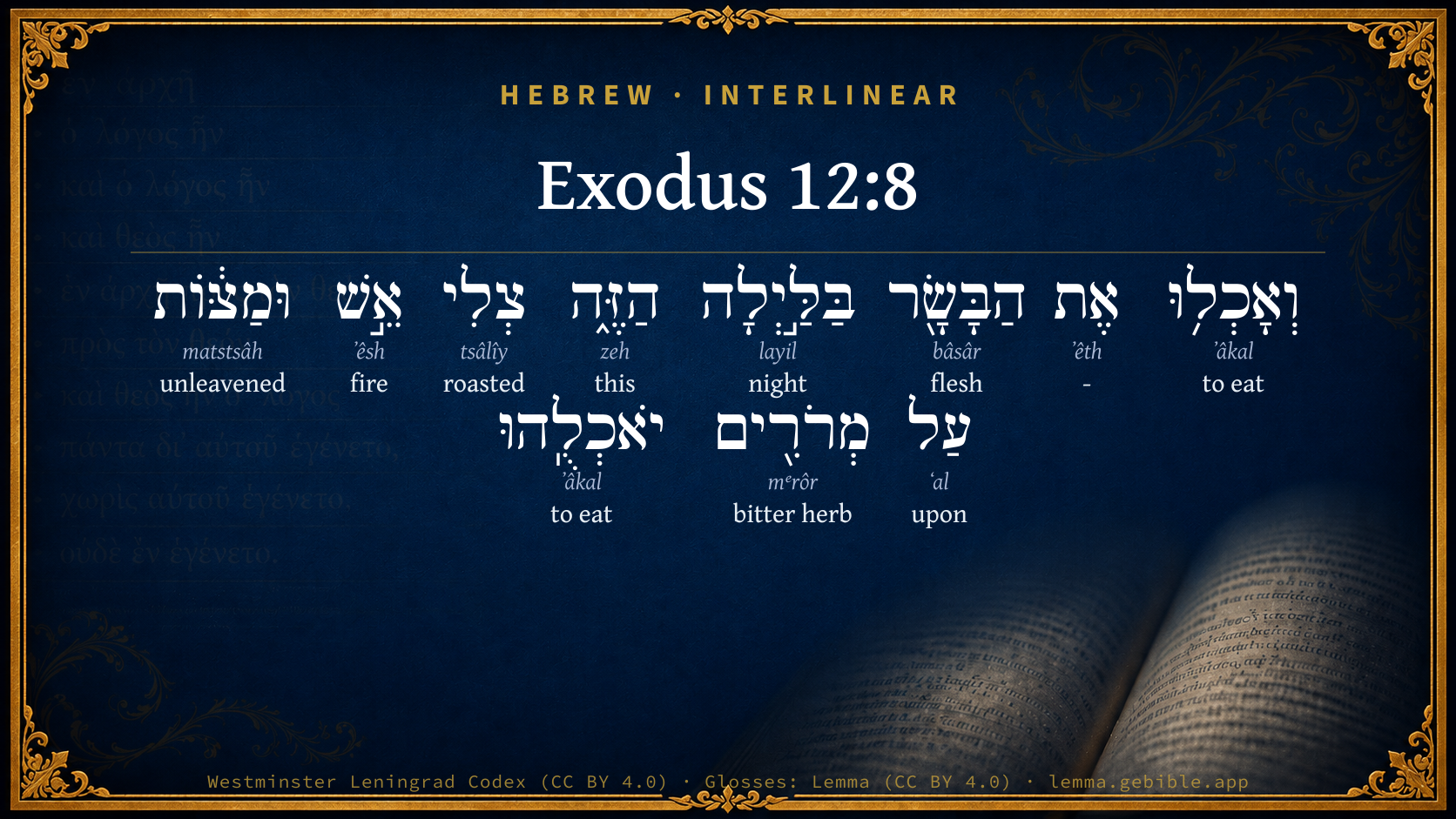
Exodus 12:8

Hebrew (Westminster Leningrad Codex) Exodus 12:8 appears in the Hebrew Old Testament. The text above is from the Westminster Leningrad Codex. Each word links to its Strong’s number, a concise gloss, and parsing drawn from the Open Scriptures Hebrew Bible morphology. Click any word for its full Brown-Driver-Briggs (BDB) entry.
Download image
Cite this verse

Exodus 12:8 (World English Bible). Public Domain. Lemma interlinear Bible study tool, https://lemma.gebible.app/v/exodus/12/8.

Show BibTeX & RIS
BibTeX
RIS
English Translation
They shall eat the flesh in that night, roasted with fire, and unleavened bread. They shall eat it with bitter herbs.
World English Bible · Public Domain
Highlights
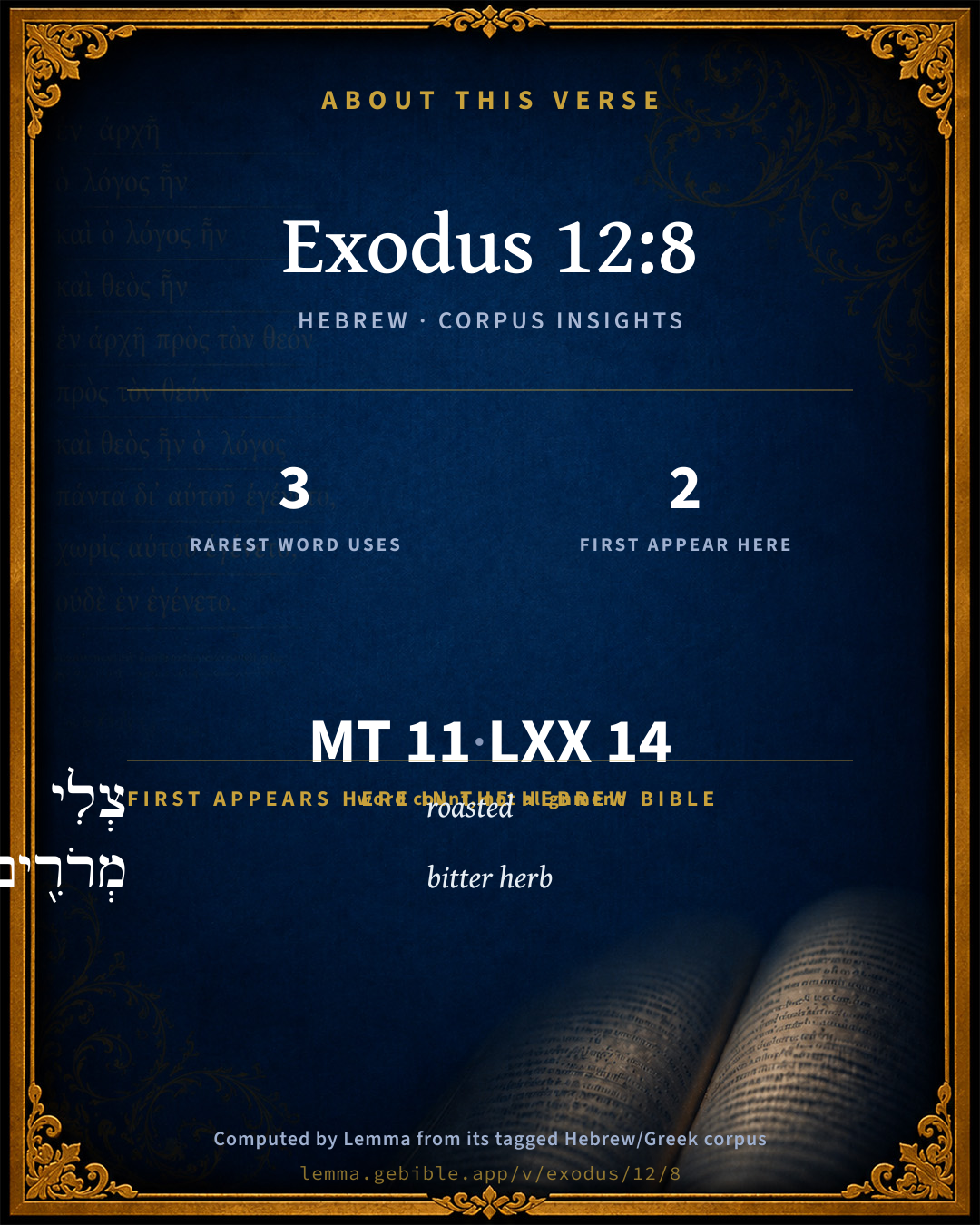
  • 2 first appearances in the Hebrew Bible
Full analysis ↓
Download a study sheet

One document with this verse’s original text, its word-by-word gloss line, the meaning frame, cross-references with their text, attributed commentary, and full source and license credits — printable, and it pastes into notes with its structure intact.

This verse Autodidact and up

Study sheet (.html) Plain text (.txt)

A passage Seminary Student

Up to 50 verses in one chapter. A passage sheet keeps up to 6 commentary sources and 12 cross-references per verse, in the order this page ranks them, and says so on the sheet whenever that leaves anything out. Ask for a single verse and you get the Autodidact verse sheet above.

Everything on this page stays free to read, with no account — the sheet is a download of what is already on screen, not access to it.

Want to remove ads? Support Godless Engineer
Compare translations 3

The same verse in 3 English versions, stacked beneath the original-language interlinear above. Click any original word for its lexicon entry.

Each is an independent rendering of the whole verse — the interlinear is not word-aligned to these translations.

Highlighted words mark where these versions differ — a whole-verse word diff, not a word-by-word alignment.

  • World English Bible Public Domain
    They shall eat the flesh in that night, roasted with fire, and unleavened bread. They shall eat it with bitter herbs.
  • King James Version Public Domain
    And they shall eat the flesh in that night, roast with fire, and unleavened bread; and with bitter herbs they shall eat it.
  • unfoldingWord Literal Text CC BY-SA 4.0
    And they shall eat the flesh that night, roast of fire, and they shall eat unleavened bread over bitter herbs.

unfoldingWord Literal Text — © unfoldingWord, licensed CC BY-SA 4.0. Word-aligned USFM3 via Door43 (git.door43.org/unfoldingWord/en_ult).

Versions to compare (up to 4)

3 of 4 selected

Show all 18 translations

Every available English version of this verse, each an independent rendering of the whole verse.

  • World English Bible Public Domain
    They shall eat the flesh in that night, roasted with fire, and unleavened bread. They shall eat it with bitter herbs.
  • Berean Standard Bible Public Domain
    They are to eat the meat that night, roasted over the fire, along with unleavened bread and bitter herbs.
  • Majority Standard Bible Public Domain
    They are to eat the meat that night, roasted over the fire, along with unleavened bread and bitter herbs.
  • King James Version Public Domain
    And they shall eat the flesh in that night, roast with fire, and unleavened bread; and with bitter herbs they shall eat it.
  • American Standard Version (1901) Public Domain
    And they shall eat the flesh in that night, roast with fire, and unleavened bread; with bitter herbs they shall eat it.
  • Revised Version (1885) Public Domain
    And they shall eat the flesh in that night, roast with fire, and unleavened bread; with bitter herbs they shall eat it.
  • Geneva Bible (1599) Public Domain
    And they shall eate the flesh the same night, roste with fire, and vnleauened bread: with sowre herbes they shall eate it.
  • Douay-Rheims (1899) Public Domain
    And they shall eat the flesh that night roasted at the fire, and unleavened bread with wild lettuce.
  • Young's Literal Translation Public Domain
    `And they have eaten the flesh in this night, roast with fire; with unleavened things and bitters they do eat it;
  • Literal Standard Version CC BY-SA 4.0
    And they have eaten the flesh in this night, a roast with fire; they eat it with unleavened things and bitters;
  • Unlocked Literal Bible CC BY-SA 4.0
    You must eat the meat that night, after first roasting it over a fire. Eat it with bread made without yeast, along with bitter herbs.
  • unfoldingWord Literal Text CC BY-SA 4.0
    And they shall eat the flesh that night, roast of fire, and they shall eat unleavened bread over bitter herbs.
  • Darby Bible Public Domain
    And they shall eat the flesh in that night, roast with fire, and unleavened bread; with bitter [herbs] shall they eat it.
  • World Messianic Bible Public Domain
    They shall eat the meat in that night, roasted with fire, with unleavened bread. They shall eat it with bitter herbs.
  • Webster's Bible Public Domain
    And they shall eat the flesh in that night, roasted with fire; and unleavened bread, and with bitter herbs they shall eat it.
  • Free Bible Version CC BY-SA 4.0
    They are to roast the meat over a fire and eat it that night, together with unleavened bread and bitter herbs.
  • Bible in Basic English Public Domain
    And let your food that night be the flesh of the lamb, cooked with fire in the oven, together with unleavened bread and bitter-tasting plants.
  • JPS Tanakh (1917) Public Domain
    And they shall eat the flesh in that night, roast with fire, and unleavened bread; with bitter herbs they shall eat it.

Literal Standard Version (2020), Covenant Press — licensed CC BY-SA 4.0. Text via the HelloAO Bible API (eBible.org). Unlocked Literal Bible (unfoldingWord) — licensed CC BY-SA 4.0. Text via the HelloAO Bible API (eBible.org). unfoldingWord Literal Text — © unfoldingWord, licensed CC BY-SA 4.0. Word-aligned USFM3 via Door43 (git.door43.org/unfoldingWord/en_ult). Free Bible Version, Dr. Jonathan Gallagher — licensed CC BY-SA 4.0. Text via the HelloAO Bible API (eBible.org).

Word by word

More ways to search: Search by grammar → Find every occurrence → Compare this word →

Practice this passage: Drill this verse → Learn its vocabulary →

צְלִי
tsâlîy
H6748
“roasted of”
Noun, Common, Masculine, Singular, Construct
Part of Speech
Noun
Type
Common
Gender
Masculine
Number
Singular
State
Construct
Full BDB Definition

Origin: pass part of H6740

TWOT: 1915a

roasted, roast (noun masculine) - (CLBL) roasted (adjective)
  1. וְאָכְל֥וּ ʼâkal H398 “and · to eat” Conjunction + Verb, Qal, Sequential Perfect, 3rd Person, Common, Plural
  2. אֶת ʼêth H853 “-” Particle, Direct Object
  3. הַבָּשָׂ֖ר bâsâr H1320 “the · flesh” Particle, Definite Article + Noun, Common, Masculine, Singular, Absolute
  4. בַּלַּ֣יְלָה layil H3915 “in/at the · night” Preposition, Determined + Noun, Common, Masculine, Singular, Absolute
  5. הַזֶּ֑ה zeh H2088 “the · this” Particle, Definite Article + Pronoun, Demonstrative, Masculine, Singular
  6. אֵ֣שׁ ʼêsh H784 “fire” Noun, Common, Both, Singular, Absolute
  7. וּמַצּ֔וֹת matstsâh H4682 “and · unleavened bread” Conjunction + Noun, Common, Feminine, Plural, Absolute
  8. עַל ʻal H5921 “upon” Preposition
  9. מְרֹרִ֖ים mᵉrôr H4844 “bitter herbs” Noun, Common, Masculine, Plural, Absolute
  10. יֹאכְלֻֽהוּ ʼâkal H398 “to eat · him” Verb, Qal, Imperfect, 3rd Person, Masculine, Plural + Suffix, Personal, 3rd Person, Masculine, Singular

About this verse

These counts appear in no published source. They are computed here, from the morphology-tagged text and Lemma’s own curated glosses. What Lemma adds →

11
words
10
distinct lemmas
Pentateuch
section

Notable vocabulary

The rarest word here is צְלִי roasted H6748 — appearing just 3 times in the whole Hebrew Bible.

First appearance in Scripture

These words make their first canonical appearance in the Hebrew Bible here:

  • צְלִי roasted H6748
  • מְרֹרִ֖ים bitter herb H4844

Shared distinctive vocabulary

צְלִי roasted H6748 occurs in 3 verses of the Hebrew Bible. Also found in:

Grammatical profile

  • 2 verbs
  • 6 nouns
  • 1 pronoun
  • 1 preposition
  • 1 particle

Verb forms

  • וְאָכְל֥וּ Qal · Sequential Perfect
  • יֹאכְלֻֽהוּ Qal · Imperfect

Repetition

A word recurs within this verse — often emphatic in Hebrew:

  • וְאָכְל֥וּ to eat H398 ×2

Hebrew & Septuagint length

In English translation the verse runs 21 words from the Hebrew and 21 from the Septuagint (LXX English) — the same length.

A rough comparison of the two English renderings, which tokenize alike — not a word-level alignment.

Word counts can differ between the Hebrew and the Greek without any difference in meaning — e.g. the Hebrew direct-object marker אֵת has no separate Greek word, and Greek often adds the article ὁ.

In the original languages it is 11 Hebrew tokens and 14 Greek tokens — but the two are counted differently (Hebrew bundles its prefixes and suffixes into one token; the Greek is in lemma form), so that isn’t a like-for-like length.

Cross-references

18

Topical passages linked to Exodus 12:8 in the Treasury of Scripture Knowledge — connected by theme and wording, ordered by reader-vote popularity; previews shown in the World English Bible.

  • Exodus 34:25 "You shall not offer the blood of my sacrifice with leavened bread; neither shall the sacrifice of the feast of the Passover be left to the morning.
  • Deuteronomy 16:7 You shall roast and eat it in the place which Yahweh your God shall choose: and you shall turn in the morning, and go to your tents.
  • Deuteronomy 16:3–4 You shall eat no leavened bread with it; seven days shall you eat unleavened bread therewith, even the bread of affliction; for you came forth out of the land of Egypt in haste: that you may remember the day when you came forth out of the land of Egypt all the days of your life.
  • Exodus 1:14 and they made their lives bitter with hard service, in mortar and in brick, and in all manner of service in the field, all their service, in which they ruthlessly made them serve.
  • Exodus 13:3 Moses said to the people, "Remember this day, in which you came out from Egypt, out of the house of bondage; for by strength of hand Yahweh brought you out from this place. No leavened bread shall be eaten.
  • Exodus 13:7 Unleavened bread shall be eaten throughout the seven days; and no leavened bread shall be seen with you, neither shall there be yeast seen with you, in all your borders.
  • Exodus 23:18 "You shall not offer the blood of my sacrifice with leavened bread, neither shall the fat of my feast remain all night until the morning.
  • Numbers 9:11–12 In the second month, on the fourteenth day at evening they shall keep it; they shall eat it with unleavened bread and bitter herbs.
  • Isaiah 53:10 Yet it pleased Yahweh to bruise him; he has put him to grief: when you shall make his soul an offering for sin, he shall see [his] seed, he shall prolong his days, and the pleasure of Yahweh shall prosper in his hand.
  • John 6:52–57 The Jews therefore contended with one another, saying, "How can this man give us his flesh to eat?"
  • 1 Corinthians 5:6–8 Your boasting is not good. Don't you know that a little yeast leavens the whole lump?
  • Psalms 22:14 I am poured out like water. All my bones are out of joint. My heart is like wax; It is melted within me.
  • Amos 4:5 Offer a sacrifice of thanksgiving of that which is leavened, And proclaim free will offerings and brag about them: For this pleases you, you children of Israel," says the Lord Yahweh.
  • Zechariah 12:10 I will pour on the house of David, and on the inhabitants of Jerusalem, the spirit of grace and of supplication; and they will look to me whom they have pierced; and they shall mourn for him, as one mourns for his only son, and will grieve bitterly for him, as one grieves for his firstborn.
  • Matthew 16:12 Then they understood that he didn't tell them to beware of the yeast of bread, but of the teaching of the Pharisees and Sadducees.
  • Matthew 26:26 As they were eating, Jesus took bread, gave thanks for it, and broke it. He gave to the disciples, and said, "Take, eat; this is my body."
  • Galatians 5:9 A little yeast grows through the whole lump.
  • 1 Thessalonians 1:6 You became imitators of us, and of the Lord, having received the word in much affliction, with joy of the Holy Spirit,

Cross-references courtesy of OpenBible.info (CC BY 4.0).

Hebrew and Greek witnesses Masoretic Hebrew ↔ Greek Septuagint

The same verse in the two great witnesses to the Old Testament, shown verse-for-verse.

These are two independent witnesses, not word-aligned to each other, and the Septuagint is shown in lemma (dictionary) form.

Hebrew Exodus 12:8 Masoretic · Westminster Leningrad Codex

וְאָכְל֥וּ אֶת הַבָּשָׂ֖ר בַּלַּ֣יְלָה הַזֶּ֑ה צְלִי אֵ֣שׁ וּמַצּ֔וֹת עַל מְרֹרִ֖ים יֹאכְלֻֽהוּ

They shall eat the flesh in that night, roasted with fire, and unleavened bread. They shall eat it with bitter herbs.

World English Bible · Public Domain

Greek LXX Exodus 12:8 Septuagint · lemma form

καί ἐσθίω ὁ κρέας ὁ νύξ οὗτος ὀπτός πῦρ καί ἄζυμος ἐπί πικρίς ἐσθίω

And they shall eat the flesh in this night roast with fire, and they shall eat unleavened bread with bitter herbs.

LXX2012 (modern English Septuagint) · Public Domain

On this verse, The Cambridge Bible for Schools and Colleges discusses the Septuagint’s reading. Read the note in Commentary ↓

Hebrew: Westminster Leningrad Codex (CC BY 4.0). Greek: Septuagint (public domain); English from LXX2012 (modern English Septuagint) (Public Domain). How the Septuagint differs from the Hebrew →

Targum (Aramaic paraphrase)

2

The Targum is the ancient Jewish Aramaic paraphrase of the Hebrew Scriptures — an interpretive translation, not the Hebrew text itself. Onkelos (literal) and Pseudo-Jonathan (expansive) render the Torah, and Jonathan the Prophets. Coverage is partial: where no permissively-licensed English translation exists for a verse, only the Aramaic is shown. This is verse-level text, not a word-by-word alignment to the Hebrew.

  1. Targum Onkelos Torah (Genesis–Deuteronomy)
    וְיֵכְלוּן יָת בִּסְרָא בְּלֵילָא הַהוּא טְּוֵי נוּר וּפַטִיר עַל מְרָרִין יֵכְלֻנֵהּ:

    (no public-domain English translation for this verse)

    Targum Onkelos — Aramaic: “Onkelos Genesis” (public domain); “Onkelos Exodus” (public domain); “Onkelos Leviticus” (public domain); “Onkelos Numbers” (public domain); “Onkelos Deuteronomy” (public domain). English: “Sefaria Community Translation” (CC0 1.0 (public-domain dedication)); “J.W. Etheridge. The Targums of Onkelos and Jonathan Ben Uzziel on the Pentateuch. London: Longmans, Green, 1862” (public domain). Text via Sefaria.

  2. Targum Pseudo-Jonathan Torah (Genesis–Deuteronomy)
    וְיֵיכְלוּן יַת בִּישְרָא בְּלֵילְיָא הָדֵין דַּחֲמֵיסַר בְּנִיסַן עַד פַּלְגוּתֵיהּ דְּלֵילְיָא טְוֵי נוּר וּפַטִּיר עַל תַּמְכָא וְעוּלְשִׁין יֵיכְלוּנֵיהּ

    And you shall eat the flesh on that night, the fifteenth of Nisan, until the dividing of the night roasted with fire, without leaven, with horehound and lettuce shall you eat it.

    Targum Pseudo-Jonathan — Aramaic: “Targum Jonathan on Genesis” (public domain); “Targum Jonathan on Exodus” (public domain); “Targum Jonathan on Leviticus” (public domain); “Targum Jonathan on Numbers” (public domain); “Targum Jonathan on Deuteronomy” (public domain). English: “The Targum of Jonathan ben Uzziel, trans. J. W. Etheridge, London, 1862” (public domain). Text via Sefaria.

Commentary

Notes on Exodus 12:8 from classic Christian and Jewish commentators (each source and its license shown beneath its notes). The classic Christian expositions comment on the surrounding passage and are grouped to its opening verse, so a note may address several verses; the Jewish commentaries on the Tanakh (Rashi and others) are per-verse, so they appear only where the commentator wrote on this verse.

Lemma curates 59 commentaries, every one of them public domain or Creative Commons licensed, each selected and text-cleaned for this edition rather than reprinted as found. About our sources →

Trapp's Complete Commentary

John Trapp

Exo 12:8 And they shall eat the flesh in that night, roast with fire, and unleavened bread; [and] with bitter [herbs] they shall eat it.

Ver. 8. In that night.] By candle light. So must we feed upon Christ, lumine supernaturali. "By his knowledge doth God’s righteous servant justify many." {Isa 53:11}

Roast withfire.] Not raw: we may not grossly conceive of Christ, nor rashly receive him. Not boiled, but roast: to show that Christ was roasted in the fire of his Father’s wrath: et sicut tostis cibariis non adhibentur alia, ut in elixis fieri consuevlt: ira solum Christum debemus apprehendere fide, saith an interpreter. {a}

And unleavened bread,] {See Trapp on "1Co 5:7"} {See Trapp on "1Co 5:8"}

And with bitter herbs.] To teach that, "looking upon Christ whom they have pierced," men must be "in bitterness," {Zec 12:10} and feel what "an evil and bitter thing sin is," {Jer 2:19} being ready to suffer hardship with Christ, though he should feed us to the full with bitter herbs, and "make us drunken with wormwood." {Lam 3:15}

{a} Alsted.

John Trapp, A Commentary or Exposition upon All the Books of the Old and New Testament (1647–1656) — public domain. Text from a community e-Sword module.

Joseph Benson's Commentary

Exo 12:8-9. Eat it not raw — Nor half dressed; but roast with fire — Not only because it might be sooner roasted than boiled, and they were in haste to be gone; but because it was thus the better type of him who endured the fierceness of divine wrath for us, Lam 1:13. Unleavened bread — Partly to remind them of their hardships in Egypt, unleavened bread being more heavy and unsavoury; and partly to commemorate their hasty deliverance, which did not allow them time to leaven it, Exo 12:39;

Deu 16:3. But as the original word for unleavened signifies pure, unmixed, uncorrupted, leaven being a kind of corruption, the use of unleavened bread, no doubt, was enjoined to show them the necessity of sincerity and uprightness: to which quality of leaven the apostle alludes, Gal 5:2, and 1Co 5:8. With bitter herbs — To remind them of their Egyptian bondage, which made their lives bitter to them.

Joseph Benson's Commentary on the Old and New Testaments (1811–1818) — public domain. Text from a community e-Sword module.

Jamieson, Fausset & Brown

Robert Jamieson, A. R. Fausset & David Brown

roast with fire--for the sake of expedition; and this difference was always observed between the cooking of the paschal lamb and the other offerings (Ch2 35:13).

unleavened bread--also for the sake of despatch (Deu 16:3), but as a kind of corruption (Luk 12:1) there seems to have been a typical meaning under it (Co1 5:8).

bitter herbs--literally, "bitters"--to remind the Israelites of their affliction in Egypt, and morally of the trials to which God's people are subject on account of sin.

Jamieson, Fausset & Brown — Commentary Critical and Explanatory on the Whole Bible (1871) — public domain (CC PDM 1.0). Text via the HelloAO Bible API.

Adam Clarke's Commentary

Verse 8. They shall eat the flesh - roast with fire] As it was the ordinary custom of the Jews to boil their flesh, some think that the command given here was in opposition to the custom of the Egyptians, who ate raw flesh in honour of Osiris. The AEthiopians are to this day remarkable for eating raw flesh, as is the case with most savage nations.

Unleavened bread] מצות matstsoth, from מצה matsah, to squeeze or compress, because the bread prepared without leaven or yeast was generally compressed, sad or heavy, as we term it. The word here properly signifies unleavened cakes; the word for leaven in Hebrew is חמץ chamets, which simply signifies to ferment. It is supposed that leaven was forbidden on this and other occasions, that the bread being less agreeable to the taste, it might be emblematical of their bondage and bitter servitude, as this seems to have been one design of the bitter herbs which were commanded to be used on this occasion; but this certainly was not the sole design of the prohibition: leaven itself is a species of corruption, being produced by fermentation, which in such cases tends to putrefaction. In this very light St. Paul considers the subject in this place; hence, alluding to the passover as a type of Christ, he says: Purge out therefore the old leaven - for Christ our passover is sacrificed for us: therefore let us keep the feast, not with old leaven, neither with the leaven of malice and wickedness, but with the unleavened bread of sincerity and truth; 1Co 5:6-8.

Bitter herbs] What kind of herbs or salad is intended by the word מררים merorim, which literally signifies bitters, is not well known. The Jews think chicory, wild lettuce, horehound, and the like are intended. Whatever may be implied under the term, whether bitter herbs or bitter ingredients in general, it was designed to put them in mind of their bitter and severe bondage in the land of Egypt, from which God was now about to deliver them.

Adam Clarke's Commentary on the Bible (1810–1826) — public domain. Text from a community e-Sword/MySword module.

Ellicott's Commentary for English Readers

(8) Roast with fire.—Roasting is the simplest, the easiest, and the most primitive mode of cooking meat. It was also the only mode open to all the Hebrews, since the generality would not possess cauldrons large enough to receive an entire lamb. Further, the requirement put a difference between this and other victims, which were generally cut up and boiled (1Sa_2:14-15).

Unleavened bread . . . bitter herbs.—As partaking of the lamb typified feeding on Christ, so the putting away of leaven and eating unleavened bread signified the putting away of all defilement and corruption ere we approach Christ to feed on Him (1Co_5:8). As for the bitter herbs, they probably represented “self-denial” or “repentance”—fitting concomitants of the holy feast, where the Lamb of God is our food. At any rate, they were a protest against that animalism which turns a sacred banquet into a means of gratifying the appetite (1Co_11:20-22).

A Bible Commentary for English Readers, edited by Charles John Ellicott (1878–1897) — public domain. Text from a community e-Sword module.

The Cambridge Bible for Schools and Colleges

gen. ed. J. J. S. Perowne

8. in that (Heb. this) night] the night between the 14th and the 15th.

roast with fire] over the fire, on a spit, not in an oven.

unleavened cakes] not ‘bread,’ for the Heb. word is plural. They were a kind of biscuit, which could be baked rapidly, as for an unexpected visitor (Gen_19:3, Jdg_6:19-21, 1Sa_28:24), or when there was no time to use leaven (below, v. 39); and they are still the ordinary food of the Bedawin. They were used in other ritual besides that of the Passover (v. 15, Exo_29:2, Lev_2:4; Lev_7:12, Num_6:15 al.). Unleavened cakes are now usually made in Syria by the thin dough being clapped on to the heated interior side of the tannûr (Exo_8:3), after the embers have been removed: they may be thinner than pasteboard, and 1–1½ ft. in diameter (EB. s.v. Bread; L. and B. iii. 219). The unleavened cakes made by modern Jews for the Passover are round, about ¼ in. thick, and 12 in. in diameter (Jewish Encycl. viii. 394). For the probable reason why leavened bread was avoided, see on Exo_23:18 a. In Deu_16:3 the unleavened cakes (of the Passover and Maẓẓoth together) are called the ‘bread of affliction,’ and explained symbolically as a memorial of the mingled hurry and alarm (ḥippâẓôn) with which the Israelites left Egypt (cf. below, vv. 11, 34, 39), and as adapted to lead Israel to a grateful recollection of its deliverance.

bitter herbs] only besides Num_9:11 (also of the Passover); and Lam_3:15 (fig. of severe suffering). LXX. πικρίδες, which is differently explained by the ancients (see Kn. ap. Di.; Nowack, Arch. ii. 173) as meaning either wild lettuce (cf. Vulg. lạctuca agrestis) or wild endive,—both plants indigenous in Egypt and Syria. The Mishna (Pes. ii. 6) mentions five species of herbs any one of which would satisfy the present injunction: lettuce, wild endive, garden endive (?), nettles, and bitter coriander (?). The intention of the bitter herbs is uncertain: perhaps they were meant simply as a condiment, or salad: the later Jews (Gamaliel in Pesâḥim Exo_10:5; Rashi) explained them as a memorial of the Israelites’ lives being ‘made bitter’ in bondage (ch. Exo_1:14).

The Cambridge Bible for Schools and Colleges (gen. ed. J. J. S. Perowne; Cambridge University Press, 1878–1918) — public domain. Text from a community e-Sword module.

John Gill's Exposition

And they shall eat the flesh in that night, roast with fire,.... The night of the fourteenth of Nisan; and as the Jews reckoned their days from the evening preceding, this must be the beginning of the fifteenth day, which being observed, will serve to reconcile some passages relating to this ordinance. The lamb was to be roasted, not only because its flesh thereby would be more palatable and savoury, but because soonest dressed that way, their present circumstances requiring haste; but chiefly to denote the sufferings of Christ, the antitype of it, when he endured the wrath of God, poured out as fire upon him; and also to show, that he is to be fed upon by faith, which works by love, or to be received with hearts inflamed with love to him:

and unleavened bread; this also was to be eaten at the same time, and for seven days running, even to the twenty first day of the month, Exo 12:15, where see more concerning this: the reason of this also was, because they were then in haste, and could not stay to leaven the dough that was in their troughs; and was significative of the unleavened bread of sincerity and truth, with which the true passover lamb is to be eaten, in opposition to the leaven of error, hypocrisy, and malice, Co1 5:7,

and with bitter herbs they shall eat it; the Vulgate Latin version renders it, "with wild lettuces", which are very bitter; and the worst sort of which, for bitterness, Pliny says (p), is what they call "picris", which has its name from the bitterness of it, and is the same by which the Septuagint render the word here: the Targum of Jonathan is,"with horehound and endive they shall eat it;''and so the Targum on Sol 2:9. Wild endive; of which Pliny says (q), there is a wild endive, which in Egypt they call cichory, and bids fair to be one of these herbs; according to the Misnah (r) and Maimonides (s), there were five sorts of them, and anyone, or all of them, might be eaten; their names with both are these, Chazoreth, Ulshin, Thamcah, Charcabinah, and Maror; the four first of which may be the wild lettuce, endive, horehound, or perhaps "tansie"; and cichory the last. Maror has its name from bitterness, and is by the Misnic commentators (t) said to be a sort of the most bitter coriander; it seems to be the same with "picris": but whatever they were, for it is uncertain what they were, they were expressive of the bitter afflictions of the children of Israel in Egypt, with which their lives were made bitter; and of those bitter afflictions and persecutions in the world, which they that will live godly in Christ Jesus must expect to endure; as well as they may signify that as a crucified Christ must be looked upon, and lived upon by faith, so with mourning and humiliation for sin, and with true repentance for it as an evil and bitter thing, see Zac 12:10.

(p) Nat. Hist. l. 19. c. 8. & 21. 17. & 32. 22. (q) Ibid. (r) Misn. Pesach. c. 2. sect. 6. (s) Hilchot, Chametz Umetzah, c. 7. sect. 13. (t) Maimon. & Bartenora in Misn. Pesach. ut supra. (c. 2. sect. 6.)

John Gill's Exposition of the Whole Bible (1746–1763) — public domain (CC PDM 1.0). Text via the HelloAO Bible API.

Albert Barnes' Notes on the Bible

In that night - The night is thus clearly distinguished from the evening when the lamb was slain. It was slain before sunset, on the 14th, and eaten after sunset, the beginning of the 15th.

With fire - Among various reasons given for this injunction the most probable and satisfactory seems to be the special sanctity attached to fire from the first institution of sacrifice (compare Gen 4:4).

And unleavened bread - On account of the hasty departure, allowing no time for the process of leavening: but the meaning discerned by Paul, 1Co 5:7-8, and recognized by the Church in all ages, was assuredly implied, though not expressly declared in the original institution. Compare our Lord’s words, Mat 16:6, Mat 16:12, as to the symbolism of leaven.

Bitter herbs - The word occurs only here and in Num 9:11, in reference to herbs. The symbolic reference to the previous sufferings of the Israelites is generally admitted.

Albert Barnes' Notes on the Bible (1834–1885) — public domain. Text from a community e-Sword/MySword module.

Haydock's Catholic Bible Commentary

Unleavened, in testimony of innocence, 1 Corinthians v. 7. The priests of Jupiter did the like. (Servius) --- Lettuce, or some "bitter herbs," Hebrew and Septuagint. The Jews allow of five sorts.

George Leo Haydock (1774–1849), Haydock's Catholic Family Bible and Commentary, 1859 edition — public domain. Excludes Psalms (Douay-Rheims chapter numbering differs from Protestant) and Deuterocanonical books (Catholic canon only).

Matthew Poole's English Annotations

In that night, i.e. the night following the fourteenth, and beginning the fifteenth day. The lamb was killed upon the fourteenth day, in the evening or close thereof, but it was eaten upon the fifteenth day, to wit, in the beginning of it; whence the passover is said to be offered sometimes upon the fourteenth, and sometimes upon the fifteenth day, which may serve for the reconciliation of some seemingly contrary scriptures.

Roast with fire; partly for expedition, Exo 12:11; and principally to be a type of the Lamb of God, Christ, and of the sharp and dreadful pains which he suffered, not only from men, but from God too, and from the fire of his sore displeasure against sinners, whose place and person Christ sustained in his sufferings.

Unleavened bread; partly, as a monument of their speedy departure out of Egypt, which gave them not time to leaven their bread, Exo 12:34, which is the reason alleged for it, Deu 16:3; partly, to teach us how men should be qualified that come to the sacrament, they should be purged from error, and pride, and malice, and hypocrisy, which are called and compared to leaven, Mat 16:6,11; Lu 12:1; 1Co 5:8; and partly, to signify the singular purity of Christ from all kind of spiritual leaven.

And with bitter herbs; both to remind them of their hard service and bitter usage in Egypt, Exo 1:14, from which God delivered them, Deu 16:3; and to prefigure the further crosses and troubles which they were to expect between their going out of Egypt and coming to Canaan. Or, with bitternesses, i.e. with great bitterness, or with grief of heart, that together with faith in God and in Christ, and hope and joy for their approaching deliverance, they might exercise bitter and hearty repentance for their idolatries, and other sinful practices whereof they were guilty in Egypt. And this instructs us as well as them of the absolute necessity of true and bitter repentance in all those that would profitably feed upon Christ our Passover.

Matthew Poole's English Annotations on the Holy Bible (1683–1685) — public domain. Text from a community e-Sword/MySword module.

Whedon's Commentary on the Bible

Daniel D. Whedon

8, 9. In that night — The night following the sunset of the fourteenth of Nisan, or Abib. Roast… not… raw, (under-done,) nor sodden (boiled) — The lamb was to be roasted whole, not a bone broken, the entrails being cleansed and put back, and all the viscera, as heart, liver, etc., (purtenance, inwards,) included. Boiling would be liable to separate the members, but the typical wholeness of the lamb was an essential thing, as setting forth the oneness of the chosen people, and this was preserved in roasting. As they gathered about the table, the lamb was to symbolize to all who ate of it the spiritual oneness into which they were then by faith to enter. Thus says the Apostle, speaking of the Christian Passover, “We being many are one bread, and one body: for we are all partakers of that one Bread.” 1Co_10:17. The lamb was to be fastened to the spit, as afterwards the Lamb of God was fastened to the cross. Jahn says that it was transfixed upon two spits, the one lengthwise and the other crosswise, (Arch., § 353,) and it is significant that the Samaritans at Nablous now fasten the lamb to a spit in the form of a cross. (Stanley’s Jewish Church, lect. 5.) Justin Martyr records that this was the Jewish usage. (Dialogue with Trypho, chap. 40.) Christ’s body was preserved unbroken, as a symbol of the same unity of the members and the Head. See note on Mat_26:2.

Unleavened bread — This specially symbolized three things: the haste in which they fled, not waiting for the bread to rise, (vers. 34 and 39;) their sufferings in Egypt, for such bread was called “bread of affliction,” (Deu_16:3;) but chiefly their purity as a consecrated nation, since fermentation is incipient putrefaction, and leaven was thus a symbol of impurity. With bitter herbs they shall eat it — A symbol of their bitter bondage. On (not “with”) bitter herbs — That is, these, with the unleavened bread, were to constitute the basis, the chief part, of the supper, while a morsel of the lamb gave it flavour. The meal as a whole was a memento both of the “passing over” of the destroying angel, and of the bondage, while the savory accompaniment of the lamb’s flesh commemorated their deliverance. It was also to be eaten as a feast, with cheerfulness and gratitude.

Daniel D. Whedon (gen. ed.), Commentary on the Old and New Testaments (1874–1909) — public domain. Text from a community e-Sword module.

The Pulpit Commentary

Roast with firs. The meat of sacrificial meals was commonly boiled by the Hebrews. (1Sa_2:14, 1Sa_2:15) The command to roast the Paschal lamb is accounted for:

1. By its being a simpler and quicker process than boiling;

2. By a special sanctity being regarded as attaching to fire;

3. By the difficulty of cooking the animal whole unless it were roasted. Justin Martyr"s statement that for roasting two wooden spits were required, placed at right angles the one to the other, and thus extending the victim on a cross, will seem to many a better ground for the direction than any of these. And unleavened bread. See below, ver. 18. With bitter herbs. Literally, "with bitternesses." That herbs, or vegetables of some kind, are intended, there is no reasonable doubt. The Mishna enumerates endive, chicory, wild lettuce, and nettles among the herbs that might be eaten. It is a strange notion of Kurtz"s, that the bitter herbs were a condiment, and "communicated a more agreeable flavour to the food." Undoubtedly they were a disagreeable accompaniment, and represented at once the bitterness of the Egyptian bondage (Exo_1:14) and the need of self-denial, if we would feed on Christ.

The Pulpit Commentary (1880–1919), ed. H.D.M. Spence-Jones & Joseph S. Exell — public domain. Text from a community e-Sword module.

Rashi

Rabbi Shlomo Yitzchaki (Rashi)

את הבשר AND THEY SHALL EAT] THE FLESH — but not the sinews and bones (Mekhilta).

ומצות על מררים AND UNLEAVENED BREAD WITH מררים — Every bitter herb is called מרור. He commanded them to eat something bitter as a reminder of: (Exodus 1:14) “And they made their lives bitter” (Pesachim 116b).

Rashi on the Tanakh — English translations: “The Judaica Press complete Tanach with Rashi, translated by A. J. Rosenberg” (CC BY 4.0); “Pentateuch with Rashi's commentary by M. Rosenbaum and A.M. Silbermann, 1929-1934” (public domain); “The Metsudah Tanach series, Lakewood, N.J” (CC BY 4.0); and “The Book of Joshua, Metsudah Publications, 1997” (CC BY 4.0). Text via Sefaria.

Ramban (Nachmanides)

Rabbi Moshe ben Nachman (Ramban / Nachmanides)

AND UNLEAVENED BREAD, ‘AL’ (WITH) BITTER HERBS THEY SHALL EAT IT. The purport of the verse is as follows: And they shall eat the flesh in that night, roast with fire, and with unleavened bread with bitter herbs, they shall eat it. [The word al here thus means “with,” and not “upon,” as it generally does.] Similarly: ‘al’ unleavened bread and bitter herbs means “with”; And they came both men ‘al’ women [means “with” the women]; its head ‘al’ its legs ‘v’al’ the inwards thereof [means its head “with” its legs “and with” the inwards thereof]. Scripture does not say im (with) [but instead uses al] in order to instruct that it is not obligatory to wrap them together, [i.e., insert the paschal meat and the bitter herbs between the unleavened bread], and eat them. on the night of Passover, the wrapping together of unleavened bread and bitter herbs is observed “according to the custom of Hillel.” Thus [the word umatzoth (and unleavened bread)] is missing the letter beth, [which would make it ubematzoth (and with unleavened bread)], similar to the expressions: they shall wash ‘mayim’ (water) [the word missing a beth, which would make it b’mayim, (with water)]; And Seled died ‘lo’ (no) children, [the word lo missing a beth, which would make it b’lo (without) children]. Thus Scripture teaches that there is no commandment for eating the bitter herbs alone, but only with the eating of the flesh of the Passover-offering. (Mishneh Torah, Hilchoth Chametz Umatzah, 7:12). Concerning unleavened bread, however, Scripture repeated it by commanding, At even ye shall eat unleavened bread, even by itself [when there is no Passover-offering], as is the opinion of our Rabbis. A more correct interpretation is that we say that the word, umatzoth (and unleavened bread), is connected with the earlier part of the verse: And they shall eat the flesh … and unleavened bread. The verse then continues to command that the flesh mentioned be eaten with bitter herbs. Thus He commanded the eating of the flesh with the eating of the unleavened bread, but He did not command the eating of bitter herbs, except by saying that they should eat the meat with bitter herbs, thus hinting that there is no [separate] commandment regarding the bitter herbs. It is only that the meat must be eaten with them, and when there is no Passover-offering there is no specific commandment [of the Torah] regarding the eating of the bitter herbs. It also teaches us that the bitter herbs do not invalidate the meat. Thus, if one ate the meat of the Passover-offering and did not eat bitter herbs, he has [nevertheless] fulfilled his duty of eating the Passover-offering, since the commandment concerning the eating of the Passover-offering is like the commandment of eating unleavened bread, each one an independent commandment in itself.

Ramban (Nachmanides) on the Tanakh — English translation: “Commentary on the Torah by Ramban (Nachmanides). Translated and annotated by Charles B. Chavel. New York, Shilo Pub. House, 1971-1976” (CC BY 4.0). Text via Sefaria.

Lesson kit

Teaching starters — assembled from the data on this page, not authored interpretation. Every prompt links to the verse data it draws on. Edit before teaching.

Exodus, in the Pentateuch, opens this verse with 11 words (10 distinct Hebrew lemmas). Its most distinctive word is tsâlîy (“roasted”). A historical commentator’s framing appears above. Read the whole chapter for the surrounding context.

Discussion questions

  1. How does “roasted” (tsâlîy) shape what this verse is saying?
  2. 2 words make their first appearance in Scripture here. What does this debut establish?
  3. How does Exodus 12:9, which shares the word «roasted», read alongside this verse?
  4. What does the repetition of “to eat” (2× in this one verse) do in this verse?
  5. These translations render this verse differently. What is at stake in choosing one wording over another?
  6. «וְאָכְל֥וּ» is a Qal Sequential Perfect verb. How does that grammatical form shape the action described?
  7. Compare how Trapp's Complete Commentary and Joseph Benson's Commentary read this verse. Where do they agree or differ?

Things to notice

Reading settings

Reading text

Shown beneath each verse's original-language words.

Old Testament
Old Testament edition

Read the OT as the Masoretic Hebrew (MT) or the Greek Septuagint (LXX).

English shown for the Greek Septuagint (in the Hebrew ↔ Greek comparison).

Comparing translations? Open the Compare panel on any verse page to stack up to four side by side.