Psalms 50:3

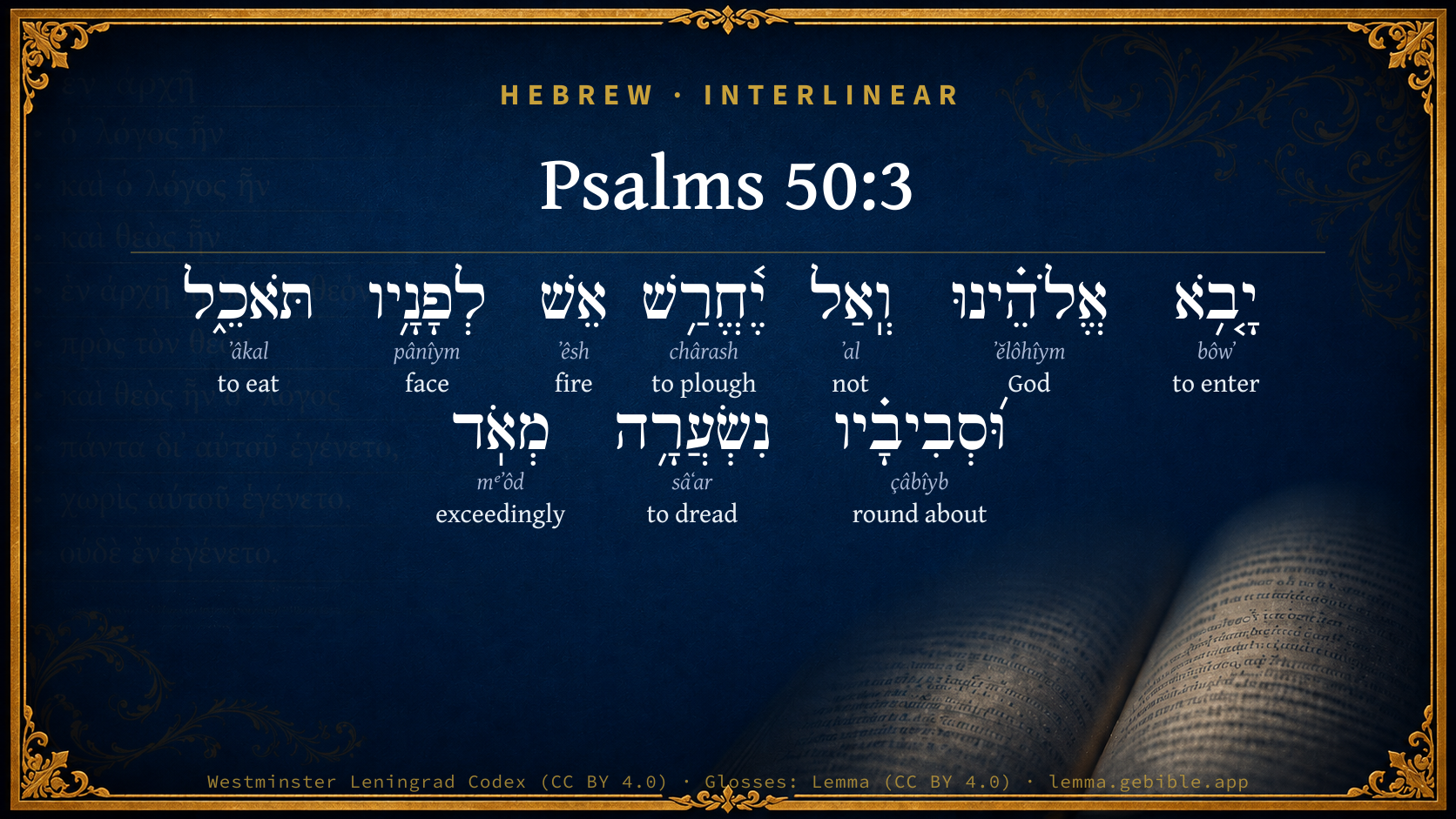
Hebrew (Westminster Leningrad Codex) Psalms 50:3 appears in the Hebrew Old Testament. The text above is from the Westminster Leningrad Codex. Each word links to its Strong’s number, a concise gloss, and parsing drawn from the Open Scriptures Hebrew Bible morphology. Click any word for its full Brown-Driver-Briggs (BDB) entry.
Download image
Cite this verse

Psalms 50:3 (World English Bible). Public Domain. Lemma interlinear Bible study tool, https://lemma.gebible.app/v/psalms/50/3.

Show BibTeX & RIS
BibTeX
RIS
English Translation
Our God comes, and does not keep silent. A fire devours before him. It is very tempestuous around him.
World English Bible · Public Domain
Download a study sheet

One document with this verse’s original text, its word-by-word gloss line, the meaning frame, cross-references with their text, attributed commentary, and full source and license credits — printable, and it pastes into notes with its structure intact.

This verse Autodidact and up

Study sheet (.html) Plain text (.txt)

A passage Seminary Student

Up to 50 verses in one chapter. A passage sheet keeps up to 6 commentary sources and 12 cross-references per verse, in the order this page ranks them, and says so on the sheet whenever that leaves anything out. Ask for a single verse and you get the Autodidact verse sheet above.

Everything on this page stays free to read, with no account — the sheet is a download of what is already on screen, not access to it.

Want to remove ads? Support Godless Engineer
Compare translations 3

The same verse in 3 English versions, stacked beneath the original-language interlinear above. Click any original word for its lexicon entry.

Each is an independent rendering of the whole verse — the interlinear is not word-aligned to these translations.

Highlighted words mark where these versions differ — a whole-verse word diff, not a word-by-word alignment.

  • World English Bible Public Domain
    Our God comes, and does not keep silent. A fire devours before him. It is very tempestuous around him.
  • King James Version Public Domain
    Our God shall come, and shall not keep silence: a fire shall devour before him, and it shall be very tempestuous round about him.
  • unfoldingWord Literal Text CC BY-SA 4.0
    Our God comes, and he is not silent. A fire devours to his face, and around him it is stormed greatly.

unfoldingWord Literal Text — © unfoldingWord, licensed CC BY-SA 4.0. Word-aligned USFM3 via Door43 (git.door43.org/unfoldingWord/en_ult).

Versions to compare (up to 4)

3 of 4 selected

Show all 18 translations

Every available English version of this verse, each an independent rendering of the whole verse.

  • World English Bible Public Domain
    Our God comes, and does not keep silent. A fire devours before him. It is very tempestuous around him.
  • Berean Standard Bible Public Domain
    Our God approaches and will not be silent! Consuming fire precedes Him, and a tempest rages around Him.
  • Majority Standard Bible Public Domain
    Our God approaches and will not be silent! Consuming fire precedes Him, and a tempest rages around Him.
  • King James Version Public Domain
    Our God shall come, and shall not keep silence: a fire shall devour before him, and it shall be very tempestuous round about him.
  • American Standard Version (1901) Public Domain
    Our God cometh, and doth not keep silence: A fire devoureth before him, And it is very tempestuous round about him.
  • Revised Version (1885) Public Domain
    Our God shall come, and shall not keep silence: a fire shall devour before him, and it shall be very tempestuous round about him.
  • Geneva Bible (1599) Public Domain
    Our God shall come and shall not keepe silence: a fire shall deuoure before him, and a mightie tempest shall be mooued round about him.
  • Douay-Rheims (1899) Public Domain
    God shall come manifestly: our God shall come, and shall not keep silence. A fire shall burn before him: and a mighty tempest shall be round about him.
  • Young's Literal Translation Public Domain
    Our God cometh, and is not silent, Fire before Him doth devour, And round about him it hath been very tempestuous.
  • Literal Standard Version CC BY-SA 4.0
    Our God comes, and is not silent, || Fire devours before Him, || And around Him it has been very tempestuous.
  • Unlocked Literal Bible CC BY-SA 4.0
    Our God comes and does not stay silent; a fire devours before him, and it is very stormy around him.
  • unfoldingWord Literal Text CC BY-SA 4.0
    Our God comes, and he is not silent. A fire devours to his face, and around him it is stormed greatly.
  • Darby Bible Public Domain
    Our God will come, and will not keep silence: fire shall devour before him, and it shall be very tempestuous round about him.
  • World Messianic Bible Public Domain
    Our God comes, and does not keep silent. A fire devours before him. It is very stormy around him.
  • Webster's Bible Public Domain
    Our God shall come, and shall not keep silence: a fire shall devour before him, and it shall be very tempestuous around him.
  • Free Bible Version CC BY-SA 4.0
    Our God arrives, and does not stay quiet. Fire flames before him, burning everything up; a violent storm rages around him.
  • Bible in Basic English Public Domain
    Our God will come, and will not keep quiet; with fire burning before him, and storm-winds round him.
  • JPS Tanakh (1917) Public Domain
    Our God cometh, and doth not keep silence; a fire devoureth before Him, and round about Him it stormeth mightily.

Literal Standard Version (2020), Covenant Press — licensed CC BY-SA 4.0. Text via the HelloAO Bible API (eBible.org). Unlocked Literal Bible (unfoldingWord) — licensed CC BY-SA 4.0. Text via the HelloAO Bible API (eBible.org). unfoldingWord Literal Text — © unfoldingWord, licensed CC BY-SA 4.0. Word-aligned USFM3 via Door43 (git.door43.org/unfoldingWord/en_ult). Free Bible Version, Dr. Jonathan Gallagher — licensed CC BY-SA 4.0. Text via the HelloAO Bible API (eBible.org).

Word by word

More ways to search: Search by grammar → Find every occurrence → Compare this word →

Practice this passage: Drill this verse → Learn its vocabulary →

נִשְׂעֲרָ֥ה
sâʻar
H8175
“to dread”
Verb, Niphal, Perfect, 3rd Person, Feminine, Singular
Part of Speech
Verb
Stem
Niphal
Form
Perfect
Person
3rd Person
Gender
Feminine
Number
Singular
Full BDB Definition

Origin: a primitive root

TWOT: 2274d , 2275 , 2276

to storm, shiver, dread, bristle (with horror), be very afraid - (Qal) - to bristle (with horror) - to dread - to storm away, sweep away, whirl away - (Qal) - to sweep away - to storm away (of God's action against the wicked) (figuratively) - (Niphal) to be stormy, be tempestuous (exceedingly) - (Piel) to whirl away, be stormed away - (Hithpael) to storm against, come as a storm
  1. יָ֤בֹ֥א bôwʼ H935 “to enter” Verb, Qal, Imperfect, 3rd Person, Masculine, Singular
  2. אֱלֹהֵ֗ינוּ ʼĕlôhîym H430 “God(s) · our” Noun, Common, Masculine, Plural, Construct + Suffix, Personal, 1st Person, Common, Plural
  3. וְֽאַל ʼal H408 “and · not” Conjunction + Particle, Negative
  4. יֶ֫חֱרַ֥שׁ chârash H2790 “to plough” Verb, Qal, Jussive, 3rd Person, Masculine, Singular
  5. אֵשׁ ʼêsh H784 “fire” Noun, Common, Both, Singular, Absolute
  6. לְפָנָ֥יו pânîym H6440 “to/for · face(s) · his” Preposition + Noun, Common, Both, Plural, Construct + Suffix, Personal, 3rd Person, Masculine, Singular
  7. תֹּאכֵ֑ל ʼâkal H398 “to eat” Verb, Qal, Imperfect, 3rd Person, Feminine, Singular
  8. וּ֝סְבִיבָ֗יו çâbîyb H5439 “and · round about · his” Conjunction + Noun, Common, Both, Singular, Construct + Suffix, Personal, 3rd Person, Masculine, Singular
  9. מְאֹֽד mᵉʼôd H3966 “exceedingly” Adverb

About this verse

These counts appear in no published source. They are computed here, from the morphology-tagged text and Lemma’s own curated glosses. What Lemma adds →

10
words
10
distinct lemmas
Wisdom
section

Notable vocabulary

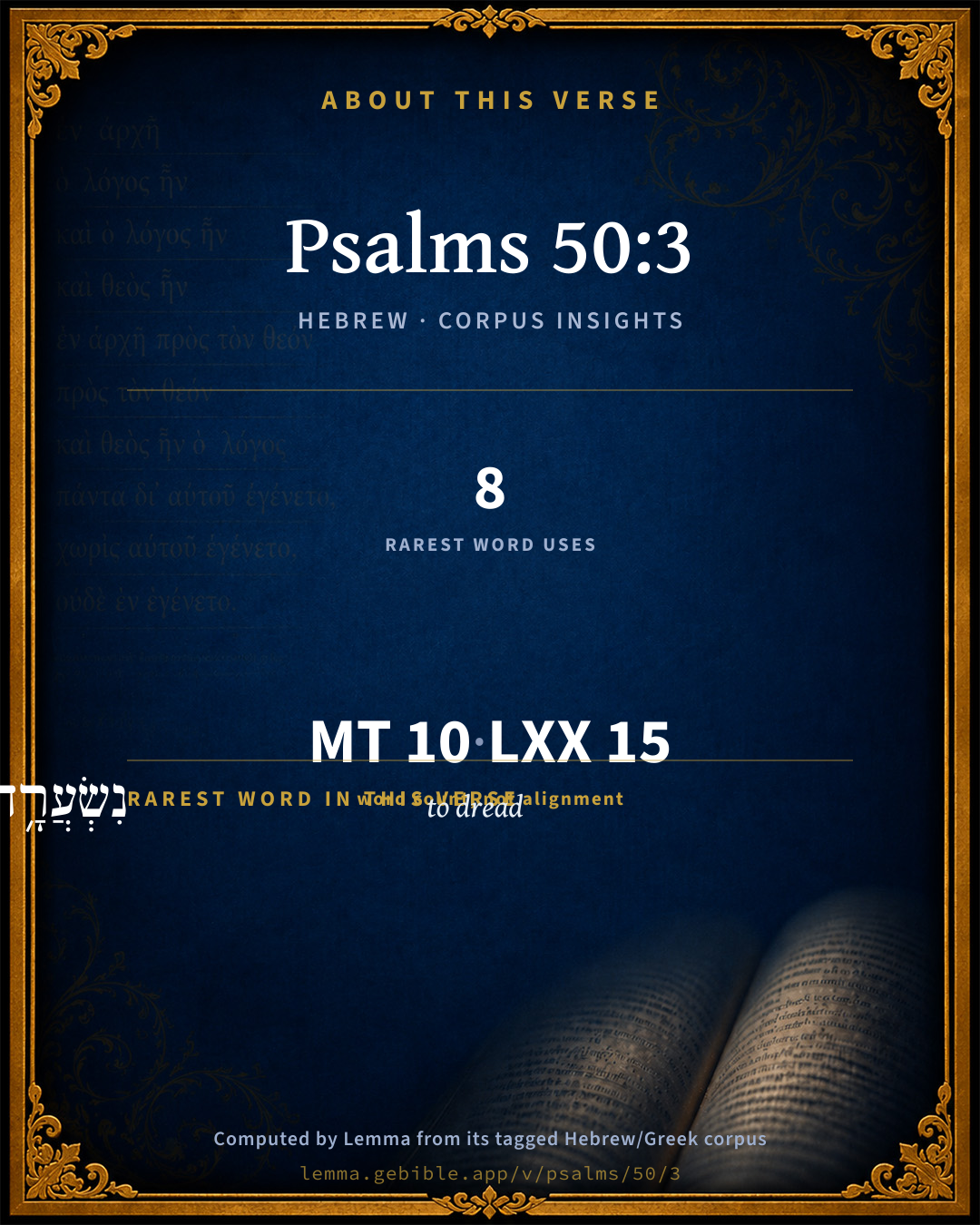
The rarest word here is נִשְׂעֲרָ֥ה to dread H8175 — appearing just 8 times in the whole Hebrew Bible.

Shared distinctive vocabulary

נִשְׂעֲרָ֥ה to dread H8175 occurs in 8 verses of the Hebrew Bible. Also found in:

Grammatical profile

  • 4 verbs
  • 4 nouns
  • 1 adverb
  • 1 particle

Verb forms

  • יָ֤בֹ֥א Qal · Imperfect
  • יֶ֫חֱרַ֥שׁ Qal · Jussive
  • תֹּאכֵ֑ל Qal · Imperfect
  • נִשְׂעֲרָ֥ה Niphal · Perfect

Hebrew & Septuagint length

In English translation the verse runs 19 words from the Hebrew and 29 from the Septuagint (LXX English) — closely comparable.

A rough comparison of the two English renderings, which tokenize alike — not a word-level alignment.

Word counts can differ between the Hebrew and the Greek without any difference in meaning — e.g. the Hebrew direct-object marker אֵת has no separate Greek word, and Greek often adds the article ὁ.

In the original languages it is 10 Hebrew tokens and 15 Greek tokens — but the two are counted differently (Hebrew bundles its prefixes and suffixes into one token; the Greek is in lemma form), so that isn’t a like-for-like length.

Cross-references

26

Topical passages linked to Psalms 50:3 in the Treasury of Scripture Knowledge — connected by theme and wording, ordered by reader-vote popularity; previews shown in the World English Bible.

  • Numbers 16:35 Fire came forth from Yahweh, and devoured the two hundred fifty men who offered the incense.
  • Daniel 7:10 A fiery stream issued and came forth from before him: thousands of thousands ministered to him, and ten thousand times ten thousand stood before him: the judgment was set, and the books were opened.
  • Leviticus 10:2 And fire came forth from before Yahweh, and devoured them, and they died before Yahweh.
  • Matthew 3:12 His winnowing fork is in his hand, and he will thoroughly cleanse his threshing floor. He will gather his wheat into the barn, but the chaff he will burn up with unquenchable fire."
  • Psalms 97:3–5 A fire goes before him, And burns up his adversaries on every side.
  • Malachi 4:1 "For, behold, the day comes, it burns as a furnace; and all the proud, and all who work wickedness, will be stubble; and the day that comes will burn them up," says Yahweh of Hosts, "that it shall leave them neither root nor branch.
  • Exodus 19:18 Mount Sinai, the whole of it, smoked, because Yahweh descended on it in fire; and its smoke ascended like the smoke of a furnace, and the whole mountain quaked greatly.
  • Deuteronomy 9:3 Know therefore this day, that Yahweh your God is he who goes over before you as a devouring fire; he will destroy them, and he will bring them down before you: so shall you drive them out, and make them to perish quickly, as Yahweh has spoken to you.
  • 1 Kings 19:11–12 He said, Go forth, and stand on the mountain before Yahweh. Behold, Yahweh passed by, and a great and strong wind tore the mountains, and broke in pieces the rocks before Yahweh; but Yahweh was not in the wind: and after the wind an earthquake; but Yahweh was not in the earthquake:
  • Psalms 18:7–15 Then the earth shook and trembled. The foundations also of the mountains quaked and were shaken, Because he was angry.
  • Psalms 48:14 For this God is our God forever and ever. He will be our guide even to death.
  • Psalms 50:21 You have done these things, and I kept silent. You thought that the "I AM" was just like you. I will rebuke you, and accuse you in front of your eyes.
  • Psalms 68:20 God is to us a God of deliverance. To Yahweh, the Lord, belongs escape from death.
  • Psalms 83:1 God, don't keep silent. Don't keep silent, And don't be still, God.
  • Psalms 96:13 Before Yahweh; for he comes, For he comes to judge the earth. He will judge the world with righteousness, The peoples with his truth.
  • Isaiah 42:13–14 Yahweh will go forth as a mighty man; he will stir up [his] zeal like a man of war: he will cry, yes, he will shout aloud; he will do mightily against his enemies.
  • Isaiah 65:6–7 Behold, it is written before me: I will not keep silence, but will recompense, yes, I will recompense into their bosom,
  • Nahum 1:5–7 The mountains quake before him, and the hills melt away. The earth trembles at his presence, yes, the world, and all who dwell in it.
  • Habakkuk 3:5 Plague went before him, And pestilence followed his feet.
  • Malachi 3:2–3 "But who can endure the day of his coming? And who will stand when he appears? For he is like a refiner's fire, and like launderer's soap;
  • 2 Thessalonians 1:8–9 giving vengeance to those who don't know God, and to those who don't obey the Gospel of our Lord Jesus,
  • Hebrews 10:28–29 A man who disregards Moses' law dies without compassion on the word of two or three witnesses.
  • Hebrews 12:29 for our God is a consuming fire.
  • Revelation 22:20 He who testifies these things says, "Yes, I come quickly." Amen! Yes, come, Lord Jesus.
  • Hebrews 2:3 how will we escape if we neglect so great a salvation-- which at the first having been spoken through the Lord, was confirmed to us by those who heard;
  • Hebrews 12:18–21 For you have not come to a mountain that might be touched, and that burned with fire, and to blackness, darkness, tempest,

Cross-references courtesy of OpenBible.info (CC BY 4.0).

Hebrew and Greek witnesses Masoretic Hebrew ↔ Greek Septuagint

The same verse in the two great witnesses to the Old Testament, shown verse-for-verse.

You’re reading Greek Psalm 49 (Hebrew Psalm 50). The Septuagint counts the superscription, so verse numbers can differ from the Hebrew — chapter-level alignment, not verse-by-verse. Numbering follows Rahlfs.

These are two independent witnesses, not word-aligned to each other, and the Septuagint is shown in lemma (dictionary) form.

Hebrew Psalms 50:3 Masoretic · Westminster Leningrad Codex

יָ֤בֹ֥א אֱלֹהֵ֗ינוּ וְֽאַל יֶ֫חֱרַ֥שׁ אֵשׁ לְפָנָ֥יו תֹּאכֵ֑ל וּ֝סְבִיבָ֗יו נִשְׂעֲרָ֥ה מְאֹֽד

Our God comes, and does not keep silent. A fire devours before him. It is very tempestuous around him.

World English Bible · Public Domain

Greek LXX Greek Psalm 49:3 Septuagint · lemma form

ὁ θεός ἐγώ καί οὐ παρασιωπάω πῦρ ἐναντίον αὐτός καίω καί κύκλος αὐτός καταιγίς σφόδρα

God, our God, shall come manifestly, and shall not keep silence: a fire shall be kindled before him, and round about him there shall be a very great tempest.

LXX2012 (modern English Septuagint) · Public Domain

Hebrew: Westminster Leningrad Codex (CC BY 4.0). Greek: Septuagint (public domain); English from LXX2012 (modern English Septuagint) (Public Domain). How the Septuagint differs from the Hebrew →

Commentary

Notes on Psalms 50:3 from classic Christian and Jewish commentators (each source and its license shown beneath its notes). The classic Christian expositions comment on the surrounding passage and are grouped to its opening verse, so a note may address several verses; the Jewish commentaries on the Tanakh (Rashi and others) are per-verse, so they appear only where the commentator wrote on this verse.

Lemma curates 59 commentaries, every one of them public domain or Creative Commons licensed, each selected and text-cleaned for this edition rather than reprinted as found. About our sources →

Trapp's Complete Commentary

John Trapp

Psa 50:3 Our God shall come, and shall not keep silence: a fire shall devour before him, and it shall be very tempestuous round about him.

Ver. 3. Our God shall come, and shall not keep silence] He doth daily come and sit upon the tribunal in his Church by the ministry of his servants, Mat 18:17, who must reprove sinners with all authority, and show themselves sons of thunder, that they may save some at least with fear, snatching them out of the fire, Jdg 1:23, as Peter, Act 2:40, and Paul, 2Co 5:11, but especially when, to work upon the Proconsul Paulus Sergius, he set his eyes upon Elymas the sorcerer, as if he would have looked through him; after which lightning followed that terrible thunder crack, "O thou full of all subtlety and all mischief, thou child of the devil, thou enemy of all righteousness, wilt thou not cease to pervert the straight ways of the Lord?" Act 13:9-10.

A fire shall devour before him] As he gave his law in fire, so in fire shall he require it.

And it shall be very tempestuous round about him] Not before him only, but around him; lest the wicked should hope to escape by creeping behind him. That was a terrible tempest that befell Alexander the Great and his army marching into the country of Pabaza; when, by reason of continual thundering and lightning, with hailstones and lightning bolts, the army was disorganized and wandered any way; many dared not stir out of the place (Curtius, lib. 3, ex Diodor.). Tremellius rendereth it wish wise, but in a parenthesis, Let our Lord come, and let him not be silent. The saints know that they shall be safe, when others shall smoke for it; because God is their God.

John Trapp, A Commentary or Exposition upon All the Books of the Old and New Testament (1647–1656) — public domain. Text from a community e-Sword module.

The Biblical Illustrator

Joseph S. Exell

Psa_50:3

Our God shall come, and shall not keep silence.

Our God shall come

I. The coming of our God. The expression is very striking: Our God shall come! Christ is God as well as man. His first coming was in His birth at Bethlehem. Here the psalmist contemplates His second coming. The cry may soon be heard, Behold, the Bridegroom cometh, etc. It is of the utmost importance that we should be ready.

II. The manner of his coming. A fire shall devour, etc. It is impossible to describe the terror of that day!

III. The object of his coming. He shall call, etc. (R. Horsfall.)

The silence of God

I. Consider the marvellous, and, as some may think, mysterious silence of god during the present economy.

1. Rise in the morning, and go forth to look upon the world as the light reveals it to the eye. You see the sun mounting to his throne of glory, dispensing, as he goes, life and warmth and beauty over all the habitable globe. All nature awakes at his approach. But though there is a very orchestra of subtile sounds--the song of birds, the hum of insect life, the sough of the swaying pines, the rustle of the dewy leaves--yet nowhere in field or forest, on the green earth or in the deep blue sky, do you hear the voice of the Deity. God keeps silence!

2. Go climb some lofty mountain, until you have the clouds beneath your feet, and the world spread out in grand panorama before you, river and plain, hill and valley, city and hamlet. You seem to breathe the pure air of heaven, and to stand under its cloudless dome. But neither in that blue arch above you, nor among those vast ranges of billowy mountains which encompass you, nor from those yet loftier snow-clad peaks which tower up to heaven, arrayed in their white robes for ever as the high priests of nature, do you hear any whisper or echo of the voice of the invisible God. The cataract thunders in the gorge, the mountain-brook babbles in the valley, the sad sea-waves chant their dirge along the shore, the hoarse thunder reverberates from peak to peak, but God keeps silence.

3. Picture some of the scenes of shameful revelry nightly enacted in such a city as this, when the licence and impiety of Belshazzars feast are reproduced; when lips that were taught in infancy to lisp the name of God in prayer are made the instruments of ribaldry and blasphemy. Yet no handwriting on the wall rebukes the shameless revellers. God keeps silence!

4. Or, think of the deeds of wickedness daily wrought among men--mans inhumanity to man, the heartless cruelty with which the strong prey upon the weak, the oppressors wrongs, the proud mans contumely, deceit and falsehood, trickery and hypocrisy, wrong and robbery. God keeps silence!

II. Why does god keep silence?

1. A spiritual being cannot be apprehended by the senses. The eye of flesh, the ear of flesh cannot perceive the invisible God. It is the soul which perceives, hears, apprehends Him. Faith in God must remain a moral act; it must be the result of moral considerations, not of the formulas of logic. The stream cannot rise above its source; and belief in God, which should be the result of a logical demonstration, would remain an act of the logical faculties, and would have no moral value. Moreover, if the being and attributes of God were so plainly exhibited in the visible universe as to preclude the possibility of a doubt, a necessary element of mans probation would be wanting.

2. The probationary character of human life. If Gods presence and power and retributive justice were forced upon the attention of men, so that they could not escape the consciousness of it; if Gods voice were ever sounding in their ears in warning; and if punishment followed swiftly upon transgression--men in that case would act as truly under compulsion as if bound hand and foot, and driven by the whip of the taskmaster. There might be obedience to the Divine law; but it would be enforced obedience, and hence its moral value would be gone. (R. H. McKim, D. D.)

The Biblical Illustrator, edited by Joseph S. Exell (c. 1880s–1900s) — public domain. Text from a community e-Sword module.

Joseph Benson's Commentary

Psa 50:3-4. Our God shall come, &c. — God will undoubtedly come and call us to judgment; though now he seems to take no notice of our conduct. The prophet speaks this in the person of one of God’s worshippers. As if he had said, Though he be our God, yet he will execute judgment upon us. And shall not keep silence — He will no longer connive at, or bear with, the hypocrisy and profaneness of the professors of the true religion, but will now speak unto them in his wrath, and will effectually reprove and chastise them. Or, he will not cease, that is, neglect or delay to come, as אל יחרשׁ, al jecheresh, may be interpreted. A fire shall devour before him, &c. — “He will not come like earthly princes, before whom marches an armed multitude; but in a far more terrible and irresistible manner, which shall make you as sensible of his dreadful presence, as your ancestors were at mount Sinai, when the devouring flames, and thunder, and lightning, which attended him, made the very mountain quake and tremble.” He shall call to the heavens, &c. — “He shall call heaven and earth (angels and men) to be witnesses of the equity of his proceedings, Isa 1:2; and you may as soon move them out of their place, as avoid appearing before his tribunal.” — Bishop Patrick. This is evidently a prediction of the terrible manner of God’s coming to execute judgment on the apostate Jews and Israelites, partly by the kings of Assyria and Babylon, who laid waste their country, destroyed their cities, and carried multitudes of them into captivity; and more especially in their last destruction by the Romans, when a signal vengeance was taken on them, as for their hypocrisy, abuse of their privileges, and all their other sins, so in particular for crucifying their own Messiah. This most terrible execution of divine wrath upon them was frequently foretold by the prophets: see Mal 3:2; and Mal 4:1; Isa 66:15; Isa 66:17; and is often represented in the Scriptures as the coming of the kingdom of God, of the Son of man, or of Christ, the Father having committed all judgment to him. Now this prediction in this Psalm seems especially to respect this event. And it has accordingly been so interpreted by the best Christian expositors, as Poole has shown in his Synopsis Criticorum; where he likewise tells us that the Jewish rabbis affirm the subject of the Psalm to be, “that judgment, which will be executed in the days of the Messiah;” “ignorant, alas!” says Dr. Horne, “that they themselves, and their people are now become the unhappy objects of that judgment.”

Joseph Benson's Commentary on the Old and New Testaments (1811–1818) — public domain. Text from a community e-Sword module.

Geneva Bible (1599)

Geneva Bible translators

As when God gave his Law in mount Sinai, he appeared terrible with thunder and tempest, so will he appear terrible to take account for the keeping thereof.

Geneva Bible (1599) marginal notes — public domain. Text via Bolls.life.

John Calvin's Commentaries

3. Our God shall come, and shall not keep silence He repeats that God would come, in order to confirm his doctrine, and more effectually arouse them. He would come, and should not always keep silence, lest they should be encouraged to presume upon his forbearance. Two reasons may be assigned why the prophet calls God our God He may be considered as setting himself, and the comparatively small number of the true fearers of the Lord, in opposition to the hypocrites whom he abhors, claiming God to be his God, and not theirs, as they were disposed to boast; or rather, he speaks as one of the people, and declares that the God who was coming to avenge the corruptions of his worship was the same God whom all the children of Abraham professed to serve. He who shall come, as if he had said, is our God, the same in whom we glory, who established his covenant with Abraham, and gave us his Law by the hand of Moses. He adds, that God would come with fire and tempest, in order to awaken a salutary fear in the secure hearts of the Jews, that they might learn to tremble at the judgments of God, which they had hitherto regarded with indifference and despised, and in allusion to the awful manifestation which God made of himself from Sinai, (Exodus 19:16; see also Hebrews 12:18.) The air upon that occasion resounded with thunders and the noise of trumpets, the heavens were illuminated with lightnings, and the mountain was in flames, it being the design of God to procure a reverential submission to the Law which he announced. And it is here intimated, that God would make a similarly terrific display of his power, in coming to avenge the gross abuses of his holy religion.

John Calvin's Commentaries (1540-1563) — public domain. Text from the Calvin Translation Society English edition (1840s-50s) via the Christian Classics Ethereal Library (ccel.org). Calvin's coverage is partial (roughly two-thirds of the Bible); uncommented books and verses are honest gaps, never fabricated. The 19th-century editor's footnotes and remarks are omitted so the notes are faithfully Calvin's own voice.

Ellicott's Commentary for English Readers

(3) Our God shall come . . . shall devour . . . shall be.—Better, comes . . . devours . . . is. The drama, the expected scene having been announced, now opens. The vision unfolds itself before the poet’s eye.

A Bible Commentary for English Readers, edited by Charles John Ellicott (1878–1897) — public domain. Text from a community e-Sword module.

The Cambridge Bible for Schools and Colleges

gen. ed. J. J. S. Perowne

3. In the preceding verses the Theophany is described as already visibly beginning. Instead of simply continuing that description, the poet-seer “imagines himself as an eager and interested spectator,” and prays God to come near and declare His will:

Let our God come, and not keep silence!

Fire devoureth before him,

And round about him it is very tempestuous.

See Driver, Hebrew Tenses, § 58; and for similar constructions cp. Psa_41:2 (note); Isa_2:9.

Lightnings and storm are the outward symbols which express the awfulness of God’s coming to judgement. He is ‘a consuming fire’ (Deu_4:24; Deu_9:3; Heb_12:29) devouring His enemies; an irresistible whirlwind (Psa_58:9), sweeping them away like chaff (Psa_1:4; Isa_29:5). Cp. Exo_19:16; Exo_19:18; Isa_29:6; Psa_18:7 ff; Psa_97:2 ff.

The Cambridge Bible for Schools and Colleges (gen. ed. J. J. S. Perowne; Cambridge University Press, 1878–1918) — public domain. Text from a community e-Sword module.

John Gill's Exposition

Our God shall come,.... That is, Christ, who is truly and properly God, and who was promised and expected as a divine Person; and which was necessary on account of the work he came about; and believers claim an interest in him as their God; and he is their God, in whom they trust, and whom they worship: and this coming of his is to be understood, not of his coming in the flesh; for though that was promised, believed, and prayed for, as these words are by some rendered, "may our God come" (r); yet at his first coming he was silent, his voice was not heard in the streets, Mat 12:19; nor did any fire or tempest attend that: nor is it to be interpreted of his second coming, or coming to judgment; for though that also is promised, believed, and prayed for; and when he will not be silent, but by his voice will raise the dead, summon all before him, and pronounce the sentence on all; and the world, and all that is therein, will be burnt with fire, and a horrible tempest rained upon the wicked; yet it is better to understand it of his coming to set up his kingdom in the world, and to punish his professing people for their disbelief and rejection of him; see Mat 16:28;

and shall not keep silence; contain himself, bear with the Jews any longer, but come forth in his wrath against them; see Psa 50:21; and it may also denote the great sound of the Gospel, and the very public ministration of it in the Gentile world, at or before this time, for the enlargement of Christ's kingdom in it;

a fire shall devour before him; meaning either the fire of the divine word making its way among the Gentiles, consuming their idolatry, superstition, &c. or rather the fire of divine wrath coming upon the Jews to the uttermost and even it may be literally understood of the fire that consumed their city and temple, as was predicted, Zac 11:1;

and it shall be very tempestuous round about him; the time of Jerusalem's destruction being such a time of trouble as has not been since the world began, Mat 24:21.

(r) "veniat", Junius & Tremellius; so Ainsworth.

John Gill's Exposition of the Whole Bible (1746–1763) — public domain (CC PDM 1.0). Text via the HelloAO Bible API.

Albert Barnes' Notes on the Bible

Our God shall come - That is, he will come to judgment. This language is derived from the supposition that God “will” judge the world, and it shows that this doctrine was understood and believed by the Hebrews. The New Testament has stated the fact that this will be done by the coming of his Son Jesus Christ to gather the nations before him, and to pronounce tile final sentence on mankind: Mat 25:31; Act 17:31; Act 10:42; Joh 5:22.

And shall not keep silence - That is, the will come forth and “express” his judgment on the conduct of mankind. See the notes at Psa 28:1. He “seems” now to be silent. No voice is heard. No sentence is pronounced. But this will not always be the case. The time is coming when he will manifest himself, and will no longer be silent as to the conduct and character of people, but will pronounce a sentence, fixing their destiny according to their character.

A fire shall devour before him - Compare the notes at 2Th 1:8; notes at Heb 10:27. The “language” here is undoubtedly taken from the representation of God as he manifested himself at Mount Sinai. Thus, in Exo 19:16, Exo 19:18, it is said, “And it came to pass on the third day in the morning, that there were thunders and lightnings, and a thick cloud upon the mount, and the voice of a trumpet exceeding loud; and Mount Sinai was altogether on a smoke, because the Lord descended upon it in fire: and the smoke thereof ascended as the smoke of a furnace, and the whole mount quaked greatly.

And it shall be very tempestuous round about him - The word used here - שׂער śa‛ar - means properly to shudder; to shiver; and then it is employed to denote the commotion and raging of a tempest. The allusion is doubtless to the descent on Mount Sinai Exo 19:16, and to the storm accompanied by thunder and lightning which beat upon the mountain when God descended on it to give his law. The whole is designed to represent God as clothed with appropriate majesty when judgment is to be pronounced upon the world.

Albert Barnes' Notes on the Bible (1834–1885) — public domain. Text from a community e-Sword/MySword module.

Matthew Poole's English Annotations

Our God: these words are used here, as they are also Heb 12:29, emphatically. The prophet speaks this in the person of the Israelites and worshippers of God, whereof he was one, and thereby takes off their fond pretence, as if because God was their God, in covenant with them, and nearly related to them by Abraham his friend for ever, he would bear with their miscarriages, and would not deal so severely with them as some fancied; which also was their conceit, Jer 7:4, &c.; Mat 3:9,10. No, saith he, though he be our God, yet he will come to execute judgment upon us.

Shall come; either,

1. From heaven, his dwelling-place, to Zion, to sit in judgment there. Or,

2. Out of Zion to some other place, as was said on Psa 50:2.

And shall not keep silence: so the sense is, he will no longer forbear or connive at the hypocrisy and profaneness of the professors of the true religion, but will now speak to them in his wrath, and will effectually reprove and chastise them. But because the psalmist is not now describing what God did or would say against them, which he doth below, Psa 50:7, &c., but as yet continues in his description of the preparation or coming of the Judge to his throne, it seems more proper to translate the words, as some do, he will not cease, (for this verb signifies not only a cessation from speech, but from motion or action, as it doth 2Sa 19:11; Psa 83:1; Isa 42:14,15) i.e. not neglect or delay to come. So here is the same thing expressed, both affirmatively and negatively, (as is frequent in Scripture, whereof divers instances have been formerly given,) for the greater assurance of the truth of the thing.

It shall be very tempestuous round about him: this is a further description of that terrible majesty wherewith God clothed himself when he came to his tribunal, in token of that just severity which, he would use in his proceedings with them. He alludes to the manner of God’s appearance at Sinai, Exo 19, and intimates to them, that although Zion was a place of grace and blessing to all true Israelites, yet God would be as dreadful there to the hypocrites among them, as ever he was at Sinai. See Isa 33:14.

Matthew Poole's English Annotations on the Holy Bible (1683–1685) — public domain. Text from a community e-Sword/MySword module.

The Treasury of David

Charles H. Spurgeon

Ver. 3. Our God shall come. The psalmist speaks of himself and his brethren as standing in immediate anticipation of the appearing of the Lord upon the scene. "He comes, "they say, "our covenant God is coming; "they can hear his voice from afar, and perceive the splendour of his attending train. Even thus should we await the long promised appearing of the Lord from heaven. And shall not keep silence. He comes to speak, to plead with his people, to accuse and judge the ungodly. He has been silent long in patience, but soon he will speak with power. What a moment of awe when the Omnipotent is expected to reveal himself! What will be the reverent joy and solemn expectation when the poetic scene of this Psalm becomes in the last great day an actual reality! A fire shall devour before him, and it shall be very tempestuous round about him. Flame and hurricane are frequently described as the attendants of the divine appearance. "Our God is a consuming fire." "At the brightness that was before him his thick clouds passed, hailstones and coals of fire." Ps 18:12. "He rode upon a cherub, and did fly; yea, he did fly upon the wings of the wind." "The Lord Jesus shall be revealed from heaven with his mighty angels, in flaming fire taking vengeance on them that know not God." 2Th 1:7-8. Fire is the emblem of justice in action, and the tempest is a token of his overwhelming power. Who will not listen in solemn silence when such is the tribunal from which the judge pleads with heaven and earth?

Ver. 3. Our God shall come, and shall not keep silence. He kept silence that he might be judged, he will not keep silence when he begins to judge. It would not have been said, He shall come manifestly, unless at first he had come concealed; nor, He shall not keep silence, had he not at first kept silence. How did he keep silence? Ask Isaiah: "He was brought as a lamb to the slaughter, and as a sheep before her shearers is dumb, so he openeth not his mouth." Isa 53:7. But he shall come manifestly, and shall not keep silence. How manifestly? A fire shall go before him, and round about him a mighty tempest. That tempest is to carry wholly away the chaff from the floor which is now in threshing; that fire, to consume what the tempest carries off. Now, however, he is silent; silent in judgment, but not in precept. For if Christ is silent, what mean these gospels? What the voices of the apostles? the canticles of the Psalms? the lofty utterances of the prophets? Truly in all these Christ is not silent. Howbeit he is silent for he present in not taking vengeance, not in not warning. But he will come in surpassing brightness to take vengeance, and will be seen of all, even of those who believe not on him; but now, forasmuch as although present he was not concealed, it behoved him to be despised: for unless he had been despised he would not have been crucified; if not crucified he would not have shed his blood, the price with which he redeemed us. But in order that he might give a price for us, he was crucified; that he might be crucified he was despised; that he might be despised, he appeared in humble guise. Augustine.

Ver. 3. (first clause). The future in the first clause may be rendered he is coming, as if the sound of his voice and the light of his glory had preceded his actual appearance. The imagery is borrowed from the giving of the law a Sinai. J. A. Alexander.

Ver. 3. (first clause). May our God come! (Version of Junius and Tremellius.) A prayer for the hastening of his advent, as in the Apocalypse, 22:20. Poole's Synopsis.

Ver. 3. A fire shall devour before him. As he gave his law in fire, so in fire shall he require it. John Trapp.

Charles H. Spurgeon's The Treasury of David (1869–1885) — public domain. Psalms only. Text from a community e-Sword/MySword module.

Whedon's Commentary on the Bible

Daniel D. Whedon

3. Is an allusion to Lev_10:2; Num_16:26. See Psa_97:3.

Tempestuous—Like the terrifying scenes of Sinai, Exo_19:16. Compare Psa_18:8-14

Daniel D. Whedon (gen. ed.), Commentary on the Old and New Testaments (1874–1909) — public domain. Text from a community e-Sword module.

The Pulpit Commentary

Our God shall come, and shall not keep silence; rather, and let him not keep silence. Let him call attention to his "coming," that his judgment may be widely known. A fire (rather, fire) shall devour before him. (comp. Psa_21:9) And it shall be very tempestuous round about him. So in all theophanies. (see Exo_19:16 1Ki_19:11Jo 1Ki 38:1 Psa_18:13 Psa_97:2-5 Act_2:2 Rev_4:5, etc.)

The Pulpit Commentary (1880–1919), ed. H.D.M. Spence-Jones & Joseph S. Exell — public domain. Text from a community e-Sword module.

John Wesley's Explanatory Notes

Our God - The prophet speaks this in the persons of the worshippers of God. Though he be our God, yet he will come to execute judgment upon us. Cease - Or delay to sit in judgment. Tempestuous - This is a farther description of that terrible majesty, wherewith God would clothe himself when he came to his tribunal.

John Wesley, Explanatory Notes Upon the Whole Bible (1754–1765) — public domain. Text via the GEBible commentary corpus.

unfoldingWord translationNotes

Door43 World Missions Community

does not stay silent

The writer uses this negative statement to emphasize the positive. AT: "speaks so that everyone can hear him" (See: Litotes)

a fire devours before him

The writer speaks of a fire burning things as if it were eating them. AT: "a fire burns in front of him" (See: Metaphor)

it is very stormy around him

"there is a great storm around him"

He calls to the heavens above and to the earth

Possible meanings are 1) God is calling on all who live in heaven and on earth to be witnesses as he judges his people or 2) God is speaking to heaven and earth as if they are people, and he is calling them to be witnesses as he judges his people. (See: Metonymy and Personification)

translationWords

God

fire

devour

call

heaven

earth

judge

people of God

faithful

covenant

sacrifice

unfoldingWord translationNotes — © Distant Shores Media and the Door43 World Missions Community, licensed CC BY-SA 4.0. Source: git.door43.org/Door43/en_tn.

Rashi

Rabbi Shlomo Yitzchaki (Rashi)

Our God shall come and not be silent any longer concerning the spilt blood of His servants.

Rashi on the Tanakh — English translations: “The Judaica Press complete Tanach with Rashi, translated by A. J. Rosenberg” (CC BY 4.0); “Pentateuch with Rashi's commentary by M. Rosenbaum and A.M. Silbermann, 1929-1934” (public domain); “The Metsudah Tanach series, Lakewood, N.J” (CC BY 4.0); and “The Book of Joshua, Metsudah Publications, 1997” (CC BY 4.0). Text via Sefaria.

Lesson kit

Teaching starters — assembled from the data on this page, not authored interpretation. Every prompt links to the verse data it draws on. Edit before teaching.

Psalms, in the Wisdom, opens this verse with 10 words (10 distinct Hebrew lemmas). Its most distinctive word is sâʻar (“to dread”). A historical commentator’s framing appears above. Read the whole chapter for the surrounding context.

Discussion questions

  1. The word sâʻar carries the sense “to dread.” How does it shape the verse?
  2. Deuteronomy 32:17 shares the word «to dread» with this verse. How do the two illuminate each other?
  3. The translations on this page render this verse differently — a whole-verse word diff, not a word-by-word alignment. What might account for the different wordings?
  4. The verb «יָ֤בֹ֥א» is Qal Imperfect. How does its form color the action?
  5. Reading how Trapp's Complete Commentary and The Biblical Illustrator read this verse, where do the two commentators agree and where do they part?

Things to notice

Reading settings

Reading text

Shown beneath each verse's original-language words.

Old Testament
Old Testament edition

Read the OT as the Masoretic Hebrew (MT) or the Greek Septuagint (LXX).

English shown for the Greek Septuagint (in the Hebrew ↔ Greek comparison).

Comparing translations? Open the Compare panel on any verse page to stack up to four side by side.