Judges 9:52

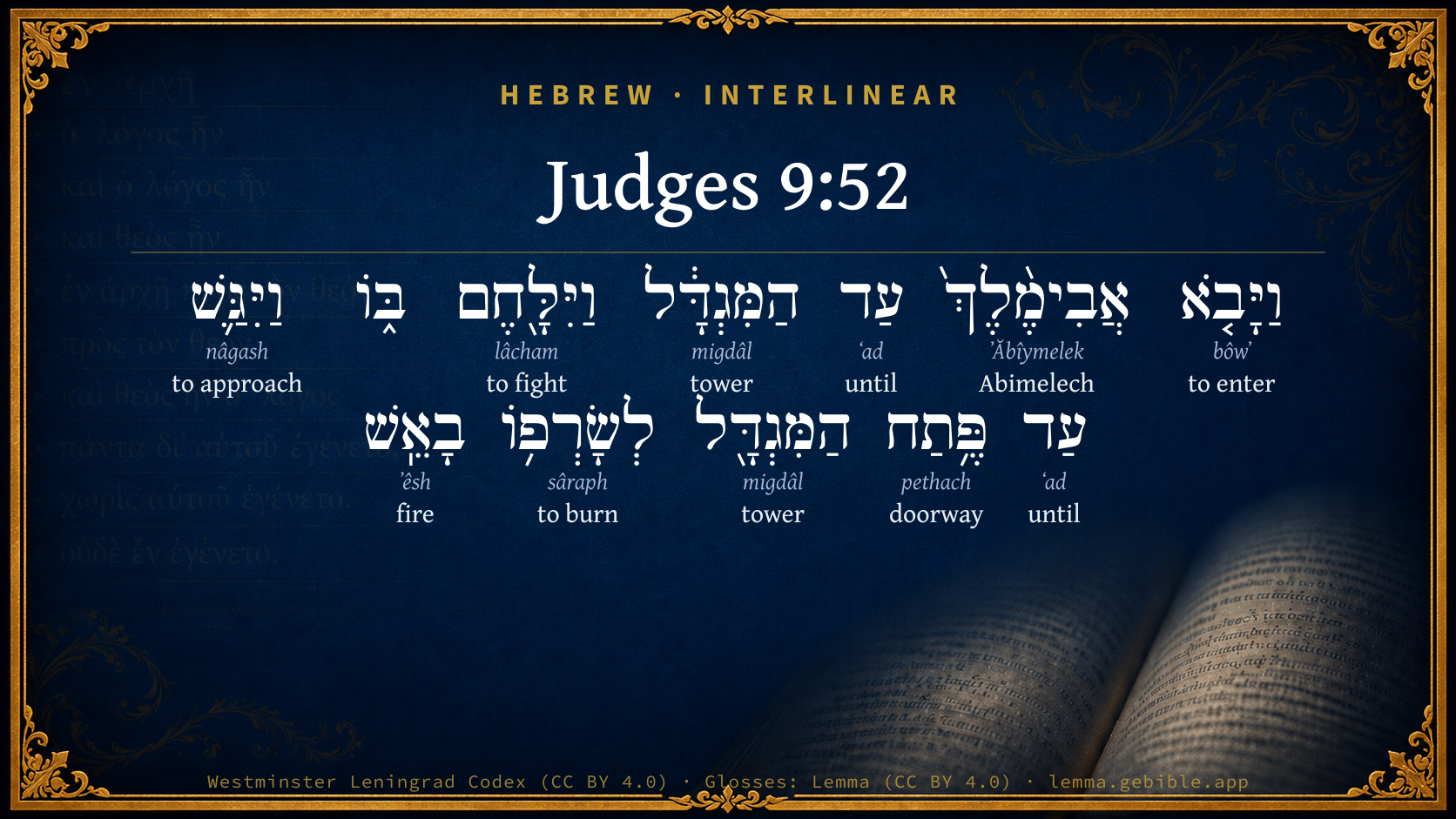
Hebrew (Westminster Leningrad Codex) Judges 9:52 appears in the Hebrew Old Testament. The text above is from the Westminster Leningrad Codex. Each word links to its Strong’s number, a concise gloss, and parsing drawn from the Open Scriptures Hebrew Bible morphology. Click any word for its full Brown-Driver-Briggs (BDB) entry.
Download image
Cite this verse

Judges 9:52 (World English Bible). Public Domain. Lemma interlinear Bible study tool, https://lemma.gebible.app/v/judges/9/52.

Show BibTeX & RIS
BibTeX
RIS
English Translation
Abimelech came to the tower, and fought against it, and drew near to the door of the tower to burn it with fire.
World English Bible · Public Domain
Download a study sheet

One document with this verse’s original text, its word-by-word gloss line, the meaning frame, cross-references with their text, attributed commentary, and full source and license credits — printable, and it pastes into notes with its structure intact.

This verse Autodidact and up

Study sheet (.html) Plain text (.txt)

A passage Seminary Student

Up to 50 verses in one chapter. A passage sheet keeps up to 6 commentary sources and 12 cross-references per verse, in the order this page ranks them, and says so on the sheet whenever that leaves anything out. Ask for a single verse and you get the Autodidact verse sheet above.

Everything on this page stays free to read, with no account — the sheet is a download of what is already on screen, not access to it.

Want to remove ads? Support Godless Engineer
Compare translations 3

The same verse in 3 English versions, stacked beneath the original-language interlinear above. Click any original word for its lexicon entry.

Each is an independent rendering of the whole verse — the interlinear is not word-aligned to these translations.

Highlighted words mark where these versions differ — a whole-verse word diff, not a word-by-word alignment.

  • World English Bible Public Domain
    Abimelech came to the tower, and fought against it, and drew near to the door of the tower to burn it with fire.
  • King James Version Public Domain
    And Abimelech came unto the tower, and fought against it, and went hard unto the door of the tower to burn it with fire.
  • unfoldingWord Literal Text CC BY-SA 4.0
    Then Abimelech came to the tower and fought with it. And he came near to the entrance of the tower to burn it with fire.

unfoldingWord Literal Text — © unfoldingWord, licensed CC BY-SA 4.0. Word-aligned USFM3 via Door43 (git.door43.org/unfoldingWord/en_ult).

Versions to compare (up to 4)

3 of 4 selected

Show all 18 translations

Every available English version of this verse, each an independent rendering of the whole verse.

  • World English Bible Public Domain
    Abimelech came to the tower, and fought against it, and drew near to the door of the tower to burn it with fire.
  • Berean Standard Bible Public Domain
    When Abimelech came to attack the tower, he approached its entrance to set it on fire.
  • Majority Standard Bible Public Domain
    When Abimelech came to attack the tower, he approached its entrance to set it on fire.
  • King James Version Public Domain
    And Abimelech came unto the tower, and fought against it, and went hard unto the door of the tower to burn it with fire.
  • American Standard Version (1901) Public Domain
    And Abimelech came unto the tower, and fought against it, and drew near unto the door of the tower to burn it with fire.
  • Revised Version (1885) Public Domain
    And Abimelech came unto the tower, and fought against it, and went hard unto the door of the tower to burn it with fire.
  • Geneva Bible (1599) Public Domain
    And Abimelech came vnto the towre and fought against it, and went hard vnto the doore of the towre to set it on fire.
  • Douay-Rheims (1899) Public Domain
    And Abimelech coming near the tower, fought stoutly: and approaching to the gate, endeavoured to set fire to it:
  • Young's Literal Translation Public Domain
    And Abimelech cometh unto the tower, and fighteth against it, and draweth nigh unto the opening of the tower to burn it with fire,
  • Literal Standard Version CC BY-SA 4.0
    And Abimelech comes to the tower, and fights against it, and draws near to the opening of the tower to burn it with fire,
  • Unlocked Literal Bible CC BY-SA 4.0
    Abimelech came to the tower and fought against it, and he came up near to the door of the tower to burn it.
  • unfoldingWord Literal Text CC BY-SA 4.0
    Then Abimelech came to the tower and fought with it. And he came near to the entrance of the tower to burn it with fire.
  • Darby Bible Public Domain
    And Abim'elech came to the tower, and fought against it, and drew near to the door of the tower to burn it with fire.
  • World Messianic Bible Public Domain
    Abimelech came to the tower and fought against it, and came near to the door of the tower to burn it with fire.
  • Webster's Bible Public Domain
    And Abimelech came to the tower, and fought against it, and came near to the door of the tower to burn it with fire.
  • Free Bible Version CC BY-SA 4.0
    Abimelech went up to the tower to attack it. But as he approached the tower's entrance to set it on fire,
  • Bible in Basic English Public Domain
    And Abimelech came to the tower and made an attack on it, and got near to the door of the tower for the purpose of firing it.
  • JPS Tanakh (1917) Public Domain
    And Abimelech came unto the tower, and fought against it, and went close unto the door of the tower to burn it with fire.

Literal Standard Version (2020), Covenant Press — licensed CC BY-SA 4.0. Text via the HelloAO Bible API (eBible.org). Unlocked Literal Bible (unfoldingWord) — licensed CC BY-SA 4.0. Text via the HelloAO Bible API (eBible.org). unfoldingWord Literal Text — © unfoldingWord, licensed CC BY-SA 4.0. Word-aligned USFM3 via Door43 (git.door43.org/unfoldingWord/en_ult). Free Bible Version, Dr. Jonathan Gallagher — licensed CC BY-SA 4.0. Text via the HelloAO Bible API (eBible.org).

Word by word

More ways to search: Search by grammar → Find every occurrence → Compare this word →

Practice this passage: Drill this verse → Learn its vocabulary →

הַמִּגְדָּ֔ל
migdâl
H4026
“the · tower”
Particle, Definite Article + Noun, Common, Both, Singular, Absolute
Part of Speech
Particle + Noun
Type
Common
Gender
Both
Number
Singular
State
Absolute
Full BDB Definition

Origin: from H1431

TWOT: 315f , 315g

tower - tower - elevated stage, pulpit - raised bed
  1. וַיָּבֹ֤א bôwʼ H935 “and · to enter” Conjunction + Verb, Qal, Sequential Imperfect, 3rd Person, Masculine, Singular
  2. אֲבִימֶ֨לֶךְ֙ ʼĂbîymelek H40 “Abimelech” Noun, Proper
  3. עַד ʻad H5704 “until” Preposition
  4. וַיִּלָּ֖חֶם lâcham H3898 “and · to fight” Conjunction + Verb, Niphal, Sequential Imperfect, 3rd Person, Masculine, Singular
  5. וַיִּגַּ֛שׁ nâgash H5066 “and · to approach” Conjunction + Verb, Qal, Sequential Imperfect, 3rd Person, Masculine, Singular
  6. עַד ʻad H5704 “until” Preposition
  7. פֶּ֥תַח pethach H6607 “doorway of” Noun, Common, Masculine, Singular, Construct
  8. הַמִּגְדָּ֖ל migdâl H4026 “the · tower” Particle, Definite Article + Noun, Common, Both, Singular, Absolute
  9. לְשָׂרְפ֥וֹ sâraph H8313 “to burn · him” Preposition + Verb, Qal, Infinitive Construct + Suffix, Personal, 3rd Person, Masculine, Singular
  10. בָאֵֽשׁ ʼêsh H784 “in/at the · fire” Preposition, Determined + Noun, Common, Both, Singular, Absolute

About this verse

These counts appear in no published source. They are computed here, from the morphology-tagged text and Lemma’s own curated glosses. What Lemma adds →

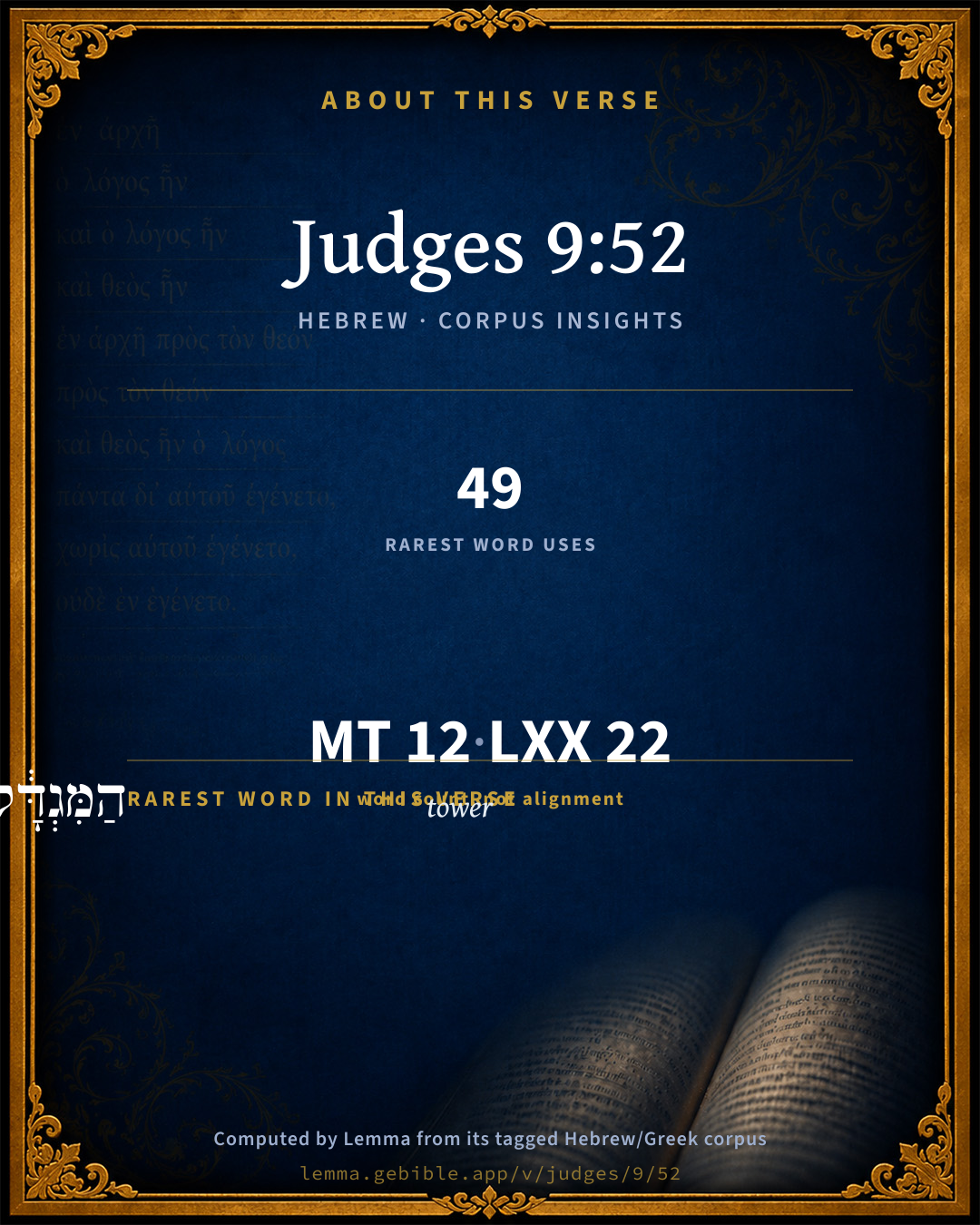
12
words
9
distinct lemmas
Historical
section

Shared distinctive vocabulary

הַמִּגְדָּ֔ל tower H4026 occurs in 44 verses of the Hebrew Bible. Also found in:

Grammatical profile

  • 4 verbs
  • 5 nouns
  • 3 prepositions

Verb forms

  • וַיָּבֹ֤א Qal · Sequential Imperfect
  • וַיִּלָּ֖חֶם Niphal · Sequential Imperfect
  • וַיִּגַּ֛שׁ Qal · Sequential Imperfect
  • לְשָׂרְפ֥וֹ Qal · Infinitive Construct

Repetition

Words recur within this verse — often emphatic in Hebrew:

  • עַד until H5704 ×2
  • הַמִּגְדָּ֔ל tower H4026 ×2

Hebrew & Septuagint length

In English translation the verse runs 23 words from the Hebrew and 26 from the Septuagint (LXX English) — closely comparable.

A rough comparison of the two English renderings, which tokenize alike — not a word-level alignment.

Word counts can differ between the Hebrew and the Greek without any difference in meaning — e.g. the Hebrew direct-object marker אֵת has no separate Greek word, and Greek often adds the article ὁ.

In the original languages it is 12 Hebrew tokens and 22 Greek tokens — but the two are counted differently (Hebrew bundles its prefixes and suffixes into one token; the Greek is in lemma form), so that isn’t a like-for-like length.

Cross-references

3

Topical passages linked to Judges 9:52 in the Treasury of Scripture Knowledge — connected by theme and wording, ordered by reader-vote popularity; previews shown in the World English Bible.

  • 2 Kings 15:16 Then Menahem struck Tiphsah, and all who were therein, and the borders of it, from Tirzah: because they didn't open to him, therefore he struck it; and all the women therein who were with child he ripped up.
  • Judges 9:48–49 Abimelech got him up to Mount Zalmon, he and all the people who were with him; and Abimelech took an axe in his hand, and cut down a bough from the trees, and took it up, and laid it on his shoulder: and he said to the people who were with him, What you have seen me do, make haste, and do as I have done.
  • 2 Kings 14:10 You have indeed struck Edom, and your heart has lifted you up: glory of it, and abide at home; for why should you meddle to [your] hurt, that you should fall, even you, and Judah with you?

Cross-references courtesy of OpenBible.info (CC BY 4.0).

Hebrew and Greek witnesses Masoretic Hebrew ↔ Greek Septuagint

The same verse in the two great witnesses to the Old Testament, shown verse-for-verse.

These are two independent witnesses, not word-aligned to each other, and the Septuagint is shown in lemma (dictionary) form.

Hebrew Judges 9:52 Masoretic · Westminster Leningrad Codex

וַיָּבֹ֤א אֲבִימֶ֨לֶךְ֙ עַד הַמִּגְדָּ֔ל וַיִּלָּ֖חֶם בּ֑וֹ וַיִּגַּ֛שׁ עַד פֶּ֥תַח הַמִּגְדָּ֖ל לְשָׂרְפ֥וֹ בָאֵֽשׁ

Abimelech came to the tower, and fought against it, and drew near to the door of the tower to burn it with fire.

World English Bible · Public Domain

Greek LXX Judges 9:52 Septuagint · lemma form

καί ἔρχομαι αβιμελεχ ἕως ὁ πύργος καί παρατάσσω αὐτός καί ἐγγίζω αβιμελεχ ἕως ὁ θύρα ὁ πύργος ὁ ἐνπίμπρημι αὐτός ἐν πῦρ

And Abimelech drew near to the tower, and they besieged it; and Abimelech drew near to the door of the tower to burn it with fire.

LXX2012 (modern English Septuagint) · Public Domain

Hebrew: Westminster Leningrad Codex (CC BY 4.0). Greek: Septuagint (public domain); English from LXX2012 (modern English Septuagint) (Public Domain). How the Septuagint differs from the Hebrew →

Targum (Aramaic paraphrase)

1

The Targum is the ancient Jewish Aramaic paraphrase of the Hebrew Scriptures — an interpretive translation, not the Hebrew text itself. Onkelos (literal) and Pseudo-Jonathan (expansive) render the Torah, and Jonathan the Prophets. Coverage is partial: where no permissively-licensed English translation exists for a verse, only the Aramaic is shown. This is verse-level text, not a word-by-word alignment to the Hebrew.

  1. Targum Jonathan Prophets (Joshua–Malachi)
    וַאֲתָא אֲבִימֶלֶךְ עַד מִגְדָלָא וְאַגִיחַ קְרָבָא בֵּיהּ וְקָרֵיב עַד תְּרַע מִגְדָלָא לְאוֹקָדוּתֵיה בְּנוּרָא:

    (no public-domain English translation for this verse)

    Targum Jonathan — Aramaic: “Mikraot Gedolot” (public domain). English: “Sefaria Community Translation” (CC0 1.0 (public-domain dedication)); “London "Chaldee Paraphrase," 1871” (public domain). Text via Sefaria.

Commentary

Notes on Judges 9:52 from classic Christian and Jewish commentators (each source and its license shown beneath its notes). The classic Christian expositions comment on the surrounding passage and are grouped to its opening verse, so a note may address several verses; the Jewish commentaries on the Tanakh (Rashi and others) are per-verse, so they appear only where the commentator wrote on this verse.

Lemma curates 59 commentaries, every one of them public domain or Creative Commons licensed, each selected and text-cleaned for this edition rather than reprinted as found. About our sources →

Trapp's Complete Commentary

John Trapp

Jdg 9:52 And Abimelech came unto the tower, and fought against it, and went hard unto the door of the tower to burn it with fire.

Ver. 52. And went hard unto the door.] This was not soldier-like, whose rule must be, Neque timide neque temere, Be neither timorous nor temerarious. See 2Sa 11:21. But Abimelech, lifted up with his former successes, thought, belike, he might do anything, and said within himself,

“ Maior sum quam cui possit fortuna, nocere. ”

John Trapp, A Commentary or Exposition upon All the Books of the Old and New Testament (1647–1656) — public domain. Text from a community e-Sword module.

Ellicott's Commentary for English Readers

(52) Went hard unto the door.—Hard, i.e., close. Like other bad men, Abimelech was not lacking in physical courage. He had all his father’s impetuous energy. The peril of such rashness served the Israelites as a perpetual warning (2Sa_11:21).

To burn it with fire.—He naturally anticipated another hideous success like that at Millo.

A Bible Commentary for English Readers, edited by Charles John Ellicott (1878–1897) — public domain. Text from a community e-Sword module.

John Gill's Exposition

And a certain woman cast a piece of a millstone,.... Of the upper millstone, as the word signifies, which is observed by Jarchi and other Jewish commentators; this with other stones being carried up to the top of the tower, to do what execution they could with them: and a woman observing Abimelech making up to the door of the tower, took up this piece of millstone, and threw it down

upon Abimelech's head, and all to break his skull; she did it with that view, though it may as well be rendered, or "she", or "it broke his skull" (r); it made a fracture in it, which was mortal. Abendana observes, and so others, that that was measure for measure, a righteous retaliation, that as he had slain seventy of his brethren on one stone, he should die by means of a stone.

(r) "et confregit cranium ejus", Junius & Tremellius, Piscator; so Tigurine version.

John Gill's Exposition of the Whole Bible (1746–1763) — public domain (CC PDM 1.0). Text via the HelloAO Bible API.

Albert Barnes' Notes on the Bible

Went hard unto the door ... - i. e. went close to the door. An act of manifest danger, seeing the roof was covered with persons who would be likely to throw down missiles of all sorts on the heads of their assailants. But the hatred of Abimelech, and his thirst for revenge, made him despise danger.

Albert Barnes' Notes on the Bible (1834–1885) — public domain. Text from a community e-Sword/MySword module.

The Pulpit Commentary

To burn it with fire encouraged by his success at the tower of Shechem.

The Pulpit Commentary (1880–1919), ed. H.D.M. Spence-Jones & Joseph S. Exell — public domain. Text from a community e-Sword module.

unfoldingWord translationNotes

Door43 World Missions Community

fought against it

"attacked it"

upper millstone

Two large, flat, round stones were used to grind grain in a mill. An upper millstone was the top one that was rolled on the lower one to crush the grain in between them.

armor-bearer

This is the man who carried the weapons of Abimelech.

pierced him through

This means the young man put the sword right through the body of Abimelech.

translationWords

Abimelech

watchtower

armor

sword

die

unfoldingWord translationNotes — © Distant Shores Media and the Door43 World Missions Community, licensed CC BY-SA 4.0. Source: git.door43.org/Door43/en_tn.

Lesson kit

Teaching starters — assembled from the data on this page, not authored interpretation. Every prompt links to the verse data it draws on. Edit before teaching.

Judges, in the Historical, opens this verse with 12 words (9 distinct Hebrew lemmas). Its most distinctive word is migdâl (“tower”). A historical commentator’s framing appears above. Read the whole chapter for the surrounding context.

Discussion questions

  1. The word migdâl carries the sense “tower.” How does it shape the verse?
  2. Genesis 11:4 shares the word «tower» with this verse. How do the two illuminate each other?
  3. “until” occurs 2× in this one verse. What is the effect of the repetition?
  4. The translations on this page render this verse differently — a whole-verse word diff, not a word-by-word alignment. What might account for the different wordings?
  5. The verb «וַיָּבֹ֤א» is Qal Sequential Imperfect. How does its form color the action?
  6. Reading how Trapp's Complete Commentary and Ellicott's Commentary for English Readers read this verse, where do the two commentators agree and where do they part?

Things to notice

Reading settings

Reading text

Shown beneath each verse's original-language words.

Old Testament
Old Testament edition

Read the OT as the Masoretic Hebrew (MT) or the Greek Septuagint (LXX).

English shown for the Greek Septuagint (in the Hebrew ↔ Greek comparison).

Comparing translations? Open the Compare panel on any verse page to stack up to four side by side.