1 Samuel 30:14

Hebrew (Westminster Leningrad Codex) 1 Samuel 30:14 appears in the Hebrew Old Testament. The text above is from the Westminster Leningrad Codex. Each word links to its Strong’s number, a concise gloss, and parsing drawn from the Open Scriptures Hebrew Bible morphology. Click any word for its full Brown-Driver-Briggs (BDB) entry.
Download image
Cite this verse

1 Samuel 30:14 (World English Bible). Public Domain. Lemma interlinear Bible study tool, https://lemma.gebible.app/v/1-samuel/30/14.

Show BibTeX & RIS
BibTeX
RIS
English Translation
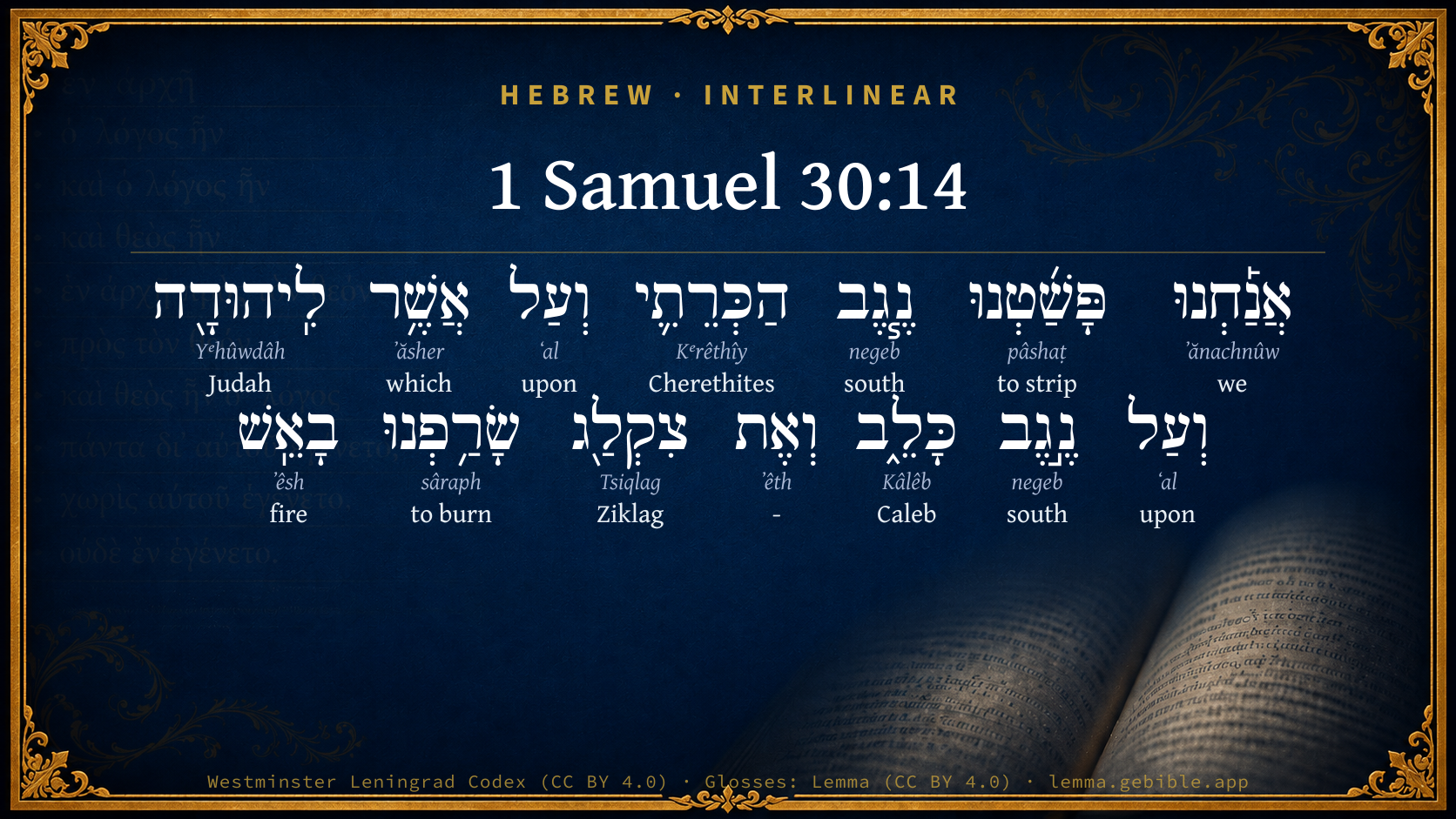
We made a raid on the South of the Cherethites, and on that which belongs to Judah, and on the South of Caleb; and we burned Ziklag with fire.
World English Bible · Public Domain
Highlights
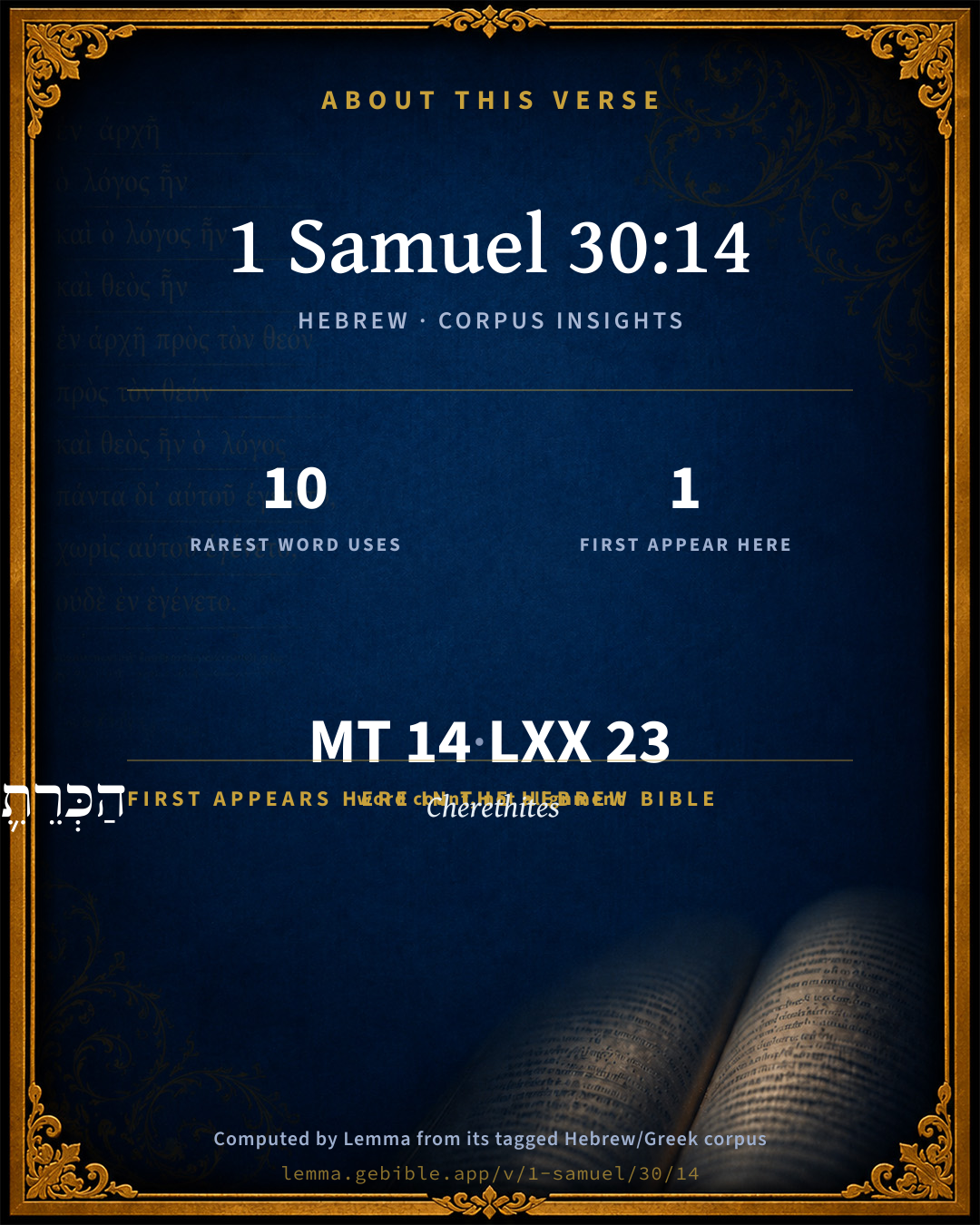
  • 1 first appearance in the Hebrew Bible
Full analysis ↓
Download a study sheet

One document with this verse’s original text, its word-by-word gloss line, the meaning frame, cross-references with their text, attributed commentary, and full source and license credits — printable, and it pastes into notes with its structure intact.

This verse Autodidact and up

Study sheet (.html) Plain text (.txt)

A passage Seminary Student

Up to 50 verses in one chapter. A passage sheet keeps up to 6 commentary sources and 12 cross-references per verse, in the order this page ranks them, and says so on the sheet whenever that leaves anything out. Ask for a single verse and you get the Autodidact verse sheet above.

Everything on this page stays free to read, with no account — the sheet is a download of what is already on screen, not access to it.

Want to remove ads? Support Godless Engineer
Compare translations 3

The same verse in 3 English versions, stacked beneath the original-language interlinear above. Click any original word for its lexicon entry.

Each is an independent rendering of the whole verse — the interlinear is not word-aligned to these translations.

Highlighted words mark where these versions differ — a whole-verse word diff, not a word-by-word alignment.

  • World English Bible Public Domain
    We made a raid on the South of the Cherethites, and on that which belongs to Judah, and on the South of Caleb; and we burned Ziklag with fire.
  • King James Version Public Domain
    We made an invasion upon the south of the Cherethites, and upon the coast which belongeth to Judah, and upon the south of Caleb; and we burned Ziklag with fire.
  • unfoldingWord Literal Text CC BY-SA 4.0
    We raided the Negev of the Kerethite and against what to Judah and against the Negev of Caleb. And Ziklag, we burned with fire.”

unfoldingWord Literal Text — © unfoldingWord, licensed CC BY-SA 4.0. Word-aligned USFM3 via Door43 (git.door43.org/unfoldingWord/en_ult).

Versions to compare (up to 4)

3 of 4 selected

Show all 18 translations

Every available English version of this verse, each an independent rendering of the whole verse.

  • World English Bible Public Domain
    We made a raid on the South of the Cherethites, and on that which belongs to Judah, and on the South of Caleb; and we burned Ziklag with fire.
  • Berean Standard Bible Public Domain
    We raided the Negev of the Cherethites, the territory of Judah, and the Negev of Caleb, and we burned down Ziklag.”
  • Majority Standard Bible Public Domain
    We raided the Negev of the Cherethites, the territory of Judah, and the Negev of Caleb, and we burned down Ziklag.”
  • King James Version Public Domain
    We made an invasion upon the south of the Cherethites, and upon the coast which belongeth to Judah, and upon the south of Caleb; and we burned Ziklag with fire.
  • American Standard Version (1901) Public Domain
    We made a raid upon the South of the Cherethites, and upon that which belongeth to Judah, and upon the South of Caleb; and we burned Ziklag with fire.
  • Revised Version (1885) Public Domain
    We made a raid upon the South of the Cherethites, and upon that which belongeth to Judah, and upon the South of Caleb; and we burned Ziklag with fire.
  • Geneva Bible (1599) Public Domain
    We roued vpon the South of Chereth, and vpon the coast belonging to Iudah, and vpon the South of Caleb, and we burnt Ziklag with fire.
  • Douay-Rheims (1899) Public Domain
    For we made an invasion on the south side of Cerethi, and upon Juda, and upon the south of Caleb, and we burnt Siceleg with fire.
  • Young's Literal Translation Public Domain
    we pushed `to' the south of the Cherethite, and against that which `is' to Judah, and against the south of Caleb, and Ziklag we burned with fire.'
  • Literal Standard Version CC BY-SA 4.0
    we pushed [to] the south of the Cherethite, and against that which [is] to Judah, and against the south of Caleb, and we burned Ziklag with fire.”
  • Unlocked Literal Bible CC BY-SA 4.0
    We made a raid on the Negev of the Kerethites, and what belongs to Judah, and the Negev of Caleb, and we burned Ziklag.”
  • unfoldingWord Literal Text CC BY-SA 4.0
    We raided the Negev of the Kerethite and against what to Judah and against the Negev of Caleb. And Ziklag, we burned with fire.”
  • Darby Bible Public Domain
    We made a raid against the south of the Cherethites, and against what [belongs] to Judah, and against the south of Caleb; and we burned Ziklag with fire.
  • World Messianic Bible Public Domain
    We made a raid on the South of the Cherethites, and on that which belongs to Judah, and on the South of Caleb; and we burned Ziklag with fire.”
  • Webster's Bible Public Domain
    We made an invasion upon the south of the Cherethites, and upon the coast which belongeth to Judah, and upon the south of Caleb; and we burned Ziklag with fire.
  • Free Bible Version CC BY-SA 4.0
    We raided the Kerethites in the Negev, as well as the part that belongs to Judah, and the Negev of Caleb. We burned Ziklag too.”
  • Bible in Basic English Public Domain
    We made an attack on the south part of the country of the Cherethites, and on the land which is Judah's, and on the south of Caleb; and we put Ziklag on fire.
  • JPS Tanakh (1917) Public Domain
    We made a raid upon the South of the Cherethites, and upon that which belongeth to Judah, and upon the South of Caleb; and we burned Ziklag with fire.'

Literal Standard Version (2020), Covenant Press — licensed CC BY-SA 4.0. Text via the HelloAO Bible API (eBible.org). Unlocked Literal Bible (unfoldingWord) — licensed CC BY-SA 4.0. Text via the HelloAO Bible API (eBible.org). unfoldingWord Literal Text — © unfoldingWord, licensed CC BY-SA 4.0. Word-aligned USFM3 via Door43 (git.door43.org/unfoldingWord/en_ult). Free Bible Version, Dr. Jonathan Gallagher — licensed CC BY-SA 4.0. Text via the HelloAO Bible API (eBible.org).

Word by word

More ways to search: Search by grammar → Find every occurrence → Compare this word →

Practice this passage: Drill this verse → Learn its vocabulary →

הַכְּרֵתִ֛י
Kᵉrêthîy
H3774
“the · Cherethites”
Particle, Definite Article + Noun, Gentilic, Masculine, Singular, Absolute
Part of Speech
Particle + Noun
Type
Gentilic
Gender
Masculine
Number
Singular
State
Absolute
Full BDB Definition

Origin: probably from H3772 in the sense of executioner

TWOT: None

Cherethites = "executioners" - a group of foreign mercenary soldiers serving as a bodyguard for king David; also executioners - either Cretans or proto-Philistines (in general)
  1. אֲנַ֡חְנוּ ʼănachnûw H587 “we” Pronoun, Personal, 1st Person, Common, Plural
  2. פָּשַׁ֜טְנוּ pâshaṭ H6584 “to strip” Verb, Qal, Perfect, 1st Person, Common, Plural
  3. נֶ֧גֶב negeb H5045 “south of” Noun, Common, Masculine, Singular, Construct
  4. וְעַל ʻal H5921 “and · upon” Conjunction + Preposition
  5. אֲשֶׁ֥ר ʼăsher H834 “which” Particle, Relative
  6. לִֽיהוּדָ֖ה Yᵉhûwdâh H3063 “to/for · Judah” Preposition + Noun, Proper
  7. וְעַל ʻal H5921 “and · upon” Conjunction + Preposition
  8. נֶ֣גֶב negeb H5045 “south of” Noun, Common, Masculine, Singular, Construct
  9. כָּלֵ֑ב Kâlêb H3612 “Caleb” Noun, Proper
  10. וְאֶת ʼêth H853 “and · -” Conjunction + Particle, Direct Object
  11. צִקְלַ֖ג Tsiqlag H6860 “Ziklag” Noun, Proper
  12. שָׂרַ֥פְנוּ sâraph H8313 “to burn” Verb, Qal, Perfect, 1st Person, Common, Plural
  13. בָאֵֽשׁ ʼêsh H784 “in/at the · fire” Preposition, Determined + Noun, Common, Both, Singular, Absolute

About this verse

These counts appear in no published source. They are computed here, from the morphology-tagged text and Lemma’s own curated glosses. What Lemma adds →

14
words
12
distinct lemmas
Historical
section

Notable vocabulary

The rarest word here is הַכְּרֵתִ֛י Cherethites H3774 — appearing just 10 times in the whole Hebrew Bible.

First appearance in Scripture

This word makes its first canonical appearance in the Hebrew Bible here:

  • הַכְּרֵתִ֛י Cherethites H3774

Shared distinctive vocabulary

הַכְּרֵתִ֛י Cherethites H3774 occurs in 10 verses of the Hebrew Bible. Also found in:

Grammatical profile

  • 2 verbs
  • 7 nouns
  • 1 pronoun
  • 2 prepositions
  • 2 particles

Verb forms

  • פָּשַׁ֜טְנוּ Qal · Perfect
  • שָׂרַ֥פְנוּ Qal · Perfect

Repetition

Words recur within this verse — often emphatic in Hebrew:

  • נֶ֧גֶב south H5045 ×2
  • וְעַל upon H5921 ×2

Hebrew & Septuagint length

In English translation the verse runs 29 words from the Hebrew and 29 from the Septuagint (LXX English) — the same length.

A rough comparison of the two English renderings, which tokenize alike — not a word-level alignment.

Word counts can differ between the Hebrew and the Greek without any difference in meaning — e.g. the Hebrew direct-object marker אֵת has no separate Greek word, and Greek often adds the article ὁ.

In the original languages it is 14 Hebrew tokens and 23 Greek tokens — but the two are counted differently (Hebrew bundles its prefixes and suffixes into one token; the Greek is in lemma form), so that isn’t a like-for-like length.

Cross-references

10

Topical passages linked to 1 Samuel 30:14 in the Treasury of Scripture Knowledge — connected by theme and wording, ordered by reader-vote popularity; previews shown in the World English Bible.

  • 2 Samuel 8:18 and Benaiah the son of Jehoiada [was over] the Cherethites and the Pelethites; and David's sons were chief ministers.
  • 1 Kings 1:38 So Zadok the priest, and Nathan the prophet, and Benaiah the son of Jehoiada, and the Cherethites and the Pelethites, went down, and caused Solomon to ride on king David's mule, and brought him to Gihon.
  • 1 Kings 1:44 and the king has sent with him Zadok the priest, and Nathan the prophet, and Benaiah the son of Jehoiada, and the Cherethites and the Pelethites; and they have caused him to ride on the king's mule;
  • Ezekiel 25:16 therefore thus says the Lord Yahweh, Behold, I will stretch out my hand on the Philistines, and I will cut off the Cherethites, and destroy the remnant of the sea coast.
  • Zephaniah 2:5 Woe to the inhabitants of the sea coast, the nation of the Cherethites! The word of Yahweh is against you, Canaan, the land of the Philistines. I will destroy you, that there will be no inhabitant.
  • Joshua 14:13 Joshua blessed him; and he gave Hebron to Caleb the son of Jephunneh for an inheritance.
  • Joshua 15:13 To Caleb the son of Jephunneh he gave a portion among the children of Judah, according to the commandment of Yahweh to Joshua, even Kiriath Arba, [which Arba was] the father of Anak (the same is Hebron).
  • 1 Samuel 30:1 It happened, when David and his men were come to Ziklag on the third day, that the Amalekites had made a raid on the South, and on Ziklag, and had struck Ziklag, and burned it with fire,
  • 1 Samuel 30:16 When he had brought him down, behold, they were spread abroad over all the ground, eating and drinking, and dancing, because of all the great spoil that they had taken out of the land of the Philistines, and out of the land of Judah.
  • 1 Chronicles 18:17 and Benaiah the son of Jehoiada was over the Cherethites and the Pelethites; and the sons of David were chief about the king.

Cross-references courtesy of OpenBible.info (CC BY 4.0).

Hebrew and Greek witnesses Masoretic Hebrew ↔ Greek Septuagint

The same verse in the two great witnesses to the Old Testament, shown verse-for-verse.

These are two independent witnesses, not word-aligned to each other, and the Septuagint is shown in lemma (dictionary) form.

Hebrew 1 Samuel 30:14 Masoretic · Westminster Leningrad Codex

אֲנַ֡חְנוּ פָּשַׁ֜טְנוּ נֶ֧גֶב הַכְּרֵתִ֛י וְעַל אֲשֶׁ֥ר לִֽיהוּדָ֖ה וְעַל נֶ֣גֶב כָּלֵ֑ב וְאֶת צִקְלַ֖ג שָׂרַ֥פְנוּ בָאֵֽשׁ

We made a raid on the South of the Cherethites, and on that which belongs to Judah, and on the South of Caleb; and we burned Ziklag with fire.

World English Bible · Public Domain

Greek LXX 1 Samuel 30:14 Septuagint · lemma form

καί ἐγώ ἐπιτίθημι ἐπί νότος ὁ χολθι καί ἐπί ὁ ὁ ἰουδαία μέρος καί ἐπί νότος χελουβ καί ὁ σεκελακ ἐνπυρίζω ἐν πῦρ

And we made an incursion on the south of the Chelethite, and on the parts of Judea, and on the south of Chelub, and we burnt Sekelac with fire.

LXX2012 (modern English Septuagint) · Public Domain

Hebrew: Westminster Leningrad Codex (CC BY 4.0). Greek: Septuagint (public domain); English from LXX2012 (modern English Septuagint) (Public Domain). How the Septuagint differs from the Hebrew →

Targum (Aramaic paraphrase)

1

The Targum is the ancient Jewish Aramaic paraphrase of the Hebrew Scriptures — an interpretive translation, not the Hebrew text itself. Onkelos (literal) and Pseudo-Jonathan (expansive) render the Torah, and Jonathan the Prophets. Coverage is partial: where no permissively-licensed English translation exists for a verse, only the Aramaic is shown. This is verse-level text, not a word-by-word alignment to the Hebrew.

  1. Targum Jonathan Prophets (Joshua–Malachi)
    אֲנַחְנָא אִתְנְגִידְנָא עַל דָרוֹמָא כְּרֵית וְעַל דִי לִיהוּדָה וְעַל דָרוֹם כָּלֵב וְיַת צִקְלַג אוֹקִידְנָא בְּנוּרָא:

    (no public-domain English translation for this verse)

    Targum Jonathan — Aramaic: “Mikraot Gedolot” (public domain). English: “Sefaria Community Translation” (CC0 1.0 (public-domain dedication)); “London "Chaldee Paraphrase," 1871” (public domain). Text via Sefaria.

Commentary

Notes on 1 Samuel 30:14 from classic Christian and Jewish commentators (each source and its license shown beneath its notes). The classic Christian expositions comment on the surrounding passage and are grouped to its opening verse, so a note may address several verses; the Jewish commentaries on the Tanakh (Rashi and others) are per-verse, so they appear only where the commentator wrote on this verse.

Lemma curates 59 commentaries, every one of them public domain or Creative Commons licensed, each selected and text-cleaned for this edition rather than reprinted as found. About our sources →

Trapp's Complete Commentary

John Trapp

1Sa 30:14 We made an invasion [upon] the south of the Cherethites, and upon [the coast] which [belongeth] to Judah, and upon the south of Caleb; and we burned Ziklag with fire.

Ver. 14. Upon the south of the Cherethites,] i.e., Of the Philistines. {1Sa 30:16} See Eze 21:15 Zep 2:5. Some think the Cretians might from these have their name and original.

And upon the south of Caleb,] i.e., Of the Calebites, amongst whom lay David’s possessions which he had with Abigail.

John Trapp, A Commentary or Exposition upon All the Books of the Old and New Testament (1647–1656) — public domain. Text from a community e-Sword module.

Joseph Benson's Commentary

1Sa 30:14. Upon the south of the Cherethites — That is, of the Philistines; for it is explained, 1Sa 30:16, to have been the land of the Philistines. Hence it appears that the Amalekites were enemies to the Philistines. So that David did not act against the interests of his benefactor, Achish, in making incursions upon those people. And upon the south of Caleb — We read nowhere else of this land; but, in all probability, it was that south part of Judah which was given to Caleb, and which his posterity inherited, Jos 14:13.

Joseph Benson's Commentary on the Old and New Testaments (1811–1818) — public domain. Text from a community e-Sword module.

Tyndale Open Study Notes

Tyndale Open Resources

30:14 The land of Caleb was in the wilderness of Judah, south of Hebron (see Josh 14:6-15).

Tyndale Open Study Notes — © Tyndale Open Resources, licensed CC BY-SA 4.0. Text via the HelloAO Bible API.

Jamieson, Fausset & Brown

Robert Jamieson, A. R. Fausset & David Brown

the Cherethites--that is, the Philistines (Eze 25:16; Zep 2:5).

Jamieson, Fausset & Brown — Commentary Critical and Explanatory on the Whole Bible (1871) — public domain (CC PDM 1.0). Text via the HelloAO Bible API.

Adam Clarke's Commentary

Verse 14. Upon the south of the Cherethites] Calmet and others maintain, that the כרתי kerethi, which, without the points, might be read Creti, were not only at this time Philistines, but that they were aborigines of Crete, from which they had their name Cherethites or Cretans, and are those of whom Zephaniah speaks, Zep 2:5: Wo to the inhabitants of the sea-coasts, the nation of the Cherethites. And by Ezekiel, Eze 25:16: Behold, I will stretch out mine hand upon the Philistines, and will cut off the Cherethim. In 2Sa 15:18 we find that the Cherethites formed a part of David's guards.

South of Caleb] Somewhere about Kirjath-arba, or Hebron, and Kirjath-sepher; these being in the possession of Caleb and his descendants.

Adam Clarke's Commentary on the Bible (1810–1826) — public domain. Text from a community e-Sword/MySword module.

Ellicott's Commentary for English Readers

(14) We made an invasion. . . .—The Egyptian, who apparently was a man of education, accurately describes to David the nature and scope of the Amalekite raid, which had closed with so signal a disaster to the inhabitants of his city of Ziklag. Taking advantage of the war between Israel and Philistia, and of the northerly march of the troops of both countries, Amalek made a swift and sudden descent upon the south country. The Cherethites were a Philistine people dwelling in the south, and along the sea-coast. Some have supposed that the name “Crçthites” which represents the Hebrew more accurately—came originally, as the name seems to indicate, from the island of Crete. Capthor, the home of the Philistines (Amo_9:7), not improbably is identical with Crete. The whole question of the history of this singular Philistine people, who were certainly not indigenous to Canaan, but who were settlers in it at a comparatively recent date, and who gave their name “Palestine” to the whole land, is most obscure.

Before the arrival of Israel in Canaan the Philistines held a very strong position on the southern coast, and not long before Samson’s time they had been strengthened by fresh arrivals from Crete and other western regions, and from this date rapidly gained power and influence, and at more than one period disputed the supremacy with the Hebrew race, whom they threatened to supplant altogether.

We hear subsequently of the Cherethites mentioned in the passage under the command of Benaiah, as a portion of King David’s body-guard. This troop or regiment of Philistines was first, no doubt, enrolled during his residence at Ziklag. He retained this body of foreigners, of course continually recruited, about his person all through his reign. Such a body-guard, made up of foreigners, has always been a favourite practice among sovereigns. The Scottish archers and the corps of Swiss Guards, at different periods of the French monarchy, and, on a larger scale, the Varangian guard of the Greek emperors of Constantinople in the tenth century, are good examples of this preference for foreigners in the case of the body-guards of the sovereign.

And upon the coast which belongeth to Judah.—The eastern portion of the Negeb or south country, reaching from the Mediterranean to the Dead Sea.

And upon the south of Caleb.—One district of the Negeb or south country was given to Caleb, the companion of Joshua, as a reward for his faith and his courage. His portion, which was called Caleb after the famous chieftain, included all the country and villages round about Hebron, which became subsequently a city of the priests.

And we burned Ziklag with fire.—This act, which closed the reign of Amalek, was intended as a piece of stern revenge for the late incursion of David into their country, and for the cruelties practised on the captives.

A Bible Commentary for English Readers, edited by Charles John Ellicott (1878–1897) — public domain. Text from a community e-Sword module.

The Cambridge Bible for Schools and Colleges

gen. ed. J. J. S. Perowne

14. the Cherethites] Evidently a tribe of Philistines living on the southern border of Philistia, as the spoil is said in 1Sa_30:16 to have been taken “out of the land of the Philistines.” Cp. 2Sa_8:18 (note); Eze_25:16; Zep_2:5. The name may possibly be connected with Crete,

coast] Border. See on ch. 1Sa_5:6.

the south of Caleb] Joshua’s faithful companion received Hebron for his inheritance (Jos_14:13), and when he ceded the city to the priests for a city of refuge, retained the surrounding land in his own possession (Jos_21:11-12; cp. 1Sa_25:3). Apparently he gave his name to part of the Negeb (1Sa_30:1), which was known as the Negeb of Caleb.

The Cambridge Bible for Schools and Colleges (gen. ed. J. J. S. Perowne; Cambridge University Press, 1878–1918) — public domain. Text from a community e-Sword module.

John Gill's Exposition

We made an invasion upon the south of the Cherethites,.... The Philistines so called, or at least one nation of them, such that dwelt to the south of the land, Sa1 30:16; See Gill on Zep 2:5,

and upon the coast which belongeth to Judah; the south of Judah, where David pretended he had been, and had spoiled, and which was now actually done by the Amalekites, Sa1 27:10,

and upon the south of Caleb; that part of the tribe of Judah which belonged to Caleb the son of Jephunneh, and his posterity, and which was the southern part of it, Jos 15:19,

and we burnt Ziklag with fire; and then departed.

John Gill's Exposition of the Whole Bible (1746–1763) — public domain (CC PDM 1.0). Text via the HelloAO Bible API.

Albert Barnes' Notes on the Bible

The Cherethites - Here used as synonymous with Philistines 1Sa 30:16. In David’s reign the body-guard commanded by Benaiah consisted of Cherethites and Pelethites (Philistines?) and a picked corps of six hundred men of Gath commanded by Ittai the Gittite. It would seem from this that the Cherethites and Philistines were two kindred and associated tribes, like Angles and Saxons, who took possession of the seacoast of Palestine. The Philistines, being the more powerful, gave their name to the country and the nation in general, though that of the Cherethites was not wholly extinguished. Many persons connect the name Cherethite with that of the island of Crete.

Albert Barnes' Notes on the Bible (1834–1885) — public domain. Text from a community e-Sword/MySword module.

Haydock's Catholic Bible Commentary

Cerethi, denotes the Philistines, (R. David. See ver. 16.; Haydock) who came originally from Crete, 2 Kings xv. 18., and Ezechiel xxv. 16. (Calmet) --- They might be natives of some province of the Philistines, (Vatable) belonging to Gaza, (Menochius) or Geth. (Haydock) --- Caleb. Hebron and Cariath-sepher fell to his share. The enemy had a good opportunity to ravage all those places, as most of the soldiers were absent (Calmet) at Jezrahel. (Haydock)

George Leo Haydock (1774–1849), Haydock's Catholic Family Bible and Commentary, 1859 edition — public domain. Excludes Psalms (Douay-Rheims chapter numbering differs from Protestant) and Deuterocanonical books (Catholic canon only).

Matthew Poole's English Annotations

The Cherethites, i.e. the Philistines, as is manifest from 1Sa 30:16, who are so called Zep 2:5.

And upon the coast which belongeth to Judah, and upon the south of Caleb: this is added by way of explication: q.d. that part of the south of Judah which belongs to Caleb’s posterity, Jos 14:13.

Matthew Poole's English Annotations on the Holy Bible (1683–1685) — public domain. Text from a community e-Sword/MySword module.

Whedon's Commentary on the Bible

Daniel D. Whedon

14. The Cherethites — The inhabitants of southern Philistia. Compare Eze_25:16; Zep_2:5. The origin of the name is involved in obscurity, but the most plausible opinion is, that both the Cherethites and the Philistines came from Crete, and that the Cherethites, as distinguished from the Philistines, were the later immigrants who settled in the land after the colonial origin of their neighbours had become generally forgotten or ignored. See note on 2Sa_8:18. Compare Deu_2:23; Amo_9:7; Jer_47:4.

The south of Caleb — The neighbourhood just south of Hebron. Compare Jos_14:14.

Daniel D. Whedon (gen. ed.), Commentary on the Old and New Testaments (1874–1909) — public domain. Text from a community e-Sword module.

The Pulpit Commentary

The Cherethites. The interest in this people arises from David"s bodyguard having been composed of foreigners bearing the name of Cherethim and Pelethim. We here find the Cherethim inhabiting the southern portion of the land of the Philistines, and such was still the case in the days of Zephaniah. (Zep_2:5, and compare Eze_25:16) As David retained Ziklag, (1Sa_27:6) he appears to have chosen the men who were to guard his person from this neighbourhood, having probably been struck by their stature and martial bearing when dwelling among them. Hence it is probable that the Pelethim were also a Philistine race. Whether the Cherethim and the Philistines generally came from Crete to Palestine is a very disputed question, but they were certainly not indigenous, but immigrants into Canaan. Caleb. Upon the settlement of the Israelites in Canaan, Hebron with a large district in the south of Judah was assigned to Caleb the Kenezite, who with his clan had been incorporated into the tribe of Judah. Though the town was afterwards assigned to the priests, the whole country round remained subject to Caleb, (Jos_21:11, Jos_21:12) and continued to bear his name. Evidently the Amalekites, beginning on the east, had swept the whole southern district of Judah before entering the country of the Philistines, where they no doubt burnt Ziklag in revenge for David"s cruel treatment of them.

The Pulpit Commentary (1880–1919), ed. H.D.M. Spence-Jones & Joseph S. Exell — public domain. Text from a community e-Sword module.

John Wesley's Explanatory Notes

Cherethites - That is, the Philistines. Caleb - This is added by way of explication: that part of the south of Judah which belongs to Caleb's posterity.

John Wesley, Explanatory Notes Upon the Whole Bible (1754–1765) — public domain. Text via the GEBible commentary corpus.

Rashi

Rabbi Shlomo Yitzchaki (Rashi)

South of the Kerethite. To the south of the Philistines. We find elsewhere the Philistines being called the כְּרֵתִים nation [in] "the inhabitants of the seacoast the nation of כְּרֵתִים."

Rashi on the Tanakh — English translations: “The Judaica Press complete Tanach with Rashi, translated by A. J. Rosenberg” (CC BY 4.0); “Pentateuch with Rashi's commentary by M. Rosenbaum and A.M. Silbermann, 1929-1934” (public domain); “The Metsudah Tanach series, Lakewood, N.J” (CC BY 4.0); and “The Book of Joshua, Metsudah Publications, 1997” (CC BY 4.0). Text via Sefaria.

Lesson kit

Teaching starters — assembled from the data on this page, not authored interpretation. Every prompt links to the verse data it draws on. Edit before teaching.

1 Samuel, in the Historical, opens this verse with 14 words (12 distinct Hebrew lemmas). Its most distinctive word is Kᵉrêthîy (“Cherethites”). A historical commentator’s framing appears above. Read the whole chapter for the surrounding context.

Discussion questions

  1. How does “Cherethites” (Kᵉrêthîy) shape what this verse is saying?
  2. The word “Cherethites” first appears here in Scripture. What is being introduced at this debut?
  3. 2 Samuel 8:18 shares the word «Cherethites» with this verse. How do the two illuminate each other?
  4. “south” occurs 2× in this one verse. What is the effect of the repetition?
  5. These translations render this verse differently. What is at stake in choosing one wording over another?
  6. The verb «פָּשַׁ֜טְנוּ» is Qal Perfect. How does its form color the action?
  7. Reading how Trapp's Complete Commentary and Joseph Benson's Commentary read this verse, where do the two commentators agree and where do they part?

Things to notice

Reading settings

Reading text

Shown beneath each verse's original-language words.

Old Testament
Old Testament edition

Read the OT as the Masoretic Hebrew (MT) or the Greek Septuagint (LXX).

English shown for the Greek Septuagint (in the Hebrew ↔ Greek comparison).

Comparing translations? Open the Compare panel on any verse page to stack up to four side by side.