Leviticus 6:30

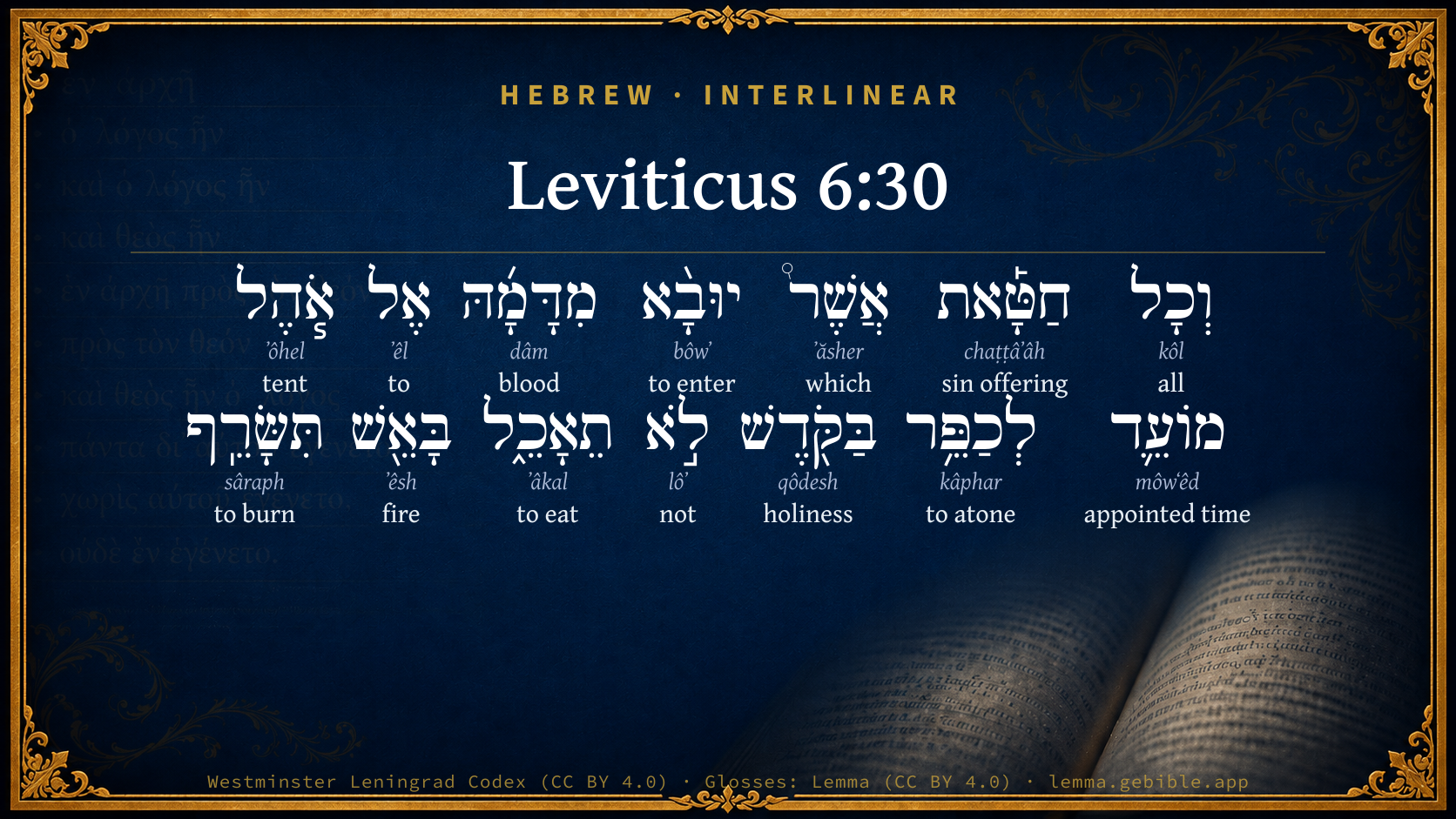
Hebrew (Westminster Leningrad Codex) Leviticus 6:30 appears in the Hebrew Old Testament. The text above is from the Westminster Leningrad Codex. Each word links to its Strong’s number, a concise gloss, and parsing drawn from the Open Scriptures Hebrew Bible morphology. Click any word for its full Brown-Driver-Briggs (BDB) entry.
Download image
Cite this verse

Leviticus 6:30 (World English Bible). Public Domain. Lemma interlinear Bible study tool, https://lemma.gebible.app/v/leviticus/6/30.

Show BibTeX & RIS
BibTeX
RIS
English Translation
No sin offering, of which any of the blood is brought into the Tent of Meeting to make atonement in the Holy Place, shall be eaten: it shall be burned with fire.
World English Bible · Public Domain
Download a study sheet

One document with this verse’s original text, its word-by-word gloss line, the meaning frame, cross-references with their text, attributed commentary, and full source and license credits — printable, and it pastes into notes with its structure intact.

This verse Autodidact and up

Study sheet (.html) Plain text (.txt)

A passage Seminary Student

Up to 50 verses in one chapter. A passage sheet keeps up to 6 commentary sources and 12 cross-references per verse, in the order this page ranks them, and says so on the sheet whenever that leaves anything out. Ask for a single verse and you get the Autodidact verse sheet above.

Everything on this page stays free to read, with no account — the sheet is a download of what is already on screen, not access to it.

Want to remove ads? Support Godless Engineer
Compare translations 3

The same verse in 3 English versions, stacked beneath the original-language interlinear above. Click any original word for its lexicon entry.

Each is an independent rendering of the whole verse — the interlinear is not word-aligned to these translations.

Highlighted words mark where these versions differ — a whole-verse word diff, not a word-by-word alignment.

  • World English Bible Public Domain
    No sin offering, of which any of the blood is brought into the Tent of Meeting to make atonement in the Holy Place, shall be eaten: it shall be burned with fire.
  • King James Version Public Domain
    And no sin offering, whereof any of the blood is brought into the tabernacle of the congregation to reconcile withal in the holy place, shall be eaten: it shall be burnt in the fire.
  • unfoldingWord Literal Text CC BY-SA 4.0
    But every sin offering that some of its blood is brought into the tent of meeting to make atonement in the Holy Place, it shall not be eaten. It shall be burned with fire.

unfoldingWord Literal Text — © unfoldingWord, licensed CC BY-SA 4.0. Word-aligned USFM3 via Door43 (git.door43.org/unfoldingWord/en_ult).

Versions to compare (up to 4)

3 of 4 selected

Show all 16 translations

Every available English version of this verse, each an independent rendering of the whole verse.

  • World English Bible Public Domain
    No sin offering, of which any of the blood is brought into the Tent of Meeting to make atonement in the Holy Place, shall be eaten: it shall be burned with fire.
  • Berean Standard Bible Public Domain
    But no sin offering may be eaten if its blood has been brought into the Tent of Meeting to make atonement in the Holy Place; it must be burned.
  • Majority Standard Bible Public Domain
    But no sin offering may be eaten if its blood has been brought into the Tent of Meeting to make atonement in the Holy Place; it must be burned.
  • King James Version Public Domain
    And no sin offering, whereof any of the blood is brought into the tabernacle of the congregation to reconcile withal in the holy place, shall be eaten: it shall be burnt in the fire.
  • American Standard Version (1901) Public Domain
    And no sin-offering, whereof any of the blood is brought into the tent of meeting to make atonement in the holy place, shall be eaten: it shall be burnt with fire.
  • Revised Version (1885) Public Domain
    And no sin offering, whereof any of the blood is brought into the tent of meeting to make atonement in the holy place, shall be eaten: it shall be burnt with fire.
  • Geneva Bible (1599) Public Domain
    But no sinne offering, whose blood is brought into the Tabernacle of the Congregation to make reconciliation in the holy place, shalbe eaten, but shalbe burnt in the fire.
  • Douay-Rheims (1899) Public Domain
    For the victim that is slain for sin, the blood of which is carried into the tabernacle of the testimony to make atonement in the sanctuary, shall not be eaten, but shall be burnt with fire.
  • Young's Literal Translation Public Domain
    and no sin-offering, `any' of whose blood is brought in unto the tent of meeting to make atonement in the sanctuary is eaten; with fire it is burnt.
  • Literal Standard Version CC BY-SA 4.0
    and no sin-offering, [any] of whose blood is brought into the Tent of Meeting to make atonement in the holy place, is eaten; it is burned with fire.”
  • Unlocked Literal Bible CC BY-SA 4.0
    But any sin offering whose blood is brought into the tent of meeting to make atonement in the holy place must not be eaten. It must be burned.
  • unfoldingWord Literal Text CC BY-SA 4.0
    But every sin offering that some of its blood is brought into the tent of meeting to make atonement in the Holy Place, it shall not be eaten. It shall be burned with fire.
  • Darby Bible Public Domain
    And no sin-offering whereof blood hath been brought to the tent of meeting, to make atonement in the sanctuary, shall be eaten: it shall be burned with fire.
  • World Messianic Bible Public Domain
    No sin offering, of which any of the blood is brought into the Tent of Meeting to make atonement in the Holy Place, shall be eaten. It shall be burned with fire.
  • Free Bible Version CC BY-SA 4.0
    But no sin offering may be eaten if its blood has been taken into the Tent of Meeting as a means to make things right in the Holy Place. In that case it must be burned.”
  • JPS Tanakh (1917) Public Domain
    (6-23) And no sin-offering, whereof any of the blood is brought into the tent of meeting to make atonement in the holy place, shall be eaten; it shall be burnt with fire.

Literal Standard Version (2020), Covenant Press — licensed CC BY-SA 4.0. Text via the HelloAO Bible API (eBible.org). Unlocked Literal Bible (unfoldingWord) — licensed CC BY-SA 4.0. Text via the HelloAO Bible API (eBible.org). unfoldingWord Literal Text — © unfoldingWord, licensed CC BY-SA 4.0. Word-aligned USFM3 via Door43 (git.door43.org/unfoldingWord/en_ult). Free Bible Version, Dr. Jonathan Gallagher — licensed CC BY-SA 4.0. Text via the HelloAO Bible API (eBible.org).

Word by word

More ways to search: Search by grammar → Find every occurrence → Compare this word →

Practice this passage: Drill this verse → Learn its vocabulary →

לְכַפֵּ֥ר
kâphar
H3722
“to atone”
Preposition + Verb, Piel, Infinitive Construct
Part of Speech
Preposition + Verb
Stem
Piel
Form
Infinitive Construct
Full BDB Definition

Origin: a primitive root

TWOT: 1023 , 1024 , 1025 , 1026

to cover, purge, make an atonement, make reconciliation, cover over with pitch - (Qal) to coat or cover with pitch - (Piel) - to cover over, pacify, propitiate - to cover over, atone for sin, make atonement for - to cover over, atone for sin and persons by legal rites - (Pual) - to be covered over - to make atonement for - (Hithpael) to be covered
  1. וְכָל kôl H3605 “and · all of” Conjunction + Noun, Common, Masculine, Singular, Construct
  2. חַטָּ֡את chaṭṭâʼâh H2403 “sin offering” Noun, Common, Feminine, Singular, Absolute
  3. אֲשֶׁר֩ ʼăsher H834 “which” Particle, Relative
  4. יוּבָ֨א bôwʼ H935 “to enter” Verb, Hophal, Imperfect, 3rd Person, Masculine, Singular
  5. מִדָּמָ֜הּ dâm H1818 “from · blood · her” Preposition + Noun, Common, Masculine, Singular, Construct + Suffix, Personal, 3rd Person, Feminine, Singular
  6. אֶל ʼêl H413 “to” Preposition
  7. אֹ֧הֶל ʼôhel H168 “tent of” Noun, Common, Masculine, Singular, Construct
  8. מוֹעֵ֛ד môwʻêd H4150 “appointed time” Noun, Common, Masculine, Singular, Absolute
  9. בַּקֹּ֖דֶשׁ qôdesh H6944 “in/at the · holiness” Preposition, Determined + Noun, Common, Masculine, Singular, Absolute
  10. לֹ֣א lôʼ H3808 “not” Particle, Negative
  11. תֵאָכֵ֑ל ʼâkal H398 “to eat” Verb, Niphal, Imperfect, 3rd Person, Feminine, Singular
  12. בָּאֵ֖שׁ ʼêsh H784 “in/at the · fire” Preposition, Determined + Noun, Common, Both, Singular, Absolute
  13. תִּשָּׂרֵֽף sâraph H8313 “to burn” Verb, Niphal, Imperfect, 3rd Person, Feminine, Singular

About this verse

These counts appear in no published source. They are computed here, from the morphology-tagged text and Lemma’s own curated glosses. What Lemma adds →

14
words
14
distinct lemmas
Pentateuch
section

Grammatical profile

  • 4 verbs
  • 7 nouns
  • 1 preposition
  • 2 particles

Verb forms

  • יוּבָ֨א Hophal · Imperfect
  • לְכַפֵּ֥ר Piel · Infinitive Construct
  • תֵאָכֵ֑ל Niphal · Imperfect
  • תִּשָּׂרֵֽף Niphal · Imperfect

Hebrew & Septuagint length

In English translation the verse runs 32 words from the Hebrew and 34 from the Septuagint (LXX English) — closely comparable.

A rough comparison of the two English renderings, which tokenize alike — not a word-level alignment.

Word counts can differ between the Hebrew and the Greek without any difference in meaning — e.g. the Hebrew direct-object marker אֵת has no separate Greek word, and Greek often adds the article ὁ.

Cross-references

5

Topical passages linked to Leviticus 6:30 in the Treasury of Scripture Knowledge — connected by theme and wording, ordered by reader-vote popularity; previews shown in the World English Bible.

  • Leviticus 4:3–21 if the anointed priest sins so as to bring guilt on the people, then let him offer for his sin, which he has sinned, a young bull without blemish to Yahweh for a sin offering.
  • Leviticus 10:18 Behold, its blood was not brought into the inner part of the sanctuary: you certainly should have eaten it in the sanctuary, as I commanded."
  • Leviticus 16:27–28 The bull for the sin offering, and the goat for the sin offering, whose blood was brought in to make atonement in the Holy Place, shall be carried forth outside the camp; and they shall burn their skins, their flesh, and their dung with fire.
  • Hebrews 13:11 For the bodies of those animals, whose blood is brought into the holy place by the high priest as an offering for sin, are burned outside of the camp.
  • Hebrews 9:11–12 But Christ having come as a high priest of the coming good things, through the greater and more perfect tabernacle, not made with hands, that is to say, not of this creation,

Cross-references courtesy of OpenBible.info (CC BY 4.0).

Hebrew and Greek witnesses Masoretic Hebrew ↔ Greek Septuagint

The same verse in the two great witnesses to the Old Testament, shown verse-for-verse.

These are two independent witnesses, not word-aligned to each other, and the Septuagint is shown in lemma (dictionary) form.

Hebrew Leviticus 6:30 Masoretic · Westminster Leningrad Codex

וְכָל חַטָּ֡את אֲשֶׁר֩ יוּבָ֨א מִדָּמָ֜הּ אֶל אֹ֧הֶל מוֹעֵ֛ד לְכַפֵּ֥ר בַּקֹּ֖דֶשׁ לֹ֣א תֵאָכֵ֑ל בָּאֵ֖שׁ תִּשָּׂרֵֽף

No sin offering, of which any of the blood is brought into the Tent of Meeting to make atonement in the Holy Place, shall be eaten: it shall be burned with fire.

World English Bible · Public Domain

Greek LXX Leviticus 6:30 Septuagint · lemma form
And no offerings for sin, of whose blood there shall be brought any into the tabernacle of witness to make atonement in the holy place, shall be eaten: they shall be burned with fire.

LXX2012 (modern English Septuagint) · Public Domain

Hebrew: Westminster Leningrad Codex (CC BY 4.0). Greek: Septuagint (public domain); English from LXX2012 (modern English Septuagint) (Public Domain). How the Septuagint differs from the Hebrew →

Commentary

Notes on Leviticus 6:30 from classic Christian and Jewish commentators (each source and its license shown beneath its notes). The classic Christian expositions comment on the surrounding passage and are grouped to its opening verse, so a note may address several verses; the Jewish commentaries on the Tanakh (Rashi and others) are per-verse, so they appear only where the commentator wrote on this verse.

Lemma curates 59 commentaries, every one of them public domain or Creative Commons licensed, each selected and text-cleaned for this edition rather than reprinted as found. About our sources →

Trapp's Complete Commentary

John Trapp

Lev 6:30 And no sin offering, whereof [any] of the blood is brought into the tabernacle of the congregation to reconcile [withal] in the holy [place], shall be eaten: it shall be burnt in the fire.

Ver. 30. And no sin offerlng.] Here the ordinary gloss makes this observation, Remissionem dare, Dei solius est, qui per ignem significatur. That to pardon sin belongs to God alone, who is a consuming fire. The Rhemists {a} tell us of a man that could remove mountains: of which they may as soon persuade us, as that their priests have as full power to pardon sins as Christ had. One of their priests meeting with a man troubled in mind, told him that their religion afforded more comfort to the conscience than ours; and that because it had, and exercised a power to pardon sin, which our ministers neither did nor durst assume to themselves. {b}

{a} Rhem. Annot. in Job xx. see. 3.

{b} Ley’s Pattern of Piety, p. 145.

John Trapp, A Commentary or Exposition upon All the Books of the Old and New Testament (1647–1656) — public domain. Text from a community e-Sword module.

Tyndale Open Study Notes

Tyndale Open Resources

6:30 Some sin offerings for the anointed priest and for the entire congregation were not to be eaten. The blood of these offerings was carried into the Holy Place and sprinkled before the curtain (see 4:1-21). The sacrifices that could be eaten were those for the lay leader and for the common people. The blood of these animals was poured on and around the base of the altar in the courtyard of the Tabernacle (see 4:22-35).

Tyndale Open Study Notes — © Tyndale Open Resources, licensed CC BY-SA 4.0. Text via the HelloAO Bible API.

Geneva Bible (1599)

Geneva Bible translators

Out of the camp, Lev. 4:12.

Geneva Bible (1599) marginal notes — public domain. Text via Bolls.life.

Ellicott's Commentary for English Readers

(30) And no sin offering, whereof . . . —Better, but no sin offering, &c. The rule set forth in the preceding verse only applies to the sin offerings of the laity (Lev_4:22, &c.); their flesh fell to the share of the priests, but the flesh of the sin offerings, the blood of which was brought into the tabernacle, “to make atonement in the sanctuary,” was not to be eaten but to be burnt. Such were the sin offerings for the high priest (Lev_4:3; Lev_4:12), and the whole congregation (Lev_4:13-21), and the sin offering of the Day of Atonement (Lev_16:27).

To reconcile withal.—Better, to make atonement for, as the Authorised Version renders it in Lev_1:4, and generally wherever it occurs.

A Bible Commentary for English Readers, edited by Charles John Ellicott (1878–1897) — public domain. Text from a community e-Sword module.

The Cambridge Bible for Schools and Colleges

gen. ed. J. J. S. Perowne

30. The rule here laid down applies to: (1) the first two cases of the Sin-Offering in Lev_4:3-21, where the place and manner of burning are specified in Lev_6:11-12; Lev_6:21; (2) the Sin-Offering on the Day of Atonement (Lev_16:27-28). See note on Lev_10:16-20.

The Cambridge Bible for Schools and Colleges (gen. ed. J. J. S. Perowne; Cambridge University Press, 1878–1918) — public domain. Text from a community e-Sword module.

Albert Barnes' Notes on the Bible

To reconcile withal generally rendered “to make atonement for.”

The holy place - The outer apartment of the tabernacle. See the Lev 10:18 note.

Albert Barnes' Notes on the Bible (1834–1885) — public domain. Text from a community e-Sword/MySword module.

Haydock's Catholic Bible Commentary

Fire. As they are the victims for the sins of the priest and of the people, chap. iv. 6, 18. (Menochius)

George Leo Haydock (1774–1849), Haydock's Catholic Family Bible and Commentary, 1859 edition — public domain. Excludes Psalms (Douay-Rheims chapter numbering differs from Protestant) and Deuterocanonical books (Catholic canon only).

Matthew Poole's English Annotations

Such were the sacrifices offered for the high priest, or for the whole assembly, either severally, Lev 4:7,18, or jointly for both, in the yearly atonement, Lev 16:27,33.

Matthew Poole's English Annotations on the Holy Bible (1683–1685) — public domain. Text from a community e-Sword/MySword module.

Whedon's Commentary on the Bible

Daniel D. Whedon

30. Blood… brought into the tabernacle — This refers to the sin offerings for the high priest and for the whole congregation, Lev_4:5; Lev_4:16, the blood of which was brought into the tabernacle and the bodies burnt without the camp. The complete propitiation symbolized by the sprinkled blood and the flesh eaten by the priest could not be effected under the Levitical dispensation. When the flesh was eaten, the blood-sprinkling within the tabernacle was lacking; and when the blood was thus sacrificially treated, eating the flesh was prohibited. For the imperfection in the Old Testament remission of sins, see Introduction, (7.) Jesus Christ made a complete atonement, having carried his blood into the holy place, “the true tabernacle,” and given his flesh to be the bread of eternal life to all believers. Joh_6:32-58.

Daniel D. Whedon (gen. ed.), Commentary on the Old and New Testaments (1874–1909) — public domain. Text from a community e-Sword module.

Scofield Reference Notes

C. I. Scofield

reconcile

Heb. "kaphar," to cover. (See Scofield "Dan 9:24") See Scofield "Exo 29:33"

The Scofield Reference Bible (1917 edition), notes by C. I. Scofield — public domain. Text from a community e-Sword module.

Lesson kit

Teaching starters — assembled from the data on this page, not authored interpretation. Every prompt links to the verse data it draws on. Edit before teaching.

Leviticus, in the Pentateuch, opens this verse with 14 words (14 distinct Hebrew lemmas). Its most distinctive word is kâphar (“to atone”). A historical commentator’s framing appears above. Read the whole chapter for the surrounding context.

Discussion questions

  1. The word kâphar carries the sense “to atone.” How does it shape the verse?
  2. How does Leviticus 4:3–21, which shares this passage’s theme, read alongside this verse?
  3. These translations render this verse differently. What is at stake in choosing one wording over another?
  4. «יוּבָ֨א» is a Hophal Imperfect verb. How does that grammatical form shape the action described?
  5. Compare how Trapp's Complete Commentary and Tyndale Open Study Notes read this verse. Where do they agree or differ?

Things to notice

Reading settings

Reading text

Shown beneath each verse's original-language words.

Old Testament
Old Testament edition

Read the OT as the Masoretic Hebrew (MT) or the Greek Septuagint (LXX).

English shown for the Greek Septuagint (in the Hebrew ↔ Greek comparison).

Comparing translations? Open the Compare panel on any verse page to stack up to four side by side.