
Psalms 104:4

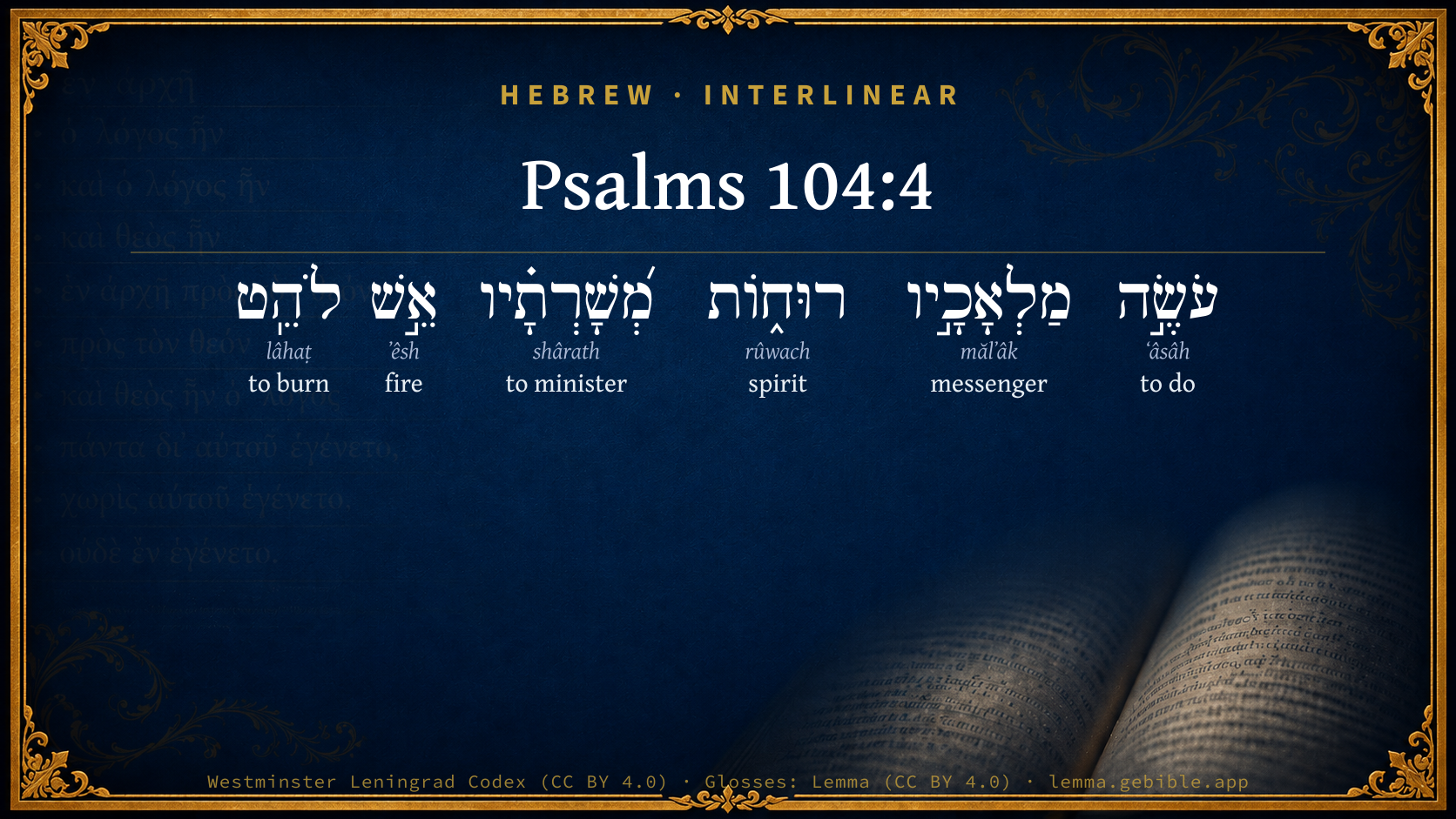
Hebrew (Westminster Leningrad Codex) Psalms 104:4 appears in the Hebrew Old Testament. The text above is from the Westminster Leningrad Codex. Each word links to its Strong’s number, a concise gloss, and parsing drawn from the Open Scriptures Hebrew Bible morphology. Click any word for its full Brown-Driver-Briggs (BDB) entry.
Download image
Cite this verse

Psalms 104:4 (World English Bible). Public Domain. Lemma interlinear Bible study tool, https://lemma.gebible.app/v/psalms/104/4.

Show BibTeX & RIS
BibTeX
RIS
English Translation
He makes his messengers winds; His servants flames of fire.
World English Bible · Public Domain
Download a study sheet

One document with this verse’s original text, its word-by-word gloss line, the meaning frame, cross-references with their text, attributed commentary, and full source and license credits — printable, and it pastes into notes with its structure intact.

This verse Autodidact and up

Study sheet (.html) Plain text (.txt)

A passage Seminary Student

Up to 50 verses in one chapter. A passage sheet keeps up to 6 commentary sources and 12 cross-references per verse, in the order this page ranks them, and says so on the sheet whenever that leaves anything out. Ask for a single verse and you get the Autodidact verse sheet above.

Everything on this page stays free to read, with no account — the sheet is a download of what is already on screen, not access to it.

Want to remove ads? Support Godless Engineer
Compare translations 3

The same verse in 3 English versions, stacked beneath the original-language interlinear above. Click any original word for its lexicon entry.

Each is an independent rendering of the whole verse — the interlinear is not word-aligned to these translations.

Highlighted words mark where these versions differ — a whole-verse word diff, not a word-by-word alignment.

  • World English Bible Public Domain
    He makes his messengers winds; His servants flames of fire.
  • King James Version Public Domain
    Who maketh his angels spirits; his ministers a flaming fire:
  • unfoldingWord Literal Text CC BY-SA 4.0
    making the winds his messengers, flaming fire, his servants.

unfoldingWord Literal Text — © unfoldingWord, licensed CC BY-SA 4.0. Word-aligned USFM3 via Door43 (git.door43.org/unfoldingWord/en_ult).

Versions to compare (up to 4)

3 of 4 selected

Show all 18 translations

Every available English version of this verse, each an independent rendering of the whole verse.

  • World English Bible Public Domain
    He makes his messengers winds; His servants flames of fire.
  • Berean Standard Bible Public Domain
    He makes the winds His messengers, flames of fire His servants.
  • Majority Standard Bible Public Domain
    He makes the winds His messengers, flames of fire His servants.
  • King James Version Public Domain
    Who maketh his angels spirits; his ministers a flaming fire:
  • American Standard Version (1901) Public Domain
    Who maketh winds his messengers; Flames of fire his ministers;
  • Revised Version (1885) Public Domain
    Who maketh winds his messengers; his ministers a flaming fire:
  • Geneva Bible (1599) Public Domain
    Which maketh his spirits his messengers, and a flaming fire his ministers.
  • Douay-Rheims (1899) Public Domain
    Who makest thy angels spirits: and thy ministers a burning fire.
  • Young's Literal Translation Public Domain
    Making His messengers -- the winds, His ministers -- the flaming fire.
  • Literal Standard Version CC BY-SA 4.0
    Making His messengers—the winds, || His ministers—the flaming fire.
  • Unlocked Literal Bible CC BY-SA 4.0
    He makes the winds his messengers, flames of fire his servants.
  • unfoldingWord Literal Text CC BY-SA 4.0
    making the winds his messengers, flaming fire, his servants.
  • Darby Bible Public Domain
    Who maketh his angels spirits; his ministers a flame of fire.
  • World Messianic Bible Public Domain
    He makes his messengers winds, and his servants flames of fire.
  • Webster's Bible Public Domain
    Who maketh his angels spirits; his ministers a flaming fire:
  • Free Bible Version CC BY-SA 4.0
    You make your angels winds, and your servants flames of fire.
  • Bible in Basic English Public Domain
    He makes winds his angels, and flames of fire his servants.
  • JPS Tanakh (1917) Public Domain
    Who makest winds Thy messengers, the flaming fire Thy ministers.

Literal Standard Version (2020), Covenant Press — licensed CC BY-SA 4.0. Text via the HelloAO Bible API (eBible.org). Unlocked Literal Bible (unfoldingWord) — licensed CC BY-SA 4.0. Text via the HelloAO Bible API (eBible.org). unfoldingWord Literal Text — © unfoldingWord, licensed CC BY-SA 4.0. Word-aligned USFM3 via Door43 (git.door43.org/unfoldingWord/en_ult). Free Bible Version, Dr. Jonathan Gallagher — licensed CC BY-SA 4.0. Text via the HelloAO Bible API (eBible.org).

Word by word

More ways to search: Search by grammar → Find every occurrence → Compare this word →

Practice this passage: Drill this verse → Learn its vocabulary →

About this verse

These counts appear in no published source. They are computed here, from the morphology-tagged text and Lemma’s own curated glosses. What Lemma adds →

6
words
6
distinct lemmas
Wisdom
section

Notable vocabulary

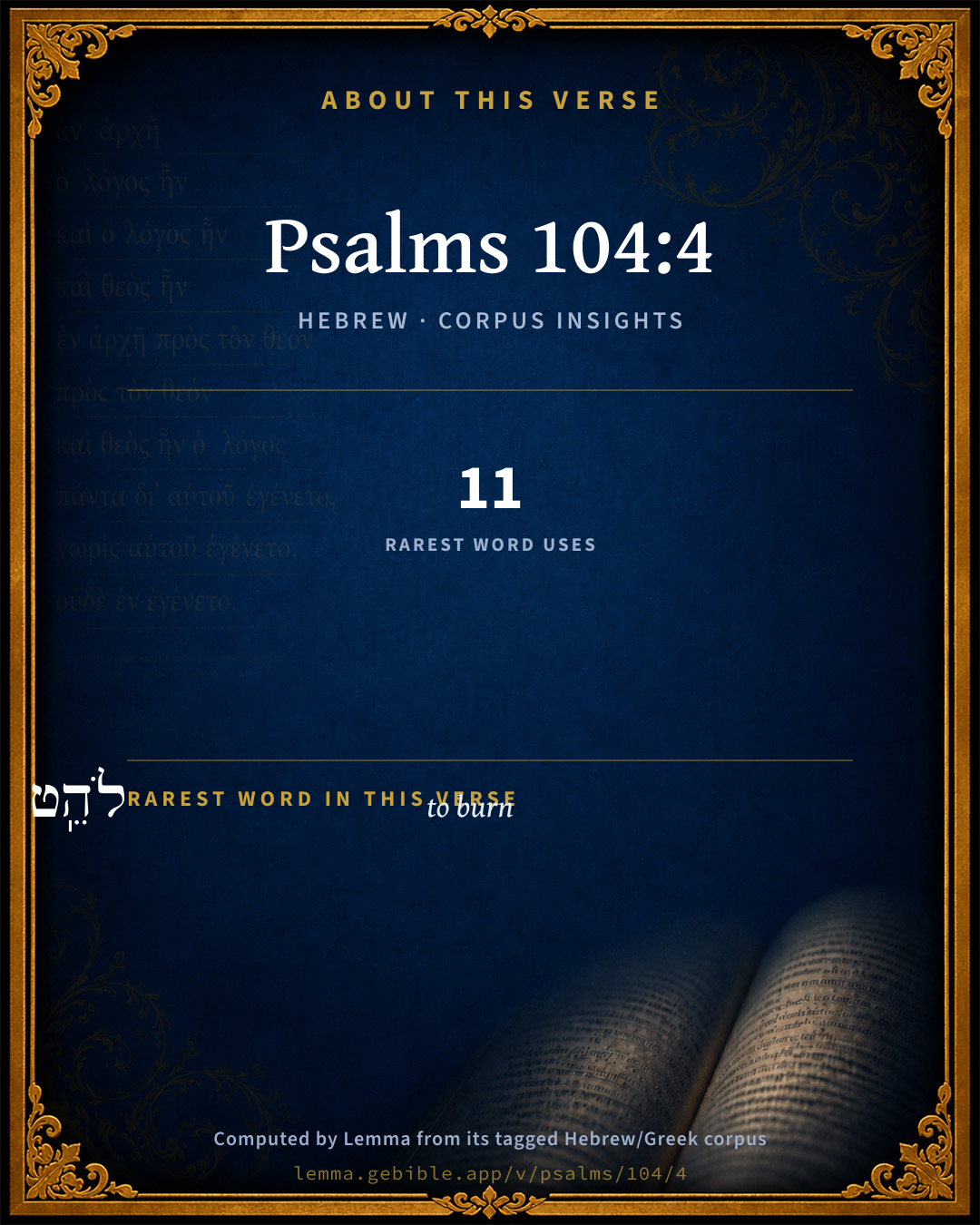
The rarest word here is לֹהֵֽט to burn H3857 — appearing just 11 times in the whole Hebrew Bible.

Shared distinctive vocabulary

לֹהֵֽט to burn H3857 occurs in 11 verses of the Hebrew Bible. Also found in:

Grammatical profile

  • 3 verbs
  • 3 nouns

Verb forms

  • עֹשֶׂ֣ה Qal · Participle Active
  • מְ֝שָׁרְתָ֗יו Piel · Participle Active
  • לֹהֵֽט Qal · Participle Active

Hebrew & Septuagint length

In English translation the verse runs 10 words from the Hebrew and 11 from the Septuagint (LXX English) — closely comparable.

A rough comparison of the two English renderings, which tokenize alike — not a word-level alignment.

Word counts can differ between the Hebrew and the Greek without any difference in meaning — e.g. the Hebrew direct-object marker אֵת has no separate Greek word, and Greek often adds the article ὁ.

Cross-references

7

Topical passages linked to Psalms 104:4 in the Treasury of Scripture Knowledge — connected by theme and wording, ordered by reader-vote popularity; previews shown in the World English Bible.

  • Hebrews 1:7 Of the angels he says, "Who makes his angels winds, And his servants a flame of fire."
  • 2 Kings 2:11 It happened, as they still went on, and talked, that behold, [there appeared] a chariot of fire, and horses of fire, which parted them both apart; and Elijah went up by a whirlwind into heaven.
  • 2 Kings 6:17 Elisha prayed, and said, Yahweh, Please open his eyes, that he may see. Yahweh opened the eyes of the young man; and he saw: and, behold, the mountain was full of horses and chariots of fire round about Elisha.
  • Hebrews 1:14 Aren't they all ministering spirits, sent out to do service for the sake of those who will inherit salvation?
  • Psalms 148:8 Lightning and hail, snow and clouds; Stormy wind, fulfilling his word;
  • Ezekiel 1:13 As for the likeness of the living creatures, their appearance was like burning coals of fire, like the appearance of torches: [the fire] went up and down among the living creatures; and the fire was bright, and out of the fire went forth lightning.
  • Acts 23:8 For the Sadducees say that there is no resurrection, nor angel, nor spirit; but the Pharisees confess all of these.

Cross-references courtesy of OpenBible.info (CC BY 4.0).

Hebrew and Greek witnesses Masoretic Hebrew ↔ Greek Septuagint

The same verse in the two great witnesses to the Old Testament, shown verse-for-verse.

You’re reading Greek Psalm 103 (Hebrew Psalm 104). The Septuagint counts the superscription, so verse numbers can differ from the Hebrew — chapter-level alignment, not verse-by-verse. Numbering follows Rahlfs.

These are two independent witnesses, not word-aligned to each other, and the Septuagint is shown in lemma (dictionary) form.

Hebrew Psalms 104:4 Masoretic · Westminster Leningrad Codex

עֹשֶׂ֣ה מַלְאָכָ֣יו רוּח֑וֹת מְ֝שָׁרְתָ֗יו אֵ֣שׁ לֹהֵֽט

He makes his messengers winds; His servants flames of fire.

World English Bible · Public Domain

Greek LXX Greek Psalm 103:4 Septuagint · lemma form

ὁ ποιέω ὁ ἄγγελος αὐτός πνεῦμα καί ὁ λειτουργός αὐτός πῦρ φλέγω

Who makes his angels spirits, and his ministers a flaming fire.

LXX2012 (modern English Septuagint) · Public Domain

On this verse, J. A. Alexander on Psalms discusses the Septuagint’s reading. Read the note in Commentary ↓

Hebrew: Westminster Leningrad Codex (CC BY 4.0). Greek: Septuagint (public domain); English from LXX2012 (modern English Septuagint) (Public Domain). How the Septuagint differs from the Hebrew →

Commentary

Notes on Psalms 104:4 from classic Christian and Jewish commentators (each source and its license shown beneath its notes). The classic Christian expositions comment on the surrounding passage and are grouped to its opening verse, so a note may address several verses; the Jewish commentaries on the Tanakh (Rashi and others) are per-verse, so they appear only where the commentator wrote on this verse.

Lemma curates 59 commentaries, every one of them public domain or Creative Commons licensed, each selected and text-cleaned for this edition rather than reprinted as found. About our sources →

Trapp's Complete Commentary

John Trapp

Psa 104:4 Who maketh his angels spirits; his ministers a flaming fire:

Ver. 4. Who maketh his angels spirits] Immaterial substances, fit to attend upon the Father of spirits, and with speed to move suddenly and invisibly into most remote parts.

His ministers a flaming fire] Seraphims they are called for their burning zeal, like so many heavenly salamanders; as also for their irresistible power; the angel that destroyed Sennacherib’s army is held to have done it by burning them within, although it appeared not outwardly, as some have been burnt by lightning.

John Trapp, A Commentary or Exposition upon All the Books of the Old and New Testament (1647–1656) — public domain. Text from a community e-Sword module.

Joseph Benson's Commentary

Psa 104:4. Who maketh his angels spirits — That is, of a spiritual or incorporeal nature, that they might be more fit for their employments; or who maketh them winds, as the word רוחות, ruchoth, commonly signifies; that is, who maketh them like the winds, powerful, active, and nimble in executing his pleasure. His ministers a flaming fire — So called for their irresistible force, agility, and fervency in the execution of his commands. But this verse is otherwise rendered by Jewish, and some Christian interpreters, and that very agreeably to the Hebrew text; namely, He maketh the winds his messengers, and flames of fire (that is, the lightning, and thunder, and fiery meteors in the air) his ministers: he maketh use of them no less than of the holy angels; and oftentimes for the same purposes; and they do as certainly and readily obey all his commands as the blessed angels themselves do. This interpretation seems most agreeable to the scope of the Psalm and of the context, wherein he is speaking of the visible works of God; and, perhaps, if properly considered, it will not be found to invalidate the argument of the apostle, (Heb 1:7,) who informs us that the words have a reference to immaterial angels: for, when the psalmist says that God maketh the winds, מלאכיו, malachaiv, his angels, or messengers, he plainly signifies that the angels are God’s ministers, or servants, no less than the winds. And that is sufficient to justify the apostle’s argument, and to prove the pre-eminence of Christ above the angels, which is the apostle’s design in that place: see on Heb 1:7.

Joseph Benson's Commentary on the Old and New Testaments (1811–1818) — public domain. Text from a community e-Sword module.

J. A. Alexander on Psalms

Joseph Addison Alexander

4. (Psa 104:4) Making his angels winds, his ministers flaming fire. According to the simplest and most obvious construction of this verse, it can only mean that God makes his angels or ministering spirits swift and ardent in his service. But such a statement would be wholly out of place in a psalm, the rest of which relates exclusively to the material creation. The best interpreters are therefore of opinion that angels and ministers are predicates, not subjects, or in other words, that the idea meant to be conveyed is, that he makes the winds his messengers or angels, and the flaming fire his minister or servant. This agrees exactly with the previous declaration that he makes the clouds his chariot or conveyance, and moves upon the wings of the wind. It may seem, however, to be inconsistent with the use made of the passage in Heb 1:7, as a proof that , the angels are inferior to the Son of God. But how could this inferiority be proved by the fact that the angels are spirits, or even wind and fire? The latter cannot be literally true, and if metaphorical, can only mean that they are swift and ardent in God's service, which they might be and yet equal to the Son in nature, who, considered as a messenger or agent of the Father, exhibits precisely the same qualities, The truth is, that the passage, as thus understood, is perfectly irrelevant and useless to the argument, and therefore that this mode of explaining it is not entitled to the preference, whatever difficulties may attend the other. Let it be observed, too, that the Septuagint version, which is quoted in Heb 1:7, is an exact transcript of the Hebrew, both as to the sense and collocation of the words, so that if the original admits of a different construction, it may be extended to the version likewise. The most satisfactory conclusion is, that the words are not quoted as an argument or proof of the inferiority of angels, but merely as a striking yet familiar form of words in which to clothe the writer's own idea, which is this, that angels are mere messengers and ministers, and as such may be classed with the material agencies which God employs in execution of his purpose. The wind and the lightning are God's angels and his ministers, and are expressly so described in the Old Testament; but they are never called his sons, much less addressed directly as the sovereign, eternal, righteous, ever-blessed God. Nor are the ministering spirits, who share with these material agencies the character of messengers and servants, ever so described or so addressed. By thus supplying the suppressed links of the chain of argument, the verse before us, in the only sense of which the context really admits, will be found not only as appropriate as the other to the pur-pose for which it is quoted in the New Testament, but incomparably more so.

Joseph Addison Alexander, The Psalms Translated and Explained (1850) — public domain. Text from a community e-Sword module.

Tyndale Open Study Notes

Tyndale Open Resources

104:4 Wind and lightning are seen as divine messengers. The Lord uses weather phenomena as he desires (77:17-18; 78:26; 135:7; 148:5-6). • The psalmist interacts with day three of creation (Gen 1:9-13). The Lord is master of water and earth.

Tyndale Open Study Notes — © Tyndale Open Resources, licensed CC BY-SA 4.0. Text via the HelloAO Bible API.

Geneva Bible (1599)

Geneva Bible translators

As the Prophet here showeth that all visible powers are ready to serve God: so the Apostle to the Hebrews 1:7, beholdeth in this glass how the very Angels also, are obedient to his commandment.

Geneva Bible (1599) marginal notes — public domain. Text via Bolls.life.

Adam Clarke's Commentary

Verse 4. עשה מלאכיו רחות oseh malachaiv ruchoth,

משרתיו אש להט mesharethaiv esh lohet.

The elements are described as prompt and expedite to perform the Divine commands, like angels or ministers serving in the tabernacle; the Hebrew word משרתיו mesharethaiv being a word most common in the sacred ministrations.

Adam Clarke's Commentary on the Bible (1810–1826) — public domain. Text from a community e-Sword/MySword module.

Ellicott's Commentary for English Readers

(4) Who maketh . . .—Rather,

Who maketh winds His messenger

A flaming fire His ministers.

Or, keeping the order of the Hebrew,

Who maketh His messengers of winds,

And His ministers of flaming fire.

This is plainly the meaning required by the context, which deals with the use made by the Divine King of the various forms and forces of Nature. Just as He makes the clouds serve as a chariot and the sky as a tent, so he employs the winds as messengers and the lightnings as servants.

Taken quite alone, the construction and arrangement of the verse favours the interpretation of the author of the Epistle to the Hebrews (Heb_1:7, Note, New Testament Commentary). This was the traditional Jewish interpretation, and on it were founded various theories of angelic agency.

But not only do the exigencies of the context set aside this interpretation, but Hebrew literature offers enough instances to show that the order in which a poet arranged his words was comparatively immaterial. Indeed, Dean Perowne has adduced two instances (Isa_37:26; Isa_60:18) of precisely similar inversion of the natural order of immediate object and predicate. (See Expositor, December, 1878.) And no difficulty need be made about the change of number in flame of fire and ministers, since even if the former were not synonymous with lightnings, its predicate might be plural. (See Pro_16:14, “The wrath of a king is messengers of death.”)

A Bible Commentary for English Readers, edited by Charles John Ellicott (1878–1897) — public domain. Text from a community e-Sword module.

The Cambridge Bible for Schools and Colleges

gen. ed. J. J. S. Perowne

4. The A.V. follows the LXX, which is quoted in Heb_1:7, with the change of a flaming fire into a flame of fire. The Greek like the Hebrew is ambiguous, for the word for angels may mean simply messengers, and that for spirits may mean simply winds. But it is clear that the spiritual nature of angels is not in question here, and that the right rendering is winds. The construction of the whole verse has however been the subject of much discussion.

(1) If the construction of the A.V. and LXX is retained, and it is the most natural construction of the Heb. words, we may render,

Who maketh his angels winds,

His ministers a flaming fire,

and the meaning will be that as Jehovah reveals Himself in the works of creation, so He arrays the spiritual agents and ministers who surround Him (Psa_103:20-21) with the form of physical phenomena, the wind and the lightning. “Where men at first see only material objects and forms of nature there God is present, fulfilling His will through His servants under the forms of elemental action” (Bp Westcott on Heb_1:7). The Targ., adopting the same construction, paraphrases, “Who makes his messengers swift as winds, his ministers strong as fire,” but this explanation misses the connexion with the preceding verses.

(2) Most commentators however think that the context demands the rendering,

Who maketh winds his messengers,

Flaming fire his ministers.

As the clouds are Jehovah’s chariot, so winds and lightnings are His messengers and servants. The great forces of Nature are His agents, employed by Him to do His bidding. Cp. Psa_148:8. But this rendering is not free from objection on grammatical grounds. The order of the words is decidedly against it.

(3) A third possible rendering is,

Who maketh his messengers of winds,

His ministers of flaming fire.

Jehovah forms His messengers and ministers out of winds and lightnings; He uses these natural agents for the execution of His purposes. This rendering expresses the same sense as (2), though somewhat less directly, and is free from its grammatical difficulty.

The first rendering however deserves more consideration than it has generally received. It is the most natural rendering, and its connexion with the context, if less obvious than that of (2) and (3), is still real. The general purport of these verses is not to shew “how the various natural agents are appropriated to different uses by the Creator,” but how the Creator is revealed in and through the works of Creation. And as Jehovah is represented in Psa_104:20-21 of Psalms 103, which is so closely related to this Ps., as environed by hosts of angels and ministers, it is suitable to shew here how these angels and ministers find expression in physical phenomena.

On the grammatical question see Driver’s Hebrew Tenses, § 195, Obs.

The Cambridge Bible for Schools and Colleges (gen. ed. J. J. S. Perowne; Cambridge University Press, 1878–1918) — public domain. Text from a community e-Sword module.

John Gill's Exposition

Who maketh his angels spirits,.... The angels are spirits, or spiritual substances, yet created ones; and so differ from God, who is a spirit, and from the Holy Spirit of God, who are Creators and not creatures; angels are spirits without bodies, and so differ from the souls or spirits of men, and are immaterial, and so die not; these are made by Christ, by whom all things are made, Col 1:16 and so he must be greater and more excellent than they; for which purpose the passage is quoted in Heb 1:7. Some render it, "who maketh his angels as the winds"; to which they may be compared for their invisibility, they being not to be seen, no more than the wind, unless when they assume an external form; and for their penetration through bodies in a very surprising manner; see Act 12:6, and for their great force and power, being mighty angels, and said to excel in strength, Psa 103:20, and for their swiftness in obeying the divine commands; so the Targum,

"he maketh his messengers, or angels, swift as the wind.''

His ministers a flaming fire; angels are ministers to God, stand before him, behold his face, wait for and listen to his orders, and execute them; they are ministers to Christ, they were so at his incarnation, in his infancy, when in the wilderness and in the garden, at his resurrection and ascension, and will attend him at his second coming; and these are ministers to his people, take the care of them, encamp about them, do many good offices to them in life, and at death carry their souls to Abraham's bosom: these are made a flaming fire, or "as" flaming fire, for their force and power; so the Targum,

"his ministers strong as flaming fire;''

and for their swiftness as before; and because of their burning love to God, Christ, and his people, and their flaming zeal for his cause and interest; hence thought by some to be called "seraphim": and because they are sometimes the executioners of God's wrath; and have sometimes appeared in fiery forms, as in forms of horses of fire and chariots of fire, and will descend with Christ in flaming fire at the last day; see Kg2 2:11. Some invert the words, both reading and sense, thus, "who maketh the winds his angels, or messengers, and flaming fire his ministers"; so Jarchi, Aben Ezra, and Kimchi; we read of stormy wind fulfilling his word, Psa 148:8, he sends out his winds at his pleasure to do his errands; as to dry up the waters of the flood, to drive back the waters of the Red sea, and make dry land, to bring quails from thence, and scatter them about the camp of Israel, and in many other instances. So flaming fire was used as his ministers in burning Sodom and Gomorrah; and multitudes of the murmuring Israelites, and the captains with their fifties; but this sense is contrary to the order of the words, and the design of them, and to the apostle's sense of them, Heb 1:7 which is confirmed by the Targum, Septuagint, and all the Oriental versions.

John Gill's Exposition of the Whole Bible (1746–1763) — public domain (CC PDM 1.0). Text via the HelloAO Bible API.

Albert Barnes' Notes on the Bible

Who maketh his angels spirits - The meaning here literally would be, “Who makes the winds his messengers,” or “his angels;” that is, who employs them to execute his purpose; who sends them out as messengers or angels to do his will.

His ministers a flaming fire - That is, Fire is employed by him - in lightnings - to accomplish his purpose as his ministers or his servants. They are entirely under his command. They are sent by him to do his will; to carry out his designs. This is intended to describe the majesty and the power of God - that he can employ wind and lightning - tempest and storm - to go on errands such as he commands; to fulfill his plans; to do his bidding. For the application of this to the angels, and as employed by the apostle Paul to prove the inferiority of the angels to the Messiah, see the notes at Heb 1:7.

Albert Barnes' Notes on the Bible (1834–1885) — public domain. Text from a community e-Sword/MySword module.

Matthew Poole's English Annotations

Who maketh his angels spirits, i.e. of a spiritual or incorporeal nature, that they might be fitter for their employments. Or, who maketh his angels winds, as this last word most commonly signifies, i.e. who made them like the winds, powerful, and active, and nimble in executing God’s pleasure. Or, who useth and governeth those glorious creatures at his pleasure, even as he commands the senseless winds. A

flaming fire; or, like a flaming fire; the note of similitude being here understood, as it is Gen 49:9; Deu 32:22; Psa 11:1, and oft elsewhere; to which he compares the angels for their irresistible force, and great agility and fervency in the execution of God’s commands. Or the sense is, Who sometimes clotheth his angels with subtile bodies of wind, or air, or of fire, as he sees fit. And the angels may not unfitly be mentioned in this place amongst and in the close of those works of God which were done in the heavens, of which he hath hitherto spoken, Psa 104:2,3 because they were made at the same time when the heavens were made, and for the same uses and purposes, and because they are commonly employed by God in managing the clouds, and winds, and meteors, to accomplish God’s designs by them. But this verse is otherwise rendered, both by Jewish and some Christian interpreters, and that very agreeably to the Hebrew text, He maketh the winds his angels, and the flame or flames of fire (i.e. the lightning and thunder, and other fiery meteors in the air)

his ministers; he maketh use of them no less than of the holy angels, and ofttimes for the same purposes, and they do as certainly and readily obey all his commands as the blessed angels themselves do. This interpretation may seem most agreeable to the scope of the Psalm, and to the context, wherein he is speaking of the evil works of God. The only difficulty is, that this seems to invalidate the allegation and argument of the apostle, who expounds it of the angels, Heb 1:7. But indeed it doth not; for (to say nothing of other solutions given by other men) when the psalmist saith that God maketh or useth the winds as his angels, &c., he plainly signifies that the angels are God’s ministers or servants, no less than the winds; and that is sufficient to justify the apostle’s argument, and to prove the pre-eminency of Christ above the angels; which is the apostle’s design in that place.

Matthew Poole's English Annotations on the Holy Bible (1683–1685) — public domain. Text from a community e-Sword/MySword module.

The Treasury of David

Charles H. Spurgeon

Ver. 4. Who maketh his angels spirits; or wields, for the word means either. Angels are pure spirits, though they are permitted to assume a visible form when God desires us to see them. God is a spirit, and he is waited upon by spirits in his royal courts. Angels are like winds for mystery, force, and invisibility, and no doubt the winds themselves are often the angels or messengers of God. God who makes his angels to be as winds, can also make winds to be his angels, and they are constantly so in the economy of nature.

His ministers a flaming fire. Here, too, we may choose which we will of two meanings: God's ministers or servants he makes to be as swift, potent, and terrible as fire, and on the other hand he makes fire, that devouring element, to be his minister flaming forth upon his errands. That the passage refers to angels is clear from Heb 1:7; and it was most proper to mention them here in connection with light and the heavens, and immediately after the robes and paltree of the Great King. Should not the retinue of the Lord of Hosts be mentioned as well as his chariot? It would have been a flaw in the description of the universe had the angels not been alluded to, and this is the most appropriate place for their introduction. When we think of the extraordinary powers entrusted to angelic beings, and the mysterious glory of the seraphim and the four living creatures, we are led to reflect upon the glory of the Master whom they serve, and again we cry out with the psalmist, "O Lord, my God, thou art very great."

Ver. 4. Who maketh his angels spirits. Some render it, Who maketh his angels as the winds, to which they may be compared for their invisibility, they being not to be seen, no more than the wind, unless when they assume an external form; and for their penetration through bodies in a very surprising manner; see Ac 7:6-10; and for their great force and power, being mighty angels, and said to excel in strength, Ps 103:20; and for their swiftness in obeying the divine commands; so the Targum, "He maketh his messengers, or angels, swift as the wind." John Gill.

Ver. 4. Who maketh his angels spirits. The words, "creating his angels spirits, "may either mean "creating them spiritual beings, not material beings, "or "creating them winds" i.e. like the winds, invisible, rapid in their movements, and capable of producing great effects. The last mode of interpretation seems pointed out by the parallelism"and his ministers" or, "servants" who are plainly the same as his angels, "a flame of fire, "i.e., like the lightning. The statement here made about the angels seems to be this: "They are created beings, who in their qualities bear a resemblance to the winds and the lightning."

The argument deduced by Paul, in Heb 2:7, from this statement for the inferiority of the angels is direct and powerful: He is the Son; they are the creatures of God. "Only begotten" is the description of his mode of existence; made is the description of theirs. All their powers are communicated power; and however high they may stand in the scale of creation, it is in that scale they stand, which places them infinitely below him, who is so the Son of God as to be "God over all, blessed for ever." John Brown, in "An Exposition of the Epistle to the Hebrews."

Ver. 4. A flaming fire. Fire is expressive of irresistible power, immaculate holiness, and ardent emotion. It is remarkable that the seraphim, one class at least of these ministers, have their name from a root signifying to burn; and the altar, from which one of them took the live coal, Isa 6:6, is the symbol of the highest form of holy love. James G. Murphy, in "A Commentary on the Book of Psalms, "1875.

Ver. 4.

1. The Nature of Angels Spirits.

2. The Lord of Angels. "Who maketh, "etc. What must Iris own spirituality be who maketh spirits?

3. The ministry of Angels.

(a) Their office: "ministers."

(b) Their activity or zeal: "a flaming fire."

(c) Their dependence: made ministers.

G. Rogers.

Psalms 104:5*

Charles H. Spurgeon's The Treasury of David (1869–1885) — public domain. Psalms only. Text from a community e-Sword/MySword module.

Whedon's Commentary on the Bible

Daniel D. Whedon

4. His angels spirits—Some have reversed the order of the Hebrew words, and translated, “Who maketh the winds his messengers, and the flaming fire his ministers;” but the apostle (Heb_1:7) has decided the meaning, making “angels,” here, not a term of office but an order of celestial beings, so that the authorized English version is to be retained. A comparison is here, undoubtedly, to be understood, though the usual Hebrew particle is omitted by ellipsis. The sense would then be, “He maketh his angels as winds, and his messengers as lightning”—two of the most powerful, subtle, and swift-moving forces known to the Hebrews, as emanating from the “chambers” where the God of nature, while operating upon nature, is supposed to have his seat. Psa_104:3; Psa_104:13. On flaming fire, (lightnings,) see Psa_78:48; Psa_105:32

Daniel D. Whedon (gen. ed.), Commentary on the Old and New Testaments (1874–1909) — public domain. Text from a community e-Sword module.

The Pulpit Commentary

Who maketh his angels spirits. Professor Cheyne renders, "Who maketh his messengers of winds;" and so (in substance) Jarchi, Aben. Ezra, Rosenmuller, Professor Alexander, and even Hengstenberg.

The difficulty in adopting this rendering is that furnished by the application of the passage in Heb_1:7; but the arguments of Hengstenberg go far to meet that difficulty. It is to be noted that our Revisers, while admitting either rendering, have preferred that of Professor Cheyne. And his ministers a flaming fire; or, "his ministers of flame and fire.

Nature forces are Divine ministries.

The precise rendering of this verse is discussed in the Exposition. Now we treat it as a poetical suggestion, which fits into the general plan of the psalm. It is a hymn of admirations of the eternal King. The first part of the psalm sees the glory of the King through the splendour of his court or palace surroundings. The second part of the psalm sees the glory of the King in the provisions, the order, the arrangements, the happiness, of his kingdom. At the court, the psalmist is moved by the sublimity of the "light" as God"s robe, the blue dome of the sky as God"s tent curtain, and the wind-driven clouds as his chariot. And he further notices the grandeur of the royal attendants, the courtiers, who wait to do the royal bidding. All the forces of nature are at the Divine command, and the force that represents them all the force that is most mysterious and sublime is the force of lightning. Illustrate what a marvel of human power and skill it seems to be that man has, in some measure, chained the lightning, and compelled it to yield him light, and to carry his messages. What, then, must he be who has used the lightning force in his service through all the long generations? The figure is a sublime and suggestive one. All the august and awful nature forces are conceived as ministrants in the court of the eternal King. Illustrate by the vision of Isaiah; the six attendant seraphim.

I THE ROYAL MINISTERS DECLARE THE GLORY OF THE GREAT KING. When an impression is to be made on us of the magnificence of Solomon, we are told the number and the dignity of his attendants and courtiers. Their nobility assures us that he must be yet more noble on whom they wait. Then show how grand are the forces of nature physical, chemical; rain, sunshine, wind, fire, electricity, etc.; or take storms, famine, plague. What must he be who is daily served by such ministrants?

II THE ROYAL MINISTERS ILLUSTRATE THE OPERATIONS OF THE KING. They execute his behests, carry out his plans; they execute his thoughts; and so we can read his mind in their doings.

1. The multitude of his ministers suggests that he is continuously working, ceaselessly active. Some of these nature forces are always at work for him.

2. The skill of his ministers suggests that he is ever efficiently working. These nature forces can do what he wills.

3. And the mystery of his ministers reminds us how we are made to feel the surprises of the Divine wisdom. R.T.

The Pulpit Commentary (1880–1919), ed. H.D.M. Spence-Jones & Joseph S. Exell — public domain. Text from a community e-Sword module.

John Wesley's Explanatory Notes

Spirits - Of a spiritual or incorporeal nature, that they might be fitter for their employments. Fire - So called for their irresistible force and agility, and fervency in the execution of God's commands.

John Wesley, Explanatory Notes Upon the Whole Bible (1754–1765) — public domain. Text via the GEBible commentary corpus.

Scofield Reference Notes

C. I. Scofield

angels

(See Scofield "Heb 1:4").

The Scofield Reference Bible (1917 edition), notes by C. I. Scofield — public domain. Text from a community e-Sword module.

unfoldingWord translationNotes

Door43 World Missions Community

He makes the winds his messengers

Possible meanings are 1) he causes the wind to be able to carry a message like a messenger, "He makes the winds to be like his messengers" or 2) "He makes his messengers swift like the wind" (See: Personification and Metaphor)

flames of fire his servants

Possible meanings are 1) "he causes flames of fire to be like his servants." He causes fire to serve him like a servant would or 2) "he makes his servants to be like flames of fire"and (See: Personification and Metaphor)

flames of fire his servants

This can be stated with the implied information from the previous line. AT: "He makes the flames of fire his servants" (See: Ellipsis)

He laid the foundations of the earth

Here the phrase "laid the foundations" means "created." AT: "He created the whole earth" (See: Idiom)

translationWords

messenger

fire

servant

found

earth

unfoldingWord translationNotes — © Distant Shores Media and the Door43 World Missions Community, licensed CC BY-SA 4.0. Source: git.door43.org/Door43/en_tn.

Rashi

Rabbi Shlomo Yitzchaki (Rashi)

He makes winds His messengers lit. He makes His messengers winds. He makes the wind His messengers.

Rashi on the Tanakh — English translations: “The Judaica Press complete Tanach with Rashi, translated by A. J. Rosenberg” (CC BY 4.0); “Pentateuch with Rashi's commentary by M. Rosenbaum and A.M. Silbermann, 1929-1934” (public domain); “The Metsudah Tanach series, Lakewood, N.J” (CC BY 4.0); and “The Book of Joshua, Metsudah Publications, 1997” (CC BY 4.0). Text via Sefaria.

Lesson kit

Teaching starters — assembled from the data on this page, not authored interpretation. Every prompt links to the verse data it draws on. Edit before teaching.

Psalms, in the Wisdom, opens this verse with 6 words (6 distinct Hebrew lemmas). Its most distinctive word is lâhaṭ (“to burn”). A historical commentator’s framing appears above. Read the whole chapter for the surrounding context.

Discussion questions

  1. How does “to burn” (lâhaṭ) shape what this verse is saying?
  2. How does Deuteronomy 32:22, which shares the word «to burn», read alongside this verse?
  3. These translations render this verse differently; the difference is in the English rendering, not the original. What questions does that raise?
  4. «עֹשֶׂ֣ה» is a Qal Participle Active verb. How does that grammatical form shape the action described?
  5. Compare how Trapp's Complete Commentary and Joseph Benson's Commentary read this verse. Where do they agree or differ?

Things to notice

Reading settings

Reading text

Shown beneath each verse's original-language words.

Old Testament
Old Testament edition

Read the OT as the Masoretic Hebrew (MT) or the Greek Septuagint (LXX).

English shown for the Greek Septuagint (in the Hebrew ↔ Greek comparison).

Comparing translations? Open the Compare panel on any verse page to stack up to four side by side.