
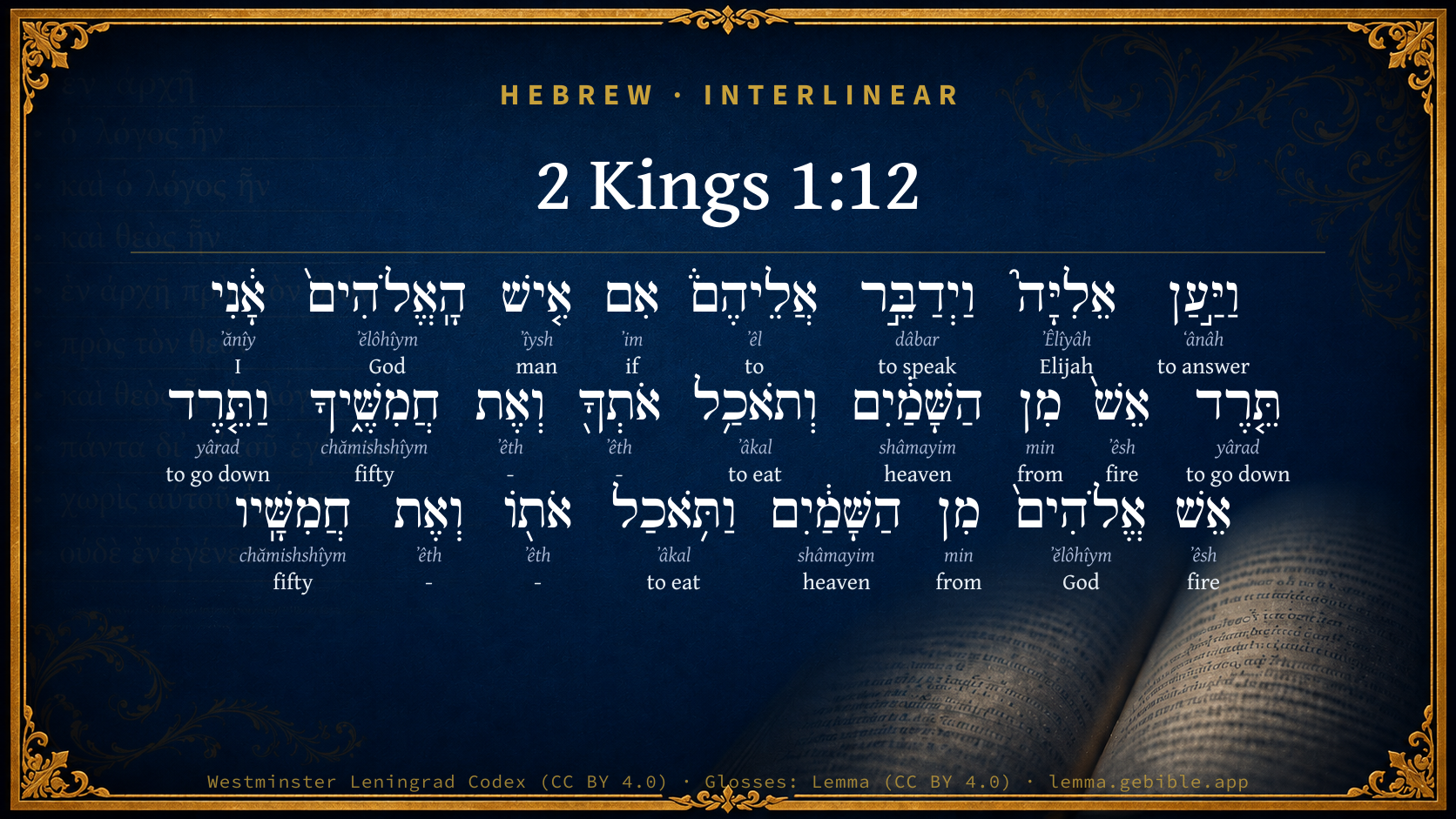
2 Kings 1:12

Hebrew (Westminster Leningrad Codex) 2 Kings 1:12 appears in the Hebrew Old Testament. The text above is from the Westminster Leningrad Codex. Each word links to its Strong’s number, a concise gloss, and parsing drawn from the Open Scriptures Hebrew Bible morphology. Click any word for its full Brown-Driver-Briggs (BDB) entry.
Download image
Cite this verse

2 Kings 1:12 (World English Bible). Public Domain. Lemma interlinear Bible study tool, https://lemma.gebible.app/v/2-kings/1/12.

Show BibTeX & RIS
BibTeX
RIS
English Translation
Elijah answered them, If I be a man of God, let fire come down from the sky, and consume you and your fifty. The fire of God came down from the sky, and consumed him and his fifty.
World English Bible · Public Domain
Download a study sheet

One document with this verse’s original text, its word-by-word gloss line, the meaning frame, cross-references with their text, attributed commentary, and full source and license credits — printable, and it pastes into notes with its structure intact.

This verse Autodidact and up

Study sheet (.html) Plain text (.txt)

A passage Seminary Student

Up to 50 verses in one chapter. A passage sheet keeps up to 6 commentary sources and 12 cross-references per verse, in the order this page ranks them, and says so on the sheet whenever that leaves anything out. Ask for a single verse and you get the Autodidact verse sheet above.

Everything on this page stays free to read, with no account — the sheet is a download of what is already on screen, not access to it.

Want to remove ads? Support Godless Engineer
Compare translations 3

The same verse in 3 English versions, stacked beneath the original-language interlinear above. Click any original word for its lexicon entry.

Each is an independent rendering of the whole verse — the interlinear is not word-aligned to these translations.

Highlighted words mark where these versions differ — a whole-verse word diff, not a word-by-word alignment.

  • World English Bible Public Domain
    Elijah answered them, If I be a man of God, let fire come down from the sky, and consume you and your fifty. The fire of God came down from the sky, and consumed him and his fifty.
  • King James Version Public Domain
    And Elijah answered and said unto them, If I be a man of God, let fire come down from heaven, and consume thee and thy fifty. And the fire of God came down from heaven, and consumed him and his fifty.
  • unfoldingWord Literal Text CC BY-SA 4.0
    And Elijah answered and said to them, “If I a man of God, let fire come down from the heavens, and let it consume you and your fifty.” And fire from God came down from the heavens, and it consumed him and his fifty.

unfoldingWord Literal Text — © unfoldingWord, licensed CC BY-SA 4.0. Word-aligned USFM3 via Door43 (git.door43.org/unfoldingWord/en_ult).

Versions to compare (up to 4)

3 of 4 selected

Show all 18 translations

Every available English version of this verse, each an independent rendering of the whole verse.

  • World English Bible Public Domain
    Elijah answered them, If I be a man of God, let fire come down from the sky, and consume you and your fifty. The fire of God came down from the sky, and consumed him and his fifty.
  • Berean Standard Bible Public Domain
    Again Elijah replied, “If I am a man of God, may fire come down from heaven and consume you and your fifty men.” And the fire of God came down from heaven and consumed the captain and his fifty men.
  • Majority Standard Bible Public Domain
    Again Elijah replied, “If I am a man of God, may fire come down from heaven and consume you and your fifty men.” And the fire of God came down from heaven and consumed the captain and his fifty men.
  • King James Version Public Domain
    And Elijah answered and said unto them, If I be a man of God, let fire come down from heaven, and consume thee and thy fifty. And the fire of God came down from heaven, and consumed him and his fifty.
  • American Standard Version (1901) Public Domain
    And Elijah answered and said unto them, If I be a man of God, let fire come down from heaven, and consume thee and thy fifty. And the fire of God came down from heaven, and consumed him and his fifty.
  • Revised Version (1885) Public Domain
    And Elijah answered and said unto them, If I be a man of God, let fire come down from heaven, and consume thee and thy fifty. And the fire of God came down from heaven, and consumed him and his fifty.
  • Geneva Bible (1599) Public Domain
    But Eliiah answered, and saide vnto them, If I be a man of God, let fire come downe from the heauen, and deuoure thee and thy fiftie. So fire came downe from the heauen, and deuoured him and his fiftie.
  • Douay-Rheims (1899) Public Domain
    Elias answering, said: If I be a man of God, let fire come down from heaven, and consume thee and thy fifty. And fire came down from heaven, and consumed him and his fifty.
  • Young's Literal Translation Public Domain
    And Elijah answereth and speaketh unto them, `If I `am' a man of God, fire doth come down from the heavens, and consume thee and thy fifty;' and fire of God cometh down from the heavens, and consumeth him and his fifty.
  • Literal Standard Version CC BY-SA 4.0
    And Elijah answers and speaks to them, “If I [am] a man of God, fire comes down from the heavens and consumes you and your fifty”; and fire of God comes down from the heavens and consumes him and his fifty.
  • Unlocked Literal Bible CC BY-SA 4.0
    Elijah answered and said to them, “If I am a man of God, let fire come down from heaven and consume you and your fifty men.” Again the fire of God came down from heaven and consumed him and his fifty men.
  • unfoldingWord Literal Text CC BY-SA 4.0
    And Elijah answered and said to them, “If I a man of God, let fire come down from the heavens, and let it consume you and your fifty.” And fire from God came down from the heavens, and it consumed him and his fifty.
  • Darby Bible Public Domain
    And Elijah answered and said to them, If I be a man of God, let fire come down from the heavens and consume thee and thy fifty. And the fire of God came down from the heavens, and consumed him and his fifty.
  • World Messianic Bible Public Domain
    Elijah answered them, “If I am a man of God, then let fire come down from the sky and consume you and your fifty!” Then God’s fire came down from the sky, and consumed him and his fifty.
  • Webster's Bible Public Domain
    And Elijah answered and said to them, If I am a man of God, let fire come down from heaven, and consume thee and thy fifty. And the fire of God came down from heaven, and consumed him and his fifty.
  • Free Bible Version CC BY-SA 4.0
    Elijah replied to the captain, “If I am a man of God, then let fire fall from heaven and burn up you and your fifty men.” Fire fell from heaven and burned up the captain and his men.
  • Bible in Basic English Public Domain
    And Elijah in answer said, If I am a man of God, may fire come down from heaven on you and on your fifty men, and put an end to you. And the fire of God came down from heaven, and put an end to him and his fifty men.
  • JPS Tanakh (1917) Public Domain
    And Elijah answered and said unto them: 'If I be a man of God, let fire come down from heaven, and consume thee and thy fifty.' And the fire of God came down from heaven, and consumed him and his fifty.

Literal Standard Version (2020), Covenant Press — licensed CC BY-SA 4.0. Text via the HelloAO Bible API (eBible.org). Unlocked Literal Bible (unfoldingWord) — licensed CC BY-SA 4.0. Text via the HelloAO Bible API (eBible.org). unfoldingWord Literal Text — © unfoldingWord, licensed CC BY-SA 4.0. Word-aligned USFM3 via Door43 (git.door43.org/unfoldingWord/en_ult). Free Bible Version, Dr. Jonathan Gallagher — licensed CC BY-SA 4.0. Text via the HelloAO Bible API (eBible.org).

Word by word

More ways to search: Search by grammar → Find every occurrence → Compare this word →

Practice this passage: Drill this verse → Learn its vocabulary →

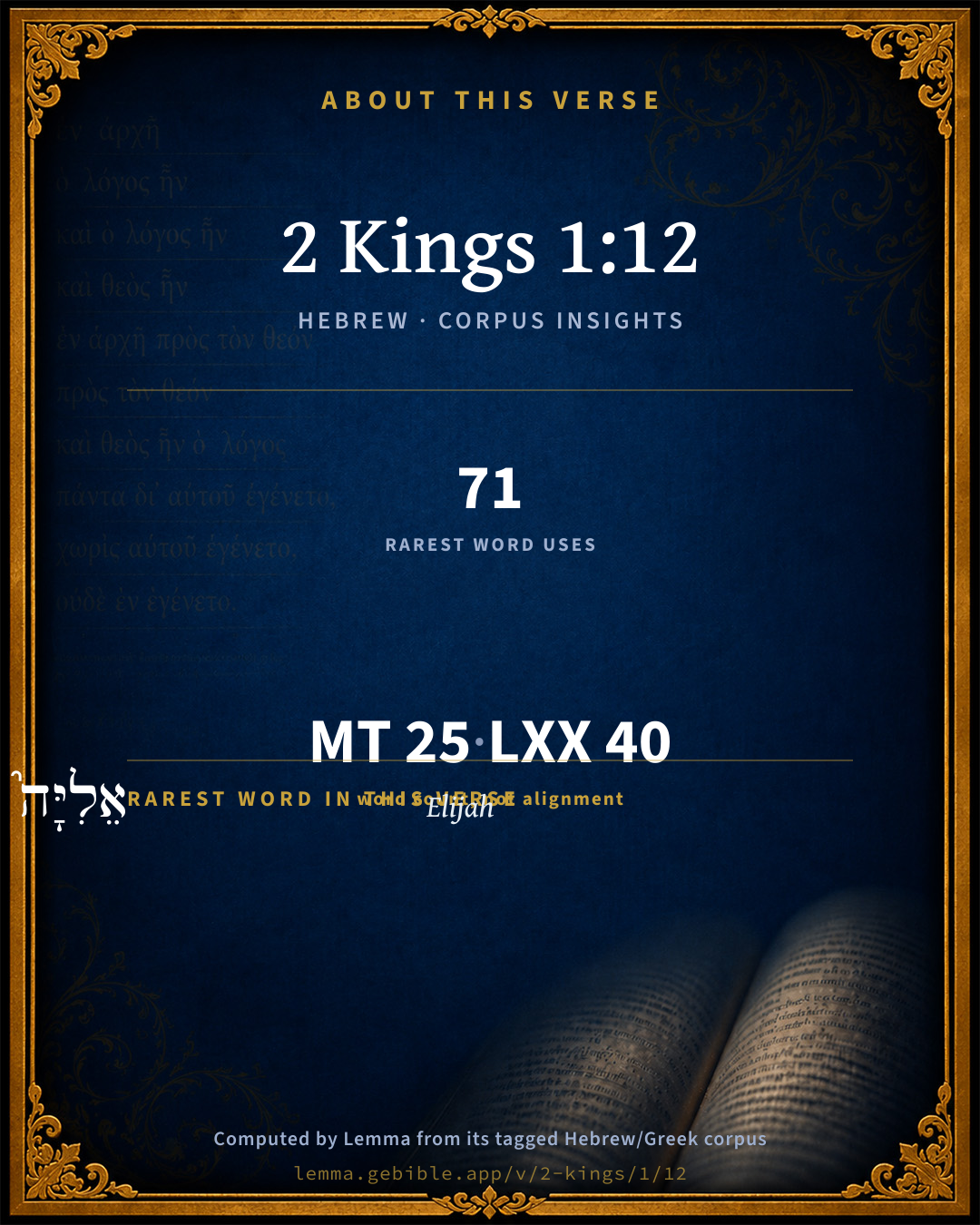
אֵלִיָּה֮
ʼÊlîyâh
H452
“Elijah”
Noun, Proper
Part of Speech
Noun
Type
Proper
Full BDB Definition

Origin: from H410 and H3050

TWOT: None

Elijah or Eliah = "my God is Jehovah" or " Yah(u) is God" - the great prophet of the reign of Ahab - Benjamite son of Jeroham - a son of Elam with foreign wife during exile - a son of Harim, and priest, with foreign wife during exile
  1. וַיַּ֣עַן ʻânâh H6030 “and · to answer” Conjunction + Verb, Qal, Sequential Imperfect, 3rd Person, Masculine, Singular
  2. וַיְדַבֵּ֣ר dâbar H1696 “and · to speak” Conjunction + Verb, Piel, Sequential Imperfect, 3rd Person, Masculine, Singular
  3. אֲלֵיהֶם֒ ʼêl H413 “to · them” Preposition + Suffix, Personal, 3rd Person, Masculine, Plural
  4. אִם ʼim H518 “if” Conjunction
  5. אִ֤ישׁ ʼîysh H376 “man of” Noun, Common, Masculine, Singular, Construct
  6. הָֽאֱלֹהִים֙ ʼĕlôhîym H430 “the · God(s)” Particle, Definite Article + Noun, Common, Masculine, Plural, Absolute
  7. אָ֔נִי ʼănîy H589 “I” Pronoun, Personal, 1st Person, Common, Singular
  8. תֵּ֤רֶד yârad H3381 “to go down” Verb, Qal, Jussive, 3rd Person, Feminine, Singular
  9. אֵשׁ֙ ʼêsh H784 “fire” Noun, Common, Both, Singular, Absolute
  10. מִן min H4480 “from” Preposition
  11. הַשָּׁמַ֔יִם shâmayim H8064 “the · heaven(s)” Particle, Definite Article + Noun, Common, Masculine, Plural, Absolute
  12. וְתֹאכַ֥ל ʼâkal H398 “and · to eat” Conjunction + Verb, Qal, Imperfect, 3rd Person, Feminine, Singular
  13. אֹתְךָ֖ ʼêth H853 “- · you” Particle, Direct Object + Suffix, Personal, 2nd Person, Masculine, Singular
  14. וְאֶת ʼêth H853 “and · -” Conjunction + Particle, Direct Object
  15. חֲמִשֶּׁ֑יךָ chămishshîym H2572 “fifty · your” Adjective, Cardinal number, Both, Plural, Construct + Suffix, Personal, 2nd Person, Masculine, Singular
  16. וַתֵּ֤רֶד yârad H3381 “and · to go down” Conjunction + Verb, Qal, Sequential Imperfect, 3rd Person, Feminine, Singular
  17. אֵשׁ ʼêsh H784 “fire of” Noun, Common, Both, Singular, Construct
  18. אֱלֹהִים֙ ʼĕlôhîym H430 “God(s)” Noun, Common, Masculine, Plural, Absolute
  19. מִן min H4480 “from” Preposition
  20. הַשָּׁמַ֔יִם shâmayim H8064 “the · heaven(s)” Particle, Definite Article + Noun, Common, Masculine, Plural, Absolute
  21. וַתֹּ֥אכַל ʼâkal H398 “and · to eat” Conjunction + Verb, Qal, Sequential Imperfect, 3rd Person, Feminine, Singular
  22. אֹת֖וֹ ʼêth H853 “- · him” Particle, Direct Object + Suffix, Personal, 3rd Person, Masculine, Singular
  23. וְאֶת ʼêth H853 “and · -” Conjunction + Particle, Direct Object
  24. חֲמִשָּֽׁיו chămishshîym H2572 “fifty · his” Adjective, Cardinal number, Both, Plural, Construct + Suffix, Personal, 3rd Person, Masculine, Singular

About this verse

These counts appear in no published source. They are computed here, from the morphology-tagged text and Lemma’s own curated glosses. What Lemma adds →

25
words
15
distinct lemmas
Historical
section

Grammatical profile

  • 6 verbs
  • 8 nouns
  • 2 adjectives
  • 1 pronoun
  • 3 prepositions
  • 1 conjunction
  • 4 particles

Verb forms

  • וַיַּ֣עַן Qal · Sequential Imperfect
  • וַיְדַבֵּ֣ר Piel · Sequential Imperfect
  • תֵּ֤רֶד Qal · Jussive
  • וְתֹאכַ֥ל Qal · Imperfect
  • וַתֵּ֤רֶד Qal · Sequential Imperfect
  • וַתֹּ֥אכַל Qal · Sequential Imperfect

Repetition

Words recur within this verse — often emphatic in Hebrew:

  • הָֽאֱלֹהִים֙ God H430 ×2
  • תֵּ֤רֶד to go down H3381 ×2
  • אֵשׁ֙ fire H784 ×2
  • הַשָּׁמַ֔יִם heaven H8064 ×2
  • וְתֹאכַ֥ל to eat H398 ×2
  • חֲמִשֶּׁ֑יךָ fifty H2572 ×2
  • מִן from H4480 ×2

Hebrew & Septuagint length

In English translation the verse runs 38 words from the Hebrew and 42 from the Septuagint (LXX English) — closely comparable.

A rough comparison of the two English renderings, which tokenize alike — not a word-level alignment.

Word counts can differ between the Hebrew and the Greek without any difference in meaning — e.g. the Hebrew direct-object marker אֵת has no separate Greek word, and Greek often adds the article ὁ.

In the original languages it is 25 Hebrew tokens and 40 Greek tokens — but the two are counted differently (Hebrew bundles its prefixes and suffixes into one token; the Greek is in lemma form), so that isn’t a like-for-like length.

Cross-references

1

Topical passages linked to 2 Kings 1:12 in the Treasury of Scripture Knowledge — connected by theme and wording, ordered by reader-vote popularity; previews shown in the World English Bible.

  • 2 Kings 1:9–10 Then [the king] sent to him a captain of fifty with his fifty. He went up to him: and, behold, he was sitting on the top of the hill. He spoke to him, man of God, the king has said, Come down.

Cross-references courtesy of OpenBible.info (CC BY 4.0).

Hebrew and Greek witnesses Masoretic Hebrew ↔ Greek Septuagint

The same verse in the two great witnesses to the Old Testament, shown verse-for-verse.

These are two independent witnesses, not word-aligned to each other, and the Septuagint is shown in lemma (dictionary) form.

Hebrew 2 Kings 1:12 Masoretic · Westminster Leningrad Codex

וַיַּ֣עַן אֵלִיָּה֮ וַיְדַבֵּ֣ר אֲלֵיהֶם֒ אִם אִ֤ישׁ הָֽאֱלֹהִים֙ אָ֔נִי תֵּ֤רֶד אֵשׁ֙ מִן הַשָּׁמַ֔יִם וְתֹאכַ֥ל אֹתְךָ֖ וְאֶת חֲמִשֶּׁ֑יךָ וַתֵּ֤רֶד אֵשׁ אֱלֹהִים֙ מִן הַשָּׁמַ֔יִם וַתֹּ֥אכַל אֹת֖וֹ וְאֶת חֲמִשָּֽׁיו

Elijah answered them, If I be a man of God, let fire come down from the sky, and consume you and your fifty. The fire of God came down from the sky, and consumed him and his fifty.

World English Bible · Public Domain

Greek LXX 2 Kings 1:12 Septuagint · lemma form

καί ἀποκρίνω ηλιου καί λαλέω πρός αὐτός καί εἶπον εἰ ἄνθρωπος ὁ θεός ἐγώ εἰμί καταβαίνω πῦρ ἐκ ὁ οὐρανός καί καταἐσθίω σύ καί ὁ πεντήκοντα σύ καί καταβαίνω πῦρ ἐκ ὁ οὐρανός καί καταἐσθίω αὐτός καί ὁ πεντήκοντα αὐτός

And Eliu answered and spoke to him, and said, If I am a man of God, fire shall come down out of heaven, and devour you and your fifty. And fire came down out of heaven, and devoured him and his fifty.

LXX2012 (modern English Septuagint) · Public Domain

On this verse, Ellicott's Commentary for English Readers discusses the Septuagint’s reading. Read the note in Commentary ↓

Hebrew: Westminster Leningrad Codex (CC BY 4.0). Greek: Septuagint (public domain); English from LXX2012 (modern English Septuagint) (Public Domain). How the Septuagint differs from the Hebrew →

Targum (Aramaic paraphrase)

1

The Targum is the ancient Jewish Aramaic paraphrase of the Hebrew Scriptures — an interpretive translation, not the Hebrew text itself. Onkelos (literal) and Pseudo-Jonathan (expansive) render the Torah, and Jonathan the Prophets. Coverage is partial: where no permissively-licensed English translation exists for a verse, only the Aramaic is shown. This is verse-level text, not a word-by-word alignment to the Hebrew.

  1. Targum Jonathan Prophets (Joshua–Malachi)
    וַאֲתֵיב אֵלִיָה וּמַלֵיל עִמְהוֹן אִם נְבִיָא דַייָ אֲנָא תֵּיחוֹת אֵשְׁתָּא מִן שְׁמַיָא וְתֵיכוּל יָתָךְ וְיַת חַמְשִׁין דְעִמָךְ וּנְחָתַת אֶשְׁתָּא מִן שְׁמַיָא וַאֲכַלַת יָתֵיהּ וְיַת חַמְשִׁין דְעִמֵיהּ:

    (no public-domain English translation for this verse)

    Targum Jonathan — Aramaic: “Mikraot Gedolot” (public domain). English: “Sefaria Community Translation” (CC0 1.0 (public-domain dedication)); “London "Chaldee Paraphrase," 1871” (public domain). Text via Sefaria.

Commentary

Notes on 2 Kings 1:12 from classic Christian and Jewish commentators (each source and its license shown beneath its notes). The classic Christian expositions comment on the surrounding passage and are grouped to its opening verse, so a note may address several verses; the Jewish commentaries on the Tanakh (Rashi and others) are per-verse, so they appear only where the commentator wrote on this verse.

Lemma curates 59 commentaries, every one of them public domain or Creative Commons licensed, each selected and text-cleaned for this edition rather than reprinted as found. About our sources →

Trapp's Complete Commentary

John Trapp

2Ki 1:12 And Elijah answered and said unto them, If I [be] a man of God, let fire come down from heaven, and consume thee and thy fifty. And the fire of God came down from heaven, and consumed him and his fifty.

Ver. 12. And Elijah answered.] See on 2Ki 1:10.

John Trapp, A Commentary or Exposition upon All the Books of the Old and New Testament (1647–1656) — public domain. Text from a community e-Sword module.

Geneva Bible (1599)

Geneva Bible translators

Meaning, that God would show by effect whether he was a true Prophet or not.

Geneva Bible (1599) marginal notes — public domain. Text via Bolls.life.

Ellicott's Commentary for English Readers

(12) Said (spake) unto them.—LXX. and Syriac, “unto him,” which seems original.

The fire of God.—“The” is not in the Hebrew. The LXX., Vulgate, Arabic, and Targum, with some MSS., omit “of God.” The phrase occurs in the sense of lightning (Job_1:16).

Consumed him and his fifty.—According to Thenius, the story of the destruction of the captains And their companies emphasises (1) the authority properly belonging to the prophet; (2) the help and protection which Jehovah bestows on His prophets. The captains and their men are simply conceived as instruments of a will opposing itself to Jehovah, and are accordingly annihilated. These considerations, he thinks, render irrelevant all questions about the moral justice of their fate, and comparative degrees of guilt. (Comp. 2Ki_2:23, seq., 2Ki_6:17.)

A Bible Commentary for English Readers, edited by Charles John Ellicott (1878–1897) — public domain. Text from a community e-Sword module.

John Gill's Exposition

And Elijah answered and said unto them,.... The same as he had to the first captain, and made the same request of fire from heaven; which accordingly came down, and destroyed this captain and his fifty also.

And Elijah answered and said unto them,.... The same as he had to the first captain, and made the same request of fire from heaven; which accordingly came down, and destroyed this captain and his fifty also.

2 Kings 1:13

kg2 1:13

kg2 1:13

kg2 1:13And he sent again a captain of the third fifty with his fifty,.... Which was most daring and insolent, and showed him to be dreadfully hardened, to persist in his messages after such rebuffs: and the third captain of fifty went up; instead of calling to the prophet at the bottom of the hill as the other did, he went up to the top of it:

and came and fell on his knees before Elijah: in reverence of him as a prophet of the Lord, and under a dread of the power he was possessed of, of calling for fire from heaven on him and his men, as the former instances showed:

and besought him, and said unto him, O man of God, I pray thee, let my life, and the life of these fifty thy servants, be precious in thy sight: he owns their lives lay at his mercy; he begs they might be spared, since it was not in contempt of him, and through ill will to him as the prophet of the Lord, but in obedience to the king's command, that they were come to him.

John Gill's Exposition of the Whole Bible (1746–1763) — public domain (CC PDM 1.0). Text via the HelloAO Bible API.

Whedon's Commentary on the Bible

Daniel D. Whedon

12. The fire of God — These severe judgments were not the fallible Elijah’s work, but the work of Elijah’s God, who to the incorrigibly wicked is ever “a consuming fire.” Heb_12:29.

Daniel D. Whedon (gen. ed.), Commentary on the Old and New Testaments (1874–1909) — public domain. Text from a community e-Sword module.

Lesson kit

Teaching starters — assembled from the data on this page, not authored interpretation. Every prompt links to the verse data it draws on. Edit before teaching.

2 Kings, in the Historical, opens this verse with 25 words (15 distinct Hebrew lemmas). Its most distinctive word is ʼÊlîyâh (“Elijah”). A historical commentator’s framing appears above. Read the whole chapter for the surrounding context.

Discussion questions

  1. How does “Elijah” (ʼÊlîyâh) shape what this verse is saying?
  2. 2 Kings 1:9–10 shares this passage’s theme. How do the two illuminate each other?
  3. “God” occurs 2× in this one verse. What is the effect of the repetition?
  4. These translations render this verse differently; the difference is in the English rendering, not the original. What questions does that raise?
  5. The verb «וַיַּ֣עַן» is Qal Sequential Imperfect. How does its form color the action?
  6. Reading how Trapp's Complete Commentary and Geneva Bible (1599) read this verse, where do the two commentators agree and where do they part?

Things to notice

Reading settings

Reading text

Shown beneath each verse's original-language words.

Old Testament
Old Testament edition

Read the OT as the Masoretic Hebrew (MT) or the Greek Septuagint (LXX).

English shown for the Greek Septuagint (in the Hebrew ↔ Greek comparison).

Comparing translations? Open the Compare panel on any verse page to stack up to four side by side.