
Psalms 18:8

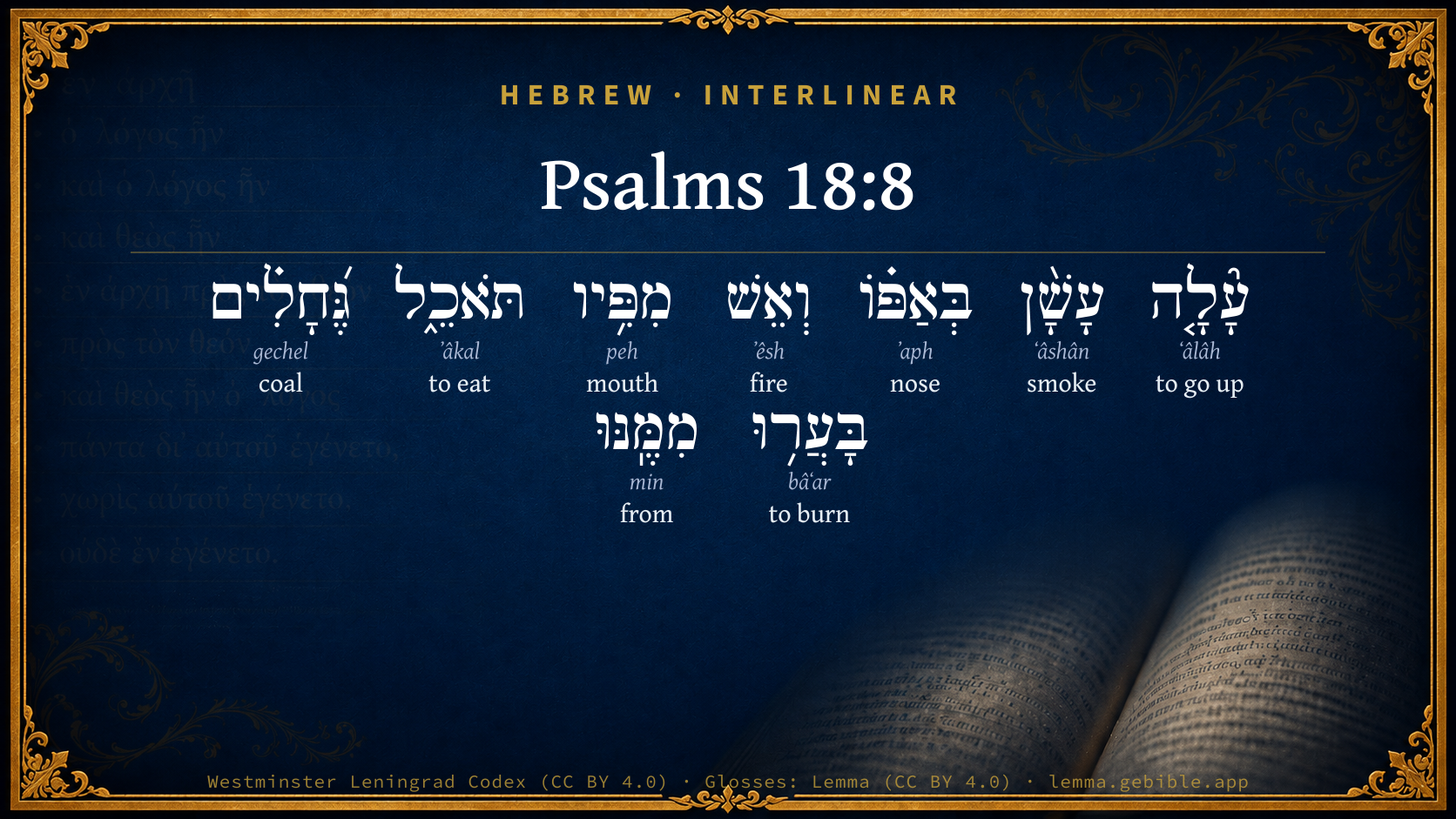
Hebrew (Westminster Leningrad Codex) Psalms 18:8 appears in the Hebrew Old Testament. The text above is from the Westminster Leningrad Codex. Each word links to its Strong’s number, a concise gloss, and parsing drawn from the Open Scriptures Hebrew Bible morphology. Click any word for its full Brown-Driver-Briggs (BDB) entry.
Download image
Cite this verse

Psalms 18:8 (World English Bible). Public Domain. Lemma interlinear Bible study tool, https://lemma.gebible.app/v/psalms/18/8.

Show BibTeX & RIS
BibTeX
RIS
English Translation
Smoke went out of his nostrils. Consuming fire came out of his mouth. Coals were kindled by it.
World English Bible · Public Domain
Download a study sheet

One document with this verse’s original text, its word-by-word gloss line, the meaning frame, cross-references with their text, attributed commentary, and full source and license credits — printable, and it pastes into notes with its structure intact.

This verse Autodidact and up

Study sheet (.html) Plain text (.txt)

A passage Seminary Student

Up to 50 verses in one chapter. A passage sheet keeps up to 6 commentary sources and 12 cross-references per verse, in the order this page ranks them, and says so on the sheet whenever that leaves anything out. Ask for a single verse and you get the Autodidact verse sheet above.

Everything on this page stays free to read, with no account — the sheet is a download of what is already on screen, not access to it.

Want to remove ads? Support Godless Engineer
Compare translations 3

The same verse in 3 English versions, stacked beneath the original-language interlinear above. Click any original word for its lexicon entry.

Each is an independent rendering of the whole verse — the interlinear is not word-aligned to these translations.

Highlighted words mark where these versions differ — a whole-verse word diff, not a word-by-word alignment.

  • World English Bible Public Domain
    Smoke went out of his nostrils. Consuming fire came out of his mouth. Coals were kindled by it.
  • King James Version Public Domain
    There went up a smoke out of his nostrils, and fire out of his mouth devoured: coals were kindled by it.
  • unfoldingWord Literal Text CC BY-SA 4.0
    Smoke went up from his nose, and fire from his mouth devoured. Coals from him burned.

unfoldingWord Literal Text — © unfoldingWord, licensed CC BY-SA 4.0. Word-aligned USFM3 via Door43 (git.door43.org/unfoldingWord/en_ult).

Versions to compare (up to 4)

3 of 4 selected

Show all 18 translations

Every available English version of this verse, each an independent rendering of the whole verse.

  • World English Bible Public Domain
    Smoke went out of his nostrils. Consuming fire came out of his mouth. Coals were kindled by it.
  • Berean Standard Bible Public Domain
    Smoke rose from His nostrils, and consuming fire came from His mouth; glowing coals blazed forth.
  • Majority Standard Bible Public Domain
    Smoke rose from His nostrils, and consuming fire came from His mouth; glowing coals blazed forth.
  • King James Version Public Domain
    There went up a smoke out of his nostrils, and fire out of his mouth devoured: coals were kindled by it.
  • American Standard Version (1901) Public Domain
    There went up a smoke out of his nostrils, And fire out of his mouth devoured: Coals were kindled by it.
  • Revised Version (1885) Public Domain
    There went up a smoke out of his nostrils, and fire out of his mouth devoured: coals were kindled by it.
  • Geneva Bible (1599) Public Domain
    Smoke went out at his nostrels, and a consuming fire out of his mouth: coales were kindled thereat.
  • Douay-Rheims (1899) Public Domain
    The earth shook and trembled: the foundations of the mountains were troubled and were moved, because he was angry with them.
  • Young's Literal Translation Public Domain
    Gone up hath smoke by His nostrils, And fire from His mouth consumeth, Coals have been kindled by it.
  • Literal Standard Version CC BY-SA 4.0
    Smoke has gone up from His nostrils, || And fire from His mouth consumes, || Coals have been kindled by it.
  • Unlocked Literal Bible CC BY-SA 4.0
    Smoke went up from out of his nostrils, and blazing fire came out of his mouth. Coals were ignited by it.
  • unfoldingWord Literal Text CC BY-SA 4.0
    Smoke went up from his nose, and fire from his mouth devoured. Coals from him burned.
  • Darby Bible Public Domain
    There went up a smoke out of his nostrils, and fire out of his mouth devoured: coals burned forth from it.
  • World Messianic Bible Public Domain
    Smoke went out of his nostrils. Consuming fire came out of his mouth. Coals were kindled by it.
  • Webster's Bible Public Domain
    \\18:7\\Then the earth shook and trembled; the foundations also of the hills moved and were shaken, because he was wroth.
  • Free Bible Version CC BY-SA 4.0
    Smoke came out of his nostrils, and fire came from his mouth; burning coals blazed before him.
  • Bible in Basic English Public Domain
    There went up a smoke from his nose, and a fire of destruction from his mouth: flames were lighted by it.
  • JPS Tanakh (1917) Public Domain
    (18-9) Smoke arose up in His nostrils, and fire out of His mouth did devour; coals flamed forth from Him.

Literal Standard Version (2020), Covenant Press — licensed CC BY-SA 4.0. Text via the HelloAO Bible API (eBible.org). Unlocked Literal Bible (unfoldingWord) — licensed CC BY-SA 4.0. Text via the HelloAO Bible API (eBible.org). unfoldingWord Literal Text — © unfoldingWord, licensed CC BY-SA 4.0. Word-aligned USFM3 via Door43 (git.door43.org/unfoldingWord/en_ult). Free Bible Version, Dr. Jonathan Gallagher — licensed CC BY-SA 4.0. Text via the HelloAO Bible API (eBible.org).

Word by word

More ways to search: Search by grammar → Find every occurrence → Compare this word →

Practice this passage: Drill this verse → Learn its vocabulary →

About this verse

These counts appear in no published source. They are computed here, from the morphology-tagged text and Lemma’s own curated glosses. What Lemma adds →

9
words
9
distinct lemmas
Wisdom
section

Notable vocabulary

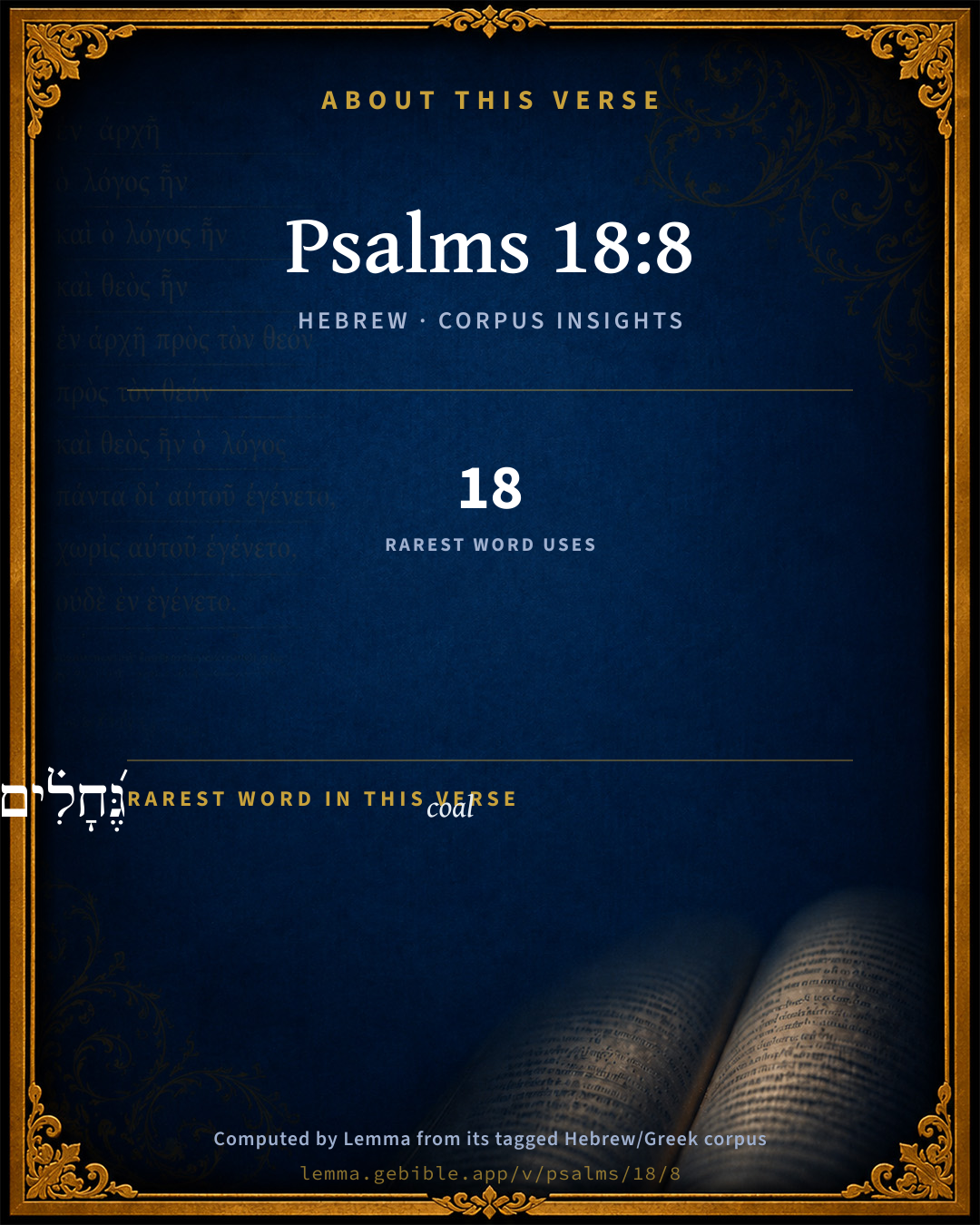
The rarest word here is גֶּ֝חָלִ֗ים coal H1513 — appearing just 18 times in the whole Hebrew Bible.

Shared distinctive vocabulary

גֶּ֝חָלִ֗ים coal H1513 occurs in 18 verses of the Hebrew Bible. Also found in:

Grammatical profile

  • 3 verbs
  • 5 nouns
  • 1 preposition

Verb forms

  • עָ֘לָ֤ה Qal · Perfect
  • תֹּאכֵ֑ל Qal · Imperfect
  • בָּעֲר֥וּ Qal · Perfect

Hebrew & Septuagint length

In English translation the verse runs 18 words from the Hebrew and 22 from the Septuagint (LXX English) — closely comparable.

A rough comparison of the two English renderings, which tokenize alike — not a word-level alignment.

Word counts can differ between the Hebrew and the Greek without any difference in meaning — e.g. the Hebrew direct-object marker אֵת has no separate Greek word, and Greek often adds the article ὁ.

Cross-references

16

Topical passages linked to Psalms 18:8 in the Treasury of Scripture Knowledge — connected by theme and wording, ordered by reader-vote popularity; previews shown in the World English Bible.

  • Psalms 21:9 You will make them as a fiery furnace in the time of your anger. Yahweh will swallow them up in his wrath. The fire shall devour them.
  • Psalms 11:6 On the wicked he will rain blazing coals; Fire, sulfur, and scorching wind shall be the portion of their cup.
  • Nahum 1:5–6 The mountains quake before him, and the hills melt away. The earth trembles at his presence, yes, the world, and all who dwell in it.
  • Genesis 19:28 He looked toward Sodom and Gomorrah, and toward all the land of the plain, and looked, and saw that the smoke of the land went up as the smoke of a furnace.
  • Leviticus 10:2 And fire came forth from before Yahweh, and devoured them, and they died before Yahweh.
  • Numbers 16:35 Fire came forth from Yahweh, and devoured the two hundred fifty men who offered the incense.
  • Psalms 144:5–6 Part your heavens, Yahweh, and come down. Touch the mountains, and they will smoke.
  • Daniel 7:10 A fiery stream issued and came forth from before him: thousands of thousands ministered to him, and ten thousand times ten thousand stood before him: the judgment was set, and the books were opened.
  • Amos 4:11 "I have overthrown some of you, As when God overthrew Sodom and Gomorrah, And you were like a burning stick plucked out of the fire; Yet you haven't returned to me," says Yahweh.
  • Numbers 11:1 The people were as murmurers, [speaking] evil in the ears of Yahweh: and when Yahweh heard it, his anger was kindled; and the fire of Yahweh burnt among them, and devoured in the uttermost part of the camp.
  • Deuteronomy 29:20 Yahweh will not pardon him, but then the anger of Yahweh and his jealousy will smoke against that man, and all the curse that is written in this book shall lie on him, and Yahweh will blot out his name from under the sky.
  • Deuteronomy 29:23–24 [and that] the whole land of it is sulfur, and salt, [and] a burning, [that] it is not sown, nor bears, nor any grass grows therein, like the overthrow of Sodom and Gomorrah, Admah and Zeboiim, which Yahweh overthrew in his anger, and in his wrath:
  • Psalms 50:3 Our God comes, and does not keep silent. A fire devours before him. It is very tempestuous around him.
  • Psalms 74:1 God, why have you rejected us forever? Why does your anger smolder against the sheep of your pasture?
  • Psalms 104:32 He looks at the earth, and it trembles. He touches the mountains, and they smoke.
  • Revelation 11:5 If anyone desires to harm them, fire proceeds out of their mouth and devours their enemies. If anyone desires to harm them, he must be killed in this way.

Cross-references courtesy of OpenBible.info (CC BY 4.0).

Hebrew and Greek witnesses Masoretic Hebrew ↔ Greek Septuagint

The same verse in the two great witnesses to the Old Testament, shown verse-for-verse.

You’re reading Greek Psalm 17 (Hebrew Psalm 18). The Septuagint counts the superscription, so verse numbers can differ from the Hebrew — chapter-level alignment, not verse-by-verse. Numbering follows Rahlfs.

These are two independent witnesses, not word-aligned to each other, and the Septuagint is shown in lemma (dictionary) form.

Hebrew Psalms 18:8 Masoretic · Westminster Leningrad Codex

עָ֘לָ֤ה עָשָׁ֨ן בְּאַפּ֗וֹ וְאֵשׁ מִפִּ֥יו תֹּאכֵ֑ל גֶּ֝חָלִ֗ים בָּעֲר֥וּ מִמֶּֽנּוּ

Smoke went out of his nostrils. Consuming fire came out of his mouth. Coals were kindled by it.

World English Bible · Public Domain

Greek LXX Greek Psalm 17:8 Septuagint · lemma form

καί σαλεύω καί ἔντρομος γίγνομαι ὁ γῆ καί ὁ θεμέλιον ὁ ὄρος ταράσσω καί σαλεύω ὅτι ὀργίζω αὐτός ὁ θεός

There went up a smoke in his wrath, and fire burst into a flame at his presence: coals were kindled at it.

LXX2012 (modern English Septuagint) · Public Domain

On this verse, The Pulpit Commentary discusses the Septuagint’s reading. Read the note in Commentary ↓

Hebrew: Westminster Leningrad Codex (CC BY 4.0). Greek: Septuagint (public domain); English from LXX2012 (modern English Septuagint) (Public Domain). How the Septuagint differs from the Hebrew →

Commentary

Notes on Psalms 18:8 from classic Christian and Jewish commentators (each source and its license shown beneath its notes). The classic Christian expositions comment on the surrounding passage and are grouped to its opening verse, so a note may address several verses; the Jewish commentaries on the Tanakh (Rashi and others) are per-verse, so they appear only where the commentator wrote on this verse.

Lemma curates 59 commentaries, every one of them public domain or Creative Commons licensed, each selected and text-cleaned for this edition rather than reprinted as found. About our sources →

Trapp's Complete Commentary

John Trapp

Psa 18:8 There went up a smoke out of his nostrils, and fire out of his mouth devoured: coals were kindled by it.

Ver. 8. There went up a smoke out of his nostrils] As angry men breathe vehemently, and seem to spit fire by their blustering speeches and menaces, so here ανθρωποπαθως omnia, quae tamen θεοπρεπως sunt intelligenda.

John Trapp, A Commentary or Exposition upon All the Books of the Old and New Testament (1647–1656) — public domain. Text from a community e-Sword module.

The Treasury of David

Charles H. Spurgeon

Ver. 8. There went up a smoke out of his nostrils. A violent oriental method of expressing fierce wrath. Since the breath from the nostrils is heated by strong emotion, the figure portrays the Almighty Deliverer as pouring forth smoke in the heat of his wrath and the impetuousness of his zeal. Nothing makes God so angry as an injury done to his children. He that toucheth you toucheth the apple of mine eye. God is not subject to the passions which govern his creatures, but acting as he does with all the energy and speed of one who is angry, he is here aptly set forth in poetic imagery suitable to human understandings. The opening of his lips is sufficient to destroy his enemies;

and fire out of his mouth devoured. This fire was no temporary one but steady and lasting;

Coals were kindled by it. The whole passage is intended to depict God's descent to the help of his child, attended by earthquake and tempest: at the majesty of his appearing the earth rocks, the clouds gather like smoke, and the lightning as flaming fire devours, setting the world on a blaze. What grandeur of description is here! Bishop Mant very admirably rhymes the verse thus:

"Smoke from his heated nostrils came, And from his mouth devouring flame;

Hot burning coals announced his ire, And flashes of careering fire."

Ver. 8. There went up a smoke out of his nostrils, (wkab Nve hle). Or there ascended into his nose, as the words literally rendered, signify. The ancients placed the seat of anger in the nose, or nostrils; because when it grows warm and violent, it discovers itself, as it were, by a heated vehement breath, that proceeds from them. Samuel Chandler, D.D., F.R. and A.S.S., 1766.

Ver. 8-19. David calls the full force of poetical imagery to aid, to describe in a becoming manner the marvels of his deliverances. He means to say that they were as manifest as the signs of heaven and earth, as sudden and powerful as the phenomena in the kingdom of nature surprise terrified mortals. Deliverance being his theme, he might have taken the figure from the peaceable phenomena of the heavens. But since man heeds heaven more in anger than in blessing, and regards God more when he descends on earth in the storm than in the rainbow, David describes the blessed condescension of God by the figure of a tempest. In order to thoroughly appreciate the beauty and truthfulness of this figure, we should endeavour to realise the full power of an Oriental storm, as it is described in Ps 29:1-11. Solitary lightning precedes the dischargethis is meant by the coals in Ps 18:8: the clouds approach the mountain summitsthe heavens bow, as Ps 18:9 has it; the storm shakes its pinions; enwraped in thick clouds as in a tent, God descends to the earth; hail (not infrequently attending Eastern storms) and lightning issue from the black clouds, through the dissolving layers of which is seen the fiery splendour which hides the Lord of nature. He speaks, and thunder is his voice; he shoots, and flashes of lightning are his arrows. At his rebuke, and at the blast of his breath the earth recedesthe sea foams up, and its beds are seenthe land bursts, and the foundations of the world are discovered. And lo! an arm of deliverance issues forth from the black clouds, and the destructive fire grasps the wretched one who had cried out from the depths, pulls him forth, and delivers him from all his enemies! Yes, the hand of the Lord has done marvellous things in the life of David. But the eye of faith alone could perceive in them all the hand of God. Thousands whose experiences of the delivering hand of God are not less signal than those of David, stop short at the powers of nature, and instead of bending the knee before the All merciful God, content themselves to express with cold hearts their admiration of the changes of the destiny of man. Augustus F. Tholuck, D.D., Ph.D. 1856.

None.

Psalms 18:9*

Ver. 8-19. See Psalms on "Ps 18:9" for further information.

Ver. 8-19.

Ver. 9-11:

"He also bowed the heavens,

And thence he did descend;

And thickest clouds of darkness did

Under his feet attend."

"And he upon a cherub rode,

And thereon he did fly;

Yea, on the swift wings of the wind,

His flight was from on high."

"He darkness made his secret place;

About him for his tent

Dark waters were, and thickest clouds

Of the airy firmament." Scotch Version, 1649.

Ver. 9-12:

"In his descent, bowed heaven with earth did meet,

And gloomy darkness rolled beneath his feet;

A golden winged cherub he bestrid,

And on the swiftly flying tempest rid."

"He darkness made his secret cabinet;

Thick fogs and dropping clouds about him set;

The beams of his bright presence these expel,

Whence showers of burning coals and hailstones fell." George Sandys, 1577-1643.

Ver. 8-19. See Psalms on "Ps 18:9" for further information.

Ver. 9-11:

"He also bowed the heavens,

And thence he did descend;

And thickest clouds of darkness did

Under his feet attend."

"And he upon a cherub rode,

And thereon he did fly;

Yea, on the swift wings of the wind,

His flight was from on high."

"He darkness made his secret place;

About him for his tent

Dark waters were, and thickest clouds

Of the airy firmament." Scotch Version, 1649.

Ver. 9-12:

"In his descent, bowed heaven with earth did meet,

And gloomy darkness rolled beneath his feet;

A golden winged cherub he bestrid,

And on the swiftly flying tempest rid."

"He darkness made his secret cabinet;

Thick fogs and dropping clouds about him set;

The beams of his bright presence these expel,

Whence showers of burning coals and hailstones fell." George Sandys, 1577-1643.

Ver. 8-19. See Psalms on "Ps 18:8" for further information.

Ver. 8-19. See Psalms on "Ps 18:9" for further information.

Ver. 8-19. See Psalms on "Ps 18:8" for further information.

Ver. 8-19. See Psalms on "Ps 18:8" for further information.

Ver. 8-19. See Psalms on "Ps 18:8" for further information.

Ver. 8-19. See Psalms on "Ps 18:8" for further information.

Ver. 8-19. See Psalms on "Ps 18:8" for further information.

Ver. 8-19. See Psalms on "Ps 18:8" for further information.

Charles H. Spurgeon's The Treasury of David (1869–1885) — public domain. Psalms only. Text from a community e-Sword/MySword module.

Joseph Benson's Commentary

Psa 18:8. There went up a smoke out of his nostrils, &c. — Here “the further effects of God’s indignation are represented by those of fire, which is the most terrible of the created elements, burning and consuming all before it: scorching the ground, and causing the mountains to smoke. Under this appearance God descended on the top of Sinai; thus he visited the cities of the plain; and thus he is to come at the end of time.” — Horne. In the poetical figure of the smoke issuing from God’s nostrils, the psalmist is thought to allude to the well-known circumstance, that when the passion of anger becomes warm and violent in any man it is wont to discover itself by the heated, vehement breath which proceeds from his nose and mouth. The latter clause of the verse is better rendered, Fire out of his mouth devoured, coals burned from before, or around him.

Joseph Benson's Commentary on the Old and New Testaments (1811–1818) — public domain. Text from a community e-Sword module.

J. A. Alexander on Psalms

Joseph Addison Alexander

9. (Psa 18:8). There went up smoke in his wrath, and fire from his mouth devours: coals are kindled from it. Smoke and fire are mentioned as natural combatants and parallel figures, both denoting anger, and suggested by the phrase it was inflamed to him in the preceding verse. Compare Deu 32:22; Deu 29:19 (20), Psa 24:1. The translation nostrils rests on a confusion of two collateral derivatives from the verb to breathe. (See my note on Isa 48:9.) Nor is this sense required by the parallelism, unless mouth and nose must always go together. There seems to be some allusion to the fire and smoke at Sinai, Exo 19:18. From it may have reference to fire; but the nearest antecedent is his mouth. Compare Job 41:11-13 (19-21). There is no need of supplying any object with devours; the idea is that of a devouring fire, i.e. one capable of consuming whatever combustible material it may meet with.

Joseph Addison Alexander, The Psalms Translated and Explained (1850) — public domain. Text from a community e-Sword module.

Tyndale Open Study Notes

Tyndale Open Resources

18:8 his nostrils . . . his mouth: The psalmist likens God to an angry person or a fierce creature (see Job 41:12-22). • The terrifying images of smoke, flames, and glowing coals express God’s wrath against sin.

Tyndale Open Study Notes — © Tyndale Open Resources, licensed CC BY-SA 4.0. Text via the HelloAO Bible API.

Geneva Bible (1599)

Geneva Bible translators

He showeth how horrible God’s judgments shall be to the wicked.

Geneva Bible (1599) marginal notes — public domain. Text via Bolls.life.

Jamieson, Fausset & Brown

Robert Jamieson, A. R. Fausset & David Brown

smoke out . . . his nostrils--bitter in His wrath (compare Psa 74:1).

by it--that is, the fire (Exo 19:18).

Jamieson, Fausset & Brown — Commentary Critical and Explanatory on the Whole Bible (1871) — public domain (CC PDM 1.0). Text via the HelloAO Bible API.

Adam Clarke's Commentary

Verse 8. There went up a smoke out of his nostrils] - Or, 'There ascended into his nostrils a smoke,' as the words, literally rendered, signify. The ancients placed the seat of anger in the nose, or nostrils; because when the passions are warm and violent, it discovers itself by the heated vehement breath which proceeds from them. Hence the physiognomists considered open wide nostrils as a sign of an angry, fiery disposition.

"This description of a smoke arising into and a fire breaking forth from the nostrils of God, denotes, by a poetical figure, the greatness of his anger and indignation.

"Fire out of his mouth devoured - means that consuming fire issued out of his mouth. Coals were kindled by it, thus we render the next clause; but the words do not mean that fire proceeding from God kindled coals, but that burning coals issued from his mouth; and it should be rendered 'living coals from his mouth burned, and consumed around him.'-Chandler.

Adam Clarke's Commentary on the Bible (1810–1826) — public domain. Text from a community e-Sword/MySword module.

John Calvin's Commentaries

8. There went up a smoke by [or out of] his nostrils, etc The Hebrew word אף, aph, properly signifies the nose, or the nostrils. But as it is sometimes taken metaphorically for wrath, some translate it thus, There went up a smoke in his wrath, which, in my opinion, is not at all appropriate. David compares the mists and vapours which darken the air to the thick smoke which a man sends forth from his nostrils when he is angry. And when God, by his very breath, covers the heaven with clouds, and taking away from us the brightness of the sun and of all the stars, overwhelms us in darkness, by this we are very impressively taught how dreadful is his wrath. By the rendering which I have given, the figure here strikingly harmonises with the one in the clause which immediately follows, namely, that fire proceeding from his mouth consumed The Psalmist means, that God, without great labor or effort, as soon as he shall have sent forth a breath or blast from his nostrils, and opened his mouth, will kindle such a fire that its smoke will darken the whole world, and its intense heat devour it. What he adds, Coals were kindled by it, serves to distinguish this dreadful fire from a flame which blazes for a moment, and then is extinguished. The bowing of the heavens, denotes a time when the heavens are covered and obscured with clouds. When dense vapours occupy the middle of the air, the clouds seem to us to come down and to lie upon our heads. And not only so, but the majesty of God then approaching, as it were, nearer us, strikes us with dread dismay, and greatly distresses us, although before, when the sky was fair, agreeable, and tranquil, we took ample scope, and enjoyed ourselves with much gaiety. Again, let us remember, that the Scripture, under these descriptions of a clouded and darkened sky, pourtray to us the anger of God. When the sky is clear and unclouded, it seems as if it were the pleasant and benignant countenance of God beaming upon us, and causing us to rejoice; whereas, on the other hand, when the atmosphere is troubled, we feel a depression of the animal spirits which constrains us to look sad, as if we saw God coming against us with a threatening aspect. At the same time, we are taught that no change takes place either in the atmosphere or in the earth, but what is a witness to us of the presence of God.

John Calvin's Commentaries (1540-1563) — public domain. Text from the Calvin Translation Society English edition (1840s-50s) via the Christian Classics Ethereal Library (ccel.org). Calvin's coverage is partial (roughly two-thirds of the Bible); uncommented books and verses are honest gaps, never fabricated. The 19th-century editor's footnotes and remarks are omitted so the notes are faithfully Calvin's own voice.

Ellicott's Commentary for English Readers

(8) A smoke.—Now the thunder-cloud forms—smoke, as it were, from the nostrils of God (comp. Psa_74:1; Deu_29:20 : the literal rendering is, “there ascended smoke in his nostrils”)—and intermittent flashes of lightning dart forth and play about the distant summits, seeming to devour everything in its path. (Comp. the expression lambent flame.”)

Coals were kindled by it.—Rather, flaming coals blazed from it.

A Bible Commentary for English Readers, edited by Charles John Ellicott (1878–1897) — public domain. Text from a community e-Sword module.

The Cambridge Bible for Schools and Colleges

gen. ed. J. J. S. Perowne

8. The startling boldness of the language will be intelligible if the distinctive character of Hebrew symbolism is borne in mind. It is no “gross anthropomorphism,” for the poet did not intend that the mind’s eye should shape his figures into a concrete form. His aim is vividly to express the awfulness of this manifestation of God’s wrath, and he does it by using figures which are intended to remain as purely mental conceptions, not to be realised as though God appeared in any visible shape. See some excellent remarks in Archbishop Trench’s Common the Epistles to the Seven Churches, p. 43.

a smoke] The outward sign of the pent-up fires of wrath. So anger is said to smoke (Psa_74:1; Psa_80:4 marg.). This bold figure is suggested by the panting and snorting of an infuriated animal. See the description of the crocodile in Job_41:19-21.

out of his nostrils] Cp. Psa_18:15. In his wrath (R.V. marg.) is a possible rendering, but the context and parallelism are against it.

fire] The constant emblem of the consuming wrath of God. See Exo_15:7; Deu_32:22; Psa_97:3; Heb_12:29.

coals &c.] Or, hot burning coals came out of it: the fiery messengers of vengeance (Psa_140:10).

The Cambridge Bible for Schools and Colleges (gen. ed. J. J. S. Perowne; Cambridge University Press, 1878–1918) — public domain. Text from a community e-Sword module.

John Gill's Exposition

He bowed the heavens also, and came down,.... To execute wrath and vengeance on wicked men; which is always the sense of these phrases when they go together; see Psa 144:6; The Targum is, "he bowed the heavens, and his glory appeared"; that is, the glory of his power, and of his mighty hand of vengeance; for not his grace and mercy, but his indignation and wrath, showed themselves; for it follows,

and darkness was under his feet; the Targum is, "a dark cloud", expressive of the awfulness of the dispensation to wicked men; who are not allowed to see the face of God, are debarred his presence, and denied, communion with him, and to whom everything appears awful and terrible, Psa 97:2.

John Gill's Exposition of the Whole Bible (1746–1763) — public domain (CC PDM 1.0). Text via the HelloAO Bible API.

Albert Barnes' Notes on the Bible

There went up a smoke out of his nostrils - Margin, “by his;” that is, as it is understood in the margin, the smoke seemed to be produced “by” his nostrils, or to be caused by his breathing. The comparison, according to Rosenmuller and DeWette, is derived from wild beasts when excited with anger, and when their rage is indicated by their violent breathing. Compare Psa 74:1; Deu 29:20; Isa 65:5.

And fire out of his mouth devoured - That is, the clouds seemed to be poured forth from his nostrils, and the lightning from his mouth. So in Hab 3:5 : “Before him went the pestilence, and burning coals went forth at his feet.”

Coals were kindled by it - Everything seemed to glow and burn. The lightning, that appeared to flash from his mouth, set everything on fire. The heavens and the earth were in a blaze.

Albert Barnes' Notes on the Bible (1834–1885) — public domain. Text from a community e-Sword/MySword module.

Matthew Poole's English Annotations

Smoke out of his nostrils; as is usual in persons transported with great anger and rage. He manifestd his great displeasure against my adversaries.

Coals were kindled by it; which notes the fervency, constancy, and efficacy of his anger.

Matthew Poole's English Annotations on the Holy Bible (1683–1685) — public domain. Text from a community e-Sword/MySword module.

Whedon's Commentary on the Bible

Daniel D. Whedon

8. There went up a smoke—Compare, on Sodom, Gen_19:27-28; also, on Sinai, Exo_19:18—a token of God’s majesty and his anger against sin.

Fire out of his mouth—See the passages last quoted.

Daniel D. Whedon (gen. ed.), Commentary on the Old and New Testaments (1874–1909) — public domain. Text from a community e-Sword module.

The Pulpit Commentary

There went up a smoke out of his nostrils. Emissions of smoke are a common feature of volcanic disturbances, with which earthquakes are closely connected. The LXX give, instead of "out of his nostrils," in his anger ( en orgh autou ), which is better, since the Hebrew prefix B, "in," certainly cannot mean "out of." And fire out of his mouth devoured. Fire-balls are said to have accompanied some earthquakes, as especially that one by which Julian"s design of rebuilding Jerusalem was frustrated. Coals were kindled by it. The fire-balls above spoken of are declared to have scorched and burnt the workmen employed by Julian (Amm. Marc., 23. 1).

The Pulpit Commentary (1880–1919), ed. H.D.M. Spence-Jones & Joseph S. Exell — public domain. Text from a community e-Sword module.

John Wesley's Explanatory Notes

There went, &c. - All these seem to be figurative expressions, denoting the greatness of his anger.

John Wesley, Explanatory Notes Upon the Whole Bible (1754–1765) — public domain. Text via the GEBible commentary corpus.

Rashi

Rabbi Shlomo Yitzchaki (Rashi)

The earth shook and quaked This is not connected to the preceding verse, but its beginning is connected to its end; i.e., when He was angered, the earth shook and quaked. [The word] כי is used as an expression of “when.” When He was angered and came to wreak the vengeance of His people, His servants, on Pharaoh and his people, the earth shook and quaked.

Rashi on the Tanakh — English translations: “The Judaica Press complete Tanach with Rashi, translated by A. J. Rosenberg” (CC BY 4.0); “Pentateuch with Rashi's commentary by M. Rosenbaum and A.M. Silbermann, 1929-1934” (public domain); “The Metsudah Tanach series, Lakewood, N.J” (CC BY 4.0); and “The Book of Joshua, Metsudah Publications, 1997” (CC BY 4.0). Text via Sefaria.

Lesson kit

Teaching starters — assembled from the data on this page, not authored interpretation. Every prompt links to the verse data it draws on. Edit before teaching.

Psalms, in the Wisdom, opens this verse with 9 words (9 distinct Hebrew lemmas). Its most distinctive word is gechel (“coal”). A historical commentator’s framing appears above. Read the whole chapter for the surrounding context.

Discussion questions

  1. What does “coal” (gechel) contribute to the verse as a whole?
  2. How does Leviticus 16:12, which shares the word «coal», read alongside this verse?
  3. These translations render this verse differently. What is at stake in choosing one wording over another?
  4. «עָ֘לָ֤ה» is a Qal Perfect verb. How does that grammatical form shape the action described?
  5. Compare how Trapp's Complete Commentary and The Treasury of David read this verse. Where do they agree or differ?

Things to notice

Reading settings

Reading text

Shown beneath each verse's original-language words.

Old Testament
Old Testament edition

Read the OT as the Masoretic Hebrew (MT) or the Greek Septuagint (LXX).

English shown for the Greek Septuagint (in the Hebrew ↔ Greek comparison).

Comparing translations? Open the Compare panel on any verse page to stack up to four side by side.