
Exodus 13:21

Hebrew (Westminster Leningrad Codex) Exodus 13:21 appears in the Hebrew Old Testament. The text above is from the Westminster Leningrad Codex. Each word links to its Strong’s number, a concise gloss, and parsing drawn from the Open Scriptures Hebrew Bible morphology. Click any word for its full Brown-Driver-Briggs (BDB) entry.
Download image
Cite this verse

Exodus 13:21 (World English Bible). Public Domain. Lemma interlinear Bible study tool, https://lemma.gebible.app/v/exodus/13/21.

Show BibTeX & RIS
BibTeX
RIS
English Translation
Yahweh went before them by day in a pillar of cloud, to lead them on their way, and by night in a pillar of fire, to give them light, that they might go by day and by night:
World English Bible · Public Domain
Highlights Full analysis ↓
Download a study sheet

One document with this verse’s original text, its word-by-word gloss line, the meaning frame, cross-references with their text, attributed commentary, and full source and license credits — printable, and it pastes into notes with its structure intact.

This verse Autodidact and up

Study sheet (.html) Plain text (.txt)

A passage Seminary Student

Up to 50 verses in one chapter. A passage sheet keeps up to 6 commentary sources and 12 cross-references per verse, in the order this page ranks them, and says so on the sheet whenever that leaves anything out. Ask for a single verse and you get the Autodidact verse sheet above.

Everything on this page stays free to read, with no account — the sheet is a download of what is already on screen, not access to it.

Want to remove ads? Support Godless Engineer
Compare translations 3

The same verse in 3 English versions, stacked beneath the original-language interlinear above. Click any original word for its lexicon entry.

Each is an independent rendering of the whole verse — the interlinear is not word-aligned to these translations.

Highlighted words mark where these versions differ — a whole-verse word diff, not a word-by-word alignment.

  • World English Bible Public Domain
    Yahweh went before them by day in a pillar of cloud, to lead them on their way, and by night in a pillar of fire, to give them light, that they might go by day and by night:
  • King James Version Public Domain
    And the LORD went before them by day in a pillar of a cloud, to lead them the way; and by night in a pillar of fire, to give them light; to go by day and night:
  • unfoldingWord Literal Text CC BY-SA 4.0
    And Yahweh went before their faces by day in a pillar of cloud to lead them on the way, and by night in a pillar of fire to be light to them, to go by day or by night.

unfoldingWord Literal Text — © unfoldingWord, licensed CC BY-SA 4.0. Word-aligned USFM3 via Door43 (git.door43.org/unfoldingWord/en_ult).

Versions to compare (up to 4)

3 of 4 selected

Show all 18 translations

Every available English version of this verse, each an independent rendering of the whole verse.

  • World English Bible Public Domain
    Yahweh went before them by day in a pillar of cloud, to lead them on their way, and by night in a pillar of fire, to give them light, that they might go by day and by night:
  • Berean Standard Bible Public Domain
    And the LORD went before them in a pillar of cloud to guide their way by day, and in a pillar of fire to give them light by night, so that they could travel by day or night.
  • Majority Standard Bible Public Domain
    And the LORD went before them in a pillar of cloud to guide their way by day, and in a pillar of fire to give them light by night, so that they could travel by day or night.
  • King James Version Public Domain
    And the LORD went before them by day in a pillar of a cloud, to lead them the way; and by night in a pillar of fire, to give them light; to go by day and night:
  • American Standard Version (1901) Public Domain
    And Jehovah went before them by day in a pillar of cloud, to lead them the way, and by night in a pillar of fire, to give them light, that they might go by day and by night:
  • Revised Version (1885) Public Domain
    And the LORD went before them by day in a pillar of cloud, to lead them the way; and by night in a pillar of fire, to give them light; that they might go by day and by night:
  • Geneva Bible (1599) Public Domain
    And the Lord went before them by day in a pillar of a cloude to leade them the way, and by night in a pillar of fire to giue them light, that they might go both by day and by night.
  • Douay-Rheims (1899) Public Domain
    And the Lord went before them to shew the way by day in a pillar of a cloud, and by night in a pillar of fire: that he might be the guide of their journey at both times.
  • Young's Literal Translation Public Domain
    and Jehovah is going before them by day in a pillar of a cloud, to lead them in the way, and by night in a pillar of fire, to give light to them, to go by day and by night;
  • Literal Standard Version CC BY-SA 4.0
    and YHWH is going before them by day in a pillar of a cloud, to lead them in the way, and by night in a pillar of fire, to give light to them, to go by day and by night;
  • Unlocked Literal Bible CC BY-SA 4.0
    Yahweh went before them by day in a pillar of cloud to lead them on the way. By night he went in a pillar of fire to give them light. In this way they could travel by day and by night.
  • unfoldingWord Literal Text CC BY-SA 4.0
    And Yahweh went before their faces by day in a pillar of cloud to lead them on the way, and by night in a pillar of fire to be light to them, to go by day or by night.
  • Darby Bible Public Domain
    And Jehovah went before their face by day in a pillar of a cloud, to lead them [in] the way; and by night in a pillar of fire, to give them light; so that they could go day and night.
  • World Messianic Bible Public Domain
    The LORD went before them by day in a pillar of cloud, to lead them on their way, and by night in a pillar of fire, to give them light, that they might go by day and by night:
  • Webster's Bible Public Domain
    And the LORD went before them by day in a pillar of a cloud, to lead them in the way; and by night in a pillar of fire, to give them light: to go by day and night.
  • Free Bible Version CC BY-SA 4.0
    The Lord went ahead of them as a pillar of cloud to show them the way during the day, and as a pillar of fire to provide them with light at night. Like this they could travel by day or night.
  • Bible in Basic English Public Domain
    And the Lord went before them by day in a pillar of cloud, guiding them on their way; and by night in a pillar of fire to give them light: so that they were able to go on day and night:
  • JPS Tanakh (1917) Public Domain
    And the LORD went before them by day in a pillar of cloud, to lead them the way; and by night in a pillar of fire, to give them light; that they might go by day and by night:

Literal Standard Version (2020), Covenant Press — licensed CC BY-SA 4.0. Text via the HelloAO Bible API (eBible.org). Unlocked Literal Bible (unfoldingWord) — licensed CC BY-SA 4.0. Text via the HelloAO Bible API (eBible.org). unfoldingWord Literal Text — © unfoldingWord, licensed CC BY-SA 4.0. Word-aligned USFM3 via Door43 (git.door43.org/unfoldingWord/en_ult). Free Bible Version, Dr. Jonathan Gallagher — licensed CC BY-SA 4.0. Text via the HelloAO Bible API (eBible.org).

Word by word

More ways to search: Search by grammar → Find every occurrence → Compare this word →

Practice this passage: Drill this verse → Learn its vocabulary →

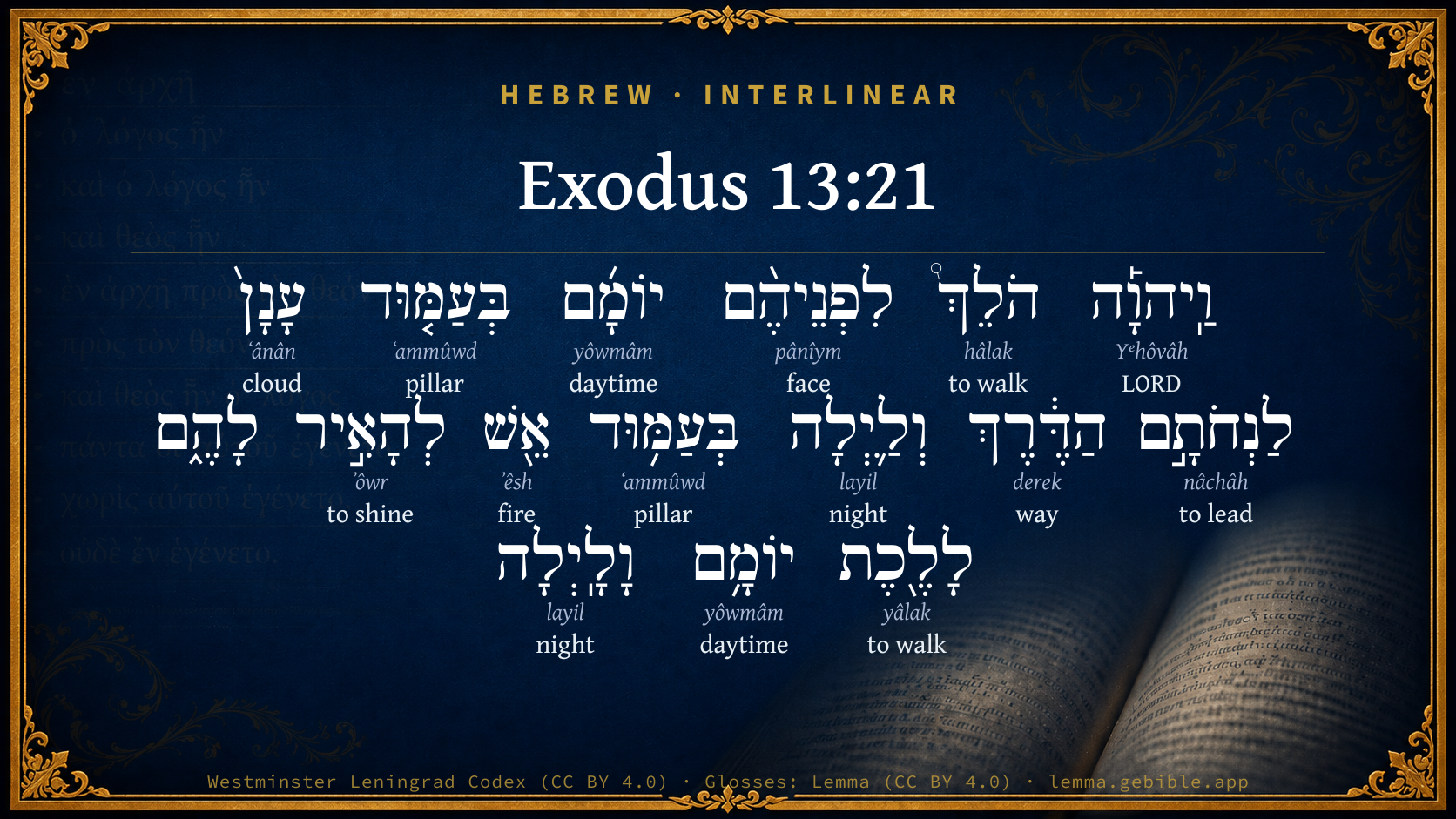
לַנְחֹתָ֣ם
nâchâh
H5148
“to lead · them”
Preposition + Verb, Hiphil, Infinitive Construct + Suffix, Personal, 3rd Person, Masculine, Plural
Part of Speech
Preposition + Verb
Stem
Hiphil
Form
Infinitive Construct
Full BDB Definition

Origin: a primitive root

TWOT: 1341

to lead, guide - (Qal) to lead, bring - (Hiphil) to lead, guide
  1. וַֽיהוָ֡ה Yᵉhôvâh H3068 “and · LORD” Conjunction + Noun, Proper
  2. הֹלֵךְ֩ hâlak H1980 “walking” Verb, Qal, Participle Active, Masculine, Singular, Absolute
  3. לִפְנֵיהֶ֨ם pânîym H6440 “to/for · face(s) · their” Preposition + Noun, Common, Both, Plural, Construct + Suffix, Personal, 3rd Person, Masculine, Plural
  4. יוֹמָ֜ם yôwmâm H3119 “daytime” Adverb
  5. בְּעַמּ֤וּד ʻammûwd H5982 “in/at · pillar of” Preposition + Noun, Common, Masculine, Singular, Construct
  6. עָנָן֙ ʻânân H6051 “cloud” Noun, Common, Masculine, Singular, Absolute
  7. הַדֶּ֔רֶךְ derek H1870 “the · way” Particle, Definite Article + Noun, Common, Both, Singular, Absolute
  8. וְלַ֛יְלָה layil H3915 “and · night” Conjunction + Noun, Common, Masculine, Singular, Absolute
  9. בְּעַמּ֥וּד ʻammûwd H5982 “in/at · pillar of” Preposition + Noun, Common, Masculine, Singular, Construct
  10. אֵ֖שׁ ʼêsh H784 “fire” Noun, Common, Both, Singular, Absolute
  11. לְהָאִ֣יר ʼôwr H215 “to shine” Preposition + Verb, Hiphil, Infinitive Construct
  12. לָלֶ֖כֶת yâlak H3212 “to walk” Preposition + Verb, Qal, Infinitive Construct
  13. יוֹמָ֥ם yôwmâm H3119 “daytime” Adverb
  14. וָלָֽיְלָה layil H3915 “and · night” Conjunction + Noun, Common, Masculine, Singular, Absolute

About this verse

These counts appear in no published source. They are computed here, from the morphology-tagged text and Lemma’s own curated glosses. What Lemma adds →

16
words
12
distinct lemmas
Pentateuch
section

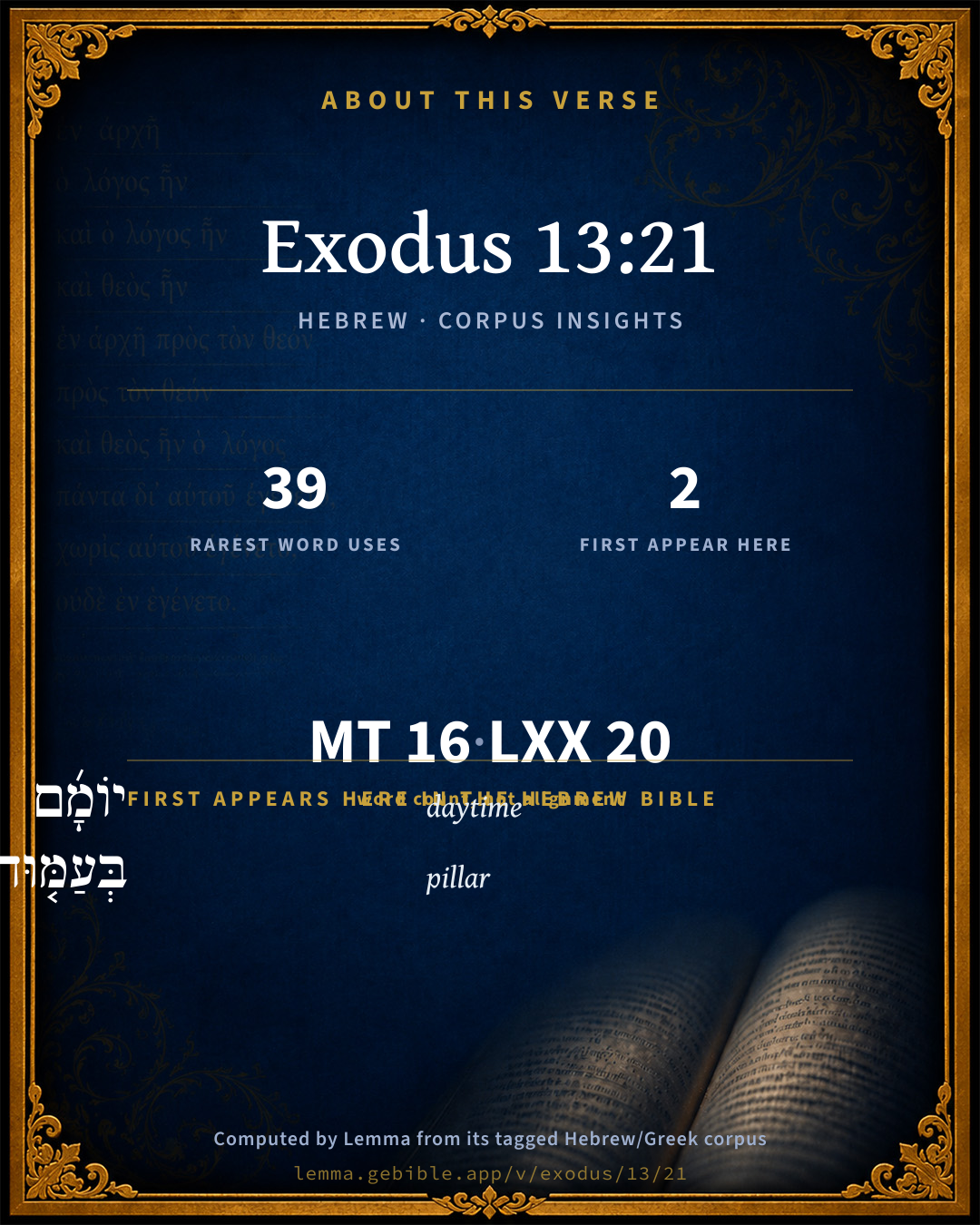
First appearance in Scripture

These words make their first canonical appearance in the Hebrew Bible here:

  • יוֹמָ֜ם daytime H3119
  • בְּעַמּ֤וּד pillar H5982

Shared distinctive vocabulary

לַנְחֹתָ֣ם to lead H5148 occurs in 39 verses of the Hebrew Bible. Also found in:

Grammatical profile

  • 4 verbs
  • 9 nouns
  • 1 preposition
  • 2 adverbs

Verb forms

  • הֹלֵךְ֩ Qal · Participle Active
  • לַנְחֹתָ֣ם Hiphil · Infinitive Construct
  • לְהָאִ֣יר Hiphil · Infinitive Construct
  • לָלֶ֖כֶת Qal · Infinitive Construct

Repetition

Words recur within this verse — often emphatic in Hebrew:

  • יוֹמָ֜ם daytime H3119 ×2
  • בְּעַמּ֤וּד pillar H5982 ×2
  • וְלַ֛יְלָה night H3915 ×2

Hebrew & Septuagint length

In English translation the verse runs 38 words from the Hebrew and 26 from the Septuagint (LXX English) — the Septuagint runs noticeably shorter here. See the side-by-side →

A rough comparison of the two English renderings, which tokenize alike — not a word-level alignment.

Word counts can differ between the Hebrew and the Greek without any difference in meaning — e.g. the Hebrew direct-object marker אֵת has no separate Greek word, and Greek often adds the article ὁ.

In the original languages it is 16 Hebrew tokens and 20 Greek tokens — but the two are counted differently (Hebrew bundles its prefixes and suffixes into one token; the Greek is in lemma form), so that isn’t a like-for-like length.

Cross-references

14

Topical passages linked to Exodus 13:21 in the Treasury of Scripture Knowledge — connected by theme and wording, ordered by reader-vote popularity; previews shown in the World English Bible.

  • 1 Corinthians 10:1–2 Now I would not have you ignorant, brothers, that our fathers were all under the cloud, and all passed through the sea;
  • Nehemiah 9:12 Moreover in a pillar of cloud you led them by day; and in a pillar of fire by night, to give them light in the way in which they should go.
  • Deuteronomy 1:33 who went before you in the way, to seek you out a place to pitch your tents in, in fire by night, to show you by what way you should go, and in the cloud by day.
  • Psalms 99:7 He spoke to them in the pillar of cloud. They kept his testimonies, The statute that he gave them.
  • Nehemiah 9:19 yet you in your manifold mercies didn't forsake them in the wilderness: the pillar of cloud didn't depart from over them by day, to lead them in the way; neither the pillar of fire by night, to show them light, and the way in which they should go.
  • Psalms 105:39 He spread a cloud for a covering, Fire to give light in the night.
  • Exodus 33:9–10 It happened, when Moses entered into the Tent, that the pillar of cloud descended, stood at the door of the Tent, and spoke with Moses.
  • Numbers 14:14 and they will tell it to the inhabitants of this land. They have heard that you Yahweh are in the midst of this people; for you Yahweh are seen face to face, and your cloud stands over them, and you go before them, in a pillar of cloud by day, and in a pillar of fire by night.
  • Psalms 78:14 In the daytime he also led them with a cloud, And all night with a light of fire.
  • Numbers 9:15–23 On the day that the tabernacle was raised up, the cloud covered the tabernacle, even the Tent of the Testimony: and at evening it was over the tabernacle as it were the appearance of fire, until morning.
  • Exodus 40:34–38 Then the cloud covered the tent of meeting, and the glory of Yahweh filled the tent.
  • Numbers 10:34 The cloud of Yahweh was over them by day, when they set forward from the camp.
  • Exodus 14:19–24 The angel of God, who went before the camp of Israel, moved and went behind them; and the pillar of cloud moved from before them, and stood behind them.
  • Isaiah 4:5–6 Yahweh will create over the whole habitation of Mount Zion, and over her assemblies, a cloud and smoke by day, and the shining of a flaming fire by night; for over all the glory will be a canopy.

Cross-references courtesy of OpenBible.info (CC BY 4.0).

Hebrew and Greek witnesses Masoretic Hebrew ↔ Greek Septuagint

The same verse in the two great witnesses to the Old Testament, shown verse-for-verse.

Here the Septuagint runs noticeably shorter than the Hebrew — LXX2012 (modern English Septuagint) 26 words vs World English Bible 38. A rough length comparison of the two English translations, not a word-level alignment — read both below.

These are two independent witnesses, not word-aligned to each other, and the Septuagint is shown in lemma (dictionary) form.

Hebrew Exodus 13:21 Masoretic · Westminster Leningrad Codex

וַֽיהוָ֡ה הֹלֵךְ֩ לִפְנֵיהֶ֨ם יוֹמָ֜ם בְּעַמּ֤וּד עָנָן֙ לַנְחֹתָ֣ם הַדֶּ֔רֶךְ וְלַ֛יְלָה בְּעַמּ֥וּד אֵ֖שׁ לְהָאִ֣יר לָהֶ֑ם לָלֶ֖כֶת יוֹמָ֥ם וָלָֽיְלָה

Yahweh went before them by day in a pillar of cloud, to lead them on their way, and by night in a pillar of fire, to give them light, that they might go by day and by night:

World English Bible · Public Domain

Greek LXX Exodus 13:21 Septuagint · lemma form

ὁ δέ θεός ἡγέομαι αὐτός ἡμέρα μέν ἐν στῦλος νεφέλη δεικνύω αὐτός ὁ ὁδός ὁ δέ νύξ ἐν στῦλος πῦρ

And God led them, in the day by a pillar of cloud, to show them the way, and in the night by a pillar of fire.

LXX2012 (modern English Septuagint) · Public Domain

Hebrew: Westminster Leningrad Codex (CC BY 4.0). Greek: Septuagint (public domain); English from LXX2012 (modern English Septuagint) (Public Domain). How the Septuagint differs from the Hebrew →

Targum (Aramaic paraphrase)

2

The Targum is the ancient Jewish Aramaic paraphrase of the Hebrew Scriptures — an interpretive translation, not the Hebrew text itself. Onkelos (literal) and Pseudo-Jonathan (expansive) render the Torah, and Jonathan the Prophets. Coverage is partial: where no permissively-licensed English translation exists for a verse, only the Aramaic is shown. This is verse-level text, not a word-by-word alignment to the Hebrew.

  1. Targum Onkelos Torah (Genesis–Deuteronomy)
    וַיְיָ מְדַבַּר קָדָמֵיהוֹן בִּימָמָא בְּעַמוּדָא דַעֲנָנָא לְדַבָּרוּתְהוֹן בְּאוֹרְחָא וְלֵילְיָא בְּעַמוּדָא דְאֶשָׁתָא לְאַנְהָרָא לְהוֹן לְמֵיזַל בִּימָמָא וּבְלֵילְיָא:

    (no public-domain English translation for this verse)

    Targum Onkelos — Aramaic: “Onkelos Genesis” (public domain); “Onkelos Exodus” (public domain); “Onkelos Leviticus” (public domain); “Onkelos Numbers” (public domain); “Onkelos Deuteronomy” (public domain). English: “Sefaria Community Translation” (CC0 1.0 (public-domain dedication)); “J.W. Etheridge. The Targums of Onkelos and Jonathan Ben Uzziel on the Pentateuch. London: Longmans, Green, 1862” (public domain). Text via Sefaria.

  2. Targum Pseudo-Jonathan Torah (Genesis–Deuteronomy)
    וְאֵיקַר שְׁכִינְתָּא דַיְיָ מִידְבַּר קֳדָמֵיהוֹן בִּימָמָא בְּעַמּוּדָא דַעֲנָנָא לְדַבָּרוּתְהוֹן בְּאָרְחָא וּבְלֵילְיָא הָדַר עַמּוּדָא דַעֲנָנָא מִבַּתְרֵיהוֹן לְמַחְשַׁךְ לִדְרַדְפִין מִן בַּתְרֵיהוֹן וְעַמּוּדָא דְאֵישָׁתָא לְאַנְהָרָא קֳדָמֵיהוֹן לְמֵיזַל בִּימָמָא וּבְלֵילְיָא

    And the glory of the Shekinah of the Lord went before them by day in the column of the Cloud to lead them in the way, and at night the column of the Cloud removed behind them to darken on their pursuers behind them; but to be a column of fire to enlighten them before, that they might go forward by day and by night.

    Targum Pseudo-Jonathan — Aramaic: “Targum Jonathan on Genesis” (public domain); “Targum Jonathan on Exodus” (public domain); “Targum Jonathan on Leviticus” (public domain); “Targum Jonathan on Numbers” (public domain); “Targum Jonathan on Deuteronomy” (public domain). English: “The Targum of Jonathan ben Uzziel, trans. J. W. Etheridge, London, 1862” (public domain). Text via Sefaria.

Commentary

Notes on Exodus 13:21 from classic Christian and Jewish commentators (each source and its license shown beneath its notes). The classic Christian expositions comment on the surrounding passage and are grouped to its opening verse, so a note may address several verses; the Jewish commentaries on the Tanakh (Rashi and others) are per-verse, so they appear only where the commentator wrote on this verse.

Lemma curates 59 commentaries, every one of them public domain or Creative Commons licensed, each selected and text-cleaned for this edition rather than reprinted as found. About our sources →

Trapp's Complete Commentary

John Trapp

Exo 13:21 And the LORD went before them by day in a pillar of a cloud, to lead them the way; and by night in a pillar of fire, to give them light; to go by day and night:

Ver. 21. And the Lord, &c.] See Psa 105:39 Isa 4:5-6. God protects, directs, and every way suits the necessities of his people.

John Trapp, A Commentary or Exposition upon All the Books of the Old and New Testament (1647–1656) — public domain. Text from a community e-Sword module.

The Biblical Illustrator

Joseph S. Exell

Exo_13:21

By day in a pillar of a cloud.

The prophetic element in life

The Lord went before them in a cloud. So God ever goes before His people, and standing as we do now on the threshold of a new year, we may recall this truth to our great comfort. The future, unknown to us, is not unknown to Him; He has gone before us, and is evermore delicately adjusting things to our discipline, our perfecting, our utmost salvation and bliss.

I. We find an illustration of the text in the preparation of the world as a dwelling-place for man. Ages before man appeared on this planet, God was preparing it as a habitation for us to dwell in. You talk of getting the house ready for some newly married pair; but consider the getting ready of this globe as the scene for humanity to dwell in, and in which to work out its fortunes. What vast ages! What complex and far-seeing adjustments! And so we find to-day that the world has been provisioned for ages, the storehouses of nature are full, we do not lack any good thing. And God also anticipated the moral exigencies of the race.

II. We find another illustration of the text in Gods government of the race. We are not moving at random, the world is full of design, the law is progress, we are always entering into our inheritance. The races of man form a vast motley multitude, and the Lord goes before us preparing for us paths, resting places, wells, palm-trees. He sent a man before them, even Joseph, who was sold for a servant (Psa_105:17). He sent a man before them. And this was not some exceptional thing; God is always sending out pioneers, outriders, heralds to prepare the way for the general host in its march through the ages. They come in science, they come in politics, they come in philosophy, they come in religion: men full of the prophetic instinct, men who anticipate a new world, and who prepare us for it. So these Josephs, these dreamers, go before us, making possible to us new creations, new redemptions, We ought all of us, as Gods people, to have a bit of this prophetic instinct in us, helping to usher in a new and better state of things--Gods messengers preparing the way. God has gone before us; He is preparing happier things for our race; and although He works mysteriously, He works certainly to His glorious purpose. And all this is true in relation to our universal life. In our worldly life God is ever providing for us new blessings, glad surprises. Some do not see God because of the cloud, but He is in it nevertheless, working out His gracious purpose. And as to our spiritual life and need, God goes before us. We believe in prevenient grace--the grace that goes before. Grace that comes before our trials, preparing us for them, so that they do not overwhelm us. Grace that comes before our temptations, warning us of them, strengthening us against them. Grace that comes before our duties, so that we no sooner hear the call than we feel the strength to obey. We may enter a new year with tranquil confidence. Sydney Smith recommended people to take short views, and we can afford to do that, because God on our behalf takes long views.

III. We find our last illustration of the text in the fact that Christ has gone before us into the heavenly places. A cloud received Him out of their sight. In that cloud He has gone before us to make ready for us once more. (W. L. Watkinson.)

The pillar of cloud; a symbol of the Bible

I. The mystic pillar resembled the Bible in the ends it answered.

1. The mystic pillar promoted their emancipation. So the Bible opens the souls prison doors, snaps its chains, delivers it from the despotism of sin, and makes its way clear into the kingdom of God.

2. The mystic pillar guided them through the wilderness. So does the Bible show us the path of life. It is ever in advance of humanity, etc.

3. The mystic pillar protected them from all that would injure. The Bible is the sword of the Spirit; the armour of the soul.

II. The mystic pillar resembled the Bible in the attributes it displayed.

1. Supernaturalness.

2. Adaptation.

3. Many-sidedness.

III. The mystic pillar resembled the Bible in the conditions it required.

1. It required a constant observance of its movements. Bible of no service unless studied.

2. It required a constant following of its movements. You must go as the Bible goes in relation to sin. Satan, holiness, and God; life and death, time and eternity. (Homilist.)

The Divine leadership of the good

I. That the good are Divinely led in the wanderings of life. The Lord went before them.

1. A visible Guide.

2. A competent Guide.

3. A faithful Guide.

II. That the good are often Divinely led during the wanderings of life into varied and unsuspected paths. The edge of the wilderness.

1. God sometimes leads His people contrary to their expectations.

2. God sometimes leads His people contrary to the dictates of their reason.

3. God always leads His people into those paths which shall yield the most sacred and safe discipline to them.

III. That the method of the Divine leadership is adapted to the changing circumstances of the good. By day in a pillar of cloud, etc.

IV. That the Divine leadership should not be mistaken in association with the ordinary agencies of life.

V. That the Divine leadership is solicitous to lead the good to their promised and peaceful destiny. (J. S. Exell, M. A.)

The cloudy and fiery pillar a symbol of the Bible

.

I. As the pillar of cloud was given to guide and comfort, so the Bible is designed to lead the thought and console the sorrow of man. Without the Bible man would be lost in the wide waste of error. It is also intended to console the human heart in all the troubled moods of life, when its joys grow dim, when it is rendered lonely by bereavement, and when it comes to death. At such times the Bible is our chief consolation, it enables us to sorrow in hope, it shows us One who is the Resurrection and the Life.

II. As the pillar combined both cloud and fire, so the Bible unites illumination and mystery. There is mystery in it which the finest genius cannot attain, which angelic intelligence cannot interpret, and which eternity may not simplify. Deity dwells in the volume, and we expect that clouds and darkness will be round about Him. But there is fire in the Book which illumines the doctrines and morality of the Christian life.

III. As the pillar of cloud aided the outgoing of Israel from bondage to rest, so the Bible is the best help man can have in walking through this life to the next. They walk the best in the wilderness of life who pay the most heed to the Word of God (Psa_119:105). Lessons:

1. Be thankful for the Bible.

2. Follow the directions of the Bible.

3. Seek the consolation of the Bible. (J. S. Exell, M. A.)

Divine guidance

I. Explain the text.

1. We may observe that Gods people in every age stand in need of a guide, and without it they would miss the path of duty and of happiness.

2. The Lord Himself graciously condescends to become the guide of His people, and He alone is fit to be so. He only has a perfect knowledge of the way, and of all the difficulties that may befall them in it; and He only is able to support and defend them against the designs of all their enemies.

3. The Lord guides His people in different ages of the world, by various means adapted to their circumstances, and to the peculiar dispensations under which they live.

(1) By His Providence.

(2) By His Word.

(3) By His Spirit.

II. Symbolic meaning.

1. It was altogether miraculous, and a symbol of the Divine presence. It was called the cloud of the Lord; there it was He dwelt in the midst of His people, and spake with them face to face (Num_19:14).

2. This mysterious cloud was intended to direct the Israelites in their journey, and by it the Lord communicated to them His will.

3. The cloudy pillar in the wilderness afforded refreshment by its shade, as well as guidance by its light. And is not Jesus both our sun and shield, our light and shade, as our different necessities require? In a season of darkness, He sends forth His cheering beams; and when our soul is ready to faint within us, He ministers to our refreshment and relief.

4. The cloudy pillar was designed for safety and defence, as well as for a guide through the wilderness. (B. Beddome, M. A.)

Need of guidance

General Hill says: In many of the battles the great want with the Confederates, strange as it may seem, was accurate knowledge of the country in their front. The map furnished me (and I suppose the six other major-generals had no better) was very full in regard to everything within our own lines, but a red line without any points marked on it was our only guide to the route on which our march was to be made. (H. O. Mackey.)

Gods guidance

The other day I was walking across the Northumbrian fells to call at a shepherds house that lay distinctly enough before me on the Fell side. The directions I received from a Fellsider whom I had just left, after the manner of those who live every day in the midst of ample space, were vague indeed. The rutty, half-formed road on which I was walking was distinct enough immediately before me, but when I strove to trace the course of the road a greater distance ahead it became blended with the frowsy bracken and bronzed heather, and was utterly lost to view. To have struck boldly out across country to reach my destination by what seemed the shortest route would have entangled me among the spongy bogs and numerous streams with which the hillside was intersected. However, by carefully following the road that was visible before me I managed to pick my way and reached my calling-place in safety. So is it in our daily search after the knowledge of the Divine will. When in our impatient eagerness we wish to look too far into the future, all is indistinct and hazy; but, if we carefully note what is near and sufficiently revealed, we shall be led up infallibly to safety and to rest. (Christian Journal.)

Gods guidance of the Israelites

There was an old fisherman who got converted in his old age. He was not able to read, and therefore had to do his own thinking, not being able to catch up all ideas aired in our newspapers. A friend of mine visited him, and knowing how he loved the Word of God, said to him, Now, John, shall I read you a chapter? Yes, if you please, I should so much like to hear a chapter. I do dearly love to hear the Word read. And what part shall I read to you? About the Lizard Lights, please. Do read about them, for when I see them I always think I am near my heavenly home. I have often been out on the Atlantic on dark stormy nights, and when I caught sight of the Lizard Lights I knew I was near Falmouth harbour, and would soon be safely moored. I am afraid, ventured my friend, that I do not know about the Lizard Lights! Not know about them! Well, I thought you a gentleman, and had Scripture knowledge, but if you dont know about the Lizard Lights, you must just wait until Mary comes in. In a short; time Mary, who was his daughter, came in, and the old man said, Mary, where is that in the Book about the Lizard Lights? You know you were reading about them last Sunday night. Oh, father, she said, that was not the Lizard Lights. It was the Israelites. That old man had made a mistake in the apprehension but not in the application. The story of the Israelites told of the guidance of God, in their wanderings, and the Lizard Lights had frequently been the beacon that had guided the fisherman to his desired haven. (Mark G. Pearse.)

The pillar of cloud; historical parallels

Xenophon mentions, in his Spartan republic, in describing the military expedition of a Spartan king, that a servant, or officer, who was called firebearer, preceded the king with the fire, which had been taken from the altar, on which he had just before sacrificed at the frontier of the Spartan territory. After they had sacrificed once more, and the march had commenced, s fire which was lighted at the second sacrifice preceded the lines, without ever extinguishing. In Curtius we read, He (Alexander the Great) ordered a lofty pole, visible from all sides, to be raised over the generals tent, and from the top of this pole streamed a signal conspicuous everywhere to every one, smoke by day and fire by night. Alexander had in this, as in many other points, imitated the custom of the Persians, who, in common with most of the eastern nations, on their mashes through deserted regions, bear before the army high poles, on which iron pots are affixed, filled with lighted combustibles; so that, the smoke by day, and the flame by night, signalized the way to the troops. Thus we cannot but acknowledge a certain curious similarity between the Biblical miracle and a general military custom prevailing in the East. Under these circumstances we entirely approve of Fabers remarks: Both the miracle and the custom, collated and compared, give light to each other. The custom effects, that we find the miracle dignified and worthy of God; and the miracle shows, that that very custom cannot have been quite unknown to the Israelites. (M. M. Kalisch, Ph. D.)

The pillar of the cloud and of fire

The pillar of cloud and of fire was certainly

(1) sacramental (1Co_10:1-2);

(2) of a typical character (Isa_4:5; Num_14:42).

He whom the cloudy and fiery pillar typified was the same Almighty Being who hath said to the faithful members of his militant Church, in every age of its warfare, Lo, I am with you always, even unto the end of the world. The cloud was manifestly intended--

I. To guide the Israelites through the wilderness.

1. The pillar of cloud guided the children of Israel with infallible certainty. God Himself was in it; and unless He could err, their way could not be mistaken. Mark here, the glorious character of the Bible,--that light to our feet with which the unsearchable compassion of our Saviours love has provided us. It testifies of Christ. It embodies His teaching and salvation, as the pillar contained them in the.wilderness.

2. This wondrous appearance in the heavens was a constant director to Israel. In every emergency the page of divine truth may be consulted.

II. The cloudy and fiery pillar afforded not merely guidance, but protection to the Israelites in their eventful march. Sin invades, temptation threatens, and every spiritual enemy seems permitted to assail with a fierceness which might well gather gloom and despondency around the heart; but the fainting Christian is encouraged by that voice which speaks as from the cloud between him and his enemies. Fear thou not, for I am with thee: be not dismayed, for I am thy God. His life is hid with Christ in God; and amidst every trial and seduction by which his salvation is endangered, he may lay bold upon One who walks with him, and has promised to uphold him with the sufficiency of an Almighty arm.

III. The pillar of cloud and of fire had yet another office to perform for the children of Israel. It gave them refreshment and comfort in the wilderness. Now say, O Christian, is it not thus with thee in the hour of thy most oppressive trial? (R. P. Buddicom.)

The pillar of cloud and fire

I. The way along which God led his people.

II. The manner in which God guided and protected them.

1. Pillar of cloud and fire only means: Jehovah Himself their true guide. God is with His people. What decision, blended with humility, will the realization of this great truth give us! What calmness in the midst of excitement; submission under trial; perseverance under difficulties.

2. Mark the adaptation of Gods method of guidance to the condition and necessities of the Israelites. Gradual progress. (G. Wagner.)

The fiery cloudy pillar

The fiery cloudy pillar performed many friendly offices to the Israelites, It was--

1. A guide. To lead was its main mission. It was a striking illustration of the longsuffering kindness of God. Neither murmurings, nor rebellion, nor idolatry, ever drove away the angel of His presence. The guidance vouchsafed, too, was of the most gracious kind--that of a shepherd (Psa_78:52), and that of a loving and affectionate parent (Deu_1:31).

2. A light (see Neh_9:19).

3. A shade (see Psa_105:39).

4. A shield (see Deu_1:30; Exo_14:19).

5. An oracle (see Psa_119:7). He who opened His mouth in the burning bush at Horeb, opened His mouth in the cloudy pillar, and frequently spake to Israels leader for Israels benefit.

6. An avenger. When God wished to mark His displeasure, the cloud assumed a very wrathful appearance. The Lord looked unto the host of the Egyptians through the pillar of fire, and troubled the host of the Egyptians. What a dreadful visage it must have worn when flashes went forth from it and devoured Nadab and Abihu (Lev_10:2), and also when fire came out from it and consumed two hundred and fifty men! (Num_21:35). If the aspect of the cloud was thus at times such as to trouble those with whom God was angry, it would, no doubt, have a very pleasing one when He desired to manifest His favour to the congregation. As they looked up, they would behold the smiling face of their Divine leader cheering and encouraging them to go on in the path of duty. (W. Brown.)

The presence of God adapted to human need

The consciousness of the Divine presence is in proportion to the circumstances in which we are placed. In other words, our circumstances determine our consciousness of the Divine nearness. Sometimes life is all day--almost a summer day with great spans of blue sky overhead, and where the clouds gather they gather in beautiful whiteness, as of purity akin to the holiness of the inner and upper cities of the universe. Then what do we want with fiery displays of God?--they would be out of keeping, out of reason and out of proportion. There are days that are themselves so bright, so hospitable, so long ending, and so poetic in all their breezes, and suggestions, and ministries, that we seem not to want any dogmatic teaching about the personality and nearness of God. All beauty represents Him. Any more emphatic demonstration would be out of harmony with the splendid serenity of the occasion. Then there are periods in life all night, all darkness, all storm or weariness. We cannot say where the door of liberty is, nor dare we step out lest we fall over a precipice; all is dark, all is trouble; friends are as absent as if they were dead, and all the sanctuaries to which we have hitherto resorted are concealed by the infinite darkness. What do we want then? A bird to sing to us? That would be helpful. A little tiny voice to break the troubled silence? That would net be amiss. But what do we really want? A column of fire, a pillar of glory, an emphatic incarnation and vision of Providence; and the soul gets both these manifestations of God according to the circumstances under which the soul is living. Take it, therefore, simply as an analogy, and then it is a rational analogy; it is true to every mans experience. And if the pillar of cloud and fire should drop off, there will remain the eternal truth, that according to the souls circumstances is the Divine revelation of itself. Where the visible is enough, why add more? A man should not want much theology of a formal sort on a bright summer day. Some little tuft of cloud will represent the Infinite. Some almost invisible wing in the air--more a thought than a thing--hardly to be identified by the bodily eye, will symbolize the all-embracing power and the all-brooding love. Then at night we want what is called dogmatic teaching, broad emphasis, piercing declaration, vividness that cannot be mistaken, God almost within the clasping of the poor arms, God almost in sight of the eyes of the body. Thus God deals with us. This is true to our history. The mere cloud may go, the pillar of fire may be accepted as figurative; but the eternal truth that God comes to us in different ways under different circumstances--now as a cloud, now as a fire, now as a judgment, now as without mercy, now a roaring tempest, now a still small voice,--is a truth that remains, whatever havoc may be wrought amid the mere figurativeness by which that truth is symbolized. (J. Parker, D. D.)

Divine guidance

How does this remarkable narrative exhibit to us in every variety the picture of Gods daily guidance of His people!

1. The guidance is as indispensable, and at the same time as obvious now as it was then. God still leads His people, through the voice of the purified conscience, through the evident suggestions of His exalted Providence, through the utterances especially of His infallible Word; and all these indications differ sufficiently from what flesh and blood make known to us in order to preserve us from wandering.

2. The guidance now is indeed as mysterious, but yet as well adapted to its purpose, as that of which the history of Israel tells us. Our countless whys and wherefores are still as little answered as the questions concerning the peculiar nature and essence of the pillar of fire and of cloud which probably disturbed the minds of the ancient Israelites. But as regards the question whither, the answer, God be praised, has not remained unknown to us; all Gods guidance of His people, we know, has one good--to bring us out of disquietude into rest, out of bondage to liberty, along the path of faith to the land of sight.

3. Also in our case Gods guidance is as varied, but still as faithful, as was the promise to the ancient people. In the day of prosperity He goes before us as in the cloudy pillar, in order to temper the glow of our joy through the remembrance of His close neighbourhood; in the night of adversity the word of His promise beams on us in as friendly and consoling a manner as did the fiery pillar on Israel in midst of the darkness. But as Moses beheld in the fortieth year of his pilgrimage the same sign in the heavens which had guided and encouraged him in the first, so Gods presence is never lost to His redeemed ones in Christ, whatever else around may faint or fail. Neither by day nor by night does He take from us the tokens of His nearness; and even when He seems to hide His face from us, new thoughts of mercy and of peace are in His heart.

4. Who does not perceive how such a guidance promises as much, but also claims as much return as that of Israel? It guarantees us the entrance into Canaan, but only along the path of believing perseverance and obedience. When the way indicated through the wilderness was despised, the pillar of cloud and fire rose above many a grave, and yet there is no single promise of God to him who chooses his own path. (J. J. Van Oosterzee, D. D.)

The mystic pillar

I have called it a mystic pillar--that cloud in the desert; and so to them who saw it, and to us who read of it, it was. Of what it was composed; by what means it was kept pillar-like and intact while all other clouds were carried and scattered by the winds of heaven; by what strange secret force the cloud-pillar was nightly transformed to a column of bright flame?--these are questions that no doubt often exercised the minds of the spectators, only to be dismissed again as a baffling mystery that could not be explored. And not only its nature and changes, but its direction, its movements as to time and place--they had no knowledge, could make no sure prediction. Whether it would bend to the right, turn to the left, or move straight onward; whether it would remain stationary, or begin to move night or morning, or at noon--all this, and all concerning it, was above and beyond their knowledge; the laws that governed it and the will that led it was as entirely outside their information as it was beyond their control. What they did know was that Jehovah was the God of the cloud; what they could do was to trust it implicitly, follow it constantly, seeing in it all the while the good hand of their God over them for good. In all this, for my learning and for yours, I see a picture--a true and instructive picture--of the providence of God. From the beginning until now, the ways of God to man have been shrouded in mystery, have exercised inquiring but baffled minds, have furnished material for the sneer of the infidel, the sophistry of the sceptic, and the logic of the merely scientific mind; ay, and have strained and tested the faith of the pious, and placed stumblingblocks before his faith, on which his foot hath well-nigh slipped. All this arises from the fact that men will strive to be equal with God; that their mind will cope with that of Deity, and by their finite feebleness gauge the plans and purposes of the Infinite and Eternal Lord of all. (J. J. Wray.)

Providential mercies

A clergyman who, with some others, had escaped in a boat from a burning ship, was discoursing in a large company of the marvellous favour of Divine Providence, that had so specially watched over and preserved him. A wonderful providence! A special intervention of Gods goodness! That was a very great mercy, sir, said Archbishop Whately, seriously, but I can record a greater in my own experience. I once sailed across the sea in just such a ship, and bound for just the same port, and--would you believe it?--the vessel never caught fire at all! My friends, that is the way I would have you think of, and trust in Providence, as being ever present, ever wise and watchful, and, like the cloud-pillar of Israel, ever for your real good--pursuing its Divine and gracious path. Good and bad, light and shade, joy and sorrow, prosperity and adversity, things present and things to come, all are proceeding on precisely the same plan,--namely, the working of the soul and mind of God for His glory in the true well-being of His creatures, and for the ultimate advancement and elevation of mankind. Wherever the pillar went, with whatever seemingly reasonless vagaries the pillar moved, and however widely experiences and opinions differed about its moving, we know now that it led them safe enough and sure enough to the Canaan which was the longing desire of every heart. The mind of a pious and thoughtful artisan named Albert Thierney was much occupied with the ways of God which seemed to him to be full of inscrutable mysteries. The two questions, How? and Why? were constantly in his thoughts, both as to the events of his own life and the government of the world. One day, in visiting a large ribbon manufactory, his attention was attracted by a large and extraordinary piece of machinery. His eye was that of a cultivated artisan, and he was immensely interested. Countless wheels were revolving in intricate motions, and thousands of threads were twirling and twisting in all directions. He could not understand its movements, and closer study only deepened his interest and increased the mystery. He was informed that all this work and motion was connected with a common centre where there was a large chest which was kept shut. Anxious to understand the principle of the machine, he asked permission to look inside the chest. The master holds the key, was the reply. The words came to him like a flash of light. Here was the answer to all his perplexing thoughts--his anxious questionings about Providence. Yes, thought he, the Master holds the key; He knows, He governs, He directs all--God! That is enough! what need I more? (J. J. Wray.)

.

The Biblical Illustrator, edited by Joseph S. Exell (c. 1880s–1900s) — public domain. Text from a community e-Sword module.

Joseph Benson's Commentary

Exo 13:21. And the Lord went before them in a pillar — In the first two stages, it was enough that God directed Moses whither to march; he knew the country, and the road; but now they are come to the edge of the wilderness, they would have occasion for a guide, and a very good guide they had, infinitely wise, kind, and faithful, the Lord went up before them; the shechinah, or appearance of the Divine Majesty, which was a previous manifestation of the eternal Word, who, in the fulness of time, was to be made flesh, and dwell among us. Christ was with the church in the wilderness, 1Co 10:9. What a satisfaction to Moses and the pious Israelites, to be sure that they were under a divine conduct! They need not fear missing their way who were thus led, nor being lost who were thus directed; they need not fear being benighted who were thus illuminated, nor being robbed who were thus protected. And they who make the glory of God their end, and the word of God their rule, the Spirit of God the guide of their affections, and the providence of God the guide of their affairs, may be confident that the Lord goes before them, as truly as he went before Israel in the wilderness, though not so sensibly. They had sensible effects of God’s going before them in this pillar. For, it led them the way in that vast howling wilderness, in which there was no road, no track, no way-marks, through which they had no guides. When they marched, this pillar went before them, at the rate that they could follow, and appointed the place of their encampment, as infinite Wisdom saw fit; which eased them from care, and secured them from danger, both in moving, and in resting. It sheltered them from the heat by day, which at some times of the year was extreme, and it gave them light by night when they had occasion for it.

Joseph Benson's Commentary on the Old and New Testaments (1811–1818) — public domain. Text from a community e-Sword module.

Keil & Delitzsch

C. F. Keil & F. Delitzsch

From Etham, at the edge of the desert which separates Egypt from Asia, the Israelites were to enter the pathless desert, and leave the inhabited country. Jehovah then undertook to direct the march, and give them a safe-conduct, through a miraculous token of His presence. Whilst it is stated in Exo 13:17, Exo 13:18, that Elohim led them and determined the direction of their road, to show that they did not take the course, which they pursued, upon their own judgment, but by the direction of God; in Exo 13:21, Exo 13:22, it is said that "Jehovah went before them by day in a pillar of cloud, to lead them the way, and by night in a pillar of fire, to give them light, to go by day and night," i.e., that they might march at all hours.

(Note: Knobel is quite wrong in affirming, that according to the primary work, the cloud was first instituted after the erection of the tabernacle. For in the passages cited in proof of this (Exo 40:34.; Num 9:15., Exo 10:11-12, cf. Exo 17:7), the cloud is invariably referred to, with the definite article, as something already known, so that all these passages refer to Exo 13:21 of the present chapter.)

To this sign of the divine presence and guidance there was a natural analogon in the caravan fire, which consisted of small iron vessels or grates, with wood fires burning in them, fastened at the end of long poles, and carried as a guide in front of caravans, and, according to Curtius (de gestis Alex. M. V. 2, 7), in trackless countries in the front of armies also, and by which the direction of the road was indicated in the day-time by the smoke, and at night by the light of the fire. There was a still closer analogy in the custom of the ancient Persians, as described by Curtius (iii. 3, 9), of carrying fire, "which they called sacred and eternal," in silver altars, in front of the army. But the pillar of cloud and fire must not be confounded with any such caravan and army fire, or set down as nothing more than a mythical conception, or a dressing up of this natural custom. The cloud was not produced by an ordinary caravan fire, nor was it "a mere symbol of the presence of God, which derived all its majesty from the belief of the Israelites, that Jehovah was there in the midst of them," according to Kster's attempt to idealize the rationalistic explanation; but it had a miraculous origin and a supernatural character. We are not to regard the phenomenon as consisting of two different pillars, that appeared alternately, one of cloud, and the other of fire. There was but one pillar of both cloud and fire (Exo 14:24); for even when shining in the dark, it is still called the pillar of cloud (Exo 14:19), or the cloud (Num 9:21); so that it was a cloud with a dark side and a bright one, causing darkness and also lighting the night (Exo 14:20), or "a cloud, and fire in it by night" (Exo 40:38). Consequently we have to imagine the cloud as the covering of the fire, so that by day it appeared as a dark cloud in contrast with the light of the sun, but by night as a fiery splendour, "a fire-look" (כּמראה־אשׁ, Num 9:15-16). When this cloud went before the army of Israel, it assumed the form of a column; so that by day it resembled a dark column of smoke rising up towards heaven, and by night a column of fire, to show the whole army what direction to take. But when it stood still above the tabernacle, or came down upon it, it most probably took the form of a round globe of cloud; and when it separated the Israelites from the Egyptians at the Red Sea, we have to imagine it spread out like a bank of cloud, forming, as it were, a dividing wall. In this cloud Jehovah, or the Angel of God, the visible representative of the invisible God under the Old Testament, was really present with the people of Israel, so that He spoke to Moses and gave him His commandments out of the cloud. In this, too, appeared "the glory of the Lord" (Exo 16:10; Exo 40:34; Num 17:7), the Shechinah of the later Jewish theology. The fire in the pillar of cloud was the same as that in which the Lord revealed Himself to Moses out of the bush, and afterwards descended upon Sinai amidst thunder and lightning in a thick cloud (Exo 19:16, Exo 19:18). It was a symbol of the "zeal of the Lord," and therefore was enveloped in a cloud, which protected Israel by day from heat, sunstroke, and pestilence (Isa 4:5-6; Isa 49:10; Psa 91:5-6; Psa 121:6), and by night lighted up its path by its luminous splendour, and defended it from the terrors of the night and from all calamity (Psa 27:1., Psa 91:5-6); but which also threatened sudden destruction to those who murmured against God (Num 17:10), and sent out a devouring fire against the rebels and consumed them (Lev 10:2; Num 16:35). As Sartorius has aptly said, "We must by no means regard it as a mere appearance or a poetical figure, and just as little as a mere mechanical clothing of elementary forms, such, for example, as storm-clouds or natural fire. Just as little, too, must we suppose the visible and material part of it to have been an element of the divine nature, which is purely spiritual. We must rather regard it as a dynamic conformation, or a higher corporeal form, composed of the earthly sphere and atmosphere, through the determining influence of the personal and specific (specimen faciens) presence of God upon the earthly element, which corporeal form God assumed and pervaded, that He might manifest His own real presence therein."

(Note: "This is done," Sartorius proceeds to say, "not by His making His own invisible nature visible, nor yet merely figuratively or ideally, but by His rendering it objectively perceptible through the energy it excites, and the glorious effects it produces. The curtain (velum) of the natural which surrounds the Deity is moved and lifted (revelatur) by the word of His will, and the corresponding intention of His presence (per dextram Dei). But this is effected not by His causing the light of His countenance, which is unapproachable, to burst forth unveiled, but by His weaving out of the natural element a holy, transparent veil, which, like the fiery cloud, both shines and throws a shade, veils and unveils, so that it is equally true that God dwells in light and that He dwells in darkness (Ch2 6:1; Ti1 6:16), as true that He can be found as that He must always be sought.")

Exo 13:22

This sign of the presence of God did not depart from Israel so long as the people continued in the wilderness.

Keil & Delitzsch — Biblical Commentary on the Old Testament (1861–1891) — public domain (CC PDM 1.0). Text via the HelloAO Bible API. (Old Testament only.)

Tyndale Open Study Notes

Tyndale Open Resources

13:21 The pillar of cloud and the pillar of fire were to be the Israelites’ constant companions for the next forty years.

Tyndale Open Study Notes — © Tyndale Open Resources, licensed CC BY-SA 4.0. Text via the HelloAO Bible API.

Geneva Bible (1599)

Geneva Bible translators

To defend them from the heat of the sun.

Geneva Bible (1599) marginal notes — public domain. Text via Bolls.life.

Jamieson, Fausset & Brown

Robert Jamieson, A. R. Fausset & David Brown

the Lord went before them--by a visible token of His presence, the Shekinah, in a majestic cloud (Psa 78:14; Neh 9:12; Co1 10:1), called "the angel of God" (Exo 14:19; Exo 23:20-23; Psa 99:6-7; Isa 63:8-9).

Next: Exodus Chapter 14

Jamieson, Fausset & Brown — Commentary Critical and Explanatory on the Whole Bible (1871) — public domain (CC PDM 1.0). Text via the HelloAO Bible API.

Adam Clarke's Commentary

Verse 21. The Lord went before them] That by the LORD here is meant the Lord Jesus, we have the authority of St. Paul to believe, 1Co 10:9: it was he whose Spirit they tempted in the wilderness, for it was he who led them through the desert to the promised rest.

Pillar of a cloud] This pillar or column, which appeared as a cloud by day, and a fire by night, was the symbol of the Divine presence. This was the Shechinah or Divine dwelling place, and was the continual proof of the presence and protection of GOD. It was necessary that they should have a guide to direct them through the wilderness, even had they taken the most direct road; and how much more so when they took a circuitous route not usually travelled, and of which they knew nothing but just as the luminous pillar pointed out the way! Besides, it is very likely that even Moses himself did not know the route which God had determined on, nor the places of encampment, till the pillar that went before them became stationary, and thus pointed out, not only the road, but the different places of rest. Whether there was more than one pillar is not clearly determined by the text. If there was but one it certainly assumed three different appearances, for the performance of THREE very important offices.

1. In the day-time, for the purpose of pointing out the way, a column or pillar of a cloud was all that was requisite.

2. At night, to prevent that confusion which must otherwise have taken place, the pillar of cloud became a pillar of fire, not to direct their journeyings, for they seldom travelled by night, but to give light to every part of the Israelitish camp.

3. In such a scorching, barren, thirsty desert, something farther was necessary than a light and a guide. Women, children, and comparatively infirm persons, exposed to the rays of such a burning sun, must have been destroyed if without a covering; hence we find that a cloud overshadowed them: and from what St. Paul observes, 1Co 10:1-2, we are led to conclude that this covering cloud was composed of aqueous particles for the cooling of the atmosphere and refreshment of themselves and their cattle; for he represents the whole camp as being sprinkled or immersed in the humidity of its vapours, and expressly calls it a being under the cloud and being baptized in the cloud.

To the circumstance of the cloud covering them, there are several references in Scripture. Thus: He spread a CLOUD for their COVERING; Ps 105:39. And the Lord will create upon every dwelling place of Mount Zion, and upon her assemblies, A CLOUD and SMOKE BY DAY, and the shining of a FLAMING FIRE by night; for upon all the glory shall be a DEFENCE, (or COVERING,) Isa 4:5; which words contain the most manifest allusion to the threefold office of the cloud in the wilderness. See Nu 9:16-18, &c.

Adam Clarke's Commentary on the Bible (1810–1826) — public domain. Text from a community e-Sword/MySword module.

Ellicott's Commentary for English Readers

(21) The Lord went before them.—In Exo_13:17-18, the writer has declared that “God led the people;” he now explains how. from Succoth certainly, probably from Rameses, He moved in front of the host in the form of a pillar, which had the appearance of smoke by day and of fire by night. The Israelites marched, it is implied, some part of each day and some part of each night, which would be in accordance with modern practice, and is an arrangement introduced to get the march accomplished before the sun attains his full power. The pillar was at once a signal and a guide. When it moved, the people moved; when it stopped, they encamped (Exo_40:36-38); where it went, they followed. It bore some resemblance to the fire and smoke signals which generals used when at the head of their armies (Lepsius, Denkmäler, vol. ii., pl. 150, 2; Papyr. Anastas, 1; Q. Curt, Vit. Alex. v. 2, &c), and indicated that God had constituted Himself the generalissimo of the host; but it was altogether of a miraculous and abnormal character.

To go by day and night.—The night journeys of the people are mentioned again in Num_9:21.

A Bible Commentary for English Readers, edited by Charles John Ellicott (1878–1897) — public domain. Text from a community e-Sword module.

The Cambridge Bible for Schools and Colleges

gen. ed. J. J. S. Perowne

21. went] In the Heb. a ptcp., implying ‘went continually.’

21, 22. How Jehovah, in a pillar of cloud by day, and in a pillar of fire by night, guided the Israelites in their journeyings. For cloud, and fire, as symbols of the Divine presence, cf. on Exo_3:2, Exo_9:28, Exo_19:9; Exo_19:18, Exo_20:18. The Pent., however, contains three representations of the Divine presence in the cloud, corresponding to the three sources: in J the pillar of cloud by day and fire by night precedes the Israelites continuously to guide them in the way (so here, Exo_14:19 b, 24a, Num_14:14 b, Deu_1:33; comp. Neh_9:12; Neh_9:19, Psa_78:14): in E the pillar of cloud is not spoken of as a guide, but it descends from time to time and ‘stands’ at the entrance to the Tent of Meeting, and Jehovah speaks in it to Moses (so Exo_33:9 f., Num_11:25; Num_12:5, Deu_31:15; cf. Psa_99:7): in P (who does not speak of a ‘pillar’) the cloud covers the Tent of Meeting immediately upon its erection, and remains there, with fire in it by night, till the camp is to be moved, when it is lifted up above it (Exo_40:34-38, Num_9:15-22; Num_10:11 f.: cf. v. 34, Exo_14:14 [the words, ‘and thy cloud standeth over them’: comp. Psa_105:39; also Isa_4:5], Lev_16:2, Num_16:42, and on Exo_16:10). The fiery cloud thus formed an imposing visible symbol of the spiritual presence of God, guiding (J), protecting (P), or (E) speaking in Israel, during its journey through the wilderness. But, as in other cases, the symbolism had no doubt some natural basis; and it is thought by Di., McNeile and others that it was suggested by the variously attested custom of a brazier filled with burning wood being borne along at the head of a caravan of pilgrims, or an army (see reff. in Di. and McN.), or of a chief having a fire blazing before his tent (T. H. Weir, Expositor, July 1910, p. 81 f.), or carried before him (cf. Ebers, Gosen, 530, 2544).

The Cambridge Bible for Schools and Colleges (gen. ed. J. J. S. Perowne; Cambridge University Press, 1878–1918) — public domain. Text from a community e-Sword module.

John Gill's Exposition

And the Lord went before them,.... Who is called the Angel of the Lord, Exo 14:19, not a created but the uncreated Angel, the Angel of Jehovah's presence, in whom his name, nature, and perfections were, even the Word and Son of God, the Lord Christ, see Co1 10:9 who went before the armies of Israel, as their King, Leader, and Commander:

by day in a pillar of a cloud, to lead them the way; through the Red sea, and the wilderness, at the edge of which they now were, which was untrodden, and trackless, and the way through it very difficult to find; and being a sandy desert, as soon as a path was made, it was immediately covered with sand, and to be seen no more: this cloud was not an ordinary one, but extraordinary, supernatural, and miraculous; in the superior part of it, it was in the form of a pillar, rising upwards towards heaven; in the lower part of it, it was more spread, and covered the camp of Israel; for, besides the use of it to show the way through a trackless wilderness, it was a shelter and protection from the scorching heat of the sun in a sandy desert, where there was scarce anything to screen them from it, to which the allusion is in Isa 4:5 this cloud was an emblem of Christ, who has sometimes appeared clothed with a cloud, Rev 10:1 of the obscurity of his human nature, of the fulness of grace in him, and being in the form of a pillar, of his uprightness, firmness, stability, and visibility in it; and of the use and benefit he is to his people, partly to show them the way in which they should go, by his Spirit and word, and lead them in it by his own example, whom it becomes them to follow, he being a wise, safe, and constant guide; and partly to shelter and protect them from the heat of a fiery law, from the flaming sword of justice, from the wrath of God, from the fiery darts of Satan, and from the furious persecution of wicked men, sometimes compared to the violent heat of the sun, Sol 1:6.

and by night in a pillar of fire, to give them light; whenever they travelled by night, as they sometimes did, and in those hot countries it was very agreeable; and this pillar of fire gave them light when the moon shone not, and was a direction to them which way to go: sometimes it is night with the people of God, a night of darkness and desertion, of drowsiness, sleepiness, and carnal security, or of affliction and distress: Christ is the light and comfort of his people, and by his Spirit and word illuminates, guides, and directs them what to do, and where and how to walk:

to go by day or night; to direct them in their journey, whether by night or day: this was but one pillar, though Aben Ezra thinks they were two; but it may be observed they are mentioned as one, and that the pillar of cloud in the night was a cloud of darkness to the Egyptians, and gave light to the Israelites, Exo 14:19, see also Num 9:21 and it is easy to observe that what appears as a cloud or smoke in the daytime, looks like fire in the night: so when Alexander's army was on the march, as a signal,"fire was observed in the night, and smoke by day,''as says the historian (x): nor can, this account of Moses seem incredible to the Heathens themselves, as Clemens of Alexandria observes (y), since they relate a story somewhat similar to this, which they profess to believe; as, that when Thrasybulus brought the exile Grecians from Phyle, and willing to do it secretly, a pillar was his guide, and as he passed in the night through untrodden paths, when the moon shone not, and it was a dark winter night, a light was seen going before him, which brought them safe to Mynichia, and then left them: indeed this was not so extraordinary and miraculous, if true, as this pillar, as Bishop Patrick observes, because it was but for a night, whereas this continued all the forty years in the wilderness, until the Israelites came to Canaan's land, as follows: the Arabic geographer (z) speaks of exhalations arising out of caves at the sides of mountains, which in the daytime looked like smoke, and in the night time like fire.

(x) Curtius, l. 5. c. 2. (y) Strom. l. 1. p. 348. (z) Climat. 3. par. 8.

John Gill's Exposition of the Whole Bible (1746–1763) — public domain (CC PDM 1.0). Text via the HelloAO Bible API.

Albert Barnes' Notes on the Bible

Pillar of cloud - The Lord Himself did for the Israelites by preternatural means that which armies were obliged to do for themselves by natural agents. The Persians and Greeks used fire and smoke as signals in their marches, and in a well-known papyrus, the commander of an Egyptian expedition is called “A flame in the darkness at the head of his soldiers.” By this sign then of the pillar of cloud, the Lord showed Himself as their leader and general Exo 15:3, Exo 15:6.

Albert Barnes' Notes on the Bible (1834–1885) — public domain. Text from a community e-Sword/MySword module.

Matthew Poole's English Annotations

The Lord, the Son of God, whose presence and conduct the Israelites had in the wilderness, as appears from 1Co 10:4,9; compare Heb 11:26; who is sometimes called the Angel of the Lord, Exo 14:19, because he was and was to be his Father’s Angel or Messenger, sent by God unto men to ratify his covenant with them; whence he is called the Angel of the covenant, Mal 3:1, as he is upon another account called the Angel of his presence, Isa 63:9.

Went before them, not by local motion, but by his gracious and powerful operations for and about them. The pillar was but one, Num 9:15,16, having two different appearances and uses, of a cloud by day, to defend them from the heat, Psa 105:39, which in those parts was excessive; and of a fire by night, to illuminate them. It was a cloud erected towards heaven, like a pillar upwards; but downwards flat and broad, spread over the body of the people, and afterwards more eminently over the tabernacle.

To lead them the way, which was altogether necessary in those vast and pathless deserts, Num 10:33; Deu 1:33.

Matthew Poole's English Annotations on the Holy Bible (1683–1685) — public domain. Text from a community e-Sword/MySword module.

Whedon's Commentary on the Bible

Daniel D. Whedon

21. And the Lord (JEHOVAH) went before them — Here now, at Etham, as they enter the wilderness, JEHOVAH himself takes command of the host, and all their marches are supernaturally directed for forty years. Large caravans and armies were often guided in desert marches by a fire elevated in the van. An oft-quoted instance is that of the great army of Alexander, as related by Curtius: — “When he wished to move the camp he gave the signal by a trumpet, the sound of which was often not well heard because of the rising tumult. He therefore erected a pole over the imperial tent which could be everywhere seen, from which the signal could appear to all at the same time. A fire was seen there by night and a smoke by day.” (CURTIUS, De Gest. Alex. Mag., 5:2, 7.) This on a small scale well illustrates what Jehovah now did for Israel. This vast host of at least two millions must often have been spread over several square miles, over the desert plains, up the mountain slopes, and along the wadies, or water courses, in search of pasturage, and they needed some signal that could be seen from far, and this was furnished by the lofty pillar of cloud and of fire. This seems to have been a fire within a cloudy envelope, shining brightly through it in the darkness, and giving it the appearance, in the sunshine, of a lofty column of light smoke or vapour. It rested afterwards upon the tabernacle, the fire then appearing as the SHEKINAH, (dwelling-place of Jehovah,) and it regulated by its movements all the marches of Israel. Exo_40:34-38.

As at the burning bramble Jehovah revealed himself to Moses by fire, so now by the same symbol he reveals himself to all Israel; a symbol suited to a people whose mission it was to teach the nations the real nature of God. Fire reveals power without form — power the most intense that we know, familiar yet mysterious. Considered as the source of both light and heat, it is an essential of life, genial and gladdening, yet the very emblem of terror and destruction; while at the same time it is the most expressive symbol of perfect purity. Thus the power and the wrath, the holiness and the mercy, of the formless, ever-living Jehovah, are all blended in this emblem. And what more perfect symbol is there of pure spirit, and of that Power whence all other powers spring, than that element or force which is all other material forces in disguise, and into which they all are resolvable?

Daniel D. Whedon (gen. ed.), Commentary on the Old and New Testaments (1874–1909) — public domain. Text from a community e-Sword module.

The Pulpit Commentary

Vers. 21, 22. THE PILLAR OF THE CLOUD AND OF FIRE. Having stated, in verse 17, that "God led the Israelites," and determined their route for them, the writer here proceeds to explain how this leading was accomplished. With extreme simplicity and directness he states, that the conduct was effected by means of an appearance, which in the daytime was like a column or pillar of smoke ascending from earth to heaven, and in the night was like a pillar of fire. He considers the presence of God to have been in the pillar, which moved in front of the host, and showed them the way that they were to go. When it halted, they halted when it advanced, they advanced. Their journeys being made as much in the night-time as in the day, on account of the intense heat, the pillar took in the night the appearance of a column of fire, so as to be equally visible as by day. All attempts to give a rational explanation of the phenomenon are misplaced, since the writer, from whom alone we derive our information on the subject, clearly regarded it as miraculous; and both here and elsewhere (Exo_14:19, Exo_14:20, 24 33:9; Num_12:5 Num_14:11) speaks of it as a form under which God was pleased to show himself. There is little doubt that fire and smoke signals were already used by commanders of armies for much the same purpose as that which God now accomplished in this way. The Egyptian documents of the period contain indications of the usage; and it is found among the Arabians, the Greeks, and the Persians. (See especially Q. Curt. Vit. Alex. 5:2; "Perticam, quae undique conspici posset, supra praetorium statuit, ex qua signum eminebat pariter omnibus conspicuum: observabatur ignis noctu, fiunus interdin.") The miracle was thus, in a certain sense, founded upon an existing custom, with the difference that God here gave the signals miraculously, which were wont to be given in a natural way by the human leaders of armies. He thus constituted himself the general of the host.

The Lord went before them. From Succoth at any rate; perhaps even on the journey from Rameses to Succoth. In a pillar of cloud. The pillar was seen the presence of Jehovah, though unseen, was believed to be in it, and to move it. To go by day and night. Or, "so that they might march both by day and by night." Night marches are generally preferred by Orientals on account of the great heat of the days. The night-marches of the Israelites are again mentioned in Num_9:21.

Vers. 21, 22. God"s guidance of his people.

The Israelites had quitted Egypt, had broken off from their old life, were about to plunge into that wild waste of sand and rock which separates Africa from Asia by an almost impassable barrier. If they took the northern line of march, they would come upon the sandy desert. Before them would stretch "endless sands yielding nothing but small stunted shrubs broad plains newly reared hills valleys dug out by the last week"s storm; the hills, and the valleys, and the plains, all sand, sand, sand, still sand, and only sand, and sand, and sand again." (Kinglake, Eothen, p. 187.) If they turned southward, they would find themselves in a labyrinth of twisted wadys, amid huge mountains, and in a region consisting chiefly of bare granite and sandstone rocks Alps unclothed." (Henneker, Notes during a Visit to Egypt, p. 214.) In either case they would sorely need God"s guidance; and God"s guidance was vouchsafed to them. So it is with Christians.

I CHRISTIANS HAVE THE GUIDANCE OF GOD"S SPIRIT THROUGH ALL THE INTRICACIES AND DESERT PLAINS OF LIFE. The Lord leads them. God himself, God the Holy Ghost, co-equal Person with the Father and the Son in the Triune Godhead, is their guide and director, "a light to their feet and a lantern to their paths." Most necessary to them such direction. Just escaped from Egypt, just freed from the bondage of sin, how would they wander and go astray, unless his right hand were stretched out to help and guide! On the weary waste, the dry, bare, monotonous plain of an eventless life, where no sign showed the way, where hope would fail and the heart grow faint, what could they do but for him? In the labyrinth of conflicting duties and uncertain devious paths, how could they determine on their course but for him? Alike in both he leads, directs, guides. He "will not leave them nor forsake them.

II THE GUIDANCE IS PERPETUAL BOTH BY NIGHT AND DAY. "Lo, I am with you always, even unto the end of the world" was the promise given us by our Lord. There is no part of life from which he withdraws himself not the darkest night of earthly misery and disappointment not the brightest day of worldly success and glory. And in both alike he is needed perhaps most needed in the day. Then men think they can walk by themselves, choose their own course, direct their own paths. Then consequently they are most apt to go wrong, and "wander out of the way in the wilderness." But he is ever at hand to restrain, correct, recover them. By internal or external cheeks, by feeling and conscience on the one hand, by his word, his ordinances, his ministers on the other, he interposes to save men from themselves, to keep them in the right way, or lead them back into the right way if they have departed from it. Darkness does not hide us from him darkness does not separate us from him yea, "the darkness is no darkness with him the night and the day with him are both alike.

III THE GUIDANCE IS VARIED TO SUIT THE DIFFERENT NEEDS OF THE SOUL. Now by cloud and darkness, an overshadowing of the soul by his felt but unseen presence; now by the flashing in of intolerable light into the secret recesses of the heart and conscience, does the Holy Spirit of God direct and rule our lives. None can limit him as to the means which he shall employ. Now he discomfits our foes, directing his keen gaze upon them "through the pillar of fire and of the cloud"; (Exo_14:24) now he simply separates between our foes and us by interposing an insurmountable barrier (ib. ver. 19); at one time he shines into our hearts with a mild, gentle, and steady radiance; at another, he gives us rest, as under the shadow of a cloudy canopy. At all times he chooses the means most fit to accomplish his ends, shrinking from none that are potent to effect his gracious purposes. Clouds and darkness would seem to be the things most opposite to the ineffable brightness of his most glorious nature; but even clouds and darkness are pressed into his service, and made his ministers, when they can be ministers of good.

IV THE GUIDANCE CONTINUES UNTIL THEY REACH THE PROMISED LAND, "The pillar of the cloud departed not" from the Israelites "by day, neither the pillar of fire by night," during the whole time of their long and weary journeying, until they reached Canaan. God"s gifts are "without repentance." They are given for the whole period during which we need them. As the Israelites required guidance until they trod the soil of the Jordan vale, and Canaan"s hills lay plainly in sight, so do Christians need the Spirit"s gentle leading, until the whole wilderness of this life is past, and the true Canaan reached. And what they need, they have. The Spirit"s aid is with them to the end.

HOMILIES BY J. ORR Vers. 21, 22The fiery-cloudy pillar.

The visible pillar is no longer beheld, but God"s fiery-cloudy presence still attends the Church in her wanderings, and confers upon her benefits analogous to those enjoyed by the ancient people. God"s presence, as manifested in the pillar of cloud and fire, was

I HOLY.

1. God is holy. Holiness is the principle which guards the distinction between the Creator and the creature. It eternally excludes everything evil and impure from the Divine nature (Martensen). It is the "zeal of the Lord of Hosts" for his own honour, and for the maintenance of the interests of truth, purity, and righteousness. The fire in the cloud was a symbol of it.

2. It is as the Holy One that God dwells in his Church. "The Holy One of Israel in the midst of thee". (Isa_12:6) Holiness, accordingly, becomes those who would serve him. (Psa_93:5)

3. The privilege is great, but perilous.

(1) Sin leads to the withdrawal of God"s presence. When Israel sinned in the matter of the golden calf, God withdrew beyond the precincts of the comp. The cloudy pillar removed to a distance. (Exo_33:7-10)

(2) Rebellion provokes God to anger. On more than one occasion fire came out from the midst of the pillar and destroyed the rebels. (Lev_10:2; Num_16:22 Num_17:10) "Our God is a consuming. (Heb_12:29) Holiness turned against sin is wrath. God

tempers the vision of his holiness, which otherwise would be unendurable to man, by shrouding it in the cloud.

II ENLIGHTENING. "A pillar of fire to give them light." God"s presence in his Church is illuminating.

1. Whence the light shines. The light shines in the Word, in Divine providence, and in the teaching of the Spirit which illuminates both.

2. What the light does. It shows us spiritual truth. It reveals duty. It guides (see below). It cheers in the night of affliction.

3. Light with attendant mystery. The light is in the cloud. At best, we know but "in part". (1Co_13:12) Even revealed truth has its side of mystery, HI SHELTERING. The allusion in Isa_4:6 would suggest that the cloud spread itself over the camp in the daytime, and so formed a canopy or shadow from the heat. God"s presence is a grateful shelter to his people. They feel the need of it when temptations fiercely assail, or when tribulation and persecution ariseth because of the Word. "In the time of trouble shall he hide me in his pavilion; in the secret of his tabernacle shall he hide me". (Psa_27:5)

IV GUIDING. The pillar went before the camp of Israel "to lead them the way" (cf. Deu_1:33) The cloud pointed the way in the daytime, the fire by night. The Church and the individual believer are similarly guided. He who seeks to know the will of God will not fail of direction. Providence opens the road. The light that streams from the Word shows the path of duty. "Thine ears shall hear a word behind thee, saying, This is the way: walk ye in it, when ye turn to the right hand and to the. (Isa_30:21)

V ADAPTIVE. The pillar adapted itself to the circumstances of the people. In the daytime, when the sky was light, it took the form of cloud; in the night season, it shone as bright fire. Now it moved in front as a guiding beacon; again, it was spread as a grateful awning over the camp; at another time, it went behind, intercepting the enemy. (Exo_14:19) Thus does God vary the aspects of his presence and the modes of his help with unfailing adaptation to the special needs of his people. He is the All-sufficient.

VI HOSTILE TO THE ENEMY. He intercepts their pursuit; he hides his people from their fury; he makes their way dark to them; he frowns upon them, and discomfits them. J.O. (Exo_14:19-26)

The Pulpit Commentary (1880–1919), ed. H.D.M. Spence-Jones & Joseph S. Exell — public domain. Text from a community e-Sword module.

John Wesley's Explanatory Notes

And the Lord went before them in a pillar - In the two first stages, it was enough that God directed Moses whither to march; he knew the country, and the road; but now they are come to the edge of the wilderness, they would have occasion for a guide, and a very good guide they had, infinitely wise, kind, and faithful, the Lord went up before them; The Shechinah or appearance of the divine Majesty, which was a precious manifestation of the eternal Word, who in the fulness of time was to be made flesh, and dwell among us. Christ was with the church in the wilderness, 1 Cor. x, 9. What a satisfaction to Moses and the pious Israelites, to be sure that they were under a divine conduct? They need not fear missing their way who were thus led, nor being lost who were thus directed; they need not fear being benighted, who were thus illuminated, nor being robbed, who were thus protected. And they who make the glory of God their end, and the word of God their rule, the spirit of God the guide of their affections, and the providence of God the guide of their affairs, may be confident that the Lord goes before them, as truly is he went before Israel in the wilderness, though not so sensibly. They had sensible effects of God's going before them in this pillar. For, It led them the way in that vast howling wilderness, in which there was no road, no track, no way-marks through which they had no guides. When they marched, this pillar went before them, at the rate that they could follow, and appointed the place of their encampment, as infinite Wisdom saw fit; which eased them from care, and secured them from danger, both in moving, and in resting. It sheltered them from the heat by day, which at sometimes of the year was extreme: And it gave them light by night when they had occasion for it.

John Wesley, Explanatory Notes Upon the Whole Bible (1754–1765) — public domain. Text via the GEBible commentary corpus.

Rashi

Rabbi Shlomo Yitzchaki (Rashi)

לנחתם הדרך TO GUIDE THEM IN THE WAY — It (the ל of לנחתם) is punctuated with Patach, because it (the word) is like לְהַנְחוֹתָם (being a contracted form of this); similar is, (Deuteronomy 1:33) “לַרְאֹתְכֶם the way in which ye shall go”, which is the same as לְהַרְאֹתְכֶם to show you. Thus, too, here: לנחתם means as much as להנחותם to make them be guided i. e. by means of an agent. And who was this agent? The pillar of cloud — and the Holy One, blessed be He, in His glory (Himself) led it before them. Nevertheless He Himself did not act as their immediate guide, but He provided the pillar of cloud that they might be guided by means of it, for, as a matter of fact, as the Scriptural account shows, it was by means of the pillar of cloud that they set forth on their journeys. The pillar of cloud was not for giving light to them but to show them the way.

Rashi on the Tanakh — English translations: “The Judaica Press complete Tanach with Rashi, translated by A. J. Rosenberg” (CC BY 4.0); “Pentateuch with Rashi's commentary by M. Rosenbaum and A.M. Silbermann, 1929-1934” (public domain); “The Metsudah Tanach series, Lakewood, N.J” (CC BY 4.0); and “The Book of Joshua, Metsudah Publications, 1997” (CC BY 4.0). Text via Sefaria.

Ramban (Nachmanides)

Rabbi Moshe ben Nachman (Ramban / Nachmanides)

AND THE ETERNAL WENT BEFORE THEM. The Sages have already said, “Wherever the phrase And the Eternal is mentioned, it means He and His Celestial Court.” The Holy One, blessed be He, went before them by day, and His Celestial Court by night. If so, the explanation of the verse is that G-d abode in the midst of the cloud, and He went before them by day in a pillar of cloud. By night, His Celestial Court abode in a pillar of fire to give them light. This is similar in meaning to that which the verse says: Inasmuch as Thou Eternal art seen face to face, and Thy cloud standeth over them, and Thou goest before them, in a pillar of cloud by day, and in a pillar of fire by night. I have seen in Eileh Shemoth Rabbah: “For ye shall not go out in haste, neither shall ye go by flight; for the Eternal will go before you. In the past, I and My Celestial Court went before you, as it is said, And the Eternal went before them by day, but in the World to Come, I Myself will go before you, as it is said, For the Eternal will go before you, and the G-d of Israel will be your rearward.” The secret of this Midrash is as I have mentioned, i.e., that at the first redemption, the Holy One, blessed be He, was with them by day and His Celestial Court by night, but in the World to Come, the attribute of His Celestial Court will be elevated in mercy and the Eternal — the Tetragrammaton — will go before them, for the G-d of Israel will then assemble His people, and the night will shine as the day, the darkness even as the light, as everything will then be united in the attribute of mercy.Rabbi Abraham ibn Ezra commented that Scripture here speaks according to the language of men, since it was the power of G-d and His messenger that went with Israel, [thus, and the Eternal went before them would mean “and the angel of the Eternal went before them”], similar in meaning to the verse, He caused His glorious arm to go at the right hand of Moses. Now it is true that the verse here is similar in meaning to the verse, He caused His glorious arm to go at the right hand of Moses, but it is not as Rabbi Abraham ibn Ezra understood it.. It was this verse apparently that forced Ibn Ezra to arrive at his interpretation here. See Ramban, ibid., for a fuller discussion. And it is further written, So didst Thou lead Thy people to make Thyself a glorious Name, [thus indicating that it was the Holy One, blessed be He, Himself that went before the people, and not, as Ibn Ezra explained, that the reference here is to an angel].

Ramban (Nachmanides) on the Tanakh — English translation: “Commentary on the Torah by Ramban (Nachmanides). Translated and annotated by Charles B. Chavel. New York, Shilo Pub. House, 1971-1976” (CC BY 4.0). Text via Sefaria.

Ibn Ezra

Rabbi Abraham ibn Ezra

In a pillar of cloud. It was shaped not like a cloud but like a pillar extending earthward from heaven. A pillar is called an amud in Hebrew because it is ma’amed—i.e. “holds up”—the house. So that they could travel by day and by night. Because of the enormity of the camp they were only able to travel short distances at a time. Therefore they traveled a brief way in the daytime and then another brief way at night. The two pillars remained with them until the reached the sea.

Ibn Ezra on the Tanakh — English translations: “Sefaria Community Translation” (CC0 1.0 (public-domain dedication)); “Yalkut, Sifsei Chachomim Chumash, Metsudah Publications, 2009” (CC BY 4.0); and “Commentary of Ibn Ezra on Isaiah - trans. by M. Friedlander, 1873” (public domain). Text via Sefaria.

Lesson kit

Teaching starters — assembled from the data on this page, not authored interpretation. Every prompt links to the verse data it draws on. Edit before teaching.

Exodus, in the Pentateuch, opens this verse with 16 words (12 distinct Hebrew lemmas). Its most distinctive word is nâchâh (“to lead”). The Greek Septuagint runs shorter here. A historical commentator’s framing appears above. Read the whole chapter for the surrounding context.

Discussion questions

  1. The word nâchâh carries the sense “to lead.” How does it shape the verse?
  2. 2 words make their first appearance in Scripture here. What does this debut establish?
  3. How does Genesis 24:27, which shares the word «to lead», read alongside this verse?
  4. What does the repetition of “daytime” (2× in this one verse) do in this verse?
  5. The Septuagint runs shorter here than the Hebrew. What might account for the difference?
  6. These translations render this verse differently; the difference is in the English rendering, not the original. What questions does that raise?
  7. «הֹלֵךְ֩» is a Qal Participle Active verb. How does that grammatical form shape the action described?
  8. Compare how Trapp's Complete Commentary and The Biblical Illustrator read this verse. Where do they agree or differ?

Things to notice

Reading settings

Reading text

Shown beneath each verse's original-language words.

Old Testament
Old Testament edition

Read the OT as the Masoretic Hebrew (MT) or the Greek Septuagint (LXX).

English shown for the Greek Septuagint (in the Hebrew ↔ Greek comparison).

Comparing translations? Open the Compare panel on any verse page to stack up to four side by side.