
Judges 15:14

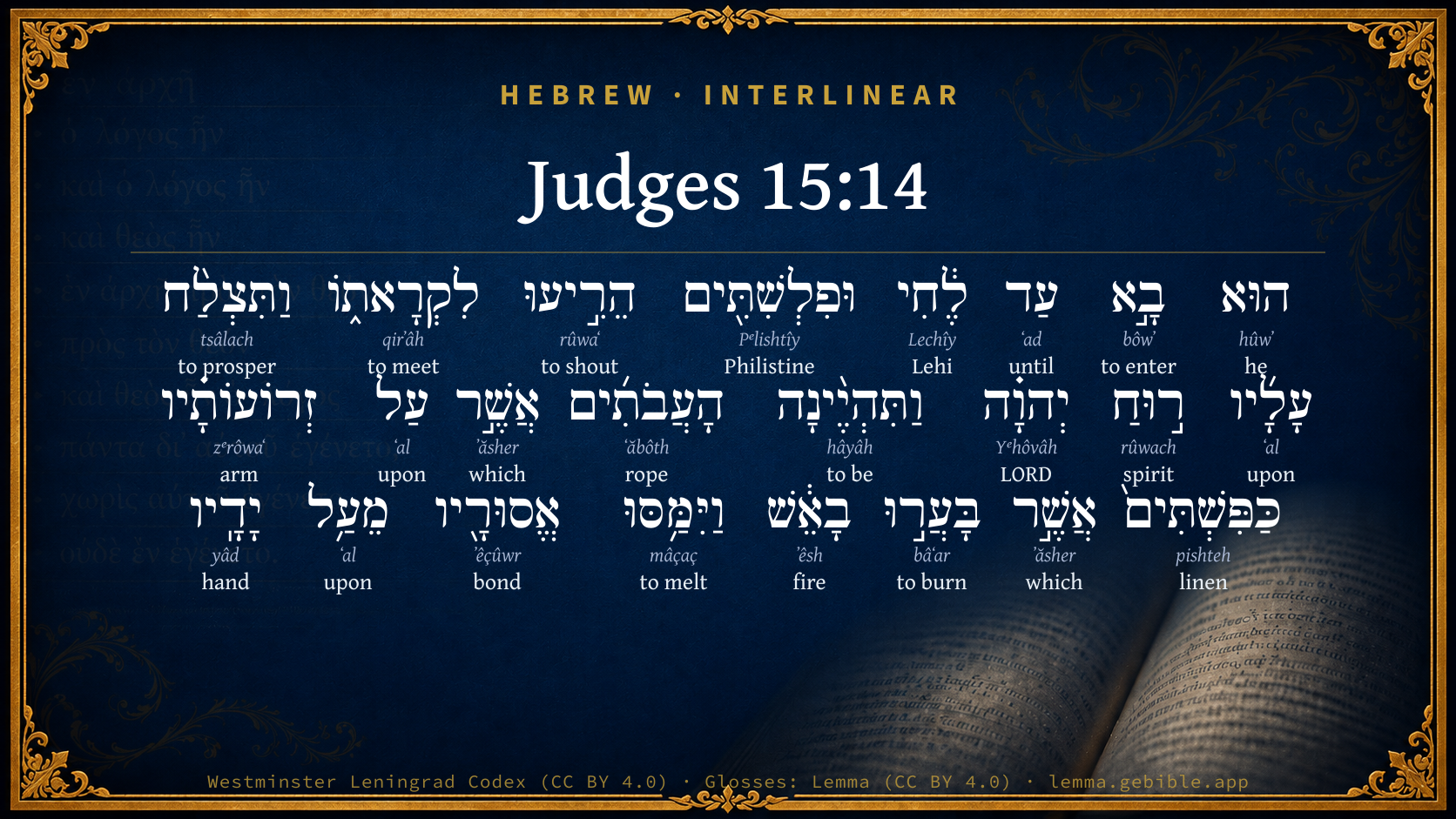
Hebrew (Westminster Leningrad Codex) Judges 15:14 appears in the Hebrew Old Testament. The text above is from the Westminster Leningrad Codex. Each word links to its Strong’s number, a concise gloss, and parsing drawn from the Open Scriptures Hebrew Bible morphology. Click any word for its full Brown-Driver-Briggs (BDB) entry.
Download image
Cite this verse

Judges 15:14 (World English Bible). Public Domain. Lemma interlinear Bible study tool, https://lemma.gebible.app/v/judges/15/14.

Show BibTeX & RIS
BibTeX
RIS
English Translation
When he came to Lehi, the Philistines shouted as they met him: and the Spirit of Yahweh came mightily on him, and the ropes that were on his arms became as flax that was burnt with fire, and his bands dropped from off his hands.
World English Bible · Public Domain
Highlights
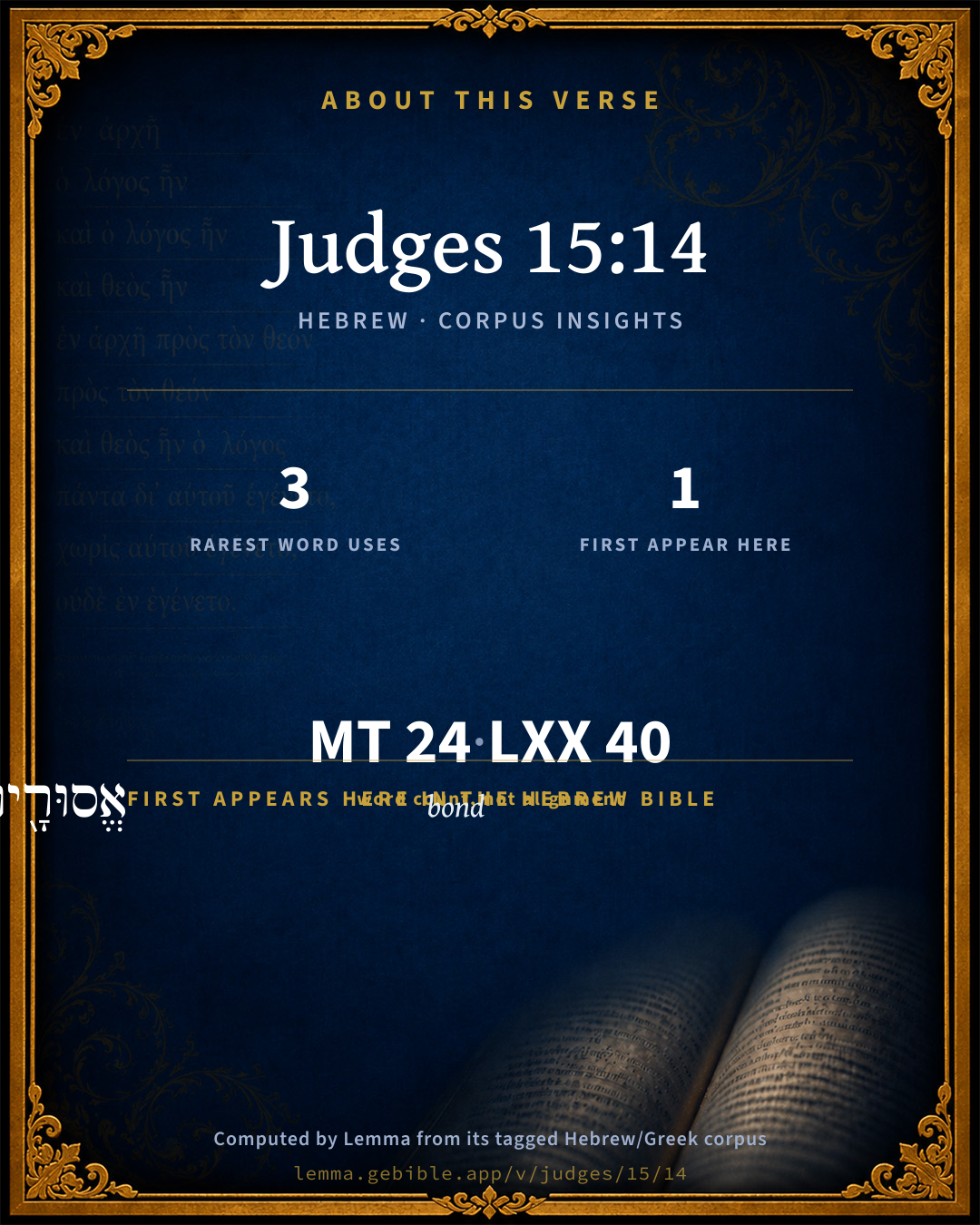
  • 1 first appearance in the Hebrew Bible
Full analysis ↓
Download a study sheet

One document with this verse’s original text, its word-by-word gloss line, the meaning frame, cross-references with their text, attributed commentary, and full source and license credits — printable, and it pastes into notes with its structure intact.

This verse Autodidact and up

Study sheet (.html) Plain text (.txt)

A passage Seminary Student

Up to 50 verses in one chapter. A passage sheet keeps up to 6 commentary sources and 12 cross-references per verse, in the order this page ranks them, and says so on the sheet whenever that leaves anything out. Ask for a single verse and you get the Autodidact verse sheet above.

Everything on this page stays free to read, with no account — the sheet is a download of what is already on screen, not access to it.

Want to remove ads? Support Godless Engineer
Compare translations 3

The same verse in 3 English versions, stacked beneath the original-language interlinear above. Click any original word for its lexicon entry.

Each is an independent rendering of the whole verse — the interlinear is not word-aligned to these translations.

Highlighted words mark where these versions differ — a whole-verse word diff, not a word-by-word alignment.

  • World English Bible Public Domain
    When he came to Lehi, the Philistines shouted as they met him: and the Spirit of Yahweh came mightily on him, and the ropes that were on his arms became as flax that was burnt with fire, and his bands dropped from off his hands.
  • King James Version Public Domain
    And when he came unto Lehi, the Philistines shouted against him: and the Spirit of the LORD came mightily upon him, and the cords that were upon his arms became as flax that was burnt with fire, and his bands loosed from off his hands.
  • unfoldingWord Literal Text CC BY-SA 4.0
    He came to Lehi, and the Philistines shouted to meet him. Then the Spirit of Yahweh rushed on him, and the ropes that on his arms became like flax that they burn with fire, and his bonds melted from on his hands.

unfoldingWord Literal Text — © unfoldingWord, licensed CC BY-SA 4.0. Word-aligned USFM3 via Door43 (git.door43.org/unfoldingWord/en_ult).

Versions to compare (up to 4)

3 of 4 selected

Show all 18 translations

Every available English version of this verse, each an independent rendering of the whole verse.

  • World English Bible Public Domain
    When he came to Lehi, the Philistines shouted as they met him: and the Spirit of Yahweh came mightily on him, and the ropes that were on his arms became as flax that was burnt with fire, and his bands dropped from off his hands.
  • Berean Standard Bible Public Domain
    When Samson arrived in Lehi, the Philistines came out shouting against him. And the Spirit of the LORD came mightily upon him. The ropes on his arms became like burnt flax, and the bonds broke loose from his hands.
  • Majority Standard Bible Public Domain
    When Samson arrived in Lehi, the Philistines came out shouting against him. And the Spirit of the LORD came mightily upon him. The ropes on his arms became like burnt flax, and the bonds broke loose from his hands.
  • King James Version Public Domain
    And when he came unto Lehi, the Philistines shouted against him: and the Spirit of the LORD came mightily upon him, and the cords that were upon his arms became as flax that was burnt with fire, and his bands loosed from off his hands.
  • American Standard Version (1901) Public Domain
    When he came unto Lehi, the Philistines shouted as they met him: and the Spirit of Jehovah came mightily upon him, and the ropes that were upon his arms became as flax that was burnt with fire, and his bands dropped from off his hands.
  • Revised Version (1885) Public Domain
    When he came unto Lehi, the Philistines shouted as they met him: and the spirit of the LORD came mightily upon him, and the ropes that were upon his arms became as flax that was burnt with fire, and his bands dropped from off his hands.
  • Geneva Bible (1599) Public Domain
    When hee came to Lehi, the Philistims shouted against him, and the Spirite of the Lord came vpon him, and the cordes that were vpon his armes, became as flaxe that was burnt with fire: for the bandes loosed from his handes.
  • Douay-Rheims (1899) Public Domain
    Now when he was come to the place of the Jawbone, and the Philistines shouting went to meet him, the spirit of the Lord came strongly upon him: and as the flax is wont to be consumed at the approach of fire, so the bands with which he was bound were broken and loosed.
  • Young's Literal Translation Public Domain
    He hath come unto Lehi -- and the Philistines have shouted at meeting him -- and the Spirit of Jehovah prospereth over him, and the thick bands which `are' on his arms are as flax which they burn with fire, and his bands are wasted from off his hands,
  • Literal Standard Version CC BY-SA 4.0
    He has come to Lehi—and the Philistines have shouted at meeting him—and the Spirit of YHWH prospers over him, and the thick bands which [are] on his arms are as flax which they burn with fire, and his bands are melted from off his hands,
  • Unlocked Literal Bible CC BY-SA 4.0
    When he came to Lehi, the Philistines came shouting as they met him. Then Yahweh's Spirit came on him with power. The ropes on his arms became like burnt flax, and they fell off his hands.
  • unfoldingWord Literal Text CC BY-SA 4.0
    He came to Lehi, and the Philistines shouted to meet him. Then the Spirit of Yahweh rushed on him, and the ropes that on his arms became like flax that they burn with fire, and his bonds melted from on his hands.
  • Darby Bible Public Domain
    When he came to Lehi, the Philistines came shouting to meet him; and the Spirit of the LORD came mightily upon him, and the ropes which were on his arms became as flax that has caught fire, and his bonds melted off his hands.
  • World Messianic Bible Public Domain
    When he came to Lehi, the Philistines shouted as they met him. Then the LORD’s Spirit came mightily on him, and the ropes that were on his arms became as flax that was burned with fire; and his bands dropped from off his hands.
  • Webster's Bible Public Domain
    And when he came to Lehi, the Philistines shouted against him: and the Spirit of the LORD came mightily upon him, and the cords that were upon his arms became as flax that was burnt with fire, and his bands loosed from off his the hands.
  • Free Bible Version CC BY-SA 4.0
    When Samson got close to Lehi, the Philistines ran towards him, shouting at him. But the Spirit of the Lord swept over him, and the ropes tying his arms together became as weak as burnt flax, and his hands broke free.
  • Bible in Basic English Public Domain
    And when he came to Lehi, the Philistines came out, meeting him with loud cries; then the spirit of the Lord came rushing on him, and the cords on his arms became like grass which has been burned with fire, and the bands came falling off his hands.
  • JPS Tanakh (1917) Public Domain
    When he came unto Lehi, the Philistines shouted as they met him; and the spirit of the LORD came mightily upon him, and the ropes that were upon his arms became as flax that was burnt with fire, and his bands dropped from off his hands.

Literal Standard Version (2020), Covenant Press — licensed CC BY-SA 4.0. Text via the HelloAO Bible API (eBible.org). Unlocked Literal Bible (unfoldingWord) — licensed CC BY-SA 4.0. Text via the HelloAO Bible API (eBible.org). unfoldingWord Literal Text — © unfoldingWord, licensed CC BY-SA 4.0. Word-aligned USFM3 via Door43 (git.door43.org/unfoldingWord/en_ult). Free Bible Version, Dr. Jonathan Gallagher — licensed CC BY-SA 4.0. Text via the HelloAO Bible API (eBible.org).

Word by word

More ways to search: Search by grammar → Find every occurrence → Compare this word →

Practice this passage: Drill this verse → Learn its vocabulary →

לֶ֔חִי
Lechîy
H3896
“Lehi”
Noun, Proper
Part of Speech
Noun
Type
Proper
Full BDB Definition

Origin: a form of H3895

TWOT: None

Lehi = "jaw" - a place in Judah which must have been in the Shephelah, near the border of the hill-country of Judah; site uncertain - place is noted for being the location of Samson's killing of 1000 men with the jawbone of an ass
  1. הוּא hûwʼ H1931 “he” Pronoun, Personal, 3rd Person, Masculine, Singular
  2. בָ֣א bôwʼ H935 “entering” Verb, Qal, Participle Active, Masculine, Singular, Absolute
  3. עַד ʻad H5704 “until” Preposition
  4. וּפִלְשִׁתִּ֖ים Pᵉlishtîy H6430 “and · Philistines” Conjunction + Noun, Gentilic, Masculine, Plural, Absolute
  5. הֵרִ֣יעוּ rûwaʻ H7321 “to shout” Verb, Hiphil, Perfect, 3rd Person, Common, Plural
  6. לִקְרָאת֑וֹ qirʼâh H7125 “to meet · him” Preposition + Verb, Qal, Infinitive Construct + Suffix, Personal, 3rd Person, Masculine, Singular
  7. וַתִּצְלַ֨ח tsâlach H6743 “and · to prosper” Conjunction + Verb, Qal, Sequential Imperfect, 3rd Person, Feminine, Singular
  8. עָלָ֜יו ʻal H5921 “upon · him” Preposition + Suffix, Personal, 3rd Person, Masculine, Singular
  9. ר֣וּחַ rûwach H7307 “spirit of” Noun, Common, Both, Singular, Construct
  10. יְהוָ֗ה Yᵉhôvâh H3068 “LORD” Noun, Proper
  11. וַתִּהְיֶ֨ינָה hâyâh H1961 “and · to be” Conjunction + Verb, Qal, Sequential Imperfect, 3rd Person, Feminine, Plural
  12. הָעֲבֹתִ֜ים ʻăbôth H5688 “the · ropes” Particle, Definite Article + Noun, Common, Both, Plural, Absolute
  13. אֲשֶׁ֣ר ʼăsher H834 “which” Particle, Relative
  14. עַל ʻal H5921 “upon” Preposition
  15. זְרוֹעוֹתָ֗יו zᵉrôwaʻ H2220 “arms · his” Noun, Common, Both, Plural, Construct + Suffix, Personal, 3rd Person, Masculine, Singular
  16. כַּפִּשְׁתִּים֙ pishteh H6593 “like/as the · linen” Preposition, Determined + Noun, Common, Masculine, Plural, Absolute
  17. אֲשֶׁ֣ר ʼăsher H834 “which” Particle, Relative
  18. בָּעֲר֣וּ bâʻar H1197 “to burn” Verb, Qal, Perfect, 3rd Person, Common, Plural
  19. בָאֵ֔שׁ ʼêsh H784 “in/at the · fire” Preposition, Determined + Noun, Common, Both, Singular, Absolute
  20. וַיִּמַּ֥סּוּ mâçaç H4549 “and · to melt” Conjunction + Verb, Niphal, Sequential Imperfect, 3rd Person, Masculine, Plural
  21. אֱסוּרָ֖יו ʼêçûwr H612 “bonds · his” Noun, Common, Masculine, Plural, Construct + Suffix, Personal, 3rd Person, Masculine, Singular
  22. מֵעַ֥ל ʻal H5921 “from · upon” Preposition + Preposition
  23. יָדָֽיו yâd H3027 “hands · his” Noun, Common, Both, Dual, Construct + Suffix, Personal, 3rd Person, Masculine, Singular

About this verse

These counts appear in no published source. They are computed here, from the morphology-tagged text and Lemma’s own curated glosses. What Lemma adds →

24
words
21
distinct lemmas
Historical
section

Notable vocabulary

The rarest word here is לֶ֔חִי Lehi H3896 — appearing just 3 times in the whole Hebrew Bible.

First appearance in Scripture

This word makes its first canonical appearance in the Hebrew Bible here:

  • אֱסוּרָ֖יו bond H612

Shared distinctive vocabulary

לֶ֔חִי Lehi H3896 occurs in 3 verses of the Hebrew Bible. Also found in:

Grammatical profile

  • 7 verbs
  • 10 nouns
  • 1 pronoun
  • 4 prepositions
  • 2 particles

Verb forms

  • בָ֣א Qal · Participle Active
  • הֵרִ֣יעוּ Hiphil · Perfect
  • לִקְרָאת֑וֹ Qal · Infinitive Construct
  • וַתִּצְלַ֨ח Qal · Sequential Imperfect
  • וַתִּהְיֶ֨ינָה Qal · Sequential Imperfect
  • בָּעֲר֣וּ Qal · Perfect
  • וַיִּמַּ֥סּוּ Niphal · Sequential Imperfect

Repetition

Words recur within this verse — often emphatic in Hebrew:

  • עָלָ֜יו upon H5921 ×3
  • אֲשֶׁ֣ר which H834 ×2

Hebrew & Septuagint length

In English translation the verse runs 45 words from the Hebrew and 49 from the Septuagint (LXX English) — closely comparable.

A rough comparison of the two English renderings, which tokenize alike — not a word-level alignment.

Word counts can differ between the Hebrew and the Greek without any difference in meaning — e.g. the Hebrew direct-object marker אֵת has no separate Greek word, and Greek often adds the article ὁ.

In the original languages it is 24 Hebrew tokens and 40 Greek tokens — but the two are counted differently (Hebrew bundles its prefixes and suffixes into one token; the Greek is in lemma form), so that isn’t a like-for-like length.

Cross-references

18

Topical passages linked to Judges 15:14 in the Treasury of Scripture Knowledge — connected by theme and wording, ordered by reader-vote popularity; previews shown in the World English Bible.

  • Judges 14:19 The Spirit of Yahweh came mightily on him, and he went down to Ashkelon, and struck thirty men of them, and took their spoil, and gave the changes [of clothing] to those who declared the riddle. His anger was kindled, and he went up to his father's house.
  • Psalms 118:11 They surrounded me, yes, they surrounded me. In the name of Yahweh I indeed cut them off.
  • Judges 3:10 The Spirit of Yahweh came on him, and he judged Israel; and he went out to war, and Yahweh delivered Cushan Rishathaim king of Mesopotamia into his hand: and his hand prevailed against Cushan Rishathaim.
  • Judges 14:6 The Spirit of Yahweh came mightily on him, and he tore him as he would have torn a kid; and he had nothing in his hand: but he didn't tell his father or his mother what he had done.
  • 1 Samuel 11:6 The Spirit of God came mightily on Saul when he heard those words, and his anger was kindled greatly.
  • 1 Samuel 17:35 I went out after him, and struck him, and delivered it out of his mouth; and when he arose against me, I caught him by his beard, and struck him, and killed him.
  • Exodus 14:3 Pharaoh will say of the children of Israel, 'They are entangled in the land. The wilderness has shut them in.'
  • Exodus 14:5 It was told the king of Egypt that the people had fled; and the heart of Pharaoh and of his servants was changed towards the people, and they said, "What is this we have done, that we have let Israel go from serving us?"
  • Judges 5:30 Have they not found, have they not divided the spoil? A lady, two ladies to every man; To Sisera a spoil of dyed garments, A spoil of dyed garments embroidered, Of dyed garments embroidered on both sides, on the necks of the spoil?
  • Judges 16:9 Now she had liers-in-wait abiding in the inner chamber. She said to him, The Philistines are on you, Samson. He broke the cords, as a string of tow is broken when it touches the fire. So his strength was not known.
  • Judges 16:12 So Delilah took new ropes, and bound him therewith, and said to him, The Philistines are on you, Samson. The liers-in-wait were abiding in the inner chamber. He broke them off his arms like a thread.
  • Judges 16:24 When the people saw him, they praised their god; for they said, Our god has delivered into our hand our enemy, and the destroyer of our country, who has slain many of us.
  • 1 Samuel 4:5 When the ark of the covenant of Yahweh came into the camp, all Israel shouted with a great shout, so that the earth rang again.
  • Job 20:5 That the triumphing of the wicked is short, The joy of the godless but for a moment?
  • Psalms 18:34 He teaches my hands to war; So that my arms bend a bow of bronze.
  • Micah 7:8 Don't rejoice against me, my enemy. When I fall, I will arise. When I sit in darkness, Yahweh will be a light to me.
  • Zechariah 4:6 Then he answered and spoke to me, saying, "This is the word of Yahweh to Zerubbabel, saying, 'Not by might, nor by power, but by my Spirit,' says Yahweh of Hosts.
  • Philippians 4:3 Yes, I beg you also, true yoke-fellow, help these women, for they labored with me in the Gospel, with Clement also, and the rest of my fellow workers, whose names are in the book of life.

Cross-references courtesy of OpenBible.info (CC BY 4.0).

Hebrew and Greek witnesses Masoretic Hebrew ↔ Greek Septuagint

The same verse in the two great witnesses to the Old Testament, shown verse-for-verse.

These are two independent witnesses, not word-aligned to each other, and the Septuagint is shown in lemma (dictionary) form.

Hebrew Judges 15:14 Masoretic · Westminster Leningrad Codex

הוּא בָ֣א עַד לֶ֔חִי וּפִלְשִׁתִּ֖ים הֵרִ֣יעוּ לִקְרָאת֑וֹ וַתִּצְלַ֨ח עָלָ֜יו ר֣וּחַ יְהוָ֗ה וַתִּהְיֶ֨ינָה הָעֲבֹתִ֜ים אֲשֶׁ֣ר עַל זְרוֹעוֹתָ֗יו כַּפִּשְׁתִּים֙ אֲשֶׁ֣ר בָּעֲר֣וּ בָאֵ֔שׁ וַיִּמַּ֥סּוּ אֱסוּרָ֖יו מֵעַ֥ל יָדָֽיו

When he came to Lehi, the Philistines shouted as they met him: and the Spirit of Yahweh came mightily on him, and the ropes that were on his arms became as flax that was burnt with fire, and his bands dropped from off his hands.

World English Bible · Public Domain

Greek LXX Judges 15:14 Septuagint · lemma form

καί ἔρχομαι ἕως σιαγών καί ὁ ἀλλόφυλος ἀλαλάζω καί τρέχω εἰς συνάντησις αὐτός καί ἅλλομαι ἐπί αὐτός πνεῦμα κύριος καί γίγνομαι ὁ καλώδιον ὁ ἐπί βραχίων αὐτός ὡσεί στιππύον ὅς ἐκκαίω ἐν πῦρ καί τήκω δεσμός αὐτός ἀπό χείρ αὐτός

And they came to Lechi: and the Philistines shouted, and ran to meet him: and the Spirit of the Lord came mightily upon him, and the ropes that were upon his arms became as tow which is burnt with fire; and his bonds were consumed from off his hands.

LXX2012 (modern English Septuagint) · Public Domain

On this verse, Ellicott's Commentary for English Readers discusses the Septuagint’s reading. Read the note in Commentary ↓

Hebrew: Westminster Leningrad Codex (CC BY 4.0). Greek: Septuagint (public domain); English from LXX2012 (modern English Septuagint) (Public Domain). How the Septuagint differs from the Hebrew →

Targum (Aramaic paraphrase)

1

The Targum is the ancient Jewish Aramaic paraphrase of the Hebrew Scriptures — an interpretive translation, not the Hebrew text itself. Onkelos (literal) and Pseudo-Jonathan (expansive) render the Torah, and Jonathan the Prophets. Coverage is partial: where no permissively-licensed English translation exists for a verse, only the Aramaic is shown. This is verse-level text, not a word-by-word alignment to the Hebrew.

  1. Targum Jonathan Prophets (Joshua–Malachi)
    הוּא אֲתָא עַד לֶחִי וּפְלִשְׁתָּאֵי יַבִּיבוּ לָקֳדָמוּתֵיהּ וּשְׁרַת עֲלוֹהִי רוּחַ גְבוּרָא מִן קֳדָם יְיָ וַהֲוָאָה גְדִילָתָא דְעַל דַרְעוֹהִי כְּכִתָּנָא דְאָרַח בֵּיהּ נוּרָא וְאִתְמְסִיוּ אֱסָרוֹהִי מֵעַל יְדוֹהִי:

    (no public-domain English translation for this verse)

    Targum Jonathan — Aramaic: “Mikraot Gedolot” (public domain). English: “Sefaria Community Translation” (CC0 1.0 (public-domain dedication)); “London "Chaldee Paraphrase," 1871” (public domain). Text via Sefaria.

Commentary

Notes on Judges 15:14 from classic Christian and Jewish commentators (each source and its license shown beneath its notes). The classic Christian expositions comment on the surrounding passage and are grouped to its opening verse, so a note may address several verses; the Jewish commentaries on the Tanakh (Rashi and others) are per-verse, so they appear only where the commentator wrote on this verse.

Lemma curates 59 commentaries, every one of them public domain or Creative Commons licensed, each selected and text-cleaned for this edition rather than reprinted as found. About our sources →

Trapp's Complete Commentary

John Trapp

Jdg 15:14 [And] when he came unto Lehi, the Philistines shouted against him: and the Spirit of the LORD came mightily upon him, and the cords that [were] upon his arms became as flax that was burnt with fire, and his bands loosed from off his hands.

Ver. 14. The Philistines shouted against him.] But ere long Samson made them change their note, and turn their crowing into crying. Thus the hope of the wicked perisheth - their Hilary-term is very short. "In the transgression of an evil man there is a snare," - or, a cord, to strangle his joy with, - "but the righteous sing and rejoice." {Pro 29:6}

Became as flax.] Similia funibus ex lino ustulato.

And his bands loosed.] Heb., Melted; dissoluta dissilierunt.

John Trapp, A Commentary or Exposition upon All the Books of the Old and New Testament (1647–1656) — public domain. Text from a community e-Sword module.

Joseph Benson's Commentary

Jdg 15:14. The Philistines shouted against him — Because they had now, as they supposed, their enemy in their hands. The cords became as flax, &c. — As easily broken by him. His bands loosed from off his hands — Hebrew, were melted; that is, were dissolved as things which are melted in the fire. “This,” says Henry, “typified the resurrection of Christ, by the power of the Spirit of holiness. In this he loosed the bands of death, it being impossible he should be holden of them. And thus he triumphed over the power of darkness, which had shouted against him.”

Joseph Benson's Commentary on the Old and New Testaments (1811–1818) — public domain. Text from a community e-Sword module.

Adam Clarke's Commentary

Verse 14. When he came unto Lehi] This was the name of the place to which they brought him, either to put him to death, or keep him in perpetual confinement.

Shouted against him] His capture was a matter of public rejoicing.

Adam Clarke's Commentary on the Bible (1810–1826) — public domain. Text from a community e-Sword/MySword module.

Ellicott's Commentary for English Readers

(14) Shouted against him.—Rather, cheered as they came to meet him (LXX., ἠλάλαξαν εἰς συνάντησιν αὐτοῦ; Vulg., cum vociferantes occurrissent ei). The verb heerioo is an onomatopœia, like our “hurrah.” This was not a war cry, as in 1Sa_17:20, but a shout of

joy.

The cords that were upon his arms became as flax.—It seems clear that the poetical colour and rhythmic structure of the narrative are influenced by some poem which described the deeds of Samson.

That was burnt with fire.—In both the LXX. and the Vulg. we find the metaphor, “flax when it has smelt the fire.”

His bands loosed.—Literally, melted, or flowed off, a highly poetic expression. A legend of Hercules in Egypt, who suddenly burst his bonds and slew the Egyptians who were leading him to sacrifice, may possibly have been coloured by this event in the life of Samson. (See Rawlinson’s Herodotus, 2, p. 70.)

A Bible Commentary for English Readers, edited by Charles John Ellicott (1878–1897) — public domain. Text from a community e-Sword module.

The Cambridge Bible for Schools and Colleges

gen. ed. J. J. S. Perowne

14. See on Jdg_14:19.

The Cambridge Bible for Schools and Colleges (gen. ed. J. J. S. Perowne; Cambridge University Press, 1878–1918) — public domain. Text from a community e-Sword module.

John Gill's Exposition

And when he came unto Lehi,.... The place which was afterwards so called, from what happened there at this time, and where the Philistines were spread, Jdg 15:9 this, according to Bunting (k), was six miles from Etam:

the Philistines shouted against him: for joy that they had got him into their hands, and in the circumstances he was, being bound, so that they had nothing to fear from him:

and the Spirit of the Lord came mightily upon him: as it at times did, and had done before; the Targum is,"the Spirit of might from the Lord,''which gave him courage and resolution of mind, and great strength of body, even while he was speaking, as a token of the wonders God more than he had at other times:

and the cords that were upon his arms became as flax that was burnt with fire; as easily parted as the flax when fire takes it, which is consumed at once:

and his bonds loosed off from his hands; by which it appears that both arms and hands were bound with the cords; his arms were pinioned close to his body, as well as his hands were tied together; and these, as in the original, "melted away" (l), like wax before the fire, or snow before the sun, so easily were these bands separated from him; this may be an emblem of Christ's loosing himself from the cords of death, Act 2:24.

(k) Travels, p. 116. (l) "diffuxerunt", Tigurine version; "liquefacta sunt", Piscator.

John Gill's Exposition of the Whole Bible (1746–1763) — public domain (CC PDM 1.0). Text via the HelloAO Bible API.

Albert Barnes' Notes on the Bible

The cords ... became as flax ... - i. e. were as weak against his strength as half-burned flax which yields to the least pressure.

Albert Barnes' Notes on the Bible (1834–1885) — public domain. Text from a community e-Sword/MySword module.

Haydock's Catholic Bible Commentary

Bone. Hebrew, "Lechi," as it was called after the slaughter made by Samson, ver. 15. It is about 20 miles to the east of Ascalon. (Calmet) --- Approach: literally, "the smell." This expression is often used to denote burning. (Septuagint; Chap xvi. 9.; Daniel iii. 94.)

George Leo Haydock (1774–1849), Haydock's Catholic Family Bible and Commentary, 1859 edition — public domain. Excludes Psalms (Douay-Rheims chapter numbering differs from Protestant) and Deuterocanonical books (Catholic canon only).

Matthew Poole's English Annotations

The Philistines shouted against him, for joy and triumph, because they had now their great enemy, as they supposed, in their hands.

His bands loosed, Heb. were melted, i.e. were dissolved, as things are which are melted in the fire.

Matthew Poole's English Annotations on the Holy Bible (1683–1685) — public domain. Text from a community e-Sword/MySword module.

Whedon's Commentary on the Bible

Daniel D. Whedon

14. Shouted against him — Raised a joyful shout of triumph to meet him as a bound captive and prisoner. They exulted as if their victory was now complete.

The cords… his bands — “The description rises,” says Keil, “to a poetical parallelism, to depict the triumph which Samson celebrated over the Philistines in the power of the Spirit of Jehovah.”

Daniel D. Whedon (gen. ed.), Commentary on the Old and New Testaments (1874–1909) — public domain. Text from a community e-Sword module.

The Pulpit Commentary

When he came, i.e. as soon as he was come to Lehi, where the Philistine camp was (ver. 9). Shouted against him. Rather, shouted as they ran out to meet him. It expresses concisely the double action of their all going out to meet him, and shouting with joy when they saw him bound and, as they thought, in their power.

HOMILIES BY A.F. MUIR. Vers. 14-16. Imperfect means made effectual by Divine inspiration.

It was but the jawbone of an ass, yet it slew as many as might have fallen in a battle.

I IN THE CONFLICTS OF TRUTH IT IS OF CHIEF CONSEQUENCE THAT WE BE ON THE SIDE OF TRUTH, AND ANIMATED BY THE SPIRIT OF GOD.

II THROUGH GOD"S BLESSING THE GRANDEST RESULTS HAVE BEEN PRODUCED BY THE RUDEST AND SIMPLEST MEANS. The preaching of the gospel by unlettered fishermen. "The solitary monk that shook the world" with the disused weapon in God"s armoury. The "simple gospel" and the evils of our age.

III NOTWITHSTANDING OUTWARD ADVANTAGES, THE ENEMIES OF GOD ARE CERTAIN IN THE END TO BE DISCOMFITED.

IV THE ABSOLUTENESS AND SPLENDOUR OF SPIRITUAL ACHIEVEMENTS. Pentecost; missionary triumphs; the song of Moses and of the Lamb. M.

The Pulpit Commentary (1880–1919), ed. H.D.M. Spence-Jones & Joseph S. Exell — public domain. Text from a community e-Sword module.

John Wesley's Explanatory Notes

Shouted - Because they had now their enemy, as they supposed, in their hands. Loosed - Hebrew. were melted; that is, were dissolved, as things which are melted in the fire. This typified the resurrection of Christ, by the power of the Spirit of holiness. In this he loosed the bands of death, it being impossible he should be holden of them. And thus he triumphed over the powers of darkness, which had shouted against him.

John Wesley, Explanatory Notes Upon the Whole Bible (1754–1765) — public domain. Text via the GEBible commentary corpus.

unfoldingWord translationNotes

Door43 World Missions Community

When he came

Samson was not travelling alone, he was being led by the men who had tied him with ropes. AT: "When they came" (See: Assumed Knowledge and Implicit Information)

Lehi

This is the name of a town in Judah. See how you translated this in Judges 15:9.

came on him with power

The phrase "came on" means that Yahweh's Spirit influenced Samson. In this case, he made him very strong. AT: "made Samson very strong" (See: Idiom)

The ropes on his arms became like burnt flax

Samson easily broken the ropes that bound his hands. The author describes how easily he broke the ropes by saying it was as if they had become burnt flax. AT: "He snapped the ropes on his arms as easily as if they had been stalks of burned flax" (See: Simile)

flax

fibers from the flax plant used for making threads and cloth

translationWords

Philistines

Yahweh

Holy Spirit

power

unfoldingWord translationNotes — © Distant Shores Media and the Door43 World Missions Community, licensed CC BY-SA 4.0. Source: git.door43.org/Door43/en_tn.

Rashi

Rabbi Shlomo Yitzchaki (Rashi)

The spirit of Adonoy. A spirit of power, emanating from Adonoy.

His bonds which tied him down.

Rashi on the Tanakh — English translations: “The Judaica Press complete Tanach with Rashi, translated by A. J. Rosenberg” (CC BY 4.0); “Pentateuch with Rashi's commentary by M. Rosenbaum and A.M. Silbermann, 1929-1934” (public domain); “The Metsudah Tanach series, Lakewood, N.J” (CC BY 4.0); and “The Book of Joshua, Metsudah Publications, 1997” (CC BY 4.0). Text via Sefaria.

Lesson kit

Teaching starters — assembled from the data on this page, not authored interpretation. Every prompt links to the verse data it draws on. Edit before teaching.

Judges, in the Historical, opens this verse with 24 words (21 distinct Hebrew lemmas). Its most distinctive word is Lechîy (“Lehi”). A historical commentator’s framing appears above. Read the whole chapter for the surrounding context.

Discussion questions

  1. What does “Lehi” (Lechîy) contribute to the verse as a whole?
  2. This is the first place “bond” appears in Scripture (first appears here). What does its debut here establish?
  3. How does Judges 15:9, which shares the word «Lehi», read alongside this verse?
  4. What does the repetition of “upon” (3× in this one verse) do in this verse?
  5. The translations on this page render this verse differently — a whole-verse word diff, not a word-by-word alignment. What might account for the different wordings?
  6. «בָ֣א» is a Qal Participle Active verb. How does that grammatical form shape the action described?
  7. Compare how Trapp's Complete Commentary and Joseph Benson's Commentary read this verse. Where do they agree or differ?

Things to notice

Reading settings

Reading text

Shown beneath each verse's original-language words.

Old Testament
Old Testament edition

Read the OT as the Masoretic Hebrew (MT) or the Greek Septuagint (LXX).

English shown for the Greek Septuagint (in the Hebrew ↔ Greek comparison).

Comparing translations? Open the Compare panel on any verse page to stack up to four side by side.