
Psalms 18:12

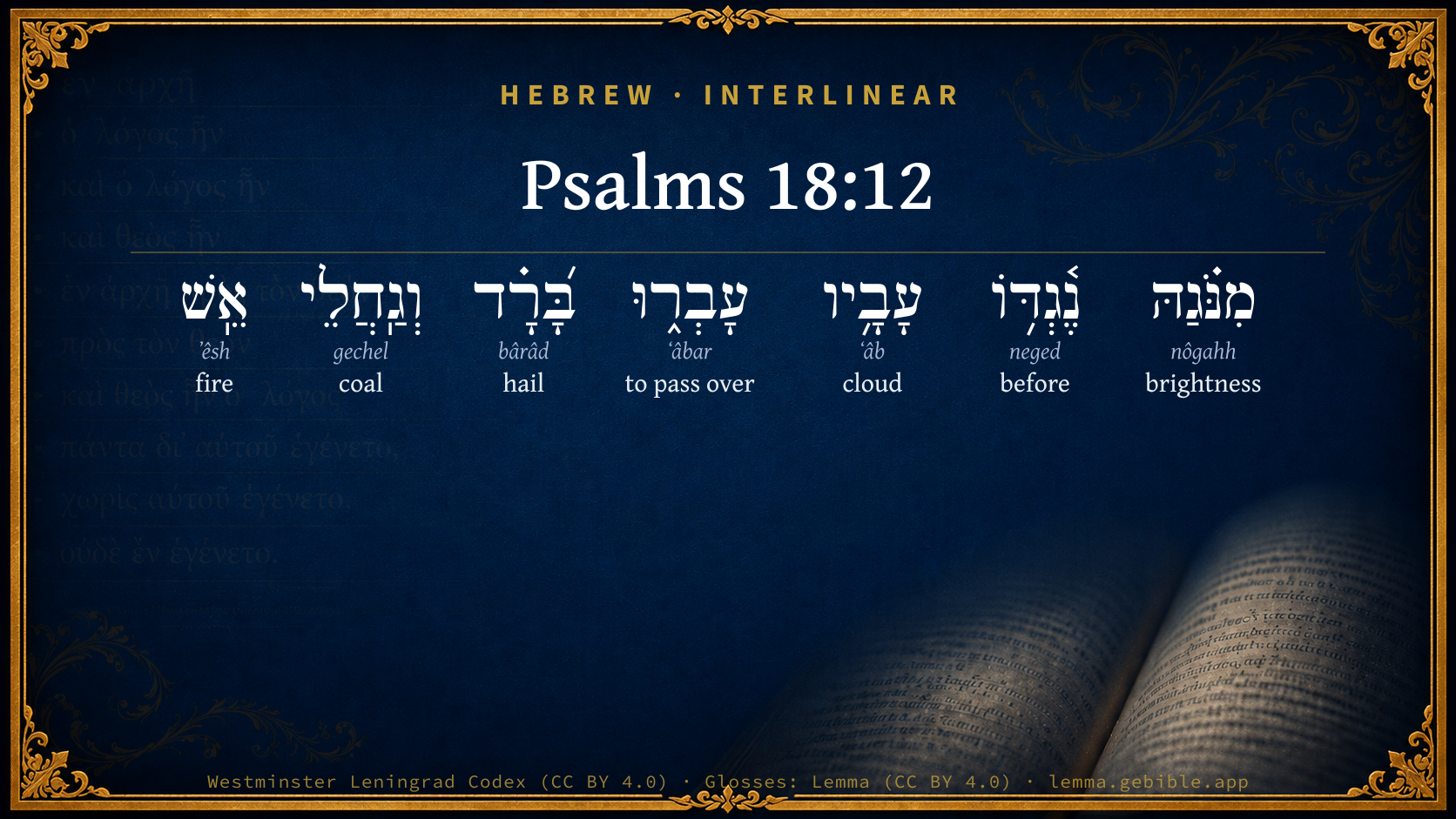
Hebrew (Westminster Leningrad Codex) Psalms 18:12 appears in the Hebrew Old Testament. The text above is from the Westminster Leningrad Codex. Each word links to its Strong’s number, a concise gloss, and parsing drawn from the Open Scriptures Hebrew Bible morphology. Click any word for its full Brown-Driver-Briggs (BDB) entry.
Download image
Cite this verse

Psalms 18:12 (World English Bible). Public Domain. Lemma interlinear Bible study tool, https://lemma.gebible.app/v/psalms/18/12.

Show BibTeX & RIS
BibTeX
RIS
English Translation
At the brightness before him his thick clouds passed, Hailstones and coals of fire.
World English Bible · Public Domain
Download a study sheet

One document with this verse’s original text, its word-by-word gloss line, the meaning frame, cross-references with their text, attributed commentary, and full source and license credits — printable, and it pastes into notes with its structure intact.

This verse Autodidact and up

Study sheet (.html) Plain text (.txt)

A passage Seminary Student

Up to 50 verses in one chapter. A passage sheet keeps up to 6 commentary sources and 12 cross-references per verse, in the order this page ranks them, and says so on the sheet whenever that leaves anything out. Ask for a single verse and you get the Autodidact verse sheet above.

Everything on this page stays free to read, with no account — the sheet is a download of what is already on screen, not access to it.

Want to remove ads? Support Godless Engineer
Compare translations 3

The same verse in 3 English versions, stacked beneath the original-language interlinear above. Click any original word for its lexicon entry.

Each is an independent rendering of the whole verse — the interlinear is not word-aligned to these translations.

Highlighted words mark where these versions differ — a whole-verse word diff, not a word-by-word alignment.

  • World English Bible Public Domain
    At the brightness before him his thick clouds passed, Hailstones and coals of fire.
  • King James Version Public Domain
    At the brightness that was before him his thick clouds passed, hail stones and coals of fire.
  • unfoldingWord Literal Text CC BY-SA 4.0
    From the brightness before him, hailstones and coals of fire broke through his thick clouds.

unfoldingWord Literal Text — © unfoldingWord, licensed CC BY-SA 4.0. Word-aligned USFM3 via Door43 (git.door43.org/unfoldingWord/en_ult).

Versions to compare (up to 4)

3 of 4 selected

Show all 18 translations

Every available English version of this verse, each an independent rendering of the whole verse.

  • World English Bible Public Domain
    At the brightness before him his thick clouds passed, Hailstones and coals of fire.
  • Berean Standard Bible Public Domain
    From the brightness of His presence His clouds advanced—hailstones and coals of fire.
  • Majority Standard Bible Public Domain
    From the brightness of His presence His clouds advanced—hailstones and coals of fire.
  • King James Version Public Domain
    At the brightness that was before him his thick clouds passed, hail stones and coals of fire.
  • American Standard Version (1901) Public Domain
    At the brightness before him his thick clouds passed, Hailstones and coals of fire.
  • Revised Version (1885) Public Domain
    At the brightness before him his thick clouds passed, hailstones and coals of fire.
  • Geneva Bible (1599) Public Domain
    At the brightnes of his presence his clouds passed, haylestones and coles of fire.
  • Douay-Rheims (1899) Public Domain
    And he made darkness his covert, his pavilion round about him: dark waters in the clouds of the air.
  • Young's Literal Translation Public Domain
    From the brightness over-against Him His thick clouds have passed on, Hail and coals of fire.
  • Literal Standard Version CC BY-SA 4.0
    From the brightness before Him His thick clouds have passed on, || Hail and coals of fire.
  • Unlocked Literal Bible CC BY-SA 4.0
    Hailstones and coals of fire fell from the lightning before him.
  • unfoldingWord Literal Text CC BY-SA 4.0
    From the brightness before him, hailstones and coals of fire broke through his thick clouds.
  • Darby Bible Public Domain
    From the brightness before him his thick clouds passed forth: hail and coals of fire.
  • World Messianic Bible Public Domain
    At the brightness before him his thick clouds passed, hailstones and coals of fire.
  • Webster's Bible Public Domain
    \\18:11\\He made darkness his secret place; his pavilion around him were dark waters and thick clouds of the skies.
  • Free Bible Version CC BY-SA 4.0
    Hailstones and burning coals flew out from his brightness, passing through his thick clouds.
  • Bible in Basic English Public Domain
    Before his shining light his dark clouds went past, raining ice and fire.
  • JPS Tanakh (1917) Public Domain
    (18-13) At the brightness before Him, there passed through His thick clouds hailstones and coals of fire.

Literal Standard Version (2020), Covenant Press — licensed CC BY-SA 4.0. Text via the HelloAO Bible API (eBible.org). Unlocked Literal Bible (unfoldingWord) — licensed CC BY-SA 4.0. Text via the HelloAO Bible API (eBible.org). unfoldingWord Literal Text — © unfoldingWord, licensed CC BY-SA 4.0. Word-aligned USFM3 via Door43 (git.door43.org/unfoldingWord/en_ult). Free Bible Version, Dr. Jonathan Gallagher — licensed CC BY-SA 4.0. Text via the HelloAO Bible API (eBible.org).

Word by word

More ways to search: Search by grammar → Find every occurrence → Compare this word →

Practice this passage: Drill this verse → Learn its vocabulary →

About this verse

These counts appear in no published source. They are computed here, from the morphology-tagged text and Lemma’s own curated glosses. What Lemma adds →

7
words
7
distinct lemmas
Wisdom
section

Notable vocabulary

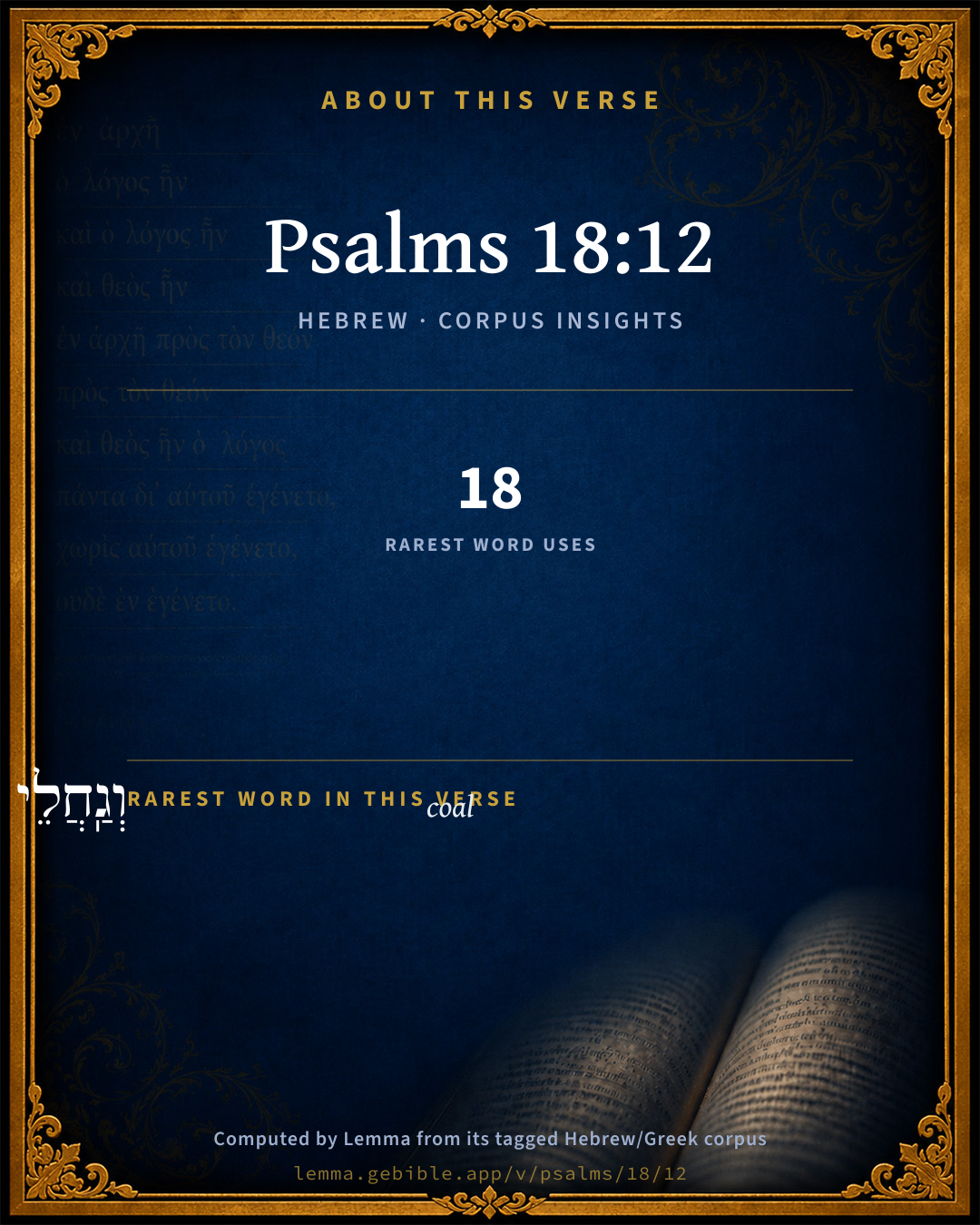
The rarest word here is וְגַֽחֲלֵי coal H1513 — appearing just 18 times in the whole Hebrew Bible.

Shared distinctive vocabulary

וְגַֽחֲלֵי coal H1513 occurs in 18 verses of the Hebrew Bible. Also found in:

Grammatical profile

  • 1 verb
  • 5 nouns
  • 1 preposition

Verb forms

  • עָבְר֑וּ Qal · Perfect

Hebrew & Septuagint length

In English translation the verse runs 14 words from the Hebrew and 13 from the Septuagint (LXX English) — closely comparable.

A rough comparison of the two English renderings, which tokenize alike — not a word-level alignment.

Word counts can differ between the Hebrew and the Greek without any difference in meaning — e.g. the Hebrew direct-object marker אֵת has no separate Greek word, and Greek often adds the article ὁ.

Cross-references

9

Topical passages linked to Psalms 18:12 in the Treasury of Scripture Knowledge — connected by theme and wording, ordered by reader-vote popularity; previews shown in the World English Bible.

  • Joshua 10:11 It happened, as they fled from before Israel, while they were at the descent of Beth Horon, that Yahweh cast down great stones from the sky on them to Azekah, and they died: they were more who died with the hailstones than they whom the children of Israel killed with the sword.
  • Revelation 16:21 Great hailstones, about the weight of a talent, came down out of the sky on people. People blasphemed God because of the plague of the hail, for this plague is exceedingly severe.
  • Exodus 9:23–24 Moses stretched forth his rod toward the heavens, and Yahweh sent thunder, hail, and lightning flashed down to the earth. Yahweh rained hail on the land of Egypt.
  • Matthew 17:2 He was transfigured before them. His face shone like the sun, and his garments became as white as the light.
  • Matthew 17:5 While he was still speaking, behold, a bright cloud overshadowed them. Behold, a voice came out of the cloud, saying, "This is my beloved Son, in whom I am well pleased. Listen to him."
  • 2 Samuel 22:13–15 At the brightness before him Coals of fire were kindled.
  • Psalms 97:3–4 A fire goes before him, And burns up his adversaries on every side.
  • Psalms 104:2 He covers himself with light as with a garment. He stretches out the heavens like a curtain.
  • Habakkuk 3:4–5 His splendor is like the sunrise. Rays shine from his hand, where his power is hidden.

Cross-references courtesy of OpenBible.info (CC BY 4.0).

Hebrew and Greek witnesses Masoretic Hebrew ↔ Greek Septuagint

The same verse in the two great witnesses to the Old Testament, shown verse-for-verse.

You’re reading Greek Psalm 17 (Hebrew Psalm 18). The Septuagint counts the superscription, so verse numbers can differ from the Hebrew — chapter-level alignment, not verse-by-verse. Numbering follows Rahlfs.

These are two independent witnesses, not word-aligned to each other, and the Septuagint is shown in lemma (dictionary) form.

Hebrew Psalms 18:12 Masoretic · Westminster Leningrad Codex

מִנֹּ֗גַהּ נֶ֫גְדּ֥וֹ עָבָ֥יו עָבְר֑וּ בָּ֝רָ֗ד וְגַֽחֲלֵי אֵֽשׁ

At the brightness before him his thick clouds passed, Hailstones and coals of fire.

World English Bible · Public Domain

Greek LXX Greek Psalm 17:12 Septuagint · lemma form

καί τίθημι σκότος ἀποκρυφή αὐτός κύκλος αὐτός ὁ σκηνή αὐτός σκοτεινός ὕδωρ ἐν νεφέλη ἀήρ

At the brightness before him the clouds passed, hail and coals of fire.

LXX2012 (modern English Septuagint) · Public Domain

On this verse, Ellicott's Commentary for English Readers discusses the Septuagint’s reading. Read the note in Commentary ↓

Hebrew: Westminster Leningrad Codex (CC BY 4.0). Greek: Septuagint (public domain); English from LXX2012 (modern English Septuagint) (Public Domain). How the Septuagint differs from the Hebrew →

Commentary

Notes on Psalms 18:12 from classic Christian and Jewish commentators (each source and its license shown beneath its notes). The classic Christian expositions comment on the surrounding passage and are grouped to its opening verse, so a note may address several verses; the Jewish commentaries on the Tanakh (Rashi and others) are per-verse, so they appear only where the commentator wrote on this verse.

Lemma curates 59 commentaries, every one of them public domain or Creative Commons licensed, each selected and text-cleaned for this edition rather than reprinted as found. About our sources →

John Gill's Exposition

The Lord also thundered in the heavens,.... By his apostles and ministers, some of which were Boanergeses, sons of thunder, whose ministry was useful to shake the consciences of men, and bring them to a sense of themselves, Mar 3:17;

and the Highest gave his voice; the same with thunder; for thunder is often called the voice of the Lord, Job 37:5; compare with this Psa 68:11; the Targum interprets it, "he lifted up his word"; the same effects as before follow,

hail stones and coals of fire; See Gill on Psa 18:12.

John Gill's Exposition of the Whole Bible (1746–1763) — public domain (CC PDM 1.0). Text via the HelloAO Bible API.

Trapp's Complete Commentary

John Trapp

Psa 18:12 At the brightness [that was] before him his thick clouds passed, hail [stones] and coals of fire.

Ver. 12. At the brightness that was before him, &c.] i.e. At his bright presence, his thick clouds (wherein he was enveloped) passed, or did cleave, as it were, in sunder; whence came hailstones mixed with coals of fire, or lightnings out of the clouds; which God maketh at once airy seas and airy furnaces; fetching fire out of the midst of water, and hard stone out of the midst of thin vapours.

John Trapp, A Commentary or Exposition upon All the Books of the Old and New Testament (1647–1656) — public domain. Text from a community e-Sword module.

Joseph Benson's Commentary

Psa 18:12. At the brightness that was before him, &c. — Schultens, Waterland, and some others, translate this verse, At his lightning, his clouds swelled and burst out into hail-stones and balls of fire. The meaning is, that through the lightning his clouds fermented, that is, swelled, and, as it were, boiled over, being rarefied by the heat. In the former part of this description, the clouds are represented as condensed, heavy, and lowering, ready to burst out with all the fury of a tempest; and here, as beginning to disburden and discharge themselves, by the eruption of the lightning in fire, flames, and hail-stones mixed. The abrupt manner in which the burning coals and hail-stones are mentioned, points out the sudden and impetuous fall of them. The words rendered coals of fire here signify living, burning coals. Where the lightning fell it devoured all before it, and turned whatever it touched into burning embers. See Chandler and Dodd.

Joseph Benson's Commentary on the Old and New Testaments (1811–1818) — public domain. Text from a community e-Sword module.

J. A. Alexander on Psalms

Joseph Addison Alexander

13. (Psa 18:12). From the blaze before him his clouds passed—hail and coals of fire. The dark clouds which enveloped him are now described as penetrated by the light within. Passed, i. e. passed away, were dispelled. The last clause may be construed as an exclamation such as an eye-witness might have uttered. The combination is borrowed from Exo 9:24. (Compare Psa 78:47-48.) Hail, as an instrument of the divine vengeance, is also mentioned in Jos 10:11.

Joseph Addison Alexander, The Psalms Translated and Explained (1850) — public domain. Text from a community e-Sword module.

Jamieson, Fausset & Brown

Robert Jamieson, A. R. Fausset & David Brown

Out of this obscurity, which impresses the beholder with awe and dread, He reveals Himself by sudden light and the means of His terrible wrath (Jos 10:11; Psa 78:47).

Jamieson, Fausset & Brown — Commentary Critical and Explanatory on the Whole Bible (1871) — public domain (CC PDM 1.0). Text via the HelloAO Bible API.

Adam Clarke's Commentary

Verse 12. At the brightness that was before him his thick clouds passed] The word נגה nogah signifies the lightning. This goes before him: the flash is seen before the thunder is heard, and before the rain descends; and then the thick cloud passes. Its contents are precipitated on the earth, and the cloud is entirely dissipated.

Hail-stones and coals of fire.] This was the storm that followed the flash and the peal; for it is immediately added-

Adam Clarke's Commentary on the Bible (1810–1826) — public domain. Text from a community e-Sword/MySword module.

John Calvin's Commentaries

12. At the brightness, etc. The Psalmist again returns to the lightnings which, by dividing and as it were cleaving the clouds, lay open the heaven; and, therefore, he says, that the clouds of God (that is to say, those which he had set before him, in token of his anger, for the purpose of depriving men of the enjoyment of the light of his countenance) passed away at the brightness which was before him These sudden changes affect us with a much more lively sense of the power and agency of God than natural phenomena which move on in one uniform course. He adds, that there followed hail-storm and coals of fire; for when the thunder separates and rends asunder the clouds, it either breaks out in lightnings, or the clouds resolve themselves into hail.

John Calvin's Commentaries (1540-1563) — public domain. Text from the Calvin Translation Society English edition (1840s-50s) via the Christian Classics Ethereal Library (ccel.org). Calvin's coverage is partial (roughly two-thirds of the Bible); uncommented books and verses are honest gaps, never fabricated. The 19th-century editor's footnotes and remarks are omitted so the notes are faithfully Calvin's own voice.

Ellicott's Commentary for English Readers

(12) At the brightness.—This is obscure. Literally, From the brightness before him his clouds passed through (Heb., avar—LXX., διῆλθον; Vulg., transierunt) hail and fiery coals. In Samuel it is “From the brightness before him flamed fiery coals,” which is the description we should expect, and, doubtless, gives the sense we are to attach to our text. Through the dark curtain of clouds the lightnings dart like emanations from the Divine brightness which they hide. The difficulty arises from the position of avaiv, “his clouds,” which looks like a subject rather than an object to avrû. It has been conjectured, from comparison with Samuel, that the word has been inserted through error, from its likeness to the verb. If retained it must be rendered as object, “Out of the brightness of his presence there passed through his clouds hail and fiery coals.” And some obscurity of language is pardonable in a description of phenomena so overpowering and bewildering as “a tempest dropping fire.” A modern poet touches this feeling:—

“Then fire was sky, and sky fire,

And both one brief ecstasy,

Then ashes.”—R. BROWNING, Easter Day.

In the Authorised Version the thought is of a sudden clearing of the heavens, which is not true to nature, and the clause “hailstones and coals of fire” comes in as an exclamation, as in the next verse. But there it is probably an erroneous repetition, being wanting in Sam. and in the LXX. version of the psalm. Notice how the feeling of the terrible fury of the storm is heightened by the mention of “hail,” so rare in Palestine.

A Bible Commentary for English Readers, edited by Charles John Ellicott (1878–1897) — public domain. Text from a community e-Sword module.

The Cambridge Bible for Schools and Colleges

gen. ed. J. J. S. Perowne

12. The best rendering of this obscure verse seems to be:

From the brightness before him there passed through his thick clouds hailstones and coals of fire.

The flashes of lightning, accompanied by hail (Exo_9:23-24), are as it were rays of the “unapproachable light” in which He dwells, piercing through the dense clouds which conceal Him. The text in 2 Sam. which has only, “at the brightness before him coals of fire were kindled,” is evidently mutilated.

The Cambridge Bible for Schools and Colleges (gen. ed. J. J. S. Perowne; Cambridge University Press, 1878–1918) — public domain. Text from a community e-Sword module.

Albert Barnes' Notes on the Bible

At the brightness that was before him - From the flash - the play of the lightnings that seemed to go before him.

His thick clouds passed - or, vanished. They seemed to pass away. The light, the flash, the blaze, penetrated those clouds, and seemed to dispel, or to scatter them. The whole heavens were in a blaze, as if there were no clouds, or as if the clouds were all driven away. The reference here is to the appearance when the vivid flashes of lightning seem to penetrate and dispel the clouds, and the heavens seem to be lighted up with a universal flame.

Hail-stones - That is, hailstones followed, or fell.

And coals of fire - There seemed to be coals of fire rolling along the ground, or falling from the sky. In the corresponding place in 2Sa 22:13 the expression is, “Through the brightness before him were coals of fire kindled.” That is, fires were kindled by the lightning. The expression in the psalm is more terse and compact, but the reason of the change cannot be assigned.

Albert Barnes' Notes on the Bible (1834–1885) — public domain. Text from a community e-Sword/MySword module.

Matthew Poole's English Annotations

At his glorious and powerful appearance

his thick clouds passed away, i.e. vanished, (as this word is oft taken, as Psa 90:5,6; Isa 29:5; Hab 3:10) being dissolved into showers of hail-stones, &c.

Matthew Poole's English Annotations on the Holy Bible (1683–1685) — public domain. Text from a community e-Sword/MySword module.

The Treasury of David

Charles H. Spurgeon

Ver. 12. Suddenly the terrible artillery of heaven was discharged; the brightness of lightning lit up the clouds as with a glory proceeding from him who was concealed within the cloudy pavilion; and volleys of hailstones and coals of fire were hurled forth upon the enemy. The lightnings seemed to cleave the clouds and kindle them into a blaze, and then hailstones and flakes of fire with flashes of terrific grandeur terrified the sons of men.

Ver. 12. Coals of fire. The word signifies, living burning coals. Where the lightning fell, it devoured all before it, and burned whatever it touched into burning embers. Samuel Chandler.

None.

Psalms 18:13*

Charles H. Spurgeon's The Treasury of David (1869–1885) — public domain. Psalms only. Text from a community e-Sword/MySword module.

Whedon's Commentary on the Bible

Daniel D. Whedon

12. Up to this point, from Psa_18:7, we have a description of the prelude and portents of deliverance. Jehovah has now descended to the scene of action, and the dreadful battle begins.

At the brightness… before him—At the effulgence of his divine glory which preceded him.

His thick clouds passed—That is, the storm clouds charged with thunderbolts passed on to the point where they were to accomplish the judicial purpose of God.

Hail stones and coals of fire—The clouds were surcharged, armed, with hail and fire. The description is highly military.

Daniel D. Whedon (gen. ed.), Commentary on the Old and New Testaments (1874–1909) — public domain. Text from a community e-Sword module.

The Pulpit Commentary

At the brightness that was before him his thick clouds passed. The "brightness" intended is probably that of lightning. The "thick clouds" are riven and parted asunder for the lightning to burst forth. Then come, almost simultaneously, hail stones and coals of fire; i.e., hail like that which fell in Egypt before the Exodus, (Exo_9:22-34) when "there was hail, and fire mingled with the hail" (ver. 24) a fire which "ran along upon the ground," or some very unusual electrical phenomenon (see the comment on Exodus in the "Homiletic Commentary," p. 208).

The Pulpit Commentary (1880–1919), ed. H.D.M. Spence-Jones & Joseph S. Exell — public domain. Text from a community e-Sword module.

John Wesley's Explanatory Notes

At - His glorious and powerful appearance. Passed - Or, passed away, vanished, being dissolved into showers.

John Wesley, Explanatory Notes Upon the Whole Bible (1754–1765) — public domain. Text via the GEBible commentary corpus.

Rashi

Rabbi Shlomo Yitzchaki (Rashi)

the darkness of waters that are in the thick clouds of the skies are the darkness that is about Him. Lest you say that within the darkness there is no light, Scripture tells us: From the brightness before Him, and from within His partition, His thick clouds that are about Him are split, and hail and coals of fire pass through them.

Rashi on the Tanakh — English translations: “The Judaica Press complete Tanach with Rashi, translated by A. J. Rosenberg” (CC BY 4.0); “Pentateuch with Rashi's commentary by M. Rosenbaum and A.M. Silbermann, 1929-1934” (public domain); “The Metsudah Tanach series, Lakewood, N.J” (CC BY 4.0); and “The Book of Joshua, Metsudah Publications, 1997” (CC BY 4.0). Text via Sefaria.

Lesson kit

Teaching starters — assembled from the data on this page, not authored interpretation. Every prompt links to the verse data it draws on. Edit before teaching.

Psalms, in the Wisdom, opens this verse with 7 words (7 distinct Hebrew lemmas). Its most distinctive word is gechel (“coal”). A historical commentator’s framing appears above. Read the whole chapter for the surrounding context.

Discussion questions

  1. What does “coal” (gechel) contribute to the verse as a whole?
  2. Leviticus 16:12 shares the word «coal» with this verse. How do the two illuminate each other?
  3. These translations render this verse differently. What is at stake in choosing one wording over another?
  4. The verb «עָבְר֑וּ» is Qal Perfect. How does its form color the action?
  5. Reading how John Gill's Exposition and Trapp's Complete Commentary read this verse, where do the two commentators agree and where do they part?

Things to notice

Reading settings

Reading text

Shown beneath each verse's original-language words.

Old Testament
Old Testament edition

Read the OT as the Masoretic Hebrew (MT) or the Greek Septuagint (LXX).

English shown for the Greek Septuagint (in the Hebrew ↔ Greek comparison).

Comparing translations? Open the Compare panel on any verse page to stack up to four side by side.