
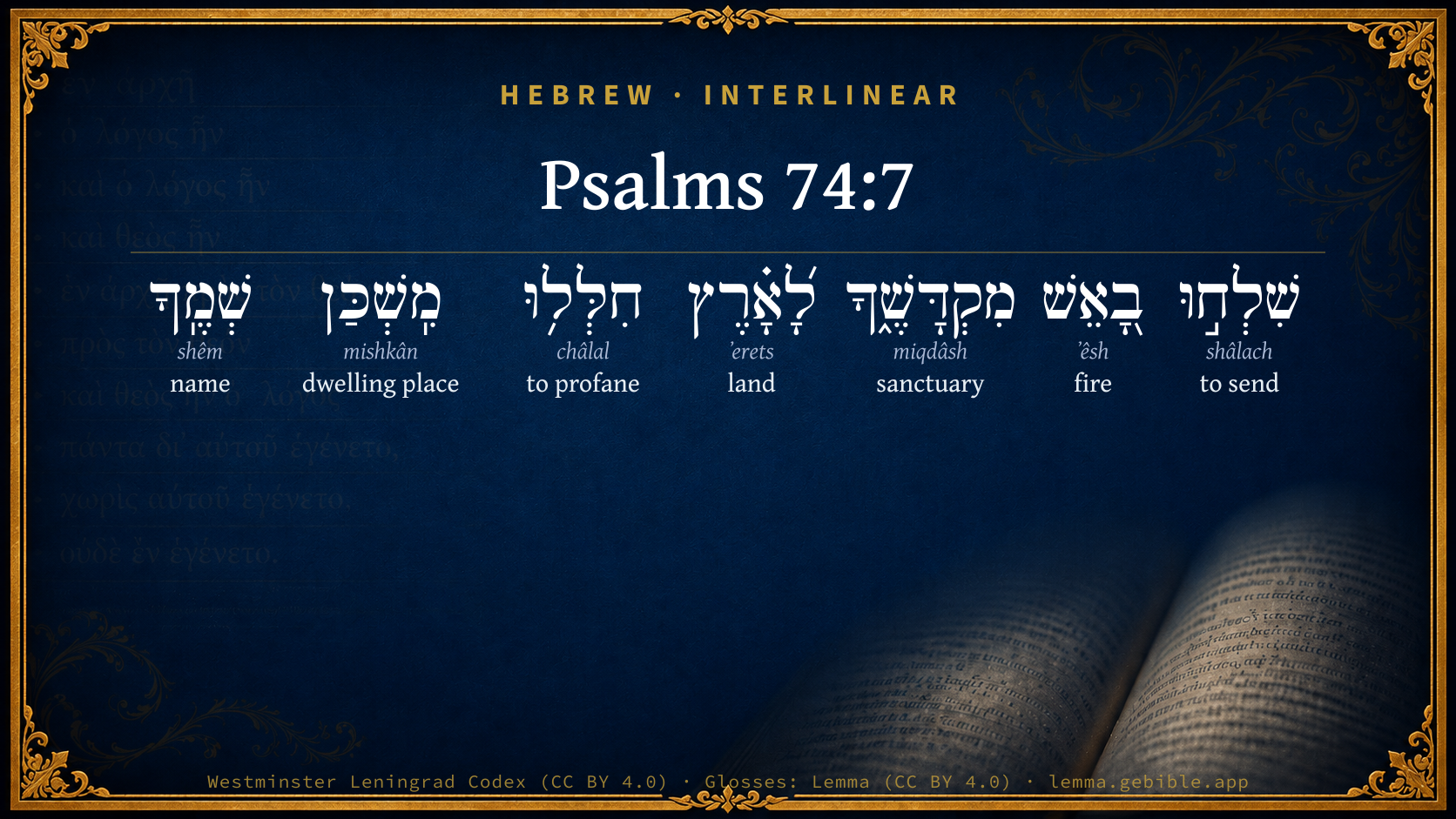
Psalms 74:7

Hebrew (Westminster Leningrad Codex) Psalms 74:7 appears in the Hebrew Old Testament. The text above is from the Westminster Leningrad Codex. Each word links to its Strong’s number, a concise gloss, and parsing drawn from the Open Scriptures Hebrew Bible morphology. Click any word for its full Brown-Driver-Briggs (BDB) entry.
Download image
Cite this verse

Psalms 74:7 (World English Bible). Public Domain. Lemma interlinear Bible study tool, https://lemma.gebible.app/v/psalms/74/7.

Show BibTeX & RIS
BibTeX
RIS
English Translation
They have burned your sanctuary to the ground. They have profaned the dwelling-place of your Name.
World English Bible · Public Domain
Download a study sheet

One document with this verse’s original text, its word-by-word gloss line, the meaning frame, cross-references with their text, attributed commentary, and full source and license credits — printable, and it pastes into notes with its structure intact.

This verse Autodidact and up

Study sheet (.html) Plain text (.txt)

A passage Seminary Student

Up to 50 verses in one chapter. A passage sheet keeps up to 6 commentary sources and 12 cross-references per verse, in the order this page ranks them, and says so on the sheet whenever that leaves anything out. Ask for a single verse and you get the Autodidact verse sheet above.

Everything on this page stays free to read, with no account — the sheet is a download of what is already on screen, not access to it.

Want to remove ads? Support Godless Engineer
Compare translations 3

The same verse in 3 English versions, stacked beneath the original-language interlinear above. Click any original word for its lexicon entry.

Each is an independent rendering of the whole verse — the interlinear is not word-aligned to these translations.

Highlighted words mark where these versions differ — a whole-verse word diff, not a word-by-word alignment.

  • World English Bible Public Domain
    They have burned your sanctuary to the ground. They have profaned the dwelling-place of your Name.
  • King James Version Public Domain
    They have cast fire into thy sanctuary, they have defiled by casting down the dwelling place of thy name to the ground.
  • unfoldingWord Literal Text CC BY-SA 4.0
    They sent your holy place into fire; they profaned the dwelling of your name to the ground.

unfoldingWord Literal Text — © unfoldingWord, licensed CC BY-SA 4.0. Word-aligned USFM3 via Door43 (git.door43.org/unfoldingWord/en_ult).

Versions to compare (up to 4)

3 of 4 selected

Show all 18 translations

Every available English version of this verse, each an independent rendering of the whole verse.

  • World English Bible Public Domain
    They have burned your sanctuary to the ground. They have profaned the dwelling-place of your Name.
  • Berean Standard Bible Public Domain
    They have burned Your sanctuary to the ground; they have defiled the dwelling place of Your Name.
  • Majority Standard Bible Public Domain
    They have burned Your sanctuary to the ground; they have defiled the dwelling place of Your Name.
  • King James Version Public Domain
    They have cast fire into thy sanctuary, they have defiled by casting down the dwelling place of thy name to the ground.
  • American Standard Version (1901) Public Domain
    They have set thy sanctuary on fire; They have profaned the dwelling-place of thy name `by casting it' to the ground.
  • Revised Version (1885) Public Domain
    They have set thy sanctuary on fire; they have profaned the dwelling place of thy name even to the ground.
  • Geneva Bible (1599) Public Domain
    They haue cast thy Sanctuarie into the fire, and rased it to the grounde, and haue defiled the dwelling place of thy Name.
  • Douay-Rheims (1899) Public Domain
    They have set fire to thy sanctuary: they have defiled the dwelling place of thy name on the earth.
  • Young's Literal Translation Public Domain
    They have sent into fire Thy sanctuary, to the earth they polluted the tabernacle of Thy name,
  • Literal Standard Version CC BY-SA 4.0
    They have sent Your sanctuary into fire, || They defiled the Dwelling Place of Your Name to the earth,
  • Unlocked Literal Bible CC BY-SA 4.0
    They set your sanctuary on fire; they desecrated where you live, knocking it to the ground.
  • unfoldingWord Literal Text CC BY-SA 4.0
    They sent your holy place into fire; they profaned the dwelling of your name to the ground.
  • Darby Bible Public Domain
    They have set on fire thy sanctuary, they have profaned the habitation of thy name to the ground.
  • World Messianic Bible Public Domain
    They have burned your sanctuary to the ground. They have profaned the dwelling place of your Name.
  • Webster's Bible Public Domain
    They have cast fire into thy sanctuary, they have defiled by casting down the dwelling-place of thy name to the ground.
  • Free Bible Version CC BY-SA 4.0
    Then they set fire to your Temple, burning it to the ground. They defiled the place where you live, the place that bears your name.
  • Bible in Basic English Public Domain
    They have put on fire your holy place; they have made the place of your name unclean, pulling it down to the earth.
  • JPS Tanakh (1917) Public Domain
    They have set Thy sanctuary on fire; they have profaned the dwelling-place of Thy name even to the ground.

Literal Standard Version (2020), Covenant Press — licensed CC BY-SA 4.0. Text via the HelloAO Bible API (eBible.org). Unlocked Literal Bible (unfoldingWord) — licensed CC BY-SA 4.0. Text via the HelloAO Bible API (eBible.org). unfoldingWord Literal Text — © unfoldingWord, licensed CC BY-SA 4.0. Word-aligned USFM3 via Door43 (git.door43.org/unfoldingWord/en_ult). Free Bible Version, Dr. Jonathan Gallagher — licensed CC BY-SA 4.0. Text via the HelloAO Bible API (eBible.org).

Word by word

More ways to search: Search by grammar → Find every occurrence → Compare this word →

Practice this passage: Drill this verse → Learn its vocabulary →

About this verse

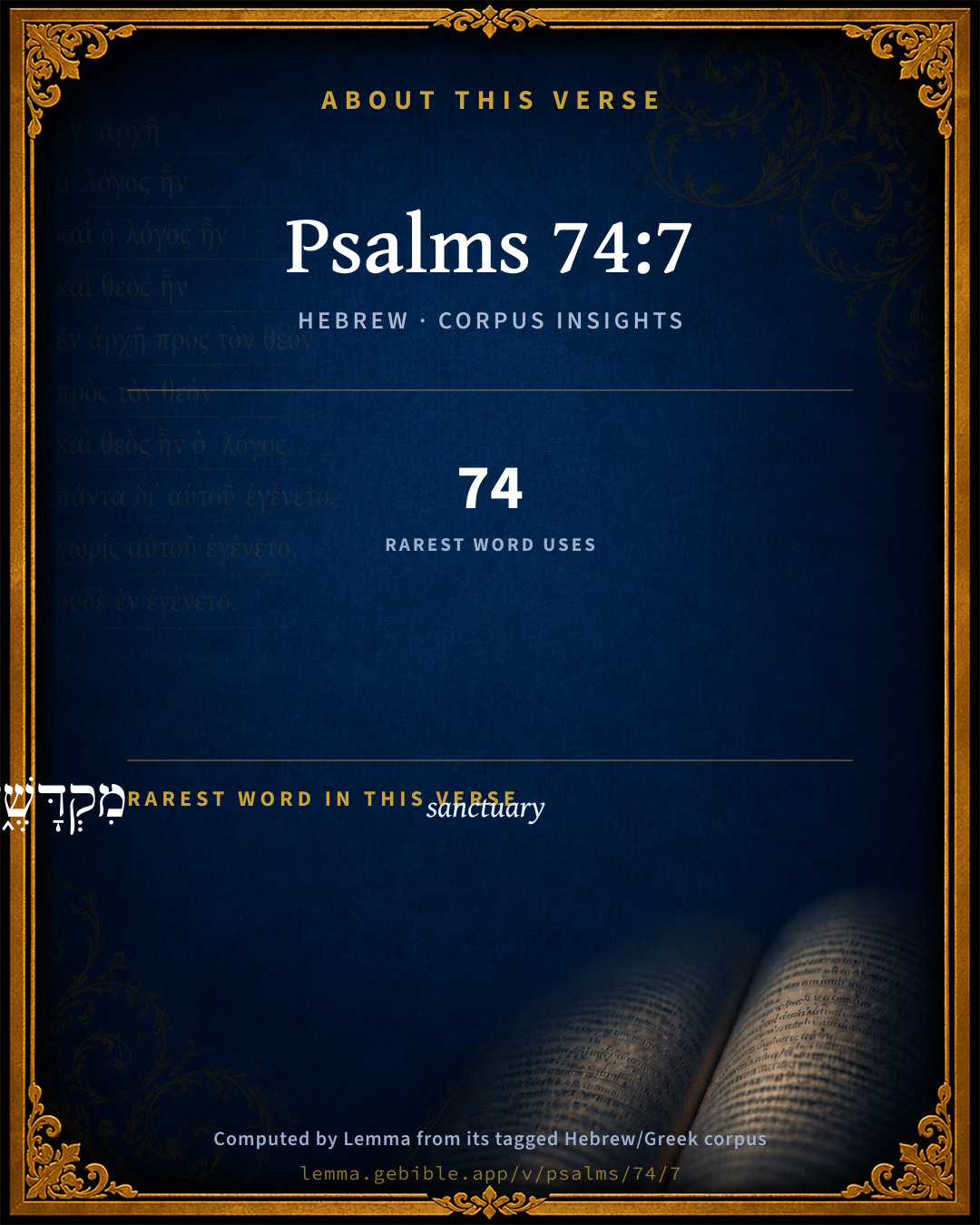
These counts appear in no published source. They are computed here, from the morphology-tagged text and Lemma’s own curated glosses. What Lemma adds →

7
words
7
distinct lemmas
Wisdom
section

Grammatical profile

  • 2 verbs
  • 5 nouns

Verb forms

  • שִׁלְח֣וּ Piel · Perfect
  • חִלְּל֥וּ Piel · Perfect

Hebrew & Septuagint length

In English translation the verse runs 16 words from the Hebrew and 18 from the Septuagint (LXX English) — closely comparable.

A rough comparison of the two English renderings, which tokenize alike — not a word-level alignment.

Word counts can differ between the Hebrew and the Greek without any difference in meaning — e.g. the Hebrew direct-object marker אֵת has no separate Greek word, and Greek often adds the article ὁ.

Cross-references

9

Topical passages linked to Psalms 74:7 in the Treasury of Scripture Knowledge — connected by theme and wording, ordered by reader-vote popularity; previews shown in the World English Bible.

  • 2 Kings 25:9 He burnt the house of Yahweh, and the king's house; and all the houses of Jerusalem, even every great house, burnt he with fire.
  • Deuteronomy 12:5 But to the place which Yahweh your God shall choose out of all your tribes, to put his name there, even to his habitation shall you seek, and there you shall come;
  • Psalms 89:39 You have renounced the covenant of your servant. You have defiled his crown in the dust.
  • Isaiah 64:11 Our holy and our beautiful house, where our fathers praised you, is burned with fire; and all our pleasant places are laid waste.
  • Ezekiel 24:21 Speak to the house of Israel, Thus says the Lord Yahweh: Behold, I will profane my sanctuary, the pride of your power, the desire of your eyes, and that which your soul pities; and your sons and your daughters whom you have left behind shall fall by the sword.
  • Matthew 22:7 When the king heard that, he was angry, and he sent his armies, destroyed those murderers, and burned their city.
  • Exodus 20:24 You shall make an altar of earth for me, and shall sacrifice on it your burnt offerings and your peace-offerings, your sheep and your oxen. In every place where I record my name I will come to you and I will bless you.
  • 1 Kings 8:20 Yahweh has established his word that he spoke; for I am risen up in the room of David my father, and sit on the throne of Israel, as Yahweh promised, and have built the house for the name of Yahweh, the God of Israel.
  • Lamentations 2:2 The Lord has swallowed up all the habitations of Jacob, and has not pitied: He has thrown down in his wrath the strongholds of the daughter of Judah; He has brought them down to the ground; he has profaned the kingdom and the princes of it.

Cross-references courtesy of OpenBible.info (CC BY 4.0).

Hebrew and Greek witnesses Masoretic Hebrew ↔ Greek Septuagint

The same verse in the two great witnesses to the Old Testament, shown verse-for-verse.

You’re reading Greek Psalm 73 (Hebrew Psalm 74). The Septuagint counts the superscription, so verse numbers can differ from the Hebrew — chapter-level alignment, not verse-by-verse. Numbering follows Rahlfs.

These are two independent witnesses, not word-aligned to each other, and the Septuagint is shown in lemma (dictionary) form.

Hebrew Psalms 74:7 Masoretic · Westminster Leningrad Codex

שִׁלְח֣וּ בָ֭אֵשׁ מִקְדָּשֶׁ֑ךָ לָ֝אָ֗רֶץ חִלְּל֥וּ מִֽשְׁכַּן שְׁמֶֽךָ

They have burned your sanctuary to the ground. They have profaned the dwelling-place of your Name.

World English Bible · Public Domain

Greek LXX Greek Psalm 73:7 Septuagint · lemma form

ἐμπυρίζω ἐν πῦρ ὁ ἁγιαστήριον σύ εἰς ὁ γῆ βεβηλόω ὁ σκήνωμα ὁ ὄνομα σύ

They have burnt your sanctuary with fire to the ground; they have profaned the habitation of your name.

LXX2012 (modern English Septuagint) · Public Domain

On this verse, John Gill's Exposition discusses the Septuagint’s reading. Read the note in Commentary ↓

Hebrew: Westminster Leningrad Codex (CC BY 4.0). Greek: Septuagint (public domain); English from LXX2012 (modern English Septuagint) (Public Domain). How the Septuagint differs from the Hebrew →

Commentary

Notes on Psalms 74:7 from classic Christian and Jewish commentators (each source and its license shown beneath its notes). The classic Christian expositions comment on the surrounding passage and are grouped to its opening verse, so a note may address several verses; the Jewish commentaries on the Tanakh (Rashi and others) are per-verse, so they appear only where the commentator wrote on this verse.

Lemma curates 59 commentaries, every one of them public domain or Creative Commons licensed, each selected and text-cleaned for this edition rather than reprinted as found. About our sources →

Trapp's Complete Commentary

John Trapp

Psa 74:7 They have cast fire into thy sanctuary, they have defiled [by casting down] the dwelling place of thy name to the ground.

Ver. 7. They have cast fire inlo thy sanctuary] Heb. They have sent thy sanctuary into the fire. So the French Papists, under the conduct of the Guises, dealt by the public meeting houses of the Protestants there, and particularly by that church at Lyons which was called Paradise, Hoc apud Ethnicos erat horrendum. The heathens observed of such as destroyed temples that they commonly came to some fearful end, by thunderbolts or otherwise.

John Trapp, A Commentary or Exposition upon All the Books of the Old and New Testament (1647–1656) — public domain. Text from a community e-Sword module.

Joseph Benson's Commentary

Psa 74:7-8. They have cast fire into thy sanctuary, &c. — The Chaldeans first polluted, and then set fire to Solomon’s temple, and burned that stately and costly fabric down to the ground. And Antiochus set fire to the gates of the second temple, (1Ma 4:28,) and afterward the Romans razed it from the foundation, and left not one stone upon another. They said, Let us destroy them together — Root and branch, one as well as another, or all at once. So they desired, and so, it seems, many of them intended, although afterward they changed their counsel, and carried some away captive, and left others to cultivate the ground. They have burned up all the synagogues — All the public places wherein the Jews used to meet together to worship God every sabbath day, as is mentioned Act 13:27, and upon other occasions. That the Jews had such synagogues is manifest, both from these and other places of Scripture, and from the testimony of the Hebrew doctors, and other ancient and learned writers, who affirm it, and particularly of Jerusalem, in which they say there were above four hundred; and from the necessity of such places: for seeing it is undeniable that they did worship God publicly on every sabbath, and at other holy times, even when they could not go up to Jerusalem, both conscience and prudence must needs have directed them to appoint convenient places for that purpose.

Joseph Benson's Commentary on the Old and New Testaments (1811–1818) — public domain. Text from a community e-Sword module.

J. A. Alexander on Psalms

Joseph Addison Alexander

Psa 74:7. They have set on fire thy holy place; to the earth they have profaned the dwelling of thy name. The literal translation of the first clause is, they have sent (or cast) into the fire thy holy place. The construction in the last clause is a pregnant one, profaned to the earth, i.e. profaned by casting to the ground a sacred edifice. This form of expression would be inappropriate to mere profanation by defilement, without actual prostration of the edifice itself.

Joseph Addison Alexander, The Psalms Translated and Explained (1850) — public domain. Text from a community e-Sword module.

John Calvin's Commentaries

7. They have set fire to thy sanctuaries. The Psalmist now complains that the temple was burned, and thus completely razed and destroyed, whereas it was only half demolished by the instruments of war. Many have supposed that the order of the words has been here inverted, not being able to perceive how a suitable meaning could be elicited from them, and therefore would resolve them thus, They have put fire into thy sanctuaries. I have, however, no doubt that the sense which I have given, although the accent is against it, is the true and natural one, That the temple was levelled with the ground by being burned. This verse corroborates more fully the statement which I have made, that the temple is called sanctuaries in the plural number, because it consisted of three parts, — the innermost sanctuary, the middle sanctuary, and the outer court; for there immediately follows the expression, The dwelling-place of thy name. The name of God is here employed to teach us that his essence was not confined to or shut up in the temple, but that he dwelt in it by his power and operation, that the people might there call upon him with the greater confidence.

John Calvin's Commentaries (1540-1563) — public domain. Text from the Calvin Translation Society English edition (1840s-50s) via the Christian Classics Ethereal Library (ccel.org). Calvin's coverage is partial (roughly two-thirds of the Bible); uncommented books and verses are honest gaps, never fabricated. The 19th-century editor's footnotes and remarks are omitted so the notes are faithfully Calvin's own voice.

Ellicott's Commentary for English Readers

(7) They have cast fire into.—Literally, They have cast into fire thy sanctuary. Probably a hyperbolic expression, and purporting to express the vastness of the conflagration. Others compare with the English “set on fire,” and French mettre à feu.

We learn from 1Ma_4:38, and Josephus, Antt. xii., 7:6, that Judas Maccabæus, in coming to restore the Temple, found that the gates had been burnt.

A Bible Commentary for English Readers, edited by Charles John Ellicott (1878–1897) — public domain. Text from a community e-Sword module.

The Cambridge Bible for Schools and Colleges

gen. ed. J. J. S. Perowne

7. They have set thy sanctuary on fire;

They have profaned the dwelling place of thy name even to the ground. (R.V.)

The verse appears to speak of a complete destruction of the Temple by fire. This was done by Nebuzaradan (2Ki_25:9-10) but not by the emissaries of Antiochus, for Judas found the main building standing, though the gates had been burned and the priests’ chambers pulled down (1Ma_4:38). Comp. the stress which Ezekiel lays on the desecration of the sanctuary (Eze_7:21-22; Eze_7:24). See also Lam_2:2.

For the dwelling place of thy name cp. Deu_12:11; Deu_16:2; Deu_16:6; Deu_16:11, &c.; Jer_7:12; Psa_26:8.

The Cambridge Bible for Schools and Colleges (gen. ed. J. J. S. Perowne; Cambridge University Press, 1878–1918) — public domain. Text from a community e-Sword module.

John Gill's Exposition

They said in their hearts, let us destroy them together,.... The Targum is,

"their children, are together;''

or "their kindred", as the Septuagint Vulgate Latin, Ethiopic, and Arabic versions, taking the word to be of which signifies a "son"; and the sense to be, that seeing they were all together, as the Jews were at the taking of Jerusalem, they might be cut off at once. Jarchi explains it of their rulers; Marinus, as Aben Ezra observes, derives it from a word which signifies to afflict and oppress, to which he agrees; see Psa 83:3,

they have burnt up all the synagogues of God in the land; not only in Jerusalem, where there were, the Jewish (q) writers say, four hundred and sixty, and others four hundred and eighty of them, but also in all the land of Judea; of these synagogues there is much mention made in the New Testament; they were places for public worship, in which, prayer was made, and the Scriptures were read and explained; see Mat 6:5, but it may be doubted whether they are meant here, since it does not appear that there were any until after the return of the Jews from Babylon (r); the temple, and the parts of it, may be meant, as Jarchi and Aben Ezra; or the schools of the prophets; though the psalm may refer to times after the Babylonish captivity, and so may design Jewish synagogues, and even take in places of worship among Christians.

(q) T. Hieros. Cetubot, fol. 35. 3. & Megillah, fol. 73. 4. (r) Vid. Vitringam de Synagog. Vet. l. 1. par. 2. c. 9. Reland. Antiqu. Heb. par. 1. c. 16. sect. 3. Burmannum de Synagogis disp. I. sect. 9.

John Gill's Exposition of the Whole Bible (1746–1763) — public domain (CC PDM 1.0). Text via the HelloAO Bible API.

Albert Barnes' Notes on the Bible

They have cast fire into thy sanctuary - Into the temple to destroy it. Literally, “They have cast thy sanctuary into the fire.” The meaning is, that they had burned it down. This was actually done by the Chaldeans, 2Ki 25:9; 2Ch 36:19.

They have defiled by casting down the dwelling-place of thy name to the ground - The place where thy name dwelt or was recorded Exo 20:24; that is, the place where God’s name was known, or where he was worshipped. The literal meaning is, “To the earth they have defiled the dwelling of thy name?” The idea is, that they had defiled or polluted the temple by throwing it to the ground; by making it a heap of ruins; by making it undistinguishable from common earth.

Albert Barnes' Notes on the Bible (1834–1885) — public domain. Text from a community e-Sword/MySword module.

Matthew Poole's English Annotations

First they polluted it, and then they burnt it, and broke it in pieces.

Matthew Poole's English Annotations on the Holy Bible (1683–1685) — public domain. Text from a community e-Sword/MySword module.

The Treasury of David

Charles H. Spurgeon

Ver. 7. They have cast fire into thy sanctuary. Axes and hammers were not sufficient for the purpose of the destroyers, they must needs try fire. Malice knows no bounds. Those who hate God are never sparing of the most cruel weapons. To this day the enmity of the human heart is quite as great as ever; and, if providence did not restrain, the saints would still be as fuel for the flames.

They have defiled by casting down the dwelling place of thy name to the ground. They made a heap of the temple, and left not one stone upon another. When the Lord left Mount Zion, and the Roman gained entrance, the military fury led the soldiers to burn out and root up the memorial of the famous House of the Lord. Could the powers of darkness have their way, a like fate would befall the church of Christ. "Rase it, "say they, "rase it even to the foundation thereof." Defilement to the church is destruction; her foes would defile her till nothing of her purity, and consequently of her real self, remained. Yet, even if they could wreak their will upon the cause of Christ, they are not able to destroy it, it would survive their blows and fires; the Lord would hold them still like dogs on a leash, and in the end frustrate all their designs.

Charles H. Spurgeon's The Treasury of David (1869–1885) — public domain. Psalms only. Text from a community e-Sword/MySword module.

Whedon's Commentary on the Bible

Daniel D. Whedon

7. They have cast fire into thy sanctuary—The temple was fired one month after it was taken. Jer_52:12-13. This fearful month witnessed, before the eyes of the now captive nation, the horrible work of demolishing and despoiling by the enemy.

The dwellingplace of thy name—Another title of sanctity and endearment for the temple, or sanctuary.

Daniel D. Whedon (gen. ed.), Commentary on the Old and New Testaments (1874–1909) — public domain. Text from a community e-Sword module.

The Pulpit Commentary

They have cast tire into thy sanctuary; or, they have set thy sanctuary fire (Revised Version). The temple of Solomon was burnt by Nebuchadnezzar. (2Ki_25:9 2Ch_36:19) That of Zerubbabel was never burnt, but was entirely rebuilt, and on a much larger scale, by Herod the Great. That of Herod the Great was burnt in the siege by Titus. They have defiled by casting down the dwelling place of thy Name to the ground. (comp. Lam_2:6 Lam_4:1) The very foundations of the second temple had to be laid by Zerubbabel. (Ezr_3:6, Ezr_3:12)

HOMILIES BY C. SHORT Vers. 7-8, 12. The destructive work of man and the constructive work of God.

The prayer in vers. 1, 2, to help the people sunk in the deepest misery, is followed by its basis or ground, which consists of a picture of this misery (vers. 3-9); the sanctuary is destroyed, and all traces of the presence of God among his people have disappeared. The short prayer in vers. 10, 11 seeks support and stay in the thought of the omnipotence of the God of Israel (vers. 12-17). The prayer is renewed at the close in an expanded form. (Gen_17:7, Gen_17:8) It shows how the Church of God and individual believers are to conduct themselves in times when everything appears to be lost and to lie in ruins. The whole psalm may suggest two general points for consideration the destructive work of man, and the constructive work of God.

I THE DESTRUCTIVE WORK OF MAN. (Vers. 3-9) The enemy had destroyed everything in the sanctuary, and burnt up the holy place itself. Look at some destructive work in our day.

1. The material tendencies of physical science. Leading to a denial of God and immortality, and striking at the foundation of morals by denying the freedom of man"s nature. Ideas destructive, as well as conduct.

2. The critical spirit which is abroad. A spirit of denial, almost universally pulling down, and not building up. This and that not true in history and creed.

3. The selfish spirit, wherever it rules, is destructive. In politics and commerce, and in our social relations tending to antagonism and separation, and breaking all law moral, Divine, and social.

4. The absence of true prophets inspired men is also a sign of the destructive process. (Ver. 9) The true prophet is the constructor, and not the destroyer; the inspirer, and not the critic.

II THE CONSTRUCTIVE WORK OF GOD.

1. God"s greatest work of old was redemptive. (Vers. 12-15) "For God is my King of old, working salvation in the midst of the earth." His work in Christ is reconstructive, building men up after the highest pattern. Christ came not to destroy, but to fulfil.

2. His work in the physical creation is constructive. (Vers. 16, 17) He prepared the light and the sun, made summer and winter. The same mind ordained and continues the precious seasons as ordained the laws and works of redemption.

3. God"s covenant is a covenant of salvation. (Ver. 20) And the world is still in urgent need of redemption. "The dark places," etc.

4. The work of redemption is God"s ownhis own cause. " (Ver. 22). And therefore he will not abandon it. We can therefore pray as the psalmist did. S.

The Pulpit Commentary (1880–1919), ed. H.D.M. Spence-Jones & Joseph S. Exell — public domain. Text from a community e-Sword module.

unfoldingWord translationNotes

Door43 World Missions Community

General Information:

Asaph continues to describe the destruction of the temple.

They ... they ... They ... They

Here "they" refers to the adversaries mentioned in Psalms 74:4.

They said in their hearts

This is an idiom. AT: "They said to themselves" or "They thought to themselves" (See: Idiom)

translationWords

fire

desecrate

heart

unfoldingWord translationNotes — © Distant Shores Media and the Door43 World Missions Community, licensed CC BY-SA 4.0. Source: git.door43.org/Door43/en_tn.

Lesson kit

Teaching starters — assembled from the data on this page, not authored interpretation. Every prompt links to the verse data it draws on. Edit before teaching.

Psalms, in the Wisdom, opens this verse with 7 words (7 distinct Hebrew lemmas). Its most distinctive word is miqdâsh (“sanctuary”). A historical commentator’s framing appears above. Read the whole chapter for the surrounding context.

Discussion questions

  1. The word miqdâsh carries the sense “sanctuary.” How does it shape the verse?
  2. 2 Kings 25:9 shares this passage’s theme. How do the two illuminate each other?
  3. The translations on this page render this verse differently — a whole-verse word diff, not a word-by-word alignment. What might account for the different wordings?
  4. The verb «שִׁלְח֣וּ» is Piel Perfect. How does its form color the action?
  5. Reading how Trapp's Complete Commentary and Joseph Benson's Commentary read this verse, where do the two commentators agree and where do they part?

Things to notice

Reading settings

Reading text

Shown beneath each verse's original-language words.

Old Testament
Old Testament edition

Read the OT as the Masoretic Hebrew (MT) or the Greek Septuagint (LXX).

English shown for the Greek Septuagint (in the Hebrew ↔ Greek comparison).

Comparing translations? Open the Compare panel on any verse page to stack up to four side by side.