
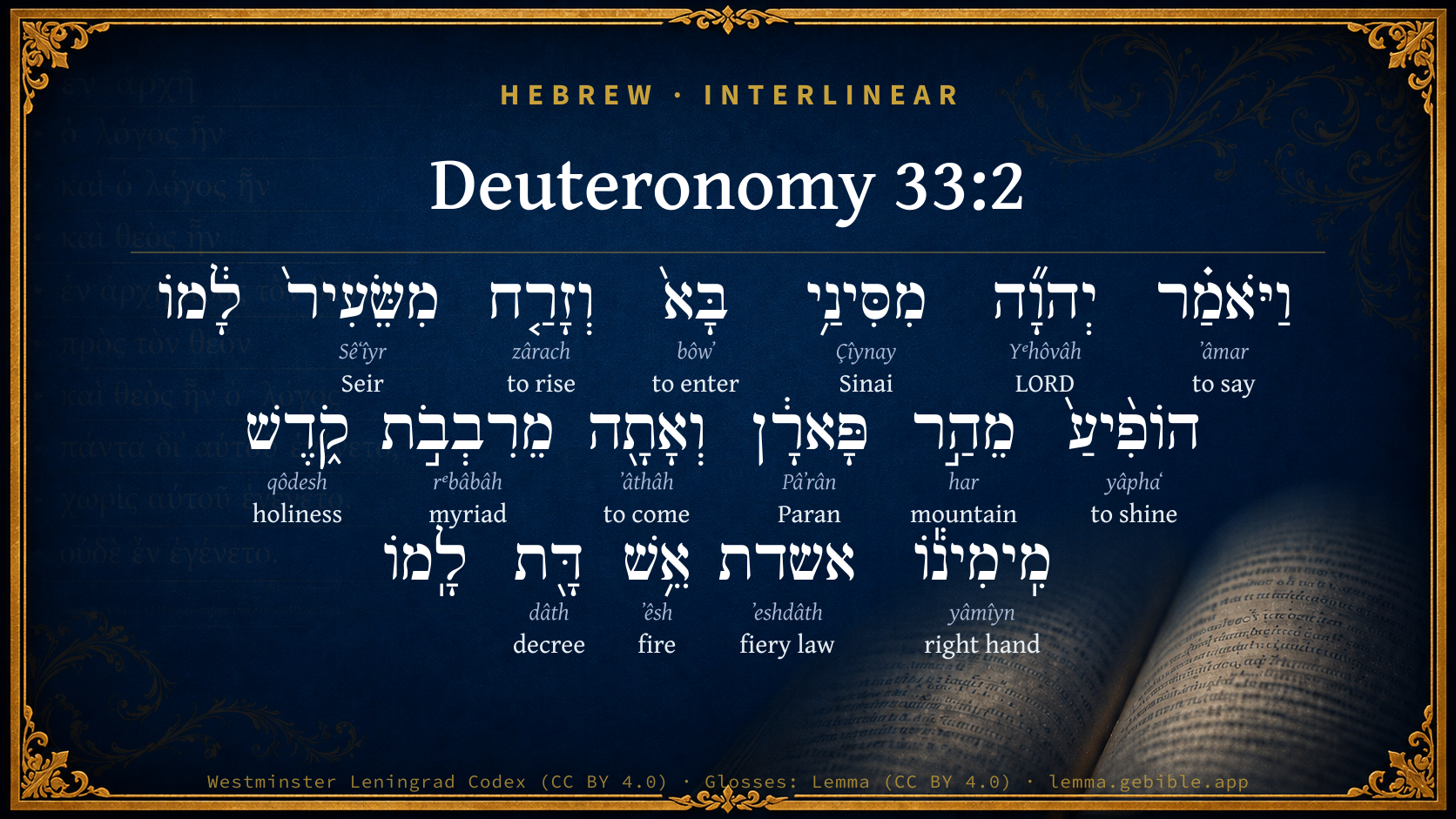
Deuteronomy 33:2

Hebrew (Westminster Leningrad Codex) Deuteronomy 33:2 appears in the Hebrew Old Testament. The text above is from the Westminster Leningrad Codex. Each word links to its Strong’s number, a concise gloss, and parsing drawn from the Open Scriptures Hebrew Bible morphology. Click any word for its full Brown-Driver-Briggs (BDB) entry.
Download image
Cite this verse

Deuteronomy 33:2 (World English Bible). Public Domain. Lemma interlinear Bible study tool, https://lemma.gebible.app/v/deuteronomy/33/2.

Show BibTeX & RIS
BibTeX
RIS
English Translation
He said, Yahweh came from Sinai, Rose from Seir to them; He shined forth from Mount Paran, He came from the ten thousands of holy ones: At his right hand was a fiery law for them.
World English Bible · Public Domain
Highlights
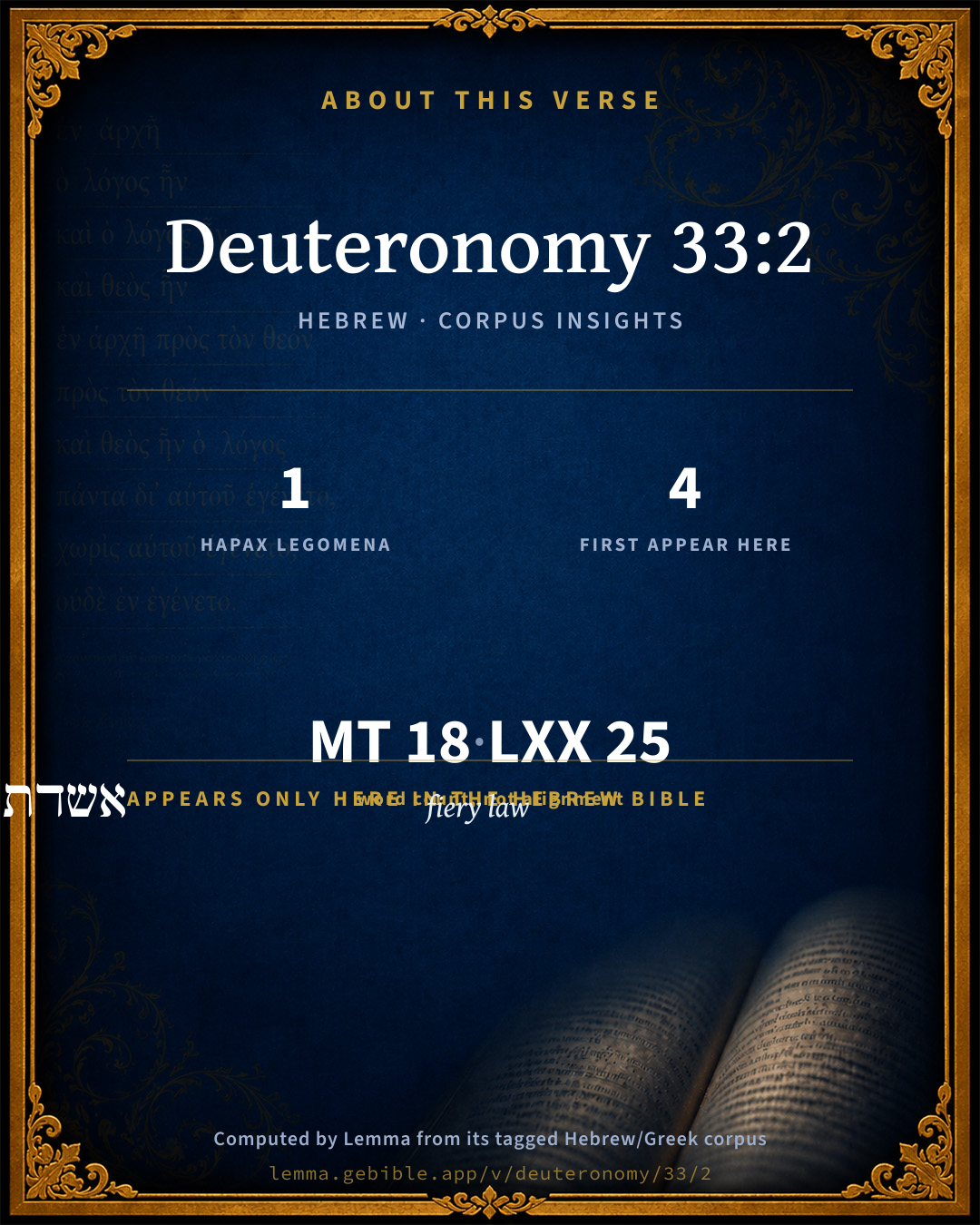
  • 1 hapax legomenon — only here in the Hebrew Bible
  • 4 first appearances in the Hebrew Bible
Full analysis ↓
Download a study sheet

One document with this verse’s original text, its word-by-word gloss line, the meaning frame, cross-references with their text, attributed commentary, and full source and license credits — printable, and it pastes into notes with its structure intact.

This verse Autodidact and up

Study sheet (.html) Plain text (.txt)

A passage Seminary Student

Up to 50 verses in one chapter. A passage sheet keeps up to 6 commentary sources and 12 cross-references per verse, in the order this page ranks them, and says so on the sheet whenever that leaves anything out. Ask for a single verse and you get the Autodidact verse sheet above.

Everything on this page stays free to read, with no account — the sheet is a download of what is already on screen, not access to it.

Want to remove ads? Support Godless Engineer
Compare translations 3

The same verse in 3 English versions, stacked beneath the original-language interlinear above. Click any original word for its lexicon entry.

Each is an independent rendering of the whole verse — the interlinear is not word-aligned to these translations.

Highlighted words mark where these versions differ — a whole-verse word diff, not a word-by-word alignment.

  • World English Bible Public Domain
    He said, Yahweh came from Sinai, Rose from Seir to them; He shined forth from Mount Paran, He came from the ten thousands of holy ones: At his right hand was a fiery law for them.
  • King James Version Public Domain
    And he said, The LORD came from Sinai, and rose up from Seir unto them; he shined forth from mount Paran, and he came with ten thousands of saints: from his right hand went a fiery law for them.
  • unfoldingWord Literal Text CC BY-SA 4.0
    And he said, “Yahweh from Sinai came and rose from Seir to them, shone forth from Mount Paran, and came with ten thousands of the holy, in his right hand, a fire of law for them.

unfoldingWord Literal Text — © unfoldingWord, licensed CC BY-SA 4.0. Word-aligned USFM3 via Door43 (git.door43.org/unfoldingWord/en_ult).

Versions to compare (up to 4)

3 of 4 selected

Show all 18 translations

Every available English version of this verse, each an independent rendering of the whole verse.

  • World English Bible Public Domain
    He said, Yahweh came from Sinai, Rose from Seir to them; He shined forth from Mount Paran, He came from the ten thousands of holy ones: At his right hand was a fiery law for them.
  • Berean Standard Bible Public Domain
    He said: “The LORD came from Sinai and dawned upon us from Seir; He shone forth from Mount Paran and came with myriads of holy ones, with flaming fire at His right hand.
  • Majority Standard Bible Public Domain
    He said: “The LORD came from Sinai and dawned upon us from Seir; He shone forth from Mount Paran and came with myriads of holy ones, with flaming fire at His right hand.
  • King James Version Public Domain
    And he said, The LORD came from Sinai, and rose up from Seir unto them; he shined forth from mount Paran, and he came with ten thousands of saints: from his right hand went a fiery law for them.
  • American Standard Version (1901) Public Domain
    And he said, Jehovah came from Sinai, And rose from Seir unto them; He shined forth from mount Paran, And he came from the ten thousands of holy ones: At his right hand was a fiery law for them.
  • Revised Version (1885) Public Domain
    And he said, The LORD came from Sinai, And rose from Seir unto them; He shined forth from mount Paran, And he came from the ten thousands of holy ones: At his right hand was a fiery law unto them.
  • Geneva Bible (1599) Public Domain
    The Lord came from Sinai, and rose vp from Seir vnto them, and appeared clearely from mount Paran, and he came with ten thousands of Saints, and at his right hand a firie Lawe for them.
  • Douay-Rheims (1899) Public Domain
    And he said: The Lord came from Sinai, and from Seir he rose up to us: he hath appeared from mount Pharan, and with him thousands of saints. In his right hand a fiery law.
  • Young's Literal Translation Public Domain
    and he saith: -- `Jehovah from Sinai hath come, And hath risen from Seir for them; He hath shone from mount Paran, And hath come `with' myriads of holy ones; At His right hand `are' springs for them.
  • Literal Standard Version CC BY-SA 4.0
    and he says: “YHWH has come from Sinai, || And has risen from Seir for them; He has shone from Mount Paran, || And has come [with] myriads of holy ones; At His right hand [came] a fiery law [[or a flaming fire]] for them.
  • Unlocked Literal Bible CC BY-SA 4.0
    He said: Yahweh came from Sinai and rose from Seir upon them. He shined out from Mount Paran, and he came with ten thousands of holy ones. In his right hand were flashes of lightning.
  • unfoldingWord Literal Text CC BY-SA 4.0
    And he said, “Yahweh from Sinai came and rose from Seir to them, shone forth from Mount Paran, and came with ten thousands of the holy, in his right hand, a fire of law for them.
  • Darby Bible Public Domain
    And he said, Jehovah came from Sinai, And rose up from Seir unto them; He shone forth from mount Paran, And he came from the myriads of the sanctuary; From his right hand [went forth] a law of fire for them.
  • World Messianic Bible Public Domain
    He said, “The LORD came from Sinai, and rose from Seir to them. He shone from Mount Paran. He came from the ten thousands of holy ones. At his right hand was a fiery law for them.
  • Webster's Bible Public Domain
    And he said, the LORD came from Sinai, and rose up from Seir to them; he shined forth from mount Paran, and he came with ten thousands of saints: from his right hand went a fiery law for them.
  • Free Bible Version CC BY-SA 4.0
    He said, The Lord came from Mount Sinai and shone on us from Mount Seir; he blazed out from Mount Paran coming with ten thousand holy ones, holding flaming fire at his right hand.
  • Bible in Basic English Public Domain
    He said, The Lord came from Sinai, dawning on them from Seir; shining out from Mount Paran, coming from Meribath Kadesh: from his right hand went flames of fire: his wrath made waste the peoples.
  • JPS Tanakh (1917) Public Domain
    And he said: The LORD came from Sinai, and rose from Seir unto them; He shined forth from mount Paran, and He came from the myriads holy, at His right hand was a fiery law unto them.

Literal Standard Version (2020), Covenant Press — licensed CC BY-SA 4.0. Text via the HelloAO Bible API (eBible.org). Unlocked Literal Bible (unfoldingWord) — licensed CC BY-SA 4.0. Text via the HelloAO Bible API (eBible.org). unfoldingWord Literal Text — © unfoldingWord, licensed CC BY-SA 4.0. Word-aligned USFM3 via Door43 (git.door43.org/unfoldingWord/en_ult). Free Bible Version, Dr. Jonathan Gallagher — licensed CC BY-SA 4.0. Text via the HelloAO Bible API (eBible.org).

Word by word

More ways to search: Search by grammar → Find every occurrence → Compare this word →

Practice this passage: Drill this verse → Learn its vocabulary →

אשדת
ʼeshdâth
H799
“fiery law of”
Noun, Common, Feminine, Singular, Construct
Part of Speech
Noun
Type
Common
Gender
Feminine
Number
Singular
State
Construct
Full BDB Definition

Origin: from H784 and H1881

TWOT: 174b ?

fiery law, fire of a law, fire was a law (meaning uncertain)
  1. וַיֹּאמַ֗ר ʼâmar H559 “and · to say” Conjunction + Verb, Qal, Sequential Imperfect, 3rd Person, Masculine, Singular
  2. יְהוָ֞ה Yᵉhôvâh H3068 “LORD” Noun, Proper
  3. מִסִּינַ֥י Çîynay H5514 “from · Sinai” Preposition + Noun, Proper
  4. בָּא֙ bôwʼ H935 “to enter” Verb, Qal, Perfect, 3rd Person, Masculine, Singular
  5. וְזָרַ֤ח zârach H2224 “and · to rise” Conjunction + Verb, Qal, Sequential Perfect, 3rd Person, Masculine, Singular
  6. מִשֵּׂעִיר֙ Sêʻîyr H8165 “from · Seir” Preposition + Noun, Proper
  7. הוֹפִ֨יעַ֙ yâphaʻ H3313 “to shine” Verb, Hiphil, Perfect, 3rd Person, Masculine, Singular
  8. מֵהַ֣ר har H2022 “from · mountain of” Preposition + Noun, Common, Masculine, Singular, Construct
  9. פָּארָ֔ן Pâʼrân H6290 “Paran” Noun, Proper
  10. וְאָתָ֖ה ʼâthâh H857 “and · to come” Conjunction + Verb, Qal, Sequential Perfect, 3rd Person, Masculine, Singular
  11. מֵרִבְבֹ֣ת rᵉbâbâh H7233 “from · myriads of” Preposition + Noun, Common, Feminine, Plural, Construct
  12. קֹ֑דֶשׁ qôdesh H6944 “holiness” Noun, Common, Masculine, Singular, Absolute
  13. מִֽימִינ֕וֹ yâmîyn H3225 “from · right hand · his” Preposition + Noun, Common, Feminine, Singular, Construct + Suffix, Personal, 3rd Person, Masculine, Singular
  14. אֵ֥שׁ ʼêsh H784 “fire of” Noun, Common, Both, Singular, Construct
  15. דָּ֖ת dâth H1881 “decree” Noun, Common, Feminine, Singular, Absolute

About this verse

These counts appear in no published source. They are computed here, from the morphology-tagged text and Lemma’s own curated glosses. What Lemma adds →

18
words
16
distinct lemmas
Pentateuch
section

Notable vocabulary

1 hapax legomenon — a word that appears only here in the entire Hebrew Bible:

  • אשדת fiery law H799

First appearance in Scripture

These words make their first canonical appearance in the Hebrew Bible here:

  • הוֹפִ֨יעַ֙ to shine H3313
  • וְאָתָ֖ה to come H857
  • אשדת fiery law H799
  • דָּ֖ת decree H1881

Shared distinctive vocabulary

הוֹפִ֨יעַ֙ to shine H3313 occurs in 8 verses of the Hebrew Bible. Also found in:

Grammatical profile

  • 5 verbs
  • 11 nouns
  • 2 prepositions

Verb forms

  • וַיֹּאמַ֗ר Qal · Sequential Imperfect
  • בָּא֙ Qal · Perfect
  • וְזָרַ֤ח Qal · Sequential Perfect
  • הוֹפִ֨יעַ֙ Hiphil · Perfect
  • וְאָתָ֖ה Qal · Sequential Perfect

Hebrew & Septuagint length

In English translation the verse runs 36 words from the Hebrew and 40 from the Septuagint (LXX English) — closely comparable.

A rough comparison of the two English renderings, which tokenize alike — not a word-level alignment.

Word counts can differ between the Hebrew and the Greek without any difference in meaning — e.g. the Hebrew direct-object marker אֵת has no separate Greek word, and Greek often adds the article ὁ.

In the original languages it is 18 Hebrew tokens and 25 Greek tokens — but the two are counted differently (Hebrew bundles its prefixes and suffixes into one token; the Greek is in lemma form), so that isn’t a like-for-like length.

Cross-references

17

Topical passages linked to Deuteronomy 33:2 in the Treasury of Scripture Knowledge — connected by theme and wording, ordered by reader-vote popularity; previews shown in the World English Bible.

  • Habakkuk 3:3 God came from Teman, The Holy One from Mount Paran. Selah. His glory covered the heavens, And his praise filled the earth.
  • Jude 1:14 About these also Enoch, the seventh from Adam, prophesied, saying, "Behold, the Lord came with ten thousands of his holy ones,
  • Revelation 5:11 I saw, and I heard something like a voice of many angels around the throne, the living creatures, and the elders; and the number of them was ten thousands of ten thousands, and thousands of thousands;
  • Judges 5:4–5 Yahweh, when you went forth out of Seir, When you marched out of the field of Edom, The earth trembled, the sky also dropped, Yes, the clouds dropped water.
  • Psalms 68:17 The chariots of God are tens of thousands and thousands of thousands. The Lord is among them, from Sinai, into the sanctuary.
  • Acts 7:53 You received the law as it was ordained by angels, and didn't keep it!"
  • Psalms 68:7–8 God, when you went forth before your people, When you marched through the wilderness... Selah.
  • Hebrews 2:2 For if the word spoken through angels proved steadfast, and every transgression and disobedience received a just recompense;
  • Exodus 19:18–20 Mount Sinai, the whole of it, smoked, because Yahweh descended on it in fire; and its smoke ascended like the smoke of a furnace, and the whole mountain quaked greatly.
  • Daniel 7:9–10 I saw until thrones were placed, and one who was ancient of days sat: his clothing was white as snow, and the hair of his head like pure wool; his throne was fiery flames, [and] the wheels of it burning fire.
  • 2 Corinthians 3:7 But if the service of death, written engraved on stones, came with glory, so that the children of Israel could not look steadfastly on the face of Moses for the glory of his face; which was passing away:
  • 2 Corinthians 3:9 For if the service of condemnation has glory, the service of righteousness exceeds much more in glory.
  • Galatians 3:10 For as many as are of the works of the law are under a curse. For it is written, "Cursed is everyone who doesn't continue in all things that are written in the book of the law, to do them."
  • Galatians 3:19 What then is the law? It was added because of transgressions, until the seed should come to whom the promise has been made. It was ordained through angels by the hand of a mediator.
  • 2 Thessalonians 1:7 and to give relief to you that are afflicted with us, when the Lord Jesus is revealed from heaven with his mighty angels in flaming fire,
  • Hebrews 12:20 for they could not stand that which was commanded, "If even an animal touches the mountain, it shall be stoned;"
  • Deuteronomy 5:22 These words Yahweh spoke to all your assembly on the mountain out of the midst of the fire, of the cloud, and of the thick darkness, with a great voice: and he added no more. He wrote them on two tables of stone, and gave them to me.

Cross-references courtesy of OpenBible.info (CC BY 4.0).

Hebrew and Greek witnesses Masoretic Hebrew ↔ Greek Septuagint

The same verse in the two great witnesses to the Old Testament, shown verse-for-verse.

These are two independent witnesses, not word-aligned to each other, and the Septuagint is shown in lemma (dictionary) form.

Hebrew Deuteronomy 33:2 Masoretic · Westminster Leningrad Codex

וַיֹּאמַ֗ר יְהוָ֞ה מִסִּינַ֥י בָּא֙ וְזָרַ֤ח מִשֵּׂעִיר֙ לָ֔מוֹ הוֹפִ֨יעַ֙ מֵהַ֣ר פָּארָ֔ן וְאָתָ֖ה מֵרִבְבֹ֣ת קֹ֑דֶשׁ מִֽימִינ֕וֹ אשדת אֵ֥שׁ דָּ֖ת לָֽמוֹ

He said, Yahweh came from Sinai, Rose from Seir to them; He shined forth from Mount Paran, He came from the ten thousands of holy ones: At his right hand was a fiery law for them.

World English Bible · Public Domain

Greek LXX Deuteronomy 33:2 Septuagint · lemma form

καί εἶπον κύριος ἐκ σινα ἥκω καί ἐπιφαίνω ἐκ σηιρ ἐγώ καί κατασπεύδω ἐκ ὄρος φαραν σύν μυριάς καδης ἐκ δεξιός αὐτός ἄγγελος μετά αὐτός

And he said, The Lord is come from Sina, and has appeared from Seir to us, and has hasted out of the mount of Pharan, with the ten thousands of Cades; on his right hand were his angels with him.

LXX2012 (modern English Septuagint) · Public Domain

On this verse, Ellicott's Commentary for English Readers discusses the Septuagint’s reading. Read the note in Commentary ↓

Hebrew: Westminster Leningrad Codex (CC BY 4.0). Greek: Septuagint (public domain); English from LXX2012 (modern English Septuagint) (Public Domain). How the Septuagint differs from the Hebrew →

Targum (Aramaic paraphrase)

2

The Targum is the ancient Jewish Aramaic paraphrase of the Hebrew Scriptures — an interpretive translation, not the Hebrew text itself. Onkelos (literal) and Pseudo-Jonathan (expansive) render the Torah, and Jonathan the Prophets. Coverage is partial: where no permissively-licensed English translation exists for a verse, only the Aramaic is shown. This is verse-level text, not a word-by-word alignment to the Hebrew.

  1. Targum Onkelos Torah (Genesis–Deuteronomy)
    וַאֲמַר יְיָ מִסִינַי אִתְגְלִי וְזֵהוֹר יְקָרֵהּ מִשֵׂעִיר אִתְחֲזֵי לָנָא אִתְגְלִי בִגְבֻרְתֵּהּ מִטוּרָא דְפָארָן וְעִמֵהּ רִבְבַת קַדִישִׁין כְּתַב יַמִינֵהּ מִגוֹ אֶשָׁתָא אוֹרַיְתָא יְהַב לָנָא

    (no public-domain English translation for this verse)

    Targum Onkelos — Aramaic: “Onkelos Genesis” (public domain); “Onkelos Exodus” (public domain); “Onkelos Leviticus” (public domain); “Onkelos Numbers” (public domain); “Onkelos Deuteronomy” (public domain). English: “Sefaria Community Translation” (CC0 1.0 (public-domain dedication)); “J.W. Etheridge. The Targums of Onkelos and Jonathan Ben Uzziel on the Pentateuch. London: Longmans, Green, 1862” (public domain). Text via Sefaria.

  2. Targum Pseudo-Jonathan Torah (Genesis–Deuteronomy)
    וַאֲמַר יְיָ מִן סִינַי אִתְגְלֵי לְמִתַּן אוֹרַיְיתָא לְעַמֵיהּ בֵּית יִשְרָאֵל וּדְנַח זִיו אִיקַר שְׁכִינְתֵּיהּ מִגַבְלָא לְמִיתְּנָהּ לִבְנוֹי דְעֵשָו וְלָא קַבִּילוּ יָתָהּ הוֹפַע בְּהַדְרַת אִיקַר מִטַוְורָא דְפָארָן לְמִיתְנָהּ לִבְנוֹי דְיִשְׁמָעֵאל וְלָא קַבִּילוּ יָתָהּ הֲדַר וְאִתְגְלֵי בִּקְדוּשָׁא עַל עַמֵיהּ בֵּית יִשְרָאֵל וְעִמֵיהּ רִיבַן רִיבְווָן מַלְאָכִין קַדִישִׁין כְּתַב יְמִינֵיהּ וְאוֹרַיְיתָא מִגוֹ שַׁלְהוֹבִית אֵישָׁתָא פִּקוּדַיָא יְהַב לְהוֹן

    And he said: The Lord was revealed at Sinai to give the law unto His people of Beth Israel, and the splendour of the glory of His Shekinah arose from Gebal to give itself to the sons of Esau: but they received it not. It shined forth in majesty and glory from mount Pharan, to give itself to the sons of Ishmael; but they received it not. It returned and revealed itself in holiness unto His people of Beth Israel, and with Him ten thousand times ten thousand holy angels. He wrote with His own right hand, and gave them His law and His commandments, out of the flaming fire.

    Targum Pseudo-Jonathan — Aramaic: “Targum Jonathan on Genesis” (public domain); “Targum Jonathan on Exodus” (public domain); “Targum Jonathan on Leviticus” (public domain); “Targum Jonathan on Numbers” (public domain); “Targum Jonathan on Deuteronomy” (public domain). English: “The Targum of Jonathan ben Uzziel, trans. J. W. Etheridge, London, 1862” (public domain). Text via Sefaria.

Commentary

Notes on Deuteronomy 33:2 from classic Christian and Jewish commentators (each source and its license shown beneath its notes). The classic Christian expositions comment on the surrounding passage and are grouped to its opening verse, so a note may address several verses; the Jewish commentaries on the Tanakh (Rashi and others) are per-verse, so they appear only where the commentator wrote on this verse.

Lemma curates 59 commentaries, every one of them public domain or Creative Commons licensed, each selected and text-cleaned for this edition rather than reprinted as found. About our sources →

Ellicott's Commentary for English Readers

(2) “And he said, Jehovah came from Sinai,

And dawned upon them from Seir;

He shone forth from mount Paran.

And there came from the ten thousands of holiness,

From His right hand, a fire of law [10] for them.”

[10] On this expression see an additional note at the end of the book.

The appearance of God on Sinai is described as a sunrise. His light rose from Sinai, and the tops of the hills of Seir caught its rays. The full blaze of light shone on Paran. (Comp. Psa_1:2 : “Out of Zion, the perfection of beauty, God hath shined.”) He came with ten thousands of saints is a mere mistranslation. The preposition is “from,” not “with.” If the verb “he came,” in the fourth line, is taken to refer to God, we must translate: “He came from ten thousands of saints” (to sinful men). Rashi takes “from” to mean “part of.” “There came some of His ten thousands of saints, but not all of them.” I believe the true translation is what I have given. The law itself was “ordained by angels in the hand of a mediator” (Gal_3:19). It is called “the word spoken by angels” in Heb_2:2. The language of Dan_7:10—“A fiery stream issued and came forth from before Him: thousand thousands ministered unto Him”—supplies a complete parallel. The fiery law came from the ten thousands on “His right hand;” or from them, and from His right hand. This construction is by far the most simple, and agrees with what we read elsewhere.

ADDITIONAL NOTE ON Deu_33:2. “A FIERY LAW.”

THE original expression, eshdath or esh dath, sometimes written as one word, and sometimes as two, has created some difficulty. Esh is “fire,” and dath, if taken as a distinct word, is “law.” But dath does not appear elsewhere in the Hebrew of the Old Testament, until we meet it in the book of Esther, where it occurs frequently. It is also found in Ezr_8:36. In the Chaldee of Daniel and Ezra it occurs six times. Modern authorities assert that it is properly a Persian word. But since it is found in the Chaldee of Daniel, it was in use among the Chaldæans before the Persian empire. The word has Semitic affinities. The Hebrewsyllable thêth would have nearly the same meaning. A datum (or dictum) is the nearest equivalent that we have. There seems no reason to doubt that the word dath had obtained a place both in Chaldee and in Hebrew at the time of the Captivity. It is perfectly possible that its existence in Chaldee dates very much earlier. We must remember that Chaldee was the language of the family of Abraham before they adopted Hebrew. “A Syrian ready to perish was my father,” is the confession dictated by Moses in Deu_26:5. Syriac and Chaldee in the Old Testament are names of the same language. In the Babylonish captivity the Jews really returned to their ancestral language. It is therefore quite conceivable that Chaldæan words lingered among them until the Exodus; and this word dath, if it be a true Chaldæan word, may be an example. But, obviously, these Chaldæan reminiscences would be fewer as the years rolled on. The three Targums all take dath to be “law” in this place. The LXX. has “angels” (ἄγγελοι), instead of the combination eshdath. Possibly the word was taken as ashdoth (plural of the Chaldee ashda), meaning “rays” (of light?) and so “angels.” Comp., “He maketh His angels spirits, and His ministers a flame of fire;” they “ran and returned as a flash of lightning” (Psa_104:4; Eze_1:14). It is also possible that the LXX. read r instead of d in the word which they had before them, and that they arrived at the meaning “angels” through the Hebrew word shârath, “to minister.” The confusion between r and d, which are extremely alike in Hebrew, is very common. The parallels referred to in the notes on the verse show that “fiery law” will yield a good sense. The only question is whether dath, “law,” can be reasonably supposed to have occurred in the Mosaic writings. If the word were at all generally known at that period, to whatever language it properly belonged, it would hardly have escaped such a man as Moses. I think it quite possible that the common translation may be right. The Hebrew commentators accept it. The only alternative I can suggest is that of the LXX., which cannot be verified with certainty.

A Bible Commentary for English Readers, edited by Charles John Ellicott (1878–1897) — public domain. Text from a community e-Sword module.

Trapp's Complete Commentary

John Trapp

Deu 33:2 And he said, The LORD came from Sinai, and rose up from Seir unto them; he shined forth from mount Paran, and he came with ten thousands of saints: from his right hand [went] a fiery law for them.

Ver. 2. Went a fiery law for them.] This fire wherein the law was given, and shall be required, is still in it, and will never out; hence are those terrors which it flasheth in every conscience that hath felt remorse of sin. Every man’s heart is a Sinai, and resembles to him both heaven and hell. "The sting of death is sin, and the strength of sin is the law." {1Co 15:56}

John Trapp, A Commentary or Exposition upon All the Books of the Old and New Testament (1647–1656) — public domain. Text from a community e-Sword module.

The Biblical Illustrator

Joseph S. Exell

Deu_33:2-5

From His right hand went a fiery law for them.

Yea, He loved the people.

The law of antagonism

At first sight the text might seem to involve a contradiction, but closer consideration will show that it expresses a great truth, namely, that the severity of human life is an expression of the Divine goodness.

I. In nature. The fiery law published at Sinai is proclaimed from every mountaintop; it burns and blazes through all the earth; the sea also is crystal mingled with fire. Nature knows nothing of indulgence; she makes no concessions to ignorance, folly, or weakness. Nature is imperative, uncompromising, terrible. In our day the severity of nature has been recognised as the struggle for existence, and students have shown with great clearness and power how full the world is of antagonism and suffering; yet these same students distinctly perceive that the struggle for existence is at bottom merciful, and that whenever nature chooses an evil it is a lesser evil to prevent a greater.

1. They see the advantage of severity so far as all sound and healthy things are concerned. If the conditions of life are in any degree softened, it is to the detriment of the noble organisms concerned.

2. They see also the advantage of severity so far as defective things are concerned. It is better for the world at large that weak organisms should be eliminated, otherwise the earth would be filled with imperfection and wretchedness; it is better for the creatures concerned that they should perish, for why should a miserable existence be indefinitely prolonged?

II. In civilisation. It is not by gentle yielding restrictions, by pliant understandings, by soft phrases, by light penalties easily remitted, by facility and complaisance, by the coddling of the individual, and the pampering of the nations, but by laws most exacting and rigorous, that God governs the race and conducts it to ultimate perfection. And yet once more we may see that the fiery law is only a definition of love.

1. Take the struggle of man with nature. The tropical sun burns us; the Arctic cold freezes us; in temperate regions the changeability of the weather troubles us; everywhere we experience the fury of the elements. All climates and countries have their special inconveniences, inhospitalities, and scourges. But is not this conflict with nature part of the inspiration and programme of civilisation? Contending with the globe, we are like Jacob wrestling with the angel. The fight is long and hard amid the mystery and the darkness, and the great Power seems reluctant to bless us; but the breaking of the day comes, and we find ourselves blest with corn, wine, oil, purple, feasts, flowers. Ah! and with gifts far beyond those of basket and store--ripened intelligence, self-reliance, courage, skill, manliness, virtue.

2. Take the struggle of man with man. Society is a great system of antitheses. There are international rivalries--a relentless competition between the several races and nations for power and supremacy. The various peoples watch each other across the seas; the earth is full of feuds, stratagems, competitions. And within the separate communities what complex and unceasing emulations and antagonisms exist! But this social rivalry brings its rich compensations. Solicitude, fatigue, difficulty, danger, hunger, these are the true king-makers; and the misfortune with many rich families today is, that they are being gradually let down because they are losing sight of the wolf. The wolf not merely suckled Romulus; it suckles all kings of men. The wolf is not a wolf at all; it is an angel in wolves clothing, saving us from rust, sloth, effeminacy, cowardice, baseness, from a miserable superficiality of thought, life, and character.

III. In character. When we are called upon to perform duties utterly repugnant to flesh and blood, to suffer grievous losses, to experience bitterest disappointments, to bleed under social humiliations, to be tortured by pain, to lose those whose love was our life, to endure the great fight of afflictions which sooner or later comes upon us all, we may rationally and consolingly murmur to ourselves, This is a lesser evil to prevent a greater. For as the catastrophes of nature are, after all, but partial and temporary, preventing immeasurably greater calamities, so our physical pain, impoverishment, social suffering, severe toil, bereavement, and all our terrestrial woes are the lesser evils, saving us from the infinitely greater one of the superficiality, corruption, misery, and ruin of the soul. And not only is the fiery law a wall of fire securing our salvation from the abyss; it is also a call unto a high and splendid perfection. It shows the way to the dignities, freedoms, treasures, felicities, perfections, of the highest universe and the unending life.

1. Let us not reject the law of Sinai because of its severity. The musician with the harp believes in strait-lacing, and it is only when the strings are stretched nigh to the breaking that he brings out the finest music. So in human life, caprice, licence, abandonment mean dissonance and misery; only through obligation, duty, discipline do all the chords of our nature become tuned to the music of a sweet perfection.

2. Let us not reject the Lord Jesus because He comes to us with a cross. To attain the highest, we must be crucified with Christ.

3. Let us not shrink from the tribulations of life. Beloved, think it not strange concerning the fiery trial which is to try you, as though some strange thing happened unto you: but rejoice, etc. The whole case is here. We must not consider the fiery trial a strange thing. It is the universal order. We witness it in all nature; we discern it in all the history of civilisation; it is the common experience. The fiery trial is not some ordeal peculiar to the Christian saints; it is appointed to the whole of humanity. We must not consider the fiery trial an uncompensated thing. The cross we carry is no longer a pitiless and crushing burden; we look to its ultimate design, and know it as the rough but precious instrument of our purification and perfecting. (W. L. Watkinson.)

All His saints are in Thy hand.

Saints in the Lords hand

These holy ones are distinguished by many things from each other. Some of them are in public life and some in private. Some are rich and some poor. Some are young and some old. But all are equally dear to God; and partakers of the common salvation; in which there is neither Jew nor Greek, for we are all one in Christ Jesus. This honour have all His saints--All His saints are in His hand.

1. In His fashioning hand. They are the clay, He is the potter; and He makes them vessels of honour, prepared unto every good work.

2. In His preserving hand. For now they are precious, they are the more exposed. They are called a crown and a diadem; and the powers of darkness would gladly seize it.

3. In His guiding hand. Though God, says Bishop Hall, has a large family, none of His children are able to go alone: they are too weak, as well as too ignorant. But fear not, says God: I will strengthen thee, yea, I will help thee, yea, I will uphold thee with the right hand of My righteousness.

4. In His chastening hand. (W. Jay.)

God and His saints

I. The Divine love which is the foundation of all. He loved the people. The word used here is probably connected with words in an allied language, which mean the bosom, and a tender embrace; so the picture we have is of the great Divine Lover folding the people to His heart, as a mother her child, and cherishing them in His bosom.

2. The word is in a form which implies that the act is continuous and perpetual. Timeless, eternal love--always the same.

3. Mark the place in the song where this comes in. It is the beginning of everything. This old singer, with the mists of antiquity round him, who knew nothing about the Cross or the historic Christ, who had only that which modern thinkers tell us is a revelation of a wrathful God, somehow or other rose to the height of the evangelical conception of Gods love as the foundation of the very existence of a people who are His.

4. If the question is asked, Why does God thus love? the only answer is, Because He is God. The love of God is inseparable from His being, and flows forth before, and independent of, anything in the creature which could draw it out. It is like an artesian well, or a fountain springing up from unknown depths in obedience to its own impulse.

II. The guardian care extended to all those that answer love by love. All His saints are in Thy hand.

1. A saint is a man that answers Gods love by his love. The root idea of sanctity or holiness is not moral character, goodness of disposition and action, but separation from the world and consecration to God. As surely as a magnet applied to a heap of miscellaneous filings will pick out every little bit of iron there, so surely will that love which God bears to the people, when it is responded to, draw to itself, and therefore draw out of the heap, the men that feel its impulse and its preciousness.

2. The saints lie in Gods hand.

(1) Absolute security; for, will He not close His fingers over His palm to keep the soul that has laid itself there?

(2) Submission. Do not try to get out of Gods hand. Be content to be guided, as the steersmans hand turns the spokes of the wheel and directs the ship.

III. The docile obedience of those that are thus guarded. They sat down at Thy feet; everyone shall receive of Thy words. These two clauses make up one picture, and one easily understands what it is. It presents a group of docile scholars, sitting at the Masters feet. He is teaching them, and they listen open-mouthed and open-eared to what He says, and will take His words into their lives, like Mary sitting at Christs feet, whilst Martha was bustling about His meal. But perhaps, instead of sitting down at Thy feet, we should read followed at Thy feet. That suggests the familiar metaphor of a guide and those led by him who without him knew not their road. As a dog follows his master, as the sheep their shepherd, so, this singer felt, will saints follow the God whom they love. Religion is imitation of God. They follow at His foot. That is the blessedness and the power of Christian morality, that it is keeping close at Christs heels, and that, instead of its being said to us, Go, He says, Come; and instead of us being bade to hew out for ourselves a path of duty, He says to us, He that followeth Me shall not walk in darkness, but shall have the light of life. They receive His words. Yes, if you will keep close to Him, He will turn round and speak to you. If you are near enough to Him to catch His whisper He will not leave you without guidance. That is one side of the thought, that following we receive what He says, whereas the people that are away far behind Him scarcely know what His will is, and never can catch the low whisper which will come to us by providences, by movements in our own spirits, through the exercise of our faculties of judgment and common sense, if only we will keep near to Him. (A. Maclaren, D. D.)

The Biblical Illustrator, edited by Joseph S. Exell (c. 1880s–1900s) — public domain. Text from a community e-Sword module.

Joseph Benson's Commentary

Deu 33:2. The Lord came — Namely, to the Israelites; manifested himself graciously and gloriously among them. He begins with this, that he may, in the first place, make them sensible of that most signal blessing which God had bestowed upon them, in choosing them to be his peculiar people. From Sinai — Beginning at Sinai, where the first appearance of God was. And rose up from Seir unto them, &c. — The plain meaning of the word is, that the same divine presence which was manifested to them on mount Sinai, accompanied them through all their journeys and encampments, especially about mount Seir and Paran, the principal places of their abode, till they came to the plains of Moab, where they were now encamped. Rose up from Seir — Namely, when, upon the removal of the cloud of glory, they marched from the neighbourhood of Idumea, in which is mount Seir. The original word signifies that his presence rose upon them like the sun from the mount, (Mal 4:2,) and spread abroad his beams upon them from Paran, namely, when they encamped below that mount, whither they came from the wilderness of Sinai, Num 10:12; Num 13:1-3. Here God eminently manifested his presence and goodness, both in giving the people flesh, which they desired, and in appointing the seventy elders, and pouring forth his Spirit upon them. He came with ten thousands of his saints — Or holy ones, that is, angels, who attended him at the giving of the law, Psa 68:17; see also Act 7:53; Gal 3:19, and Heb 2:2. From his right hand — An allusion to the manner of men, who ordinarily both write and give gifts with their right hands. Thus God both wrote and gave the law. A fiery law — The law is termed fiery, because, like fire, it is of a searching, purging, and enflaming nature; because it inflicts fiery wrath on sinners for the violation of it, and principally, because it was delivered out of the midst of fire.

Joseph Benson's Commentary on the Old and New Testaments (1811–1818) — public domain. Text from a community e-Sword module.

Keil & Delitzsch

C. F. Keil & F. Delitzsch

In the introduction Moses depicts the elevation of Israel into the nation of God, in its origin (Deu 33:2), its nature (Deu 33:3), its intention and its goal (Deu 33:4, Deu 33:5).

Deu 33:2

"Jehovah came from Sinai, and rose up from Seir unto them; He shone from the mountains of Paran, and came out of holy myriads, at His right rays of fire to them." To set forth the glory of the covenant which God made with Israel, Moses depicts the majesty and glory in which the Lord appeared to the Israelites at Sinai, to give them the law, and become their king. The three clauses, "Jehovah came from Sinai...from Seir...from the mountains of Paran," do not refer to different manifestations of God (Knobel), but to the one appearance of God at Sinai. Like the sun when it rises, and fills the whole of the broad horizon with its beams, the glory of the Lord, when He appeared, was not confined to one single point, but shone upon the people of Israel from Sinai, and Seir, and the mountains of Paran, as they came from the west to Sinai. The Lord appeared to the people from the summit of Sinai, as they lay encamped at the foot of the mountain. This appearance rose like a streaming light from Seir, and shone at the same time from the mountains of Paran. Seir is the mountain land of the Edomites to the east of Sinai; and the mountains of Paran are in all probability not the mountains of et-Tih, which form the southern boundary of the desert of Paran, but rather the mountains of the Azazimeh, which ascend to a great height above Kadesh, and form the boundary wall of Canaan towards the south. The glory of the Lord, who appeared upon Sinai, sent its beams even to the eastern and northern extremities of the desert. This manifestation of God formed the basis for all subsequent manifestations of the omnipotence and grace of the Lord for the salvation of His people. This explains the allusions to the description before us in the song of Deborah (Jdg 5:4) and in Hab 3:3. - The Lord came not only from Sinai, but from heaven, "out of holy myriads," i.e., out of the midst of the thousands of holy angels who surround His throne (Kg1 22:19; Job 1:6; Dan 7:10), and who are introduced in Gen 28:12 as His holy servants, and in Gen 32:2-3, as the hosts of God, and form the assembly of holy ones around His throne (Psa 89:6, Psa 89:8; cf. Psa 68:18; Zac 14:5; Mat 26:53; Heb 12:22; Rev 5:11; Rev 7:11). - The last clause is a difficult one. The writing דּת אשׁ in two words, "fire of the law," not only fails to give a suitable sense, but has against it the fact that דּת, law, edictum, is not even a Semitic word, but was adopted from the Persian into the Chaldee, and that it is only by Gentiles that it is ever applied to the law of God (Ezr 7:12, Ezr 7:21, Ezr 7:25-26; Dan 6:6). It must be read as one word, אשׁדת, as it is in many MSS and editions - not, however, as connected with אשׁד, אשׁדות, the pouring out of the brooks, slopes of the mountains (Num 21:15), but in the form אשּׁדת, composed, according to the probable conjecture of Bttcher, of אשׁ, fire, and שׁדה (in the Chaldee and Syriac), to throw, to shoot arrows, in the sense of "fire of throwing," shooting fire, a figurative description of the flashes of lightning. Gesenius adopts this explanation, except that he derives דּת from ידה, to throw. It is favoured by the fact that, according to Exo 19:16, the appearance of God upon Sinai was accompanied by thunder and lightning; and flashes of lightning are often called the arrows of God, whilst shaadaah, in Hebrew, is established by the name שׁדיאוּר (Num 1:5; Num 2:10). To this we may add the parallel passage, Hab 3:4, "rays out of His hand," which renders this explanation a very probable one. By "them," in the second and fifth clauses, the Israelites are intended, to whom this fearful theophany referred. On the signification of the manifestation of God in fire, see Deu 4:11, and the exposition of Exo 3:2.

Deu 33:3

"Yea, nations He loves; all His holy ones are in Thy hand: and they lie down at Thy feet; they rise up at Thy words." עמּים חבב is the subject placed first absolutely: "nations loving," sc., is he; or "as loving nations - all Thy holy ones are in Thy hand." The nations or peoples are not the tribes of Israel here, any more than in Deu 32:8, or Gen 28:3; Gen 35:11, and Gen 48:4; whilst Jdg 5:14 and Hos 10:14 cannot come into consideration at all, for there the word is defined by a suffix. The meaning of the words depends upon whether "all His holy ones" are the godly in Israel, or the Israelites generally, or the angels. There is nothing to favour the first explanation, as the distinction between the godly and the wicked would be out of place in the introduction to a blessing upon all the tribes. The second has only as seeming support in Dan 7:21. and Exo 19:6. It does not follow at once from the calling of Israel to be the holy nation of Jehovah, that all the Israelites were or could be called "holy ones of the Lord." Least of all should Num 16:3 be adduced in support of this. Even in Dan 7 the holy ones of the Most High are not the Jews generally, but simply the godly, or believers, in the nation of God. The third view, on the other hand, is a perfectly natural one, on account of the previous reference to the holy myriads. The meaning, therefore, would be this: The Lord embraces all nations with His love, He who, so to speak, has all His holy angels in His hand, i.e., His power, so that they serve Him as their Lord. They lie down at His feet. The ἄπ. λεγ. תּכּוּ is explained by Kimchi and Saad. as signifying adjuncti sequuntur vestigia sua; and by the Syriac, They follow thy foot, from conjecture rather than any certain etymology. The derivation proposed by modern linguists, from the verb תּכה, according to an Arabic word signifying recubuit, innixus est, has apparently more to support it. ישּׂא, it rises up: intransitive, as in Hab 1:3; Nah 1:5; Hos 13:1, and Psa 89:10. מדּבּרתיך is not a Hithpael participle (that which is spoken); for מדּבּר has not a passive, but an active signification, to converse (Num 7:89; Eze 2:2, etc.). It is rather a noun, דבּרת, from דּבּרה, words, utterances. The singular, ישּׂא, is distributive: every one (of them) rises on account of thine utterance, i.e., at thy words. The suffixes relate to God, and the discourse passes from the third to the second person. In our own language, such a change in a sentence like this, "all His (God's) holy ones are in Thy (God's) hand," would be intolerably harsh, but in Hebrew poetry it is by no means rare (see, for example, Psa 49:19).

Deu 33:4-5

"Moses appointed us a law, a possession of the congregation of Jacob. And He became King in righteous-nation (Jeshurun); there the heads of the people assembled, in crowds the tribes of Israel." The God who met Israel at Sinai in terrible majesty, out of the myriads of holy angels, who embraces all nations in love, and has all the holy angels in His power, so that they lie at His feet and rise up at His word, gave the law through Moses to the congregation of Jacob as a precious possession, and became King in Israel. This was the object of the glorious manifestation of His holy majesty upon Sinai. Instead of saying, "He gave the law to the tribes of Israel through my mediation," Moses personates the listening nation, and not only speaks of himself in the third person, but does so by identifying his own person with the nation, because he wished the people to repeat his words from thorough conviction, and because the law which he gave in the name of the Lord was given to himself as well, and was as binding upon him as upon every other member of the congregation. In a similar manner the prophet Habakkuk identifies himself with the nation in ch. 3, and says in Hab 3:19, out of the heart of the nation, "The Lord is my strength,...who maketh me to walk upon mine high places," - an expression which did not apply to himself, but to the nation as a whole. So again in Psa 20:1-9 and Psa 21:1-13, which David composed as the prayers of the nation for its king, he not only speaks of himself as the anointed of the Lord, but addresses such prayers to the Lord for himself as could only be offered by the nation for its king. "A possession for the congregation of Jacob." "Israel was distinguished above all other nations by the possession of the divinely revealed law (Deu 4:5-8); that was its most glorious possession, and therefore is called its true κειμήλιον" (Knobel). The subject in Deu 33:5 is not Moses but Jehovah, who became King in Jeshurun (see at Deu 32:15 and Exo 15:18). "Were gathered together;" this refers to the assembling of the nation around Sinai (Deu 4:10.; cf. Exo 19:17.), to the day of assembly (Deu 9:10; Deu 10:4; Deu 18:16).

Keil & Delitzsch — Biblical Commentary on the Old Testament (1861–1891) — public domain (CC PDM 1.0). Text via the HelloAO Bible API. (Old Testament only.)

Tyndale Open Study Notes

Tyndale Open Resources

33:2 This poetic account does not establish an itinerary that God followed. Instead, it portrays God in his splendor as he came at certain times and places to lead his people against their foes in God’s war. • Mount Paran is the highlands of Paran in the northeast region of the Sinai Peninsula (see 1:1).

Tyndale Open Study Notes — © Tyndale Open Resources, licensed CC BY-SA 4.0. Text via the HelloAO Bible API.

Geneva Bible (1599)

Geneva Bible translators

Meaning, infinite Angels.

Geneva Bible (1599) marginal notes — public domain. Text via Bolls.life.

Jamieson, Fausset & Brown

Robert Jamieson, A. R. Fausset & David Brown

The Lord came--Under a beautiful metaphor, borrowed from the dawn and progressive splendor of the sun, the Majesty of God is sublimely described as a divine light which appeared in Sinai and scattered its beams on all the adjoining region in directing Israel's march to Canaan. In these descriptions of a theophania, God is represented as coming from the south, and the allusion is in general to the thunderings and lightnings of Sinai; but other mountains in the same direction are mentioned with it. The location of Seir was on the east of the Ghor; mount Paran was either the chain on the west of the Ghor, or rather the mountains on the southern border of the desert towards the peninsula [ROBINSON]. (Compare Jdg 5:4-5; Psa 68:7-8; Hab 3:3).

ten thousands of saints--rendered by some, "with the ten thousand of Kadesh," or perhaps better still, "from Meribah" [EWALD].

a fiery law--so called both because of the thunder and lightning which accompanied its promulgation (Exo 19:16-18; Deu 4:11), and the fierce, unrelenting curse denounced against the violation of its precepts (Co2 3:7-9). Notwithstanding those awe-inspiring symbols of Majesty that were displayed on Sinai, the law was really given in kindness and love (Deu 33:3), as a means of promoting both the temporal and eternal welfare of the people. And it was "the inheritance of the congregation of Jacob," not only from the hereditary obligation under which that people were laid to observe it, but from its being the grand distinction, the peculiar privilege of the nation.

Jamieson, Fausset & Brown — Commentary Critical and Explanatory on the Whole Bible (1871) — public domain (CC PDM 1.0). Text via the HelloAO Bible API.

The Cambridge Bible for Schools and Colleges

gen. ed. J. J. S. Perowne

2 (3). Nor shall the Son of an Unlawful Marriage Enter the Congregation nor his Descendants.

bastard] This meaning is derived from the LXX ἐκ πόρνης. More probably the Heb. mamzer (elsewhere only in Zec_9:6) signifies the offspring either of such unlawful unions as are exemplified in Deu_22:30 (Deu_23:1), which was the opinion of the Rabbis (Mishnah, ‘Yebamoth’ Deu_4:13, cp. Levy, Chald. u. Neuhebr. Wörterbuch, sub voce), or of the equally forbidden marriages with foreign wives, Neh_13:23 ff.

2. The Lord] Jehovah; as frequently, the Divine Name opens the poem; see on Deu_1:6.

Sinai] See Deu_1:2; Deu_1:6, on Ḥoreb, and on the view that the mountain lay in Se‘îr cp. Jdg_5:4.

rose] Like the sun: rays, or beams, forth.

unto them] So Heb. and Sam. But LXX, Targ., Vulg. read to us. V. Gall (followed by Berth. and Marti) reads to his people.

shined forth] Or flashed, so of God in Psa_50:2; Psa_80:1 (2), Psa_94:1; and Job.

Paran] See Deu_1:1; mount Paran, as in Hab_3:3, is not to be identified with any one range in that mountainous wilderness: mount is collective.

came] Better comes, hies or is sped; a vb common in Aram. but in Heb. used only in poetry.

from Merîbath-Kadesh] A probable conjecture from the Heb. meribeboth-ḳodesh = from holy myriads and LXX with myriads of Ḳadesh. Others propose, with him (so Sam. Pesh. Targ. instead of comes) were holy chariots (markeboth-kodesh). From the Targ. with him were holy myriads arose the late Jewish belief that angels (cp. LXX ἄγγελοι in next clause) ministered at the giving of the Law, Act_7:53, Gal_3:19, Heb_2:2.

At his right hand] Or from; confirmed by the Versions; yet it is possible that for mîmîno we should read miyyamîn = from the South, in parallel to the previous lines.

was a fiery law] Very questionable. The Heb. consonants ’sh d th are written as one word, but read by the Massoretes as two, ’esh dath = fire, law; but their construction is awkward and dath is a late word from the Persian and improbable here. Sam. reads two words, each = light; if the first be read as a vb we get the probable there flashed light. Dillm. adding two consonants reads a burning fire. By reading one word we have an equivalent of the Aram. ’ashidoth = lightning flashes; cp. Hab_3:4, He had horns (i.e. rays) from his hand. LXX ἄγγελοι, cp. Psa_104:4 his ministers a flame of fire. The line may be an intrusion; it is not one of a couplet.

2–5. The Proem—The Origin of Israel

The Revelation by which the tribes became a nation is described in the mingled figures of a dawn and a thunderstorm, theophanies frequent in the Ar. poetry of the desert where natural phenomena suggestive of divine appearance and power are few (hardly more than these and the rainbow); and used several times in Heb. poetry of Jehovah the Inhabiter of Sinai; Jdg_5:4 f., Hab_3:3 ff.; cp. Psa_18:29. and contrast 1Ki_19:11 f. See further Early Poetry of Israel, 56 ff.

2 The Lord from Sinai is come

And risen on us from Se‘îr,

Hath flashed from the hills of Parán,

And sped from Merîbath-Ḳadesh.

[From the South (?) blazed fire (?) on them.]

3 Lover indeed of His people,

His hallowed are all in His hand,

They, they fall in (?) at Thy feet,

They take up Thine orders.

4 [Moses commanded us law]

His domain is the Assembly of Jacob,

5 And King He became in Yeshurun,

When the heads of the people were gathered,

The tribes of Israel were one.

The Cambridge Bible for Schools and Colleges (gen. ed. J. J. S. Perowne; Cambridge University Press, 1878–1918) — public domain. Text from a community e-Sword module.

John Gill's Exposition

Yea, he loved the people,.... The people of Israel, of which his giving the law to them in such a glorious manner was an instance, and was a distinguishing blessing which other nations were not favoured with, see Deu 4:6; how much more is the love of God shown to his spiritual Israel and special people, by giving them his Gospel, the precious truths, promises, and ordinances of it, and, above all, in giving them his Son to be the Redeemer and Saviour of them, as revealed therein! these he embraces in his arms and in his bosom, as the word here signifies; admitting them to great nearness and familiarity with him, to commune with Father, Son, and Spirit, to a participation of all the blessings of grace here, and to the enjoyment of glory hereafter:

all his saints are in thy hand; not the sons of Levi, who were round about the ark, as Aben Ezra interprets it; rather all the people of Israel, who were chosen to be an holy people to the Lord above all people, and who were the care of his providence, protected by his power, and guided with his right hand; and were in a wonderful manner kept and preserved by him, both at the time of the giving of the law, and in their passage through the wilderness; it is eminently true of the chosen people of God, who are given to Christ, and made his care and charge, as all such who are sanctified and set apart by God the Father are, they are preserved in Christ, Jde 1:1; and these are sanctified in and by Christ, and by the Spirit of Christ, and so may be truly called his saints; and they are in the hands of Christ, as dear to him as his right hand, highly valued by him, held in his right hand; they are in his possession, are his peculiar people, portion, and inheritance, they are at his dispose, under his guidance and direction; and are in his custody and under his protection, and where they are safe from every enemy, and can never be snatched, taken, or removed from thence; see Joh 10:28; here they are put by the Father, as an instance of his love to them, and care of them, though not without the consent and desire of the Son, and this was done in eternity, when they were chosen in him:

and they sat down at thy feet; which may respect the position of the Israelites at the bottom of Mount Sinai, while the law was giving, which may be said to be the feet of the Lord, he being on the top of the mount, see Exo 19:17; all the Targums interpret it of the feet of the cloud of glory, they pitching their tents where that rested, Num 9:17; some think it an allusion to scholars sitting at the feet of their masters to receive instructions from them, see Act 22:3; so the disciples and followers of Christ sit at his feet, attending on his word and ordinances with calmness and serenity of mind, with much spiritual pleasure and delight, and where they continue and abide; and which may denote their modesty and humility, their subjection to his ordinances, and readiness to receive his doctrines, and their perseverance in them, see Mar 5:15; the word signifies, in the Arabic language, to sit down at a table (e), and so the word is used in the Arabic version of Mat 8:11; and the ancient manner being reclining, the guests might be said to sit at the feet of each, especially at the feet of the master; so Christ sits at his table, and his people with him at his feet, Sol 1:12,

everyone shall receive of thy words; of the words of the law, as the Israelites, who heard them and promised obedience to them, Exo 24:7; and would hear and receive them again, Jos 8:34; and so Christ's disciples, everyone of them that hath heard and learned of the Father, and comes to him, and believes in him, receives the words or doctrines given him by the Father, Joh 17:8; so as to understand them, approve of them, love them, believe them, and act according to them; these they receive into their hearts as well as into their heads, with all readiness, gladness, and meekness; even everyone of the persons before described or loved by the Lord, are in the hands of Christ and sitting at his feet.

(e) Hence "a table", with the Talmudists. T. Bab. Beracot, fol. 42. 1. Pesach. fol. 110. 2. Kiddushin, fol. 81. 1.

John Gill's Exposition of the Whole Bible (1746–1763) — public domain (CC PDM 1.0). Text via the HelloAO Bible API.

Albert Barnes' Notes on the Bible

By “Seir” is to be understood the mountain-land of the Edomites, and by “mount Paran” the range which forms the northern boundary of the desert of Sinai (compare Gen 14:6 note). Thus the verse forms a poetical description of the vast arena upon which the glorious manifestation of the Lord in the giving of the covenant took place.

With ten thousands of saints - Render, from amidst ten thousands of holy ones: literally from myriads of holiness, i. e., holy Angels (compare Zec 14:5). God is represented as leaving heaven where He dwells amidst the host of the Angels 1Ki 22:19 and descending in majesty to earth Mic 1:3.

A fiery law - more literally as in the margin, with perhaps an allusion to the pillar of fire Exo 13:21. The word is much disputed.

Albert Barnes' Notes on the Bible (1834–1885) — public domain. Text from a community e-Sword/MySword module.

Haydock's Catholic Bible Commentary

Pharan. Habacuc iii. 3, mentions this apparition. See also Psalm lxvii. 9. --- Saints. God was accompanied by legions of angels, when he delivered the law to the Israelites, who are styled a nation of saints, Numbers xvi. 3. Septuagint, "he hastened from Mount Pharan, with ten thousands to Cades. At his right hand are his angels attending." (Haydock) --- Kodesh does not mean saints, but holiness, or the city of Cades; and the preceding word, which Protestants translate, with ten thousands, more probably refers to another title of the city, as it is specified Meriba-Cadesh, chap. xxxii. 51., and Ezechiel xlviii. 28. (Kennicott) --- Law. Chaldean, "from the midst of the fire he has given us a law, written with his own hand." We may translate, "He hath shone from Mount Pharan, and multitudes accompanied him. The Holy One, who hath in his hand fire and the law." See Isaias vi. 3. God conducted his people, like a victorious general, through the wilderness, frequently appearing to them to strike terror into the rebellious. (Calmet) --- When he first descended upon Sinai, his glory shone on Pharan and Seir, as it were in its progress thither. (Menochius) --- The law is styled fiery, not only because it was given from the midst of flames, but also because it was to be put in execution with the utmost rigour. (Haydock) --- But doth is Chaldean, and no where else used for the law in the books written before the captivity, nor is it acknowledged by the Septuagint, Syriac, &c. Perhaps it was originally aur, as it is in the Samaritan version, "shone forth," conformably to a similar passage, Habacuc iii. 4. "His brightness was as the sun, horns, or rather splendours (issuing forth) from his hand," &c. (Kennicott)

George Leo Haydock (1774–1849), Haydock's Catholic Family Bible and Commentary, 1859 edition — public domain. Excludes Psalms (Douay-Rheims chapter numbering differs from Protestant) and Deuterocanonical books (Catholic canon only).

Matthew Poole's English Annotations

The Lord came, to wit, to the Israelites, i.e. manifested graciously and gloriously among them.

From Sinai, i.e. beginning at Sinai, where the first and most glorious appearance of God was, and so going on with them to Seir and Paran. Or, to Sinai, the particle mem oft signifying to, as is evident by comparing Isa 59:20, with Rom 11:26; 1Ki 8:30, with 2Ch 6:21; 2Sa 6:2, with 1Ch 13:6. See also Gen 2:8; 11:2; 13:11; 1Sa 14:15. Or, in Sinai; mem being put for beth, in, as Exo 25:18; Deu 15:1; Job 19:26; Psa 68:29; 72:16.

Rose up; he appeared or showed himself, as the sun doth when it riseth.

From Seir, i.e. from the mountain or land of Edom, which is called Seir, Gen 32:3; 36:8; Deu 2:4, to which place the Israelites came, Num 20:14, &c.; and from thence God led them on towards the Land of Promise, and then gloriously appeared for them in subduing Sihon and Og before them, and giving their countries unto them; which glorious work of God’s is particularly celebrated Jdg 5:4. But because the land of Seir or Edom is sometimes taken more largely, and so reacheth even to the Red Sea, as appears from 1Ki 9:26, and therefore Mount Sinai was near to it; and because Paran, which here follows, was also near Sinai, as being the next station into which they came from the wilderness of Sinai, Num 10:12; all this verse may belong to God’s appearance in Mount Sinai, where that glorious light which shone upon Mount-Sinai directly did in all probability scatter its beams into adjacent parts, such as Seir and Paean were; and so this is only a poetical and prophetical variation of the phrase and expression of the same thing in divers words, and God coming, or rising, or shining from or to or in Sinai, and Sear, and Paran note one and the same illustrious action of God appearing there with

ten thousands of his saints or holy angels, and there giving

a fiery law to them, as it here follows. And this interpretation may receive some strength from Hab 3:3, where this glorious march of God before his people is remembered; only teman, which signifies the south, is put for Seir, which is here, possibly to signify that that Seir which is here mentioned was to be understood of the southern part of the country of Seir or Edom, which was that part adjoining to the Red Sea. Others refer this of Seir to the brazen serpent, that eminent type of Christ, which was erected in this place.

Mount Paran; a place where God eminently manifested his presence and goodness, both in giving the people flesh which they desired, and in appointing the seventy elders, and pouring forth his Spirit upon them, Num 11; though the exposition mentioned in the foregoing branch may seem more probable. With

ten thousands of saints, i.e. with a a great company of holy angels, Psa 68:17; Dan 7:10, which attended upon him in this great and glorious work of giving the law, as may be gathered from Act 7:53; Gal 3:19; Heb 2:2; 12:22.

From his right hand; which both wrote the law and gave it to men; an allusion to men, who ordinarily write and give gifts with their right, and not with their left hand.

A fiery law. The law is called fiery, partly, because it is of a fiery nature, purging, and searching, and inflaming, for which reasons God’s word is compared to fire, Jer 23:29; partly, to signify that fiery wrath and curse which it inflicteth upon sinners for the violation of it, 2Co 3:7,9; and principally, because it was delivered out of the midst of the fire, Exo 19:16,18; Deu 4:11; 5:22,23.

Matthew Poole's English Annotations on the Holy Bible (1683–1685) — public domain. Text from a community e-Sword/MySword module.

Whedon's Commentary on the Bible

Daniel D. Whedon

2. The Lord came from Sinai, and rose up from Seir unto them; he shined forth from Mount Paran — These expressions do not refer to different appearances of Jehovah, but to that signal manifestation of himself at the giving of the law. The language is highly poetical. It is as though Moses saw the glory of Jehovah shine forth from the lofty heights of Sinai to the heights of Edom on the east and to the mountains of Paran, which form the boundary of the desert, on the north. “The glory of the Lord who appeared upon Sinai sent its beams even to the eastern and northern extremities of the desert.” — Keil. Comp. Jdg_5:4-5, and Hab_3:3.

And he came with ten thousands of saints — Literally, from myriads of holiness. The expression is meant to describe Jehovah leaving his heavenly abode, where he dwells surrounded by holy ones, and coming down to announce the law to his people.

From his right hand went a fiery law for them — Our English version here follows the Vulgate. As the Hebrew reads, the literal rendering would be fire of law, a fire which was a law for them. Gesenius thinks it would be better referred to the pillar of fire, (Exo_13:21,) which was as a law to direct them, than to the lightnings which Jehovah employs for his servants. Some Hebrew manuscripts write אשׁ דתas one word. If this reading should be accepted it might be rendered so as to refer to flashes of lightning. Comp. Hab_3:4.

Daniel D. Whedon (gen. ed.), Commentary on the Old and New Testaments (1874–1909) — public domain. Text from a community e-Sword module.

The Pulpit Commentary

And he said. Here begin the words of Moses. He commences by depicting the majesty of Jehovah as he appeared to Israel when he came to make the covenant with them and give them his Law. The Lord came from Sinai, and rose up from Seir unto them, etc. Seir is the mountain land of Edom to the cast of Sinai. Mount Paran is probably the range of lofty hills which form the southern boundary of the Promised Land to the north of the desert of Et-Tih. These places are not mentioned as scenes of different manifestations of the Divine glory, but as indicating the extent to which the one manifestation given at Sinai reached. The light of the Divine glory that rested on Sinai was reflected also from the mountains of Seir and Paran. (cf. Heb_3:3; Jud_1:5:4) He came with ten thousands of saints; rather, he came from ten thousands of holy ones; literally, out from myriads of holiness; i.e. "from his celestial seat, where myriads of angels surround his throne" (Rosenm The rendering "with," though that of the Targum, LXX, and Vulgate, cannot be retained; nor does Scripture represent God as attended by angels when he comes forth to manifest his glory to men. They are represented as surrounding his throne in heaven (1Ki_22:19; Job_1:6; Dan_7:10) as his servants awaiting his behest, and his host that do his pleasure (Gen_28:12 Gen_32:2, Gen_32:3; Psa_103:21) and God is represented as dwelling in the midst of them. (Psa_68:17) Hence he is represented here as coming forth from among them to manifest himself to his people. A fiery law. There is a various reading here; instead of tD vae, fire of law, many codices have tdva in one word, and this is supported by the Samaritan text and other authorities, and is accepted by most critics and interpreters. It is a fatal objection to the textual reading that tD is not a Semitic word, but one of Persian origin, brought by the Jews from Babylonia, and found only in the post-exilian books (Est_1:8, 19 2:8, 12 3:8, 14 4:11, 15; Ezr_7:12, 21 8:36; Dan_2:9, Dan_2:13, 15 6:5, 9, 13, 16) and in them as applied to the Law of God only by heathens. It is, therefore, altogether improbable that this word should be found in any Hebrew writing anterior to the Captivity. Besides, what is the sense of tD vae, supposing td to mean "law?" The words cannot be rendered, as in the Authorized Version, by "fiery law;" they can only be rendered by "a fire, a law," or "a fire of law," and What either of these may mean it is not easy to see. The ancient versions vary here very considerably: LXX, ejk dexiwn aujtou aggeloi met aujtou: Vulgate, fin dextera ejus ignea lex; Targum of Onkelos, "Written by his right hand, from the midst of the fire, a law gave he to us;" Syriac, "With myriads of his saints at his right hand. He gave to them, and also caused all peoples to love them." The best Hebrew manuscripts have tdva as one word. The Masoretic note is, "The Chatiph is one word, and the K"ri two." The word tdva is best explained as a compound of vae, fire, and adv, an Aramaic word signifying to throw or dart; the Syriac, or the Hebrew hd; y; having the same signification, so that the meaning is "fire-dartings:" from his right hand went rays of fire like arrows shot forth. (cf. Hab_3:4; Exo_19:16) To them; i.e. to the Israelites, to whom this manifestation was vouchsafed.

HOMILIES BY J. ORR. Ver. 2. A fiery Law.

The fieriness of the Law, significant:

1. Of the holiness from which the Law emanated.

2. Of the fiery sanctions by which it is guarded.

3. Of the threatening aspect which it wears to sinners.

4. Of the purifying effects which it exerts in the hearts and consciences of believers. J.O.

The Pulpit Commentary (1880–1919), ed. H.D.M. Spence-Jones & Joseph S. Exell — public domain. Text from a community e-Sword module.

John Wesley's Explanatory Notes

The Lord came - Namely, to the Israelites, manifested himself graciously and gloriously among them. From Sinai - Beginning at Sinai, where the first appearance of God was, and so going on with them to Seir and Paran. And rose up - He appeared or shewed himself, as the sun doth when it riseth. From Seir - From the mountain or land of Edom, to which place the Israelites came, Num. xx, 14, &c. and from thence God led them on towards the land of promise, and then gloriously appeared for them in subduing Sihon and Og before them. But because the land of Edom is sometimes taken more largely, and so reacheth even to the Red-sea, and therefore Mount Sinai was near to it, and because Paran was also near Sinai, being the next station into which they came from the wilderness of Sinai: all this verse may belong to God's appearance in Mount Sinai, where that glorious light which shone upon Mount Sinai directly, did in all probability scatter its beams into adjacent parts, such as Seir and Paran were. And if so, this is only a poetical expression of the same thing in divers words, and God coming or rising or shining from or to or in Sinai and Seir and Paran note one and the same illustrious action of God appearing there with ten thousands of his saints or holy angels, and giving a fiery law to them. Paran - A place where God eminently manifested his presence and goodness both in giving the people flesh which they desired, and in appointing the seventy elders and pouring forth his spirit upon them. With ten thousands of saints - That is, with a great company of holy angels, Psalm lxviii, 17 Dan. vii, 10, which attended upon him in this great and glorious work of giving the law, as may be gathered from Acts vii, 53 Gal. iii, 19. From his right hand - Which both wrote the law and gave it to men. An allusion to men who ordinarily write and give gifts with their right hand. A fiery law - The law is called fiery, because it is of a fiery nature purging and searching and inflaming, to signify that fiery wrath which it inflicteth upon sinners for the violation of it, and principally because it was delivered out of the midst of the fire.

John Wesley, Explanatory Notes Upon the Whole Bible (1754–1765) — public domain. Text via the GEBible commentary corpus.

Rashi

Rabbi Shlomo Yitzchaki (Rashi)

ויאמר ה' מסיני בא AND HE SAID, THE LORD CAME FROM SINAI — First he began with praise of the Omnipresent, and only afterwards did he begin with what concerned Israel; but in the praise of God with which he began there is also mention of Israel’s merit. All this was by way of intercession, as though to say, “These are worthy that blessing should rest upon them” (Sifrei Devarim 343:1).

מסיני בא [THE LORD] CAME FROM SINAI — He went forth towards them when they were about to take their stand at the foot of the Mount, — as a bridegroom goes forth to welcome his bride, as it is said, (Exodus 19:17) “And Moses brought the people forth to meet God”: this teaches us that He (God) was Himself going forth facing them (cf. Mekhilta and Rashi on the verse quoted).

וזרח משעיר למו AND HE SHONE FORTH FROM SEIR UNTO THEM (the Israelites), because He first addressed Himself to the sons of Esau (the inhabitants of Seir) that they should accept the Law, but they refused,

הופיע מהר פארן HE APPEARED FROM MOUNT PARAN, because He went there and addressed Himself to the sons of Ishmael (who dwelt in Paran, see Genesis 21:21) that they should accept it and they also refused (Sifrei Devarim 343:6; Avodah Zarah 2b),

ואתה AND HE CAME therefore to Israel,

מרבבת קדש — i.e. and with Him were a part of the myriads of the holy angels, and not all of them and not even the majority of them: not as is the way of a human being who displays all the splendour of his riches and magnificence on his marriage day (Sifrei Devarim 343:11).

אשדת (lit., “fire, Law”, or “fire of Law”) — i.e. the Law which had been written before Him from olden times in black fire upon white fire (Midrash Tanchuma, Bereshit 1). The meaning of the verse is: He gave to them (למו) upon the Tablets the writing of His right hand (cf. Talmud Yerushalmi Shekalim 9:1). Another explanation of אש דת: Understand this as the Targum has it: a law which was given them from the midst of the fire (cf. Exodus 19:18).

Rashi on the Tanakh — English translations: “The Judaica Press complete Tanach with Rashi, translated by A. J. Rosenberg” (CC BY 4.0); “Pentateuch with Rashi's commentary by M. Rosenbaum and A.M. Silbermann, 1929-1934” (public domain); “The Metsudah Tanach series, Lakewood, N.J” (CC BY 4.0); and “The Book of Joshua, Metsudah Publications, 1997” (CC BY 4.0). Text via Sefaria.

Ramban (Nachmanides)

Rabbi Moshe ben Nachman (Ramban / Nachmanides)

THE ETERNAL CAME FROM SINAI. Moses states that the Eternal came to Israel from Sinai, for it was from there that He caused His Divine Glory to dwell among them and never departed from them again. The purport thereof is as follows: The Glory came down upon Mount Sinai, as it is said, And the Eternal came down upon Mount Sinai, to the top of the mount; and the Eternal called Moses etc., and there it [the Glory] remained all the days that Moses ascended and descended the mountain, as it is said, And the appearance of the Glory of the Eternal was like devouring fire on the top of the mount etc., 24:17. And when the last [i.e., the second] Tablets were given to him [Moses], the Glory rested in the tent of meeting [Moses’ own tent], as it is stated, And it came to pass, when Moses entered the tent, the pillar of cloud descended, and stood at the door of the tent, and He spoke with Moses, 33:9. and it is further written, And the Eternal spoke unto Moses face to face etc., Verse 11. This continued from the Day of Atonement until the first day of Nisan when the Tabernacle was permanently set up. See Vol. II, pp. 574-576. When the Tabernacle was set up, the Glory rested therein, as it is said, Then the cloud covered the Tent of Meeting, and the Glory of the Eternal filled the Tabernacle, and all communications to Moses came from there during all the years in the wilderness.

AND HE SHONE FORTH FROM SEIR UNTO THEM. For after they journeyed from Sinai the cloud abode in the wilderness of Paran, and from there Moses sent the spies, as it is said, And Moses sent them from the wilderness of Paran., 13:3. As a result of the spies’ report, the people were banished, and there was no Divine communication to Moses until they came to Seir, at the border of the children of Esau, at the end of the forty years, as it is said there, For the Eternal thy G-d hath blessed thee in all the work of thy hand; He hath known thy walking through this great wilderness; these forty years the Eternal thy G-d hath been with thee., Verse 7. Now, at the time, when they arrived at Seir, the Eternal was again to them an everlasting light and the days of their mourning were ended, and He commanded them to be heedful of Ammon and Moab [not to take their lands]. At that time He said that they should begin to possess their land the land of Sihon and Og, the two great Amorite kings.

HE BEAMED FROM MOUNT PARAN — He regarded them and placed their needs in the light of His countenance emanating from Mount Paran. The sense thereof is as follows: The beginning of their entry into the great wilderness was from Paran, as it is said, And the children of Israel set forward by their stages out of the wilderness of Sinai; and the cloud abode in the wilderness of Paran. Then G-d shone forth upon them to see what they needed in the great and dreadful wilderness., 8:15. This expression is similar to, and Thou didst shine forth upon the counsel of the wicked, meaning that You have observed and seen with Your great light all their secret thoughts.

AND HE CAME ‘MEIRIVEVOTH KODESH’ (FROM THE HOLY MYRIADS), AT HIS RIGHT HAND WAS A FIERY LAW UNTO THEM. He is stating that the Glory came to Israel from the countless holy ones of the Most High who descended upon the mountain with Him, similar to what is stated, The chariots of G-d are myriads, even thousands upon thousands; the Eternal is among them, as in Sinai, in holiness. At His right hand was a fiery law unto them, meaning: the fiery law came to them from His glorious right hand. not from the hand of the aforementioned angels, but from the right hand of G-d, Himself and His Glory. And it is possible that meirivevoth kodesh means “from the abundance of His holiness,” for holy, holy, holy is the Eternal of hosts with all terms of holiness.

And the meaning of ‘eish dath lamo’ (a fiery law unto them) is like dath eish (a law given with fire), just as he said, and we have heard His voice out of the midst of the fire. Or its meaning may be like “fire ‘and’ the law to them,” the verse mentioning that He showed them the fire from on high and He made them hear the law. This is similar to what is stated, and upon earth He made thee to see His great fire; and thou didst hear His words out of the midst of the fire., 4:36. And by way of the Truth, [the mystic teachings of the Cabala], the verse also states that the fire, which is the law, is at His right hand, because the attribute of justice is comprised also of mercy.And in the opinion of our Rabbis the sense of the verse is that from Sinai He came to give the Torah to Israel, for it was from there that He appeared to them. And He shone forth from Seir to them, that is, to Israel, for He had appeared to the children of Esau to give them the Torah, and, when the children of Esau refused to accept it, He shone His countenance upon Israel and He gave it to them with His right hand and His arm, and the light of His countenance, because He was favorable unto them. And He beamed and showed them His radiance and the beauty of His Presence from Mount Paran when the children of Ishmael refused the Torah. Thus Moses mentions that the merit of Israel was great when the rest of the nations did not wish to accept the Torah. Now he mentioned all the seed of Abraham — that not one of them desired the Torah except for Israel, but He also appeared to all nations to give it to them and they did not desire it, according to what has been transmitted [to us] in the tradition of our Rabbis.

Ramban (Nachmanides) on the Tanakh — English translation: “Commentary on the Torah by Ramban (Nachmanides). Translated and annotated by Charles B. Chavel. New York, Shilo Pub. House, 1971-1976” (CC BY 4.0). Text via Sefaria.

Lesson kit

Teaching starters — assembled from the data on this page, not authored interpretation. Every prompt links to the verse data it draws on. Edit before teaching.

Deuteronomy, in the Pentateuch, opens this verse with 18 words (16 distinct Hebrew lemmas). Its most distinctive word is ʼeshdâth (“fiery law”). A historical commentator’s framing appears above. Read the whole chapter for the surrounding context.

Discussion questions

  1. The word ʼeshdâth carries the sense “fiery law.” How does it shape the verse?
  2. 1 word here appears nowhere else in the Hebrew Bible. Why might the author reach for such rare wording?
  3. 4 words make their first appearance in Scripture here. What does this debut establish?
  4. How does Job 3:4, which shares the word «to shine», read alongside this verse?
  5. These translations render this verse differently; the difference is in the English rendering, not the original. What questions does that raise?
  6. «וַיֹּאמַ֗ר» is a Qal Sequential Imperfect verb. How does that grammatical form shape the action described?
  7. Compare how Ellicott's Commentary for English Readers and Trapp's Complete Commentary read this verse. Where do they agree or differ?

Things to notice

Reading settings

Reading text

Shown beneath each verse's original-language words.

Old Testament
Old Testament edition

Read the OT as the Masoretic Hebrew (MT) or the Greek Septuagint (LXX).

English shown for the Greek Septuagint (in the Hebrew ↔ Greek comparison).

Comparing translations? Open the Compare panel on any verse page to stack up to four side by side.