Malachi 3:2

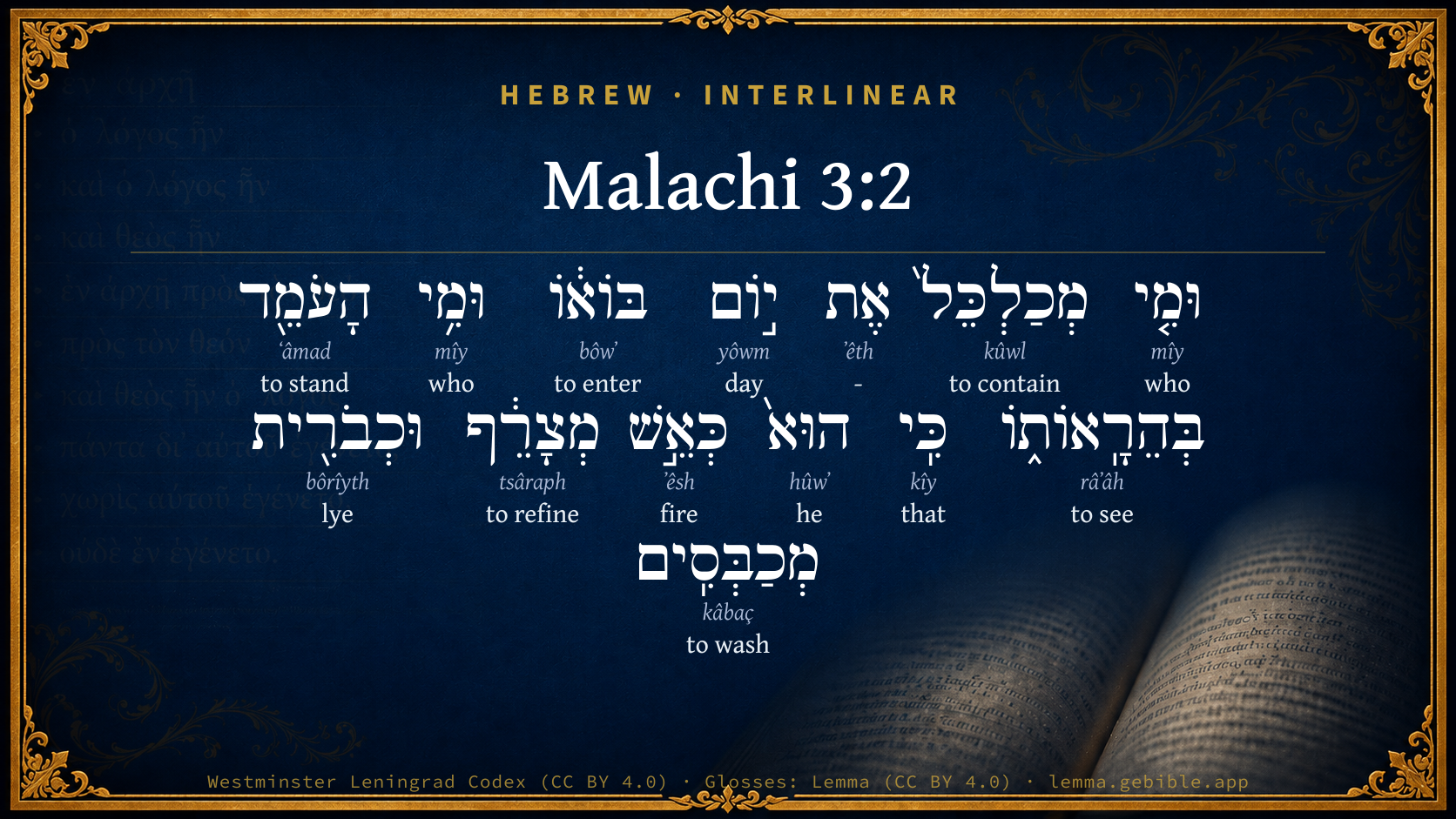
Hebrew (Westminster Leningrad Codex) Malachi 3:2 appears in the Hebrew Old Testament. The text above is from the Westminster Leningrad Codex. Each word links to its Strong’s number, a concise gloss, and parsing drawn from the Open Scriptures Hebrew Bible morphology. Click any word for its full Brown-Driver-Briggs (BDB) entry.
Download image
Cite this verse

Malachi 3:2 (World English Bible). Public Domain. Lemma interlinear Bible study tool, https://lemma.gebible.app/v/malachi/3/2.

Show BibTeX & RIS
BibTeX
RIS
English Translation
"But who can endure the day of his coming? And who will stand when he appears? For he is like a refiner's fire, and like launderer's soap;
World English Bible · Public Domain
Download a study sheet

One document with this verse’s original text, its word-by-word gloss line, the meaning frame, cross-references with their text, attributed commentary, and full source and license credits — printable, and it pastes into notes with its structure intact.

This verse Autodidact and up

Study sheet (.html) Plain text (.txt)

A passage Seminary Student

Up to 50 verses in one chapter. A passage sheet keeps up to 6 commentary sources and 12 cross-references per verse, in the order this page ranks them, and says so on the sheet whenever that leaves anything out. Ask for a single verse and you get the Autodidact verse sheet above.

Everything on this page stays free to read, with no account — the sheet is a download of what is already on screen, not access to it.

Want to remove ads? Support Godless Engineer
Compare translations 3

The same verse in 3 English versions, stacked beneath the original-language interlinear above. Click any original word for its lexicon entry.

Each is an independent rendering of the whole verse — the interlinear is not word-aligned to these translations.

Highlighted words mark where these versions differ — a whole-verse word diff, not a word-by-word alignment.

  • World English Bible Public Domain
    "But who can endure the day of his coming? And who will stand when he appears? For he is like a refiner's fire, and like launderer's soap;
  • King James Version Public Domain
    But who may abide the day of his coming? and who shall stand when he appeareth? for he is like a refiner's fire, and like fullers' soap:
  • unfoldingWord Literal Text CC BY-SA 4.0
    “But who enduring the day of his coming? And who the one standing in his appearing? For he like the fire of a refiner and like the soap of launderers.

unfoldingWord Literal Text — © unfoldingWord, licensed CC BY-SA 4.0. Word-aligned USFM3 via Door43 (git.door43.org/unfoldingWord/en_ult).

Versions to compare (up to 4)

3 of 4 selected

Show all 18 translations

Every available English version of this verse, each an independent rendering of the whole verse.

  • World English Bible Public Domain
    "But who can endure the day of his coming? And who will stand when he appears? For he is like a refiner's fire, and like launderer's soap;
  • Berean Standard Bible Public Domain
    But who can endure the day of His coming? And who can stand when He appears? For He will be like a refiner’s fire, like a launderer’s soap.
  • Majority Standard Bible Public Domain
    But who can endure the day of His coming? And who can stand when He appears? For He will be like a refiner’s fire, like a launderer’s soap.
  • King James Version Public Domain
    But who may abide the day of his coming? and who shall stand when he appeareth? for he is like a refiner's fire, and like fullers' soap:
  • American Standard Version (1901) Public Domain
    But who can abide the day of his coming? and who shall stand when he appeareth? for he is like a refiner's fire, and like fuller's soap:
  • Revised Version (1885) Public Domain
    But who may abide the day of his coming? and who shall stand when he appeareth? for he is like a refiner’s fire, and like fullers’ soap:
  • Geneva Bible (1599) Public Domain
    But who may abide the day of his comming? and who shall endure, when he appeareth? for he is like a purging fire, and like fullers sope.
  • Douay-Rheims (1899) Public Domain
    And who shall be able to think of the day of his coming? and who shall stand to see him? for he is like a refining fire, and like the fuller's herb:
  • Young's Literal Translation Public Domain
    And who is bearing the day of his coming? And who is standing in his appearing? For he `is' as fire of a refiner, And as soap of a fuller.
  • Literal Standard Version CC BY-SA 4.0
    “And who is bearing the day of His coming? And who is standing in His appearing? For He [is] as fire of a refiner, || And as soap of a fuller.
  • Unlocked Literal Bible CC BY-SA 4.0
    But who will be able to endure the day of his coming? Who will be able to stand when he appears? For he will be like a refiner's fire and like laundry soap.
  • unfoldingWord Literal Text CC BY-SA 4.0
    “But who enduring the day of his coming? And who the one standing in his appearing? For he like the fire of a refiner and like the soap of launderers.
  • Darby Bible Public Domain
    But who shall endure the day of his coming? and who shall stand when he appeareth? For he will be like a refiner's fire, and like fullers' lye.
  • World Messianic Bible Public Domain
    “But who can endure the day of his coming? And who will stand when he appears? For he is like a refiner’s fire, and like launderers’ soap;
  • Webster's Bible Public Domain
    But who may abide the day of his coming? and who shall stand when he appeareth? for he is like a refiner's fire, and like fuller's soap.
  • Free Bible Version CC BY-SA 4.0
    Who can survive the day when he comes? Who can stand before him when he appears? For he will be like a blazing furnace that refines metal, or like the strong alkali that cleanses stains.
  • Bible in Basic English Public Domain
    But by whom may the day of his coming be faced? and who may keep his place when he is seen? for he is like the metal-tester's fire and the cleaner's soap.
  • JPS Tanakh (1917) Public Domain
    But who may abide the day of his coming? And who shall stand when he appeareth? For he is like a refiner's fire, and like fullers' soap;

Literal Standard Version (2020), Covenant Press — licensed CC BY-SA 4.0. Text via the HelloAO Bible API (eBible.org). Unlocked Literal Bible (unfoldingWord) — licensed CC BY-SA 4.0. Text via the HelloAO Bible API (eBible.org). unfoldingWord Literal Text — © unfoldingWord, licensed CC BY-SA 4.0. Word-aligned USFM3 via Door43 (git.door43.org/unfoldingWord/en_ult). Free Bible Version, Dr. Jonathan Gallagher — licensed CC BY-SA 4.0. Text via the HelloAO Bible API (eBible.org).

Word by word

More ways to search: Search by grammar → Find every occurrence → Compare this word →

Practice this passage: Drill this verse → Learn its vocabulary →

וּכְבֹרִ֖ית
bôrîyth
H1287
“and · like/as · lye”
Conjunction + Preposition + Noun, Common, Feminine, Singular, Absolute
Part of Speech
Conjunction + Preposition + Noun
Type
Common
Gender
Feminine
Number
Singular
State
Absolute
Full BDB Definition

Origin: from H1253

TWOT: 288e

lye, potash, soap, alkali (used in washing)
  1. וּמִ֤י mîy H4310 “and · who” Conjunction + Particle, Interrogative
  2. מְכַלְכֵּל֙ kûwl H3557 “containing” Verb, Pilpel, Participle Active, Masculine, Singular, Absolute
  3. אֶת ʼêth H853 “-” Particle, Direct Object
  4. י֣וֹם yôwm H3117 “day of” Noun, Common, Masculine, Singular, Construct
  5. בּוֹא֔וֹ bôwʼ H935 “to enter · him” Verb, Qal, Infinitive Construct + Suffix, Personal, 3rd Person, Masculine, Singular
  6. וּמִ֥י mîy H4310 “and · who” Conjunction + Particle, Interrogative
  7. הָעֹמֵ֖ד ʻâmad H5975 “the · standing” Particle, Definite Article + Verb, Qal, Participle Active, Masculine, Singular, Absolute
  8. בְּהֵרָֽאוֹת֑וֹ râʼâh H7200 “in/at · to see · him” Preposition + Verb, Niphal, Infinitive Construct + Suffix, Personal, 3rd Person, Masculine, Singular
  9. כִּֽי kîy H3588 “that” Conjunction
  10. הוּא֙ hûwʼ H1931 “he” Pronoun, Personal, 3rd Person, Masculine, Singular
  11. כְּאֵ֣שׁ ʼêsh H784 “like/as · fire” Preposition + Noun, Common, Both, Singular, Absolute
  12. מְצָרֵ֔ף tsâraph H6884 “refining” Verb, Piel, Participle Active, Masculine, Singular, Absolute
  13. מְכַבְּסִֽים kâbaç H3526 “washing” Verb, Piel, Participle Active, Masculine, Plural, Absolute

About this verse

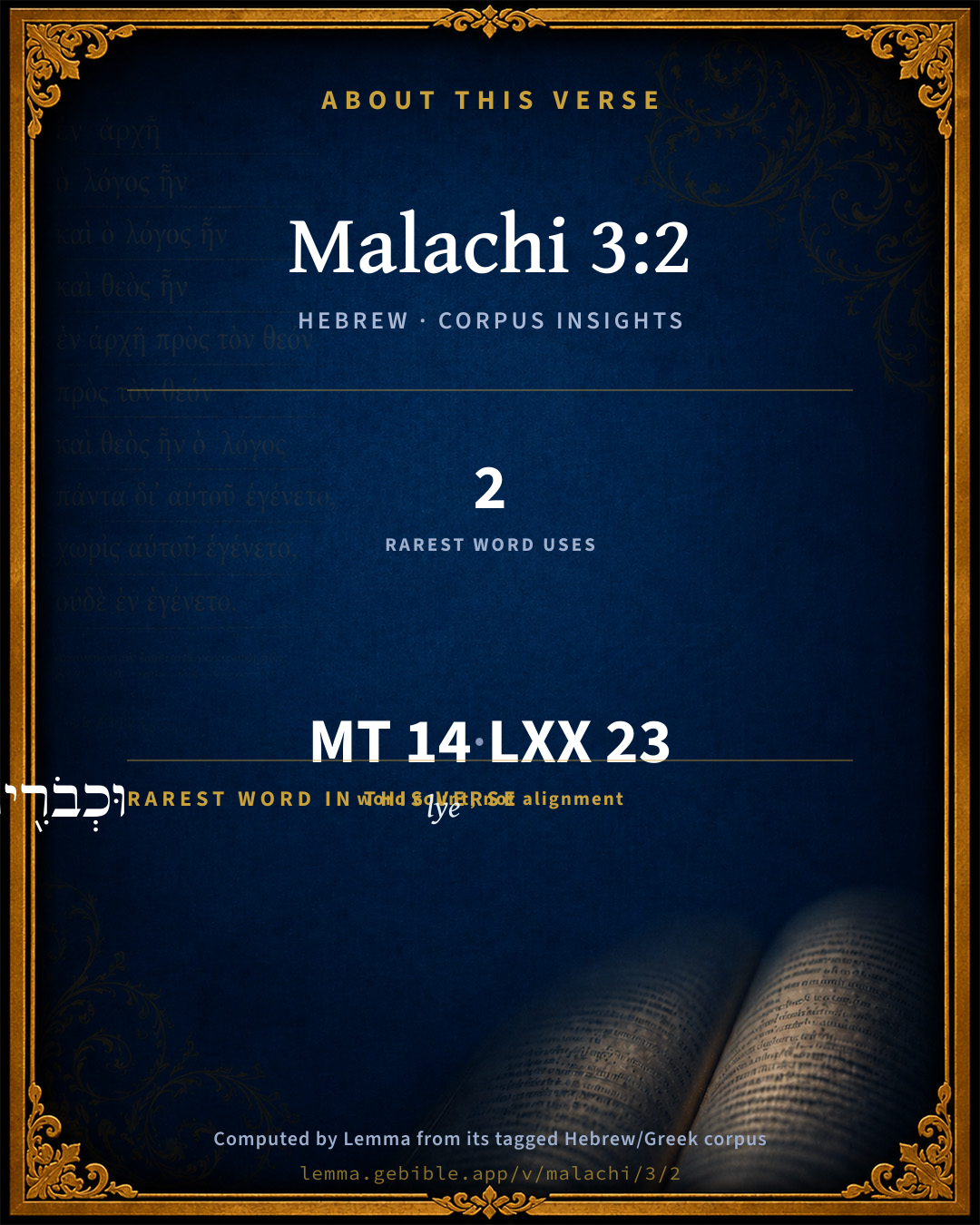
These counts appear in no published source. They are computed here, from the morphology-tagged text and Lemma’s own curated glosses. What Lemma adds →

14
words
13
distinct lemmas
Prophets
section

Notable vocabulary

The rarest word here is וּכְבֹרִ֖ית lye H1287 — appearing just 2 times in the whole Hebrew Bible.

Shared distinctive vocabulary

וּכְבֹרִ֖ית lye H1287 occurs in 2 verses of the Hebrew Bible. Also found in:

Grammatical profile

  • 6 verbs
  • 3 nouns
  • 1 pronoun
  • 1 conjunction
  • 3 particles

Verb forms

  • מְכַלְכֵּל֙ Pilpel · Participle Active
  • בּוֹא֔וֹ Qal · Infinitive Construct
  • הָעֹמֵ֖ד Qal · Participle Active
  • בְּהֵרָֽאוֹת֑וֹ Niphal · Infinitive Construct
  • מְצָרֵ֔ף Piel · Participle Active
  • מְכַבְּסִֽים Piel · Participle Active

Repetition

A word recurs within this verse — often emphatic in Hebrew:

  • וּמִ֤י who H4310 ×2

Hebrew & Septuagint length

In English translation the verse runs 27 words from the Hebrew and 33 from the Septuagint (LXX English) — closely comparable.

A rough comparison of the two English renderings, which tokenize alike — not a word-level alignment.

Word counts can differ between the Hebrew and the Greek without any difference in meaning — e.g. the Hebrew direct-object marker אֵת has no separate Greek word, and Greek often adds the article ὁ.

In the original languages it is 14 Hebrew tokens and 23 Greek tokens — but the two are counted differently (Hebrew bundles its prefixes and suffixes into one token; the Greek is in lemma form), so that isn’t a like-for-like length.

Cross-references

36

Topical passages linked to Malachi 3:2 in the Treasury of Scripture Knowledge — connected by theme and wording, ordered by reader-vote popularity; previews shown in the World English Bible.

  • Zechariah 13:9 I will bring the third part into the fire, And will refine them as silver is refined, And will test them like gold is tested. They will call on my name, and I will hear them. I will say, 'It is my people;' And they will say, 'Yahweh is my God.'"
  • Isaiah 4:4 when the Lord shall have washed away the filth of the daughters of Zion, and shall have purged the blood of Jerusalem from its midst, by the spirit of justice, and by the spirit of burning.
  • 1 Corinthians 3:13–15 each man's work will be revealed. For the Day will declare it, because it is revealed in fire; and the fire itself will test what sort of work each man's work is.
  • Revelation 6:17 for the great day of his wrath has come; and who is able to stand?"
  • 1 Peter 2:7–8 For you therefore who believe is the honor, but for such as are disobedient, "The stone which the builders rejected, Has become the chief cornerstone,"
  • Luke 21:36 Therefore be watchful all the time, asking that you may be counted worthy to escape all these things that will happen, and to stand before the Son of Man."
  • Psalms 2:7 I will tell of the decree. Yahweh said to me, "You are my son. Today I have become your father.
  • Luke 3:17 whose fan is in his hand, and he will thoroughly cleanse his threshing floor, and will gather the wheat into his barn; but he will burn up the chaff with unquenchable fire."
  • Malachi 4:1 "For, behold, the day comes, it burns as a furnace; and all the proud, and all who work wickedness, will be stubble; and the day that comes will burn them up," says Yahweh of Hosts, "that it shall leave them neither root nor branch.
  • Luke 3:9 Even now the axe also lies at the root of the trees. Every tree therefore that doesn't bring forth good fruit is cut down, and thrown into the fire."
  • John 6:42–44 They said, "Isn't this Jesus, the son of Joseph, whose father and mother we know? How then does he say, 'I have come down out of heaven?'"
  • Hebrews 10:28–29 A man who disregards Moses' law dies without compassion on the word of two or three witnesses.
  • Revelation 2:23 I will kill her children with Death, and all the assemblies will know that I am he who searches the minds and hearts. I will give to each one of you according to your deeds.
  • Jeremiah 2:22 For though you wash yourself with lye, and use much soap, yet your iniquity is marked before me, says the Lord Yahweh.
  • Amos 5:18–20 "Woe to you who desire the day of Yahweh! Why do you long for the day of Yahweh? It is darkness, And not light.
  • Romans 9:31–33 but Israel, following after a law of righteousness, didn't arrive at the law of righteousness.
  • Romans 11:5–10 Even so then at this present time also there is a remnant according to the election of grace.
  • Hebrews 12:25 See that you don't refuse him who speaks. For if they didn't escape when they refused him who warned on the Earth, how much more will we not escape who turn away from him who warns from heaven,
  • Isaiah 1:18 "Come now, and let us reason together," says Yahweh: "Though your sins be as scarlet, they shall be as white as snow. Though they be red like crimson, they shall be as wool.
  • Luke 2:34 and Simeon blessed them, and said to Mary, his mother, "Behold, this child is set for the falling and the rising of many in Israel, and for a sign which is spoken against.
  • Luke 11:52–54 Woe to you lawyers! For you took away the key of knowledge. You didn't enter in yourselves, and those who were entering in, you hindered."
  • John 8:41–48 You do the works of your father." They said to him, "We were not born of sexual immorality. We have one Father, God."
  • John 8:55 You have not known him, but I know him. If I said, 'I don't know him,' I would be like you, a liar. But I know him, and keep his word.
  • Revelation 1:5–7 and from Jesus Christ, the faithful witness, the firstborn of the dead, and the ruler of the kings of the earth. To him who loves us, and washed us from our sins by his blood;
  • Matthew 3:7–12 But when he saw many of the Pharisees and Sadducees coming for his baptism, he said to them, "You offspring of vipers, who warned you to flee from the wrath to come?
  • Matthew 21:31–44 Which of the two did the will of his father?" They said to him, "The first." Jesus said to them, "Most assuredly I tell you that the tax collectors and the prostitutes are entering into the Kingdom of God before you.
  • Matthew 25:10 While they went away to buy, the bridegroom came, and those who were ready went in with him to the marriage feast, and the door was shut.
  • John 15:22–24 If I had not come and spoken to them, they would not have had sin; but now they have no excuse for their sin.
  • Acts 7:52–54 Which of the prophets didn't your fathers persecute? They killed those who foretold the coming of the Righteous One, of whom you have now become betrayers and murderers.
  • Ezekiel 22:14 Can your heart endure, or can your hands be strong, in the days that I shall deal with you? I, Yahweh, have spoken it, and will do it.
  • Mark 9:3 His clothing became glistening, exceedingly white, like snow, such as no launderer on earth can whiten them.
  • Luke 11:37–47 Now as he spoke, a certain Pharisee asked him to dine with him. He went in, and sat at the table.
  • John 9:39–41 Jesus said, "I came into this world for judgment, that those who don't see may see; and that those who see may become blind."
  • Matthew 23:13–35 "Woe to you, scribes and Pharisees, hypocrites! For you devour widows' houses, and as a pretense you make long prayers. Therefore you will receive greater condemnation.
  • Revelation 7:14 I told him, "My lord, you know." He said to me, "These are those who came out of the great tribulation. They washed their robes, and made them white in the Lamb's blood.
  • Revelation 19:8 It was given to her that she would array herself in bright, pure, fine linen: for the fine linen is the righteous acts of the saints.

Cross-references courtesy of OpenBible.info (CC BY 4.0).

Hebrew and Greek witnesses Masoretic Hebrew ↔ Greek Septuagint

The same verse in the two great witnesses to the Old Testament, shown verse-for-verse.

These are two independent witnesses, not word-aligned to each other, and the Septuagint is shown in lemma (dictionary) form.

Hebrew Malachi 3:2 Masoretic · Westminster Leningrad Codex

וּמִ֤י מְכַלְכֵּל֙ אֶת י֣וֹם בּוֹא֔וֹ וּמִ֥י הָעֹמֵ֖ד בְּהֵרָֽאוֹת֑וֹ כִּֽי הוּא֙ כְּאֵ֣שׁ מְצָרֵ֔ף וּכְבֹרִ֖ית מְכַבְּסִֽים

"But who can endure the day of his coming? And who will stand when he appears? For he is like a refiner's fire, and like launderer's soap;

World English Bible · Public Domain

Greek LXX Malachi 3:2 Septuagint · lemma form

καί τίς ὑπομένω ἡμέρα εἴσοδος αὐτός ἤ τίς ὑποἵστημι ἐν ὁ ὀπτασία αὐτός διότι αὐτός εἰςπορεύομαι ὡς πῦρ χωνευτηρίον καί ὡς πόα πλύνω

And who will abide the day of his coming? or who will withstand at his appearing? for he is coming in as the fire of a furnace and as the herb of fullers.

LXX2012 (modern English Septuagint) · Public Domain

On this verse, Joseph Benson's Commentary discusses the Septuagint’s reading. Read the note in Commentary ↓

Hebrew: Westminster Leningrad Codex (CC BY 4.0). Greek: Septuagint (public domain); English from LXX2012 (modern English Septuagint) (Public Domain). How the Septuagint differs from the Hebrew →

Targum (Aramaic paraphrase)

1

The Targum is the ancient Jewish Aramaic paraphrase of the Hebrew Scriptures — an interpretive translation, not the Hebrew text itself. Onkelos (literal) and Pseudo-Jonathan (expansive) render the Torah, and Jonathan the Prophets. Coverage is partial: where no permissively-licensed English translation exists for a verse, only the Aramaic is shown. This is verse-level text, not a word-by-word alignment to the Hebrew.

  1. Targum Jonathan Prophets (Joshua–Malachi)
    וּמַן מְסוֹבַר יַת יוֹם מֵיתוֹהִי וּמַן יְקוּם בְּאִתְגַלְיוּתֵיהּ אֲרֵי רוּגְזֵיהּ כְּאֶשְׁתָּא מִמְסֵי וּכְבוֹרִיתָא דִמְחַוְרִין בָהּ:

    (no public-domain English translation for this verse)

    Targum Jonathan — Aramaic: “Mikraot Gedolot” (public domain). English: “Sefaria Community Translation” (CC0 1.0 (public-domain dedication)); “London "Chaldee Paraphrase," 1871” (public domain). Text via Sefaria.

Commentary

Notes on Malachi 3:2 from classic Christian and Jewish commentators (each source and its license shown beneath its notes). The classic Christian expositions comment on the surrounding passage and are grouped to its opening verse, so a note may address several verses; the Jewish commentaries on the Tanakh (Rashi and others) are per-verse, so they appear only where the commentator wrote on this verse.

Lemma curates 59 commentaries, every one of them public domain or Creative Commons licensed, each selected and text-cleaned for this edition rather than reprinted as found. About our sources →

The Cambridge Bible for Schools and Colleges

gen. ed. J. J. S. Perowne

2. a refiner’s fire] Comp. Mat_3:12.

fullers’ sope] “The process of fulling or cleansing cloth, so far as it may be gathered from the practice of other nations, consisted in treading or stamping on the garments with the feet or with bats in tubs of water, in which some alkaline substance answering the purpose of soap had been dissolved. The substances used for this purpose which are mentioned in Scripture are nitre, Pro_25:20; Jer_2:22, and soap, Mal_3:2.… The juice also of some saponaceous plant, perhaps Gypsaphila struthium, or Saponaria officinalis, was sometimes mixed with the water for the like purpose, and may thus be regarded as representing the soap of Scripture.” Dict. of Bible, Art. Fuller. But probably borax is meant.

The Cambridge Bible for Schools and Colleges (gen. ed. J. J. S. Perowne; Cambridge University Press, 1878–1918) — public domain. Text from a community e-Sword module.

Trapp's Complete Commentary

John Trapp

Mal 3:2 But who may abide the day of his coming? and who shall stand when he appeareth? for he [is] like a refiner’s fire, and like fullers’ soap:

Ver. 2. But who may abide the day of his coming?] The prophet Isaiah asketh "Who shall declare his generation?" Isa 53:8, that is, the mystery of his incarnation (that habitatio Dei cum carne, which the magicians held impossible, Dan 2:11); or the history of his birth, life, and death (as some sense it), whose tongue shall be able to speak it or pen to write it? Who can think of the day of his coming? so the Vulgate reads this text; viz. of all the glory, graces, benefits of that day? But the Hebrew word is the same as Pro 18:14 "The spirit of a man will sustain his infirmity"; and is so rendered here by the Chaldee and Kimchi. Who can sustain or abide the day of his coming, sc. in the flesh? What wicked man will be able to endure it? for, "he shall smite the earth with the rod of his mouth" (that is, the consciences of carnal men glued to the earth), "and with the breath of his lips shall he slay the wicked," Isa 11:4. And this is spoken of the Branch that grew out of the root of Jesse, Isa 11:1, when that goodly family was sunk so low, as from David the king to Joseph the carpenter. With what terror struck he the hearts of Herod and all Jerusalem by the news of his nativity! Mat 2:3. And si praesepe vagientis Herodem tantum terruit, quid tribunal iudicantis? If Christ in the cradle were so terrible, what will he be on the tribunal? The text that troubled those miscreants was Mic 5:2, which some (taking tsagnir in the neuter gender) render thus: And thou, Bethlehem Ephratah, it is a small thing to be among the princes of Judah; out of thee shall come a ruler, &c. This Herod and his complices could not hear of without horror; as neither could that other Herod, of the fame of Christ’s mighty works, Mat 14:1-2, such a glimpse of divine glory shone in them. "The sinners in Zion are afraid; fearfulness surpriseth the hypocrites"; and they run as far and as fast as they can from Christ, with these frightful words in their mouths: "Who among us shall dwell with the devouring fire? who shall abide with the everlasting burnings?" The ruffian soldiers were flung flat on their backs when he said no more but, "I am he," Joh 18:6. Quid autem Iudicaturus faciet, qui iudicandus hoc fecit? What will he do when he comes to judgment, who was thus terrible now that he was to be judged? (August.). Oh that the terror of the Lord might persuade people to forsake their sins, and to kiss the Son, lest he be angry. Though a lamb, he can be terrible to the kings of the earth; and though he break not the bruised reed, Mat 12:20, yet his enemies he will break with a rod of iron, and dash them in pieces like a potter’s vessel. Be wise now therefore, O ye kings, &c., Psa 2:9-10. And as the sun, moon, and eleven stars in Joseph’s vision did obeisance to him; so let our souls, bodies, all our temporal, natural, moral, and spiritual abilities, be subject and serviceable to Christ, as ever we hope to look him in the face with comfort.

And who shall stand when he appeareth?] Heb. at the sight of him. True it is that Christ, coming to help us in distress, for the want of external pomp in his ordinances, and worldly glory in his ministers and members, and splendour of human eloquence in his doctrines, is despised by those that form and frame to themselves a Christ like to the mighty monarchs of the earth; like as Agesilaus, King of Spartans, coming to help the King of Egypt, was slighted in that country for his lowly clothes and contemptible outside. But if the centurion were worthy of respect, because he loved the Jewish nation, and built them a synagogue; shall not Christ much more, even as prince of the kings of the earth, since he loved us, and washed us with his own blood, and hath made us kings and priests unto God and his Father, Rev 1:5-6; by whom also he is made unto us righteousness (imputatively), wisdom, sanctification, and redemption, effectively, by way of inherency and gracious operation? "Who is able to stand before this holy Lord God?" as the men of Bethshemesh once said, 1Sa 6:20. Who would not fear this King of nations, saith Jeremiah, Jer 10:7, this King of saints? saith John, Rev 15:3-4, for to him doth it appertain; since there is none like unto him; neither can any stand before him when he appeareth, any more than a glass bottle can stand before a cannon shot. O come, let us worship and bow down; let us kneel before this Lord our maker, Psa 95:6. If we harden our hearts he will harden his hand, and hasten our destruction. There is no standing before this lion, no bearing up sail in the tempest of his wrath: you must either be his subjects or his footstool; either vail to him or perish by him. "Thine arrows are in the heart of the king’s enemies; whereby the people fall under thee," Psa 45:5. What a world of miseries have the refractory Jews suffered, and do yet, for rejecting the Lord Jesus! They might have known, out of their own cabalists (besides Daniel’s seventy weeks, and other Scripture evidences), that the Messiah was among them; for it is there expressly recorded that Messias should come in the time of Hillel’s disciples; one of whom was Simeon the Just, who embraced the child Jesus in his arms; who also foretold that that child was "set for the ruin and rising again of many in Israel; and for a sign which should be spoken against, that the thoughts of many hearts might be revealed," Luk 2:34-35; and to the same purpose, 1Pe 2:7-8. But before them both, our prophet here.

For he is like a refiner’s fire] Intimating that the times of the Messiah would be discriminating, shedding times; and that he would separate the precious from the vile, the gold from the dross, the sheep from the goats: that Nabal should no more be called Nadib, the vile person liberal, the churl bountiful, Isa 32:5; but that good people should be discerned and honoured; hypocrites detected and detested, as was Judas, Magus, Demas, &c., slit up and slain by Christ’s two-edged sword, by his presence and preaching. Surely "his fan is in his hand," though the devil and his imps would fain wring it out, "and he will throughly purge his floor," mali in area nobiscum esse possunt, in horreo non possunt (Augustine), he will drive the chaff one way and the wheat another; for what is the chaff to the wheat? saith the Lord, Mat 3:12 Jer 23:20; he will purify the souls of his saints, "in obeying the truth through the Spirit unto unfeigned love of the brethren," 1Pe 1:22. So that they shall be united to such, and separated from sinners. Fire, we know, congregat homogenea, segregat heterogenea; for what fellowship hath light with darkness? The spirit of Christ, called a spirit of judgment and of burning, washeth away (lo, here refiner’s fire and fuller’s soap) the filth of the daughter of Zion, and purgeth the blood of Jerusalem from the midst thereof, Isa 4:4. By filth and blood understand their excessive bravery, mentioned Isa 3:1-26, which now they had learned to call by another name, since their own names were written among the living in Jerusalem, Isa 4:3. And here God made good to them that which he had promised, Isa 1:25, that he would purely purge away their dross, and take away all their tin; and that though their sins were as scarlet, they should be white as snow; though red like crimson, they should be as wool, Isa 3:18. Fuller’s soap (or soap weed, Saponaria, as some render it) is of singular use to fetch out stains and spots, and to whiten wool: so much more is the blood and spirit of Christ to whiten sinful souls, and to make men his candidates, ut fiant Candidati Dei. Such were those Corinthians 1Co 6:11 "Such were some of you" (that is, as bad as bad might be, lepers all over), "but ye are washed," sc. by that fuller of souls, Christ Jesus. And if any ask, How washed? It follows, "but ye are sanctified, but ye are justified in the name," that is, by the merit of the Lord Jesus, "and by the spirit of our God." The Jews in their Talmud hammer at this, when they question, what is the name of Messias? Their answer is, Hhevara, leprous (sc. by imputation, 2Co 5:21 Isa 53:6, whence also he is said by one to be Maximus peccatorum, the greatest of sinners), and he sitteth among the poor in the gates of Rome, carrying their sicknesses, according to that, "Himself took our infirmities, and bore our sicknesses." There are two things in guilt. 1. The merit and desert of it: this Christ took not. 2. The obligation to punishment: this he took, and so he became sin, that is, bound to the punishment of sin; which also he suffered, even to the effusion of his blood (that true Pactolus, agreement or rather Jordan), whereby he hath cleansed his people from sins, both guiltiness and filthiness. We have inveterate stains, which will hardly be got out till the cloth be almost rubbed to pieces: corruption cleaves so close to us, that fire and fuller’s soap is but needful to fetch it off, Jer 13:23. Nature and custom have made our spots like that of the leopard, which no art can cure, no water wash off; because they are not in the skin only, but in the flesh and bones, in the sinews and in the most inner parts. Hence David prayeth again and again to be washed thoroughly, to be purged with hyssop, to be washed and wrung in this fuller’s soap of Christ’s blood, and with the clean water of his Holy Spirit. This is the only true purgatory, the king’s bath, the fountain opened for sin and for uncleanness, Zec 13:1. Here Christ washeth his, not only from outward defilements, but from their swinish nature; that when washed clean they may not (as else they would) wallow in the next guzzle. Here are those sovereign muddifying waters of the sanctuary, which so wash off the corruption of the ulcer, that they cool the heat, and stay the spread of the infection; and by degrees heal the same. Hither poor sinners need not come, as to the pool of Bethesda, one by one, but as Turks to their Mahomet, Papists to their Lady, by troops and caravans, true Christians to their All-sufficient Saviour, how much more! In that pool of Bethesda the priests used to wash their sacrifices; because no unclean thing might come within the temple. The water was of reddish colour, and ran into that place in great abundance; and therefore it was called, saith one, the house of effusion. This shadowed out that every one of Christ’s sheep must be washed in the pool of his blood before they can be meet sacrifices, an offering unto the Lord in righteousness, as it is in the next verse. Other blood stains what is washed in it; this blood of the spotless Lamb whiteneth as fuller’s soap, and purifieth from all pollution of flesh and spirit, Rev 7:14 "This is he that came by water and blood, even Jesus Christ; not by water only, but by water and blood," 1Jn 5:6. The priests of the old law were consecrated first with oil, and then with blood; so was Christ, first with the Spirit, Isa 61:1, and then with his own blood, for our benefit.

John Trapp, A Commentary or Exposition upon All the Books of the Old and New Testament (1647–1656) — public domain. Text from a community e-Sword module.

The Biblical Illustrator

Joseph S. Exell

Mal_3:2

But who may abide the day of His coming?

The coming of the Lord

Look at this subject in two points of view.

I. As a question of solemn remonstrance. That the Lord has come, we know; that the Lord will come, we profess to believe. The Scripture tells us much about that coming, but leaves much that is uncertain. One thing is clear--the return is to be sudden. But the very suddenness of that return teaches us that when the time comes for the Lords appearing, then the time of preparation is past. When our blessed Lord does come suddenly, He returns for judgment; no nice distinctions will then be drawn; party spirit must then sleep, and sleep for ever. Then shall it be seen who have worshipped God in spirit and in truth. A difference, however, will be made, absolute and relative--absolute to the right or to the left--relative, for we know there are degrees in glory. At the Lords coming no secret shall be hidden, the mere outward appearance of religion will be unavailing. Then we shall learn who can abide His coming. There is a true and a false profession: and then the false profession will be detected, the veil of hypocrisy will be rent, and the mere formal hypocrite will be made known to all. It seems that the very teacher may then be lost. Then search and see whether there is Christian practice with the Christian profession. Those who have crowded together to hear the Word of God will then be detected.

II. As an appeal to our Christian confidence. The Apostle says that some can stand in that day. Who? The real Christian alone: the man who has the Spirit of the living God dwelling in his heart. What is your preparation for eternity? Faith in the Lord Jesus Christ is essential. The man that stands now, stands by faith. The man that does not trust Christ--I care not what his morality may be, I speak of him as one weighed in the balances of eternity. (Bishop of Carlisle.)

Christs second coming

I. Remind of some particulars in the second coming of Christ.

1. The certainty of that event. That. Christ will come is a point on which we are not left to doubt and conjecture. We have the plainest testimony which words could give (Act_1:11).

2. The manner of it. It will be glorious. The first coming was in all outward meanness and humiliation. The second is to be the glorious appearing of the great God and our Saviour. His coming will be sudden.

3. The purpose and consequences of it. In His state of humiliation Christ came as a Saviour; when He comes in glory, He will come as a Judge.

II. Answer the solemn question of the text. Who may abide the day-of His coming? Who will be able to bear that severe and close inquiry which will then be made into our lives and characters?

1. Those who will not be able to abide. Every open and habitual sinner. The worldly man, who has made the world his god, and has set up his idols in his heart. The hypocrite, who has the form of godliness, but is without the power of it. The man who is self-righteous, and trusts to his own merits and strength.

2. Those who will abide. The humble, penitent, believing Christian, a character widely differing from every other. His ground of confidence in that day will not be his innocence. He will claim an interest in the death of Christ. His penitence, his uprightness, his secret striving with sin, his useful life, his godly motives will be brought in evidence of the soundness and reality of his faith. The Judge Himself will own him as a friend. (E. Cooper.)

Before the Son of Man

The coming of Christ was the trial-test of the world. Men never needed Him more; were never less prepared to receive Him. It was the age of force. Society was not in a condition to hear Christ favourably. We say the time was ripe for His coming. As to necessity, yes; as to preparation, no. This was the historical day of Christ. Few were able to abide it. Few could stand when He appeared.

I. Rigid requirements of His standard. Christs coming is represented as attended by healing, comfort, and blessing. An era of peace and goodwill. But these results were not immediate. Gods promises are conditional. It is not easy to live by Christs standard. What is the nature of these requirements?

1. Consecration, which implies self-surrender. The doctrine of the Cross is but faintly understood to-day.

2. Purity. Involves thought of the heart, speech, actions. Christ raised the white standard of chastity higher than ever before.

3. Non-resistance. Must not give blow for blow. Overcome evil with good.

4. Forgiveness of injury. We are actually to love our enemies. Must pray for them, and do them good.

II. Duty of standing before Him. Christ does not judge the world in person to-day. Does this through the Gospel. Christ is the great refiner of men. It is our duty to stand before Him.

1. Because He is the only perfect standard.

2. Because it is the only way to secure His favour.

3. Because by this we reach our proper place. To hate sin, and love the sinning one--this is a Christlike prerogative. To separate the one from the other--this is a Christlike work. To stand before the Son of Man implies--

(1) That your life is in harmony with His.

(2) Watching and prayer.

(3) His favour and Divinest blessing. (Henry Schell Lobingier.)

Solemn questions

I. What did they imply?

1. A false security. Jews thought they were ready for Messiah. The prophet sees them to be self willed, dreaming of their own notions rather than desiring Gods truth. Religion only nominal.

2. The coming judgment.

3. A call to prepare.

II. They convince us of--Indifference, worldliness, indolence, self-indulgence. We need Gods call, the prophets appeal. Christ is coming: are we ready to meet Him? to be examined and tested by Him?

III. How are we to reply? We are at first struck dumb. None can stand. So says conscience, experience, observation, Scripture. Then the Gospel message of forgiveness and salvation comes to us in the person of Him who was presented in the temple in our nature unto God, and is the Mediator between God and man, the man Christ Jesus. In Jesus we find our refuge, our hope, our holiness, our home. (Homilist.)

The day of Christs coming

I. There is a momentous period for man to anticipate. The distinguishing characteristics of that day are--

1. It will be a day on which the Lord will visibly and personally appear in the presence of the universe.

2. It will be a day on which the Lord, by His coming, will perform great and wondrous acts. Note the inevitable certainty of that day.

II. There is a momentous question for man to consider. Who may abide the day of His coming?

1. This inquiry shall be vindicated. Our right to press and urge this inquiry is as valid as was the right of the prophets of old. On what is our right founded?

(1) On the nature of the commission which we have received in the ministry of the Lord.

(2) Upon a just estimate of the value of your intelligent and immortal spirits.

(3) Upon a just conviction of the fact, that while in a state of impenitent and unbelieving sin, you are in danger.

2. This inquiry is to be applied. To the infidel, the sensualist, the worldling, the Pharisee, the hypocrite.

3. This inquiry is to be advised upon.

(1) To embrace from the heart the appointed method of preparation for the day of the Lords coming.

(2) To embrace this method of preparation without procrastination or delay. Consider the importance of the matter at issue; the hardening influence of sin, while there is delay; and the uncertainties of human life. (James Parsons.)

The solemnities of the last great day, and the characters of those who are prepared for it

These words of the prophet relate immediately to the first advent. They naturally lead our thoughts to the second advent.

I. Lay before you some of the solemnities of that great day.

1. The actual coming of the Lord, or His appearance in His human nature.

(1) This revelation of Jesus Christ will be visible to the universal assembly of the human race.

(2) It will be unspeakably glorious.

2. The resurrection of the dead. The bodies of the unnumbered millions, who through succeeding ages have inhabited the globe, wherever laid, or however consumed, will be restored to life, and reunited to their immortal souls; that, with them, they may participate their happiness or misery.

3. The general judgment. The books shall be opened. The book of the Divine law: of Gods omniscience; the book of life.

4. The assignment of an endless doom. Our departure into everlasting punishment, or our admission into life eternal.

II. Consider the important questions of the text.

1. The profane scoffer will not be able to abide that day.

2. Neither will that numerous class of persons, who live in the habitual practice of open and flagrant sin, be able to stand before the Judge.

3. Nor that more respectable class who, nevertheless, are wholly devoted to the world.

4. Nor those who pay attention to the duties of religion in a proud and self-complacent spirit.

5. Nor those who acknowledge that salvation is of grace, but forget that we are created in Christ Jesus unto good works. They insist much on faith, but are lamentably deficient in its fruits. Who then may abide the day of His coming? Only the Christian who is worthy of the name. The man absolved by the Judge is one who, condemned by himself for his transgressions, has deeply repented and sought pardon on the ground of Christs meritorious obedience unto the death of the Cross, and works out his salvation with fear and trembling. (John Natt, B. D.)

Divine manifestations

Scepticism abounded, but no moral gloom could deaden the prophets faith. God, whose authority was contemned, would reveal Himself.

I. Divine manifestations are searching. If God were fully to disclose Himself no flesh could live. Veiled in material glory, His ancient saints found it difficult to bear His appearing. The manifestation of God in Christ, though veiled in the weakness of human flesh, was not easy to bear. Men felt it as a piercing light. Corrupt and oppressive rulers, selfish and self-satisfied moralists, hypocritical religionists, and ruthless evil-doers could not bear His presence. Some could bear His coming, and stand when He appeared. They were those--

1. Who were willing to feel, confess, and turn from their sinfulness.

2. Those who were sincerely waiting for His coming, as Simeon.

3. Those who had within them true faith, or spiritual receptiveness, as the Roman centurion and the Syrophenician woman. These could bear the most searching day in the worlds history, when the Lord appeared among men.

II. Divine manifestations are separating. He is like a refiners fire. The appearance of the Lord on the earth tested and separated men. Society was then like seething, molten metal. The good were revealed and refined; the bad, like recrement, were separated from them, to be cast away. In His presence men discovered of what sort they were, and ranged themselves for Him or against Him. As fire, His Spirit still tests and separates men. Fire has been by several nations regarded as a symbol of the Deity. As a Divine heat, enkindling shame, disgust, and remorse at our failures and sins. He will not consume us, but our impurities.

1. That we have much dross in our natures need not lead us to despair.

2. We should be thankful that God manifests Himself to us as a refining heat.

3. We should seek for continued manifestations of God to our souls.

III. Divine manifestations are cleansing or destroying. He is like fullers soap. The fullers trade was one well-known in Judaea. White garments were worn by the Jews on all festive occasions; these the fuller cleansed from all stains, and whitened them by rubbing them with a kind of marl. Creta limolia was probably the earth most commonly used. His soap (borith) was a vegetable alkali obtained from numerous plants, such as the Salsola huli, the Ajram, the Gilloo, and a heath which grows abundantly in the neighbourhood of Joppa. If a garment could not bear the work of the fuller, it was destroyed by it. So the coming of Christ would either cleanse men or hasten their destruction. Christ Himself is the cleansing power. He can wash out the most inveterate stains. None but He can cleanse men. If men will not bear His cleansing, their corruptions will destroy them. All Divine manifestations are essentially the same. There is one yet in the future for mankind. He who came in lowliness to redeem men will come in awful majesty to fix their doom. Who may abide that day of His coming? Who will be able to stand then? Only those who could have borne His first advent--the contrite, the sincere, the believing. (W. Osborne Lilley.)

The coming of Christ and the purification of the Church

Thoughts suggested by the day. As Christ was presented pure in the temple, so it should be our prayer that by His blood and righteousness, and by the sanctifying power of His Spirit, we may be presented unto God by Him, at the last day, pure and spotless. We will consider--

I. The coming of the Lord.

I. John the Baptist prepared the way for that event--

(1) By giving warning that it was near at hand.

(2) By calling men to repent.

2. Christ is called the messenger of the covenant, because that covenant began to be spoken by Him (Heb_2:3). He who was also the prince of the covenant, condescended to be its messenger.

3. Whom ye delight in. Christ is called the desire of all nations. (Hag_2:7); but especially was He the desire of the Jewish nation, because He was especially promised to them, and was to be one of themselves.

II. Who may abide the day of his coming? Not the hypocrite, not the formalist, not the self-righteous, not the lukewarm Laodicean, not the stony-ground hearer who is ashamed when tribulation or persecution because of the Word ariseth; but he who can endure the refiners fire and the fullers soap.

III. Christ shall sit as a refiner and purifier of silver.

1. By this process He will purify His visible Church, by sifting and testing it.

2. He will purify His own people by purging them.

3. The refiner of silver always sits, in order that he may watch the silver carefully; for if it be a minute too long or too short a time in the fire, the whole is spoiled, or at least injured. The sign which tells him when the silver is fit for use is his being able to see in it his own image. All this is a picture of the manner in which Christ purifies His people by trial, and of the end which He aims at. (Ven. Archd. Whately, M. A.)

The appearing of Christ

This truth was once brought out in an unusual manner at a gathering of literary men. After some general conversation it occurred to them to speculate how they would feel were certain of the illustrious dead suddenly to appear in their midst. Think, said one, if Homer were to enter this room, or Dante! How should we meet them? Or suppose, exclaimed another, Milton or Shakespeare were to come? We should stand in profound respect; we should honour the great seers and singers of the past. Ah, added one who had not yet spoken, and if Jesus Christ stood before us? That would be wholly different, was the instant and united response; He is above all. We should fall down on our knees and do homage to Gods Son and mans Saviour.

The coming of Christ not the same thing to all

Did you ever hear the sound of the trumpets which are blown before the judges as they come to a city to open the assizes? How different the feelings of the different people who hear the sound. The innocent man against whom there is no charge hears them unmoved. But the poor wretch waiting his trial in yonder cell, they tell him the day of his trial has arrived. Soon he will stand at the bar of justice, and receive his sentence. So will it be when Jesus comes; some will rejoice, but others will be afraid to meet Him. (Home Magazine.)

The Biblical Illustrator, edited by Joseph S. Exell (c. 1880s–1900s) — public domain. Text from a community e-Sword module.

Joseph Benson's Commentary

Mal 3:2. But who may abide the day of his coming — The LXX. read, τις υωομενει ημεραν εισοδου αυτου, who shall be able to bear the day of his coming? So also the Chaldee. “Quare hoc?” “Why this?” says Grotius: “Because he himself shall bear the cross, that he may come to the kingdom, and shall show the same way to his followers.” The day of his coming, with respect to the Jews, includes all the time from the beginning of his preaching, to the total destruction of their temple and city by the Romans: and his coming, here and in several other places, comprehends all the effects and consequences of his coming, as well the judgments which arose from it to the disobedient, as the mercy that flowed from it to the obedient. So that the meaning of the question is, Who shall be able to stand under the weight of those trials and tribulations which at that time will fall on all sorts of men? great crosses being to be borne by the believing and pious, and great calamities to be endured by the unbelieving and refractory. In the same light John the Baptist represents the effects of Christ’s coming, Mat 3:7-12, Who hath warned you to flee from the wrath to come? meaning, primarily, the wrath about to come on that rebellious people: whose fan, he adds, is in his hand, and he will thoroughly purge his floor, and burn up the chaff with unquenchable fire. For he is like a refiner’s fire — As if he had said, Some men are like metals, mixed with much dross, which nothing but a fierce fire can purge away. Such a fire shall the troubles of these days be. The divine judgments are often called a fiery trial, such as separates the pure metal from the dross, purifying the former and consuming the latter. See Isa 1:25; Isa 4:4; Zec 13:9. Our Lord is to be understood in the same sense, Luk 12:49, where he says, I am come to send fire upon the earth, namely, a fire of trial and purgation, to try and purify the hearts and reins of men, and find out and separate the good from the bad; like as the refiner’s fire makes the dross of the metal to appear and fly off. And like fuller’s soap — The word ברית, here rendered soap, and Jer 2:22, according to St. Jerome, was an herb growing in Palestine, which the fullers used to take spots out of clothes,

Joseph Benson's Commentary on the Old and New Testaments (1811–1818) — public domain. Text from a community e-Sword module.

Keil & Delitzsch

C. F. Keil & F. Delitzsch

With the coming of the Lord the judgment will also begin; not the judgment upon the heathen, however, for which the ungodly nation was longing, but the judgment upon the godless members of the covenant nation. Mal 3:2. "And who endures the day of His coming? and who can stand at His appearing? for He is like the smelter's fire, and like washers' lye: Mal 3:3. And will sit smelting and purifying silver, and will purify the children of Levi, and refine like gold and silver, that they may be offering to Jehovah His sacrifice in righteousness. Mal 3:4. And the sacrifice of Judah and Jerusalem will be pleasant, as in the days of the olden time, and as in the years of the past." The question "who endures the day" has a negative meaning, like מי in Isa 53:1 : no one endures it (for the fact itself compare Joe 2:11). The prophet is speaking to the ungodly. The second clause is synonymous. עמד, to remain standing, in contrast with falling, or sinking under the burden of the judgment. The reason for this is given in the second hemistich. The Lord when He comes will be like a smelter's fire, which burns out all the corrupt ingredients that are mixed with the gold and silver (cf. Zac 13:9), and like the lye or alkaline salt by which clothes are cleansed from dirt (cf. Isa 4:4). The double figure has but one meaning; hence only the first figure is carried out in Mal 3:3, a somewhat different turn being given to it, since the Lord is no longer compared to the fire, but represented as a smelter. As a smelter purifies gold and silver from the dross adhering to it, so will the Lord refine the sons of Levi, by whom the priests are principally intended. The yâshabh (sit) serves as a pictorial description, like ‛âmad (stand) in Mic 5:3. The participles metsârēph and metahēr describe the capacity in which He sits, viz., as a smelter and purifier of silver. זקּק: to strain, or filter; a term transferred to metals, because in smelting the pure metal is allowed to flow off, so that the earthy ingredients are left in the crucible (Psa 12:7; Job 28:1, etc.). The fact that the sons of Levi are named, as the object of the refining action of the Lord, is to be explained from what is mentioned in Mal 1:6. concerning their degeneracy. Since they, the supporters and promoters of the religious life of the nation, were quite corrupt, the renovation of the national life must begin with their purification. This purification, however, does not consist merely in the fact, that the individuals who are displeasing to God will be cut off from among them (Koehler), nor merely in their being cleansed from the sins and crimes adhering to them (Hitzig), but in both, so that those who are corrigible are improved, and the incorrigible cut off. This is implied in the idea of purification, and is confirmed by the result of the refining work of the Lord, as given in the last clause of the verse. They are to become to the Lord offerers of sacrifices in righteousness. Bitsedâqâh does not refer to the nature of the sacrifices, viz., righteous sacrifices, i.e., such as correspond to the law, but to the moral character of the offerers, viz., that they will attend to the offering of sacrifice in a proper state of heart, as in Psa 4:6. היוּ מגּישׁי is a constructio periphr. to denote the permanence of the action (cf. Ewald, 168, c). The tsaqeph-qaton does not compel us to separate היוּ ליהוה (compare, on the contrary, Gen 1:6 for example). Then, namely when the priests offer sacrifices in righteousness again, will the sacrificing of the whole nation be pleasant to the Lord, as was the case in the olden time. The days of the olden time and years of the past are the times of Moses, or the first years of the sojourn in the desert (Jer 2:2), possibly also the times of David and of the first years of the reign of Solomon; whereas now, i.e., in the time of Malachi, the sacrifices of the nation were displeasing to God, not merely on account of the sins of the people (Mal 2:13), but chiefly on account of the badness of the sacrificing priests (Mal 1:10, Mal 1:13). Moreover, we must not infer from Mal 3:3 and Mal 3:4, that Malachi imagined that the Old Testament worship would be continued during the Messianic times; but his words are to be explained from the custom of the prophets, of using the forms of the Old Testament worship to depict the reverence for God which would characterize the new covenant.

Keil & Delitzsch — Biblical Commentary on the Old Testament (1861–1891) — public domain (CC PDM 1.0). Text via the HelloAO Bible API. (Old Testament only.)

Tyndale Open Study Notes

Tyndale Open Resources

3:2 blazing fire: The dross of the people’s wickedness must be burned away by the fires of divine testing and chastisement (Isa 1:25; Jer 6:29; Ezek 22:22). • strong soap: An alkaline detergent was made from plants (see Jer 2:22). The blazing fire and strong soap signify the testing (by smelting) and cleansing (by laundering) that would restore Israel’s faithfulness to its covenant with the Lord.

Tyndale Open Study Notes — © Tyndale Open Resources, licensed CC BY-SA 4.0. Text via the HelloAO Bible API.

Geneva Bible (1599)

Geneva Bible translators

He showeth that the hypocrites which wish so much for the Lord’s coming will not abide when he draweth near: for he will consume them, and purge his and make them clean.

Geneva Bible (1599) marginal notes — public domain. Text via Bolls.life.

Jamieson, Fausset & Brown

Robert Jamieson, A. R. Fausset & David Brown

(Mal 4:1; Rev 6:16-17). The Messiah would come, not, as they expected, to flatter the theocratic nation's prejudices, but to subject their principles to the fiery test of His heart-searching truth (Mat 3:10-12), and to destroy Jerusalem and the theocracy after they had rejected Him. His mission is here regarded as a whole from the first to the second advent: the process of refining and separating the godly from the ungodly beginning during Christ's stay on earth, going on ever since, and about to continue till the final separation (Mat. 25:31-46). The refining process, whereby a third of the Jews is refined as silver of its dross, while two-thirds perish, is described, Zac 13:8-9 (compare Isa 1:25).

Jamieson, Fausset & Brown — Commentary Critical and Explanatory on the Whole Bible (1871) — public domain (CC PDM 1.0). Text via the HelloAO Bible API.

Adam Clarke's Commentary

Verse 2. But who may abide the day of his coming?] Only they who shall believe on his name; for they that will not, shall be blinded, and the unbelieving nations shall be destroyed by the Romans.

Like fuller's soap] כברית keborith, from ברר barar, to cleanse, any thing that deterges. Kali, or fern ashes, or such things. I doubt whether the composition which we call soap, was known in ancient times.

Adam Clarke's Commentary on the Bible (1810–1826) — public domain. Text from a community e-Sword/MySword module.

John Calvin's Commentaries

The Prophet in this verse contends more sharply with the Jews, and shows that it was a mere presence that they so much expected the coming of the Mediator, for they were far different from him through the whole course of their life. And when he says that the coming of Christ would be intolerable, what is said is to be confined to the ungodly; for we know that nothing is more delightful and sweeter to us than when Christ is nigh us: though now we are pilgrims and at a distance from him, yet his invisible presence is our chief joy and happiness. (Romans 8:22, 23.) Besides, were not the expectation of his coming to sustain our minds, how miserable would be our condition! It is therefore by this mark that the faithful are to be distinguished, — that they expect his coming; and Paul does not in vain exhort us, by the example of heaven and earth, to be like those in travail, until Christ appears to us as our Redeemer.

But the Prophet here directs his discourse to the ungodly, who though they seem to burn with desire for God’s presence, do not yet wish him to be nigh them, but they flee from him as much as they can. We have met with a similar passage in Amos,

“Wo to those who desire the day of the Lord! What will it be to you? for it will be darkness, yea darkness and not light, a day of sorrow and not of joy.” (Amos 5:18.)

Amos in this passage spoke on the same subject; for the Jews, inflated with false confidence, thought that God could not forsake them, as he had pledged his faith to them; but he reminded them that God had been so provoked by their sins, that he was become their professed and sworn enemy. So also in this place, Come, the Prophet says, come shall the Redeemer; but this will avail you nothing; on the contrary, his coming will be dreadful to you. We indeed know that Christ appeared not for salvation to all, but only to the remnant, and to those of Jacob who repented, according to what Isaiah says. (Isaiah 10:21, 22.) But since they obstinately rejected the favor of God, it is no wonder that the Prophet excluded them from the blessings of the Redeemer.

Who then will endure his coming? and who shall stand at his appearance? as though he had said, “In vain do ye flatter yourselves, and even upbraid God, that he retains the promised Redeemer as it were hidden in his own bosom; for he will come in due time, but without any advantage to you; nor will it be given you to enjoy his favor; but on the contrary he will bring to you nothing but terrors; for he will be like a purifying fire, and as the herb of the fullers The latter clause may be taken in a good or a bad sense, as it is evident from the next verse. The power of the fire, we know, is twofold; for it burns and it purifies; it burns what is corrupt; but it purifies gold and silver from their dross. The Prophet no doubt meant to include both, for in the next verse he says, that Christ will be as fire to purify and to refine the sons of Levi as gold and silver. With regard then to the people of whom he has been hitherto speaking, he shows that Christ will be like fire, to burn and consume their filth; for though they boasted with their mouth of their religion, yet we know that the Church of God had many defilements and pollutions; they were therefore to perish by fire. But Malachi teaches us at the same time, that the whole Church was not to perish, for the Lord would purify the sons of Levi

There is here a part stated for the whole; for the promise belongs to the whole Church. The sons of Levi were the first-fruits, and the whole people were in the name of that tribe consecrated to God. This is the reason why he mentions the sons of Levi rather than the whole people; as though he had said, that though the Church was corrupt and polluted, there would yet be a residue which God would save, having purified them. The words which I had omitted are these -

John Calvin's Commentaries (1540-1563) — public domain. Text from the Calvin Translation Society English edition (1840s-50s) via the Christian Classics Ethereal Library (ccel.org). Calvin's coverage is partial (roughly two-thirds of the Bible); uncommented books and verses are honest gaps, never fabricated. The 19th-century editor's footnotes and remarks are omitted so the notes are faithfully Calvin's own voice.

Ellicott's Commentary for English Readers

(2) This coming of the Lord to His temple acts as a crucial test (comp. Luk_2:35); the people ought, therefore, seriously to have considered how far they were prepared for that advent before they desired it so eagerly and impatiently.

A Bible Commentary for English Readers, edited by Charles John Ellicott (1878–1897) — public domain. Text from a community e-Sword module.

John Gill's Exposition

But who may abide the day of his coming?.... When he should be manifest in Israel, and come preaching the Gospel of the kingdom; who could bear the doctrines delivered by him, concerning his deity and equality with God the Father; concerning his character and mission as the Messiah, and his kingdom not being a temporal, but a spiritual one; concerning his giving his flesh for the life of the world, and eating that by faith; concerning distinguishing and efficacious grace; and all such that so severely struck at the wickedness of the Scribes and Pharisees, and their self-righteous principles; and especially since for judgment he came, that they might not see? nor could they bear the light of this glorious Sun of righteousness; and he came not to send peace and outward prosperity to the Jews, but a sword and division, Joh 9:39 very few indeed could bear his ministry, or the light of that day, it being so directly contrary to their principles and practices:

and who shall stand when he appeareth? in his kingdom and glory, to take vengeance on the Jews for their rejection of him and his Gospel; for this coming and appearance of his include all the time between his manifestation in the flesh and the destruction of Jerusalem; and so all those sorrows and distresses which went before it, or attended it, and were such as had never been from the creation of the world; and unless those times had been shortened, no flesh could have been saved; see Mat 24:3,

for he is like a refiner's fire; partly by the ministry of the word, compared to fire, Jer 23:29 separating pure doctrines from ones of dross; and partly by his fiery dispensations and judgments on the wicked Jews, when he distinguished and saved his own people from that untoward generation, and destroyed them:

and like fuller's soap; or "fuller's herb", as the Septuagint and Vulgate Latin versions render it, and Jarchi interprets it: and so R. Jonah (s) interprets it of an herb which fullers use: and in the Misna (t) this is one of the seven things used to take out spots, namely, "borith", the word here used; and which Maimonides (u) says is a plant known by the name of "algasul" and "gazul" in the Arabic language: it signifies something by which filth is washed away; and so Bartenora (w) says it is a plant which purifies and cleanses; and Jerom (x) relates that this herb grows in Palestine, in moist and green places, and has the same virtue as nitre to take away filth; agreeably to which some other versions render it "fuller's weed", or "soap weed" (y). The Syriac version is,

"as sulphur that makes white;''

and fullers, with the Romans, were wont to make use of that along with chalk to take out spots; and so Pliny (z) speaks of a kind of sulphur which fullers make use of. A metaphor signifying the same thing as before, the removing of spotted doctrines or spotted persons, the one by the preaching of the Gospel, the other by awful judgments, as spots in garments are removed by the fuller's herb or soap.

(s) Apud Kimchi in Sepher Shorash. rad. (t) Niddah. c. 9. sect. 6. (u) In Misn. ib. (w) In ib. (x) Comment. in Jer. ii. 22. (y) "ut lanaria fullonum", Drusius; "radicula, vel saponaria", Vatablus. (z) Nat. Hist. l. 35. c. 15.

John Gill's Exposition of the Whole Bible (1746–1763) — public domain (CC PDM 1.0). Text via the HelloAO Bible API.

Albert Barnes' Notes on the Bible

And who may abide the day of His coming? And who shall stand when He appeareth? - The implied answer is, “No one;” as in the Psalm Psa 130:3, “If Thou, Lord, wilt mark iniquities, O Lord, who shall stand?” Joel had asked the same , “The day of the Lord is great and very terrible; and who can abide it?” “How can the weakness of man endure such might; his blindness, such light; his frailty, such power; his uncleanness, such holiness; the chaff, such a fire? For He is like a refine’s fire. Who would not fail through stupefaction, fear, horror, shrinking reverence, from such majesty?”

Malachi seems to blend, as Joel, the first and second coming of our Lord. The first coming too was a time of sifting and severance, according as those, to whom He came, did or did not receive Him. The severance was not final, because there was yet space for repentance; but it was real, an earnest of the final judgment. Joh 9:39, “for judgment,” our Lord says, “I am come into this world, that they which see not may see, and they which see might be made blind;” and again Joh 12:31, “Now is the judgment of this world;” and Joh 3:18, “He that believeth not is condemned already, because he hath not believed on the name of the Only-Begotten Son of God; Joh 3:36. He that believeth not the Son, shall not see life, but the wrath of God abideth on him.” As, on the other hand, He saith Joh 6:54. “whoso eateth My Flesh and drinketh My Blood hath eternal life;” and Joh 6:47, “he that believeth on the Son hath everlasting life;” “hath,” He saith; not, “shall have;” “hath it,” in present reality and earnest, though he may forfeit it: so the other class is “condemned already,” although the one may repent and be saved, the other may Eze 33:18. “turn from his righteousness and commit iniquity;” and if he persevere in it, “shall die therein.”

It is then one ever-present judgment. Every soul of man is in a state of grace or out of it; in God’s favor or under His wrath; and the judgment of the Great Day, in which the secrets of men’s hearts shall be revealed, will be but an outward manifestation of that now hidden judgment. But the words, in their fullest sense, imply a passing of that judgment, in which men do or do not stand, as in those of our Lord Luk 21:35-36. “As a snare shall that day come on all those that dwell on the face of the whole earth. Watch ye, therefore, and pray always, that ye may be accounted worthy to escape all these things which shall come to pass, and to stand before the Son of Man;” and Paul Eph 6:13. “Take unto you the whole armor of God, that ye may be able to withstand in the evil day, and, having done all, to stand;” and in the Revelation Rev 6:16-17. “They said to the mountains and rocks; Fall on us, and hide us from the wrath of Him that sitteth upon the throne, and from the wrath of the Lamb. For the great day of His wrath is come, and who shall be able to stand?” Asaph says of a temporal, yet for this life, final destruction; Psa 76:6-7, “At Thy rebuke, O God of, Jacob, both the chariot and horse are cast into a deep sleep. Thou art to be feared, and who may stand in Thy sight, when Thou art angry?”

For He is like a refiner’s fire, and like fuller’s soup - Two sorts of materials for cleansing are mentioned, the one severe, where the baser materials are inworked with the rich ore; the other mild, where the defilement is easily separable. “He shall come like a refining fire; Psa 50:3-4, ‘a fire shall burn before Him, and it shall be very tempestuous round about Him. Then He shall call the heaven from above, and the earth, that He may judge HIs people;’ streams of fire shall sweep before, bearing away all sinners. For the Lord is called a fire, and a Deu 4:24. consuming fire, so as to burn our 1Co 3:12. wood, hay, stubble. And not fire only, but fuller’s soap. To those who sin heavily, He is a refining and consuming fire, but to those who commit light sins, fuller’s soap, to restore cleanness to it, when washed.”

Yet, though light in comparison, this too had its severity, for clothes which were washed (of which the word is used) were trampled on by the feet. “The nitrum and the fuller’s soap is penitence.” Yet the whiteness and purity so restored, is, at the last, perfected. Inspiration could find no more adequate comparison for us, for the brightness of our Lord’s raiment from the glory of the Transfiguration, than Mar 9:3, “exceeding white as snow; so as no fuller on earth can white them.”

Our Lord is, in many ways, as a fire. He says of Himself; Luk 12:49, “I am come to send a fire upon earth, and what will I, if it be already kindled?” John Baptist said of Him Luk 3:16, “He shall baptize you with the Holy Spirit and with fire.” He kindles in the heart “a fire of love,” which softens what is hard, the will.

“Wash whate’er of stain is here,

Sprinkle what is dry or sere,

Heal and bind the wounded sprite;

Bend whate’er is stubborn still,

Kindle what is cold and chill,

What hath wandered guide aright.”

But as God is “a consuming fire,” Who must burn out the dross, unless we be Jer 6:29-30 “reprobate silver” which “the founder melteth in vain,” either He must, by His grace, consume the sin within us, or must consume us with it, in hell.

Albert Barnes' Notes on the Bible (1834–1885) — public domain. Text from a community e-Sword/MySword module.

Haydock's Catholic Bible Commentary

Coming. This may be explained of [John] the Baptist, (Luke iii. 7.) or of the second coming of Christ; though his first coming shewed the hypocrisy of the Jews. They would not acknowledge him, but sought his death, and brought on their own condemnation. (Calmet) --- Fuller’s. Septuagint, "washers’ herb." Borith is found in all the low places of Palestine, (St. Jerome) and probably denotes soda, (Jeremias ii. 22.; Calmet) or fullers’ earth. (Haydock) --- Christ purified the religion of the Jews, or did what was requisite for that purpose. The people would not obey. Yet he established his Church in all purity.

George Leo Haydock (1774–1849), Haydock's Catholic Family Bible and Commentary, 1859 edition — public domain. Excludes Psalms (Douay-Rheims chapter numbering differs from Protestant) and Deuterocanonical books (Catholic canon only).

Matthew Poole's English Annotations

But, Heb. And. Who may abide the day of his coming? among the Jews were two sorts of inquirers after the day of the Messiah’s coming: some inquired with doubt of the truth of the promises, that he should come to set all right, like them Mal 2:17,

Where is the God of judgment? Others inquired hoping for preferment in the kingdom of the Messiah: of these, who shall be able to endure, to abide this day, when the unparalleled afflictions of that time shall cut off so many Jews, when the sword of the God of judgment shall destroy the ungodly scoffers, when so many must, as in Zec 13:8,9,

be cut off, and so many must pass through the fire? This will be a terrible day to these ungodly ones. Nor will it be much better with those who, disappointed of the expected worldly grandeur of the Messiah, shall stumble and fall, and be snared and broken; who will reject that Messiah who appears in a character so extremely different from that they had preconceived; and when God shall punish for the rejecting the Messiah, it will be a dreadful day, as it is described, Mat 24:6-8, &c.; Mar 13:2,8,12-14; the righteous will scarcely be saved; what then will become of the sinner?

Abide; think of, as the Latin Vulgate: the forethought of those calamities would be a burden; who shall be able to stand under the heavy weight of those crosses which in that day will fall on all sorts of men?

The day of his coming: this day was from his preaching till the utter destruction of the city Jerusalem, about seventy years after the birth of Christ: days they were, had they not been shortened, which would have worn out all; but for the elect’s sake they were shortened, Mat 24:22.

Who shall stand when he appeareth? an elegant ingemination, to confirm the thing, and to affect us with it.

For he is like a refiner’s fire: some are like metals, which nothing but a fierce fire can purge; such fire shall the troubles of these days be.

And like fullers’ soap; another allusion; though this may express the troubles of those times somewhat more tolerable, yet troublesome enough. The boiling waters into which spotted clothes are thrown, where they lie soaking ere they are taken out; the rubbing of them with the soap, by which the clothes are whitened and cleansed indeed, but withal fretted, weakened, and in time worn out: so that day of the Lord will prove to all a day of great trial, to purge and refine.

Matthew Poole's English Annotations on the Holy Bible (1683–1685) — public domain. Text from a community e-Sword/MySword module.

Whedon's Commentary on the Bible

Daniel D. Whedon

2. However, they will be disappointed when he appears, for he will come to execute a terrible judgment (compare Amo_5:18-20).

Who may abide… who shall stand — The moral and spiritual condition of the contemporaries of Malachi was such that it would be difficult for any one to endure the manifestation of Jehovah, for it meant death and destruction to everything impure.

Day of his coming… when he appeareth — As announced in Mal_3:1. This is the day of Jehovah (see on Joe_1:15).

Refiner’s fire — Which burns up all the impure ingredients that are mixed with the precious metal (compare Zec_13:9).

Fullers’ soap — The process of fulling “seems to have consisted in washing the material with some preparation of lye, beating or rubbing it, and exposing it to the rays of the sun.” This preparation of lye, which was intended to remove all impurity, is here called soap (compare Jer_2:22). That the day of Jehovah is a day of purging and purification is an idea frequently expressed in the Old Testament (Isa_4:2-4; Zec_13:9; compare Mat_3:12).

Daniel D. Whedon (gen. ed.), Commentary on the Old and New Testaments (1874–1909) — public domain. Text from a community e-Sword module.

The Pulpit Commentary

Who may abide the day of his comings? They had expected him to come and judge the heathen; the prophet warns them that they themselves shall be first judged. (comp. Amo_5:18) "Malachi, like John the Baptist, sees the future Judge in the present Saviour" (Wordsworth); Joe_2:11. Who shall stand! Who can stand up under the burden of this judgment? The Vulgate Version, Quis stabit ad videndum eum? points to the brightness of his presence, which eye of man cannot endure. Like a refiner"s fire, which separates the precious metal from the refuse. So the Lord at his coming shall sever the good among men from the world. (Isa_1:25 Jer_6:29 Zec_13:9) Like fullers" soap; Septuagint, wv poia plunontwn , "as the grass of washers;" Vulgate, quasi herba fullonum, What is to be understood exactly by the "soap" (borith), washing herb, is not known. Probably the ashes of some plant yielding a lye, like carbonate of soda, are meant. Such plants are met with on the shores of the Mediterranean and Dead Seas, and at this day large quantities of alkalies are extracted from them and exported in different directions. (see Tristram, "Nat. Hist. of the Bible," p. 480, etc.; Isa_4:4 Jer_2:22) The Lord shall wash away all that is filthy. (comp. Mat_3:10, Mat_3:12)

Ver. 2. The manifestation of Christ a testing time to all.

We may apply this truth

I TO CHRIST"S FIRST MANIFESTATION TO THE WORLD. This truth was foreseen by Simeon. (Luk_2:34, Luk_2:35) And when Jesus entered on his public ministry, his preaching and his very presence served as a testing time to all.

1. His teaching was a process of sifting. (Mat_3:12) Socrates used to go about Athens testing and refining men"s ideas, and in his own unrivalled method extracting the few grains of gold from the mass of rubbish in young men"s minds. Our Lord did a more valuable service, testing men"s hearts rather than their heads, their characters rather than their opinions. Illust.: Nicodemus, tested, convicted of ignorance, but ultimately refined. Others when convicted were offended and repelled; e.g. Mat_15:12-14 Joh_6:25-66 Joh_8:33-59. So severe was this testing process that Christ pronounced a special blessing on all who stood. (Luk_7:23) Yet Christ"s teaching held out the door of mercy to all. He showed to the world that in the midst of the dross of some of the foulest lives there were grains of gold, gems of Divinity, which his purifying power could disengage. Sinful men and women "loved much," because through his words they learned that they had been much forgiven.

2. The purity of his life made his very presence like the flame of a refiner"s fire. Men could not be much with him without being either attracted and purified or repelled and made worse; e.g. the Gadarenes, the chief priests, Judas. On the other hand we note Zacchaeus, the Samaritan woman, file "sinner", (Luk_7:37) the eleven apostles. This testing process took effect especially among the religious people of that day (ver. 3). Judgment began at the house of God. Some priests believed in him; few, if any, confessed him. Of most he had to say Mat_21:31; and see vers. 44.

II TO THE MANIFESTATION OF CHRIST TO THE SOUL OF A MAN. It was not the mere fact of Christ having come to the world and being seen that made him like a refiner"s fire; it was when he came home to men"s hearts and was manifested to their consciences that the real testing began. In this sense Christ still comes to our homes and appears to our hearts. Of this manifestation we remark:

1. We naturally dread it. Joh_1:26 is too often true. Many shun that manifestation. They put up the shutters and close every chink, "lest the light," etc. (2Co_4:4) Thus they can tolerate secret sins of which they would be ashamed "in the light of his countenance." Imagine that we were living in the same house as Jesus Christ, that he noticed every act and word, and that we knew he was acquainted with our thoughts as well. How could we bear it? Should we not at times be constrained to cry out, in distress, if not in defiance, "Depart from me; for I am a sinful man, O Lord"? But alas! we often do not realize "the real presence" of the invisible Christ. When we do, our feelings will be those of guilty Adam or at least of righteous Job.

2. Yet we ought to desire it. For everything depends on our knowing ourselves as sinners, and Christ as our Saviour. This should make us very anxious that when Christ reveals himself it may be not simply as the light of God, but as the fire of God. Light merely reveals. Illust.: morning light dawning on the horrors of yesterday"s battlefield. But fire may purify, and Christ is like a refiner"s fire. The two figures of the text are suggestive. "Two sorts of material for cleansing are mentioned: the one severe, where the baser materials are in worked with the rich ore; the other mild, where the defilement is easily separable.

(1) He is like a refiner"s fire. Illust.: Zacchaeus "purged from his old sins" by Christ, who not only came to his home, but appeared, manifested himself in his heart. Like the flame of the fiery furnace, the fire of the Lord"s holy love consumed the bonds of sin, but the man himself stood upright and walked at liberty. This refining process may be a very severe one to us. But the refining fire is himself the Refiner. He knows the ore he has to deal with. We can calmly leave him to select every step in the process. We know that he is working towards an end which is, or ought to be, very dear to us our own sanctification. (Psa_79:9)

(2) He is like fuller"s soap. This is a milder process. Yet even this may imply some rough treatment like treading, beating, hammering with mallets. Linen after cleansing may show how much dirt there was in it before. So Christ"s purifying power may show us how many secret sins there were ingrained in the very essence of our hearts. The discovery may prompt to confession and to prayer, (Psa_51:1-10) which will be met by the promise, Isa_1:18. Christ is no mere reformer or disciplinarian. He himself is the fire; his blood is the cleansing fountain; his Spirit is the source of our sanctification. Our supreme desire should be that Christ should be manifested to our souls now as the purifying fire of that holy God who, because he changeth not, doth not consume us (ver. 6). For otherwise he will for the same reason (vers. 5, 6, "For I change not") consume us at last.

III TO THE SECOND COMING OF CHRIST. In this prophecy, as Augustine says, "the first and second advents of Christ are brought together." Malachi sees the great white throne in the background. (Mal_4:1) The result of that coming to us will depend on his treatment of us and our treatment of him now. (2Ti_1:18)

The severe side of Messiah"s mission.

"Like a refiner"s fire, and like fuller"s soap." It is usually shown that the triumphant side of Messiah"s mission wholly occupied the mind of the Jews, and that consequently the stern, judgment side needed to be presented vigorously. But some recent accounts of the actual condition of Jewish thought in the first century suggest that the fears of Messiah"s time were so extravagant that they needed to be corrected and qualified. The stern things of the Gospels are mild and reasonable when compared with the extravagant fears of the people. "The people looked forward with dread to the coming of the Messianic era. They were afraid of seeing the war of Gog and Magog, which the scribes predicted as its precursor. They looked for fearful calamities. Rabbi Eliezar ben Abena said, "When ye shall see nations rising up one against the other, then look for Messiah to follow. In the weeks of years in which the Son of David shall come, there will be in the first year abundance of rain upon one city, and drought upon another. In the second year the arrows of famine will go abroad. In the third there will be a great famine, and men, women, and children will die, as well as the saints and the rich; and there will be a judgment of forgetfulness upon those that study the Law. In the fourth there will be abundance for some and barrenness for others. In the fifth a great abundance; and they shall eat, drink, and rejoice, and the Law shall he again held in honour, among those who teach it. In the sixth year voices will be heard. In the seventh wars will break out, and at the end of the seventh the Son of David will appear It was as necessary to correct these delusions as those which pictured a triumphant earthly conqueror. The severity must be fully recognized as a moral, not material, severity.

I MESSIAH WORKS TO REVEAL EVIL. This his very presence does. Put a foul thing beside a pure thing, and the pure thing shows and intensifies the foulness. Let God show, in a man"s human life among men, what he requires and what he can accept, and wherever that man goes he is sure to bring evil to light. Christ is doing that work still.

II MESSIAH WORKS TO PUNISH EVIL. "All judgment is committed unto the Son" But the sphere of the punishment is moral and spiritual. Christ never asked the secular arm to carry out his condemnations.

III MESSIAH WORKS TO DELIVER FROM EVIL. This is indicated in his work as Refiner. He is getting the metal freed from the dross. Much of our evil is not us, only attached to us, blended with us, a bondage of us.

IV MESSIAH WORKS TO CLEANSE FROM EVIL. This is indicated in the soap figure. The evil is conceived of as in us, and as having to be got out by the severe processes of the fuller, or washer, by pounding. R.T.

The Pulpit Commentary (1880–1919), ed. H.D.M. Spence-Jones & Joseph S. Exell — public domain. Text from a community e-Sword module.

John Wesley's Explanatory Notes

Abide - Who shall be able to stand under the weight of those crosses which in that day, will fall on all sorts of men? The day - This day was from his preaching, 'till the utter destruction of Jerusalem, about seventy years after the birth of Christ. A refiner's fire - Some are like metals, which nothing but a fierce fire can purge, such fire shall the troubles of these days be. Fuller's soap - As boiling waters, into which, spotted cloaths are thrown, and as the rubbing of them with soap; so that day will prove to all, a day of great trial, to purge and refine.

John Wesley, Explanatory Notes Upon the Whole Bible (1754–1765) — public domain. Text via the GEBible commentary corpus.

Rashi

Rabbi Shlomo Yitzchaki (Rashi)

Now who can abide This is synonymous with; וּמִי יָכִיל

and who will stand Will be able to stand.

and like fullers’ soap Like soap used by the fullers, which removes the entire stain. So will he remove all the wickedness. and like soap It is an herb which removes stains, erbe savonijere in Old French, probably soapwort. The word בֹּרִית signifies a thing that cleans and purifies, as in (Ps. 73:1), “to the pure of heart.”

Rashi on the Tanakh — English translations: “The Judaica Press complete Tanach with Rashi, translated by A. J. Rosenberg” (CC BY 4.0); “Pentateuch with Rashi's commentary by M. Rosenbaum and A.M. Silbermann, 1929-1934” (public domain); “The Metsudah Tanach series, Lakewood, N.J” (CC BY 4.0); and “The Book of Joshua, Metsudah Publications, 1997” (CC BY 4.0). Text via Sefaria.

Lesson kit

Teaching starters — assembled from the data on this page, not authored interpretation. Every prompt links to the verse data it draws on. Edit before teaching.

Malachi, in the Prophets, opens this verse with 14 words (13 distinct Hebrew lemmas). Its most distinctive word is bôrîyth (“lye”). A historical commentator’s framing appears above. Read the whole chapter for the surrounding context.

Discussion questions

  1. How does “lye” (bôrîyth) shape what this verse is saying?
  2. Jeremiah 2:22 shares the word «lye» with this verse. How do the two illuminate each other?
  3. “who” occurs 2× in this one verse. What is the effect of the repetition?
  4. The translations on this page render this verse differently — a whole-verse word diff, not a word-by-word alignment. What might account for the different wordings?
  5. The verb «מְכַלְכֵּל֙» is Pilpel Participle Active. How does its form color the action?
  6. Reading how The Cambridge Bible for Schools and Colleges and Trapp's Complete Commentary read this verse, where do the two commentators agree and where do they part?

Things to notice

Reading settings

Reading text

Shown beneath each verse's original-language words.

Old Testament
Old Testament edition

Read the OT as the Masoretic Hebrew (MT) or the Greek Septuagint (LXX).

English shown for the Greek Septuagint (in the Hebrew ↔ Greek comparison).

Comparing translations? Open the Compare panel on any verse page to stack up to four side by side.