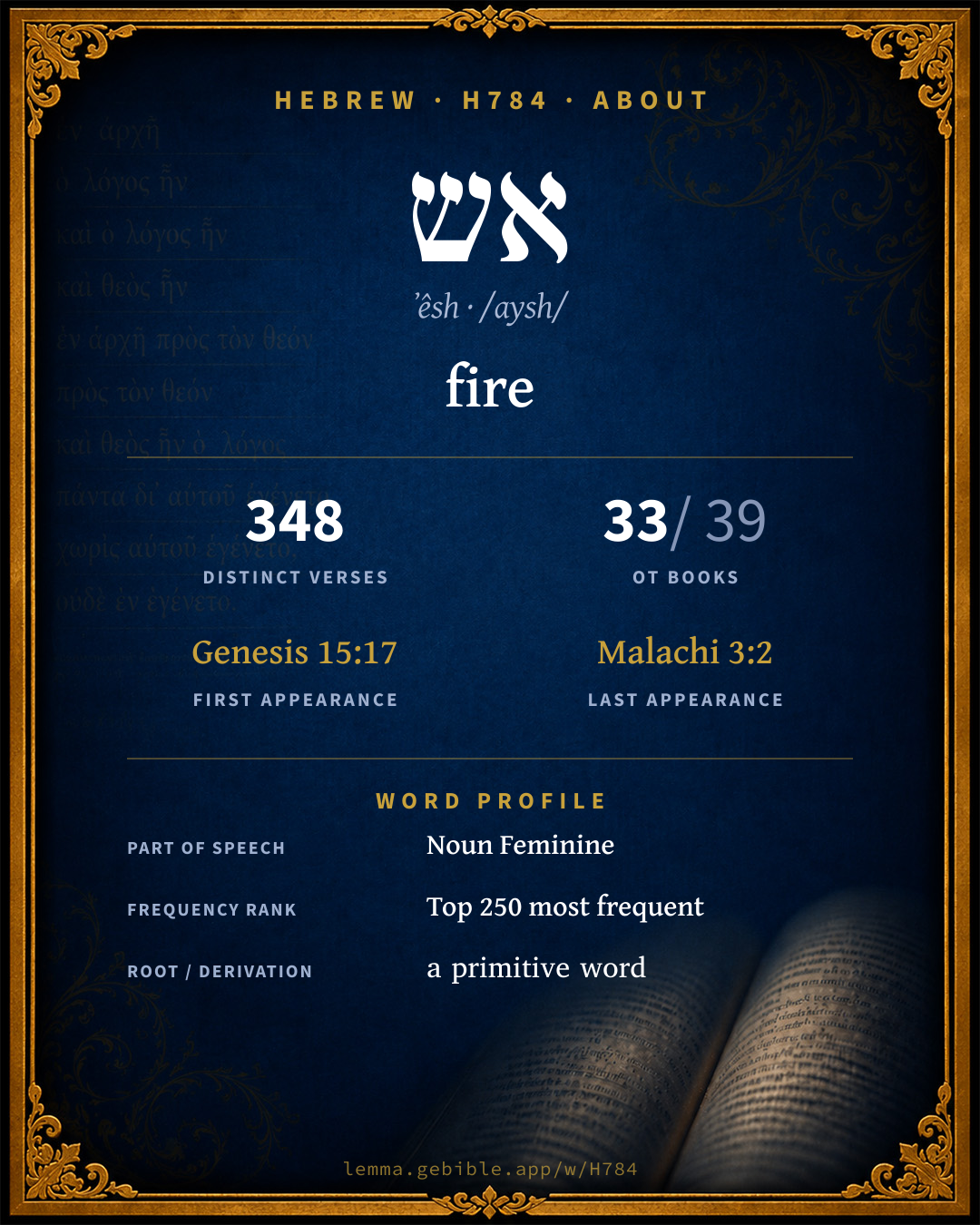
אֵשׁ
fire
‘fire’ is one of 6 main senses fuller range ↓
Full lexicon entry — Brown-Driver-Briggs (BDB)
From Brown-Driver-Briggs (BDB)
Where this word appears
See every Absolute-state word in the Hebrew Bible →
Grammar key — what these labels mean
Part of speech
- Noun
- A naming word — a person, place, thing, or idea.
Noun type
- Common
- A common noun — a general class of person, place, or thing (“king,” “city,” “water”), not a specific name.
State
- Absolute
- The independent form of a noun, not bound to a following word.
- Construct
- A noun bound to a following noun in a possessive / “of” relationship (the construct chain).
Gender
- Both
- Attested as both masculine and feminine.
Number
- Singular
- One.
Every verse where H784 appears in the Book of Deuteronomy — 28 distinct verses. Click any verse to open its interlinear word-by-word view. Verse text shown in the World English Bible for context — . Each verse’s Hebrew form is shown with its reference; the English is not keyword-highlighted, since the data carries no word-level English alignment. Use “Compare translations” on any verse to read it across multiple English versions. This concordance covers the Hebrew Bible; Septuagint (Greek Old Testament) occurrences are not indexed here.
Deuteronomy
- Deuteronomy 1:33 בָּ/אֵ֣שׁ prep det + n c bs who went before you in the way, to seek you out a place to pitch your tents in, in fire by night, to show you by what way you should go, and in the cloud by day.
- Deuteronomy 4:11 בָּ/אֵשׁ֙ prep det + n c bs You came near and stood under the mountain; and the mountain burned with fire to the heart of the sky, with darkness, cloud, and thick darkness.
- Deuteronomy 4:12 הָ/אֵ֑שׁ ptcl def.art + n c bs Yahweh spoke to you out of the midst of the fire: you heard the voice of words, but you saw no form; only [you heard] a voice.
- Deuteronomy 4:15 הָ/אֵֽשׁ ptcl def.art + n c bs Take therefore good heed to yourselves; for you saw no manner of form on the day that Yahweh spoke to you in Horeb out of the midst of the fire.
- Deuteronomy 4:24 אֵ֥שׁ n c bs For Yahweh your God is a devouring fire, a jealous God.
- Deuteronomy 4:33 הָ/אֵ֛שׁ ptcl def.art + n c bs Did ever a people hear the voice of God speaking out of the midst of the fire, as you have heard, and live?
- Deuteronomy 4:36 אִשּׁ֣/וֹ הָ/אֵֽשׁ n c bs cs + sfx pers 3ms ptcl def.art + n c bs Out of heaven he made you to hear his voice, that he might instruct you: and on earth he made you to see his great fire; and you heard his words out of the midst of the fire.
- Deuteronomy 5:4 הָ/אֵֽשׁ ptcl def.art + n c bs Yahweh spoke with you face to face on the mountain out of the midst of the fire,
- Deuteronomy 5:5 הָ/אֵ֔שׁ ptcl def.art + n c bs (I stood between Yahweh and you at that time, to show you the word of Yahweh: for you were afraid because of the fire, and didn't go up onto the mountain;) saying,
- Deuteronomy 5:22 הָ/אֵשׁ֙ ptcl def.art + n c bs These words Yahweh spoke to all your assembly on the mountain out of the midst of the fire, of the cloud, and of the thick darkness, with a great voice: and he added no more. He wrote them on two tables of stone, and gave them to me.
- Deuteronomy 5:23 בָּ/אֵ֑שׁ prep det + n c bs It happened, when you heard the voice out of the midst of the darkness, while the mountain was burning with fire, that you came near to me, even all the heads of your tribes, and your elders;
- Deuteronomy 5:24 הָ/אֵ֑שׁ ptcl def.art + n c bs and you said, Behold, Yahweh our God has shown us his glory and his greatness, and we have heard his voice out of the midst of the fire: we have seen this day that God does speak with man, and he lives.
- Deuteronomy 5:25 הָ/אֵ֥שׁ ptcl def.art + n c bs Now therefore why should we die? for this great fire will consume us: if we hear the voice of Yahweh our God any more, then we shall die.
- Deuteronomy 5:26 הָ/אֵ֛שׁ ptcl def.art + n c bs For who is there of all flesh, that has heard the voice of the living God speaking out of the midst of the fire, as we have, and lived?
- Deuteronomy 7:5 בָּ/אֵֽשׁ prep det + n c bs But thus shall you deal with them: you shall break down their altars, and dash in pieces their pillars, and hew down their Asherim, and burn their engraved images with fire.
- Deuteronomy 7:25 בָּ/אֵ֑שׁ prep det + n c bs The engraved images of their gods shall you burn with fire: you shall not covet the silver or the gold that is on them, nor take it to you, lest you be snared therein; for it is an abomination to Yahweh your God.
- Deuteronomy 9:3 אֵ֣שׁ n c bs Know therefore this day, that Yahweh your God is he who goes over before you as a devouring fire; he will destroy them, and he will bring them down before you: so shall you drive them out, and make them to perish quickly, as Yahweh has spoken to you.
- Deuteronomy 9:10 הָ/אֵ֖שׁ ptcl def.art + n c bs Yahweh delivered to me the two tables of stone written with the finger of God; and on them [was written] according to all the words, which Yahweh spoke with you on the mountain out of the midst of the fire in the day of the assembly.
- Deuteronomy 9:15 בָּ/אֵ֑שׁ prep det + n c bs So I turned and came down from the mountain, and the mountain was burning with fire: and the two tables of the covenant were in my two hands.
- Deuteronomy 9:21 בָּ/אֵשׁ֒ prep det + n c bs I took your sin, the calf which you had made, and burnt it with fire, and stamped it, grinding it very small, until it was as fine as dust: and I cast the dust of it into the brook that descended out of the mountain.
- Deuteronomy 10:4 הָ/אֵ֖שׁ ptcl def.art + n c bs He wrote on the tables, according to the first writing, the ten commandments, which Yahweh spoke to you on the mountain out of the midst of the fire in the day of the assembly: and Yahweh gave them to me.
- Deuteronomy 12:3 בָּ/אֵ֔שׁ prep det + n c bs and you shall break down their altars, and dash in pieces their pillars, and burn their Asherim with fire; and you shall cut down the engraved images of their gods; and you shall destroy their name out of that place.
- Deuteronomy 12:31 בָ/אֵ֖שׁ prep det + n c bs You shall not do so to Yahweh your God: for every abomination to Yahweh, which he hates, have they done to their gods; for even their sons and their daughters do they burn in the fire to their gods.
- Deuteronomy 13:16 בָ/אֵ֜שׁ prep det + n c bs You shall gather all the spoil of it into the midst of the street of it, and shall burn with fire the city, and all the spoil of it every whit, to Yahweh your God: and it shall be a heap forever; it shall not be built again.
- Deuteronomy 18:10 בָּ/אֵ֑שׁ prep det + n c bs There shall not be found with you anyone who makes his son or his daughter to pass through the fire, one who uses divination, one who practices sorcery, or an enchanter, or a sorcerer,
- Deuteronomy 18:16 הָ/אֵ֨שׁ ptcl def.art + n c bs according to all that you desired of Yahweh your God in Horeb in the day of the assembly, saying, Let me not hear again the voice of Yahweh my God, neither let me see this great fire any more, that I not die.
- Deuteronomy 32:22 אֵשׁ֙ n c bs For a fire is kindled in my anger, Burns to the lowest Sheol, Devours the earth with its increase, Sets on fire the foundations of the mountains.
- Deuteronomy 33:2 אֵ֥שׁ n c bs cs He said, Yahweh came from Sinai, Rose from Seir to them; He shined forth from Mount Paran, He came from the ten thousands of holy ones: At his right hand was a fiery law for them.
About this entry
At a glance — auto-summarized from this page’s data, not written by a person. Every figure links to its source below. This summary describes the numbers; it doesn’t interpret them.
The Hebrew noun אש centers on the idea of “fire.” The lexicon spreads it across several senses; see its full sense range. Spanning 348 verses in 33 books, it ranks among the common words of the Hebrew Bible. Debuting at Genesis 15:17, it then recurs through the corpus. Sharing its root, it stands alongside אש, אש and אשדת. Dig into 348-verse concordance and the renderings breakdown below.
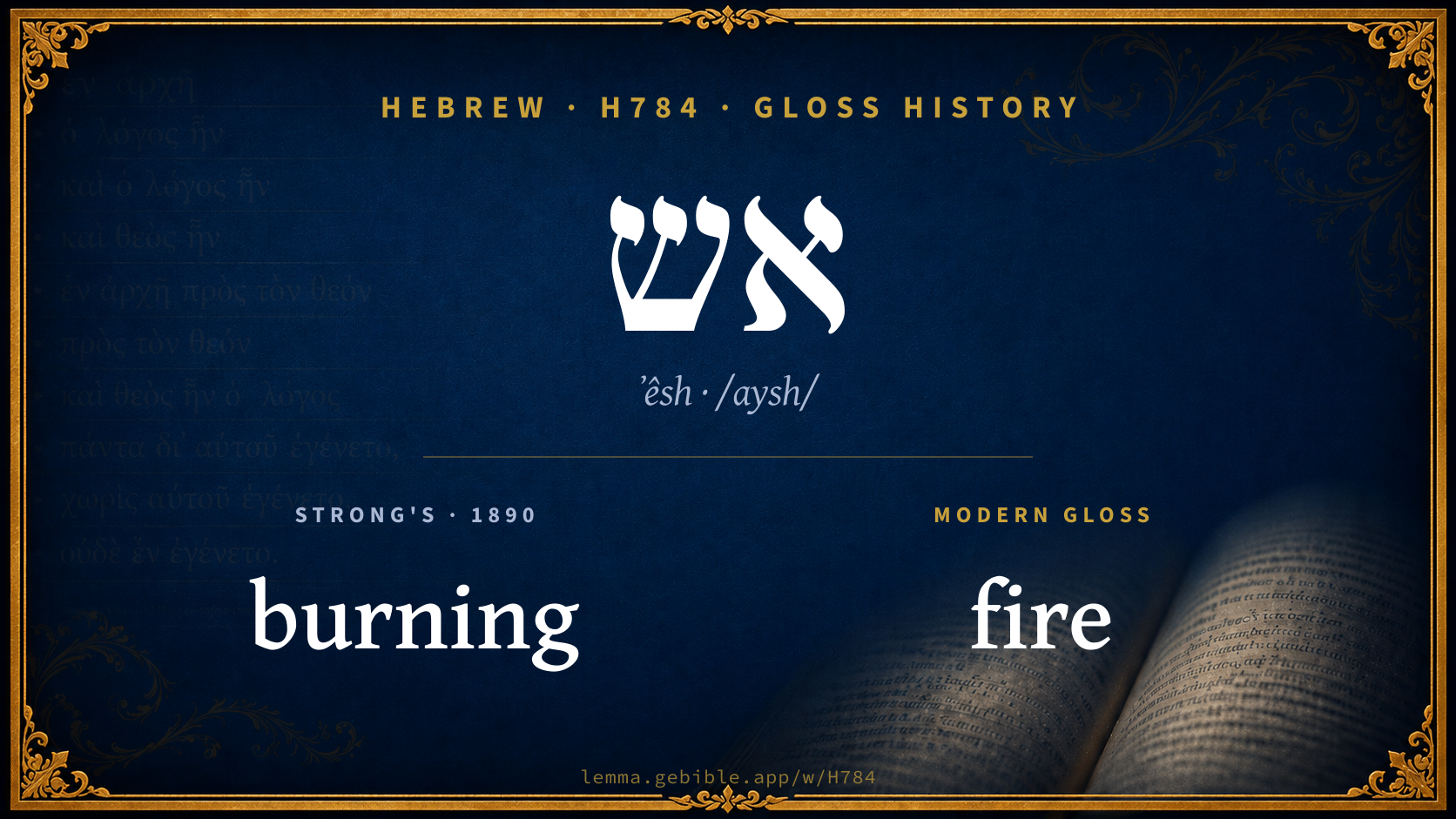
Gloss history
Strong's 1890 vs modern scholarship
About this word
Strong's H784 catalogs a Hebrew word from the Hebrew Old Testament.
These counts are not copied from any lexicon or concordance. They are computed here, from the morphology-tagged Hebrew Old Testament. What Lemma adds →
- 348
- distinct verses
- The word appears in 348 distinct verses.
- 33 / 39
- OT books
- The word appears in 33 of 39 Old Testament books.
- #131
- by frequency
- Top 250 most frequent Hebrew words (rank 131 of 8,640 Hebrew words by occurrence).
View all 348 occurrences in the concordance →
By section of the Old Testament
By traditional corpus
Conventional, traditional groupings — biblical authorship is debated, so this is a traditional corpus grouping, not an authorship claim. Each share is this word’s portion of its verses in that division of the Hebrew canon. Each figure is a share of the word’s 348 distinct verses.
- Prophets (Nevi'im) 189 verses · 54%
- Torah (Pentateuch) 99 verses · 28%
- Writings (Ketuvim) 60 verses · 17%
How translations render this word
Counts come from each version’s own published word-to-Strong’s tagging or interlinear alignment — an approximate guide to how each version renders this word, not a word-level alignment the data otherwise carries. Because each total is that version’s own tagged count, the per-version totals vary from one another and need not match the appearance or distinct-verse counts above. These counts may also differ from a printed concordance because Lemma counts each distinctly tagged rendering and does not collapse phrase taggings into a single head-word total. This is a fixed set of word-tagged versions (KJV, ASV, BSB, ULT) and does not change with the reading translation you choose elsewhere. Each version’s license is shown beside its name below (and on Sources).
- King James Version: Fire 321×, Like fire 7×, Let fire 5×
- American Standard Version: Fire 292×, Like fire 7×, Fires 3×
- Berean Standard Bible: Fire 244×, Like fire 10×, Fiery 7×
- unfoldingWord Literal Text: Fire 307×, Fire of 8×, Like fire 6×
King James Version Public Domain
Renders H784 across 378 tagged occurrences — most commonly:
Plus 32 renderings that appear only once — usually multi-word phrases or single function words the recovered tagging swept in, not distinct renderings. Not rendered by a distinct English word in 2 further occurrences.
American Standard Version Public Domain
Renders H784 across 379 tagged occurrences — most commonly:
Plus 55 renderings that appear only once — usually multi-word phrases or single function words the recovered tagging swept in, not distinct renderings.
Berean Standard Bible Public Domain
Renders H784 across 313 tagged occurrences — most commonly:
Plus other, less common renderings. Plus 20 renderings that appear only once — usually multi-word phrases or single function words the recovered tagging swept in, not distinct renderings. Not rendered by a distinct English word in 60 further occurrences.
unfoldingWord Literal Text CC BY-SA 4.0
Renders H784 across 368 tagged occurrences — most commonly:
Plus 27 renderings that appear only once — usually multi-word phrases or single function words the recovered tagging swept in, not distinct renderings.
Senses in the full BDB
What do BDB’s symbols mean?
BDB uses these scholarly abbreviations:
| Symbol | Meaning |
|---|---|
| 𝔊 | the Septuagint (the ancient Greek translation, LXX) |
| 𝔙 | the Vulgate (the Latin translation) |
| 𝔖 | the Syriac version (the Peshitta) |
| 𝔗 | the Targum (the Aramaic translation) |
| ψ | the Psalms |
| √ | root (the underlying root or stem) |
| ‖ | parallel passage (a synonymous or contrasted parallel) |
| † | the dagger: every passage where the word occurs is cited |
The 6 senses and sub-senses the full Brown-Driver-Briggs lexicon distinguishes for this word, in lexicon order (not ranked by frequency), with BDB’s own verbatim wording and sub-sense lettering. Shown in Hebrew script with BDB’s own scholarly abbreviations. The condensed entry is in the Lexicon Entry tab. See also the Forms in the corpus table below.
- 1. fire, of conflagration, e.g. in briers, endangering or destroying crops תֵּצֵא אֵשׁ וּמָֽצְאָה קֹצִים Ex 22:5 cf. 3:2 הַסְּנֶה בֹּעֵר בָּאֵשׁ (both E); more often of deliberate destruction by fire, especially שָׂרַף בָּאֵשׁ (בָּ c. qam. preton.) obj. golden calf Ex 32:20 (J), other idols Dt 7:5, 25, Asherim 12:3, chariots Jos 11:6, 9 2 K 23:11, house Ju 12:1; 14:15, tower 9:52, city-gates Ne 1:3; 2:3, 13, 17, city Jos 6:24 Ju 18:27 cf. Is 1:7 +; also שִׁלַּח אֵשׁ בְּ Am 1:4, 7, 10 +; שִׁלַּח אֶת־הָעִיר בָּאֵשׁ †Ju 1:8; 20:48 cf. 2 K 8:12; הִצִּית אֶת־הָעִיר בָּאֵשׁ Jos 8:8, 19 הצ׳ אֵשׁ ב׳ Je 17:27 +; cf. Ju 9:49 2 S 14:30, 31 (of field, cf. Ex 22:5 supr.). e.g. Exodus 22:5
- 2. of supernatural fire, attending theophany Ex 3:2; 19:18 (both JE) Dt 4:11, 12, 15, 33, 36 +; specif. עַמּוּד (הָ)אֵשׁ Ex 13:21, 22; 14:24 (all JE) Ne 9:12, 19 cf. Dt 1:33 (v. מַרְאֵה־אֵשׁ Nu 9:15, 16 P); of destructive fire from י׳ Nu 11:1, 2, 3 (J) 26:10 (P) Lv 10:2 (P); cf. א׳ אֹכֶלֶת in sim. of Yahweh’s glory Ex 24:17 (E) Dt 4:24; 9:3; v. also 1 K 18:24, 38 2 K 1:10(×2), 12(×2), 14 Jb 1:16 (perhaps lightning intended), cf. further of lightning Ex 9:23, 24 (JE) ψ 18:13, 14; 148:8 etc. e.g. Exodus 3:2
- 3. fire for cooking, roasting, parching, etc. צְלִי אֵשׁ roasted at a fire Ex 12:8, 9 (P) cf. Lv 2:14 2 Ch 35:13 Is 44:16, 19; of tinder for lighting fire Gn 22:6, 7 (E); of fire for melting (gold for the idolatrous calf) Ex 32:24; for refining Je 6:29, where read with Qr מֵאֵשׁ תַּם עֹפָֽרֶת; cf. Mal 3:2 (sim. of purifying work of messenger of cov’t). e.g. Exodus 12:8
- 4. especially of altar-fire Lv 1:7(×2); 6:2, 3, 5, 16 +; in offering incense Lv 10:1, also אֵשׁ זָרָה strange fire, i.e. an incense not commanded, offered presumptuously 10:1 Nu 3:4; 26:61; fire from י׳ consuming sacrifice (cf. 2 Lv 9:24 2 Ch 7:1, 3; of fire in child-sacrifice (usually (לְ) הֶעֱבִיר בֵּן בָּאֵשׁ) 2 K 16:3; 21:6 cf. 17:17; 23:10 2 Ch 33:6; also שׂרף בָּא׳ 2 K 17:31, בער בָּא׳ 2 Ch 28:3. e.g. Leviticus 1:7
- 5. fig. of Yahweh’s anger ψ 89:47 (sim.) cf. Na 1:6 La 2:4 אֵשׁ־עֶבְרָתִי Ez 21:36; 22:31; 38:19, אֵשׁ־קִנְאָתִי Ez 36:5; v. also Is 66:15 ψ 79:5 etc.; of word of י׳ Je 23:29; fig.of outbursting emotion ψ 39:4; of flagrant wickedness Is 9:17, etc. e.g. Psalms 89:47
- 6. in various combinations, לַפִּיד אֵשׁ Gn 15:17 (J) a torch of fire (cf. Di); לַבַּת־אֵשׁ Ex 3:2 flame of fire, לַהַב אֵשׁ Jo 2:5, לַפִּידֵי אֵשׁ (in sim.) Dn 10:6 cf. Zc 12:6, לַהֲבוֹת אֵשׁ ψ 29:7 לַהֲבֵי אֵשׁ Is 66:15 cf. א׳ לֶהָבוֹת ψ 105:32, נֹגַהּ א׳ לֶהָבָה Is 4:5 cf. Ho 7:6; שְׂבִיב אִשּׁוֹ spark of his fire Jb 18:5 cf. כִּידוֹדֵי אֵשׁ 41:11; תַּנּוּר אֵשׁ ψ 21:10 oven of fire, כִּיּוֹר אֵשׁ Zc 12:6; אוֹר אֵשׁ light of fire ψ 78:14; אֵשׁ לֹהֵט flaming fire ψ 104:4; לְשׁוֹן אֵשׁ Is 5:24 tongue of fire, גַּחֲלֵי אֵשׁ Ez 1:13 coals of fire, so 10:2, cf. רִשְׁפֵּי אֵשׁ Ct 8:6; on אַבְנֵי אֵשׁ Ez 28:14, 16 v. אֶבֶן; אֵשׁ דַּת Dt 33:2, lit. fire of a law, or fire was a law, but דָּת law is Pers. & late; read perhaps אֵשׁ [לַףִּ]דֹת cf. Ex 20:18 or אֵשׁ [יֹקֶ]דֶת cf. Is 65:5. e.g. Genesis 15:17
Senses from the full Brown-Driver-Briggs lexicon (Brown, Driver, Briggs; Oxford 1906 — public domain), digitized via Sefaria, supplemented by the OpenScriptures HebrewLexicon (CC BY 4.0). Full attribution on Sources.
Word origin
n.f. Ex 9:23 (m. Je 48:45; ψ 104·4; f. & m. Je 20:9; Jb 20:26) אֵשׁ ‘m.’ is dub.: Nu 16:18 read עָלֶיהָ for 2nd עֲלֵיהֶם (𝔊B); Je 20:9 v. Ges§ 132 d; 48:45 read (many MSS., Nu 21:28) יצאה; ψ 104:4 read perhaps (Ol) לֹהֵֽטָה׃ or (Kenn) וָלָֽהַט׃; Jb 20:26 v. Ges§ 145 u (or 121 b): cf. AlbrZAW xvi (1896), 63. fire (Assyrian išatu COTGloss, Syriac ܐܶܫܳܬܳܐ, እሳት deriv. from ii. אנשׁ,أَنَسَ, sociable, friendly element (MV Wetzst in De Psalmen, ed. 4, p. 888 LagBN 68 cf. انيسة, مانوسة), improb. especially in view of Assyrian; daghesh prob. secondary; cf. also Sta§ 189 b)—א׳ abs. Ex 9:24 +; cstr. Lv 6:2 + (seld.); †sf. אִשּׁוֹ Dt 4:36 Jb 18:5; אֶשְׁכֶם Is 50:11; אִשָּׁם Is 66:24;—
— Brown-Driver-Briggs (Oxford 1906, public domain), digitized via Sefaria, supplemented by the OpenScriptures HebrewLexicon (CC BY 4.0). See Sources.
Origin: a primitive word
Jastrow Dictionary
A second Hebrew/Aramaic lexicon for comparison, covering Aramaic and post-biblical (Talmudic, Targumic, Midrashic) usage that the biblical-Hebrew BDB does not. Matched by lemma rather than by Strong’s number, so a lemma may carry more than one Jastrow headword (shown separately below), and the entries cover usage well beyond the Bible.
אֵשׁ
- c. (b. h.;
- 1. fire. Sabb. 11ᵃ; a. e. כא׳ לנעורת as destructive as fire to the flax. Sot. 48ᵇ כא׳ בנעורת like fire among flax, i.e. inflaming the senses. Gen. R. s. 39 מבול של א׳ (v. מַבּוּל) destruction by fire.—Num. R. s. 2 end א׳ הדיוטית fire from outside of the sanctuary; a. fr.—Pl. אִשֹּׁות. Yoma 21ᵇ; a. fr.
- 2. fever, א׳ של עצמות. Gitt. 70ᵃ
A Dictionary of the Targumim, the Talmud Babli and Yerushalmi, and the Midrashic Literature (Marcus Jastrow; London, Luzac, 1903) — Public Domain. Digitized via Sefaria. Digitized via Sefaria. Full attribution on Sources.
Forms in the corpus
The 91 distinct written forms H784 takes in the Hebrew Bible, most frequent first — each parse links to that state’s occurrences in the concordance. Hebrew forms include their vowel points and cantillation, so a single lemma takes many written forms.
The 60 most common forms are shown; 31 rarer forms follow in the full concordance.
Same root — word family
Other BDB entries built from the same root as H784, grouped by Strong’s listed origin. These share a root / origin per the lexicon — not necessarily a shared meaning. Each links to that word’s own entry.
Derived from this word
- אש ʼêsh H785 fire
- אש ʼish H786 there is
- אשדת ʼeshdâth H799 fiery law
- אשה ʼeshshâh H800 fire
- אשיש ʼâshîysh H808 foundation
- אתון ʼattûwn H861 furnace
Compare all same-root words → Showing 4 of 7 — not the complete family. They share a root, not necessarily a meaning.
Septuagint verse parallels
This word appears in 321 verses that also exist in the Greek Old Testament (Septuagint), out of the 348 Hebrew verses it occurs in. You can read those verses in Greek by switching the Old Testament edition to the Septuagint.
Read these verses in the Septuagint
- Genesis 15:17
- Exodus 3:2
- Leviticus 1:7
- Numbers 3:4
- Deuteronomy 1:33
- Joshua 6:24
- Judges 1:8
- 1 Samuel 30:1
- 2 Samuel 14:30
- 1 Kings 9:16
- 2 Kings 1:10
- 1 Chronicles 14:12
This is a verse-level parallel only — the same verses exist in both the Hebrew and Greek Old Testaments. No word-level Hebrew↔Greek correspondence is claimed: the data carries no such alignment, so no Greek word is shown as this Hebrew word’s translation. Coverage is not total — the Septuagint omits the deuterocanon and renumbers the Psalms, so some Hebrew verses have no direct Greek parallel.