Joshua 11:9

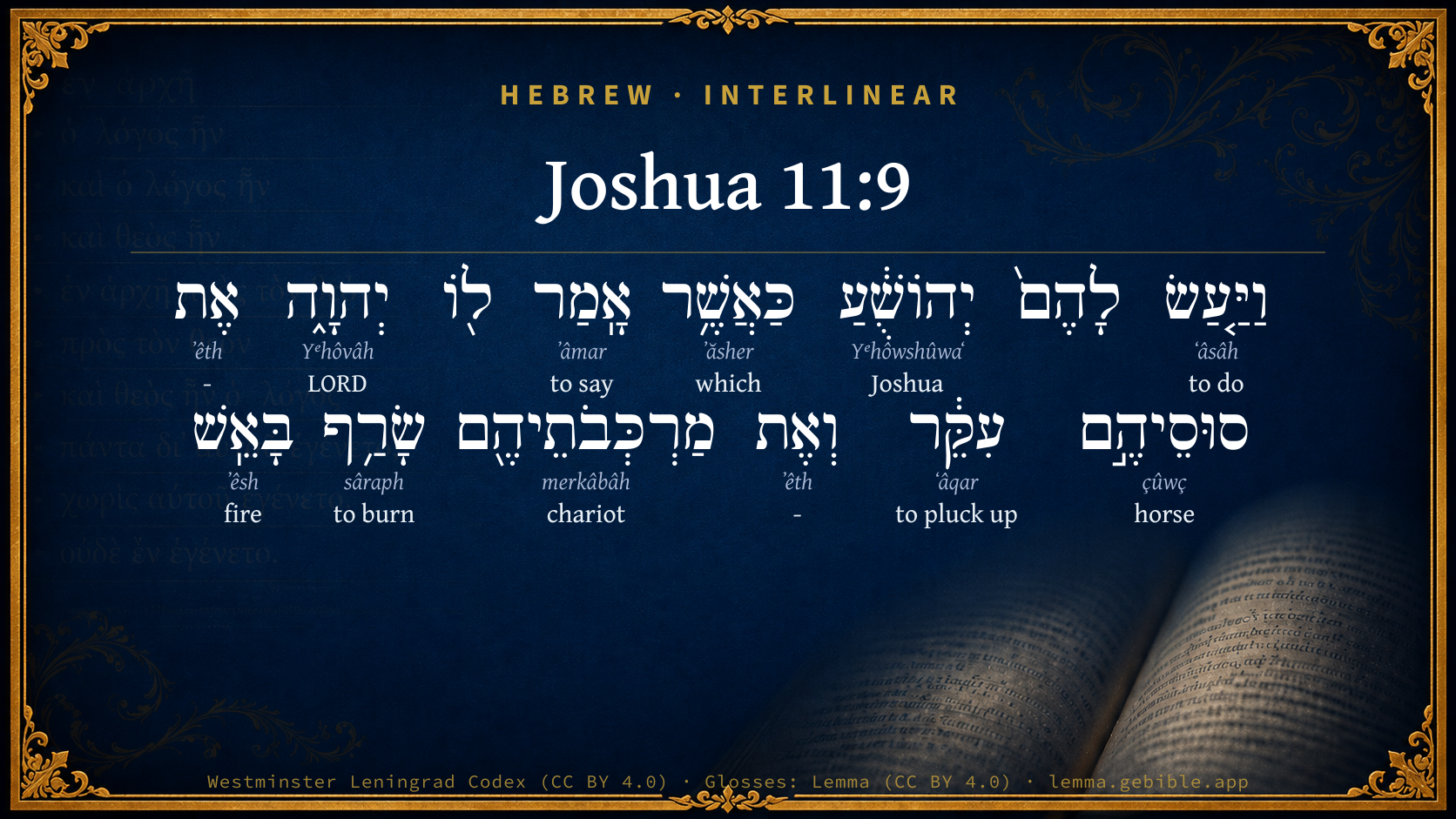
Hebrew (Westminster Leningrad Codex) Joshua 11:9 appears in the Hebrew Old Testament. The text above is from the Westminster Leningrad Codex. Each word links to its Strong’s number, a concise gloss, and parsing drawn from the Open Scriptures Hebrew Bible morphology. Click any word for its full Brown-Driver-Briggs (BDB) entry.
Download image
Cite this verse

Joshua 11:9 (World English Bible). Public Domain. Lemma interlinear Bible study tool, https://lemma.gebible.app/v/joshua/11/9.

Show BibTeX & RIS
BibTeX
RIS
English Translation
Joshua did to them as Yahweh bade him: he hamstrung their horses, and burnt their chariots with fire.
World English Bible · Public Domain
Download a study sheet

One document with this verse’s original text, its word-by-word gloss line, the meaning frame, cross-references with their text, attributed commentary, and full source and license credits — printable, and it pastes into notes with its structure intact.

This verse Autodidact and up

Study sheet (.html) Plain text (.txt)

A passage Seminary Student

Up to 50 verses in one chapter. A passage sheet keeps up to 6 commentary sources and 12 cross-references per verse, in the order this page ranks them, and says so on the sheet whenever that leaves anything out. Ask for a single verse and you get the Autodidact verse sheet above.

Everything on this page stays free to read, with no account — the sheet is a download of what is already on screen, not access to it.

Want to remove ads? Support Godless Engineer
Compare translations 3

The same verse in 3 English versions, stacked beneath the original-language interlinear above. Click any original word for its lexicon entry.

Each is an independent rendering of the whole verse — the interlinear is not word-aligned to these translations.

Highlighted words mark where these versions differ — a whole-verse word diff, not a word-by-word alignment.

  • World English Bible Public Domain
    Joshua did to them as Yahweh bade him: he hamstrung their horses, and burnt their chariots with fire.
  • King James Version Public Domain
    And Joshua did unto them as the LORD bade him: he houghed their horses, and burnt their chariots with fire.
  • unfoldingWord Literal Text CC BY-SA 4.0
    And Joshua did to them just as Yahweh had said to him. He hamstrung their horses and burned their chariots with fire.

unfoldingWord Literal Text — © unfoldingWord, licensed CC BY-SA 4.0. Word-aligned USFM3 via Door43 (git.door43.org/unfoldingWord/en_ult).

Versions to compare (up to 4)

3 of 4 selected

Show all 18 translations

Every available English version of this verse, each an independent rendering of the whole verse.

  • World English Bible Public Domain
    Joshua did to them as Yahweh bade him: he hamstrung their horses, and burnt their chariots with fire.
  • Berean Standard Bible Public Domain
    Joshua treated them as the LORD had told him; he hamstrung their horses and burned up their chariots.
  • Majority Standard Bible Public Domain
    Joshua treated them as the LORD had told him; he hamstrung their horses and burned up their chariots.
  • King James Version Public Domain
    And Joshua did unto them as the LORD bade him: he houghed their horses, and burnt their chariots with fire.
  • American Standard Version (1901) Public Domain
    And Joshua did unto them as Jehovah bade him: he hocked their horses, and burnt their chariots with fire.
  • Revised Version (1885) Public Domain
    And Joshua did unto them as the LORD bade him: he houghed their horses, and burnt their chariots with fire.
  • Geneva Bible (1599) Public Domain
    And Ioshua did vnto them as the Lord bade him: he houghed their horses, and burnt their charets with fire.
  • Douay-Rheims (1899) Public Domain
    And he did as the Lord had commanded him, he hamstringed their horses and burned their chariots.
  • Young's Literal Translation Public Domain
    and Joshua doth to them as Jehovah said to him; their horses he hath houghed, and their chariots burnt with fire.
  • Literal Standard Version CC BY-SA 4.0
    and Joshua does to them as YHWH commanded to him; he has hamstrung their horses, and burned their chariots with fire.
  • Unlocked Literal Bible CC BY-SA 4.0
    Joshua did to them just as Yahweh told him. He hamstrung the horses and burned the chariots.
  • unfoldingWord Literal Text CC BY-SA 4.0
    And Joshua did to them just as Yahweh had said to him. He hamstrung their horses and burned their chariots with fire.
  • Darby Bible Public Domain
    And Joshua did to them as Jehovah had said to him: he houghed their horses, and burned their chariots with fire.
  • World Messianic Bible Public Domain
    Joshua did to them as the LORD told him. He hamstrung their horses and burned their chariots with fire.
  • Webster's Bible Public Domain
    And Joshua did to them as the LORD bade him: he houghed their horses, and burnt their chariots with fire.
  • Free Bible Version CC BY-SA 4.0
    Afterwards Joshua did what the Lord had ordered: he crippled the horses and burned the chariots.
  • Bible in Basic English Public Domain
    And Joshua did to them as the Lord had said to him; he had the leg-muscles of their horses cut and their war-carriages burned with fire.
  • JPS Tanakh (1917) Public Domain
    And Joshua did unto them as the LORD bade him; he houghed their horses, and burnt their chariots with fire.

Literal Standard Version (2020), Covenant Press — licensed CC BY-SA 4.0. Text via the HelloAO Bible API (eBible.org). Unlocked Literal Bible (unfoldingWord) — licensed CC BY-SA 4.0. Text via the HelloAO Bible API (eBible.org). unfoldingWord Literal Text — © unfoldingWord, licensed CC BY-SA 4.0. Word-aligned USFM3 via Door43 (git.door43.org/unfoldingWord/en_ult). Free Bible Version, Dr. Jonathan Gallagher — licensed CC BY-SA 4.0. Text via the HelloAO Bible API (eBible.org).

Word by word

More ways to search: Search by grammar → Find every occurrence → Compare this word →

Practice this passage: Drill this verse → Learn its vocabulary →

עִקֵּ֔ר
ʻâqar
H6131
“to pluck up”
Verb, Piel, Perfect, 3rd Person, Masculine, Singular
Part of Speech
Verb
Stem
Piel
Form
Perfect
Person
3rd Person
Gender
Masculine
Number
Singular
Full BDB Definition

Origin: a primitive root

TWOT: 1681 , 1682

to pluck up, root up - (Qal) to pluck up, root up - (Niphal) to be plucked up - to cut, hamstring - (Piel) to cut, hamstring
  1. וַיַּ֤עַשׂ ʻâsâh H6213 “and · to do” Conjunction + Verb, Qal, Sequential Imperfect, 3rd Person, Masculine, Singular
  2. יְהוֹשֻׁ֔עַ Yᵉhôwshûwaʻ H3091 “Joshua” Noun, Proper
  3. כַּאֲשֶׁ֥ר ʼăsher H834 “like/as · which” Preposition + Particle, Relative
  4. אָֽמַר ʼâmar H559 “to say” Verb, Qal, Perfect, 3rd Person, Masculine, Singular
  5. יְהוָ֑ה Yᵉhôvâh H3068 “LORD” Noun, Proper
  6. אֶת ʼêth H853 “-” Particle, Direct Object
  7. סוּסֵיהֶ֣ם çûwç H5483 “horses · their” Noun, Common, Masculine, Plural, Construct + Suffix, Personal, 3rd Person, Masculine, Plural
  8. וְאֶת ʼêth H853 “and · -” Conjunction + Particle, Direct Object
  9. מַרְכְּבֹתֵיהֶ֖ם merkâbâh H4818 “chariots · their” Noun, Common, Feminine, Plural, Construct + Suffix, Personal, 3rd Person, Masculine, Plural
  10. שָׂרַ֥ף sâraph H8313 “to burn” Verb, Qal, Perfect, 3rd Person, Masculine, Singular
  11. בָּאֵֽשׁ ʼêsh H784 “in/at the · fire” Preposition, Determined + Noun, Common, Both, Singular, Absolute

About this verse

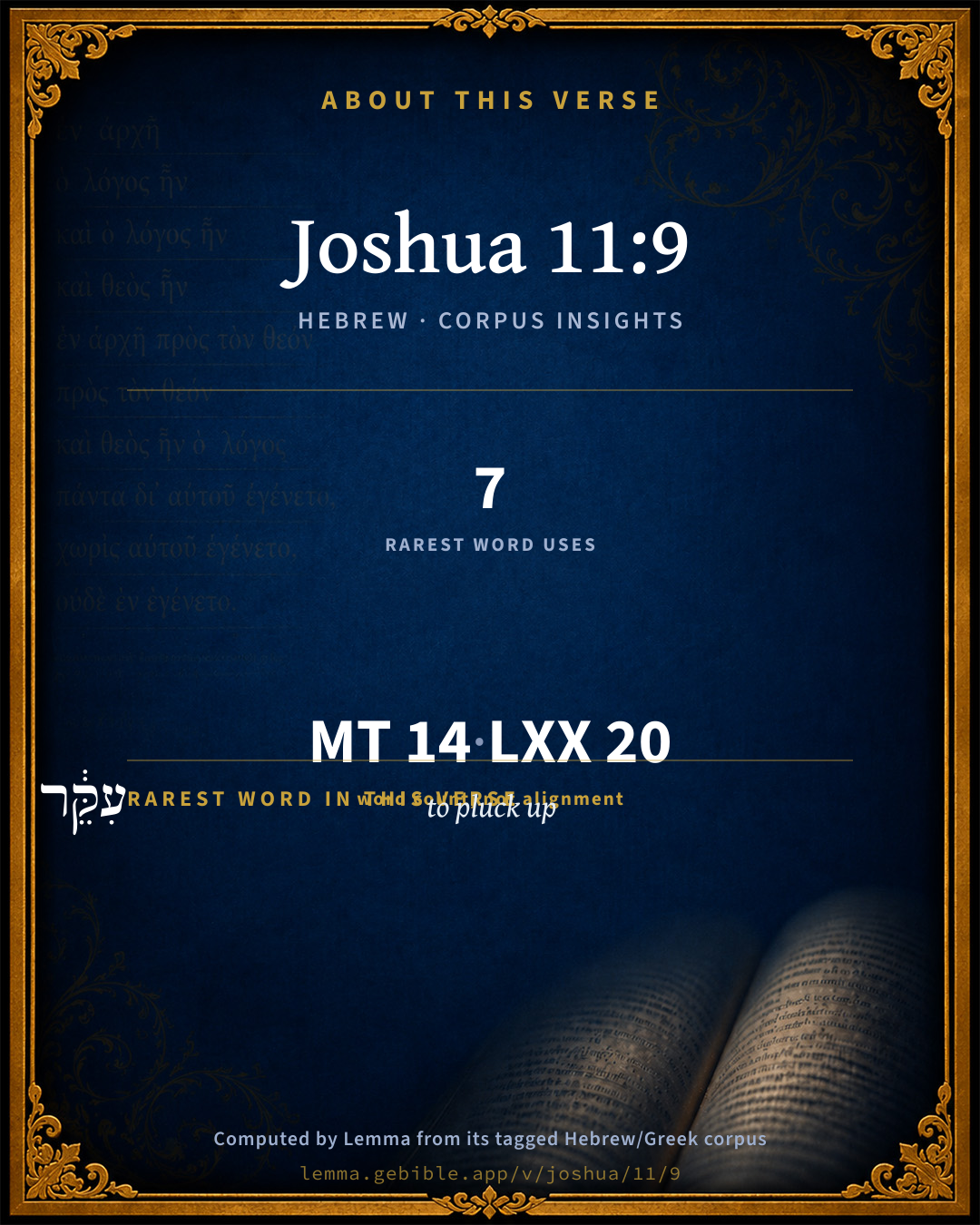
These counts appear in no published source. They are computed here, from the morphology-tagged text and Lemma’s own curated glosses. What Lemma adds →

14
words
11
distinct lemmas
Historical
section

Notable vocabulary

The rarest word here is עִקֵּ֔ר to pluck up H6131 — appearing just 7 times in the whole Hebrew Bible.

Shared distinctive vocabulary

עִקֵּ֔ר to pluck up H6131 occurs in 7 verses of the Hebrew Bible. Also found in:

Grammatical profile

  • 4 verbs
  • 5 nouns
  • 2 prepositions
  • 3 particles

Verb forms

  • וַיַּ֤עַשׂ Qal · Sequential Imperfect
  • אָֽמַר Qal · Perfect
  • עִקֵּ֔ר Piel · Perfect
  • שָׂרַ֥ף Qal · Perfect

Hebrew & Septuagint length

In English translation the verse runs 18 words from the Hebrew and 20 from the Septuagint (LXX English) — closely comparable.

A rough comparison of the two English renderings, which tokenize alike — not a word-level alignment.

Word counts can differ between the Hebrew and the Greek without any difference in meaning — e.g. the Hebrew direct-object marker אֵת has no separate Greek word, and Greek often adds the article ὁ.

In the original languages it is 14 Hebrew tokens and 20 Greek tokens — but the two are counted differently (Hebrew bundles its prefixes and suffixes into one token; the Greek is in lemma form), so that isn’t a like-for-like length.

Cross-references

2

Topical passages linked to Joshua 11:9 in the Treasury of Scripture Knowledge — connected by theme and wording, ordered by reader-vote popularity; previews shown in the World English Bible.

  • Joshua 11:6 Yahweh said to Joshua, Don't be afraid because of them; for tomorrow at this time will I deliver them up all slain before Israel: you shall hamstring their horses, and burn their chariots with fire.
  • Ezekiel 39:9–10 Those who dwell in the cities of Israel shall go forth, and shall make fires of the weapons and burn them, both the shields and the bucklers, the bows and the arrows, and the war clubs, and the spears, and they shall make fires of them seven years;

Cross-references courtesy of OpenBible.info (CC BY 4.0).

Hebrew and Greek witnesses Masoretic Hebrew ↔ Greek Septuagint

The same verse in the two great witnesses to the Old Testament, shown verse-for-verse.

These are two independent witnesses, not word-aligned to each other, and the Septuagint is shown in lemma (dictionary) form.

Hebrew Joshua 11:9 Masoretic · Westminster Leningrad Codex

וַיַּ֤עַשׂ לָהֶם֙ יְהוֹשֻׁ֔עַ כַּאֲשֶׁ֥ר אָֽמַר ל֖וֹ יְהוָ֑ה אֶת סוּסֵיהֶ֣ם עִקֵּ֔ר וְאֶת מַרְכְּבֹתֵיהֶ֖ם שָׂרַ֥ף בָּאֵֽשׁ

Joshua did to them as Yahweh bade him: he hamstrung their horses, and burnt their chariots with fire.

World English Bible · Public Domain

Greek LXX Joshua 11:9 Septuagint · lemma form

καί ποιέω αὐτός ἰησοῦς ὅς τρόπος ἐντέλλομαι αὐτός κύριος ὁ ἵππος αὐτός νευροκοπέω καί ὁ ἅρμα αὐτός ἐνπίμπρημι ἐν πῦρ

And Joshua did to them, as the Lord commanded him: he houghed their horses, and burned their chariots with fire.

LXX2012 (modern English Septuagint) · Public Domain

Hebrew: Westminster Leningrad Codex (CC BY 4.0). Greek: Septuagint (public domain); English from LXX2012 (modern English Septuagint) (Public Domain). How the Septuagint differs from the Hebrew →

Targum (Aramaic paraphrase)

1

The Targum is the ancient Jewish Aramaic paraphrase of the Hebrew Scriptures — an interpretive translation, not the Hebrew text itself. Onkelos (literal) and Pseudo-Jonathan (expansive) render the Torah, and Jonathan the Prophets. Coverage is partial: where no permissively-licensed English translation exists for a verse, only the Aramaic is shown. This is verse-level text, not a word-by-word alignment to the Hebrew.

  1. Targum Jonathan Prophets (Joshua–Malachi)
    וַעֲבַד לְהוֹן יְהוֹשֻׁעַ כְּמָא דַאֲמַר לֵיהּ יְיָ יַת סוּסְוָתְהוֹן עִקַר וְיַת רְתִיכֵיהוֹן אוֹקֵד בְּנוּרָא:

    (no public-domain English translation for this verse)

    Targum Jonathan — Aramaic: “Mikraot Gedolot” (public domain). English: “Sefaria Community Translation” (CC0 1.0 (public-domain dedication)); “London "Chaldee Paraphrase," 1871” (public domain). Text via Sefaria.

Commentary

Notes on Joshua 11:9 from classic Christian and Jewish commentators (each source and its license shown beneath its notes). The classic Christian expositions comment on the surrounding passage and are grouped to its opening verse, so a note may address several verses; the Jewish commentaries on the Tanakh (Rashi and others) are per-verse, so they appear only where the commentator wrote on this verse.

Lemma curates 59 commentaries, every one of them public domain or Creative Commons licensed, each selected and text-cleaned for this edition rather than reprinted as found. About our sources →

Trapp's Complete Commentary

John Trapp

Jos 11:9 And Joshua did unto them as the LORD bade him: he houghed their horses, and burnt their chariots with fire.

Ver. 9. See Jos 11:6.

John Trapp, A Commentary or Exposition upon All the Books of the Old and New Testament (1647–1656) — public domain. Text from a community e-Sword module.

Jamieson, Fausset & Brown

Robert Jamieson, A. R. Fausset & David Brown

Joshua did unto them as the Lord bade him--(See Jos 11:6). Houghing the horses is done by cutting the sinews and arteries of their hinder legs, so that they not only become hopelessly lame, but bleed to death. The reasons for this special command were that the Lord designed to lead the Israelites to trust in Him, not in military resources (Psa 20:7); to show that in the land of promise there was no use of horses; and, finally, to discourage their travelling as they were to be an agricultural, not a trading, people.

Jamieson, Fausset & Brown — Commentary Critical and Explanatory on the Whole Bible (1871) — public domain (CC PDM 1.0). Text via the HelloAO Bible API.

Adam Clarke's Commentary

Verse 9. He houghed their horses] The Hebrew word עקר akar, which we render to hough or hamstring, signifies to wound, cut, or lop off. It is very likely that it means here, not only an act by which they were rendered useless, but by which they were destroyed; as God had purposed that his people should not possess any cattle of this kind, that a warlike and enterprising spirit might not be cultivated among them; and that, when obliged to defend themselves and their country, they might be led to depend upon God for protection and victory. On the same ground, God had forbidden the kings of Israel to multiply horses, De 17:16. See the note there containing the reasons on which this prohibition was founded.

Burnt their chariots] As these could have been of no use without the horses.

Adam Clarke's Commentary on the Bible (1810–1826) — public domain. Text from a community e-Sword/MySword module.

Ellicott's Commentary for English Readers

(9) He houghed their horses.—In what particular way this was done we are not informed; we cannot, therefore, be certain whether it was done so as to destroy the lives of the horses, or merely to make them useless for purposes of warfare.

A Bible Commentary for English Readers, edited by Charles John Ellicott (1878–1897) — public domain. Text from a community e-Sword module.

The Cambridge Bible for Schools and Colleges

gen. ed. J. J. S. Perowne

9. he houghed their horses] “he kuttide the sinewis at the knee,” Wyclif. The command, to render the horses useless, was intended to lead Israel not to place its confidence in horses and chariots (Psa_20:7; Psa_147:10), and wisely incapacitated them from extending their conquests beyond the borders of Canaan. See Deu_17:16.

The Cambridge Bible for Schools and Colleges (gen. ed. J. J. S. Perowne; Cambridge University Press, 1878–1918) — public domain. Text from a community e-Sword module.

John Gill's Exposition

And Joshua did unto them as the Lord bade him,.... Namely, in the following instances:

he houghed their horses, and burnt their chariots with fire; not consulting his own worldly interest or that of the people of Israel, but the command of God, which he carefully obeyed, and reserved none for himself or them, as David in another case afterwards did; see Sa2 8:4.

John Gill's Exposition of the Whole Bible (1746–1763) — public domain (CC PDM 1.0). Text via the HelloAO Bible API.

Lesson kit

Teaching starters — assembled from the data on this page, not authored interpretation. Every prompt links to the verse data it draws on. Edit before teaching.

Joshua, in the Historical, opens this verse with 14 words (11 distinct Hebrew lemmas). Its most distinctive word is ʻâqar (“to pluck up”). A historical commentator’s framing appears above. Read the whole chapter for the surrounding context.

Discussion questions

  1. The word ʻâqar carries the sense “to pluck up.” How does it shape the verse?
  2. How does Genesis 49:6, which shares the word «to pluck up», read alongside this verse?
  3. These translations render this verse differently; the difference is in the English rendering, not the original. What questions does that raise?
  4. «וַיַּ֤עַשׂ» is a Qal Sequential Imperfect verb. How does that grammatical form shape the action described?
  5. Compare how Trapp's Complete Commentary and Jamieson, Fausset & Brown read this verse. Where do they agree or differ?

Things to notice

Reading settings

Reading text

Shown beneath each verse's original-language words.

Old Testament
Old Testament edition

Read the OT as the Masoretic Hebrew (MT) or the Greek Septuagint (LXX).

English shown for the Greek Septuagint (in the Hebrew ↔ Greek comparison).

Comparing translations? Open the Compare panel on any verse page to stack up to four side by side.