
Leviticus 4:12

Hebrew (Westminster Leningrad Codex) Leviticus 4:12 appears in the Hebrew Old Testament. The text above is from the Westminster Leningrad Codex. Each word links to its Strong’s number, a concise gloss, and parsing drawn from the Open Scriptures Hebrew Bible morphology. Click any word for its full Brown-Driver-Briggs (BDB) entry.
Download image
Cite this verse

Leviticus 4:12 (World English Bible). Public Domain. Lemma interlinear Bible study tool, https://lemma.gebible.app/v/leviticus/4/12.

Show BibTeX & RIS
BibTeX
RIS
English Translation
even the whole bull shall he carry forth outside the camp to a clean place, where the ashes are poured out, and burn it on wood with fire. Where the ashes are poured out it shall be burned.
World English Bible · Public Domain
Highlights
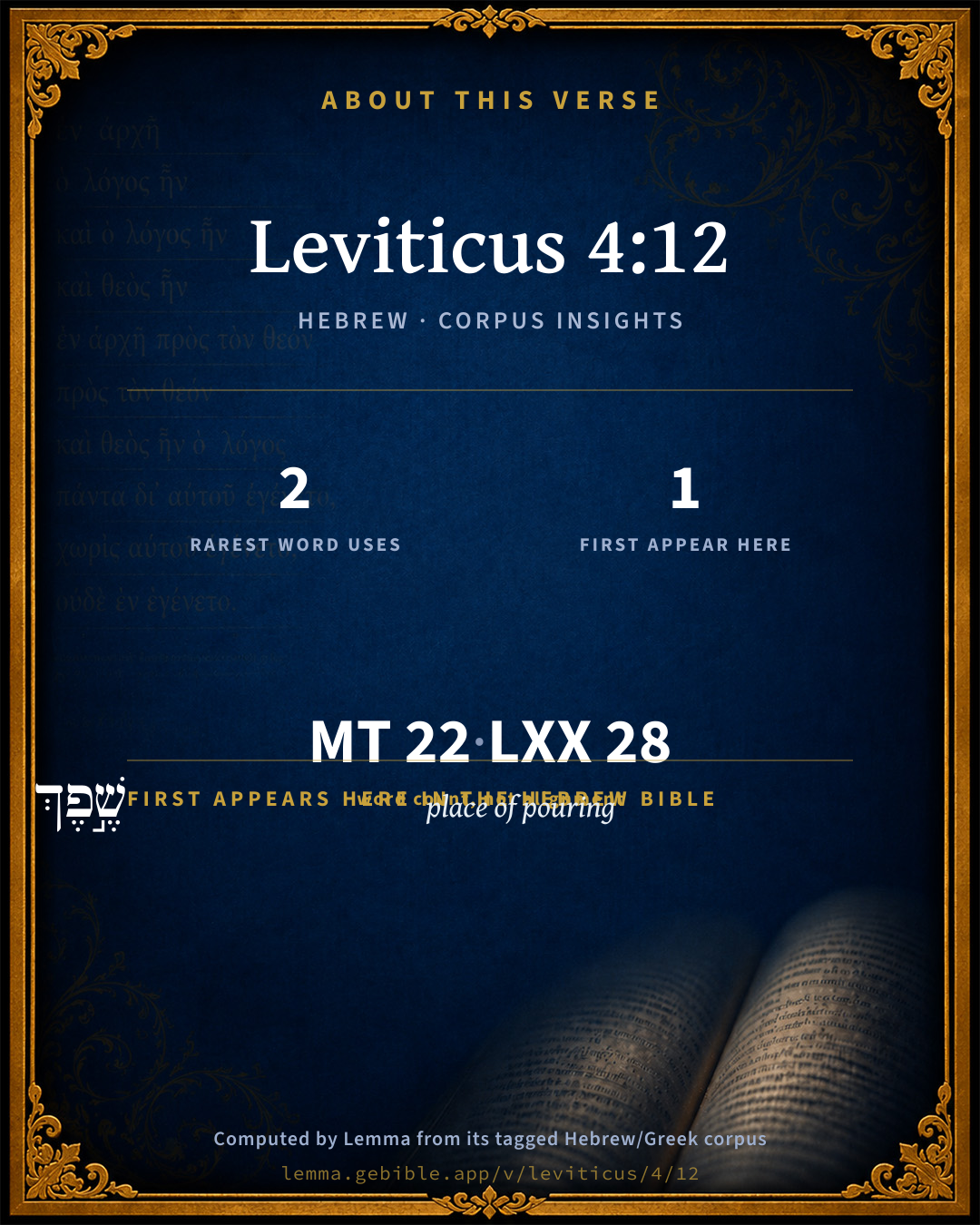
  • 1 first appearance in the Hebrew Bible
Full analysis ↓
Download a study sheet

One document with this verse’s original text, its word-by-word gloss line, the meaning frame, cross-references with their text, attributed commentary, and full source and license credits — printable, and it pastes into notes with its structure intact.

This verse Autodidact and up

Study sheet (.html) Plain text (.txt)

A passage Seminary Student

Up to 50 verses in one chapter. A passage sheet keeps up to 6 commentary sources and 12 cross-references per verse, in the order this page ranks them, and says so on the sheet whenever that leaves anything out. Ask for a single verse and you get the Autodidact verse sheet above.

Everything on this page stays free to read, with no account — the sheet is a download of what is already on screen, not access to it.

Want to remove ads? Support Godless Engineer
Compare translations 3

The same verse in 3 English versions, stacked beneath the original-language interlinear above. Click any original word for its lexicon entry.

Each is an independent rendering of the whole verse — the interlinear is not word-aligned to these translations.

Highlighted words mark where these versions differ — a whole-verse word diff, not a word-by-word alignment.

  • World English Bible Public Domain
    even the whole bull shall he carry forth outside the camp to a clean place, where the ashes are poured out, and burn it on wood with fire. Where the ashes are poured out it shall be burned.
  • King James Version Public Domain
    Even the whole bullock shall he carry forth without the camp unto a clean place, where the ashes are poured out, and burn him on the wood with fire: where the ashes are poured out shall he be burnt.
  • unfoldingWord Literal Text CC BY-SA 4.0
    — and he shall bring out all of the bull to on the outside of the camp, to a clean place, to the pouring out place of the fatty ash. And he shall burn it on wood on the fire; on the pouring out place of the fatty ash, it shall be burned.

unfoldingWord Literal Text — © unfoldingWord, licensed CC BY-SA 4.0. Word-aligned USFM3 via Door43 (git.door43.org/unfoldingWord/en_ult).

Versions to compare (up to 4)

3 of 4 selected

Show all 18 translations

Every available English version of this verse, each an independent rendering of the whole verse.

  • World English Bible Public Domain
    even the whole bull shall he carry forth outside the camp to a clean place, where the ashes are poured out, and burn it on wood with fire. Where the ashes are poured out it shall be burned.
  • Berean Standard Bible Public Domain
    all the rest of the bull—he must take outside the camp to a ceremonially clean place where the ashes are poured out, and there he must burn it on a wood fire on the ash heap.
  • Majority Standard Bible Public Domain
    all the rest of the bull—he must take outside the camp to a ceremonially clean place where the ashes are poured out, and there he must burn it on a wood fire on the ash heap.
  • King James Version Public Domain
    Even the whole bullock shall he carry forth without the camp unto a clean place, where the ashes are poured out, and burn him on the wood with fire: where the ashes are poured out shall he be burnt.
  • American Standard Version (1901) Public Domain
    even the whole bullock shall he carry forth without the camp unto a clean place, where the ashes are poured out, and burn it on wood with fire: where the ashes are poured out shall it be burnt.
  • Revised Version (1885) Public Domain
    even the whole bullock shall he carry forth without the camp unto a clean place, where the ashes are poured out, and burn it on wood with fire: where the ashes are poured out shall it be burnt.
  • Geneva Bible (1599) Public Domain
    So he shall cary the whole bullocke out of the host vnto a cleane place, where the ashes are powred, and shall burne him on ye wood in the fire: where ye ashes are cast out, shall he be burnt.
  • Douay-Rheims (1899) Public Domain
    And the rest of the body he shall carry forth without the camp into a clean place where the ashes are wont to be poured out, and he shall burn them upon a pile of wood, they shall be burnt in the place where the ashes are poured out.
  • Young's Literal Translation Public Domain
    he hath even brought out the whole bullock unto the outside of the camp, unto a clean place, unto the place of the pouring out of the ashes, and he hath burnt it on the wood with fire; beside the place of the pouring out of the ashes it is burnt.
  • Literal Standard Version CC BY-SA 4.0
    he has even brought out the whole bullock to the outside of the camp, to a clean place, to the place of the pouring out of the ashes, and he has burned it on the wood with fire; it is burned beside the place of the pouring out of the ashes.
  • Unlocked Literal Bible CC BY-SA 4.0
    all the rest of the parts of the bull—he will carry all these parts outside the camp to a place that they have cleansed for me, where they pour out the ashes; they will burn those parts there on wood. They must burn those parts where they pour out the ashes.
  • unfoldingWord Literal Text CC BY-SA 4.0
    — and he shall bring out all of the bull to on the outside of the camp, to a clean place, to the pouring out place of the fatty ash. And he shall burn it on wood on the fire; on the pouring out place of the fatty ash, it shall be burned.
  • Darby Bible Public Domain
    even the whole bullock shall he carry forth outside the camp unto a clean place, where the ashes are poured out, and burn it on wood with fire; where the ashes are poured out shall it be burnt.
  • World Messianic Bible Public Domain
    —all the rest of the bull—outside of the camp to a clean place where the ashes are poured out, and burn it on wood with fire. It shall be burned where the ashes are poured out.
  • Webster's Bible Public Domain
    Even the whole bullock shall he carry forth without the camp to a clean place, where the ashes are poured out, and burn him on the wood with fire: where the ashes are poured out shall he be burnt.
  • Free Bible Version CC BY-SA 4.0
    all the rest of it—he has to take outside the camp to a place that is ceremonially clean, where the ashes are dumped, and he must burn it on a wood fire there on the ash heap.
  • Bible in Basic English Public Domain
    All the ox, he is to take away outside the circle of the tents into a clean place where the burned waste is put, and there it is to be burned on wood with fire.
  • JPS Tanakh (1917) Public Domain
    even the whole bullock shall he carry forth without the camp unto a clean place, where the ashes are poured out, and burn it on wood with fire; where the ashes are poured out shall it be burnt.

Literal Standard Version (2020), Covenant Press — licensed CC BY-SA 4.0. Text via the HelloAO Bible API (eBible.org). Unlocked Literal Bible (unfoldingWord) — licensed CC BY-SA 4.0. Text via the HelloAO Bible API (eBible.org). unfoldingWord Literal Text — © unfoldingWord, licensed CC BY-SA 4.0. Word-aligned USFM3 via Door43 (git.door43.org/unfoldingWord/en_ult). Free Bible Version, Dr. Jonathan Gallagher — licensed CC BY-SA 4.0. Text via the HelloAO Bible API (eBible.org).

Word by word

More ways to search: Search by grammar → Find every occurrence → Compare this word →

Practice this passage: Drill this verse → Learn its vocabulary →

שֶׁ֣פֶךְ
shephek
H8211
“place of pouring of”
Noun, Common, Masculine, Singular, Construct
Part of Speech
Noun
Type
Common
Gender
Masculine
Number
Singular
State
Construct
Full BDB Definition

Origin: from H8210

TWOT: 2444a

place of pouring
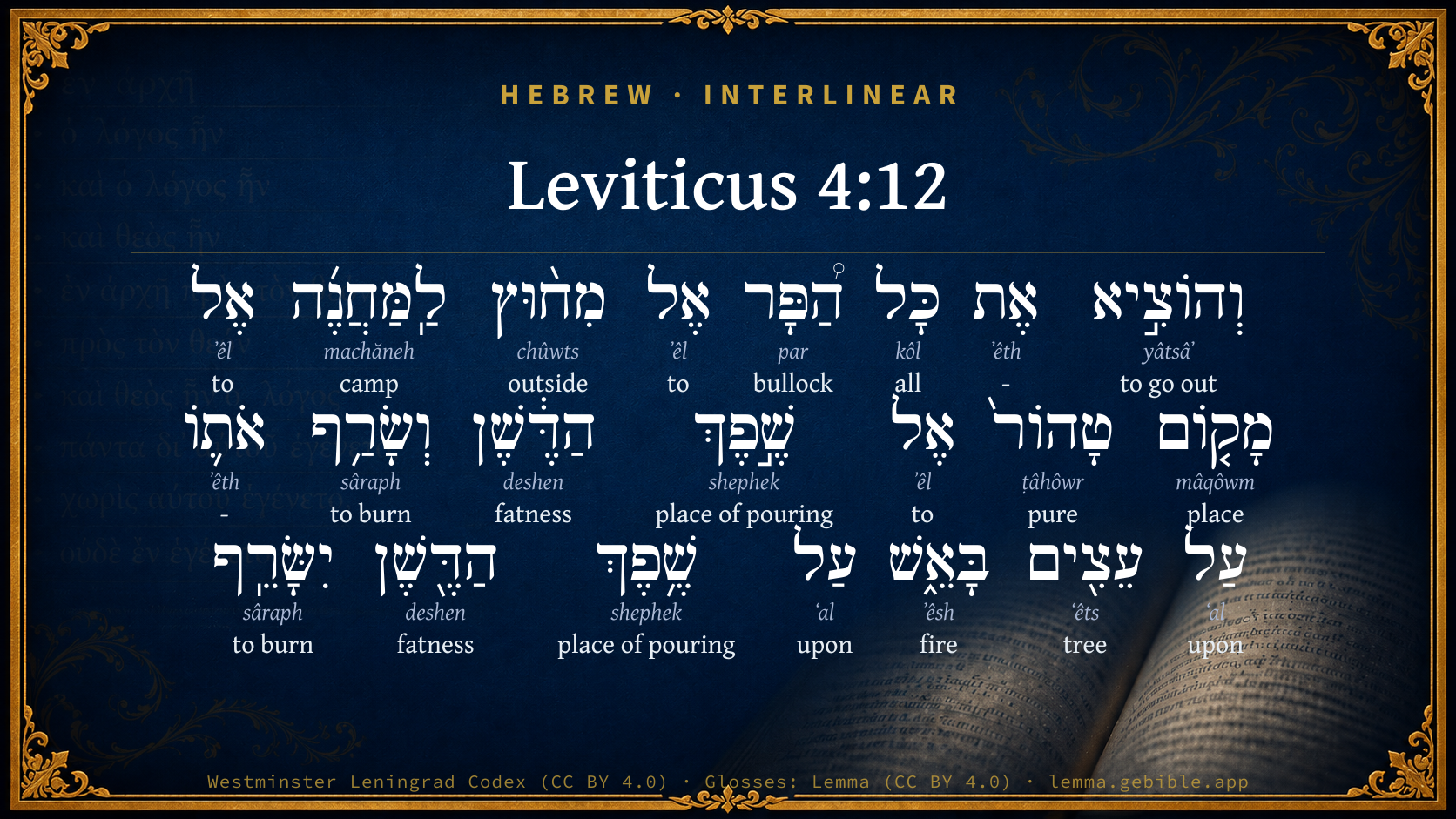
  1. וְהוֹצִ֣יא yâtsâʼ H3318 “and · to go out” Conjunction + Verb, Hiphil, Perfect, 3rd Person, Masculine, Singular
  2. אֶת ʼêth H853 “-” Particle, Direct Object
  3. כָּל kôl H3605 “all of” Noun, Common, Masculine, Singular, Construct
  4. הַ֠פָּר par H6499 “the · bullock” Particle, Definite Article + Noun, Common, Masculine, Singular, Absolute
  5. אֶל ʼêl H413 “to” Preposition
  6. מִח֨וּץ chûwts H2351 “from · outside” Preposition + Noun, Common, Masculine, Singular, Absolute
  7. לַֽמַּחֲנֶ֜ה machăneh H4264 “to/for the · camp” Preposition, Determined + Noun, Common, Both, Singular, Absolute
  8. אֶל ʼêl H413 “to” Preposition
  9. מָק֤וֹם mâqôwm H4725 “place” Noun, Common, Masculine, Singular, Absolute
  10. טָהוֹר֙ ṭâhôwr H2889 “pure” Adjective, Adjective, Masculine, Singular, Absolute
  11. אֶל ʼêl H413 “to” Preposition
  12. הַדֶּ֔שֶׁן deshen H1880 “the · fatness” Particle, Definite Article + Noun, Common, Masculine, Singular, Absolute
  13. וְשָׂרַ֥ף sâraph H8313 “and · to burn” Conjunction + Verb, Qal, Perfect, 3rd Person, Masculine, Singular
  14. אֹת֛וֹ ʼêth H853 “- · him” Particle, Direct Object + Suffix, Personal, 3rd Person, Masculine, Singular
  15. עַל ʻal H5921 “upon” Preposition
  16. עֵצִ֖ים ʻêts H6086 “trees” Noun, Common, Masculine, Plural, Absolute
  17. בָּאֵ֑שׁ ʼêsh H784 “in/at the · fire” Preposition, Determined + Noun, Common, Both, Singular, Absolute
  18. עַל ʻal H5921 “upon” Preposition
  19. שֶׁ֥פֶךְ shephek H8211 “place of pouring of” Noun, Common, Masculine, Singular, Construct
  20. הַדֶּ֖שֶׁן deshen H1880 “the · fatness” Particle, Definite Article + Noun, Common, Masculine, Singular, Absolute
  21. יִשָּׂרֵֽף sâraph H8313 “to burn” Verb, Niphal, Imperfect, 3rd Person, Masculine, Singular

About this verse

These counts appear in no published source. They are computed here, from the morphology-tagged text and Lemma’s own curated glosses. What Lemma adds →

22
words
15
distinct lemmas
Pentateuch
section

Notable vocabulary

The rarest word here is שֶׁ֣פֶךְ place of pouring H8211 — appearing just 2 times in the whole Hebrew Bible.

First appearance in Scripture

This word makes its first canonical appearance in the Hebrew Bible here:

  • שֶׁ֣פֶךְ place of pouring H8211

Grammatical profile

  • 3 verbs
  • 11 nouns
  • 1 adjective
  • 5 prepositions
  • 2 particles

Verb forms

  • וְהוֹצִ֣יא Hiphil · Perfect
  • וְשָׂרַ֥ף Qal · Perfect
  • יִשָּׂרֵֽף Niphal · Imperfect

Repetition

Words recur within this verse — often emphatic in Hebrew:

  • שֶׁ֣פֶךְ place of pouring H8211 ×2
  • הַדֶּ֔שֶׁן fatness H1880 ×2
  • וְשָׂרַ֥ף to burn H8313 ×2
  • עַל upon H5921 ×2
  • אֶל to H413 ×3

Hebrew & Septuagint length

In English translation the verse runs 38 words from the Hebrew and 41 from the Septuagint (LXX English) — closely comparable.

A rough comparison of the two English renderings, which tokenize alike — not a word-level alignment.

Word counts can differ between the Hebrew and the Greek without any difference in meaning — e.g. the Hebrew direct-object marker אֵת has no separate Greek word, and Greek often adds the article ὁ.

In the original languages it is 22 Hebrew tokens and 28 Greek tokens — but the two are counted differently (Hebrew bundles its prefixes and suffixes into one token; the Greek is in lemma form), so that isn’t a like-for-like length.

Cross-references

9

Topical passages linked to Leviticus 4:12 in the Treasury of Scripture Knowledge — connected by theme and wording, ordered by reader-vote popularity; previews shown in the World English Bible.

  • Hebrews 13:11 For the bodies of those animals, whose blood is brought into the holy place by the high priest as an offering for sin, are burned outside of the camp.
  • Exodus 29:14 But the flesh of the bull, and its skin, and its dung, you shall burn with fire outside of the camp: it is a sin-offering.
  • Leviticus 6:10–11 The priest shall put on his linen garment, and he shall put on his linen breeches upon his body; and he shall remove the ashes from where the fire has consumed the burnt offering on the altar, and he shall put them beside the altar.
  • Leviticus 16:27 The bull for the sin offering, and the goat for the sin offering, whose blood was brought in to make atonement in the Holy Place, shall be carried forth outside the camp; and they shall burn their skins, their flesh, and their dung with fire.
  • Leviticus 13:46 All the days in which the plague is in him he shall be unclean. He is unclean. He shall dwell alone. Outside of the camp shall be his dwelling.
  • Numbers 5:3 Both male and female shall you put out, outside of the camp shall you put them; that they not defile their camp, in the midst of which I dwell."
  • Numbers 15:35 Yahweh said to Moses, The man shall surely be put to death: all the congregation shall stone him with stones outside of the camp.
  • Numbers 19:3 You shall give her to Eleazar the priest, and he shall bring her forth outside of the camp, and one shall kill her before his face:
  • Numbers 19:5 One shall burn the heifer in his sight; her skin, and her flesh, and her blood, with her dung, shall he burn:

Cross-references courtesy of OpenBible.info (CC BY 4.0).

Hebrew and Greek witnesses Masoretic Hebrew ↔ Greek Septuagint

The same verse in the two great witnesses to the Old Testament, shown verse-for-verse.

These are two independent witnesses, not word-aligned to each other, and the Septuagint is shown in lemma (dictionary) form.

Hebrew Leviticus 4:12 Masoretic · Westminster Leningrad Codex

וְהוֹצִ֣יא אֶת כָּל הַ֠פָּר אֶל מִח֨וּץ לַֽמַּחֲנֶ֜ה אֶל מָק֤וֹם טָהוֹר֙ אֶל שֶׁ֣פֶךְ הַדֶּ֔שֶׁן וְשָׂרַ֥ף אֹת֛וֹ עַל עֵצִ֖ים בָּאֵ֑שׁ עַל שֶׁ֥פֶךְ הַדֶּ֖שֶׁן יִשָּׂרֵֽף

even the whole bull shall he carry forth outside the camp to a clean place, where the ashes are poured out, and burn it on wood with fire. Where the ashes are poured out it shall be burned.

World English Bible · Public Domain

Greek LXX Leviticus 4:12 Septuagint · lemma form

καί ἐκφέρω ὅλος ὁ μόσχος ἔξω ὁ παρεμβολή εἰς τόπος καθαρός οὗ ἐκχέω ὁ σποδιά καί κατακαίω αὐτός ἐπί ξύλον ἐν πῦρ ἐπί ὁ ἔκχυσις ὁ σποδιά καίω

and they shall carry out the whole calf out of the camp into a clean place, where they pour out the ashes, and they shall consume it there on wood with fire: it shall be burnt on the ashes poured out.

LXX2012 (modern English Septuagint) · Public Domain

On this verse, Ellicott's Commentary for English Readers discusses the Septuagint’s reading. Read the note in Commentary ↓

Hebrew: Westminster Leningrad Codex (CC BY 4.0). Greek: Septuagint (public domain); English from LXX2012 (modern English Septuagint) (Public Domain). How the Septuagint differs from the Hebrew →

Targum (Aramaic paraphrase)

2

The Targum is the ancient Jewish Aramaic paraphrase of the Hebrew Scriptures — an interpretive translation, not the Hebrew text itself. Onkelos (literal) and Pseudo-Jonathan (expansive) render the Torah, and Jonathan the Prophets. Coverage is partial: where no permissively-licensed English translation exists for a verse, only the Aramaic is shown. This is verse-level text, not a word-by-word alignment to the Hebrew.

  1. Targum Onkelos Torah (Genesis–Deuteronomy)
    וְיַפֵּק יָת כָּל תּוֹרָא מִבָּרָא לְמַשְׁרִיתָא לַאֲתַר דְכֵי לַאֲתַר בֵּית מֵישַׁד קִטְמָא וְיוֹקִיד יָתֵהּ עַל אָעַיָא בְּאֶשָׁתָא עַל אֲתַר בֵּית מֵישַׁד קִטְמָא יִתּוֹקָד

    (no public-domain English translation for this verse)

    Targum Onkelos — Aramaic: “Onkelos Genesis” (public domain); “Onkelos Exodus” (public domain); “Onkelos Leviticus” (public domain); “Onkelos Numbers” (public domain); “Onkelos Deuteronomy” (public domain). English: “Sefaria Community Translation” (CC0 1.0 (public-domain dedication)); “J.W. Etheridge. The Targums of Onkelos and Jonathan Ben Uzziel on the Pentateuch. London: Longmans, Green, 1862” (public domain). Text via Sefaria.

  2. Targum Pseudo-Jonathan Torah (Genesis–Deuteronomy)
    וְיִפּוֹק יַת כָּל תּוֹרָא לַאֲתַר דְכֵי לְמִבָּרָא לְמַשְׁרִיתָא לַאֲתַר בֵּית מֵישַׁד קִיטְמָא וְיוֹקֵד יָתֵיהּ עַל קִיסִין בְּנוּרָא עַל אֲתַר בֵּית מֵישַׁד קִיטְמָא יְתוֹקַד

    the whole of the bullock he shall carry forth into a clean place without the camp, to a place where the cinders are poured out, and shall burn him with wood in the fire, at the place where cinders are poured out shall be be burned.

    Targum Pseudo-Jonathan — Aramaic: “Targum Jonathan on Genesis” (public domain); “Targum Jonathan on Exodus” (public domain); “Targum Jonathan on Leviticus” (public domain); “Targum Jonathan on Numbers” (public domain); “Targum Jonathan on Deuteronomy” (public domain). English: “The Targum of Jonathan ben Uzziel, trans. J. W. Etheridge, London, 1862” (public domain). Text via Sefaria.

Commentary

Notes on Leviticus 4:12 from classic Christian and Jewish commentators (each source and its license shown beneath its notes). The classic Christian expositions comment on the surrounding passage and are grouped to its opening verse, so a note may address several verses; the Jewish commentaries on the Tanakh (Rashi and others) are per-verse, so they appear only where the commentator wrote on this verse.

Lemma curates 59 commentaries, every one of them public domain or Creative Commons licensed, each selected and text-cleaned for this edition rather than reprinted as found. About our sources →

Trapp's Complete Commentary

John Trapp

Lev 4:12 Even the whole bullock shall he carry forth without the camp unto a clean place, where the ashes are poured out, and burn him on the wood with fire: where the ashes are poured out shall he be burnt.

Ver. 12. Shall he carry forth,] Heb 13:11-12. {See Trapp on "Heb 13:11"} {See Trapp on "Heb 13:12"}

John Trapp, A Commentary or Exposition upon All the Books of the Old and New Testament (1647–1656) — public domain. Text from a community e-Sword module.

Joseph Benson's Commentary

Lev 4:12. The whole bullock — So no part of this was to be eaten by the priests, as it was in other sin-offerings. The reason is plain, because the offerer might not eat of his own sin-offering, and the priest was the offerer in this case, as also in the sin-offering for the whole congregation below, of which the priest himself was a member. Shall be carried forth — Not by himself, which would have defiled him, but by another whom he shall appoint for that work. Without the camp — To signify either, 1st, The abominable nature of sin, especially in high and holy persons, or when it overspreads a whole people. Or, 2d, The removing of the guilt or punishment of that sin from the people. Or, 3d, That Christ should suffer without the camp or gate. Where the ashes are — For the ashes, though at first they were thrown down near the altar, (Lev 1:16,) yet afterward they, together with the filth of the sacrifices, were carried into a certain place without the camp.

Joseph Benson's Commentary on the Old and New Testaments (1811–1818) — public domain. Text from a community e-Sword module.

Adam Clarke's Commentary

Verse 12. Without the camp] This was intended figuratively to express the sinfulness of this sin, and the availableness of the atonement. The sacrifice, as having the sin of the priest transferred from himself to it by his confession and imposition of hands, was become unclean and abominable, and was carried, as it were, out of the Lord's sight; from the tabernacle and congregation it must be carried without the camp, and thus its own offensiveness was removed, and the sin of the person in whose behalf it was offered. The apostle (Heb 13:11-13) applies this in the most pointed manner to Christ: "For the bodies of those beasts whose blood is brought into the sanctuary by the high priest for sin, are burned without the camp. Wherefore JESUS also, that he might sanctify the people with his own blood, suffered without the gate. Let us go forth therefore unto him without the camp, bearing his reproach."

Adam Clarke's Commentary on the Bible (1810–1826) — public domain. Text from a community e-Sword/MySword module.

Ellicott's Commentary for English Readers

(12) Even the whole bullock shall he carry forth.—This does not mean that the high priest himself had to carry the whole bullock all that distance, but in accordance with the idiom so common in Hebrew, where the singular is used for the plural, or the indefinite or impersonal form, denotes that those who assisted in doing the rough work of the altar shall carry the victim. Hence the ancient Greek Version (LXX.) and the Samaritan rightly render it by “and they shall carry,” in the plural: i.e., the whole bullock shall be carried forth. In Lev_4:24 of this very chapter the Authorised Version properly translates the same idiom into “in the place where they kill the burnt offering,” though the verb, as in the verse before us, is in the singular. (See also Lev_4:14.)

Without the camp.—During the time of the second Temple there were three places for burning: one place was in the court of the sanctuary, where they burnt the sacrifices which were unfit and rejected; the second place was in the mountain of the house called Birah, where were buried those sacrifices which met with an accident after they had been carried out of the court; and the third place was without Jerusalem, called the place of ashes. It is this place to which the Apostle refers when he says, “for the bodies of those beast whose blood is brought into the holy place by the high priest as an offering for sin are burned without the camp. Wherefore Jesus also, that he might sanctify the people through his own blood, suffered without the gate” (Heb_13:11-12).

And burn him on the wood with fire.—Whilst special wood was required for the burning of those victims which were consumed in the court of the sanctuary (see Lev_1:7), the sacrifices which were taken outside the city could be burnt with any wood, or even straw or stubble. All that was insisted on was that it should be burned with fire, as the text before us has it, but not with cinder, coals, or lime.

A Bible Commentary for English Readers, edited by Charles John Ellicott (1878–1897) — public domain. Text from a community e-Sword module.

John Gill's Exposition

And if the whole congregation of Israel sin through ignorance,.... That is, all Israel, or the greatest part of them, as Gersom interprets it, through the ignorant teaching of the judges, who by their instruction cause the people to err, and commit sins of ignorance, as Baal Hatturim on the place observes, and Maimonides elsewhere (g); wherefore Jarchi, and some others, by the congregation of Israel understand the sanhedrim, or the bench of judges, consisting of seventy one. Ainsworth remarks on the words, that the church may err:

and the thing be hid from the eyes of the assembly; congregation or church, so that they do not know that it is a sin which they have committed:

and they have done somewhat against any of the commandments of the Lord, concerning things which should not be done; transgressed negative precepts:

and are guilty; of sin, though as yet they know it not.

(g) Hilchot Shegagot, c. 12. sect. 1.

John Gill's Exposition of the Whole Bible (1746–1763) — public domain (CC PDM 1.0). Text via the HelloAO Bible API.

Albert Barnes' Notes on the Bible

A clean place where the ashes are poured out See Lev 1:16 note. It was a place free from impurities, not like those referred to in Lev 14:40, Lev 14:45. The flesh, though it was burned in an ordinary way, and not sent up in the fire of the altar (see Lev 1:9 note), was not to be confounded with carrion, but was associated with the remains of the sacrifices. The priests could not eat the flesh of this victim or of that offered for the sin of the congregation, as they ate that of other sin-offerings Lev 6:26. Compare Lev 10:17-18, because they were in these cases in the position of offerers. Lev 16:27; Heb 13:11. The same rule was observed in regard to the meat-offering of the priests, Lev 6:23. It was only of the peace-offering that the offerer himself could partake.

Albert Barnes' Notes on the Bible (1834–1885) — public domain. Text from a community e-Sword/MySword module.

Haydock's Catholic Bible Commentary

Ashes of the victims. They were first laid beside the altar of holocausts. By this ceremony, the priest begged that his sins might be removed from the sight of God, (Menochius) by virtue of Christ’s sacrifice, who suffered out of the gate of Jerusalem, Hebrews xiii. 13. The high priest was obliged to offer this sacrifice himself, to expiate his own sin, as well as that of the people, Hebrews ix. 7.

George Leo Haydock (1774–1849), Haydock's Catholic Family Bible and Commentary, 1859 edition — public domain. Excludes Psalms (Douay-Rheims chapter numbering differs from Protestant) and Deuterocanonical books (Catholic canon only).

Matthew Poole's English Annotations

So no part of this was to be eaten by the priests, as it was in other sin-offerings, Lev 6:26. The reason is plain, because the offerer might not eat of his own sin-offering, and the priest was the offerer in this case, as also in the sin-offering for the whole congregation below, Lev 4:21, of which the priest himself was a member.

Shall he carry forth; not himself, which would have defiled him, but by another whom he shall appoint for that work, as may be gathered from Lev 16:27,28.

Without the camp, to signify either,

1. The horrible and abominable nature of sin, especially in high and holy persons, or when it overspreads a whole people. Or,

2. The removing of the guilt and punishment of that sin from the people, and their duty of keeping such wickedness out of the camp for time to come. Or,

3. That Christ should suffer without the camp or gate, as he did. See Heb 13:11,12. Where the ashes are poured out; for the ashes, though at first they were thrown down near the altar, Lev 1:16, yet afterwards they, together with the filth of the sacrifices, were carried into a certain place without the camp. See Lev 6:10,11.

Matthew Poole's English Annotations on the Holy Bible (1683–1685) — public domain. Text from a community e-Sword/MySword module.

Whedon's Commentary on the Bible

Daniel D. Whedon

12. The whole bullock shall he carry forth — Bishop Colenso finds a physical impossibility here, and in his estimation a conclusive proof that Leviticus is “unhistorical,” a bungling fabrication of a later age. But the Hebrew does not require the priest personally to carry forth the bullock, but “to cause it to go forth,” by the agency of others, probably the Levites.

Without the camp — The reason for this requirement is not recorded. Says Fairbairn, “It is true that all impure things were carried without the camp, but it does not follow that every thing carried out of the camp was impure.” A clean place in which it was to be burned implies that it is most holy. But the usual treatment of the most holy things, namely, eating by the priests could not be resorted to, because it was a sin offering for a priest. The only other way in which Jehovah signified his acceptance was by receiving the sweet odour when consumed by fire. But if burned on the altar there would be nothing to distinguish it from the burnt offering. Hence, though most holy, it was borne without the camp and consumed in a clean place, yet where carrion and other impurities were found near at hand. The holy Son of God, the great Sin Offering, suffered between two malefactors, himself separate from sinners. “Wherefore Jesus also, that he might sanctify the people with his own blood, suffered without the gate,” (Heb_13:12,) after “the Lord had laid on him the iniquity of us all.” Isa_53:6.

Where the ashes are poured out — At a little distance from Jerusalem are several large mounds of ashes, one of them forty feet high, which some conjecture may be as old as the age of the temple, having been built up by the ashes carried out thither from the altar of sacrifice. Professor Liebig has proved them to be composed largely of animal elements.

And burn him — “The word ‘burn,’ here, is different from that which is used to denote turning into odour or perfume on the altar. It signifies to destroy by fire; whereas the other means to incend or consume as incense.” There is something very peculiar and exceptional about the treatment of the sin offering for the people and for the high priest, their representative; it was most holy, and yet was committed not to the slow altar-fires to sweeten the sky with its odour, but to the devouring flames in a place surrounded by impurities. How unique and mysterious the sufferings of Christ when forsaken by the Father!

Daniel D. Whedon (gen. ed.), Commentary on the Old and New Testaments (1874–1909) — public domain. Text from a community e-Sword module.

John Wesley's Explanatory Notes

The whole bullock - So no part of this was to be eaten by the priests, as it was in other sin-offerings. The reason is plain, because the offerer might not eat of his own sin-offering, and the priest was the offerer in this case, as also in the sin-offering for the whole congregation below, of which the priest himself was a member. Shall be carried forth - Not himself, which would have defiled him, but by another whom he shall appoint for that work. Without the camp - To signify either,

1. The abominable nature of sin, especially in high and holy persons, or when it overspreads a whole people. Or,

2. The removing of the guilt or punishment of that sin from the people. Or,

3. That Christ should suffer without the camp or gate. Where the ashes are - For the ashes, though at first they were thrown down near the altar, chap. i, 16, yet afterwards they, together with the filth of the sacrifices, were carried into a certain place without the camp.

John Wesley, Explanatory Notes Upon the Whole Bible (1754–1765) — public domain. Text via the GEBible commentary corpus.

Scofield Reference Notes

C. I. Scofield

without the camp

Cf. Exo 29:14; Lev 16:27; Num 19:3; Heb 13:10-13. The last passage is the interpretative one. The "camp" was Judaism-- a religion of forms and ceremonies. "Jesus, also, that He might sanctify separate, or set apart for God] the people with or ’through’ His own blood, suffered without the gate" temple gate, city gate, i.e. Judaism civil and religious]; Heb 13:12 but how does this sanctify, or set apart, a people? "Let us go forth therefore unto Him without the camp Judaism then, Judaized Christianity now--anything religious which denies Him as our sin-offering] bearing His reproach" Heb 13:13. The sin- offering, "burned without the camp," typifies this aspect of the death of Christ. The cross becomes a new altar, in a new place, where, without the smallest merit in themselves, the redeemed gather to offer, as believer-priests, spiritual sacrifices.; Heb 13:15; 1Pe 2:5. The bodies of the sin-offering beasts were not burned without the camp, as some have fancied, because "saturated with sin," and unfit for a holy camp. Rather, an unholy camp was an unfit place for a holy sin-offering. The dead body of our Lord was not "saturated with sin," though in it our sins had been borne 1Pe 2:24.

The Scofield Reference Bible (1917 edition), notes by C. I. Scofield — public domain. Text from a community e-Sword module.

Rashi

Rabbi Shlomo Yitzchaki (Rashi)

אל מקום טהור [EVEN THE WHOLE BULLOCK SHALL HE BRING FORTH WITHOUT THE CAMP] UNTO A CLEAN PLACE — Because there was outside the city (Jerusalem) a place intended for depositing unclean things viz., to cast there the plague-stricken stones (cf. Leviticus 14:45) and to serve as a place of burial, Scripture was compelled to state regarding this term “without the camp” — which in the case of Jerusalem, is identical with: “without the city” — that the place where it was to be burnt shall be a clean one.

מחוץ למחנה WITHOUT THE CAMP — i. e. without the three camps (מחנה שכינה, מחנה לויה ומחנה ישראל); and, in the case of the “House of Eternity” (the Temple), it was to be brought forth without the city, just as our Rabbis have explained it in Treatise Yoma 68a and in Treatise Sanhedrin 42b.

אל שפך הדשן means: to the place where the ashes that were removed from the altar were cast, as it is said (Leviticus 6:4) “and he shall bring out the ashes without the camp”.

על שפך הדשן UPON THE PLACE FOR SHEDDING THE ASHES [SHALL IT BE BURNT] — This is something which need not have been stated (since it says immediately before, that it shall be brought forth to this spot), but it is intended to teach that even if at the time there happen to be no ashes there, the bullock shall nevertheless be burnt there (Sifra, Vayikra Dibbura d'Chovah, Chapter 5 5; Pesachim 75b).

Rashi on the Tanakh — English translations: “The Judaica Press complete Tanach with Rashi, translated by A. J. Rosenberg” (CC BY 4.0); “Pentateuch with Rashi's commentary by M. Rosenbaum and A.M. Silbermann, 1929-1934” (public domain); “The Metsudah Tanach series, Lakewood, N.J” (CC BY 4.0); and “The Book of Joshua, Metsudah Publications, 1997” (CC BY 4.0). Text via Sefaria.

Lesson kit

Teaching starters — assembled from the data on this page, not authored interpretation. Every prompt links to the verse data it draws on. Edit before teaching.

Leviticus, in the Pentateuch, opens this verse with 22 words (15 distinct Hebrew lemmas). Its most distinctive word is shephek (“place of pouring”). A historical commentator’s framing appears above. Read the whole chapter for the surrounding context.

Discussion questions

  1. The word shephek carries the sense “place of pouring.” How does it shape the verse?
  2. This is the first place “place of pouring” appears in Scripture (first appears here). What does its debut here establish?
  3. How does Hebrews 13:11, which shares this passage’s theme, read alongside this verse?
  4. What does the repetition of “place of pouring” (2× in this one verse) do in this verse?
  5. These translations render this verse differently; the difference is in the English rendering, not the original. What questions does that raise?
  6. «וְהוֹצִ֣יא» is a Hiphil Perfect verb. How does that grammatical form shape the action described?
  7. Compare how Trapp's Complete Commentary and Joseph Benson's Commentary read this verse. Where do they agree or differ?

Things to notice

Reading settings

Reading text

Shown beneath each verse's original-language words.

Old Testament
Old Testament edition

Read the OT as the Masoretic Hebrew (MT) or the Greek Septuagint (LXX).

English shown for the Greek Septuagint (in the Hebrew ↔ Greek comparison).

Comparing translations? Open the Compare panel on any verse page to stack up to four side by side.