
Psalms 97:3

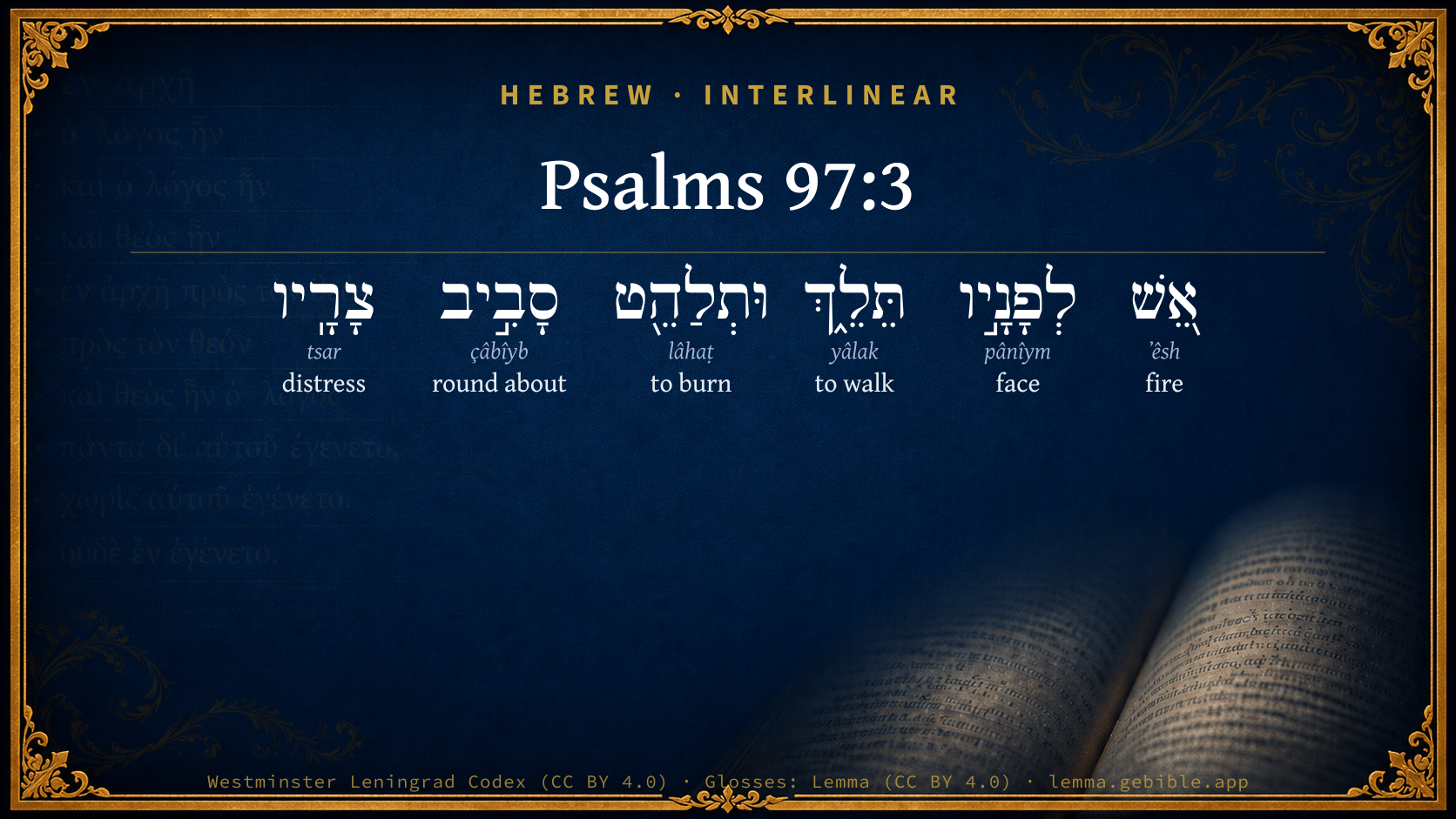
Hebrew (Westminster Leningrad Codex) Psalms 97:3 appears in the Hebrew Old Testament. The text above is from the Westminster Leningrad Codex. Each word links to its Strong’s number, a concise gloss, and parsing drawn from the Open Scriptures Hebrew Bible morphology. Click any word for its full Brown-Driver-Briggs (BDB) entry.
Download image
Cite this verse

Psalms 97:3 (World English Bible). Public Domain. Lemma interlinear Bible study tool, https://lemma.gebible.app/v/psalms/97/3.

Show BibTeX & RIS
BibTeX
RIS
English Translation
A fire goes before him, And burns up his adversaries on every side.
World English Bible · Public Domain
Download a study sheet

One document with this verse’s original text, its word-by-word gloss line, the meaning frame, cross-references with their text, attributed commentary, and full source and license credits — printable, and it pastes into notes with its structure intact.

This verse Autodidact and up

Study sheet (.html) Plain text (.txt)

A passage Seminary Student

Up to 50 verses in one chapter. A passage sheet keeps up to 6 commentary sources and 12 cross-references per verse, in the order this page ranks them, and says so on the sheet whenever that leaves anything out. Ask for a single verse and you get the Autodidact verse sheet above.

Everything on this page stays free to read, with no account — the sheet is a download of what is already on screen, not access to it.

Want to remove ads? Support Godless Engineer
Compare translations 3

The same verse in 3 English versions, stacked beneath the original-language interlinear above. Click any original word for its lexicon entry.

Each is an independent rendering of the whole verse — the interlinear is not word-aligned to these translations.

Highlighted words mark where these versions differ — a whole-verse word diff, not a word-by-word alignment.

  • World English Bible Public Domain
    A fire goes before him, And burns up his adversaries on every side.
  • King James Version Public Domain
    A fire goeth before him, and burneth up his enemies round about.
  • unfoldingWord Literal Text CC BY-SA 4.0
    Fire goes to his face and burns his adversaries all around.

unfoldingWord Literal Text — © unfoldingWord, licensed CC BY-SA 4.0. Word-aligned USFM3 via Door43 (git.door43.org/unfoldingWord/en_ult).

Versions to compare (up to 4)

3 of 4 selected

Show all 18 translations

Every available English version of this verse, each an independent rendering of the whole verse.

  • World English Bible Public Domain
    A fire goes before him, And burns up his adversaries on every side.
  • Berean Standard Bible Public Domain
    Fire goes before Him and consumes His foes on every side.
  • Majority Standard Bible Public Domain
    Fire goes before Him and consumes His foes on every side.
  • King James Version Public Domain
    A fire goeth before him, and burneth up his enemies round about.
  • American Standard Version (1901) Public Domain
    A fire goeth before him, And burneth up his adversaries round about.
  • Revised Version (1885) Public Domain
    A fire goeth before him, and burneth up his adversaries round about.
  • Geneva Bible (1599) Public Domain
    There shall goe a fire before him, and burne vp his enemies round about.
  • Douay-Rheims (1899) Public Domain
    A fire shall go before him, and shall burn his enemies round about.
  • Young's Literal Translation Public Domain
    Fire before Him goeth, And burneth round about His adversaries.
  • Literal Standard Version CC BY-SA 4.0
    Fire goes before Him, || And burns around His adversaries.
  • Unlocked Literal Bible CC BY-SA 4.0
    Fire goes before him and consumes his adversaries on every side.
  • unfoldingWord Literal Text CC BY-SA 4.0
    Fire goes to his face and burns his adversaries all around.
  • Darby Bible Public Domain
    A fire goeth before him, and burneth up his adversaries round about.
  • World Messianic Bible Public Domain
    A fire goes before him, and burns up his adversaries on every side.
  • Webster's Bible Public Domain
    A fire goeth before him, and burneth up his enemies round about.
  • Free Bible Version CC BY-SA 4.0
    Flames proceed him, burning up his enemies on every side.
  • Bible in Basic English Public Domain
    Fire goes before him, burning up all those who are against him round about.
  • JPS Tanakh (1917) Public Domain
    A fire goeth before Him, and burneth up His adversaries round about.

Literal Standard Version (2020), Covenant Press — licensed CC BY-SA 4.0. Text via the HelloAO Bible API (eBible.org). Unlocked Literal Bible (unfoldingWord) — licensed CC BY-SA 4.0. Text via the HelloAO Bible API (eBible.org). unfoldingWord Literal Text — © unfoldingWord, licensed CC BY-SA 4.0. Word-aligned USFM3 via Door43 (git.door43.org/unfoldingWord/en_ult). Free Bible Version, Dr. Jonathan Gallagher — licensed CC BY-SA 4.0. Text via the HelloAO Bible API (eBible.org).

Word by word

More ways to search: Search by grammar → Find every occurrence → Compare this word →

Practice this passage: Drill this verse → Learn its vocabulary →

About this verse

These counts appear in no published source. They are computed here, from the morphology-tagged text and Lemma’s own curated glosses. What Lemma adds →

6
words
6
distinct lemmas
Wisdom
section

Notable vocabulary

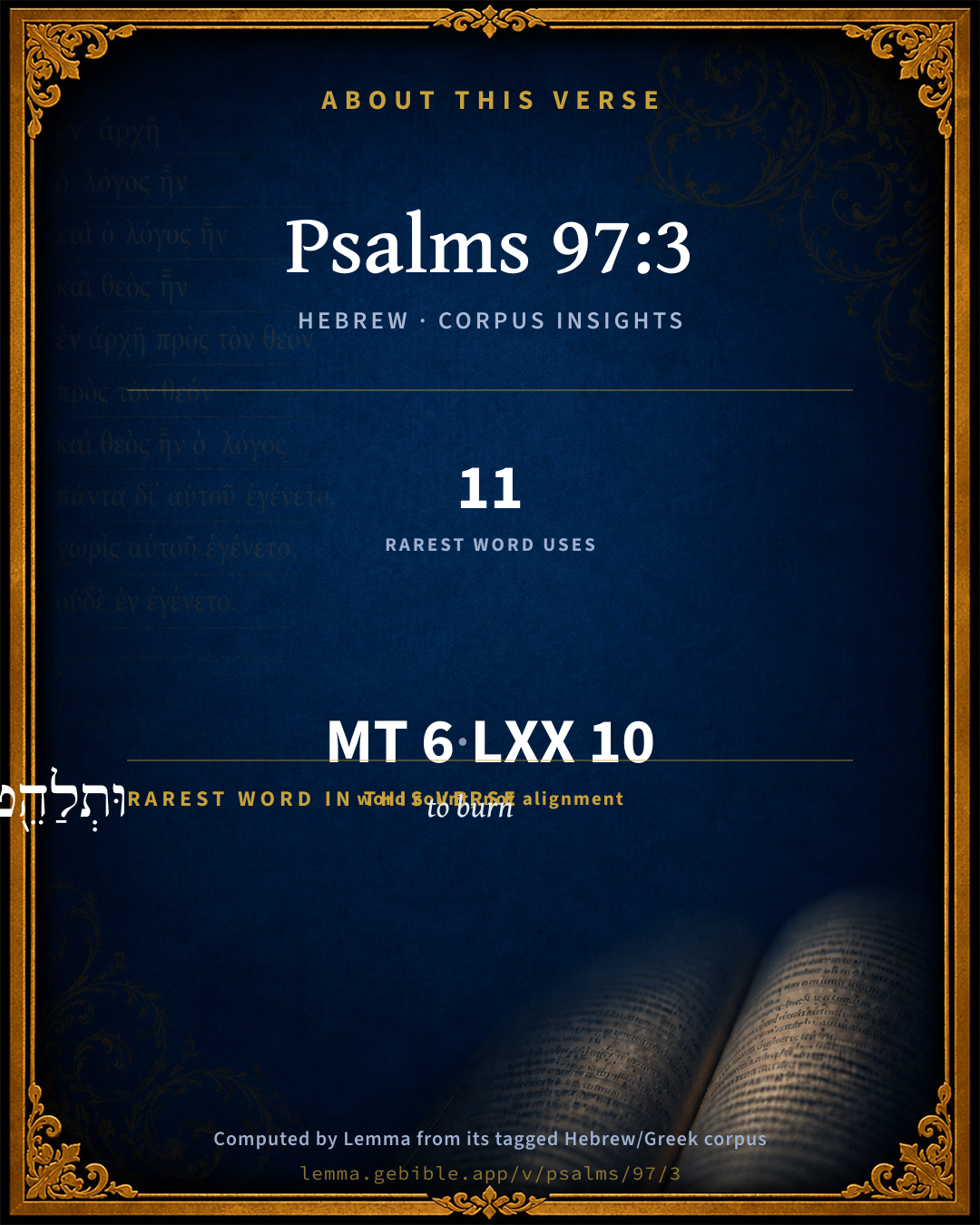
The rarest word here is וּתְלַהֵ֖ט to burn H3857 — appearing just 11 times in the whole Hebrew Bible.

Shared distinctive vocabulary

וּתְלַהֵ֖ט to burn H3857 occurs in 11 verses of the Hebrew Bible. Also found in:

Grammatical profile

  • 2 verbs
  • 4 nouns

Verb forms

  • תֵּלֵ֑ךְ Qal · Imperfect
  • וּתְלַהֵ֖ט Piel · Imperfect

Hebrew & Septuagint length

In English translation the verse runs 13 words from the Hebrew and 12 from the Septuagint (LXX English) — closely comparable.

A rough comparison of the two English renderings, which tokenize alike — not a word-level alignment.

Word counts can differ between the Hebrew and the Greek without any difference in meaning — e.g. the Hebrew direct-object marker אֵת has no separate Greek word, and Greek often adds the article ὁ.

In the original languages it is 6 Hebrew tokens and 10 Greek tokens — but the two are counted differently (Hebrew bundles its prefixes and suffixes into one token; the Greek is in lemma form), so that isn’t a like-for-like length.

Cross-references

15

Topical passages linked to Psalms 97:3 in the Treasury of Scripture Knowledge — connected by theme and wording, ordered by reader-vote popularity; previews shown in the World English Bible.

  • Psalms 50:3 Our God comes, and does not keep silent. A fire devours before him. It is very tempestuous around him.
  • Psalms 18:8 Smoke went out of his nostrils. Consuming fire came out of his mouth. Coals were kindled by it.
  • Hebrews 12:29 for our God is a consuming fire.
  • Malachi 4:1 "For, behold, the day comes, it burns as a furnace; and all the proud, and all who work wickedness, will be stubble; and the day that comes will burn them up," says Yahweh of Hosts, "that it shall leave them neither root nor branch.
  • 2 Thessalonians 1:8 giving vengeance to those who don't know God, and to those who don't obey the Gospel of our Lord Jesus,
  • Daniel 7:10 A fiery stream issued and came forth from before him: thousands of thousands ministered to him, and ten thousand times ten thousand stood before him: the judgment was set, and the books were opened.
  • Psalms 21:8–9 Your hand will find out all of your enemies. Your right hand will find out those who hate you.
  • Deuteronomy 32:22 For a fire is kindled in my anger, Burns to the lowest Sheol, Devours the earth with its increase, Sets on fire the foundations of the mountains.
  • Nahum 1:5–6 The mountains quake before him, and the hills melt away. The earth trembles at his presence, yes, the world, and all who dwell in it.
  • 2 Peter 3:10–12 But the day of the Lord will come as a thief in the night; in which the heavens will pass away with a great noise, and the elements will be dissolved with fervent heat, and the earth and the works that are in it will be burned up.
  • Deuteronomy 4:11 You came near and stood under the mountain; and the mountain burned with fire to the heart of the sky, with darkness, cloud, and thick darkness.
  • Deuteronomy 5:4 Yahweh spoke with you face to face on the mountain out of the midst of the fire,
  • Deuteronomy 5:23–24 It happened, when you heard the voice out of the midst of the darkness, while the mountain was burning with fire, that you came near to me, even all the heads of your tribes, and your elders;
  • Habakkuk 3:5 Plague went before him, And pestilence followed his feet.
  • Revelation 11:5 If anyone desires to harm them, fire proceeds out of their mouth and devours their enemies. If anyone desires to harm them, he must be killed in this way.

Cross-references courtesy of OpenBible.info (CC BY 4.0).

Hebrew and Greek witnesses Masoretic Hebrew ↔ Greek Septuagint

The same verse in the two great witnesses to the Old Testament, shown verse-for-verse.

You’re reading Greek Psalm 96 (Hebrew Psalm 97). The Septuagint counts the superscription, so verse numbers can differ from the Hebrew — chapter-level alignment, not verse-by-verse. Numbering follows Rahlfs.

These are two independent witnesses, not word-aligned to each other, and the Septuagint is shown in lemma (dictionary) form.

Hebrew Psalms 97:3 Masoretic · Westminster Leningrad Codex

אֵ֭שׁ לְפָנָ֣יו תֵּלֵ֑ךְ וּתְלַהֵ֖ט סָבִ֣יב צָרָֽיו

A fire goes before him, And burns up his adversaries on every side.

World English Bible · Public Domain

Greek LXX Greek Psalm 96:3 Septuagint · lemma form

πῦρ ἐναντίον αὐτός προπορεύομαι καί φλογίζω κύκλος ὁ ἐχθρός αὐτός

Fire shall go before him, and burn up his enemies round about.

LXX2012 (modern English Septuagint) · Public Domain

Hebrew: Westminster Leningrad Codex (CC BY 4.0). Greek: Septuagint (public domain); English from LXX2012 (modern English Septuagint) (Public Domain). How the Septuagint differs from the Hebrew →

Commentary

Notes on Psalms 97:3 from classic Christian and Jewish commentators (each source and its license shown beneath its notes). The classic Christian expositions comment on the surrounding passage and are grouped to its opening verse, so a note may address several verses; the Jewish commentaries on the Tanakh (Rashi and others) are per-verse, so they appear only where the commentator wrote on this verse.

Lemma curates 59 commentaries, every one of them public domain or Creative Commons licensed, each selected and text-cleaned for this edition rather than reprinted as found. About our sources →

Trapp's Complete Commentary

John Trapp

Psa 97:3 A fire goeth before him, and burneth up his enemies round about.

Ver. 3. A fire goeth before him] For even our God is a consuming fire, Heb 12:29 (and not the God of the Jews only), as shall well appear at the last day, 2Th 1:8. {See Trapp on "Psa 97:2"}

John Trapp, A Commentary or Exposition upon All the Books of the Old and New Testament (1647–1656) — public domain. Text from a community e-Sword module.

Joseph Benson's Commentary

Psa 97:3-5. A fire goeth before him, &c. — “The judgments of God, and their effects upon the world, are here set forth, under the usual similitude of lightning and fire from heaven, causing the earth to tremble, and the mountains to melt and dissolve away.” And by these terrible appearances in the natural world are especially signified those dreadful judgments of God, which were to be inflicted upon the Jews and others for their contempt and rejection of the Messiah, which was foretold in the Old Testament, and accomplished in the New. His lightnings enlightened the world — This phrase signifies, not so much illumination as terror and judgments, as appears, both from the following words, and from the constant use of the phrase in that sense. The hills melted — The strongest and loftiest parts of the earth, by which he may intend the great potentates of the world, who set themselves against the Messiah; at the presence of the Lord of the whole earth — Whose dominion shall not then be confined in Canaan, as now, in a manner, it is, but shall be enlarged over the whole earth. “The exaltation of Christ to the throne of his kingdom was followed by a dreadful display of that vengeance which broke in pieces the Jewish nation, and brought their civil and religious polity to an utter dissolution. In the history of their destruction the world of the ungodly may view a striking picture of the great and terrible day when the Lord Jesus shall render a recompense to all his enemies. He is then to descend in flaming fire; lightnings shall be his harbingers; the earth shall tremble, and the hills shall literally melt like wax at the presence of Jehovah.” — Horne.

Joseph Benson's Commentary on the Old and New Testaments (1811–1818) — public domain. Text from a community e-Sword module.

J. A. Alexander on Psalms

Joseph Addison Alexander

3. (Psa 97:3) Fire before him goes, and burns up around (him) his foes. With the first clause compare Psa 50:3; with the last, Isa 42:25. See also Psa 83:14. The future form is used because the verb describes not what the wrath of God is doing or has actually done, but what it will do when provoked by obstinate resistance.

Joseph Addison Alexander, The Psalms Translated and Explained (1850) — public domain. Text from a community e-Sword module.

Adam Clarke's Commentary

Verse 3. A fire goeth before him] Literally, this and the following verse may refer to the electric fluid, or to manifestations of the Divine displeasure, in which, by means of ethereal fire, God consumed his enemies. But fire is generally represented as an accompaniment of the appearances of the Supreme Being. He appeared on Mount Sinai in the midst of fire, thunder, and lightnings, Ex 19:16-18. Daniel, Da 7:9; Da 7:10, represents the Sovereign Judge as being on a throne which was a fiery flame, and the wheels of his chariot like burning fire; and a fiery stream issuing from it, and coming forth from before him. St. Paul tells us (2Th 1:8) that the Lord Jesus shall be revealed from heaven with his mighty angels, in flaming fire; and St. Peter, (2Pe 3:7; 2Pe 3:10; 2Pe 3:11,) that when the Lord shall come to judgment the heavens and the earth shall be destroyed by fire, the heavens shall pass away with a great noise, the elements melt with fervent heat, and the earth and its works be burnt up. Here then, will appear, -

"Our God in grandeur, and our world on fire."

Burneth up his enemies round about.] The fire is his pioneer which destroys all the hinderances in his way, and makes him a plain passage.

Adam Clarke's Commentary on the Bible (1810–1826) — public domain. Text from a community e-Sword/MySword module.

Ellicott's Commentary for English Readers

(3) This is an echo of Psa_1:3. (Comp. also Psa_18:8; Hab_3:4-5.)

A Bible Commentary for English Readers, edited by Charles John Ellicott (1878–1897) — public domain. Text from a community e-Sword module.

John Gill's Exposition

A fire goeth before him, Not the fiery law, which went forth from his right hand on Mount Sinai; but rather his Gospel, which, as it enlightens, warms, comforts, and refreshes his people, searches, torments, and destroys his enemies, and is the savour of death unto death to them; see Jer 23:29. Some apply this to the gifts of the Spirit on the day of Pentecost, signified by cloven tongues of fire; but then no such effect followed as mentioned in the next clause: it seems best to interpret it of his wrath, which, like fire, was poured out to the uttermost on the Jews, for their disbelief and rejection of him; they would not have him to reign over them; they despised his Gospel, and slew his servants; wherefore he sent the Roman armies to them, who destroyed those murderers, and burnt their city, Mat 22:7, this will be also verified in the second coming of Christ, who will descend in flaming fire, and the earth will be burnt up, and all that is therein, Th2 1:7, some Jewish writers interpret this of the war of Gog and Magog, in Ezekiel, which they suppose still future; as, when it is, fire will be sent and rained upon them, Eze 38:22, but may be better applied to the Gog and Magog in Rev 20:8.

and burneth up his enemies round about; so that none can escape: this was true of the Jewish nation, who were burnt up; so that there was not left root nor branch in it, Mal 4:1, and will be true of the wicked, at the general conflagration of the world, upon Christ's second coming; and of the Gog and Magog army, after the resurrection.

John Gill's Exposition of the Whole Bible (1746–1763) — public domain (CC PDM 1.0). Text via the HelloAO Bible API.

Albert Barnes' Notes on the Bible

A fire goeth before him - See Psa 18:13, note; Psa 50:3, note.

And burneth up his enemies round about - Is especially directed against his foes. That is, he manifests himself as a just God, inflicting vengeance on his enemies. He comes to reign, and in his reign all his foes will be destroyed.

Albert Barnes' Notes on the Bible (1834–1885) — public domain. Text from a community e-Sword/MySword module.

Matthew Poole's English Annotations

This fire, and lightning, and earthquake, and the sad effects of them, mentioned here, and Psa 97:4,5, signify those dreadful judgments of God which should be inflicted upon the Jews and others for their refusal and contempt of the Messias; which was foretold in the Old Testament, and accomplished in the New Testament.

Matthew Poole's English Annotations on the Holy Bible (1683–1685) — public domain. Text from a community e-Sword/MySword module.

The Treasury of David

Charles H. Spurgeon

Ver. 3. A fire goeth before him. Like an advance guard clearing the way. So was it at Sinai, so must it be: the very Being of God is power, consuming all opposition; omnipotence is a devouring flame which

burneth up his enemies round about. God is longsuffering, but when he comes forth to judgment he will make short work with the unrighteous, they will be as chaff before the flame. Reading this verse in reference to the coming of Jesus, and the descent of the Spirit, we are reminded of the tongues of fire, and of the power which attended the gospel, so that all opposition was speedily overcome. Even now where the gospel is preached in faith, and in the power of the Spirit, it burns its own way, irresistibly destroying falsehood, superstition, unbelief, sin, indifference, and hardness of heart. In it the Lord reigneth, and because of it let the earth rejoice.

Ver. 3. A fire goeth before him. Like a marshall or advance guard before a royal presence, or as the javelin men who precede a judge. Fire is the sign both of grace and wrath (Ex 3:2 Ps 18:9.) Majesty marches forth in both displays of Deity. C.H.S. from Poli Synopsis.

Ver. 3. A fire goeth before him. That fire which Christ came to send upon the earth, the kindling blaze of the Holy Ghost, which came down in tongues of fire at Pentecost, to burn freely throughout the world, for the destruction of obstinate unbelievers, and the purifying of those who gladly received the Word. And of this the prophet spake, saying, "I will send a fire on Magog, and among them that dwell carelessly its the isles: and they shall know that I am the LORD." (Eze 39:6.) This divine flame goes still before the face of the Lord in his coming to every faithful soul, as it kindles with longing for him, and burns up all its sins therewith, as he heaps his coals of fire upon its head, to soften and purify it. "It must needs be", teaches a great saint, (S. Bernard.) "that the fervour of holy desire must go before his face to every soul to which he means to come, a flame which will burn up all the mildew of sin, and make ready a place for the Lord. And then the soul knows that the Lord is at hand, when it feels itself kindled with that fire, and it saith with the prophet, `My heart was hot within me; then spake I with my tongue.'"(Ps 39:3). Augustine, and others, quoted by Neale and Littledale.

Ver. 3. A fire goeth before him. There is no less, but rather more wrath attending the despisers of the Gospel, than did attend the giving out of the law. Heb 12:29. David Dickson.

Ver. 3-6. The accompaniments of Christ's gospel advent.

1. The fire of his Spirit.

2. The light of the word.

3. The commotion in the world.

4. The removal of obstacles.

5. The display of the divine glory.

Psalms 97:4*

Charles H. Spurgeon's The Treasury of David (1869–1885) — public domain. Psalms only. Text from a community e-Sword/MySword module.

Whedon's Commentary on the Bible

Daniel D. Whedon

3. A fire goeth before him—To herald his coming. If the word of God is one of mercy to those who love and obey him, it is also one of judgment and terror to those who despise him. The figures are still borrowed from the scenes of Sinai. (See Deu_4:11; compare Isa_66:15-16; Heb_12:29; Rev_4:5.) God is represented in Psa_97:2-6 as the universal ruler, passing through the nations of the earth, visiting judicial judgments on his enemies, and dispensing pardon and peace to his willing and submissive subjects. These rejoice, (Psa_97:1,) those tremble, (Psa_97:4.)

Daniel D. Whedon (gen. ed.), Commentary on the Old and New Testaments (1874–1909) — public domain. Text from a community e-Sword module.

The Pulpit Commentary

A fire goeth before him. So long as there is evil in the world, the "fire" of God"s wrath must necessarily "go before him" at each theophany, to sweep the evil from his path. (see Isa_42:25) It is in this sense that "our God is a consuming fire". (Heb_12:29) And burneth up his enemies round about. (comp. Psa_50:8 Mat_13:30)

Vers. 3-5. The sign of the storm god. (comp. Ex 19 Ex 20 Hab 3 Heb_12:18-21; see also Psa_77:17, Psa_77:18)

There is here an evident reference to an Eastern thunderstorm. Lightning and thunder, among all superstitious peoples, are regarded as special manifestations of the Deity. To us storms are but nature forces, having their intensity, and their comings and goings, according to ordinary nature laws. But poetry can now do, better than superstition, what superstition has done in all ages and in all lands. We inquire what the "storm sign" tells concerning God. The one common feeling in tempest is the sense of the presence of an august and awful force that is uncontrollable by man, but controllable by God. In addition to this it may be said that the storm-witness for God is universal; it is rendered in every land and in every age. Point out that in Jewish history storms are directly associated with the destruction of God"s foes, and the deliverance of God"s people, as in the case of Sisera. See also the revelation of God to Elijah, at Horeb, in the wild storm and the still small voice. The storm voice says concerning God

I HE HAS AUGUST FORCES AT COMMAND. Nature forces are sublime in themselves, but they represent moral and spiritual forces far more sublime.

II HIS FORCES ARE ALTOGETHER OUT OF MAN"S LIMITATION. Tempest makes us feel this. All the combined powers of all humanity could not stop a flash of lightning or silence a peal of thunder. What makes the storm so trying to us is the sense it brings of our utter helplessness. But that lesson man needs to learn in a thousand ways, and over and over again.

III HIS FORCES MAY BE USED IN MISSIONS OF JUDGMENT. The lightning strikes some. The storm may damage much. And though we may not say in a particular case the lightning stroke is a particular judgment on the individual, we do properly get the impression of God"s power to carry out the Divine threatening.

IV HIS FORCES, HOWEVER USED, HELP US FULLY TO REALIZE HIMSELF. There is constant danger of men"s being satisfied with one-sided views of God. Christianity exalts his love; therefore it is needful to qualify our view of God by the nature-teachings and the older revelations. R.T.

The Pulpit Commentary (1880–1919), ed. H.D.M. Spence-Jones & Joseph S. Exell — public domain. Text from a community e-Sword module.

unfoldingWord translationNotes

Door43 World Missions Community

Fire goes before him

The psalmist speaks as if fire were a person walking before King Yahweh and telling people that the king was coming. (See: Personification)

consumes his adversaries

"burns up his enemies"

the earth sees and trembles

The writer speaks of the earth as if it were a person who sees what Yahweh does and trembles in fear. AT: "like a person, the earth sees and trembles" (See: Personification)

trembles

shakes with fear

The mountains melt like wax before Yahweh

The writer speaks of the mountains crumbling before Yahweh as if they were wax that was exposed to a fire. AT: "The mountains are unable to stand as Yahweh comes near" or "The mountains crumble in Yahweh's presence" (See: Simile)

translationWords

fire

consume

adversary

world

Yahweh

unfoldingWord translationNotes — © Distant Shores Media and the Door43 World Missions Community, licensed CC BY-SA 4.0. Source: git.door43.org/Door43/en_tn.

Rashi

Rabbi Shlomo Yitzchaki (Rashi)

Fire will go before Him in the war of Gog and Magog, for it is written concerning his war (Ezek. 38:22): “And I shall plead against him with pestilence and with blood, and rain bringing floods and great hailstones, fire and brimstone.”

Rashi on the Tanakh — English translations: “The Judaica Press complete Tanach with Rashi, translated by A. J. Rosenberg” (CC BY 4.0); “Pentateuch with Rashi's commentary by M. Rosenbaum and A.M. Silbermann, 1929-1934” (public domain); “The Metsudah Tanach series, Lakewood, N.J” (CC BY 4.0); and “The Book of Joshua, Metsudah Publications, 1997” (CC BY 4.0). Text via Sefaria.

Lesson kit

Teaching starters — assembled from the data on this page, not authored interpretation. Every prompt links to the verse data it draws on. Edit before teaching.

Psalms, in the Wisdom, opens this verse with 6 words (6 distinct Hebrew lemmas). Its most distinctive word is lâhaṭ (“to burn”). A historical commentator’s framing appears above. Read the whole chapter for the surrounding context.

Discussion questions

  1. What does “to burn” (lâhaṭ) contribute to the verse as a whole?
  2. How does Deuteronomy 32:22, which shares the word «to burn», read alongside this verse?
  3. These translations render this verse differently. What is at stake in choosing one wording over another?
  4. «תֵּלֵ֑ךְ» is a Qal Imperfect verb. How does that grammatical form shape the action described?
  5. Compare how Trapp's Complete Commentary and Joseph Benson's Commentary read this verse. Where do they agree or differ?

Things to notice

Reading settings

Reading text

Shown beneath each verse's original-language words.

Old Testament
Old Testament edition

Read the OT as the Masoretic Hebrew (MT) or the Greek Septuagint (LXX).

English shown for the Greek Septuagint (in the Hebrew ↔ Greek comparison).

Comparing translations? Open the Compare panel on any verse page to stack up to four side by side.