
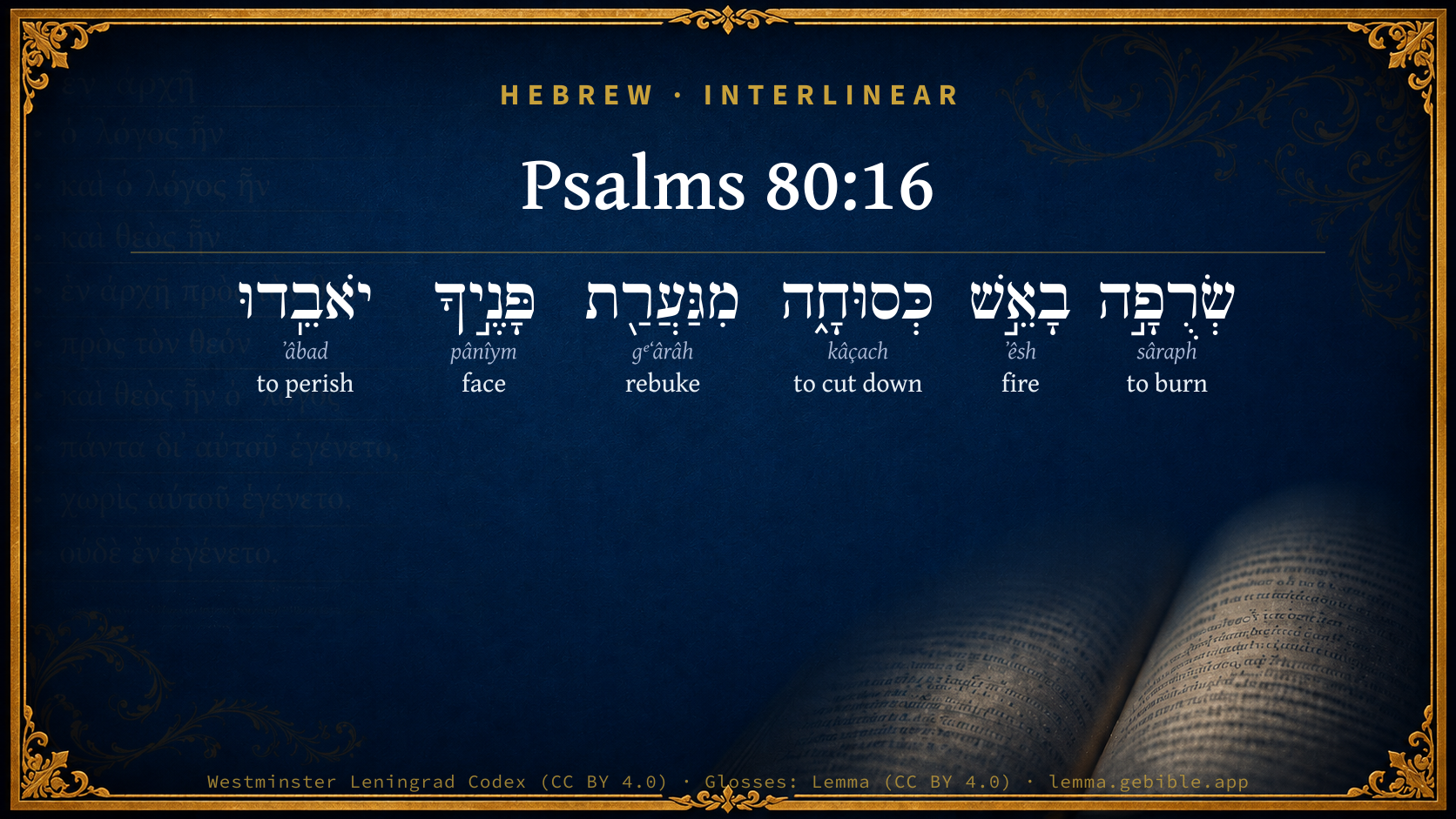
Psalms 80:16

Hebrew (Westminster Leningrad Codex) Psalms 80:16 appears in the Hebrew Old Testament. The text above is from the Westminster Leningrad Codex. Each word links to its Strong’s number, a concise gloss, and parsing drawn from the Open Scriptures Hebrew Bible morphology. Click any word for its full Brown-Driver-Briggs (BDB) entry.
Download image
Cite this verse

Psalms 80:16 (World English Bible). Public Domain. Lemma interlinear Bible study tool, https://lemma.gebible.app/v/psalms/80/16.

Show BibTeX & RIS
BibTeX
RIS
English Translation
It's burned with fire. It's cut down. They perish at your rebuke.
World English Bible · Public Domain
Highlights
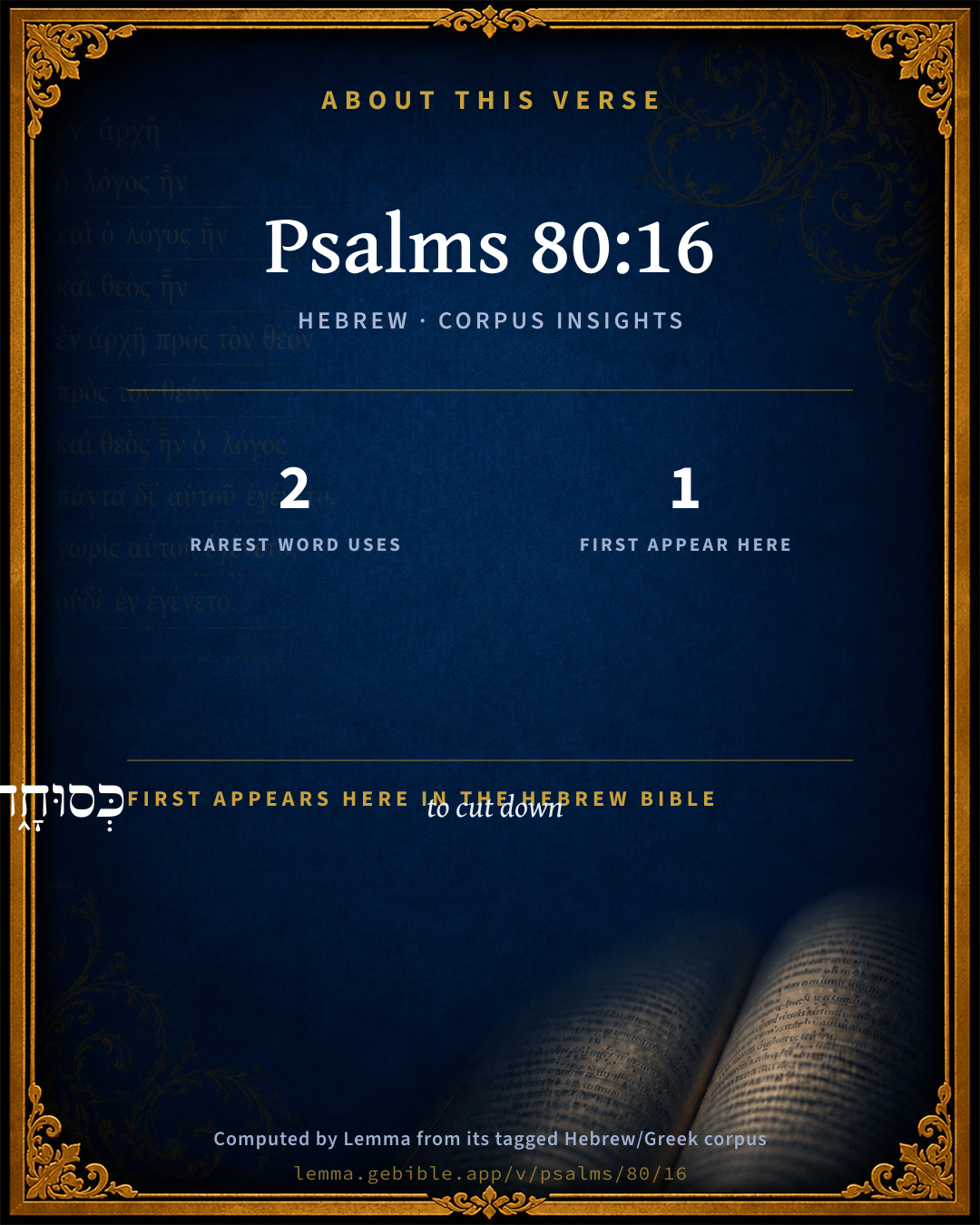
  • 1 first appearance in the Hebrew Bible
Full analysis ↓
Download a study sheet

One document with this verse’s original text, its word-by-word gloss line, the meaning frame, cross-references with their text, attributed commentary, and full source and license credits — printable, and it pastes into notes with its structure intact.

This verse Autodidact and up

Study sheet (.html) Plain text (.txt)

A passage Seminary Student

Up to 50 verses in one chapter. A passage sheet keeps up to 6 commentary sources and 12 cross-references per verse, in the order this page ranks them, and says so on the sheet whenever that leaves anything out. Ask for a single verse and you get the Autodidact verse sheet above.

Everything on this page stays free to read, with no account — the sheet is a download of what is already on screen, not access to it.

Want to remove ads? Support Godless Engineer
Compare translations 3

The same verse in 3 English versions, stacked beneath the original-language interlinear above. Click any original word for its lexicon entry.

Each is an independent rendering of the whole verse — the interlinear is not word-aligned to these translations.

Highlighted words mark where these versions differ — a whole-verse word diff, not a word-by-word alignment.

  • World English Bible Public Domain
    It's burned with fire. It's cut down. They perish at your rebuke.
  • King James Version Public Domain
    It is burned with fire, it is cut down: they perish at the rebuke of thy countenance.
  • unfoldingWord Literal Text CC BY-SA 4.0
    It is burned with fire, it is cut down; from the rebuke of your face they perish.

unfoldingWord Literal Text — © unfoldingWord, licensed CC BY-SA 4.0. Word-aligned USFM3 via Door43 (git.door43.org/unfoldingWord/en_ult).

Versions to compare (up to 4)

3 of 4 selected

Show all 18 translations

Every available English version of this verse, each an independent rendering of the whole verse.

  • World English Bible Public Domain
    It's burned with fire. It's cut down. They perish at your rebuke.
  • Berean Standard Bible Public Domain
    Your vine has been cut down and burned; they perish at the rebuke of Your countenance.
  • Majority Standard Bible Public Domain
    Your vine has been cut down and burned; they perish at the rebuke of Your countenance.
  • King James Version Public Domain
    It is burned with fire, it is cut down: they perish at the rebuke of thy countenance.
  • American Standard Version (1901) Public Domain
    It is burned with fire, it is cut down: They perish at the rebuke of thy countenance.
  • Revised Version (1885) Public Domain
    It is burned with fire, it is cut down: they perish at the rebuke of thy countenance.
  • Geneva Bible (1599) Public Domain
    It is burnt with fire and cut downe: and they perish at the rebuke of thy countenance.
  • Douay-Rheims (1899) Public Domain
    And perfect the same which thy right hand hath planted: and upon the son of man whom thou hast confirmed for thyself.
  • Young's Literal Translation Public Domain
    Burnt with fire -- cut down, From the rebuke of Thy face they perish.
  • Literal Standard Version CC BY-SA 4.0
    Burned with fire—cut down, || They perish from the rebuke of Your face.
  • Unlocked Literal Bible CC BY-SA 4.0
    It has been burned and cut down; they perish because of your rebuke.
  • unfoldingWord Literal Text CC BY-SA 4.0
    It is burned with fire, it is cut down; from the rebuke of your face they perish.
  • Darby Bible Public Domain
    It is burned with fire, it is cut down; they perish at the rebuke of thy countenance.
  • World Messianic Bible Public Domain
    It’s burned with fire. It’s cut down. They perish at your rebuke.
  • Webster's Bible Public Domain
    \\80:15\\And the vineyard which thy right hand planted, and the branch that thou madest strong for thyself.
  • Free Bible Version CC BY-SA 4.0
    We, your vine, have been chopped down and burned. May those who did this die when you glare at them.
  • Bible in Basic English Public Domain
    It is burned with fire; it is cut down: they are made waste by the wrath of your face.
  • JPS Tanakh (1917) Public Domain
    (80-17) It is burned with fire, it is cut down; they perish at the rebuke of Thy countenance.

Literal Standard Version (2020), Covenant Press — licensed CC BY-SA 4.0. Text via the HelloAO Bible API (eBible.org). Unlocked Literal Bible (unfoldingWord) — licensed CC BY-SA 4.0. Text via the HelloAO Bible API (eBible.org). unfoldingWord Literal Text — © unfoldingWord, licensed CC BY-SA 4.0. Word-aligned USFM3 via Door43 (git.door43.org/unfoldingWord/en_ult). Free Bible Version, Dr. Jonathan Gallagher — licensed CC BY-SA 4.0. Text via the HelloAO Bible API (eBible.org).

Word by word

More ways to search: Search by grammar → Find every occurrence → Compare this word →

Practice this passage: Drill this verse → Learn its vocabulary →

About this verse

These counts appear in no published source. They are computed here, from the morphology-tagged text and Lemma’s own curated glosses. What Lemma adds →

6
words
6
distinct lemmas
Wisdom
section

Notable vocabulary

The rarest word here is כְּסוּחָ֑ה to cut down H3683 — appearing just 2 times in the whole Hebrew Bible.

First appearance in Scripture

This word makes its first canonical appearance in the Hebrew Bible here:

  • כְּסוּחָ֑ה to cut down H3683

Shared distinctive vocabulary

כְּסוּחָ֑ה to cut down H3683 occurs in 2 verses of the Hebrew Bible. Also found in:

Grammatical profile

  • 3 verbs
  • 3 nouns

Verb forms

  • שְׂרֻפָ֣ה Qal · Participle Passive
  • כְּסוּחָ֑ה Qal · Participle Passive
  • יֹאבֵֽדוּ Qal · Imperfect

Hebrew & Septuagint length

In English translation the verse runs 12 words from the Hebrew and 17 from the Septuagint (LXX English) — closely comparable.

A rough comparison of the two English renderings, which tokenize alike — not a word-level alignment.

Word counts can differ between the Hebrew and the Greek without any difference in meaning — e.g. the Hebrew direct-object marker אֵת has no separate Greek word, and Greek often adds the article ὁ.

Cross-references

8

Topical passages linked to Psalms 80:16 in the Treasury of Scripture Knowledge — connected by theme and wording, ordered by reader-vote popularity; previews shown in the World English Bible.

  • Psalms 39:11 When you rebuke and correct man for iniquity, You consume his wealth like a moth. Surely every man is but a breath." Selah.
  • John 15:6 If a man doesn't remain in me, he is thrown out as a branch, and is withered; and they gather them, throw them into the fire, and they are burned.
  • 2 Thessalonians 1:9 who will pay the penalty: eternal destruction from the face of the Lord and from the glory of his might,
  • Psalms 76:6–7 At your rebuke, God of Jacob, Both chariot and horse are cast into a deep sleep.
  • Psalms 79:5 How long, Yahweh? Will you be angry forever? Will your jealousy burn like fire?
  • Psalms 90:7 For we are consumed in your anger. We are troubled in your wrath.
  • Isaiah 27:11 When the boughs of it are withered, they shall be broken off; the women shall come, and set them on fire; for it is a people of no understanding: therefore he who made them will not have compassion on them, and he who formed them will show them no favor.
  • Ezekiel 20:47–48 and tell the forest of the South, Hear the word of Yahweh: Thus says the Lord Yahweh, Behold, I will kindle a fire in you, and it shall devour every green tree in you, and every dry tree: the flaming flame shall not be quenched, and all faces from the south to the north shall be burnt thereby.

Cross-references courtesy of OpenBible.info (CC BY 4.0).

Hebrew and Greek witnesses Masoretic Hebrew ↔ Greek Septuagint

The same verse in the two great witnesses to the Old Testament, shown verse-for-verse.

You’re reading Greek Psalm 79 (Hebrew Psalm 80). The Septuagint counts the superscription, so verse numbers can differ from the Hebrew — chapter-level alignment, not verse-by-verse. Numbering follows Rahlfs.

These are two independent witnesses, not word-aligned to each other, and the Septuagint is shown in lemma (dictionary) form.

Hebrew Psalms 80:16 Masoretic · Westminster Leningrad Codex

שְׂרֻפָ֣ה בָאֵ֣שׁ כְּסוּחָ֑ה מִגַּעֲרַ֖ת פָּנֶ֣יךָ יֹאבֵֽדוּ

It's burned with fire. It's cut down. They perish at your rebuke.

World English Bible · Public Domain

Greek LXX Greek Psalm 79:16 Septuagint · lemma form

καί καταἀρτίζω αὐτός ὅς φυτεύω ὁ δεξιός σύ καί ἐπί υἱός ἄνθρωπος ὅς κραταίοω σεαυτοῦ

It is burnt with fire and dug up: they shall perish at the rebuke of your presence.

LXX2012 (modern English Septuagint) · Public Domain

Hebrew: Westminster Leningrad Codex (CC BY 4.0). Greek: Septuagint (public domain); English from LXX2012 (modern English Septuagint) (Public Domain). How the Septuagint differs from the Hebrew →

Commentary

Notes on Psalms 80:16 from classic Christian and Jewish commentators (each source and its license shown beneath its notes). The classic Christian expositions comment on the surrounding passage and are grouped to its opening verse, so a note may address several verses; the Jewish commentaries on the Tanakh (Rashi and others) are per-verse, so they appear only where the commentator wrote on this verse.

Lemma curates 59 commentaries, every one of them public domain or Creative Commons licensed, each selected and text-cleaned for this edition rather than reprinted as found. About our sources →

Ellicott's Commentary for English Readers

(16) It is burned.—This verse would certainly be far more intelligible, and also fit better into the rhythm, if it followed immediately after Psa_80:13. The poet, while complaining that God fumed with anger while Israel prayed, would scarcely speak of themselves as perishing under His rebuke, which, in Psa_76:6, is used of His attitude towards foes actually contending against Him. But if we read Psa_80:13; Psa_80:16 together, we avoid this:—

“The boar out of the wood doth waste it

And the wild beast of the field doth devour it:

It is burned with fire, it is cut down;

Let them (the beasts) perish at the rebuke of thy

countenance.”

(See also Note to next verse.)

A Bible Commentary for English Readers, edited by Charles John Ellicott (1878–1897) — public domain. Text from a community e-Sword module.

Trapp's Complete Commentary

John Trapp

Psa 80:16 [It is] burned with fire, [it is] cut down: they perish at the rebuke of thy countenance.

Ver. 16. They perish] Scilicet palmites, et propagines, Psa 80:10-11.

John Trapp, A Commentary or Exposition upon All the Books of the Old and New Testament (1647–1656) — public domain. Text from a community e-Sword module.

Joseph Benson's Commentary

Psa 80:16. It is burned with fire, &c. — Namely, thy vineyard or branch; since, upon our provoking sins, thou hast withdrawn thy mercy from us, the enemies have broken in upon us, and great numbers of us are destroyed already, and may be compared to the numerous branches of a remaining stock, which, being cut off, are burned with fire. They perish — Namely, thy people of Israel, signified by the vine. So now he passes from the metaphor to the thing signified by it. At the rebuke of thy countenance — Through the effects of thine anger, without which our enemies could do us no hurt.

Joseph Benson's Commentary on the Old and New Testaments (1811–1818) — public domain. Text from a community e-Sword module.

J. A. Alexander on Psalms

Joseph Addison Alexander

17. (Psa 80:16) (It is) burnt with fire, cut (down or up); at the rebuke of thy countenance they perish. The prayer is interrupted for a moment by a new description of the evils which occasioned it. The first clause alludes to the destruction of vineyards by fire and steel in ancient warfare, here recognised, however, as a divine judgment. At the rebuke, i.e. at the time, and also as a consequence of it. Any expression of disapprobation and displeasure, whether by word or deed, is a rebuke. See above, on Psa 76:6. The rebuke is here supposed to be expressed in the countenance, a much more natural interpretation than that which makes thy face mean thy presence. They perish, those who had before been represented by the vine transplanted out of Egypt. The future form implies that it will always be so, when God utters his rebuke.

Joseph Addison Alexander, The Psalms Translated and Explained (1850) — public domain. Text from a community e-Sword module.

Tyndale Open Study Notes

Tyndale Open Resources

80:16-19 The community prays for God to change their desperate situation and restore them. They are still the Lord’s chosen people.

Tyndale Open Study Notes — © Tyndale Open Resources, licensed CC BY-SA 4.0. Text via the HelloAO Bible API.

Geneva Bible (1599)

Geneva Bible translators

Only when thou art angry and not of the sword of the enemy.

Geneva Bible (1599) marginal notes — public domain. Text via Bolls.life.

John Calvin's Commentaries

16 It is burnt with fire. The calamities of the people are now more clearly expressed. It had been said that the Lord’s vine was abandoned to the wild beasts, that they might lay it waste. But it was a greater calamity for it to be consumed with fire, rooted up and utterly destroyed. The Israelites had perfidiously apostatised from the true religion; but, as has been previously observed, they were still a part of the Church. We are accordingly warned by this melancholy example, of the severity of the punishment due to our ingratitude, especially when it is joined with obstinacy, which prevents the threatenings and rebukes of God, however sharp and severe they may be, from being of any benefit to us. Let us also learn from the same example, when the Divine anger is blazing all around, and even when we are in the midst of its burning flames, to cast all our sorrows into the bosom of God, who, in a wonderful manner, raises up his Church from the gulf of destruction. He would assuredly be ready not only to exercise without interruption his favor towards us, but also to enrich us with his blessings more and more, did not our wickedness hinder him. As it is impossible for him not to be angry at the many offenses which we have committed, it is an evidence of unparalleled mercy for him to extinguish the fire which we ourselves have kindled, and which has spread far and wide, and to save some portion or remnant of the Church, or, to speak more properly, to raise up even from the very ashes a people to call upon his name. It is again repeated that the Church perished not by the strength and arms of her enemies, but at the rebuke of God’s countenance. Never can we expect any alleviation of our punishment, unless we are fully persuaded that we are justly chastised by the hand of God. It was a good sign of the repentance of these Israelites that, as is observed in Isaiah 9:12, “they looked to the hand of him who smote them.”

John Calvin's Commentaries (1540-1563) — public domain. Text from the Calvin Translation Society English edition (1840s-50s) via the Christian Classics Ethereal Library (ccel.org). Calvin's coverage is partial (roughly two-thirds of the Bible); uncommented books and verses are honest gaps, never fabricated. The 19th-century editor's footnotes and remarks are omitted so the notes are faithfully Calvin's own voice.

The Cambridge Bible for Schools and Colleges

gen. ed. J. J. S. Perowne

16. The gender of the word shews that it refers to the vine. Cut down, as fit for nothing but fuel. Cp. Isa_33:12; Eze_15:4.

they perish &c.] The figure is dropped. The Israelites perish, for God has not merely hidden His face, but turned it upon them in anger.

It has been conjectured that there has been some displacement of the text, and various rearrangements have been proposed. Thus Cheyne would read the verses in this order: 11, 14, 15, 12, 13, 16. Let them perish will then refer to Israel’s enemies. Then too there may have been some confusion between 15 b and 17 b.

The Cambridge Bible for Schools and Colleges (gen. ed. J. J. S. Perowne; Cambridge University Press, 1878–1918) — public domain. Text from a community e-Sword module.

John Gill's Exposition

Let thy hand be upon the man of thy right hand,.... Which some understand of the people of Israel in general, beloved, supported, and strengthened, by the Lord: and others of the then king of Israel, or Judah, the vinedresser, or keeper of the vineyard under God; praying that he might be directed, supported, and protected, by the Lord; but it seems better to understand it with R. Obadiah on the place, and Abarbinel (x) of the Messiah; and so Aben Ezra interprets it either of Israel, or of Messiah the son of Ephraim. Christ is called the "man", though as yet he was not really man, because it was purposed and promised that he should; and he had agreed to become man, and had appeared often in an human form; and it was certain that he would be incarnate: and also the man of God's "right hand", which is expressive of the power of God, because by him, who, in time, became man, even the Son of God, the world, and all things in it, were made; and by him all things are upheld in their being; by him his people were to be redeemed, and have been redeemed from all their enemies; and by him they are upheld, kept, and preserved from a final and total falling away, and will be raised at the last day: and the phrase may design the support and strength the human nature of Christ, which was weak in itself, was to have, and had, not only from its union in the Son of God, but from God the Father; who promised and gave support and strength to it, under all the sufferings endured in it: to which may be added, that this phrase is expressive of love and affection; so Benjamin had his name, which signifies the son of the right hand, from the great affection of his father; so Christ is the Son of God's love, his dear and well beloved Son; as appears by hiding nothing from him, by putting all things into his hands, and appointing him the Head and Saviour of his people, and the Judge of the world; and his love to him is a love of complacency and delight, is everlasting and unchangeable: moreover, he may be so called, because he was to be, and now is, exalted at the right hand of God, in human nature, as a Prince and Saviour, above angels, authorities, and powers, and above every name whatever: and the prayer is either that the hand of vindictive justice might not be upon the vine, or the church of God, but upon Christ their surety, who was able to bear it, and had engaged to do it; or the hand of divine power and support might be upon him, to strengthen him for the work of redemption and salvation, that so that might prosper in his hand; and the hand of love, grace, and mercy, might be turned upon his people: it is added,

upon the son of man, whom thou madest strong for thyself; for the accomplishment of his purposes, promises, and covenant, for the bringing about the salvation of his own people, and for ends of his own glory: the same person is here meant as before; and his being called "the Son of Man", which is a very usual phrase for Christ in the New Testament, and which seems to be taken from hence, and from Dan 7:13, shows that he could not be really from eternity, since he was to be the Son of Man, as he was, of Abraham, David, &c.

(x) Mashmiah Jeshuah, fol. 81. 2.

John Gill's Exposition of the Whole Bible (1746–1763) — public domain (CC PDM 1.0). Text via the HelloAO Bible API.

Albert Barnes' Notes on the Bible

It is burned with fire - That is, the vineyard. This is a description of the desolations that had come upon the nation, such as would come upon a vineyard if it were consumed by fire.

It is cut down - It has been made desolate by fire and by the axe.

They perish at the rebuke of thy countenance - At the frown on thy face, as if God has only to look upon people in anger, and they perish. The word they refers to those who were represented by the vine which had been brought out of Egypt - the people of the land.

Albert Barnes' Notes on the Bible (1834–1885) — public domain. Text from a community e-Sword/MySword module.

Matthew Poole's English Annotations

It is burned with fire, to wit, thy vineyard or branch.

They perish; thy people of Israel, signified by the vine. So now he passeth from the metaphor to the thing designed by it.

At the rebuke of thy countenance; through the effects of thine anger, without which their enemies could do them no hurt.

Matthew Poole's English Annotations on the Holy Bible (1683–1685) — public domain. Text from a community e-Sword/MySword module.

The Treasury of David

Charles H. Spurgeon

Ver. 16. It is burned with fire. In broken utterances the sorrowful singer utters his distress. The vineyard was like a forest which has been set on fire; the choice vines were charred and dead.

It is cut down. The cruel axe had hacked after its murderous fashion, the branches were lopped, the trunk was wounded, desolation reigned supreme.

They perish at the rebuke of thy countenance. God's rebuke was to Israel what fire and axe would be to a vine. His favour is life, and his wrath is as messengers of death. One angry glance from Jehovah's eye is sufficient to lay all the vineyards of Ephraim desolate. O Lord, look not thus upon our churches. Rebuke us, but not in anger.

Charles H. Spurgeon's The Treasury of David (1869–1885) — public domain. Psalms only. Text from a community e-Sword/MySword module.

Whedon's Commentary on the Bible

Daniel D. Whedon

16. It is burned with fire… cut down—As the tender vines are devoured by fire, so the nation had been wasted by foreign war and internal broils. The twofold figure of cutting and burning seems borrowed from Isa_33:12, “As thorns cut up, shall they be burned with fire.” The predominant figure of the vine here begins to yield to the literal application, which further discovers itself in Psa_80:17-18

Daniel D. Whedon (gen. ed.), Commentary on the Old and New Testaments (1874–1909) — public domain. Text from a community e-Sword module.

The Pulpit Commentary

It is burned with fire, it is cut down. The flames of war have begun to consume it it is no longer a vine, but mere fuel, (comp. Isa_33:12) ready to be burned. They perish at the rebuke of thy countenance. Here the metaphor is dropped. The climax has been reached, and the matter is too serious for rhetorical treatment. The nation typified by the vine, the Israel of God, is perishing perishing "at the rebuke of God"s countenance because his favour is withdrawn from them. Unless God steps in to save, destruction is certain.

The Pulpit Commentary (1880–1919), ed. H.D.M. Spence-Jones & Joseph S. Exell — public domain. Text from a community e-Sword module.

John Wesley's Explanatory Notes

They - Thy people, signified by the vine. So now he passes from the metaphor to the thing designed by it.

John Wesley, Explanatory Notes Upon the Whole Bible (1754–1765) — public domain. Text via the GEBible commentary corpus.

Rashi

Rabbi Shlomo Yitzchaki (Rashi)

And of the foundation that Your right hand has planted Which is founded and established, which Your right hand has planted, an expression of (Gen. 40:13): “and restore you to your office (כנך).”

and over the son You have strengthened for Yourself And over Esau, who was a beloved son to this father, who would call him, “my son.” You strengthened the vine of Jacob for Yourself, as it is said (Gen. 27:40): “and You will serve your brother.” Now it is...

Rashi on the Tanakh — English translations: “The Judaica Press complete Tanach with Rashi, translated by A. J. Rosenberg” (CC BY 4.0); “Pentateuch with Rashi's commentary by M. Rosenbaum and A.M. Silbermann, 1929-1934” (public domain); “The Metsudah Tanach series, Lakewood, N.J” (CC BY 4.0); and “The Book of Joshua, Metsudah Publications, 1997” (CC BY 4.0). Text via Sefaria.

Lesson kit

Teaching starters — assembled from the data on this page, not authored interpretation. Every prompt links to the verse data it draws on. Edit before teaching.

Psalms, in the Wisdom, opens this verse with 6 words (6 distinct Hebrew lemmas). Its most distinctive word is kâçach (“to cut down”). A historical commentator’s framing appears above. Read the whole chapter for the surrounding context.

Discussion questions

  1. The word kâçach carries the sense “to cut down.” How does it shape the verse?
  2. This is the first place “to cut down” appears in Scripture (first appears here). What does its debut here establish?
  3. How does Isaiah 33:12, which shares the word «to cut down», read alongside this verse?
  4. These translations render this verse differently. What is at stake in choosing one wording over another?
  5. «שְׂרֻפָ֣ה» is a Qal Participle Passive verb. How does that grammatical form shape the action described?
  6. Compare how Ellicott's Commentary for English Readers and Trapp's Complete Commentary read this verse. Where do they agree or differ?

Things to notice

  • 1 word makes its first canonical appearance in Scripture here.
  • These translations choose different wording for 3 words in this verse.
  • 6 distinct Hebrew lemmas span 6 words in this verse.

Reading settings

Reading text

Shown beneath each verse's original-language words.

Old Testament
Old Testament edition

Read the OT as the Masoretic Hebrew (MT) or the Greek Septuagint (LXX).

English shown for the Greek Septuagint (in the Hebrew ↔ Greek comparison).

Comparing translations? Open the Compare panel on any verse page to stack up to four side by side.