Exodus 12:10

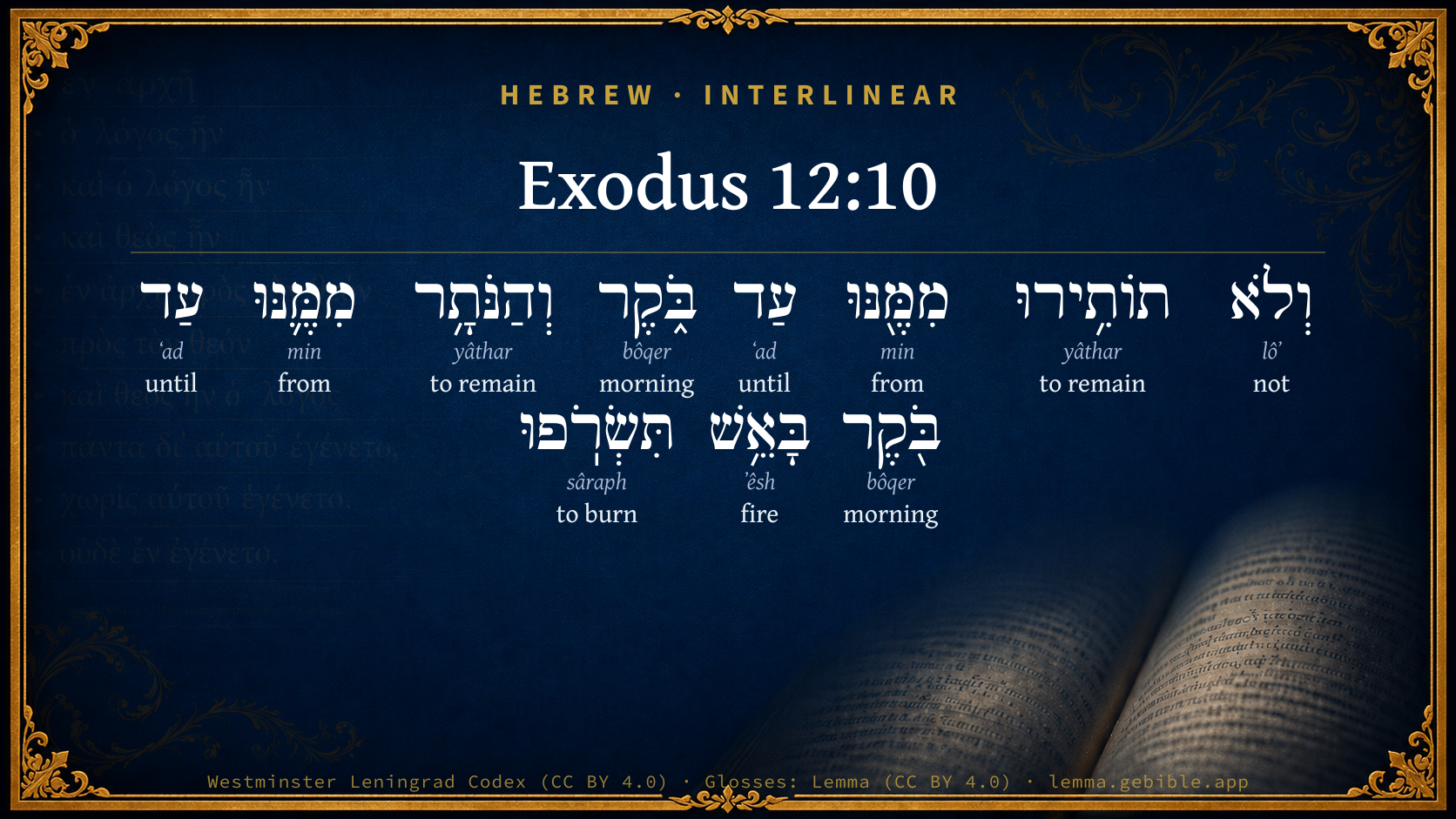
Hebrew (Westminster Leningrad Codex) Exodus 12:10 appears in the Hebrew Old Testament. The text above is from the Westminster Leningrad Codex. Each word links to its Strong’s number, a concise gloss, and parsing drawn from the Open Scriptures Hebrew Bible morphology. Click any word for its full Brown-Driver-Briggs (BDB) entry.
Download image
Cite this verse

Exodus 12:10 (World English Bible). Public Domain. Lemma interlinear Bible study tool, https://lemma.gebible.app/v/exodus/12/10.

Show BibTeX & RIS
BibTeX
RIS
English Translation
You shall let nothing of it remain until the morning; but that which remains of it until the morning you shall burn with fire.
World English Bible · Public Domain
Download a study sheet

One document with this verse’s original text, its word-by-word gloss line, the meaning frame, cross-references with their text, attributed commentary, and full source and license credits — printable, and it pastes into notes with its structure intact.

This verse Autodidact and up

Study sheet (.html) Plain text (.txt)

A passage Seminary Student

Up to 50 verses in one chapter. A passage sheet keeps up to 6 commentary sources and 12 cross-references per verse, in the order this page ranks them, and says so on the sheet whenever that leaves anything out. Ask for a single verse and you get the Autodidact verse sheet above.

Everything on this page stays free to read, with no account — the sheet is a download of what is already on screen, not access to it.

Want to remove ads? Support Godless Engineer
Compare translations 3

The same verse in 3 English versions, stacked beneath the original-language interlinear above. Click any original word for its lexicon entry.

Each is an independent rendering of the whole verse — the interlinear is not word-aligned to these translations.

Highlighted words mark where these versions differ — a whole-verse word diff, not a word-by-word alignment.

  • World English Bible Public Domain
    You shall let nothing of it remain until the morning; but that which remains of it until the morning you shall burn with fire.
  • King James Version Public Domain
    And ye shall let nothing of it remain until the morning; and that which remaineth of it until the morning ye shall burn with fire.
  • unfoldingWord Literal Text CC BY-SA 4.0
    And you shall not cause to remain anything from it until morning; and you shall burn in the fire what remains from it until morning.

unfoldingWord Literal Text — © unfoldingWord, licensed CC BY-SA 4.0. Word-aligned USFM3 via Door43 (git.door43.org/unfoldingWord/en_ult).

Versions to compare (up to 4)

3 of 4 selected

Show all 18 translations

Every available English version of this verse, each an independent rendering of the whole verse.

  • World English Bible Public Domain
    You shall let nothing of it remain until the morning; but that which remains of it until the morning you shall burn with fire.
  • Berean Standard Bible Public Domain
    Do not leave any of it until morning; before the morning you must burn up any part that is left over.
  • Majority Standard Bible Public Domain
    Do not leave any of it until morning; before the morning you must burn up any part that is left over.
  • King James Version Public Domain
    And ye shall let nothing of it remain until the morning; and that which remaineth of it until the morning ye shall burn with fire.
  • American Standard Version (1901) Public Domain
    And ye shall let nothing of it remain until the morning; but that which remaineth of it until the morning ye shall burn with fire.
  • Revised Version (1885) Public Domain
    And ye shall let nothing of it remain until the morning; but that which remaineth of it until the morning ye shall burn with fire.
  • Geneva Bible (1599) Public Domain
    And ye shall reserue nothing of it vnto the morning: but that, which remaineth of it vnto the morowe, shall ye burne with fire.
  • Douay-Rheims (1899) Public Domain
    Neither shall there remain any thing of it until morning. If there be any thing left, you shall burn it with fire.
  • Young's Literal Translation Public Domain
    and ye do not leave of it till morning, and that which is remaining of it till morning with fire ye do burn.
  • Literal Standard Version CC BY-SA 4.0
    and you do not leave of it until morning, and that which is remaining of it until morning you burn with fire.
  • Unlocked Literal Bible CC BY-SA 4.0
    You must not let any of it be left over until morning. You must burn whatever is left over in the morning.
  • unfoldingWord Literal Text CC BY-SA 4.0
    And you shall not cause to remain anything from it until morning; and you shall burn in the fire what remains from it until morning.
  • Darby Bible Public Domain
    And ye shall let none of it remain until the morning; and what remaineth of it until the morning ye shall burn with fire.
  • World Messianic Bible Public Domain
    You shall let nothing of it remain until the morning; but that which remains of it until the morning you shall burn with fire.
  • Webster's Bible Public Domain
    And ye shall let nothing of it remain till the morning: and that which remaineth of it till the morning ye shall burn with fire.
  • Free Bible Version CC BY-SA 4.0
    Make sure nothing is left until the morning. If there is anything left over, burn it by morning.
  • Bible in Basic English Public Domain
    Do not keep any of it till the morning; anything which is not used is to be burned with fire.
  • JPS Tanakh (1917) Public Domain
    And ye shall let nothing of it remain until the morning; but that which remaineth of it until the morning ye shall burn with fire.

Literal Standard Version (2020), Covenant Press — licensed CC BY-SA 4.0. Text via the HelloAO Bible API (eBible.org). Unlocked Literal Bible (unfoldingWord) — licensed CC BY-SA 4.0. Text via the HelloAO Bible API (eBible.org). unfoldingWord Literal Text — © unfoldingWord, licensed CC BY-SA 4.0. Word-aligned USFM3 via Door43 (git.door43.org/unfoldingWord/en_ult). Free Bible Version, Dr. Jonathan Gallagher — licensed CC BY-SA 4.0. Text via the HelloAO Bible API (eBible.org).

Word by word

More ways to search: Search by grammar → Find every occurrence → Compare this word →

Practice this passage: Drill this verse → Learn its vocabulary →

תוֹתִ֥ירוּ
yâthar
H3498
“to remain”
Verb, Hiphil, Imperfect, 2nd Person, Masculine, Plural
Part of Speech
Verb
Stem
Hiphil
Form
Imperfect
Person
2nd Person
Gender
Masculine
Number
Plural
Full BDB Definition

Origin: a primitive root

TWOT: 936

to be left over, remain, remain over, leave - (Qal) remainder (participle) - (Niphal) to be left over, remain over, be left behind - (Hiphil) - to leave over, leave - to save over, preserve alive - to excel, show pre-eminence - to show excess, have more than enough, have an excess
  1. וְלֹא lôʼ H3808 “and · not” Conjunction + Particle, Negative
  2. מִמֶּ֖נּוּ min H4480 “from · us” Preposition + Suffix, Personal, 1st Person, Common, Plural
  3. עַד ʻad H5704 “until” Preposition
  4. בֹּ֑קֶר bôqer H1242 “morning” Noun, Common, Masculine, Singular, Absolute
  5. וְהַנֹּתָ֥ר yâthar H3498 “and · the · remaining” Conjunction + Particle, Definite Article + Verb, Niphal, Participle Active, Masculine, Singular, Absolute
  6. מִמֶּ֛נּוּ min H4480 “from · us” Preposition + Suffix, Personal, 1st Person, Common, Plural
  7. עַד ʻad H5704 “until” Preposition
  8. בֹּ֖קֶר bôqer H1242 “morning” Noun, Common, Masculine, Singular, Absolute
  9. בָּאֵ֥שׁ ʼêsh H784 “in/at the · fire” Preposition, Determined + Noun, Common, Both, Singular, Absolute
  10. תִּשְׂרֹֽפוּ sâraph H8313 “to burn” Verb, Qal, Imperfect, 2nd Person, Masculine, Plural

About this verse

These counts appear in no published source. They are computed here, from the morphology-tagged text and Lemma’s own curated glosses. What Lemma adds →

11
words
7
distinct lemmas
Pentateuch
section

Grammatical profile

  • 3 verbs
  • 3 nouns
  • 4 prepositions
  • 1 particle

Verb forms

  • תוֹתִ֥ירוּ Hiphil · Imperfect
  • וְהַנֹּתָ֥ר Niphal · Participle Active
  • תִּשְׂרֹֽפוּ Qal · Imperfect

Repetition

Words recur within this verse — often emphatic in Hebrew:

  • תוֹתִ֥ירוּ to remain H3498 ×2
  • עַד until H5704 ×2
  • בֹּ֑קֶר morning H1242 ×2
  • מִמֶּ֖נּוּ from H4480 ×2

Hebrew & Septuagint length

In English translation the verse runs 24 words from the Hebrew and 33 from the Septuagint (LXX English) — closely comparable.

A rough comparison of the two English renderings, which tokenize alike — not a word-level alignment.

Word counts can differ between the Hebrew and the Greek without any difference in meaning — e.g. the Hebrew direct-object marker אֵת has no separate Greek word, and Greek often adds the article ὁ.

Cross-references

6

Topical passages linked to Exodus 12:10 in the Treasury of Scripture Knowledge — connected by theme and wording, ordered by reader-vote popularity; previews shown in the World English Bible.

  • Exodus 23:18 "You shall not offer the blood of my sacrifice with leavened bread, neither shall the fat of my feast remain all night until the morning.
  • Exodus 34:25 "You shall not offer the blood of my sacrifice with leavened bread; neither shall the sacrifice of the feast of the Passover be left to the morning.
  • Exodus 29:34 If anything of the flesh of the consecration, or of the bread, remains to the morning, then you shall burn the remainder with fire: it shall not be eaten, because it is holy.
  • Leviticus 22:30 It shall be eaten on the same day; you shall leave none of it until the morning. I am Yahweh.
  • Leviticus 7:15–17 The flesh of the sacrifice of his peace offerings for thanksgiving shall be eaten on the day of his offering. He shall not leave any of it until the morning.
  • Deuteronomy 16:4–5 There shall be no yeast seen with you in all your borders seven days; neither shall any of the flesh, which you sacrifice the first day at even, remain all night until the morning.

Cross-references courtesy of OpenBible.info (CC BY 4.0).

Hebrew and Greek witnesses Masoretic Hebrew ↔ Greek Septuagint

The same verse in the two great witnesses to the Old Testament, shown verse-for-verse.

These are two independent witnesses, not word-aligned to each other, and the Septuagint is shown in lemma (dictionary) form.

Hebrew Exodus 12:10 Masoretic · Westminster Leningrad Codex

וְלֹא תוֹתִ֥ירוּ מִמֶּ֖נּוּ עַד בֹּ֑קֶר וְהַנֹּתָ֥ר מִמֶּ֛נּוּ עַד בֹּ֖קֶר בָּאֵ֥שׁ תִּשְׂרֹֽפוּ

You shall let nothing of it remain until the morning; but that which remains of it until the morning you shall burn with fire.

World English Bible · Public Domain

Greek LXX Exodus 12:10 Septuagint · lemma form

οὐ ἀπολείπω ἀπό αὐτός ἕως πρωΐ καί ὀστέον οὐ συντρίβω ἀπό αὐτός ὁ δέ καταλείπω ἀπό αὐτός ἕως πρωΐ ἐν πῦρ κατακαίω

Nothing shall be left of it till the morning, and a bone of it you⌃ shall not break; but that which is left of it till the morning you⌃ shall burn with fire.

LXX2012 (modern English Septuagint) · Public Domain

Hebrew: Westminster Leningrad Codex (CC BY 4.0). Greek: Septuagint (public domain); English from LXX2012 (modern English Septuagint) (Public Domain). How the Septuagint differs from the Hebrew →

Targum (Aramaic paraphrase)

2

The Targum is the ancient Jewish Aramaic paraphrase of the Hebrew Scriptures — an interpretive translation, not the Hebrew text itself. Onkelos (literal) and Pseudo-Jonathan (expansive) render the Torah, and Jonathan the Prophets. Coverage is partial: where no permissively-licensed English translation exists for a verse, only the Aramaic is shown. This is verse-level text, not a word-by-word alignment to the Hebrew.

  1. Targum Onkelos Torah (Genesis–Deuteronomy)
    וְלָא תַשְׁאֲרוּן מִנֵהּ עַד צַפְרָא וּדְיִשְׁתָּאַר מִנֵהּ עַד צַפְרָא בְּנוּרָא תוֹקְדוּן:

    (no public-domain English translation for this verse)

    Targum Onkelos — Aramaic: “Onkelos Genesis” (public domain); “Onkelos Exodus” (public domain); “Onkelos Leviticus” (public domain); “Onkelos Numbers” (public domain); “Onkelos Deuteronomy” (public domain). English: “Sefaria Community Translation” (CC0 1.0 (public-domain dedication)); “J.W. Etheridge. The Targums of Onkelos and Jonathan Ben Uzziel on the Pentateuch. London: Longmans, Green, 1862” (public domain). Text via Sefaria.

  2. Targum Pseudo-Jonathan Torah (Genesis–Deuteronomy)
    וְלָא תְשַׁיְירוּן מִנֵּיהּ עַד צַפְרָא וּדְאִשְׁתַּיֵּיר מִנֵּיהּ עַד צַפְרָא תַּצְנְעִנֵּיהּ וּבְאוֹרְתָּא דְּשִׁתְּסַר בְּנוּרָא תוֹקְדוּן דְּלֵית אֶפְשַׁר לְמִיתוֹקְדָא מוֹתַר נִיכְסַת קוּדְשַׁיָא בְּיוֹמָא טָבָא

    Nor shall any be left of it till the morning; but what may remain of it in the morning you shall cover over, and in the daylight of the sixteenth day burn with fire; for you may not burn the residue of a holy oblation on the feast day.

    Targum Pseudo-Jonathan — Aramaic: “Targum Jonathan on Genesis” (public domain); “Targum Jonathan on Exodus” (public domain); “Targum Jonathan on Leviticus” (public domain); “Targum Jonathan on Numbers” (public domain); “Targum Jonathan on Deuteronomy” (public domain). English: “The Targum of Jonathan ben Uzziel, trans. J. W. Etheridge, London, 1862” (public domain). Text via Sefaria.

Commentary

Notes on Exodus 12:10 from classic Christian and Jewish commentators (each source and its license shown beneath its notes). The classic Christian expositions comment on the surrounding passage and are grouped to its opening verse, so a note may address several verses; the Jewish commentaries on the Tanakh (Rashi and others) are per-verse, so they appear only where the commentator wrote on this verse.

Lemma curates 59 commentaries, every one of them public domain or Creative Commons licensed, each selected and text-cleaned for this edition rather than reprinted as found. About our sources →

Trapp's Complete Commentary

John Trapp

Exo 12:10 And ye shall let nothing of it remain until the morning; and that which remaineth of it until the morning ye shall burn with fire.

Ver. 10. And ye shall let nothing of it remain.] We may not presume to sin in hope of pardon. Christ will not stand us for a sinning stock.

John Trapp, A Commentary or Exposition upon All the Books of the Old and New Testament (1647–1656) — public domain. Text from a community e-Sword module.

Joseph Benson's Commentary

Exo 12:10-11. With your loins girded — In a travelling posture, prepared for a journey, which is also the import of the three following particulars. Ye shall eat it in haste — As men expecting every moment to begin their journey. Now all these ceremonies were to accompany the feast, that it might be a more lively commemoration of their signal deliverance out of Egypt. It is the Lord’s passover — A sacrifice in honour of Jehovah, who passed over, or spared the Israelites, when he smote the Egyptians. It was not, however, strictly a sacrifice, not being offered upon the altar, but a religious ceremony, acknowledging God’s goodness to them, not only in preserving them from, but in delivering them by, the plagues inflicted on the Egyptians. Let nothing of it remain until the morning — God would have them to depend on him for their daily bread. That which remaineth ye shall burn with fire — To prevent its corruption, and the profane abuse of it.

Joseph Benson's Commentary on the Old and New Testaments (1811–1818) — public domain. Text from a community e-Sword module.

Tyndale Open Study Notes

Tyndale Open Resources

12:10 Since this was not a regular meal, none of the meat was to be saved for another day.

Tyndale Open Study Notes — © Tyndale Open Resources, licensed CC BY-SA 4.0. Text via the HelloAO Bible API.

Jamieson, Fausset & Brown

Robert Jamieson, A. R. Fausset & David Brown

let nothing of it remain until the morning--which might be applied in a superstitious manner, or allowed to putrefy, which in a hot climate would speedily have ensued; and which was not becoming in what had been offered to God.

Jamieson, Fausset & Brown — Commentary Critical and Explanatory on the Whole Bible (1871) — public domain (CC PDM 1.0). Text via the HelloAO Bible API.

Adam Clarke's Commentary

Verse 10. Ye shall let nothing of it remain until the morning] Merely to prevent putrefaction; for it was not meet that a thing offered to God should be subjected to corruption, which in such hot countries it must speedily undergo. Thus the body of our blessed Lord saw no corruption, Ps 16:10; Ac 2:27, because, like the paschal lamb, it was a sacrifice offered to God.

It appears that from the Jewish passover the heathens borrowed their sacrifice termed PROPTER VIAM. It was their custom previously to their undertaking a journey, to offer a sacrifice to their gods, and to eat the whole if possible, but if any part was left they burned it with fire; and this was called propter viam, because it was made to procure a prosperous journey. It was in reference to this that Cato is said to have rallied a person called Q. Albidius, who, having eaten up all his goods, set fire to his house, his only remaining property. "He has offered his sacrifice propter viam," says Cato, "because he has burned what he could not eat." This account is given by Macrobius, Saturn., lib. ii., 2, edit. Bipont., vol. 1., p. 333; and is a remarkable instance how closely some of the religious observances of the people of God have been copied by the heathen nations.

Adam Clarke's Commentary on the Bible (1810–1826) — public domain. Text from a community e-Sword/MySword module.

Ellicott's Commentary for English Readers

(10) Ye shall let nothing of it remain.—That there might be neither profanation nor superstitious use of what was left. (Comp. the requirement of the Church of England with respect to the Eucharistic elements.)

That which remaineth—i.e., the bones and such particles of flesh as necessarily adhered to them. These were to be at once totally consumed by fire. Thus only could they be, as it were, annihilated, and so secured from profanation.

A Bible Commentary for English Readers, edited by Charles John Ellicott (1878–1897) — public domain. Text from a community e-Sword module.

The Cambridge Bible for Schools and Colleges

gen. ed. J. J. S. Perowne

10. Nothing of it to be left over to the morning. An injunction given generally in the case of sacrifices, and intended to guard against profanation of the sacred flesh: Exo_23:18 = Exo_34:25; Deu_16:4 (of the Passover); Lev_7:15 (cf. v. 17).

The Cambridge Bible for Schools and Colleges (gen. ed. J. J. S. Perowne; Cambridge University Press, 1878–1918) — public domain. Text from a community e-Sword module.

John Gill's Exposition

And ye shall let nothing of it remain until the morning,.... It was to be all ate up; a whole Christ is to be received and fed upon by faith; Christ in both his natures, divine and human, united in his person, in all his offices of prophet, priest, and King, and with all the benefits and blessings of his grace, and which come by his blood, righteousness, and sacrifice:

and that which remaineth of it until the morning, ye shall burn with fire: what of the flesh which remaineth not ate, and what of it that could not be eaten, as the bones, which were not broken, and the nerves and sinews, which might not be eaten; and so runs the Jewish canon (d),"the bones, and the sinews, and what remains, they shall burn on the sixteenth day; and if the sixteenth happens on the sabbath, they shall burn on the seventeenth.''The reason of this law was, that what was left might not be converted to common or superstitious uses, as also that the Israelites might not be burdened with it in their journey, nor the Egyptians have an opportunity of treating it with contempt.

(d) Misn. ut supra, (Persch. c. 7.) sect. 10.

John Gill's Exposition of the Whole Bible (1746–1763) — public domain (CC PDM 1.0). Text via the HelloAO Bible API.

Albert Barnes' Notes on the Bible

This was afterward a general law of sacrifices; at once preventing all possibility of profanity, and of superstitious abuse. The injunction is on both accounts justly applied by our Church to the eucharist.

Burn with fire - Not being consumed by man, it was thus offered, like other sacrifices Exo 12:8, to God.

Albert Barnes' Notes on the Bible (1834–1885) — public domain. Text from a community e-Sword/MySword module.

Haydock's Catholic Bible Commentary

CHAPTER XII.

George Leo Haydock (1774–1849), Haydock's Catholic Family Bible and Commentary, 1859 edition — public domain. Excludes Psalms (Douay-Rheims chapter numbering differs from Protestant) and Deuterocanonical books (Catholic canon only).

Matthew Poole's English Annotations

That which either was not usually eaten, or was more than all of you could conveniently eat,

ye shall burn with fire; to prevent either,

1. The superstitious use of the relics of that lamb by the Israelites, who thereby had received a greater benefit than they did afterwards by the brazen serpent, which upon that account they worshipped; or,

2. The profane abuse of that which had been consecrated to God’s service. Compare Exo 29:34.

Matthew Poole's English Annotations on the Holy Bible (1683–1685) — public domain. Text from a community e-Sword/MySword module.

Whedon's Commentary on the Bible

Daniel D. Whedon

10, 11. Let nothing of it remain — It was sacred to this special use, and was not to be profaned.

Loins girded — As the first passover was eaten in the last hours of their stay in Egypt, they must then have been all ready to leave, waiting for the final word. Usually they sat or reclined about the table, but now they were to stand on their feet. Their feet were always bare within the house, but now they were to be shod for the rough desert roads. Their long garments were usually loose as they sat at meals, but now they were to be girded up closely for a long journey. Each was to have his travelling staff in hand, and to eat in haste. It is the Lord’s passover — Here for the first time occurs the word פסח, pesach, well rendered by our word passover, as it sets forth the passing over the houses of Israel in the tenth judgment-stroke. Jehovah says, “When I see the blood, I will pass over you.” So ever will the God of judgment pass over the soul marked with the blood of the spotless Lamb.

Daniel D. Whedon (gen. ed.), Commentary on the Old and New Testaments (1874–1909) — public domain. Text from a community e-Sword module.

The Pulpit Commentary

Ye shall let nothing of it remain till the morning. The whole of the flesh was to be consumed by the guests, and at one sitting, lest there should be any even accidental profanation of the food by man or animal, if part were put away.. The English Church, acting on the same principle of careful reverence, declines to allow any reservation of the Eucharistic elements, requiring the whole of the consecrated bread and wine to be consumed by the Priest and communicants in the Church immediately after the service. That which remainethi.e., the bones, and any small fragments of the flesh necessarily adhering to them. Ye shall burn with fire. Thus only could its complete disappearance, and seeming annihilation be secured. It does not appear that this burning was viewed as a sacrificial act.

The Pulpit Commentary (1880–1919), ed. H.D.M. Spence-Jones & Joseph S. Exell — public domain. Text from a community e-Sword module.

John Wesley's Explanatory Notes

Ye shall burn with fire - To prevent the profane abuse of it.

John Wesley, Explanatory Notes Upon the Whole Bible (1754–1765) — public domain. Text via the GEBible commentary corpus.

Rashi

Rabbi Shlomo Yitzchaki (Rashi)

והנתר ממנו עד בקר AND THAT WHICH REMAINETH OF IT UNTIL THE MORNING — What does Scripture intend to teach by stating עד בקר a second time? It intends to add an earlier stage of morning to the stage of morning already mentioned: because the term morning usually signifies the period beginning with sun-rise, and Scripture here intends to advance the hour and forbid eating it even from the break of day. This is the explanation according to what the text really implies. And there is still another Halacha derived from it: it teaches that it is not to be burnt on the festival itself but on the following day, and this is how you must explain it: “[and ye shall not leave anything of it until the morning]”; והנתר ממנו “and as regards that which is left of it” unto that first morning (עד בקר), until the second morning shalt thou wait, and then shalt thou burn it (Mekhilta; Pesachim 83b; Shabbat 24b).

Rashi on the Tanakh — English translations: “The Judaica Press complete Tanach with Rashi, translated by A. J. Rosenberg” (CC BY 4.0); “Pentateuch with Rashi's commentary by M. Rosenbaum and A.M. Silbermann, 1929-1934” (public domain); “The Metsudah Tanach series, Lakewood, N.J” (CC BY 4.0); and “The Book of Joshua, Metsudah Publications, 1997” (CC BY 4.0). Text via Sefaria.

Lesson kit

Teaching starters — assembled from the data on this page, not authored interpretation. Every prompt links to the verse data it draws on. Edit before teaching.

Exodus, in the Pentateuch, opens this verse with 11 words (7 distinct Hebrew lemmas). Its most distinctive word is yâthar (“to remain”). A historical commentator’s framing appears above. Read the whole chapter for the surrounding context.

Discussion questions

  1. What does “to remain” (yâthar) contribute to the verse as a whole?
  2. Exodus 23:18 shares this passage’s theme. How do the two illuminate each other?
  3. “to remain” occurs 2× in this one verse. What is the effect of the repetition?
  4. The translations on this page render this verse differently — a whole-verse word diff, not a word-by-word alignment. What might account for the different wordings?
  5. The verb «תוֹתִ֥ירוּ» is Hiphil Imperfect. How does its form color the action?
  6. Reading how Trapp's Complete Commentary and Joseph Benson's Commentary read this verse, where do the two commentators agree and where do they part?

Things to notice

  • These translations choose different wording for 9 words in this verse.
  • “to remain” occurs 2× in this single verse.
  • 7 distinct Hebrew lemmas span 11 words in this verse.

Reading settings

Reading text

Shown beneath each verse's original-language words.

Old Testament
Old Testament edition

Read the OT as the Masoretic Hebrew (MT) or the Greek Septuagint (LXX).

English shown for the Greek Septuagint (in the Hebrew ↔ Greek comparison).

Comparing translations? Open the Compare panel on any verse page to stack up to four side by side.