
Leviticus 2:14

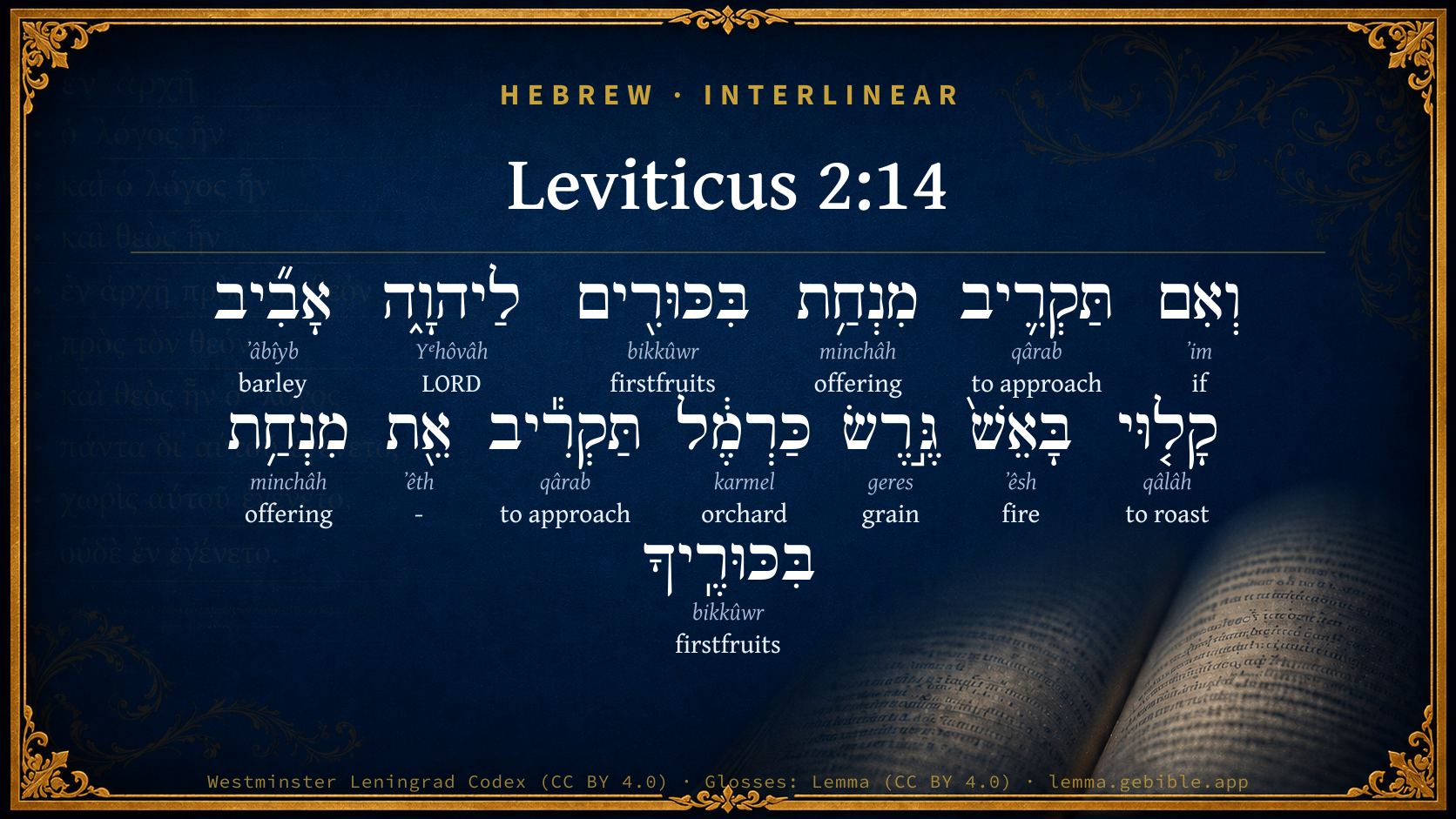
Hebrew (Westminster Leningrad Codex) Leviticus 2:14 appears in the Hebrew Old Testament. The text above is from the Westminster Leningrad Codex. Each word links to its Strong’s number, a concise gloss, and parsing drawn from the Open Scriptures Hebrew Bible morphology. Click any word for its full Brown-Driver-Briggs (BDB) entry.
Download image
Cite this verse

Leviticus 2:14 (World English Bible). Public Domain. Lemma interlinear Bible study tool, https://lemma.gebible.app/v/leviticus/2/14.

Show BibTeX & RIS
BibTeX
RIS
English Translation
"'If you offer a meal offering of first fruits to Yahweh, you shall offer for the meal offering of your first fruits grain in the ear parched with fire, bruised grain of the fresh ear.
World English Bible · Public Domain
Highlights
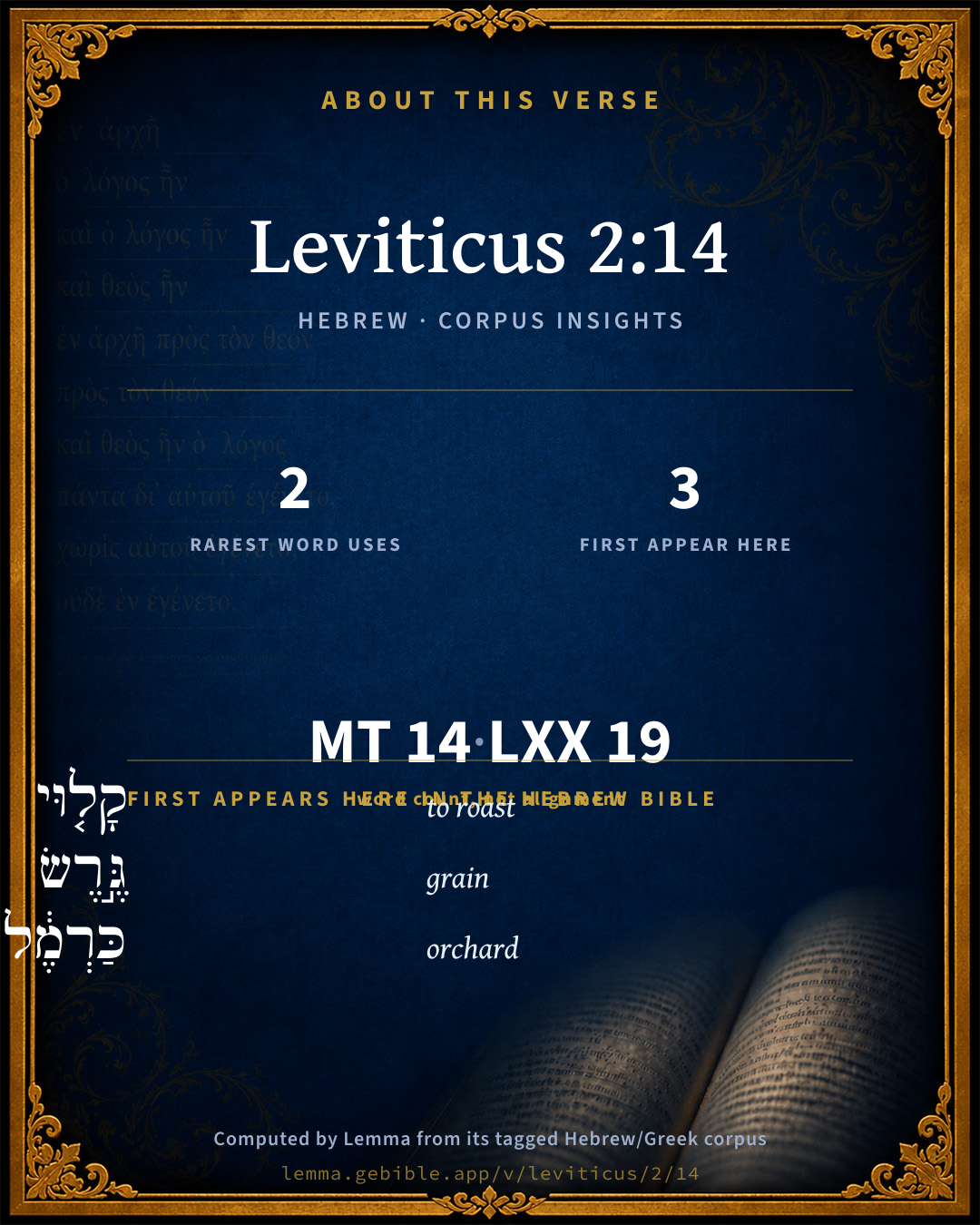
  • 3 first appearances in the Hebrew Bible
Full analysis ↓
Download a study sheet

One document with this verse’s original text, its word-by-word gloss line, the meaning frame, cross-references with their text, attributed commentary, and full source and license credits — printable, and it pastes into notes with its structure intact.

This verse Autodidact and up

Study sheet (.html) Plain text (.txt)

A passage Seminary Student

Up to 50 verses in one chapter. A passage sheet keeps up to 6 commentary sources and 12 cross-references per verse, in the order this page ranks them, and says so on the sheet whenever that leaves anything out. Ask for a single verse and you get the Autodidact verse sheet above.

Everything on this page stays free to read, with no account — the sheet is a download of what is already on screen, not access to it.

Want to remove ads? Support Godless Engineer
Compare translations 3

The same verse in 3 English versions, stacked beneath the original-language interlinear above. Click any original word for its lexicon entry.

Each is an independent rendering of the whole verse — the interlinear is not word-aligned to these translations.

Highlighted words mark where these versions differ — a whole-verse word diff, not a word-by-word alignment.

  • World English Bible Public Domain
    "'If you offer a meal offering of first fruits to Yahweh, you shall offer for the meal offering of your first fruits grain in the ear parched with fire, bruised grain of the fresh ear.
  • King James Version Public Domain
    And if thou offer a meat offering of thy firstfruits unto the LORD, thou shalt offer for the meat offering of thy firstfruits green ears of corn dried by the fire, even corn beaten out of full ears.
  • unfoldingWord Literal Text CC BY-SA 4.0
    And if you present a grain offering of first ripe grains to Yahweh, a tender ear roasted with fire, crushed grain of a ripe ear, you shall present a grain offering of your first ripe grains.

unfoldingWord Literal Text — © unfoldingWord, licensed CC BY-SA 4.0. Word-aligned USFM3 via Door43 (git.door43.org/unfoldingWord/en_ult).

Versions to compare (up to 4)

3 of 4 selected

Show all 18 translations

Every available English version of this verse, each an independent rendering of the whole verse.

  • World English Bible Public Domain
    "'If you offer a meal offering of first fruits to Yahweh, you shall offer for the meal offering of your first fruits grain in the ear parched with fire, bruised grain of the fresh ear.
  • Berean Standard Bible Public Domain
    If you bring a grain offering of firstfruits to the LORD, you shall offer crushed heads of new grain roasted on the fire.
  • Majority Standard Bible Public Domain
    If you bring a grain offering of firstfruits to the LORD, you shall offer crushed heads of new grain roasted on the fire.
  • King James Version Public Domain
    And if thou offer a meat offering of thy firstfruits unto the LORD, thou shalt offer for the meat offering of thy firstfruits green ears of corn dried by the fire, even corn beaten out of full ears.
  • American Standard Version (1901) Public Domain
    And if thou offer a meal-offering of first-fruits unto Jehovah, thou shalt offer for the meal-offering of thy first-fruits grain in the ear parched with fire, bruised grain of the fresh ear.
  • Revised Version (1885) Public Domain
    And if thou offer a meal offering of firstfruits unto the LORD, thou shalt offer for the meal offering of thy firstfruits corn in the ear parched with fire, bruised corn of the fresh ear.
  • Geneva Bible (1599) Public Domain
    If then thou offer a meate offring of thy first fruites vnto the Lord, thou shalt offer for thy meate offering of thy first fruites eares of corne dryed by the fire, and wheate beaten out of the greene eares.
  • Douay-Rheims (1899) Public Domain
    But if thou offer a gift of the firstfruits of thy corn to the Lord, of the ears yet green, thou shalt dry it at the fire, and break it small like meal, and so shalt thou offer thy firstfruits to the Lord,
  • Young's Literal Translation Public Domain
    `And if thou bring near a present of first-ripe `fruits' to Jehovah, -- of green ears, roasted with fire, beaten out `corn' of a fruitful field thou dost bring near the present of thy first-ripe `fruits',
  • Literal Standard Version CC BY-SA 4.0
    And if you bring a present of first-fruits near to YHWH, you bring the present of your first-fruits near of green ears, roasted with fire, beaten out [grain] of a fruitful field,
  • Unlocked Literal Bible CC BY-SA 4.0
    If you offer a grain offering of firstfruits to Yahweh, offer fresh grain that is roasted with fire and then crushed into meal.
  • unfoldingWord Literal Text CC BY-SA 4.0
    And if you present a grain offering of first ripe grains to Yahweh, a tender ear roasted with fire, crushed grain of a ripe ear, you shall present a grain offering of your first ripe grains.
  • Darby Bible Public Domain
    And if thou present an oblation of thy first-fruits to Jehovah, thou shalt present as the oblation of thy first-fruits green ears of corn roasted in fire, corn beaten out of full ears.
  • World Messianic Bible Public Domain
    “‘If you offer a meal offering of first fruits to the LORD, you shall offer for the meal offering of your first fruits fresh heads of grain parched with fire and crushed.
  • Webster's Bible Public Domain
    And if thou shalt offer a meat-offering of thy first-fruits to the LORD, thou shalt offer for the meat-offering of thy first-fruits, green ears of corn dried by the fire, even corn beaten out of full ears.
  • Free Bible Version CC BY-SA 4.0
    When you bring a grain offering of firstfruits to the Lord, offer crushed heads of new grain roasted on the fire.
  • Bible in Basic English Public Domain
    And if you give a meal offering of first-fruits to the Lord, give, as your offering of first-fruits, new grain, made dry with fire, crushed new grain.
  • JPS Tanakh (1917) Public Domain
    And if thou bring a meal-offering of first-fruits unto the LORD, thou shalt bring for the meal-offering of thy first-fruits corn in the ear parched with fire, even groats of the fresh ear.

Literal Standard Version (2020), Covenant Press — licensed CC BY-SA 4.0. Text via the HelloAO Bible API (eBible.org). Unlocked Literal Bible (unfoldingWord) — licensed CC BY-SA 4.0. Text via the HelloAO Bible API (eBible.org). unfoldingWord Literal Text — © unfoldingWord, licensed CC BY-SA 4.0. Word-aligned USFM3 via Door43 (git.door43.org/unfoldingWord/en_ult). Free Bible Version, Dr. Jonathan Gallagher — licensed CC BY-SA 4.0. Text via the HelloAO Bible API (eBible.org).

Word by word

More ways to search: Search by grammar → Find every occurrence → Compare this word →

Practice this passage: Drill this verse → Learn its vocabulary →

גֶּ֣רֶשׂ
geres
H1643
“grain of”
Noun, Common, Masculine, Singular, Construct
Part of Speech
Noun
Type
Common
Gender
Masculine
Number
Singular
State
Construct
Full BDB Definition

Origin: from an unused root meaning to husk

TWOT: 387a

a crushing (that which is crushed), grain, grits, groats
  1. וְאִם ʼim H518 “and · if” Conjunction + Conjunction
  2. תַּקְרִ֛יב qârab H7126 “to approach” Verb, Hiphil, Imperfect, 2nd Person, Masculine, Singular
  3. מִנְחַ֥ת minchâh H4503 “offering of” Noun, Common, Feminine, Singular, Construct
  4. בִּכּוּרִ֖ים bikkûwr H1061 “firstfruits” Noun, Common, Both, Plural, Absolute
  5. לַיהוָ֑ה Yᵉhôvâh H3068 “to/for · LORD” Preposition + Noun, Proper
  6. אָבִ֞יב ʼâbîyb H24 “barley” Noun, Common, Masculine, Singular, Absolute
  7. קָל֤וּי qâlâh H7033 “roasted” Verb, Qal, Participle Passive, Masculine, Singular, Absolute
  8. בָּאֵשׁ֙ ʼêsh H784 “in/at the · fire” Preposition, Determined + Noun, Common, Both, Singular, Absolute
  9. כַּרְמֶ֔ל karmel H3759 “orchard” Noun, Common, Masculine, Singular, Absolute
  10. תַּקְרִ֕יב qârab H7126 “to approach” Verb, Hiphil, Imperfect, 2nd Person, Masculine, Singular
  11. אֵ֖ת ʼêth H853 “-” Particle, Direct Object
  12. מִנְחַ֥ת minchâh H4503 “offering of” Noun, Common, Feminine, Singular, Construct
  13. בִּכּוּרֶֽיךָ bikkûwr H1061 “firstfruits · your” Noun, Common, Both, Plural, Construct + Suffix, Personal, 2nd Person, Masculine, Singular

About this verse

These counts appear in no published source. They are computed here, from the morphology-tagged text and Lemma’s own curated glosses. What Lemma adds →

14
words
11
distinct lemmas
Pentateuch
section

Notable vocabulary

The rarest word here is גֶּ֣רֶשׂ grain H1643 — appearing just 2 times in the whole Hebrew Bible.

First appearance in Scripture

These words make their first canonical appearance in the Hebrew Bible here:

  • קָל֤וּי to roast H7033
  • גֶּ֣רֶשׂ grain H1643
  • כַּרְמֶ֔ל orchard H3759

Shared distinctive vocabulary

גֶּ֣רֶשׂ grain H1643 occurs in 2 verses of the Hebrew Bible. Also found in:

Grammatical profile

  • 3 verbs
  • 9 nouns
  • 1 conjunction
  • 1 particle

Verb forms

  • תַּקְרִ֛יב Hiphil · Imperfect
  • קָל֤וּי Qal · Participle Passive
  • תַּקְרִ֕יב Hiphil · Imperfect

Repetition

Words recur within this verse — often emphatic in Hebrew:

  • תַּקְרִ֛יב to approach H7126 ×2
  • מִנְחַ֥ת offering H4503 ×2
  • בִּכּוּרִ֖ים firstfruits H1061 ×2

Hebrew & Septuagint length

In English translation the verse runs 35 words from the Hebrew and 34 from the Septuagint (LXX English) — closely comparable.

A rough comparison of the two English renderings, which tokenize alike — not a word-level alignment.

Word counts can differ between the Hebrew and the Greek without any difference in meaning — e.g. the Hebrew direct-object marker אֵת has no separate Greek word, and Greek often adds the article ὁ.

In the original languages it is 14 Hebrew tokens and 19 Greek tokens — but the two are counted differently (Hebrew bundles its prefixes and suffixes into one token; the Greek is in lemma form), so that isn’t a like-for-like length.

Cross-references

13

Topical passages linked to Leviticus 2:14 in the Treasury of Scripture Knowledge — connected by theme and wording, ordered by reader-vote popularity; previews shown in the World English Bible.

  • Leviticus 23:10 "Speak to the children of Israel, and tell them, 'When you have come into the land which I give to you, and shall reap its the harvest, then you shall bring the sheaf of the first fruits of your harvest to the priest:
  • Numbers 28:2 Command the children of Israel, and tell them, My offering, my food for my offerings made by fire, of a sweet savor to me, shall you observe to offer to me in their due season.
  • Proverbs 3:9–10 Honor Yahweh with your substance, With the first fruits of all your increase:
  • Isaiah 53:2–10 For he grew up before him as a tender plant, and as a root out of a dry ground: he has no form nor comeliness; and when we see him, there is no beauty that we should desire him.
  • Malachi 1:11 For from the rising of the sun even to the going down of the same, my name is great among the nations, and in every place incense will be offered to my name, and a pure offering: for my name is great among the nations," says Yahweh of Hosts.
  • 1 Corinthians 15:20 But now Christ has been raised from the dead. He became the first fruits of those who are asleep.
  • Revelation 14:4 These are those who were not defiled with women, for they are virgins. These are those who follow the Lamb wherever he goes. These were redeemed by Jesus from among men, the first fruits to God and to the Lamb.
  • Genesis 4:3 As time passed, it happened that Cain brought an offering to Yahweh from the fruit of the ground.
  • Leviticus 22:29 "When you sacrifice a sacrifice of thanksgiving to Yahweh, you shall sacrifice it so that you may be accepted.
  • Leviticus 23:14–17 You shall eat neither bread, nor roasted grain, nor fresh grain, until this same day, until you have brought the offering of your God. This is a statute forever throughout your generations in all your dwellings.
  • Leviticus 23:20 The priest shall wave them with the bread of the first fruits for a wave offering before Yahweh, with the two lambs. They shall be holy to Yahweh for the priest.
  • Deuteronomy 26:2 that you shall take of the first of all the fruit of the ground, which you shall bring in from your land that Yahweh your God gives you; and you shall put it in a basket, and shall go to the place which Yahweh your God shall choose, to cause his name to dwell there.
  • 2 Kings 4:42 There came a man from Baal Shalishah, and brought the man of God bread of the first fruits, twenty loaves of barley, and fresh ears of grain in his sack. He said, Give to the people, that they may eat.

Cross-references courtesy of OpenBible.info (CC BY 4.0).

Hebrew and Greek witnesses Masoretic Hebrew ↔ Greek Septuagint

The same verse in the two great witnesses to the Old Testament, shown verse-for-verse.

These are two independent witnesses, not word-aligned to each other, and the Septuagint is shown in lemma (dictionary) form.

Hebrew Leviticus 2:14 Masoretic · Westminster Leningrad Codex

וְאִם תַּקְרִ֛יב מִנְחַ֥ת בִּכּוּרִ֖ים לַיהוָ֑ה אָבִ֞יב קָל֤וּי בָּאֵשׁ֙ גֶּ֣רֶשׂ כַּרְמֶ֔ל תַּקְרִ֕יב אֵ֖ת מִנְחַ֥ת בִּכּוּרֶֽיךָ

"'If you offer a meal offering of first fruits to Yahweh, you shall offer for the meal offering of your first fruits grain in the ear parched with fire, bruised grain of the fresh ear.

World English Bible · Public Domain

Greek LXX Leviticus 2:14 Septuagint · lemma form

ἐάν δέ προςφέρω θυσία πρωτογένημα ὁ κύριος νέος φρύγω χίδρον ἐρεικτός ὁ κύριος καί προςφέρω ὁ θυσία ὁ πρωτογένημα

And if you would offer a sacrifice of first fruits to the Lord, it shall be new grains ground and roasted for the Lord; so shall you bring the sacrifice of the first fruits.

LXX2012 (modern English Septuagint) · Public Domain

Hebrew: Westminster Leningrad Codex (CC BY 4.0). Greek: Septuagint (public domain); English from LXX2012 (modern English Septuagint) (Public Domain). How the Septuagint differs from the Hebrew →

Targum (Aramaic paraphrase)

2

The Targum is the ancient Jewish Aramaic paraphrase of the Hebrew Scriptures — an interpretive translation, not the Hebrew text itself. Onkelos (literal) and Pseudo-Jonathan (expansive) render the Torah, and Jonathan the Prophets. Coverage is partial: where no permissively-licensed English translation exists for a verse, only the Aramaic is shown. This is verse-level text, not a word-by-word alignment to the Hebrew. Some Onkelos verses here show an unreviewed machine translation (clearly flagged), not a published edition.

  1. Targum Onkelos Torah (Genesis–Deuteronomy)
    וְאִם תְּקָרֵב מִנְחַת בִּכּוּרִין קֳדָם יְיָ אָבִיב קְלֵי בְנוּר פֵּירוּכִין רַכִּיכָן תְּקָרֵיב יַת מִנְחַת בִּכּוּרָךְ

    Unreviewed machine translation (Claude Sonnet 5) — not public domain confidence: high

    And if you bring near a meal-offering of first-fruits before the Lord, ripe grain roasted with fire, soft crushed groats, you shall bring near as the meal-offering of your first-fruits.

    Generated by an AI translate-then-audit pipeline and checked against an independent public-domain English translation of the underlying Hebrew for drift only. Not a published edition; pending human review.

    Aramaic base: public-domain Targum Onkelos (via Sefaria). The English above is the unreviewed machine translation, not public domain.

  2. Targum Pseudo-Jonathan Torah (Genesis–Deuteronomy)
    וְאִין תְּקָרֵב מִנְחַת בִּכּוּרִין קֳדָם יְיָ מְהַבְהַב קָלִי בְּנוּרָא קֶמַח קָלִי וּפֵירוּכִין תִּקְרַב יַת מִנְחַת בִּיכּוּרַיִךְ

    And if thou wilt present a mincha of first fruits before the Lord, (ears of wheat) roasted by fire, roasted flour and meal of barley shalt thou offer as a mincha of thy first fruits.

    Targum Pseudo-Jonathan — Aramaic: “Targum Jonathan on Genesis” (public domain); “Targum Jonathan on Exodus” (public domain); “Targum Jonathan on Leviticus” (public domain); “Targum Jonathan on Numbers” (public domain); “Targum Jonathan on Deuteronomy” (public domain). English: “The Targum of Jonathan ben Uzziel, trans. J. W. Etheridge, London, 1862” (public domain). Text via Sefaria.

Commentary

Notes on Leviticus 2:14 from classic Christian and Jewish commentators (each source and its license shown beneath its notes). The classic Christian expositions comment on the surrounding passage and are grouped to its opening verse, so a note may address several verses; the Jewish commentaries on the Tanakh (Rashi and others) are per-verse, so they appear only where the commentator wrote on this verse.

Lemma curates 59 commentaries, every one of them public domain or Creative Commons licensed, each selected and text-cleaned for this edition rather than reprinted as found. About our sources →

Ellicott's Commentary for English Readers

(14) And if thou offer.—The third kind of meat offering (Lev_2:14-16) is of the firstfruits. These verses should properly come immediately after Lev_2:12, since Lev_2:13 concludes the directions about the different kinds of minchas or bloodless offerings, with general remarks applying to all animal sacrifices. Such transpositions are not uncommon in the Hebrew Scriptures. Parched or roasted corn, as here described, was, and still is, a favourite article of food in the East (Lev_23:14; Jos_5:11; 1Sa_17:17; 1Sa_25:18; 2Sa_17:28; Rth_2:14). It was, therefore, an appropriate meat offering. Hence the regulations about it, Lev_2:14-16, are the same as those given with regard to the other two kinds of bloodless offerings.

A Bible Commentary for English Readers, edited by Charles John Ellicott (1878–1897) — public domain. Text from a community e-Sword module.

The Cambridge Bible for Schools and Colleges

gen. ed. J. J. S. Perowne

14. corn in the ear] Heb. Abîb, from which the Passover month is named.

parched with fire] Cp. Rth_2:14.

bruised corn of the fresh ear] Heb. géres karmel. The first word occurs only here and in Lev_2:16; karmel is found Lev_23:14 and 2Ki_4:42. The bruised corn is treated as the fine flour of Lev_2:1; a memorial of it is burnt, and the remainder would be for the priests. Cp. Lev_2:1-3 and Lev_2:10.

14–16. Meal-Offering of firstfruits (Heb. bikkûrîm). The rçshîth of Lev_2:12 is not to be offered on the altar, while the ‘memorial’ of the bikkûrîm is offered (Lev_2:16) as ‘an offering made by fire unto the Lord.’

The Cambridge Bible for Schools and Colleges (gen. ed. J. J. S. Perowne; Cambridge University Press, 1878–1918) — public domain. Text from a community e-Sword module.

Trapp's Complete Commentary

John Trapp

Lev 2:14 And if thou offer a meat offering of thy firstfruits unto the LORD, thou shalt offer for the meat offering of thy firstfruits green ears of corn dried by the fire, [even] corn beaten out of full ears.

Ver. 14. Green ears of corn.] To signify that God should be served with the firstfruits of our age, the primrose of our childhood.

John Trapp, A Commentary or Exposition upon All the Books of the Old and New Testament (1647–1656) — public domain. Text from a community e-Sword module.

Joseph Benson's Commentary

Lev 2:14. First-fruits — Of thine own free-will; for there were other first- fruits, and that of several sorts, which were prescribed, and the time, quality, and proportion of them appointed by God.

Joseph Benson's Commentary on the Old and New Testaments (1811–1818) — public domain. Text from a community e-Sword module.

Keil & Delitzsch

C. F. Keil & F. Delitzsch

The third kind was the meat-offering of first-fruits, i.e., of the first ripening corn. This was to be offered in the form of "ears parched or roasted by the fire; in other words, to be made from ears which had been roasted at the fire. To this is added the further definition כּרמל גּרשׂ "rubbed out of field-fruit." גּרשׂ, from גּרשׂ = גּרס, to rub to pieces, that which is rubbed to pieces; it only occurs here and in Lev 2:14 and Lev 2:16. כּרמל is applied generally to a corn-field, in Isa 29:17 and Isa 32:16 to cultivated ground, as distinguished from desert; here, and in Lev 23:14 and Kg2 4:42, it is used metonymically for field-fruit, and denotes early or the first-ripe corn. Corn roasted by the fire, particularly grains of wheat, is still a very favourite food in Palestine, Syria, and Egypt. The ears are either burnt along with the stalks before they are quite ripe, and then rubbed out in a sieve; or stalks of wheat are bound up in small bundles and roasted at a bright fire, and then the grains are eaten (Seetzen, i. p. 94, iii. p. 221; Robinson, Biblical Researches, p. 393). Corn roasted in this manner is not so agreeable as when (as is frequently the case in harvest, Rut 2:14) the grains of wheat are taken before they are quite dry and hard, and parched in a pan or upon an iron plate, and then eaten either along with or in the place of bread (Robinson, Pal. ii. 394). The minchah mentioned here was prepared in the first way, viz., of roasted ears of corn, which were afterwards rubbed to obtain the grains: it consisted, therefore, not of crushed corn or groats, but only of toasted grains. In the place of קלוּי אביב we find קלי (Lev 23:14), or קלוּי (Jos 5:11), afterwards employed. Oil and incense were to be added, and the same course adopted with the offering as in the case of the offering of flour (Lev 2:2, Lev 2:3).

If therefore, all the meat-offerings consisted either of flour and oil-the most important ingredients in the vegetable food of the Israelites, - or of food already prepared for eating, there can be no doubt that in them the Israelite offered his daily bread to the Lord, though in a manner which made an essential difference between them and the merely dedicatory offerings of the first-fruits of corn and bread. For whilst the loaves of first-fruits were leavened, and, as in the case of the sheaf of first-fruits, no part of them was burnt upon the altar (Lev 23:10-11; 17, 20), every independent meat-offering was to be prepared without leaven, and a portion given to the Lord as fire-food, for a savour of satisfaction upon the altar; and the rest was to be scrupulously kept from being used by the offerer, as a most holy thing, and to be eaten at the holy place by the sanctified priests alone, as the servants of Jehovah, and the mediators between Him and the nation. On account of this peculiarity, the meat-offerings cannot have denoted merely the sanctification of earthly food, but were symbols of the spiritual food prepared and enjoyed by the congregation of the Lord. If even the earthly life is not sustained and nourished merely by the daily bread which a man procures and enjoys, but by the power of divine grace, which strengthens and blesses the food as means of preserving life; much less can the spiritual life be nourished by earthly food, but only by the spiritual food which a man prepares and partakes of, by the power of the Spirit of God, from the true bread of life, or the word of God. Now, as oil in the Scriptures is invariably a symbol of the Spirit of God as the principle of all spiritual vis vitae, so bread-flour and bread, procured from the seed of the field, are symbols of the word of God (Deu 8:3; Luk 8:11). As God gives man corn and oil to feed and nourish his bodily life, so He gives His people His word and Spirit, that they may draw food from these for the spiritual life of the inner man. The work of sanctification consists in the operation of this spiritual food, through the right use of the means of grace for growth in pious conversation and good works (Mat 5:16; Pe1 2:12). The enjoyment of this food fills the inner man with peace, joy, and blessedness in God. This fruit of the spiritual life is shadowed forth in the meat-offerings. They were to be kept free, therefore, both from the leaven of hypocrisy (Luk 12:1) and of malice and wickedness (Co1 5:8), and also from the honey of the deliciae carnis, because both are destructive of spiritual life; whilst, on the other hand, the salt of the covenant of God (i.e., the purifying, strengthening, and quickening power of the covenant, by which moral corruption was averted) and the incense of prayer were both to be added, in order that the fruits of the spiritual life might become well-pleasing to the Lord. It was upon this signification that the most holy character of the meat-offerings was founded.

Keil & Delitzsch — Biblical Commentary on the Old Testament (1861–1891) — public domain (CC PDM 1.0). Text via the HelloAO Bible API. (Old Testament only.)

Geneva Bible (1599)

Geneva Bible translators

Or, full ears: for the word signifieth a fruitful field. Read 2 Chron. 26:10 in the note 2.

Geneva Bible (1599) marginal notes — public domain. Text via Bolls.life.

Jamieson, Fausset & Brown

Robert Jamieson, A. R. Fausset & David Brown

a meat offering of thy first-fruits--From the mention of "green ears," this seems to have been a voluntary offering before the harvest--the ears being prepared in the favorite way of Eastern people, by parching them at the fire, and then beating them out for use. It was designed to be an early tribute of pious thankfulness for the earth's increase, and it was offered according to the usual directions.

Next: Leviticus Chapter 3

Jamieson, Fausset & Brown — Commentary Critical and Explanatory on the Whole Bible (1871) — public domain (CC PDM 1.0). Text via the HelloAO Bible API.

Adam Clarke's Commentary

Verse 14. Green ears of corn dried by the fire] Green or half-ripe ears of wheat parched with fire is a species of food in use among the poor people of Palestine and Egypt to the present day. As God is represented as keeping a table among his people, (for the tabernacle was his house, where he had the golden table, shewbread, c.,) so he represents himself as partaking with them of all the aliments that were in use, and even sitting down with the poor to a repast on parched corn! We have already seen that these green ears were presented as a sort of eucharistical offering for the blessings of seed time, and the prospect of a plentiful harvest.

See Clarke on Le 2:1 several other examples might be added here, but they are not necessary.

The command to offer salt with every oblation, and which was punctually observed by the Jews, will afford the pious reader some profitable reflections. It is well known that salt has two grand properties.

1. It seasons and renders palatable the principal ailments used for the support of life.

2. It prevents putrefaction and decay.

The covenant of God, that is, his agreement with his people, is called a covenant of salt, to denote as we have seen above, its stable undecaying nature, as well as to point out its importance and utility in the preservation of the life of the soul. The grace of God by Christ Jesus is represented under the emblem of salt, (see Mr 9:49; Eph 4:29; Col 4:6), because of its relishing, nourishing, and preserving quality. Without it no offering, no sacrifice, no religious service, no work even of charity and mercy, can be acceptable in the sight of God. In all things we must come unto the Father THROUGH HIM. And from none of our sacrifices or services must this salt of the covenant of our God be lacking.

Adam Clarke's Commentary on the Bible (1810–1826) — public domain. Text from a community e-Sword/MySword module.

John Gill's Exposition

And if thou offer a meat offering of thy firstfruits unto the Lord,.... This, according to Aben Ezra, was not any of the offerings of the firstfruits, which they were obliged to, as at the passover or pentecost, or feast of tabernacles, but a free will offering; but Jarchi thinks it is to be understood of the meat offering of the Omer, Lev 23:13 and so Gersom, which was offered up on the sixteenth of Nisan; and this is the general sense of the Jewish writers (b):

thou shalt bring for the meat offering of thy firstfruits green ears of corn dried by the fire; these were ears of barley, which began to be ripe in the month Abib, which month had its name from hence, and is the word here used; these were dried by the fire, being green and moist, or otherwise they could not have been ground; for, according to Gersom, these were afterwards ground into fine flour:

even corn beaten out of full ears; and so made the finest flour: the firstfruits were a type of Christ, who is so called, Co1 15:23 the beating of the ears of corn, and drying of them by the fire, and the grinding of them, denoted the sufferings of Christ.

(b) Maimon. & Bartenora in Misn. Menachot, c. 10. sect. 4.

John Gill's Exposition of the Whole Bible (1746–1763) — public domain (CC PDM 1.0). Text via the HelloAO Bible API.

Albert Barnes' Notes on the Bible

Green ears of corn - Rather, “fresh ears of corn;” that is, just-ripe grain, freshly gathered. Parched grain, such as is here spoken of, is a common article of food in Syria and Egypt, and was very generally eaten in ancient times.

Beaten out - Not rubbed out by the hands, as described in Luk 6:1, but bruised or crushed so as to form groats.

Albert Barnes' Notes on the Bible (1834–1885) — public domain. Text from a community e-Sword/MySword module.

Haydock's Catholic Bible Commentary

And break, &c. Hebrew has simply, "corn beaten out (or ready to be beaten out) of full ears." (Haydock) --- These were to be offered at the Passover. (Du Hamel)

George Leo Haydock (1774–1849), Haydock's Catholic Family Bible and Commentary, 1859 edition — public domain. Excludes Psalms (Douay-Rheims chapter numbering differs from Protestant) and Deuterocanonical books (Catholic canon only).

Matthew Poole's English Annotations

If thou offer a meat-offering of thy first-fruits, to wit, of thine own free will; for there were other first-fruits, and that of several sorts, which were prescribed, and the time, quality, and proportion of them appointed by God. See Lev 23:10.

Matthew Poole's English Annotations on the Holy Bible (1683–1685) — public domain. Text from a community e-Sword/MySword module.

Whedon's Commentary on the Bible

Daniel D. Whedon

14. Green ears of corn — This refers chiefly to wheat and barley, the heads of which are called ears. Indian corn was unknown.

Dried by the fire — In order to be broken into groats by grinding, as the Seventy have rendered it, the green grain first harvested for the oblation must be dried. Says Adam Clarke: “As God is represented as keeping a table among his people, so he represents himself as partaking with them of all the ailments that were in use, even sitting down with the poor to a repast on parched corn!”

Corn beaten out — The scorched grains or grits were to be separated from the straw. The bread offering, as a whole, is a type of the Son of God, who is the bread of life, to be appropriated by all who have first been cleansed from the guilt of sin by the blood of sprinkling shed by our great Sin Offering. The risen Jesus is our Bread of Life. Because he lives and sends up the incense of his prayers, and sends down the oil of gladness, the Anointing Spirit, we live also.

Daniel D. Whedon (gen. ed.), Commentary on the Old and New Testaments (1874–1909) — public domain. Text from a community e-Sword module.

The Pulpit Commentary

Vers. 14-16. The third form of meat offering, parched grains of corn, with oil, salt, and frankincense. The mark of a new paragraph should be transferred from verse 12 to the beginning of verse 14.

Vers. 14-16. The minchah of the firstfruits.

Having viewed the minchah as a type of Christ, and having considered the feast upon it as expressing fellowship with God in him, we proceed to consider the offering of the firstfruits, which is still the minchah under yet another form. The text brings before us

I THINGS PECULIAR TO THE OFFERING OF THE FIRSTFRUITS. These are:

1. The matter of the offering.

(1) It is specified as "green ears of corn." Still, observe, it is of the nature of bread, and so still typifies Christ, the Bread of Life.

(2) But in this case the life is in the grain. In this view Christ compares himself to a corn of wheat. (Joh_12:24) In this passage there is also a reference to Psa_72:16, which is construed by learned Jews thus: "He shall be a corn of wheat in the earth on the top of the mountains.

(3) It is specified as "firstfruits." As the firstborn of every animal was the Lord"s, (Exo_12:29 Exo_13:12, 13 Num_18:16) so did he claim the vegetable firstfruits. And as Christ is "the Firstborn of every creature", (Col_1:15) the Anti-type of every firstborn, so is he the Firstfruits of everything in the creation. Through him all things are blessed to our use and benefit.

(4) In this character Jesus will come out in full form in the resurrection. He is the "First-begotten from the dead". (Rev_1:5) The "Firstfruits of them that slept;" and still sleep. (1Co_15:20, 23 1Th_4:14) Thus is he "the Beginning or Chief of the new creation of God ". (Rev_3:14)

2. The treatment it received.

(1) The corn was dried by the fire. It was not allowed to dry gradually and gently in the air, but was violently scorched. Here was set forth expressively that fire of grief and sorrow which parched the soul of Jesus. The fires of his zeal for the glory of God, which was outraged by the sinfulness of men, entered into his very soul. (Psa_119:139) So did the corresponding flames of sympathy for that humanity which he had so wondrously assumed; consuming, because of its sinfulness, under the fires of God"s anger.

(2) It was beaten. This threshing of the wheat represented the severity with which Jesus was treated,

(a) in the court of Caiaphas;

(b) in the hall of Pilate;

(c) at the place called Calvary. (Isa_53:5, Isa_53:8)

II THINGS COMMON TO THE FIRSTFRUITS AND OTHER FORMS OF THE MINCHAH.

1. It was offered upon the altar of burnt offerings.

(1) Touching the altar, it became a sacrifice to God.

(2) Consumed in the fire, it was accepted by God.

2. It was offered with oil.

(1) The natural use of this was that the offering thereby became more readily consumed. The flame of oil is bright and fervent.

(2) This was a symbol of the Holy Spirit"s grace, which without measure rested upon Christ. (see Psa_69:9 Joh_2:17)

3. It was offered with frankincense.

(1) The physical use of this would be to take away from the tabernacle the smell of a slaughter-house, and to fill the courts with a grateful odour.

(2) The spiritual use was to prefigure the fragrance of the merits of Jesus,

(a) in his sacrifice; (Eph_5:2)

(b) in his intercession. (Rev_8:3, Rev_8:4)

Thus the offensiveness of the flesh in us is destroyed, and the living sacrifice becomes acceptable. J.A.M. (Rom_12:1)

The Pulpit Commentary (1880–1919), ed. H.D.M. Spence-Jones & Joseph S. Exell — public domain. Text from a community e-Sword module.

John Wesley's Explanatory Notes

First-fruits - Of thine own free-will; for there were other first-fruits, and that of several sorts, which were prescribed, and the time, quality, and proportion of them appointed by God.

John Wesley, Explanatory Notes Upon the Whole Bible (1754–1765) — public domain. Text via the GEBible commentary corpus.

unfoldingWord translationNotes

Door43 World Missions Community

General Information:

Yahweh continues telling Moses what the people must do so their offerings will be acceptable to him.

that is roasted with fire and then crushed

This can be stated in active form. AT: "that you have cooked over a fire and then crushed" (See: Active or Passive)

a representative offering

The handful of the grain offering represents the whole grain offering. This means the whole offering belongs to Yahweh. See how you translated this in Leviticus 2:2.

This is an offering made by fire to Yahweh

This can be stated in active form. AT: "This is a burnt offering to Yahweh" (See: Active or Passive)

translationWords

grain offering

firstfruits

Yahweh

oil

incense

priest

unfoldingWord translationNotes — © Distant Shores Media and the Door43 World Missions Community, licensed CC BY-SA 4.0. Source: git.door43.org/Door43/en_tn.

Rashi

Rabbi Shlomo Yitzchaki (Rashi)

ואם תקריב AND IF (according to Rashi, AND “WHEN”) THOU OFFER [A MEAL-OFFERING OF FIRST FRUITS] — אם here has the meaning of כי, “when”, for this (the offering of the מנחת בכורים) is not optional, since Scripture is speaking of the meal-offering of the “Omer” which is obligatory. Similar is אם in the phrase (Numbers 36:4) ואם יהיה היובל which means: “when the jubilee will be”, not: “if the jubilee will be”, since it is bound to come (cf. Sifra, Vayikra Dibbura d'Nedavah, Section 13 2; see also Rashi on Exodus 20:22).

מנחת בכורים THE MEAL-OFFERING OF FIRSTFRUITS — Scripture is speaking here of the meal-offering of the “Omer” (Leviticus 23:10) which is brought when the grain is in the green ears,(אביב), i.e.. at the time of the ripening of the grain, and which was brought of barley, for it states here “אביב”, and there, too, (Exodus 9:31) it slates “for the barley was in the ears (אביב)” (Sifra, Vayikra Dibbura d'Nedavah, Section 13 4; Menachot 68b).

קלוי באש PARCHED BY THE FIRE It is thus described because they roast it on the fire in the “tube of the grain-parchers (אביב של קלאים)”, for unless it was treated thus it could not be ground in the mill because it was fresh, as the term אביב green, fresh suggests (cf. Rashi on Exodus 9:31).

גרש כרמל means broken (גרוש) whilst it was yet fresh (כרמל).

גרש is an expression for breaking and grinding. — He ground it in a grit-mill. — גרש has the same meaning as the verb in (Lamentations 3:16) “and He hath broken (ויגרס) [my teeth] with gravel-stones”; and similarly (Psalms 119:20) “My soul is broken (גרסה).

כרמל — i. e., broken whilst the husk (כר) is yet full (מלא) (according to this כרמל is a word compounded of כר and מל) — when the crop is yet fresh and full in its stalks; for this reason the fresh ears are called כרמל. Similar is, (2 Kings 4:42) “and full ears of corn (כרמל) in the husk thereof”.

Rashi on the Tanakh — English translations: “The Judaica Press complete Tanach with Rashi, translated by A. J. Rosenberg” (CC BY 4.0); “Pentateuch with Rashi's commentary by M. Rosenbaum and A.M. Silbermann, 1929-1934” (public domain); “The Metsudah Tanach series, Lakewood, N.J” (CC BY 4.0); and “The Book of Joshua, Metsudah Publications, 1997” (CC BY 4.0). Text via Sefaria.

Ramban (Nachmanides)

Rabbi Moshe ben Nachman (Ramban / Nachmanides)

V’IM (AND IF) THOU BRING A MEAL-OFFERING OF FIRST-FRUITS. “The word im (if) here has the meaning of ki (when), for the bringing [of this meal-offering of the first-fruits] is not a voluntary matter, since Scripture speaks here of the meal-offering of the new barley, which is obligatory. Similarly, ‘V’im’ (and if) the Jubilee of the children of Israel shall be [means ‘when’ the Jubilee will be — for it is bound to come].” This is Rashi’s language.The correct interpretation is that He used the expression im (if) because He is not commanding the performance now of this precept [namely bringing the meal-offering of the new barley], and He is thus saying: “When you offer a meal-offering baked on the griddle you shall do it in such-and-such a way; and if you offer a meal-offering of the stewing-pan, you shall make it in another way; and if the meal-offering you will bring will be the one of first-fruits, you should do it in this manner.” Thus the word im is here to be understood in its literal sense [namely, “if”]. Then the meaning of the verse, ‘V’im’the Jubilee of the children of Israel shall be is as follows: [The heads of the fathers’ houses of the tribe of Manasseh] said to Moses: “Even ‘if’ the children of Israel will inherit the Land forever, and will be privileged to sanctify the year of the Jubilee, the inheritance [of Zelophchad] will not return to us” [because his daughters might marry men from other tribes, which would cause the land to be transferred to other tribes].It is also possible that He is stating: “And if you bring a meal-offering of the first-fruits, you shall do it in this prescribed way,” as if He were to say, “if the Eternal your G-d will bring you into the Land, and you will reap the harvest thereof and bring the meal-offering of the first-fruits, you shall do it in such-and-such a manner;” for G-d always mentions the inheritance of the Land to them conditionally, just as He said, For if ye shall diligently keep all this commandment … then will the Eternal drive out all these nations from before you, and so also in many places.

Ramban (Nachmanides) on the Tanakh — English translation: “Commentary on the Torah by Ramban (Nachmanides). Translated and annotated by Charles B. Chavel. New York, Shilo Pub. House, 1971-1976” (CC BY 4.0). Text via Sefaria.

Lesson kit

Teaching starters — assembled from the data on this page, not authored interpretation. Every prompt links to the verse data it draws on. Edit before teaching.

Leviticus, in the Pentateuch, opens this verse with 14 words (11 distinct Hebrew lemmas). Its most distinctive word is geres (“grain”). A historical commentator’s framing appears above. Read the whole chapter for the surrounding context.

Discussion questions

  1. How does “grain” (geres) shape what this verse is saying?
  2. 3 words make their first appearance in Scripture here. What does this debut establish?
  3. How does Leviticus 2:16, which shares the word «grain», read alongside this verse?
  4. What does the repetition of “to approach” (2× in this one verse) do in this verse?
  5. The translations on this page render this verse differently — a whole-verse word diff, not a word-by-word alignment. What might account for the different wordings?
  6. «תַּקְרִ֛יב» is a Hiphil Imperfect verb. How does that grammatical form shape the action described?
  7. Compare how Ellicott's Commentary for English Readers and The Cambridge Bible for Schools and Colleges read this verse. Where do they agree or differ?

Things to notice

Reading settings

Reading text

Shown beneath each verse's original-language words.

Old Testament
Old Testament edition

Read the OT as the Masoretic Hebrew (MT) or the Greek Septuagint (LXX).

English shown for the Greek Septuagint (in the Hebrew ↔ Greek comparison).

Comparing translations? Open the Compare panel on any verse page to stack up to four side by side.