Psalms 21:9

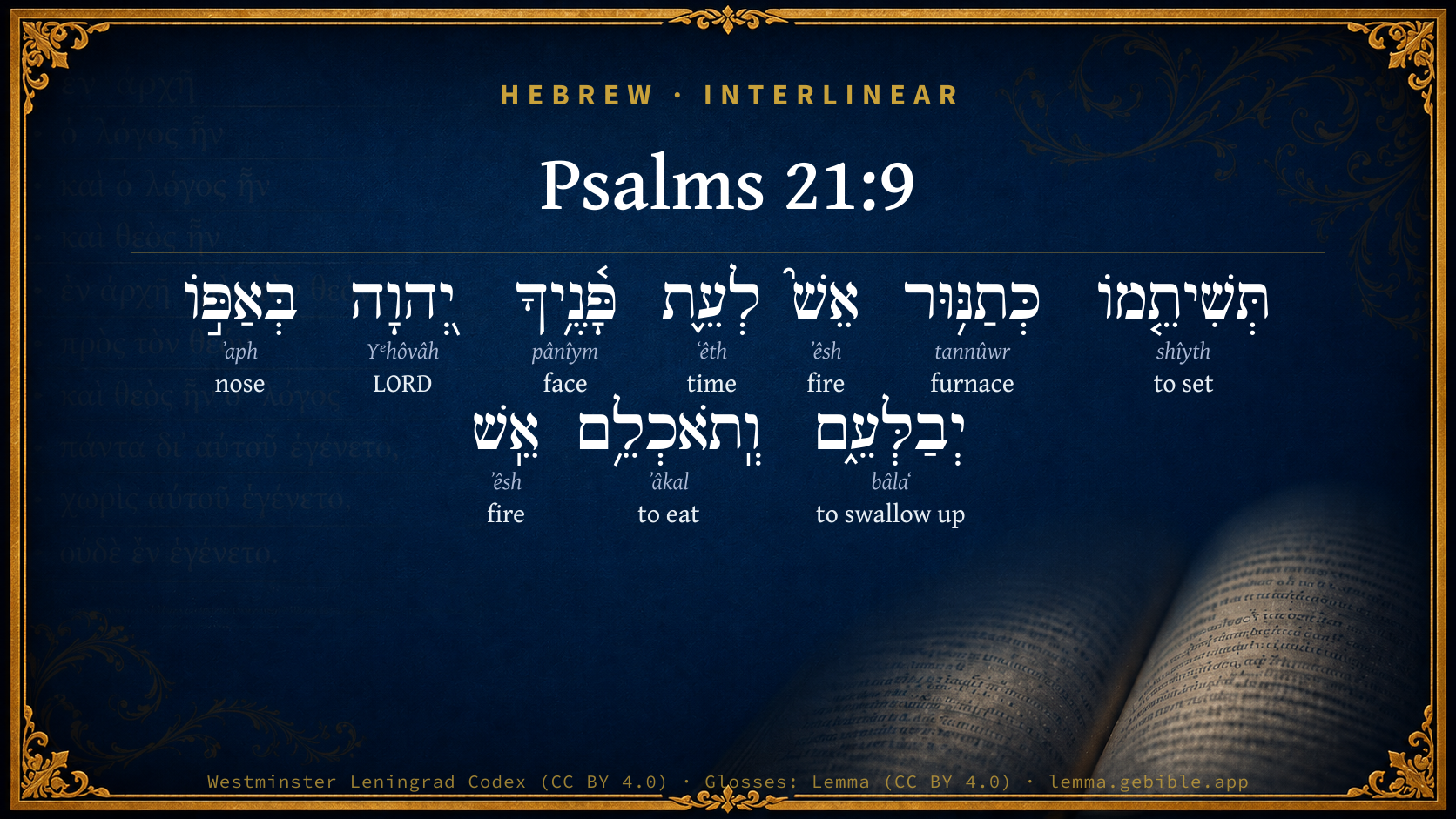
Hebrew (Westminster Leningrad Codex) Psalms 21:9 appears in the Hebrew Old Testament. The text above is from the Westminster Leningrad Codex. Each word links to its Strong’s number, a concise gloss, and parsing drawn from the Open Scriptures Hebrew Bible morphology. Click any word for its full Brown-Driver-Briggs (BDB) entry.
Download image
Cite this verse

Psalms 21:9 (World English Bible). Public Domain. Lemma interlinear Bible study tool, https://lemma.gebible.app/v/psalms/21/9.

Show BibTeX & RIS
BibTeX
RIS
English Translation
You will make them as a fiery furnace in the time of your anger. Yahweh will swallow them up in his wrath. The fire shall devour them.
World English Bible · Public Domain
Download a study sheet

One document with this verse’s original text, its word-by-word gloss line, the meaning frame, cross-references with their text, attributed commentary, and full source and license credits — printable, and it pastes into notes with its structure intact.

This verse Autodidact and up

Study sheet (.html) Plain text (.txt)

A passage Seminary Student

Up to 50 verses in one chapter. A passage sheet keeps up to 6 commentary sources and 12 cross-references per verse, in the order this page ranks them, and says so on the sheet whenever that leaves anything out. Ask for a single verse and you get the Autodidact verse sheet above.

Everything on this page stays free to read, with no account — the sheet is a download of what is already on screen, not access to it.

Want to remove ads? Support Godless Engineer
Compare translations 3

The same verse in 3 English versions, stacked beneath the original-language interlinear above. Click any original word for its lexicon entry.

Each is an independent rendering of the whole verse — the interlinear is not word-aligned to these translations.

Highlighted words mark where these versions differ — a whole-verse word diff, not a word-by-word alignment.

  • World English Bible Public Domain
    You will make them as a fiery furnace in the time of your anger. Yahweh will swallow them up in his wrath. The fire shall devour them.
  • King James Version Public Domain
    Thou shalt make them as a fiery oven in the time of thine anger: the LORD shall swallow them up in his wrath, and the fire shall devour them.
  • unfoldingWord Literal Text CC BY-SA 4.0
    You will make them as an oven of fire at the time of your face. In his nose Yahweh will swallow them and will consume them fire.

unfoldingWord Literal Text — © unfoldingWord, licensed CC BY-SA 4.0. Word-aligned USFM3 via Door43 (git.door43.org/unfoldingWord/en_ult).

Versions to compare (up to 4)

3 of 4 selected

Show all 18 translations

Every available English version of this verse, each an independent rendering of the whole verse.

  • World English Bible Public Domain
    You will make them as a fiery furnace in the time of your anger. Yahweh will swallow them up in his wrath. The fire shall devour them.
  • Berean Standard Bible Public Domain
    You will place them in a fiery furnace at the time of Your appearing. In His wrath the LORD will engulf them, and the fire will consume them.
  • Majority Standard Bible Public Domain
    You will place them in a fiery furnace at the time of Your appearing. In His wrath the LORD will engulf them, and the fire will consume them.
  • King James Version Public Domain
    Thou shalt make them as a fiery oven in the time of thine anger: the LORD shall swallow them up in his wrath, and the fire shall devour them.
  • American Standard Version (1901) Public Domain
    Thou wilt make them as a fiery furnace in the time of thine anger: Jehovah will swallow them up in his wrath, And the fire shall devour them.
  • Revised Version (1885) Public Domain
    Thou shalt make them as a fiery furnace in the time of thine anger. The LORD shall swallow them up in his wrath, and the fire shall devour them.
  • Geneva Bible (1599) Public Domain
    Thou shalt make them like a fierie ouen in time of thine anger: the Lord shall destroy them in his wrath, and the fire shall deuoure them.
  • Douay-Rheims (1899) Public Domain
    Let thy hand be found by all thy enemies: let thy right hand find out all them that hate thee.
  • Young's Literal Translation Public Domain
    Thou makest them as a furnace of fire, At the time of Thy presence. Jehovah in His anger doth swallow them, And fire doth devour them.
  • Literal Standard Version CC BY-SA 4.0
    You make them as a furnace of fire, || At the time of Your presence. YHWH swallows them in His anger, || And fire devours them.
  • Unlocked Literal Bible CC BY-SA 4.0
    At the time of your anger, you will burn them up as in a fiery furnace. Yahweh will consume them in his wrath, and the fire will devour them.
  • unfoldingWord Literal Text CC BY-SA 4.0
    You will make them as an oven of fire at the time of your face. In his nose Yahweh will swallow them and will consume them fire.
  • Darby Bible Public Domain
    Thou shalt make them as a fiery furnace in the time of thy presence; Jehovah shall swallow them up in his anger, and the fire shall devour them:
  • World Messianic Bible Public Domain
    You will make them as a fiery furnace in the time of your anger. The LORD will swallow them up in his wrath. The fire shall devour them.
  • Webster's Bible Public Domain
    \\21:8\\Thy hand shall find out all thy enemies: thy right hand shall find out those that hate thee.
  • Free Bible Version CC BY-SA 4.0
    When you appear on the scene you will burn them up like in a furnace; the Lord in his anger will destroy them, burning them up with fire.
  • Bible in Basic English Public Domain
    You will make them like a flaming oven before you; the Lord in his wrath will put an end to them, and they will be burned up in the fire.
  • JPS Tanakh (1917) Public Domain
    (21-10) Thou shalt make them as a fiery furnace in the time of thine anger; the LORD shall swallow them up in His wrath, and the fire shall devour them.

Literal Standard Version (2020), Covenant Press — licensed CC BY-SA 4.0. Text via the HelloAO Bible API (eBible.org). Unlocked Literal Bible (unfoldingWord) — licensed CC BY-SA 4.0. Text via the HelloAO Bible API (eBible.org). unfoldingWord Literal Text — © unfoldingWord, licensed CC BY-SA 4.0. Word-aligned USFM3 via Door43 (git.door43.org/unfoldingWord/en_ult). Free Bible Version, Dr. Jonathan Gallagher — licensed CC BY-SA 4.0. Text via the HelloAO Bible API (eBible.org).

Word by word

More ways to search: Search by grammar → Find every occurrence → Compare this word →

Practice this passage: Drill this verse → Learn its vocabulary →

כְּתַנּ֥וּר
tannûwr
H8574
“like/as · furnace of”
Preposition + Noun, Common, Masculine, Singular, Construct
Part of Speech
Preposition + Noun
Type
Common
Gender
Masculine
Number
Singular
State
Construct
Full BDB Definition

Origin: from H5216

TWOT: 2526

furnace, oven, fire-pot, (portable) stove - for cooking - of God's wrath, His furnace (figuratively) - of hunger, desire for evil - fire-pot
  1. תְּשִׁיתֵ֤מוֹ shîyth H7896 “to set · them” Verb, Qal, Imperfect, 2nd Person, Masculine, Singular + Suffix, Personal, 3rd Person, Masculine, Plural
  2. אֵשׁ֮ ʼêsh H784 “fire” Noun, Common, Both, Singular, Absolute
  3. לְעֵ֪ת ʻêth H6256 “to/for · time of” Preposition + Noun, Common, Both, Singular, Construct
  4. פָּ֫נֶ֥יךָ pânîym H6440 “face(s) · your” Noun, Common, Both, Plural, Construct + Suffix, Personal, 2nd Person, Masculine, Singular
  5. יְ֭הוָה Yᵉhôvâh H3068 “LORD” Noun, Proper
  6. בְּאַפּ֣וֹ ʼaph H639 “in/at · nose · his” Preposition + Noun, Common, Masculine, Singular, Construct + Suffix, Personal, 3rd Person, Masculine, Singular
  7. יְבַלְּעֵ֑ם bâlaʻ H1104 “to swallow up · them” Verb, Piel, Imperfect, 3rd Person, Masculine, Singular + Suffix, Personal, 3rd Person, Masculine, Plural
  8. וְֽתֹאכְלֵ֥ם ʼâkal H398 “and · to eat · them” Conjunction + Verb, Qal, Imperfect, 3rd Person, Feminine, Singular + Suffix, Personal, 3rd Person, Masculine, Plural
  9. אֵֽשׁ ʼêsh H784 “fire” Noun, Common, Both, Singular, Absolute

About this verse

These counts appear in no published source. They are computed here, from the morphology-tagged text and Lemma’s own curated glosses. What Lemma adds →

10
words
9
distinct lemmas
Wisdom
section

Notable vocabulary

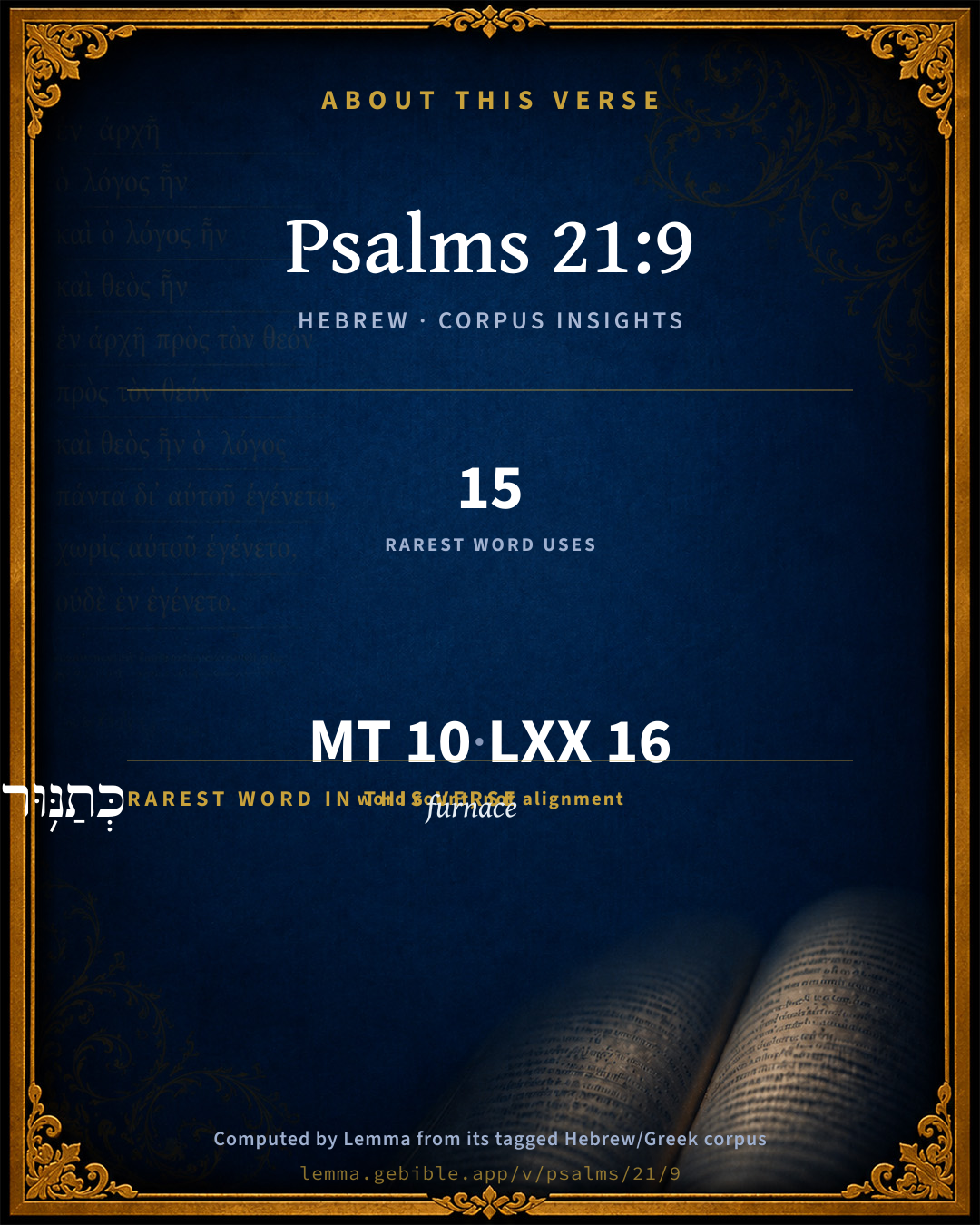
The rarest word here is כְּתַנּ֥וּר furnace H8574 — appearing just 15 times in the whole Hebrew Bible.

Shared distinctive vocabulary

כְּתַנּ֥וּר furnace H8574 occurs in 15 verses of the Hebrew Bible. Also found in:

Grammatical profile

  • 3 verbs
  • 7 nouns

Verb forms

  • תְּשִׁיתֵ֤מוֹ Qal · Imperfect
  • יְבַלְּעֵ֑ם Piel · Imperfect
  • וְֽתֹאכְלֵ֥ם Qal · Imperfect

Repetition

A word recurs within this verse — often emphatic in Hebrew:

  • אֵשׁ֮ fire H784 ×2

Hebrew & Septuagint length

In English translation the verse runs 27 words from the Hebrew and 27 from the Septuagint (LXX English) — the same length.

A rough comparison of the two English renderings, which tokenize alike — not a word-level alignment.

Word counts can differ between the Hebrew and the Greek without any difference in meaning — e.g. the Hebrew direct-object marker אֵת has no separate Greek word, and Greek often adds the article ὁ.

In the original languages it is 10 Hebrew tokens and 16 Greek tokens — but the two are counted differently (Hebrew bundles its prefixes and suffixes into one token; the Greek is in lemma form), so that isn’t a like-for-like length.

Cross-references

26

Topical passages linked to Psalms 21:9 in the Treasury of Scripture Knowledge — connected by theme and wording, ordered by reader-vote popularity; previews shown in the World English Bible.

  • Malachi 4:1 "For, behold, the day comes, it burns as a furnace; and all the proud, and all who work wickedness, will be stubble; and the day that comes will burn them up," says Yahweh of Hosts, "that it shall leave them neither root nor branch.
  • Psalms 18:8 Smoke went out of his nostrils. Consuming fire came out of his mouth. Coals were kindled by it.
  • Psalms 50:3 Our God comes, and does not keep silent. A fire devours before him. It is very tempestuous around him.
  • Lamentations 2:2 The Lord has swallowed up all the habitations of Jacob, and has not pitied: He has thrown down in his wrath the strongholds of the daughter of Judah; He has brought them down to the ground; he has profaned the kingdom and the princes of it.
  • Nahum 1:6 Who can stand before his indignation? Who can endure the fierceness of his anger? His wrath is poured out like fire, and the rocks are broken apart by him.
  • 2 Thessalonians 1:8 giving vengeance to those who don't know God, and to those who don't obey the Gospel of our Lord Jesus,
  • Deuteronomy 32:22 For a fire is kindled in my anger, Burns to the lowest Sheol, Devours the earth with its increase, Sets on fire the foundations of the mountains.
  • Isaiah 26:11 Yahweh, your hand is lifted up, yet they don't see: but they shall see [your] zeal for the people, and be disappointed; yes, fire shall devour your adversaries.
  • Genesis 19:28 He looked toward Sodom and Gomorrah, and toward all the land of the plain, and looked, and saw that the smoke of the land went up as the smoke of a furnace.
  • Daniel 3:20–22 He commanded certain mighty men who were in his army to bind Shadrach, Meshach, and Abednego, [and] to cast them into the burning fiery furnace.
  • Matthew 3:12 His winnowing fork is in his hand, and he will thoroughly cleanse his threshing floor. He will gather his wheat into the barn, but the chaff he will burn up with unquenchable fire."
  • Psalms 2:5 Then he will speak to them in his anger, And terrify them in his wrath:
  • Psalms 2:12 Kiss the son, lest he be angry, and you perish in the way, For his wrath will soon be kindled. Blessed are all those who take refuge in him.
  • Revelation 20:14 Death and Hades were thrown into the lake of fire. This is the second death, the lake of fire.
  • Psalms 106:17 The earth opened and swallowed up Dathan, And covered the company of Abiram.
  • Matthew 3:10 "Even now the axe lies at the root of the trees. Therefore, every tree that doesn't bring forth good fruit is cut down, and cast into the fire.
  • Matthew 13:42 and will cast them into the furnace of fire. There will be weeping and the gnashing of teeth.
  • Matthew 13:50 and will cast them into the furnace of fire. There will be the weeping and the gnashing of teeth."
  • Matthew 22:7 When the king heard that, he was angry, and he sent his armies, destroyed those murderers, and burned their city.
  • Matthew 25:41 Then he will say also to those on the left hand, 'Depart from me, you cursed, into the eternal fire which is prepared for the devil and his angels;
  • Matthew 25:46 These will go away into eternal punishment, but the righteous into eternal life."
  • 1 Thessalonians 2:16 forbidding us to speak to the Gentiles that they may be saved; to fill up their sins always. But wrath has come on them to the uttermost.
  • Revelation 6:16–17 They told the mountains and the rocks, "Fall on us, and hide us from the face of him who sits on the throne, and from the wrath of the Lamb,
  • Revelation 19:15 Out of his mouth proceeds a sharp, double-edged sword, that with it he should strike the nations. He will rule them with a rod of iron. He treads the winepress of the fierceness of the wrath of God, the Almighty.
  • Job 6:3 For now it would be heavier than the sand of the seas, Therefore have my words been rash.
  • Psalms 56:1–2 Be merciful to me, God, for man wants to swallow me up. All day long, he attacks and oppresses me.

Cross-references courtesy of OpenBible.info (CC BY 4.0).

Hebrew and Greek witnesses Masoretic Hebrew ↔ Greek Septuagint

The same verse in the two great witnesses to the Old Testament, shown verse-for-verse.

You’re reading Greek Psalm 20 (Hebrew Psalm 21). The Septuagint counts the superscription, so verse numbers can differ from the Hebrew — chapter-level alignment, not verse-by-verse. Numbering follows Rahlfs.

These are two independent witnesses, not word-aligned to each other, and the Septuagint is shown in lemma (dictionary) form.

Hebrew Psalms 21:9 Masoretic · Westminster Leningrad Codex

תְּשִׁיתֵ֤מוֹ כְּתַנּ֥וּר אֵשׁ֮ לְעֵ֪ת פָּ֫נֶ֥יךָ יְ֭הוָה בְּאַפּ֣וֹ יְבַלְּעֵ֑ם וְֽתֹאכְלֵ֥ם אֵֽשׁ

You will make them as a fiery furnace in the time of your anger. Yahweh will swallow them up in his wrath. The fire shall devour them.

World English Bible · Public Domain

Greek LXX Greek Psalm 20:9 Septuagint · lemma form

εὑρίσκω ὁ χείρ σύ πᾶς ὁ ἐχθρός σύ ὁ δεξιός σύ εὑρίσκω πᾶς ὁ μισέω σύ

You shall make them as a fiery oven at the time of your presence: the Lord shall trouble them in his anger, and fire shall devour them.

LXX2012 (modern English Septuagint) · Public Domain

Hebrew: Westminster Leningrad Codex (CC BY 4.0). Greek: Septuagint (public domain); English from LXX2012 (modern English Septuagint) (Public Domain). How the Septuagint differs from the Hebrew →

Commentary

Notes on Psalms 21:9 from classic Christian and Jewish commentators (each source and its license shown beneath its notes). The classic Christian expositions comment on the surrounding passage and are grouped to its opening verse, so a note may address several verses; the Jewish commentaries on the Tanakh (Rashi and others) are per-verse, so they appear only where the commentator wrote on this verse.

Lemma curates 59 commentaries, every one of them public domain or Creative Commons licensed, each selected and text-cleaned for this edition rather than reprinted as found. About our sources →

Trapp's Complete Commentary

John Trapp

Psa 21:9 Thou shalt make them as a fiery oven in the time of thine anger: the LORD shall swallow them up in his wrath, and the fire shall devour them.

Ver. 9. Thou shalt make them as a fiery oven] i.e. Thou shall lay upon them grievous and exquisite miseries, Lam 5:10. He alludeth to the overthrow of Sodom, saith Vatablus.

The Lord shall swallow them up] As the fire doth the fuel. Some think the prophet here alludeth to that direful kind of punishment which David inflicted upon the Ammonites whom he made to pass through the brickkiln, 2Sa 12:31, perhaps the furnace of their idol Moloch or Milcom, wherein they caused their children to pass through the fire, 2Ki 16:3; 2Ki 23:10.

And the fire shall devour them] Hell fire, saith the Chaldee paraphrast.

John Trapp, A Commentary or Exposition upon All the Books of the Old and New Testament (1647–1656) — public domain. Text from a community e-Sword module.

The Biblical Illustrator

Joseph S. Exell

Psa_21:9

Thou shalt make them as a fiery oven in the time of Thine anger.

The deluge of fire

How, then, shall it fare with sinners when, after all, shall come that general fire so often foretold, which shall either fall from heaven or ascend out of hell, or (according to Albertus Magnus) proceed from both, and shall devour and consume all it meets with? Whither shall the miserable fly when that river of flames or (to say better) that inundation and deluge of fire shall so encompass them, as no place of surety shall be left; where nothing can avail but a holy life; when all besides shall perish in that universal ruin of the whole world? What lamentations were in Rome when it burnt for seven days together! What shrieks were heard in Troy when it was wholly consumed with flames! What howling and astonishment in Pentapolis when those cities were destroyed with fire from heaven! What weeping was there in Jerusalem when they beheld the house of God, the glory of their kingdom, the wonder of the world, involved in fire and smoke! Imagine what these people felt; they saw their houses and goods on fire, and no possibility of saving them: when the husband heard the shrieks and cries of his dying wife; the father, of his little children, and, unawares, perceived himself so encompassed with flames that he could neither relieve them nor free himself. (Jeremy Taylor.)

Gods anger

I have read that a frown of Queen Elizabeth killed Sir Christopher Hatton, the Lord Chancellor of England. What, then, shall the frowns of the King of nations do? If the rocks rend, the mountains melt, and the foundations of the earth tremble under His wrath, how will the ungodly sinner appear when He comes in all His royal glory to take vengeance on all that knew Him not, and that obeyed not His glorious Gospel? (Charles Bradbury.)

The Biblical Illustrator, edited by Joseph S. Exell (c. 1880s–1900s) — public domain. Text from a community e-Sword module.

J. A. Alexander on Psalms

Joseph Addison Alexander

10. (Psa 21:9). Thou shalt make them like a fiery furnace at the time of thy presence; Jehovah in his wrath shall swallow them up, and fire shall devour them. The ascription of this destroying agency to God in the last clause serves to shew that the king acts merely as his instrument. Thou shalt make, literally set or place, i.e. put them in such or such a situation. A fiery furnace, literally a furnace (or oven) of fire. To make them like a furnace here means, not to make them the destroyers of others, but, by a natural abbreviation, to make them as if they were in a fiery furnace. At the time of thy presence, literally thy face, which may be understood to mean, when thou lookest at them.

Joseph Addison Alexander, The Psalms Translated and Explained (1850) — public domain. Text from a community e-Sword module.

Tyndale Open Study Notes

Tyndale Open Resources

21:9 The flaming furnace and fire portray the severity of God’s judgment on the wicked. In the Old Testament, this image often refers to hell (11:6; 18:8; 50:3; 68:2; 78:21; 79:5; 80:16; 89:46; 97:3; 104:4; 140:10; see Isa 66:24).

Tyndale Open Study Notes — © Tyndale Open Resources, licensed CC BY-SA 4.0. Text via the HelloAO Bible API.

Geneva Bible (1599)

Geneva Bible translators

This teacheth us patiently to endure the cross till God destroy the adversary.

Geneva Bible (1599) marginal notes — public domain. Text via Bolls.life.

Jamieson, Fausset & Brown

Robert Jamieson, A. R. Fausset & David Brown

The king is only God's agent.

anger--literally, "face," as appearing against them.

as a fiery oven--as in it.

Jamieson, Fausset & Brown — Commentary Critical and Explanatory on the Whole Bible (1871) — public domain (CC PDM 1.0). Text via the HelloAO Bible API.

Adam Clarke's Commentary

Verse 9. Thou shalt make them as a fiery oven] By thy wrath they shall be burnt up, and they shall be the means of consuming others. One class of sinners shall, in God's judgments, be the means of destroying another class; and at last themselves shall be destroyed.

Adam Clarke's Commentary on the Bible (1810–1826) — public domain. Text from a community e-Sword/MySword module.

John Calvin's Commentaries

9. Thou shalt put them as it were into a furnace of fire. French and Skinner’s translation of these words is the same, and so also is that of Rogers. This last author observes, “The common interpretation, Thou shalt make them like a fiery oven, etc., is not very intelligible. I consider כתור as put by ellipsis for כבתנור Thou shalt place them as it were [in] a furnace of fire.” — (Rogers’ Book of Psalms, in Hebrew, metrically arranged, vol. 2, p. 178.) Poole takes the same view. Calvin, however, in his French version, gives a translation much the same as that of our English version: ”Tu les rendras comme une fournaise de feu en temps de ta cholere.” “Thou shalt make them like a furnace of fire, in the time of thy anger.” This is exactly the rendering of Horsley, in which he is followed by Walford. “It describes,” says the learned prelate, “the smoke of the Messiah’s enemies perishing by fire, ascending like the smoke of a furnace. ‘The smoke of their torment shall ascend for ever and ever.’” “How awfully grand,” says Bishop Mant, “is that description of the ruins of the cities of the plain, as the prospect struck on Abraham’s eye on the fatal morning of their destruction:’And he looked toward Sodom and Gomorrah, and toward all the land of the plain, and beheld, and lo! the smoke of the country went up as the smoke of a furnace.’”

The allusion is to the fabulous giants of heathen mythology, who waged war against heaven.

John Calvin's Commentaries (1540-1563) — public domain. Text from the Calvin Translation Society English edition (1840s-50s) via the Christian Classics Ethereal Library (ccel.org). Calvin's coverage is partial (roughly two-thirds of the Bible); uncommented books and verses are honest gaps, never fabricated. The 19th-century editor's footnotes and remarks are omitted so the notes are faithfully Calvin's own voice.

Ellicott's Commentary for English Readers

(9) Thou shalt make . . .—As it stands the figure is most obscure. Lam_5:10 is not analogous. Here the fire and not the blackness of the smoky oven is the object of comparison. A very slight literal change gives the sense obviously required: Thou shalt put them into a fiery oven. The figure is not drawn from Sodom and Gomorrah, but from a smelter’s furnace. (Comp. Isa_31:9; Mal_3:3. For the custom in its literal horror, see Jer_48:45; Jer_49:2; Amo_2:1, where the reference is to the Transjordanic tribes.) The Philistines subjected their enemies to a similar treatment (Jdg_15:6).

In the time of thine anger.—Literally, of thy face, i.e., by thy very appearance. The dread majesty of God’s face is often thus spoken of (Psa_34:16; Lev_20:6). Here the same awful power of withering the wicked with a glance is ascribed to the representative of Jehovah. (Comp. Pro_16:14-15; Pro_19:12.) But, as if startled by the boldness of his own figure, the poet instantly refers to Jehovah.

In his wrath.—Literally, in his nostril, in direct parallelism with “face” in last clause.

A Bible Commentary for English Readers, edited by Charles John Ellicott (1878–1897) — public domain. Text from a community e-Sword module.

The Cambridge Bible for Schools and Colleges

gen. ed. J. J. S. Perowne

9. Thou shalt make them as a fiery oven] R.V., as a fiery furnace.

The comparison is condensed, and inexact in form; but the sense is clear: thou wilt consume them as fuel in a furnace. The phrase is figurative (Mal_4:1): yet there may be an allusion to the terrible vengeance inflicted on the Ammonites (2Sa_12:31).

in the time of thine anger] Lit. in the time of thy countenance, or presence: when Thou appearest in person. Cp. 2Sa_17:11. ‘The face of Jehovah’ is the manifestation of His Presence in wrath as well as in mercy (Psa_34:16); and the king is His representative.

The Cambridge Bible for Schools and Colleges (gen. ed. J. J. S. Perowne; Cambridge University Press, 1878–1918) — public domain. Text from a community e-Sword module.

John Gill's Exposition

Thou shalt make them as a fiery oven,.... Some think the allusion is to David's causing the Ammonites to pass through the brick kiln, Sa2 12:31; others to the burning of Sodom and Gomorrah: it represents what a severe punishment shall be inflicted on the enemies of Christ; they shall be cast into a fiery oven, or furnace of fire, as Shadrach, Meshach, and Abednego, were by the order of Nebuchadnezzar; so some render the words, "thou shalt put them into a fiery oven", "as", being put for "into" (c): wicked men are as dry trees, as stubble, as thorns or briers, and are fit fuel for a fiery oven or furnace; by which is meant the wrath and fury of God, which is poured forth as fire; and this has had its fulfilment in part in the Jews at Jerusalem's destruction; when that day of the Lord burned like an oven, and the proud and haughty Jews, and who dealt wickedly by Christ, were burned up in it, Mal 4:1; and will have an additional accomplishment when the whore of Babylon shall be burnt with fire, and when the beast and false prophet shall be cast alive into a lake of fire burning with brimstone; and still more fully at the general conflagration, when will be the perdition of ungodly men, and the earth and all that is therein shall be burnt up; and especially when all wicked men and devils shall be cast into the lake and furnace of fire, where will be weeping, wailing, and gnashing of teeth; see Rev 17:16. This will be

in the time of thine anger, or "of thy countenance" (d); not his gracious, but his angry countenance; when he shall put on a fierce look, and appear as the Lion of the tribe of Judah, and stir up all his wrath;

the Lord shall swallow them up in his wrath; not that they shall be annihilated; their souls remain after death, and their bodies after the resurrection; and will be tormented with the fire of God's wrath for ever and ever; the phrase is expressive of utter ruin, of the destruction of soul and body in hell; see Psa 35:25; Jarchi takes it to be a prayer, "may the Lord swallow them up", &c.

and the fire shall devour them; that is, as the Targum paraphrases it, the fire of hell; or, however, it designs the wrath of God, who is a consuming fire; or that fiery indignation of his, which shall devour the adversaries; which comes down upon them either in temporal judgments here, or in their everlasting destruction hereafter.

(c) Vide Aben Ezram in loc. (d) "vultus tui", V. L. so Sept. Aethiop. Gejerus, Muis, Ainsworth; "faciei iratae tuae", Junius & Tremellius; so Michaelis.

John Gill's Exposition of the Whole Bible (1746–1763) — public domain (CC PDM 1.0). Text via the HelloAO Bible API.

Albert Barnes' Notes on the Bible

Thou shalt make them as a fiery oven in the time of thine anger - Thou shalt consume or destroy them, “as if” they “were” burned in a heated oven. Or, they shall burn, as if they were a flaming oven; that is, they would be wholly consumed. The word rendered “oven” - תנור tannûr - means either an “oven” or a “furnace.” It is rendered “furnace and furnaces” in Gen 15:17; Neh 3:11; Neh 12:38; Isa 31:9; and, as here, “oven” or “ovens,” in Exo 8:3; Lev 2:4; Lev 7:9; Lev 11:35; Lev 26:26; Lam 5:10; Hos 7:4, Hos 7:6-7; Mal 4:1. It does not occur elsewhere. The oven among the Hebrews was in the form of a large “pot,” and was heated from within by placing the wood inside of it. Of course, while being heated, it had the appearance of a furnace. The meaning here is that the wicked would be consumed or destroyed “as if” they were such a burning oven; as if they were set on fire, and burned up.

The Lord shall swallow them up in his wrath - The same idea of the utter destruction of the wicked is here presented under another form - that they would be destroyed as if the earth should open and swallow them up. Perhaps the allusion in the language is to the case of Korah, Dathan, and Abiram, Num 16:32; compare Psa 106:17.

And the fire shall devour them - The same idea under another form. The wrath of God would utterly destroy them. That wrath is often represented under the image of “fire.” See Deu 4:24; Deu 32:22; Psa 18:8; Mat 13:42; Mat 18:8; Mat 25:41; Mar 9:44; 2Th 1:8. Fire is the emblem by which the future punishment of the wicked is most frequently denoted.

Albert Barnes' Notes on the Bible (1834–1885) — public domain. Text from a community e-Sword/MySword module.

Matthew Poole's English Annotations

Thou shalt make them as a fiery oven; or, thou shalt put them, (as the Hebrew word properly signifies,) as it were, into (so there is only an ellipsis of the preposition beth, which is most frequent) a fiery oven, i.e. like wood, which when it is cast in there, is quickly consumed.

Shall swallow them up, i.e. destroy them, as this phrase is oft used, as 2Sa 20:19,20; Psa 56:1,2; Pr 1:12.

Matthew Poole's English Annotations on the Holy Bible (1683–1685) — public domain. Text from a community e-Sword/MySword module.

The Treasury of David

Charles H. Spurgeon

Ver. 9. Thou shalt make them as a fiery oven in the time of thine anger. They themselves shall be an oven to themselves, and so their own tormentors. Those who burned with anger against thee shall be burned by thine anger. The fire of sin will be followed by the fire of wrath. Even as the smoke of Sodom and Gomorrah went up to heaven, so shall the enemies of the Lord Jesus be utterly and terribly consumed. Some read it, "thou shalt put them as it were into a furnace of fire." Like faggots cast into an oven they shall burn furiously beneath the anger of the Lord; "they shall be cast into a furnace of fire, there shall be weeping and gnashing of teeth." These are terrible words, and those teachers do not well who endeavour by their sophistical reasonings to weaken their force. Reader, never tolerate slight thoughts of hell, or you will soon have low thoughts of sin. The hell of sinners must be fearful beyond all conception, or such language as the present would not be used. Who would have the Son of God to be his enemy when such an overthrow awaits his foes? The expression, "the time of thine anger, "reminds us that as now is the time of his grace, so there will be a set time for his wrath. The judge goes upon assize at an appointed time. There is a day of vengeance of our God; let those who despise the day of grace remember this day of wrath.

The Lord shall swallow them up in his wrath, and the fire shall devour them. Jehovah will himself visit with his anger the enemies of his Son. The Lord Jesus will, as it were, judge by commission from God, whose solemn assent and cooperation shall be with him in his sentences upon impenitent sinners. An utter destruction of soul and body, so that both shall be swallowed up with misery, and be devoured with anguish, is here intended. Oh, the wrath to come! The wrath to come! Who can endure it? Lord, save us from it, for Jesu's sake.

Ver. 9. Thou shalt make them as a fiery oven in the time of thine anger: the Lord shall swallow them up in his wrath, and the fire shall devour them. How then shall it fare with sinners, when, after all, shall come that general fire so often foretold, which shall either fall from heaven, or ascend out of hell, or (according to Albertus Magnus), proceed from both, and shall devour and consume all it meets with? Whither shall the miserable fly, when that river of flames, or (to say better), that inundation and deluge of fire shall so encompass them, as no place of surety shall be left; where nothing can avail but a holy life; when all besides shall perish, in that universal ruin of the whole world? What lamentations were in Rome, when it burnt for seven days together! What shrieks were heard in Troy, when it was wholly consumed with flames! What howling and astonishment in Pentapolis, when those cities were destroyed with fire from heaven! What weeping there was in Jerusalem, when they beheld the house of God, the glory of their kingdom, the wonder of the world, involved in fire and smoke! Imagine what these people felt; they saw their houses and goods on fire, and no possibility of saving them; when the husband heard the shrieks and cries of his dying wife; the father, of his little children; and, unawares, perceived himself so encompassed with flames, that he could neither relieve them, nor free himself. What shall it then profit the worldlings, to have rich vessels of gold and silver, curious embroideries, precious tapestries, pleasant gardens, sumptuous palaces, and all what the world now esteems, when they shall with their own eyes, behold their costly palaces burnt, their rich and curious pieces of gold melted, and their flourishing and pleasant orchards consumed, without power to preserve them or themselves? All shall burn, and with it the world, and all the memory and fame of it shall die; and that which mortals thought to be immortal, shall then end and perish. Jeremy Taylor.

Ver. 9. Thou shalt make them as a fiery oven in the time of thine anger. They shall not only be cast into a furnace of fire (Mt 13:42), but he shall make them themselves as a fiery oven or furnace, they shall be their own tormentors, the reflections and terrors of their own consciences will be their hell. Those that might have had Christ to rule and save them, but rejected him, and fought against him, even the remembrance of that will be enough to make them to eternity a fiery oven to themselves. Matthew Henry.

Ver. 9. Thou shalt make them as a fiery oven: thou shalt make them on fire within, by the consciousness of their ungodliness: "In the time of thy countenance; "in the time of thy manifestation. Augustine.

Ver. 9. As a fiery oven, where the burning is extremely hot, the heat striking upon what is in it from all sides, above, below, and about, on all hands, and the door closed from going out, or from suffering any cool refreshment to come in. David Dickson.

Ver. 9. As a fiery oven. Shall make them like a vault of fire, literally, "an oven, "as in our translation, or "furnace of fire." Bishop Horsley remarks, "It describes the smoke of the Messiah's enemies perishing by fire, ascending like the smoke of a furnace. `The smoke of their torments shall ascend for ever and ever.'" How awfully grand is that description of the ruins of the cities of the plain, as the prospect struck on Abraham's eye on the fatal morning of their destruction! "And he looked toward Sodom and Gomorrah, and toward all the land of the plain, and beheld, and, lo, the smoke of the country went up as the smoke of a furnace." Milton puts it

"Overhead the dismal hiss Of fiery darts in flaming volleys flew, And flying vaulted either host with fire."

Richard Mant.

Ver. 9. The Chaldee reads: "The fire of Gehenna, or hell." John Morison.

Ver. 9. The time of thine anger. If God be willing to pour out his heavy displeasure upon those that displease him, what can hinder his mighty arm from performing? Creatures indeed may be angry, but oftentimes, like drones without stings, cannot hurt; as cannons charged with powder without shot only make a roaring; like the Pope's Bulls, threaten many, hurt none but those whose conscience is enslaved. Saul may be angry at David, but cannot find him out; but from God's all piercing eye none can hide himself. Satan may desire to kill Job, Jonah may be angry till death for Nineveh's preservation; yet God puts a bit in both their mouths, who, if he be angry, nothing can be holden out of his reach. Princes, if they take captives, may have them rescued from them again, as Lot was from the King of Sodom; bought with a price, as Joseph of the Ishmaelites. But no power can rescue us from God's anger, no ransom but Christ's blood redeem us. God's will being set afoot, all his attributes follow; if his will say, Be angry, his eye seek out the object of his anger, and finds it; his wisdom tempers the cup, his hand whets the sword, his arm strikes the blow. Thus you see there is a time of God's anger for sin, because he will have it so. John Cragge.

Ver. 9. The fire shall devour them. Being troubled by the vengeance of the Lord, after the accusation of their conscience, they shall be given up to eternal fire to be devoured. Augustine.

Ver. 9. I have read that a frown of Queen Elizabeth killed Sir Christopher Hatton, the Lord Chancellor of England. What then shall the frowns of the King of nations do? If the rocks rend, the mountains melt, and the foundations of the earth tremble under his wrath; how will the ungodly sinner appear when he comes in all his royal glory to take vengeance on all that knew him not, and that obeyed not his glorious gospel? Charles Bradbury.

Charles H. Spurgeon's The Treasury of David (1869–1885) — public domain. Psalms only. Text from a community e-Sword/MySword module.

Whedon's Commentary on the Bible

Daniel D. Whedon

9. As a fiery oven—See Mal_4:1. The ovens of the Hebrews were heated mostly with dry thorns and grass, (Mat_6:30,) material the most inflammable and destructible, which is the point of the figure.

Swallow them up—As the oven receives and quickly devours the light fuel thrown into it. See Psa_18:8

Daniel D. Whedon (gen. ed.), Commentary on the Old and New Testaments (1874–1909) — public domain. Text from a community e-Sword module.

The Pulpit Commentary

Thou shalt make them as a fiery oven in the time of his anger. Some suppose a reference to the event mentioned in 2Sa_12:31, "He (David) made them (the Ammonites) to pass through the brick-kiln. ;" but the expression "fiery oven" is probably not intended to be taken literally, but metaphorically. Severe suffering is continually compared in Scripture to confinement in an oven or furnace. (see Deu_4:20 1Ki_8:51 Isa_48:10 Jer_11:4 Eze_22:18, Eze_22:20, 22 Mal_4:1) And we may best understand the present passage to mean simply that in the time of his anger David would subject such of his enemies as fell into his hands to very terrible sufferings. (See, as showing what extreme severities David did sometimes inflict on captured enemies, 2Sa_12:31 which is to the point, as also is 1Ki_11:15, 1Ki_11:16) The Lord shall swallow them up in his wrath, and the fire shall devour them. The metaphor is followed up, with the addition that what was previously attributed to David alone is here declared to have the sanction of God.

The Pulpit Commentary (1880–1919), ed. H.D.M. Spence-Jones & Joseph S. Exell — public domain. Text from a community e-Sword module.

John Wesley's Explanatory Notes

Oven - Like wood, which when it is cast in there, is quickly consumed.

John Wesley, Explanatory Notes Upon the Whole Bible (1754–1765) — public domain. Text via the GEBible commentary corpus.

Keil & Delitzsch

C. F. Keil & F. Delitzsch

(Heb.: 21:10-11) Hitherto the Psalm has moved uniformly in synonymous dipodia, now it becomes agitated; and one feels from its excitement that the foes of the king are also the people's foes. True as it is, as Hupfeld takes it, that לעת פּניך sounds like a direct address to Jahve, Psa 21:10 nevertheless as truly teaches us quite another rendering. The destructive effect, which in other passages is said to proceed from the face of Jahve, Psa 34:17; Lev 20:6; Lam 4:16 (cf. ἔχει θεὸς ἔκδικον ὄμμα), is here ascribed to the face, i.e., the personal appearing (Sa2 17:11) of the king. David's arrival did actually decide the fall of Rabbath Ammon, of whose inhabitants some died under instruments of torture and others were cast into brick-kilns, Sa2 12:26. The prospect here moulds itself according to this fate of the Ammonites. כּתנּוּר אשׁ is a second accusative to תּשׁיתנו, thou wilt make them like a furnace of fire, i.e., a burning furnace, so that like its contents they shall entirely consume by fire (synecdoche continentis pro contento). The figure is only hinted at, and is differently applied to what it is in Lam 5:10, Mal 4:1. Psa 21:10 and Psa 21:10 are intentionally two long rising and falling wave-like lines, to which succeed, in Psa 21:11, two short lines; the latter describe the peaceful gleaning after the fiery judgment of God that has been executed by the hand of David. פּרימו, as in Lam 2:20; Hos 9:16, is to be understood after the analogy of the expression פּרי הבּטן. It is the fate of the Amalekites (cf. Psa 9:6.), which is here predicted of the enemies of the king.

Keil & Delitzsch — Biblical Commentary on the Old Testament (1861–1891) — public domain (CC PDM 1.0). Text via the HelloAO Bible API. (Old Testament only.)

unfoldingWord translationNotes

Door43 World Missions Community

At the time of your anger

"When you appear in your anger"

your anger ... You will destroy

Possible meaning for all occurrences of "your" and "you" are 1) they refer to God or 2) they refer to the king.

you will burn them up as in a fiery furnace

Yahweh or the king destroying their enemies is spoken of as if their enemies are wood and Yahweh or the king will throw them into a furnace. (See: Metaphor)

Yahweh will consume them in his wrath, and the fire will devour them

Both clauses mean basically the same thing. Yahweh completely destroying his enemies is spoken of as if his wrath is a fire that completely burns up his enemies. (See: Parallelism and Metaphor)

from the earth ... from among the human race

Both phrases mean the same thing. They emphasize that absolutely none of their enemies will survive. (See: Parallelism)

translationWords

anger

fire

furnace

consume

wrath

devour

offspring

descend

unfoldingWord translationNotes — © Distant Shores Media and the Door43 World Missions Community, licensed CC BY-SA 4.0. Source: git.door43.org/Door43/en_tn.

Rashi

Rabbi Shlomo Yitzchaki (Rashi)

Your hand shall suffice for all Your enemies All the smiting of Your hand that You have to bring, bring upon Your enemies.

Rashi on the Tanakh — English translations: “The Judaica Press complete Tanach with Rashi, translated by A. J. Rosenberg” (CC BY 4.0); “Pentateuch with Rashi's commentary by M. Rosenbaum and A.M. Silbermann, 1929-1934” (public domain); “The Metsudah Tanach series, Lakewood, N.J” (CC BY 4.0); and “The Book of Joshua, Metsudah Publications, 1997” (CC BY 4.0). Text via Sefaria.

Lesson kit

Teaching starters — assembled from the data on this page, not authored interpretation. Every prompt links to the verse data it draws on. Edit before teaching.

Psalms, in the Wisdom, opens this verse with 10 words (9 distinct Hebrew lemmas). Its most distinctive word is tannûwr (“furnace”). A historical commentator’s framing appears above. Read the whole chapter for the surrounding context.

Discussion questions

  1. How does “furnace” (tannûwr) shape what this verse is saying?
  2. Genesis 15:17 shares the word «furnace» with this verse. How do the two illuminate each other?
  3. “fire” occurs 2× in this one verse. What is the effect of the repetition?
  4. These translations render this verse differently. What is at stake in choosing one wording over another?
  5. The verb «תְּשִׁיתֵ֤מוֹ» is Qal Imperfect. How does its form color the action?
  6. Reading how Trapp's Complete Commentary and The Biblical Illustrator read this verse, where do the two commentators agree and where do they part?

Things to notice

Reading settings

Reading text

Shown beneath each verse's original-language words.

Old Testament
Old Testament edition

Read the OT as the Masoretic Hebrew (MT) or the Greek Septuagint (LXX).

English shown for the Greek Septuagint (in the Hebrew ↔ Greek comparison).

Comparing translations? Open the Compare panel on any verse page to stack up to four side by side.