Numbers 21:28

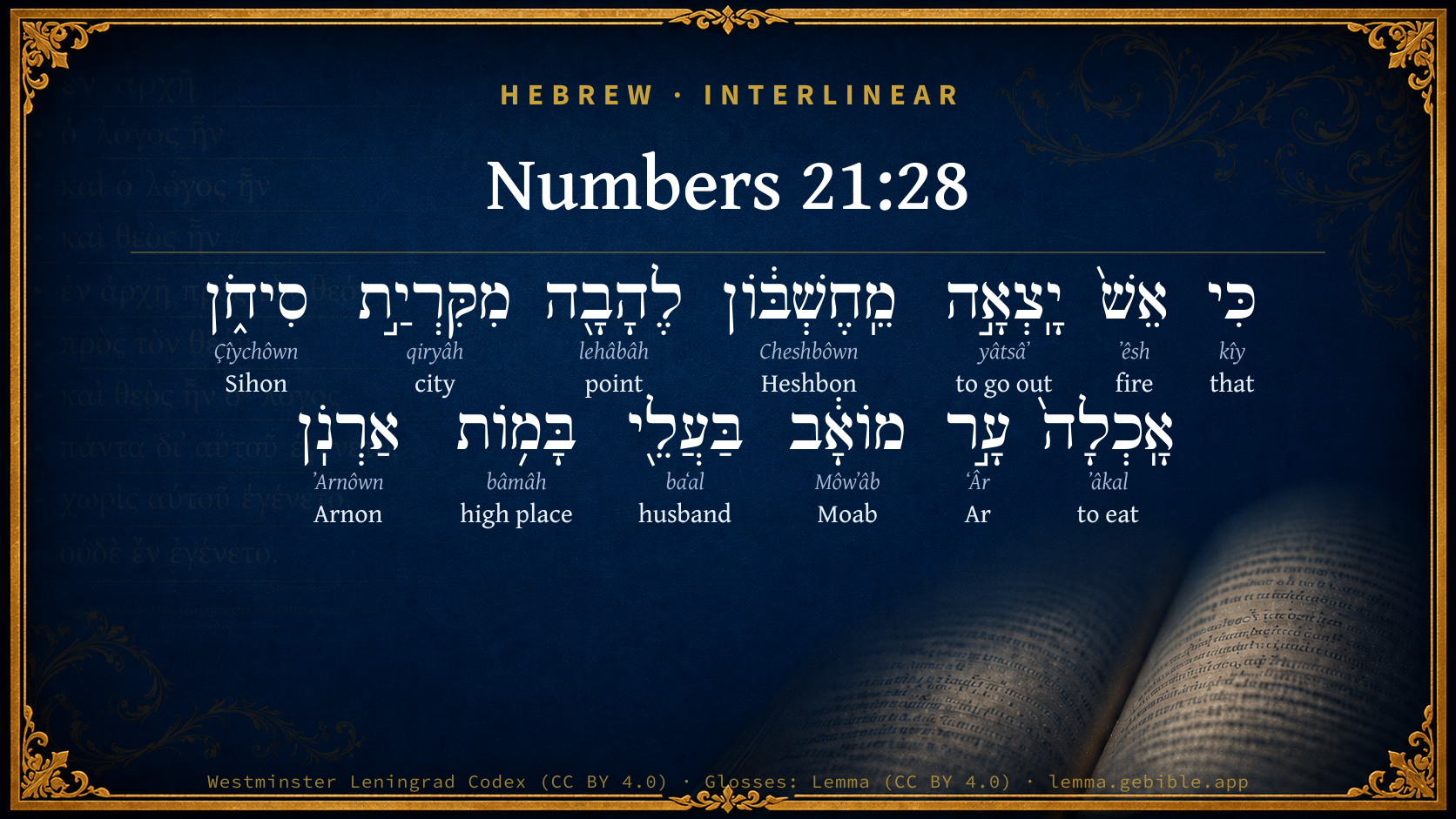
Hebrew (Westminster Leningrad Codex) Numbers 21:28 appears in the Hebrew Old Testament. The text above is from the Westminster Leningrad Codex. Each word links to its Strong’s number, a concise gloss, and parsing drawn from the Open Scriptures Hebrew Bible morphology. Click any word for its full Brown-Driver-Briggs (BDB) entry.
Download image
Cite this verse

Numbers 21:28 (World English Bible). Public Domain. Lemma interlinear Bible study tool, https://lemma.gebible.app/v/numbers/21/28.

Show BibTeX & RIS
BibTeX
RIS
English Translation
For a fire is gone out of Heshbon, A flame from the city of Sihon: It has devoured Ar of Moab, The lords of the high places of the Arnon.
World English Bible · Public Domain
Highlights
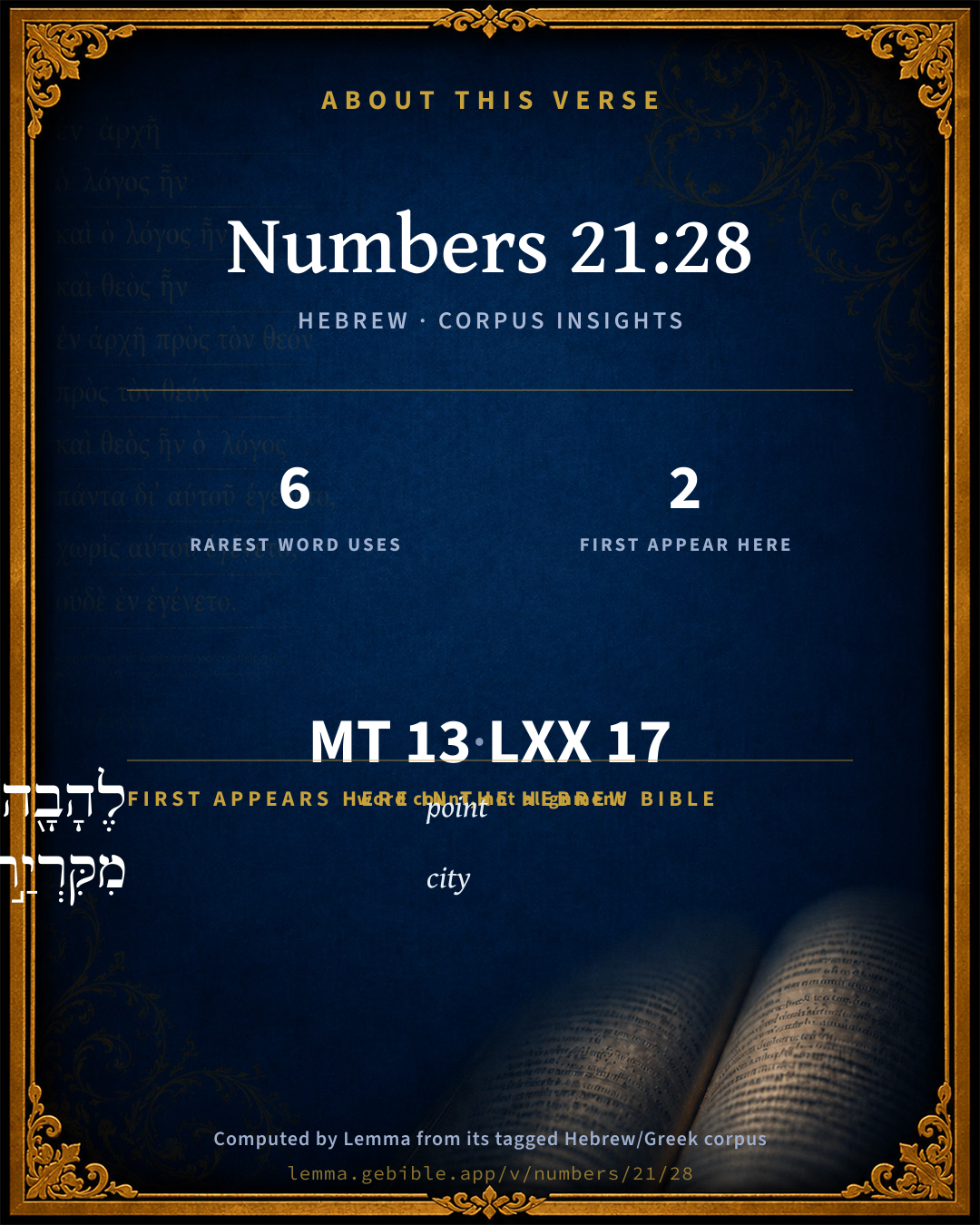
  • 2 first appearances in the Hebrew Bible
Full analysis ↓
Download a study sheet

One document with this verse’s original text, its word-by-word gloss line, the meaning frame, cross-references with their text, attributed commentary, and full source and license credits — printable, and it pastes into notes with its structure intact.

This verse Autodidact and up

Study sheet (.html) Plain text (.txt)

A passage Seminary Student

Up to 50 verses in one chapter. A passage sheet keeps up to 6 commentary sources and 12 cross-references per verse, in the order this page ranks them, and says so on the sheet whenever that leaves anything out. Ask for a single verse and you get the Autodidact verse sheet above.

Everything on this page stays free to read, with no account — the sheet is a download of what is already on screen, not access to it.

Want to remove ads? Support Godless Engineer
Compare translations 3

The same verse in 3 English versions, stacked beneath the original-language interlinear above. Click any original word for its lexicon entry.

Each is an independent rendering of the whole verse — the interlinear is not word-aligned to these translations.

Highlighted words mark where these versions differ — a whole-verse word diff, not a word-by-word alignment.

  • World English Bible Public Domain
    For a fire is gone out of Heshbon, A flame from the city of Sihon: It has devoured Ar of Moab, The lords of the high places of the Arnon.
  • King James Version Public Domain
    For there is a fire gone out of Heshbon, a flame from the city of Sihon: it hath consumed Ar of Moab, and the lords of the high places of Arnon.
  • unfoldingWord Literal Text CC BY-SA 4.0
    For a fire went out from Heshbon, a flame from the city of Sihon. It consumed Ar of Moab, the lords of the high places of the Arnon.

unfoldingWord Literal Text — © unfoldingWord, licensed CC BY-SA 4.0. Word-aligned USFM3 via Door43 (git.door43.org/unfoldingWord/en_ult).

Versions to compare (up to 4)

3 of 4 selected

Show all 18 translations

Every available English version of this verse, each an independent rendering of the whole verse.

  • World English Bible Public Domain
    For a fire is gone out of Heshbon, A flame from the city of Sihon: It has devoured Ar of Moab, The lords of the high places of the Arnon.
  • Berean Standard Bible Public Domain
    For a fire went out from Heshbon, a blaze from the city of Sihon. It consumed Ar of Moab, the rulers of Arnon’s heights.
  • Majority Standard Bible Public Domain
    For a fire went out from Heshbon, a blaze from the city of Sihon. It consumed Ar of Moab, the rulers of Arnon’s heights.
  • King James Version Public Domain
    For there is a fire gone out of Heshbon, a flame from the city of Sihon: it hath consumed Ar of Moab, and the lords of the high places of Arnon.
  • American Standard Version (1901) Public Domain
    For a fire is gone out of Heshbon, A flame from the city of Sihon: It hath devoured Ar of Moab, The lords of the high places of the Arnon.
  • Revised Version (1885) Public Domain
    For a fire is gone out of Heshbon, A flame from the city of Sihon: It hath devoured Ar of Moab, The lords of the high places of Arnon.
  • Geneva Bible (1599) Public Domain
    For a fire is gone out of Heshbon, and a flame from the citie of Sihon, and hath consumed Ar of the Moabites, and the lords of Bamoth in Arnon.
  • Douay-Rheims (1899) Public Domain
    A fire is gone out of Hesebon, a flame from the city of Sehon, and hath consumed Ar of the Moabites, and the inhabitants of the high places of the Arnon.
  • Young's Literal Translation Public Domain
    For fire hath gone out from Heshbon, A flame from the city of Sihon, It hath consumed Ar of Moab, Owners of the high places of Arnon.
  • Literal Standard Version CC BY-SA 4.0
    For fire has gone out from Heshbon, || A flame from the city of Sihon, || It has consumed Ar of Moab, || Owners of the high places of Arnon.
  • Unlocked Literal Bible CC BY-SA 4.0
    A fire blazed from Heshbon, a flame from the city of Sihon that devoured Ar of Moab, and the owners of the high places of Arnon.
  • unfoldingWord Literal Text CC BY-SA 4.0
    For a fire went out from Heshbon, a flame from the city of Sihon. It consumed Ar of Moab, the lords of the high places of the Arnon.
  • Darby Bible Public Domain
    For there went forth fire from Heshbon, a flame from the city of Sihon; It consumed Ar of Moab, the lords of the high places of the Arnon.
  • World Messianic Bible Public Domain
    for a fire has gone out of Heshbon, a flame from the city of Sihon. It has devoured Ar of Moab, The lords of the high places of the Arnon.
  • Webster's Bible Public Domain
    For there has a fire gone out of Heshbon, a flame from the city of Sihon: it hath consumed Ar of Moab, and the lords of the high places of Arnon.
  • Free Bible Version CC BY-SA 4.0
    For a fire blazed out from Heshbon, a flame from the town of Sihon. It burned up Ar in Moab where the rulers live on the high places of Arnon.
  • Bible in Basic English Public Domain
    For a fire has gone out of Heshbon, a flame from the town of Sihon: for the destruction of Ar in Moab, and the lords of the high places of the Arnon.
  • JPS Tanakh (1917) Public Domain
    For a fire is gone out of Heshbon, a flame from the city of Sihon; it hath devoured Ar of Moab, the lords of the high places of Arnon.

Literal Standard Version (2020), Covenant Press — licensed CC BY-SA 4.0. Text via the HelloAO Bible API (eBible.org). Unlocked Literal Bible (unfoldingWord) — licensed CC BY-SA 4.0. Text via the HelloAO Bible API (eBible.org). unfoldingWord Literal Text — © unfoldingWord, licensed CC BY-SA 4.0. Word-aligned USFM3 via Door43 (git.door43.org/unfoldingWord/en_ult). Free Bible Version, Dr. Jonathan Gallagher — licensed CC BY-SA 4.0. Text via the HelloAO Bible API (eBible.org).

Word by word

More ways to search: Search by grammar → Find every occurrence → Compare this word →

Practice this passage: Drill this verse → Learn its vocabulary →

About this verse

These counts appear in no published source. They are computed here, from the morphology-tagged text and Lemma’s own curated glosses. What Lemma adds →

13
words
13
distinct lemmas
Pentateuch
section

Notable vocabulary

The rarest word here is עָ֣ר Ar H6144 — appearing just 6 times in the whole Hebrew Bible.

First appearance in Scripture

These words make their first canonical appearance in the Hebrew Bible here:

  • לֶהָבָ֖ה point H3852
  • מִקִּרְיַ֣ת city H7151

Shared distinctive vocabulary

עָ֣ר Ar H6144 occurs in 6 verses of the Hebrew Bible. Also found in:

Grammatical profile

  • 2 verbs
  • 10 nouns
  • 1 conjunction

Verb forms

  • יָֽצְאָ֣ה Qal · Perfect
  • אָֽכְלָה֙ Qal · Perfect

Hebrew & Septuagint length

In English translation the verse runs 30 words from the Hebrew and 28 from the Septuagint (LXX English) — closely comparable.

A rough comparison of the two English renderings, which tokenize alike — not a word-level alignment.

Word counts can differ between the Hebrew and the Greek without any difference in meaning — e.g. the Hebrew direct-object marker אֵת has no separate Greek word, and Greek often adds the article ὁ.

In the original languages it is 13 Hebrew tokens and 17 Greek tokens — but the two are counted differently (Hebrew bundles its prefixes and suffixes into one token; the Greek is in lemma form), so that isn’t a like-for-like length.

Cross-references

15

Topical passages linked to Numbers 21:28 in the Treasury of Scripture Knowledge — connected by theme and wording, ordered by reader-vote popularity; previews shown in the World English Bible.

  • Numbers 21:15 The slope of the valleys That inclines toward the dwelling of Ar, Leans on the border of Moab.
  • Jeremiah 48:45–46 Those who fled stand without strength under the shadow of Heshbon; for a fire is gone forth out of Heshbon, and a flame from the midst of Sihon, and has devoured the corner of Moab, and the crown of the head of the tumultuous ones.
  • Numbers 22:41 It happened in the morning, that Balak took Balaam, and brought him up into the high places of Baal; and he saw from there the utmost part of the people.
  • Deuteronomy 2:9 Yahweh said to me, Don't bother Moab, neither contend with them in battle; for I will not give you of his land for a possession; because I have given Ar to the children of Lot for a possession.
  • Deuteronomy 2:18 You are this day to pass over Ar, the border of Moab:
  • Judges 9:20 but if not, let fire come out from Abimelech, and devour the men of Shechem, and the house of Millo; and let fire come out from the men of Shechem, and from the house of Millo, and devour Abimelech.
  • Isaiah 10:16 Therefore will the Lord, Yahweh of Hosts, send among his fat ones leanness; and under his glory there shall be kindled a burning like the burning of fire.
  • Isaiah 15:1–2 The burden of Moab. For in a night Ar of Moab is laid waste, [and] brought to nothing; for in a night Kir of Moab is laid waste, [and] brought to nothing.
  • Amos 1:4 But I will send a fire into the house of Hazael, And it will devour the palaces of Ben Hadad.
  • Amos 1:7 But I will send a fire on the wall of Gaza, And it will devour its palaces.
  • Amos 1:10 But I will send a fire on the wall of Tyre, And it will devour its palaces."
  • Amos 1:12 But I will send a fire on Teman, And it will devour the palaces of Bozrah."
  • Amos 1:14 But I will kindle a fire in the wall of Rabbah, And it will devour its palaces, With shouting in the day of battle, With a tempest in the day of the whirlwind;
  • Amos 2:2 But I will send a fire on Moab, And it will devour the palaces of Kerioth; And Moab will die with tumult, with shouting, and with the sound of the trumpet;
  • Amos 2:5 But I will send a fire on Judah, And it will devour the palaces of Jerusalem."

Cross-references courtesy of OpenBible.info (CC BY 4.0).

Hebrew and Greek witnesses Masoretic Hebrew ↔ Greek Septuagint

The same verse in the two great witnesses to the Old Testament, shown verse-for-verse.

These are two independent witnesses, not word-aligned to each other, and the Septuagint is shown in lemma (dictionary) form.

Hebrew Numbers 21:28 Masoretic · Westminster Leningrad Codex

כִּי אֵשׁ֙ יָֽצְאָ֣ה מֵֽחֶשְׁבּ֔וֹן לֶהָבָ֖ה מִקִּרְיַ֣ת סִיחֹ֑ן אָֽכְלָה֙ עָ֣ר מוֹאָ֔ב בַּעֲלֵ֖י בָּמ֥וֹת אַרְנֹֽן

For a fire is gone out of Heshbon, A flame from the city of Sihon: It has devoured Ar of Moab, The lords of the high places of the Arnon.

World English Bible · Public Domain

Greek LXX Numbers 21:28 Septuagint · lemma form

ὅτι πῦρ ἐκἔρχομαι ἐκ εσεβων φλόξ ἐκ πόλις σηων καί καταἐσθίω ἕως μωαβ καί καταπίνω στήλη αρνων

For a fire has gone forth from Esebon, a flame from the city of Seon, and has consumed as far as Moab, and devoured the pillars of Arnon.

LXX2012 (modern English Septuagint) · Public Domain

On this verse, Haydock's Catholic Bible Commentary discusses the Septuagint’s reading. Read the note in Commentary ↓

Hebrew: Westminster Leningrad Codex (CC BY 4.0). Greek: Septuagint (public domain); English from LXX2012 (modern English Septuagint) (Public Domain). How the Septuagint differs from the Hebrew →

Targum (Aramaic paraphrase)

2

The Targum is the ancient Jewish Aramaic paraphrase of the Hebrew Scriptures — an interpretive translation, not the Hebrew text itself. Onkelos (literal) and Pseudo-Jonathan (expansive) render the Torah, and Jonathan the Prophets. Coverage is partial: where no permissively-licensed English translation exists for a verse, only the Aramaic is shown. This is verse-level text, not a word-by-word alignment to the Hebrew.

  1. Targum Onkelos Torah (Genesis–Deuteronomy)
    אֲרֵי קִידוּם תַּקִיף כְּאֶשָׁא נְפַק מֵחֶשְׁבּוֹן עָבְדֵי קְרָבָא כְּשַׁלְהוֹבִיתָא מִקַרְתָּא דְסִיחוֹן קַטִילוּ עַמָא דִשְׁרוֹ בִּלְחָיַת מוֹאָב כּוּמְרַיָא דְפַלְחִין בֵּית דַחֲלָא רָמָתָא דְאַרְנוֹן

    (no public-domain English translation for this verse)

    Targum Onkelos — Aramaic: “Onkelos Genesis” (public domain); “Onkelos Exodus” (public domain); “Onkelos Leviticus” (public domain); “Onkelos Numbers” (public domain); “Onkelos Deuteronomy” (public domain). English: “Sefaria Community Translation” (CC0 1.0 (public-domain dedication)); “J.W. Etheridge. The Targums of Onkelos and Jonathan Ben Uzziel on the Pentateuch. London: Longmans, Green, 1862” (public domain). Text via Sefaria.

  2. Targum Pseudo-Jonathan Torah (Genesis–Deuteronomy)
    אֲרוּם מִילִין תַּקִיפִין הֵי כְאֵישָׁא נַפְקִין מִפּוּמֵי צַדִיקַיָא מָרֵי חוּשְׁבְּנָא דְנָא וְזַכְוַון חֲסִינַן הֵי כְשַׁלְהוֹבִיתָא מֵאִלֵין דְקַרְיָין וּמְשִ¦יחִין בְּאוֹרַיְיתָא אָכְלַת אֵישְׁתְּהוֹן לְסַנָאָה וְלִבְעֵיל דְבָבָא דְמִתְחַשְׁבִין קוּמֵיהוֹן הֵי כְפִלְחֵי בַּמְתֵי טַעֲוָותָא דְנַחֲלֵי אַרְנוֹנָא

    for mighty words like fire go forth from the lips of the righteous, the masters of such thought, (calculation, heshbona,) and powerful merit like flames from those who are read and devoted in the law: their fire devoureth the foe and the adversary, who are reckoned before them as the worshippers of the idol altars in the valley of Arnona.

    Targum Pseudo-Jonathan — Aramaic: “Targum Jonathan on Genesis” (public domain); “Targum Jonathan on Exodus” (public domain); “Targum Jonathan on Leviticus” (public domain); “Targum Jonathan on Numbers” (public domain); “Targum Jonathan on Deuteronomy” (public domain). English: “The Targum of Jonathan ben Uzziel, trans. J. W. Etheridge, London, 1862” (public domain). Text via Sefaria.

Commentary

Notes on Numbers 21:28 from classic Christian and Jewish commentators (each source and its license shown beneath its notes). The classic Christian expositions comment on the surrounding passage and are grouped to its opening verse, so a note may address several verses; the Jewish commentaries on the Tanakh (Rashi and others) are per-verse, so they appear only where the commentator wrote on this verse.

Lemma curates 59 commentaries, every one of them public domain or Creative Commons licensed, each selected and text-cleaned for this edition rather than reprinted as found. About our sources →

Joseph Benson's Commentary

Num 21:28. A fire — The fury of war, which is fitly compared to fire. Out of Heshbon — That city which before was a refuge and defence to all the country, now is turned into a great annoyance. It hath consumed Ar —

This may be understood not of the city Ar, but of the people or the country subject or belonging to that great and royal city. The lords of the high places — The princes or governors of the strong holds, which were frequently in high places, especially in that mountainous country, and which were in divers parts all along the river Arnon. So the Amorites triumphed over the vanquished Moabites. But the triumphing of the wicked is short!

Joseph Benson's Commentary on the Old and New Testaments (1811–1818) — public domain. Text from a community e-Sword module.

Tyndale Open Study Notes

Tyndale Open Resources

21:28 King Sihon had destroyed Moab’s towns from his center of operations at Heshbon.

Tyndale Open Study Notes — © Tyndale Open Resources, licensed CC BY-SA 4.0. Text via the HelloAO Bible API.

Geneva Bible (1599)

Geneva Bible translators

Meaning, war.

Geneva Bible (1599) marginal notes — public domain. Text via Bolls.life.

The Cambridge Bible for Schools and Colleges

gen. ed. J. J. S. Perowne

28. For a fire went out from Heshbon … it devoured &c.] The Amorites in the past gained possession of Heshbon, and from thence sent forth destruction upon the other towns of Moab. See Jer_48:45 f. where the passage is quoted.

The Cambridge Bible for Schools and Colleges (gen. ed. J. J. S. Perowne; Cambridge University Press, 1878–1918) — public domain. Text from a community e-Sword module.

John Gill's Exposition

Thus Israel dwelt in the land of the Amorites. Not the land of the Moabites; and by those means before mentioned; by conquering Sihon their king, they came into the possession of it, and took up their dwelling in it; this was the beginning of the conquest of the Canaanites, and an earnest and pledge of inheriting their land promised unto them; the Israelites that dwelt here were the tribes of Reuben and Gad.

Thus Israel dwelt in the land of the Amorites. Not the land of the Moabites; and by those means before mentioned; by conquering Sihon their king, they came into the possession of it, and took up their dwelling in it; this was the beginning of the conquest of the Canaanites, and an earnest and pledge of inheriting their land promised unto them; the Israelites that dwelt here were the tribes of Reuben and Gad.

Numbers 21:32

num 21:32

num 21:32

num 21:32And Moses sent to spy out Jaazer,.... Or Jazer, as it is called in Isa 16:9, another city that belonged to the Amorites, and which they had taken from the Moabites; and which came into the hands of the latter again, after the captivity of the ten tribes, as appears from the above places; according to Jerom (s), it was fifteen miles distant from Heshbon:

and they took the villages thereof; not the spies, as Jarchi, but the Israelites under Moses; who upon the return of the spies, and the report they made, marched towards it, and took it, and all the towns and villages round about it; for it seems to have been a principal city:

and drove out the Amorites that were there; that dwelt there, and were in possession of it; otherwise they would not have attacked it, had it, and its villages, been in the hands of the Moabites.

(s) De locis Heb. fol. 92. G.

John Gill's Exposition of the Whole Bible (1746–1763) — public domain (CC PDM 1.0). Text via the HelloAO Bible API.

Haydock's Catholic Bible Commentary

A fire and flame, denote the horrors of war, Judges ix. 20. --- Ar. Samaritan and Septuagint read ad, "hath consumed even the country of the Moabites and the lords (or pillars, Septuagint) of Bamoth, (the heights mentioned in ver. 18, 19,) on the Arnon." These lords may be the principal men, priests, or gods of the city. Jeremias (xlviii. 45,) reads this passage in a different manner, "it (the flame) shall devour part of Moab, and the crown of the head of the children of tumult." The city of Ar (which some confound with Aroer) always continued in the hands of the Moabites, so that the efforts of Sehon against it, seem to have proved abortive, Deuteronomy ii. 9, 18, 29. (Bonfrere) See chap. xxiv. 17.

George Leo Haydock (1774–1849), Haydock's Catholic Family Bible and Commentary, 1859 edition — public domain. Excludes Psalms (Douay-Rheims chapter numbering differs from Protestant) and Deuterocanonical books (Catholic canon only).

Matthew Poole's English Annotations

A fire, i.e. the fury of war, which is oft and fitly compared to fire here, as Isa 47:14; Amo 1:7,10,12,14; 2:2,5;

Heshbon; that city which before was a refuge and defence to all the country, now is turned into a great annoyance and a public mischief.

Ar of Moab.

Quest. How can this be, since Ar was yet in the hands of the Moabites, Deu 2:9,18,29?

Answ. 1. This may be understood not of the city Ar, but of the people or the country subject or belonging to that great and royal city, as the Chaldee understands it.

2. Possibly Ar was taken by Sihon of the Moabites, but afterwards was either recovered by the Moabites, or upon the Israelites’ approach quitted by Sihon, gathering all his forces together that he might fight with the Israelites, and so repossessed by the Moabites.

3. This place may be thus rendered, It shall consume Ar of Moab, the past tense being put for the future, as is usual in prophetical passages; and so this may be the Amorites’ prediction or presage, that having taken Heshbon and its territories, they should now extend their victories to

Ar of Moab, though they fell short of that hope, as ordinarily men do.

The lords of the high places; either,

1. The princes or governors of the strong holds, which were frequently in high places, especially in that mountainous country, and which were in divers parts all along the river of Arnon; and having taken some of these, they promised to themselves that they should take all the rest, and so proceed further and further, till they had taken Ar itself. Or rather,

2. The priests and people that worshipped their god in their high places; which may seem more probable,

1. Because as the Israelites worshipped God, so the heathens worshipped Baal, in high places, Num 22:41, and particularly the Moabites are noted for so doing, Jer 48:35.

2. Because amongst the eminent places of Moab there is mention of Bamoth-baal, or, of the high places of Baal, Jos 13:17.

Matthew Poole's English Annotations on the Holy Bible (1683–1685) — public domain. Text from a community e-Sword/MySword module.

Whedon's Commentary on the Bible

Daniel D. Whedon

28. Ar — See Num_21:15, note. The high places of Arnon are mentioned as the limits to which Sihon had carried his victorious supremacy. The lords are the Moabites.

Daniel D. Whedon (gen. ed.), Commentary on the Old and New Testaments (1874–1909) — public domain. Text from a community e-Sword module.

The Pulpit Commentary

There is a fire gone out of Heshbon. This must refer to the war-fire which the Amorites kindled from Heshbon when they made it the capital of the new kingdom. Ar Moab and the (northern) heights of Arnon were the furthest points to which their victory extended.

The Pulpit Commentary (1880–1919), ed. H.D.M. Spence-Jones & Joseph S. Exell — public domain. Text from a community e-Sword module.

John Wesley's Explanatory Notes

A fire - The fury of war, which is fitly compared to fire. Out of Heshbon - That city which before was a refuge and defense to all the country, now is turned into a great annoyance. It hath consumed Ar -This may be understood not of the city Ar, but of the people or the country subject or belonging to that great and royal city. The lords of the high places - The princes or governors of the strong holds, which were frequently in high places, especially in that mountainous country, and which were in divers parts all along the river Arnon. So the Amorites triumphed over the vanquished Moabites. But the triumphing of the wicked is short!

John Wesley, Explanatory Notes Upon the Whole Bible (1754–1765) — public domain. Text via the GEBible commentary corpus.

Rashi

Rabbi Shlomo Yitzchaki (Rashi)

כי אש יצאה מחשבון FOR A FIRE WILL GO FORTH FROM HESHBON after Sihon captures it,

אכלה ער מואב IT WILL CONSUME AR OF MOAB — The name of that province was called Ar in the Hebrew language and Lechayath (see the Targum Onkelos) in the Aramaic language.

ער מואב means AR OF MOAB.

Rashi on the Tanakh — English translations: “The Judaica Press complete Tanach with Rashi, translated by A. J. Rosenberg” (CC BY 4.0); “Pentateuch with Rashi's commentary by M. Rosenbaum and A.M. Silbermann, 1929-1934” (public domain); “The Metsudah Tanach series, Lakewood, N.J” (CC BY 4.0); and “The Book of Joshua, Metsudah Publications, 1997” (CC BY 4.0). Text via Sefaria.

Lesson kit

Teaching starters — assembled from the data on this page, not authored interpretation. Every prompt links to the verse data it draws on. Edit before teaching.

Numbers, in the Pentateuch, opens this verse with 13 words (13 distinct Hebrew lemmas). Its most distinctive word is ʻÂr (“Ar”). A historical commentator’s framing appears above. Read the whole chapter for the surrounding context.

Discussion questions

  1. How does “Ar” (ʻÂr) shape what this verse is saying?
  2. 2 words make their first appearance in Scripture here. What does this debut establish?
  3. How does Numbers 21:15, which shares the word «Ar», read alongside this verse?
  4. These translations render this verse differently; the difference is in the English rendering, not the original. What questions does that raise?
  5. «יָֽצְאָ֣ה» is a Qal Perfect verb. How does that grammatical form shape the action described?
  6. Compare how Joseph Benson's Commentary and Tyndale Open Study Notes read this verse. Where do they agree or differ?

Things to notice

Reading settings

Reading text

Shown beneath each verse's original-language words.

Old Testament
Old Testament edition

Read the OT as the Masoretic Hebrew (MT) or the Greek Septuagint (LXX).

English shown for the Greek Septuagint (in the Hebrew ↔ Greek comparison).

Comparing translations? Open the Compare panel on any verse page to stack up to four side by side.