
Proverbs 6:27

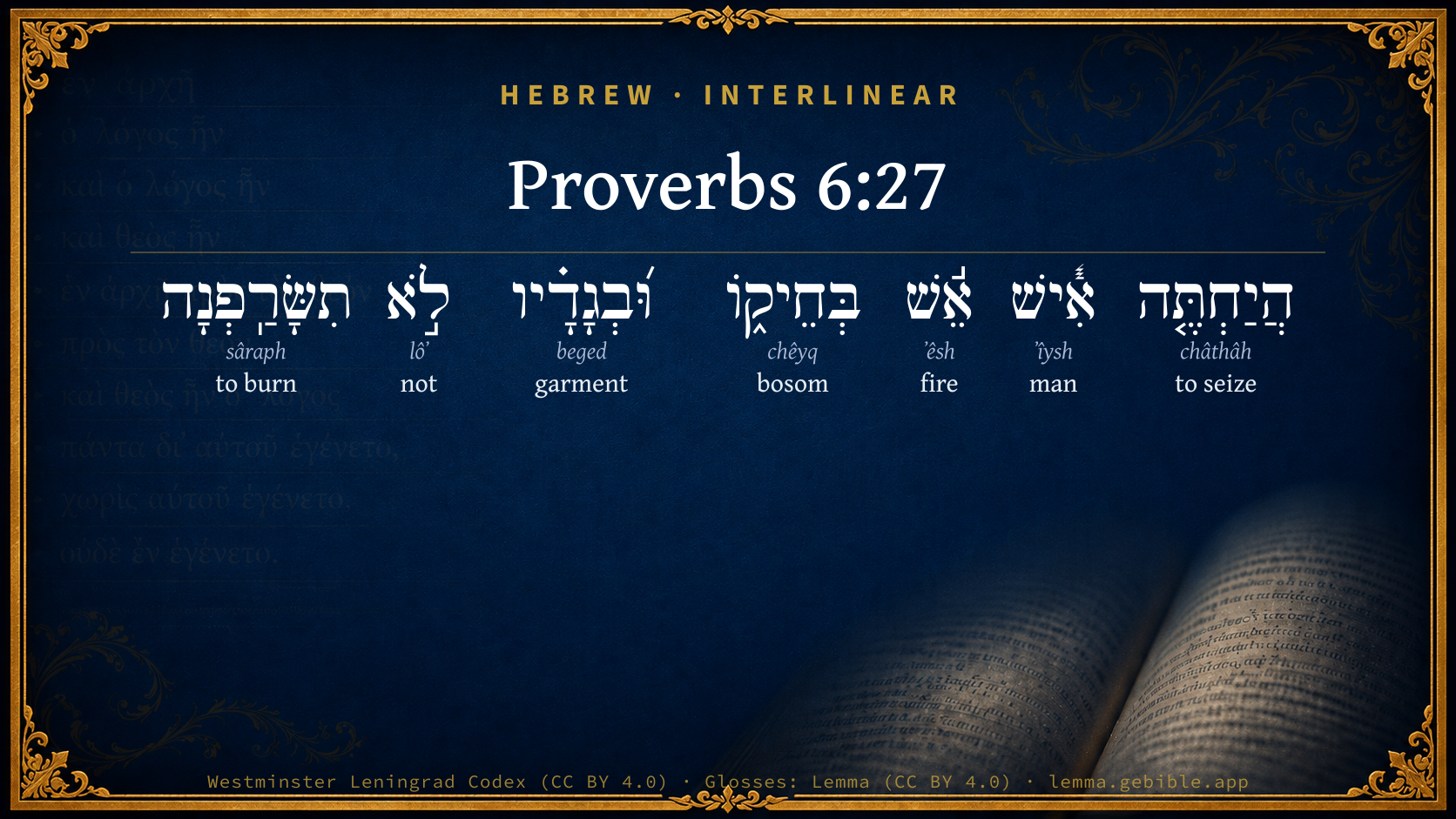
Hebrew (Westminster Leningrad Codex) Proverbs 6:27 appears in the Hebrew Old Testament. The text above is from the Westminster Leningrad Codex. Each word links to its Strong’s number, a concise gloss, and parsing drawn from the Open Scriptures Hebrew Bible morphology. Click any word for its full Brown-Driver-Briggs (BDB) entry.
Download image
Cite this verse

Proverbs 6:27 (World English Bible). Public Domain. Lemma interlinear Bible study tool, https://lemma.gebible.app/v/proverbs/6/27.

Show BibTeX & RIS
BibTeX
RIS
English Translation
Can a man scoop fire into his lap, And his clothes not be burned?
World English Bible · Public Domain
Download a study sheet

One document with this verse’s original text, its word-by-word gloss line, the meaning frame, cross-references with their text, attributed commentary, and full source and license credits — printable, and it pastes into notes with its structure intact.

This verse Autodidact and up

Study sheet (.html) Plain text (.txt)

A passage Seminary Student

Up to 50 verses in one chapter. A passage sheet keeps up to 6 commentary sources and 12 cross-references per verse, in the order this page ranks them, and says so on the sheet whenever that leaves anything out. Ask for a single verse and you get the Autodidact verse sheet above.

Everything on this page stays free to read, with no account — the sheet is a download of what is already on screen, not access to it.

Want to remove ads? Support Godless Engineer
Compare translations 3

The same verse in 3 English versions, stacked beneath the original-language interlinear above. Click any original word for its lexicon entry.

Each is an independent rendering of the whole verse — the interlinear is not word-aligned to these translations.

Highlighted words mark where these versions differ — a whole-verse word diff, not a word-by-word alignment.

  • World English Bible Public Domain
    Can a man scoop fire into his lap, And his clothes not be burned?
  • King James Version Public Domain
    Can a man take fire in his bosom, and his clothes not be burned?
  • unfoldingWord Literal Text CC BY-SA 4.0
    Could a man carry a fire on his chest and his clothes not be burned?

unfoldingWord Literal Text — © unfoldingWord, licensed CC BY-SA 4.0. Word-aligned USFM3 via Door43 (git.door43.org/unfoldingWord/en_ult).

Versions to compare (up to 4)

3 of 4 selected

Show all 18 translations

Every available English version of this verse, each an independent rendering of the whole verse.

  • World English Bible Public Domain
    Can a man scoop fire into his lap, And his clothes not be burned?
  • Berean Standard Bible Public Domain
    Can a man embrace fire and his clothes not be burned?
  • Majority Standard Bible Public Domain
    Can a man embrace fire and his clothes not be burned?
  • King James Version Public Domain
    Can a man take fire in his bosom, and his clothes not be burned?
  • American Standard Version (1901) Public Domain
    Can a man take fire in his bosom, And his clothes not be burned?
  • Revised Version (1885) Public Domain
    Can a man take fire in his bosom, and his clothes not be burned?
  • Geneva Bible (1599) Public Domain
    Can a man take fire in his bosome, and his clothes not be burnt?
  • Douay-Rheims (1899) Public Domain
    Can a man hide fire in his bosom, and his garments not burn?
  • Young's Literal Translation Public Domain
    Doth a man take fire into his bosom, And are his garments not burnt?
  • Literal Standard Version CC BY-SA 4.0
    Does a man take fire into his bosom, || And are his garments not burned?
  • Unlocked Literal Bible CC BY-SA 4.0
    Can a man carry a fire against his chest without burning his clothes?
  • unfoldingWord Literal Text CC BY-SA 4.0
    Could a man carry a fire on his chest and his clothes not be burned?
  • Darby Bible Public Domain
    Can a man take fire in his bosom, and his garments not be burned?
  • World Messianic Bible Public Domain
    Can a man scoop fire into his lap, and his clothes not be burned?
  • Webster's Bible Public Domain
    Can a man take fire in his bosom, and his clothes not be burned?
  • Free Bible Version CC BY-SA 4.0
    Can you put fire in your lap and not burn your clothes?
  • Bible in Basic English Public Domain
    May a man take fire to his breast without burning his clothing?
  • JPS Tanakh (1917) Public Domain
    Can a man take fire in his bosom, and his clothes not be burned?

Literal Standard Version (2020), Covenant Press — licensed CC BY-SA 4.0. Text via the HelloAO Bible API (eBible.org). Unlocked Literal Bible (unfoldingWord) — licensed CC BY-SA 4.0. Text via the HelloAO Bible API (eBible.org). unfoldingWord Literal Text — © unfoldingWord, licensed CC BY-SA 4.0. Word-aligned USFM3 via Door43 (git.door43.org/unfoldingWord/en_ult). Free Bible Version, Dr. Jonathan Gallagher — licensed CC BY-SA 4.0. Text via the HelloAO Bible API (eBible.org).

Word by word

More ways to search: Search by grammar → Find every occurrence → Compare this word →

Practice this passage: Drill this verse → Learn its vocabulary →

About this verse

These counts appear in no published source. They are computed here, from the morphology-tagged text and Lemma’s own curated glosses. What Lemma adds →

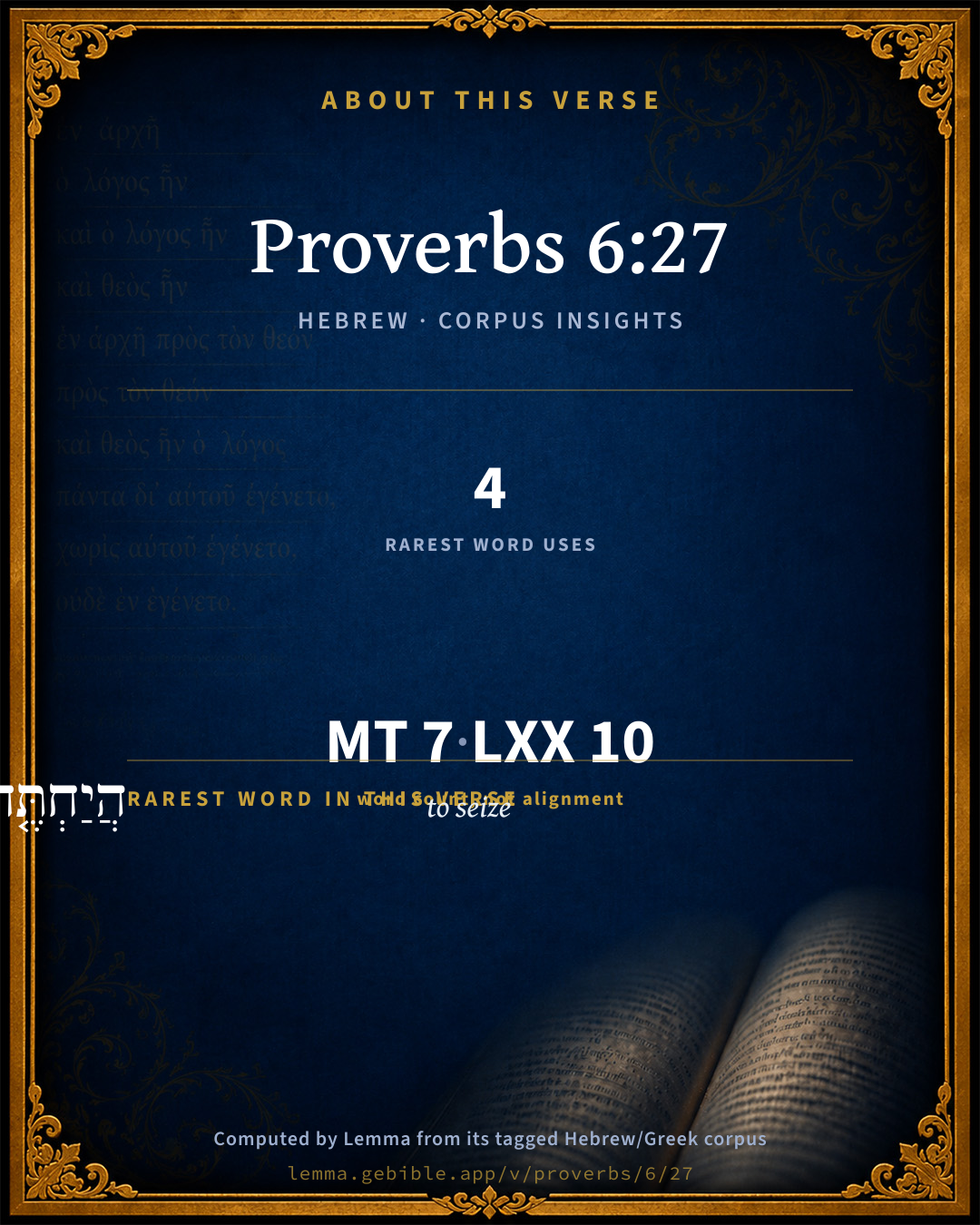
7
words
7
distinct lemmas
Wisdom
section

Notable vocabulary

The rarest word here is הֲיַחְתֶּ֤ה to seize H2846 — appearing just 4 times in the whole Hebrew Bible.

Shared distinctive vocabulary

הֲיַחְתֶּ֤ה to seize H2846 occurs in 4 verses of the Hebrew Bible. Also found in:

Grammatical profile

  • 2 verbs
  • 4 nouns
  • 1 particle

Verb forms

  • הֲיַחְתֶּ֤ה Qal · Imperfect
  • תִשָּׂרַֽפְנָה Niphal · Imperfect

Hebrew & Septuagint length

In English translation the verse runs 14 words from the Hebrew and 13 from the Septuagint (LXX English) — closely comparable.

A rough comparison of the two English renderings, which tokenize alike — not a word-level alignment.

Word counts can differ between the Hebrew and the Greek without any difference in meaning — e.g. the Hebrew direct-object marker אֵת has no separate Greek word, and Greek often adds the article ὁ.

In the original languages it is 7 Hebrew tokens and 10 Greek tokens — but the two are counted differently (Hebrew bundles its prefixes and suffixes into one token; the Greek is in lemma form), so that isn’t a like-for-like length.

Cross-references

3

Topical passages linked to Proverbs 6:27 in the Treasury of Scripture Knowledge — connected by theme and wording, ordered by reader-vote popularity; previews shown in the World English Bible.

  • Job 31:9–12 "If my heart has been enticed to a woman, And I have laid wait at my neighbor's door;
  • Hosea 7:4–7 They are all adulterers. They are burning like an oven that the baker stops stirring, From the kneading of the dough, until it is leavened.
  • James 3:5 So the tongue is also a little member, and boasts great things. See how a small fire can spread to a large forest!

Cross-references courtesy of OpenBible.info (CC BY 4.0).

Hebrew and Greek witnesses Masoretic Hebrew ↔ Greek Septuagint

The same verse in the two great witnesses to the Old Testament, shown verse-for-verse.

These are two independent witnesses, not word-aligned to each other, and the Septuagint is shown in lemma (dictionary) form.

Hebrew Proverbs 6:27 Masoretic · Westminster Leningrad Codex

הֲיַחְתֶּ֤ה אִ֓ישׁ אֵ֬שׁ בְּחֵיק֑וֹ וּ֝בְגָדָ֗יו לֹ֣א תִשָּׂרַֽפְנָה

Can a man scoop fire into his lap, And his clothes not be burned?

World English Bible · Public Domain

Greek LXX Proverbs 6:27 Septuagint · lemma form

ἀποδέω τις πῦρ ἐν κόλπος ὁ δέ ἱμάτιον οὐ κατακαύω

Shall any one bind fire in his bosom, and not burn his garments?

LXX2012 (modern English Septuagint) · Public Domain

On this verse, The Pulpit Commentary discusses the Septuagint’s reading. Read the note in Commentary ↓

Hebrew: Westminster Leningrad Codex (CC BY 4.0). Greek: Septuagint (public domain); English from LXX2012 (modern English Septuagint) (Public Domain). How the Septuagint differs from the Hebrew →

Commentary

Notes on Proverbs 6:27 from classic Christian and Jewish commentators (each source and its license shown beneath its notes). The classic Christian expositions comment on the surrounding passage and are grouped to its opening verse, so a note may address several verses; the Jewish commentaries on the Tanakh (Rashi and others) are per-verse, so they appear only where the commentator wrote on this verse.

Lemma curates 59 commentaries, every one of them public domain or Creative Commons licensed, each selected and text-cleaned for this edition rather than reprinted as found. About our sources →

Trapp's Complete Commentary

John Trapp

Pro 6:27 Can a man take fire in his bosom, and his clothes not be burned?

Ver. 27. Can a man take fire?] Lest any man should reply, ‘I will see to myself, and save one from the afore named mischiefs; I have more wit than to trust any harlot, and more skill than to let it come abroad to my disgrace and detriment’; the wise man answers, that it is as possible to take a live coal from the hearth, and bear it in a man’s bosom without burning his clothes, or to walk upon fire without scorching his feet, as to attempt anything in this kind and to escape Scot free. Flagitium et flagellum sicut acus et filum. Sin and punishment go linked together with chains of adamant. Thy clothes will stink, at least, of that fire; thy feet will blister, at least, with those coals. If the great shower blow over thee, yet thou shalt be wet with the after drops.

John Trapp, A Commentary or Exposition upon All the Books of the Old and New Testament (1647–1656) — public domain. Text from a community e-Sword module.

The Biblical Illustrator

Joseph S. Exell

Pro_6:27

Can a man take fire in his bosom, and his clothes not be burned?

The danger of playing with enticements to sin

The law of the acquisition of knowledge is that the mind knows the unknown through the known. It gets at the distant through the near, and at the near through the nearer. It ascends to the Divine through the human, and through the material and the temporal mounts up to the spiritual and eternal. As a consequence, the teaching of the Scriptures in the feature alluded to is more specific and intelligible to such a creature as man than it could be in any other mode. The words of the text directly refer to the sin of adultery. The wise man directs youth to the best defence against every tendency to this evil. That defence he finds in the remembrance of, attention to, and conformity with, the family training he received in the morning of life. Then, in a manner remarkably elegant, he places before him the advantages he would reap by assuming towards the law the attitude prescribed. The law is here personified as a wise counsellor, as a careful guardian, and as an interesting companion. That law will preserve against the particular dangers to which age and circumstances make the young peculiarly liable. It is of prime importance to be kept from the strange woman. In the text the wise man returns again to the necessity of directly resisting the evil in the occasion of it, in the temptation to it, and that from the consideration of the impossibility of playing with the enticement without falling into the sin.

I. Every temptation presented to man addresses itself to a nature that is already corrupt, and therefore liable to take to it. It appears from the history of mankind that there is force enough in temptation, by keeping the mind in fellowship with it, to influence even holy creatures so as to make them fall. So it happened with our first parents in Eden. If there was such force in temptation when there was nothing but holiness in the mind, what must be its power to a creature that is already depraved? Wherever you find a man you find a sinner. The bias of our nature is towards sin, the original propensity of our minds is in the direction of evil. Here lies the danger of playing with temptation. There is something in thee that is advantageous to it. The whole moral nature of man is impaired. The moral deterioration of mankind is such as to expose them to various assaults of temptation, and if any one boldly frequents infectious places, dallying with and fondling the disease, it is impossible for him, possessing the nature he does, to escape the contagion.

II. Man, in playing with the temptation, puts himself directly in the way that leads naturally to sin. Every sin has certain enticements peculiar to itself. The great moral defect of thousands is that they do not recognise the sin in the enticement thereto. Show how, by playing with temptation, a man may develop into a thief, a gambler, or a drunkard. Scripture not only forbids the sin itself, but also all the occasions to it, and the first motions of the heart towards it. Do you desire not to fall into any sin, then shut your ears that you hear not the voice of the temptation; turn your eyes away from looking at it; bind yourself to something strong enough to keep you from falling into its snare. When a man plays with the temptation he is in the middle of the road which leads into the sin.

III. Playing with temptation to any evil shows some degree of bias in the nature to that particular evil. It is in the communion of the mind with the temptation that power resides, and if there be in the mind a sufficient amount of virtue--of virtue the direct opposite of the sin to which the temptation prompts--to keep a man on his guard from playing with it, he is perfectly safe from any injury that may be inflicted by it. In truth, when it is so the temptation is to him no longer a temptation. When a man hates the sin with perfect hatred the temptation to it is hateful to him, and he avoids not only the sin itself, but all occasions to it and all things that might lead thereto. There is in each one of us separately some predisposition to some particular sin, just as in some bodily constitutions there is a predisposition to certain fevers. There may be something in a mans organism making him incline beforehand to some special sin, and thus placing him under an obligation to exercise special vigilance against that sin. Natural predispositions these may be called; but there are others, the result of habit only, equally powerful in their influence and equally dangerous if any advantage be given them to show themselves. And sometimes the natural predispositions are strengthened by habit. When a man plays with any temptation it is proof of some bias toward the sin which is the direct object of the temptation. The playing with the temptation is nothing else than the heart reaching out after the sin, the lust conceiving in the mind.

IV. Playing with temptation only brings man into contact with sin on its agreeable side, and thus gives it an advantage to make an impression favourable to itself on the mind. It must be confessed that sin has its pleasure. It means the immediate satisfaction of the depraved propensities of the nature. Only the pleasure of sin is in the temptation. There you see the impossibility for any one to dally with it without falling a prey to it.

V. Man, through plating with temptation, weakens his moral resistance to the sin, and gradually gets so weak that he cannot resist it. When a man entertains evil suggestion his moral force begins to be undermined. One depraved thought invites another. Playing with temptation eats away the moral energy. The conscience at last gets so depraved that it permits unforbidden what it once condemned, and so step by step, almost unwittingly to himself, the man finds himself utterly powerless to resist temptation. And that is not all, but playing with the temptation keeps a man from the only means through which he might acquire strength to overcome the sin.

VI. Man, by playing with temptation, at last tempts the spirit of God to withdraw his protection from him, and to leave him to himself and a prey to his lust. Scriptures teach that the Spirit of the Lord exerts His influence in different ways to keep one from sin. Sometimes He overrules external circumstances. At other times He influences the mind by means of certain reflections, so that the temptation fails in its effect upon him. When a man continues to play with temptation, permitting his heart always to run in the channel of his lust, beginning to give way to his first impulses and desires, he vexes and grieves Gods Spirit and gradually offends Him so much that He withdraws from him, withholds His protection and allows the temptation in all its force to assault him at a time when lust is strong and the external opportunity perfectly advantageous. And the result is he falls a prey to the temptation. (Owen Thomas, D. D.)

The Biblical Illustrator, edited by Joseph S. Exell (c. 1880s–1900s) — public domain. Text from a community e-Sword module.

Tyndale Open Study Notes

Tyndale Open Resources

6:27-29 walk on hot coals: Of course his feet will blister. The consequences are horrible.

Tyndale Open Study Notes — © Tyndale Open Resources, licensed CC BY-SA 4.0. Text via the HelloAO Bible API.

Geneva Bible (1599)

Geneva Bible translators

Meaning, that she will never cease till she have brought thee to beggary, and then seek thy destruction.

Geneva Bible (1599) marginal notes — public domain. Text via Bolls.life.

Jamieson, Fausset & Brown

Robert Jamieson, A. R. Fausset & David Brown

The guilt and danger most obvious.

Jamieson, Fausset & Brown — Commentary Critical and Explanatory on the Whole Bible (1871) — public domain (CC PDM 1.0). Text via the HelloAO Bible API.

Adam Clarke's Commentary

Verse 27. Can a man take fire] These were proverbial expressions, the meaning of which was plain to every capacity.

Adam Clarke's Commentary on the Bible (1810–1826) — public domain. Text from a community e-Sword/MySword module.

John Gill's Exposition

Can one go upon hot coals, and his feet not be burned? He cannot; if he sets his feet upon them, and continues them ever so little on them, they will be burnt, and much more if he walks upon them; and so if a man gives way to the burning lusts of his heart after a whorish woman, and commits adultery with her, though not with frequency, he will not escape punishment in one shape or another; and much more if he continues such a lewd course of life; such practices are extremely dangerous (q), and there is no possibility of being unhurt by them: see Job 31:12; the lake of fire and brimstone, everlasting burnings, will be the portion of those that commit fornication with the whore of Rome, Rev 14:10.

(q) "Periculosae plenum opus aleae tractas: et incedis per ignes suppositos cineri doloso", Horat. Carmin. l. 2. Ode. 1.

John Gill's Exposition of the Whole Bible (1746–1763) — public domain (CC PDM 1.0). Text via the HelloAO Bible API.

Haydock's Catholic Bible Commentary

Burn. No one can deal with an adulteress without guilt. (Menochius) --- All probable occasions of sin must be shunned. (Worthington)

George Leo Haydock (1774–1849), Haydock's Catholic Family Bible and Commentary, 1859 edition — public domain. Excludes Psalms (Douay-Rheims chapter numbering differs from Protestant) and Deuterocanonical books (Catholic canon only).

Matthew Poole's English Annotations

The question implies a denial; he cannot escape burning. No more can he who burns in lust avoid destruction.

Matthew Poole's English Annotations on the Holy Bible (1683–1685) — public domain. Text from a community e-Sword/MySword module.

Whedon's Commentary on the Bible

Daniel D. Whedon

27-29. Take fire — Kindle, or keep up a fire — a forcible way of saying that this sin cannot go unpunished; the dreadful consequences will, sooner or later, inevitably follow.

Daniel D. Whedon (gen. ed.), Commentary on the Old and New Testaments (1874–1909) — public domain. Text from a community e-Sword module.

The Pulpit Commentary

In this and the two following verses (28 and 29) the discourse proceeds from statement to illustration, and by examples of cause and effect the teacher shows "the moral necessity of the evil consequences of the sin of adultery" (Delitzsch). The meaning of the verses is plain enough, viz. that as it is in vain to suppose that a person"s garment will not be burnt or his feet not be scorched if fire is brought near them, so it is equally inconceivable that a person indulging in adultery can escape its consequences or the retribution that follows. The two questions in vers. 27 and 28 imply a strong negative, and so prepare for the conclusion in ver. 30. Take fire. The Hebrew verb khathah signifies to take burning or live coals from the hearth" (Placater); and hence is used here in a pregnant sense "to take from the hearth and place in" (cf. Pro_25:22, "For thou wilt take coals "and heap them:" Hebrew, gekhalim khotheh ) on his head"). The fuller expression is met with in Isa_30:14, "So that thereshall not be found in the bursting of it a sherd to take fire from the hearth (lakh"toth esh miyyakud). The Vulgate renders by abscondere," to hide: Numquid potest homo absconders ignem; and the LXX by apodein , equivalent to the Latin alligare "to tie or bind fast." Wordsworth explains "to take and heap up, as in a firepan or censer." In his bosom; Hebrew, b"kheyko; LXX, en kolpw ; Vulgate, in sinu suo. The word kheyk is properly "an undulation" (Delitzsch). not the lap, but as in the Authorized Version here, "the bosom," and "the bosom of a garment" as in Pro_16:33 Pro_17:23 Pro_21:14. The answer to the question of this and the next verse is of course a decided negative, but we may note that the teacher compares adultery to a burning fire in its consequences.

Fire in the bosom.

I SIN IS FIRE. Fire has an activity that mocks life; it is full of noise and movement. It hisses like a demon serpent; it sends forth its tongues of flame like living creatures. Yet it is lifeless and the deadliest enemy to all life. Though some animals are drowned in water, others are fitted to find it their natural element; but all living creatures perish in fire. The phoenix is an impossibility. So sin mocks life and beauty and healthy energy. But it is only a death power.

1. It is destructive. Fire exists by consuming its victims. So sin does not simply use, it destroys the faculties it works through.

2. It tends to spread. Fire leaps from object to object, rushing over a wide prairie, enveloping a whole city. "Behold, how great a matter a little fire kindleth!". (Jam_3:5) So sin spreads through the soul, and from one man to another.

3. It converts into fire everything that it lays hold of. So sin turns all that comes under its power into its own nature.

4. It rages furiously. Nothing is so like madness as a great fire. It is infinitely more horrible than the wildest tempest of wind and water. Sin is a fury of passion.

5. It leaves smouldering embers and dismal heaps of ashes. When the fire of passion is burnt out, the soul is left charred, empty, dismal, as but dust and ashes.

II THE SINNER CARRIES FIRE IN HIS BOSOM.

1. It is in himself. You cannot kindle the fires of your sin outside your own soul at a safe distance. You cannot even sin with your hands while your heart is untouched. When sin is indulged, it takes up its abode in a man"s bosom. It enters his affections, it lies close to his heart, it coils about his very life.

2. Moreover, he who takes this fire in his bosom cannot readily get rid of it. It penetrates deeper and deeper and spreads further and further, till it fills the whole man. It is not possible to sin for a moment and leave the scene of guilt scatheless. He who enters the furnace of sin lets the fire of sin enter his own bosom, and when he goes forth carries it with him himself a furnace of sins!

III THE SINNER WITH FIRE IN HIS BOSOM WILL FIND IT BURN HIM. Men talk of the fires of retribution as though they were kindled in some remote region by some unknown executioner, and so they are often as little moved by the thought of them as they are affected by the heat of the stars. But the fire in a man"s bosom will bring its own retribution. The wicked man has a hell within him. He is becoming like Milton"s Satan when he felt the impossibility of escaping from hell because of his own fearful state, and exclaimed, "Myself am Hell!" This is natural. It would require a miracle to prevent the fire in the bosom from burning. But these terrible thoughts are not intended to induce despair. Rather they should so awaken us to the horror of sin as to lead us to shun it as we would run from a house on fire, and make us so realize our danger as to seek safety in that fountain opened for all uncleanness which can quench the fires of sin and stay all their fatal consequences.

The Pulpit Commentary (1880–1919), ed. H.D.M. Spence-Jones & Joseph S. Exell — public domain. Text from a community e-Sword module.

Keil & Delitzsch

C. F. Keil & F. Delitzsch

The moral necessity of ruinous consequences which the sin of adultery draws after it, is illustrated by examples of natural cause and effect necessarily connected:

27 Can one take fire in his bosom

And his clothes not be burned?

28 Or can any one walk over burning coals

And his feet not be burned?

29 So he that goeth to his neighbour's wife,

No one remains unpunished that toucheth her.

We would say: Can any one, without being, etc.; the former is the Semitic "extended (paratactic)

(Note: The παρατακτικὸς χρόνος denotes the imperfect tense, because it is still extended to the future.)

construction." The first אישׁ has the conjunctive Shalsheleth. חתה signifies to seize and draw forth a brand or coal with the fire-tongs or shovel (מחתּה, the instrument for this); cf. Arab. khât, according to Lane, "he seized or snatched away a thing;" the form יחתּה is Kal, as יחנה (vid., Khler, De Tetragammate, 1867, p. 10). חיק (properly indentation) is here not the lap, but, as Isa 40:11, the bosom.

Pro 6:28

A second example of destructive consequences naturally following a certain course is introduced with אם of the double question. גּחלים (from גּחל, after the form פּחם, but for which גּחלת is used) is the regular modification of gaḥḥalı̂m (Gesen. 27, 2). The fem. ורגליו is followed here (cf. on the other hand Pro 1:16) by the rhythmically full-sounding form תכּוינה (retaining the distinction of gender), from כּוה, Arab. kwy, to burn so that a brand-mark (כּי, Isa 3:24, cauterium) remains.

Pro 6:29

The instruction contained in these examples here follows: τὸ εἰς πῦρ καὶ εἰς γυναῖκα ἐμπεσεῖν Ἴσον ὑπάρχει (Pythagoras in Maximi Eclog. c. 39). בּוא אל is here, as the second in Psa 51:1, a euphemism, and נגע בּ, to come in contact with, means, as נגע אל, to touch, Gen 20:6. He who goes in to his neighbour's wife shall not do so with impunity (נקי). Since both expressions denote fleshly nearness and contact, so it is evident he is not guiltless.

Keil & Delitzsch — Biblical Commentary on the Old Testament (1861–1891) — public domain (CC PDM 1.0). Text via the HelloAO Bible API. (Old Testament only.)

Rashi

Rabbi Shlomo Yitzchaki (Rashi)

Can a man rake Can a man pick up live coals with the skirt of his garments without burning them? Every expression of חתיה is an expression of raking according to its apparent meaning, that he fills the vessel in the fire.

Rashi on the Tanakh — English translations: “The Judaica Press complete Tanach with Rashi, translated by A. J. Rosenberg” (CC BY 4.0); “Pentateuch with Rashi's commentary by M. Rosenbaum and A.M. Silbermann, 1929-1934” (public domain); “The Metsudah Tanach series, Lakewood, N.J” (CC BY 4.0); and “The Book of Joshua, Metsudah Publications, 1997” (CC BY 4.0). Text via Sefaria.

Lesson kit

Teaching starters — assembled from the data on this page, not authored interpretation. Every prompt links to the verse data it draws on. Edit before teaching.

Proverbs, in the Wisdom, opens this verse with 7 words (7 distinct Hebrew lemmas). Its most distinctive word is châthâh (“to seize”). A historical commentator’s framing appears above. Read the whole chapter for the surrounding context.

Discussion questions

  1. What does “to seize” (châthâh) contribute to the verse as a whole?
  2. Psalms 52:5 shares the word «to seize» with this verse. How do the two illuminate each other?
  3. The translations on this page render this verse differently — a whole-verse word diff, not a word-by-word alignment. What might account for the different wordings?
  4. The verb «הֲיַחְתֶּ֤ה» is Qal Imperfect. How does its form color the action?
  5. Reading how Trapp's Complete Commentary and The Biblical Illustrator read this verse, where do the two commentators agree and where do they part?

Things to notice

Reading settings

Reading text

Shown beneath each verse's original-language words.

Old Testament
Old Testament edition

Read the OT as the Masoretic Hebrew (MT) or the Greek Septuagint (LXX).

English shown for the Greek Septuagint (in the Hebrew ↔ Greek comparison).

Comparing translations? Open the Compare panel on any verse page to stack up to four side by side.