
Leviticus 16:27

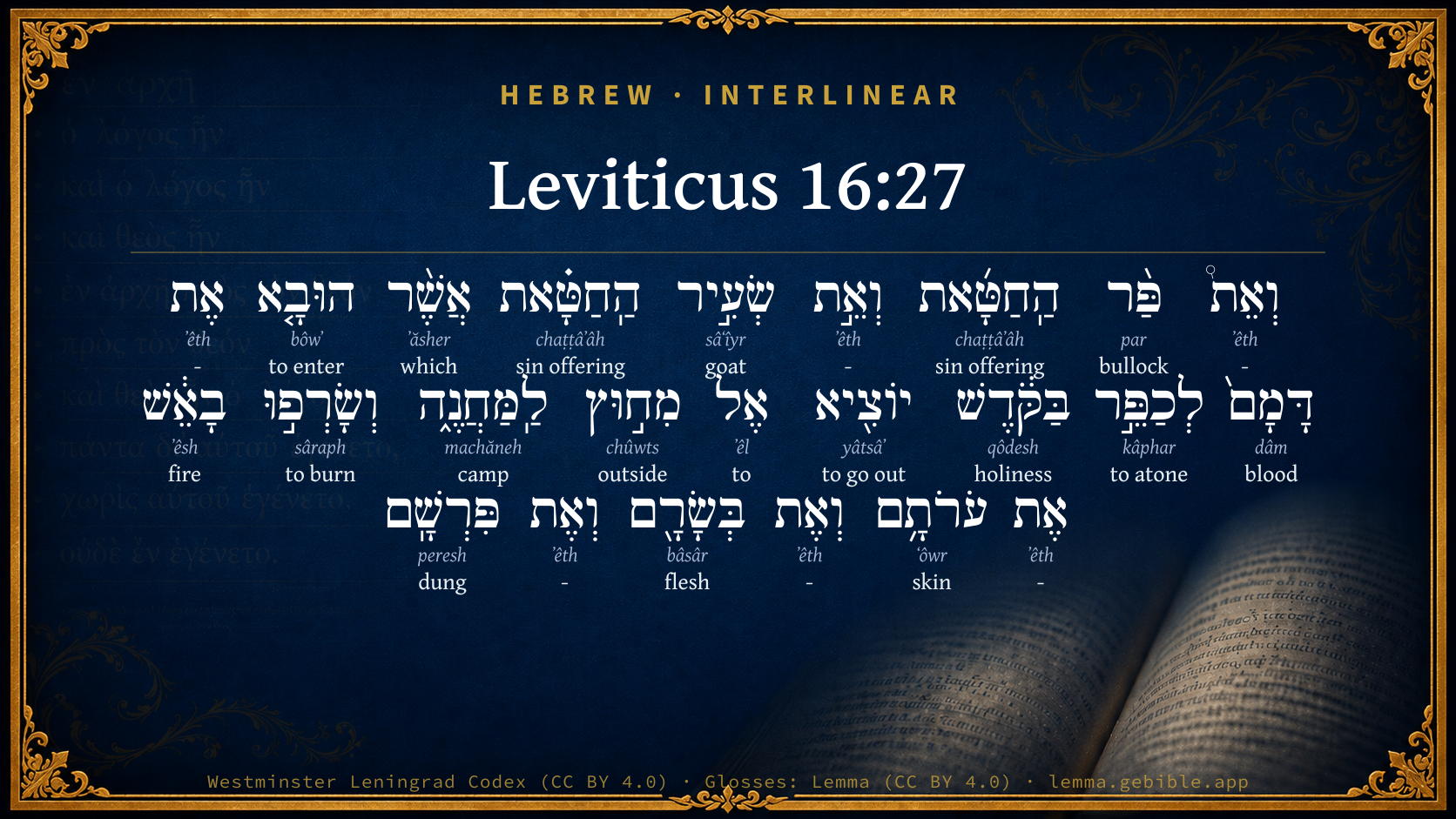
Hebrew (Westminster Leningrad Codex) Leviticus 16:27 appears in the Hebrew Old Testament. The text above is from the Westminster Leningrad Codex. Each word links to its Strong’s number, a concise gloss, and parsing drawn from the Open Scriptures Hebrew Bible morphology. Click any word for its full Brown-Driver-Briggs (BDB) entry.
Download image
Cite this verse

Leviticus 16:27 (World English Bible). Public Domain. Lemma interlinear Bible study tool, https://lemma.gebible.app/v/leviticus/16/27.

Show BibTeX & RIS
BibTeX
RIS
English Translation
The bull for the sin offering, and the goat for the sin offering, whose blood was brought in to make atonement in the Holy Place, shall be carried forth outside the camp; and they shall burn their skins, their flesh, and their dung with fire.
World English Bible · Public Domain
Download a study sheet

One document with this verse’s original text, its word-by-word gloss line, the meaning frame, cross-references with their text, attributed commentary, and full source and license credits — printable, and it pastes into notes with its structure intact.

This verse Autodidact and up

Study sheet (.html) Plain text (.txt)

A passage Seminary Student

Up to 50 verses in one chapter. A passage sheet keeps up to 6 commentary sources and 12 cross-references per verse, in the order this page ranks them, and says so on the sheet whenever that leaves anything out. Ask for a single verse and you get the Autodidact verse sheet above.

Everything on this page stays free to read, with no account — the sheet is a download of what is already on screen, not access to it.

Want to remove ads? Support Godless Engineer
Compare translations 3

The same verse in 3 English versions, stacked beneath the original-language interlinear above. Click any original word for its lexicon entry.

Each is an independent rendering of the whole verse — the interlinear is not word-aligned to these translations.

Highlighted words mark where these versions differ — a whole-verse word diff, not a word-by-word alignment.

  • World English Bible Public Domain
    The bull for the sin offering, and the goat for the sin offering, whose blood was brought in to make atonement in the Holy Place, shall be carried forth outside the camp; and they shall burn their skins, their flesh, and their dung with fire.
  • King James Version Public Domain
    And the bullock for the sin offering, and the goat for the sin offering, whose blood was brought in to make atonement in the holy place, shall one carry forth without the camp; and they shall burn in the fire their skins, and their flesh, and their dung.
  • unfoldingWord Literal Text CC BY-SA 4.0
    And the bull of the sin offering and the goat of the sin offering, whose blood was brought to make atonement into the Holy Place, shall be brought out to outside of the camp. And they shall burn with fire their skins and their flesh and their dung.

unfoldingWord Literal Text — © unfoldingWord, licensed CC BY-SA 4.0. Word-aligned USFM3 via Door43 (git.door43.org/unfoldingWord/en_ult).

Versions to compare (up to 4)

3 of 4 selected

Show all 18 translations

Every available English version of this verse, each an independent rendering of the whole verse.

  • World English Bible Public Domain
    The bull for the sin offering, and the goat for the sin offering, whose blood was brought in to make atonement in the Holy Place, shall be carried forth outside the camp; and they shall burn their skins, their flesh, and their dung with fire.
  • Berean Standard Bible Public Domain
    The bull for the sin offering and the goat for the sin offering, whose blood was brought into the Most Holy Place to make atonement, must be taken outside the camp; and their hides, flesh, and dung must be burned up.
  • Majority Standard Bible Public Domain
    The bull for the sin offering and the goat for the sin offering, whose blood was brought into the Most Holy Place to make atonement, must be taken outside the camp; and their hides, flesh, and dung must be burned up.
  • King James Version Public Domain
    And the bullock for the sin offering, and the goat for the sin offering, whose blood was brought in to make atonement in the holy place, shall one carry forth without the camp; and they shall burn in the fire their skins, and their flesh, and their dung.
  • American Standard Version (1901) Public Domain
    And the bullock of the sin-offering, and the goat of the sin-offering, whose blood was brought in to make atonement in the holy place, shall be carried forth without the camp; and they shall burn in the fire their skins, and their flesh, and their dung.
  • Revised Version (1885) Public Domain
    And the bullock of the sin offering, and the goat of the sin offering, whose blood was brought in to make atonement in the holy place, shall be carried forth without the camp; and they shall burn in the fire their skins, and their flesh, and their dung.
  • Geneva Bible (1599) Public Domain
    Also the bullocke for the sinne offring, and the goate for the sinne offring (whose blood was brought to make a reconciliation in the Holy place) shall one carie out without the hoste to be burnt in the fire, with their skinnes, and with their flesh, and with their doung.
  • Douay-Rheims (1899) Public Domain
    But the calf and the buck goat, that were sacrificed for sin, and whose blood was carried into the sanctuary, to accomplish the atonement, they shall carry forth without the camp, e and shall burn with fire, their skins and their flesh, and their dung:
  • Young's Literal Translation Public Domain
    `And the bullock of the sin-offering, and the goat of the sin-offering, whose blood hath been brought in to make atonement in the sanctuary, doth `one' bring out unto the outside of the camp, and they have burnt with fire their skins, and their flesh, and their dung;
  • Literal Standard Version CC BY-SA 4.0
    And the bullock of the sin-offering and the goat of the sin-offering, whose blood has been brought in to make atonement in the holy place, [one] brings out to the outside of the camp, and they have burned their skins, and their flesh, and their dung with fire;
  • Unlocked Literal Bible CC BY-SA 4.0
    The bull for the sin offering and the goat for the sin offering, whose blood was brought in to make atonement in the holy place, must be carried outside the camp. There they must burn their hides, flesh, and dung.
  • unfoldingWord Literal Text CC BY-SA 4.0
    And the bull of the sin offering and the goat of the sin offering, whose blood was brought to make atonement into the Holy Place, shall be brought out to outside of the camp. And they shall burn with fire their skins and their flesh and their dung.
  • Darby Bible Public Domain
    And the bullock of the sin-offering, and the goat of the sin-offering whose blood was brought in to make atonement in the sanctuary, shall one carry forth outside the camp; and they shall burn with fire their skins, and their flesh, and their dung.
  • World Messianic Bible Public Domain
    The bull for the sin offering, and the goat for the sin offering, whose blood was brought in to make atonement in the Holy Place, shall be carried outside the camp; and they shall burn their skins, their flesh, and their dung with fire.
  • Webster's Bible Public Domain
    And the bullock for the sin-offering, and the goat for the sin-offering, whose blood was brought in to make atonement in the holy place, shall one carry forth without the camp; and they shall burn in the fire their skins, and their flesh, and their dung.
  • Free Bible Version CC BY-SA 4.0
    The remains of the bull used for the sin offering and the goat for the sin offering, whose blood was brought into the Most Holy Place to purify it, must be taken outside the camp. Their skin, meat, and waste must be burned.
  • Bible in Basic English Public Domain
    And the ox of the sin-offering and the goat of the sin-offering, whose blood was taken in to make the holy place free from sin, are to be taken away outside the tent-circle and their skins and their flesh and their waste are to be burned with fire.
  • JPS Tanakh (1917) Public Domain
    And the bullock of the sin-offering, and the goat of the sin-offering, whose blood was brought in to make atonement in the holy place, shall be carried forth without the camp; and they shall burn in the fire their skins, and their flesh, and their dung.

Literal Standard Version (2020), Covenant Press — licensed CC BY-SA 4.0. Text via the HelloAO Bible API (eBible.org). Unlocked Literal Bible (unfoldingWord) — licensed CC BY-SA 4.0. Text via the HelloAO Bible API (eBible.org). unfoldingWord Literal Text — © unfoldingWord, licensed CC BY-SA 4.0. Word-aligned USFM3 via Door43 (git.door43.org/unfoldingWord/en_ult). Free Bible Version, Dr. Jonathan Gallagher — licensed CC BY-SA 4.0. Text via the HelloAO Bible API (eBible.org).

Word by word

More ways to search: Search by grammar → Find every occurrence → Compare this word →

Practice this passage: Drill this verse → Learn its vocabulary →

פִּרְשָֽׁם
peresh
H6569
“dung · their”
Noun, Common, Masculine, Singular, Construct + Suffix, Personal, 3rd Person, Masculine, Plural
Part of Speech
Noun
Type
Common
Gender
Masculine
Number
Singular
State
Construct
Full BDB Definition

Origin: from H6567

TWOT: 1835a

faecal matter, dung, offal
  1. וְאֵת֩ ʼêth H853 “and · -” Conjunction + Particle, Direct Object
  2. פַּ֨ר par H6499 “bullock of” Noun, Common, Masculine, Singular, Construct
  3. הַֽחַטָּ֜את chaṭṭâʼâh H2403 “the · sin offering” Particle, Definite Article + Noun, Common, Feminine, Singular, Absolute
  4. וְאֵ֣ת ʼêth H853 “and · -” Conjunction + Particle, Direct Object
  5. שְׂעִ֣יר sâʻîyr H8163 “goat of” Noun, Common, Masculine, Singular, Construct
  6. הַֽחַטָּ֗את chaṭṭâʼâh H2403 “the · sin offering” Particle, Definite Article + Noun, Common, Feminine, Singular, Absolute
  7. אֲשֶׁ֨ר ʼăsher H834 “which” Particle, Relative
  8. הוּבָ֤א bôwʼ H935 “to enter” Verb, Hophal, Perfect, 3rd Person, Masculine, Singular
  9. אֶת ʼêth H853 “-” Particle, Direct Object
  10. דָּמָם֙ dâm H1818 “blood · their” Noun, Common, Masculine, Singular, Construct + Suffix, Personal, 3rd Person, Masculine, Plural
  11. לְכַפֵּ֣ר kâphar H3722 “to atone” Preposition + Verb, Piel, Infinitive Construct
  12. בַּקֹּ֔דֶשׁ qôdesh H6944 “in/at the · holiness” Preposition, Determined + Noun, Common, Masculine, Singular, Absolute
  13. יוֹצִ֖יא yâtsâʼ H3318 “to go out” Verb, Hiphil, Imperfect, 3rd Person, Masculine, Singular
  14. אֶל ʼêl H413 “to” Preposition
  15. מִח֣וּץ chûwts H2351 “from · outside” Preposition + Noun, Common, Masculine, Singular, Absolute
  16. לַֽמַּחֲנֶ֑ה machăneh H4264 “to/for the · camp” Preposition, Determined + Noun, Common, Both, Singular, Absolute
  17. וְשָׂרְפ֣וּ sâraph H8313 “and · to burn” Conjunction + Verb, Qal, Sequential Perfect, 3rd Person, Common, Plural
  18. בָאֵ֔שׁ ʼêsh H784 “in/at the · fire” Preposition, Determined + Noun, Common, Both, Singular, Absolute
  19. אֶת ʼêth H853 “-” Particle, Direct Object
  20. עֹרֹתָ֥ם ʻôwr H5785 “skins · their” Noun, Common, Masculine, Plural, Construct + Suffix, Personal, 3rd Person, Masculine, Plural
  21. וְאֶת ʼêth H853 “and · -” Conjunction + Particle, Direct Object
  22. בְּשָׂרָ֖ם bâsâr H1320 “flesh · their” Noun, Common, Masculine, Singular, Construct + Suffix, Personal, 3rd Person, Masculine, Plural
  23. וְאֶת ʼêth H853 “and · -” Conjunction + Particle, Direct Object

About this verse

These counts appear in no published source. They are computed here, from the morphology-tagged text and Lemma’s own curated glosses. What Lemma adds →

24
words
18
distinct lemmas
Pentateuch
section

Notable vocabulary

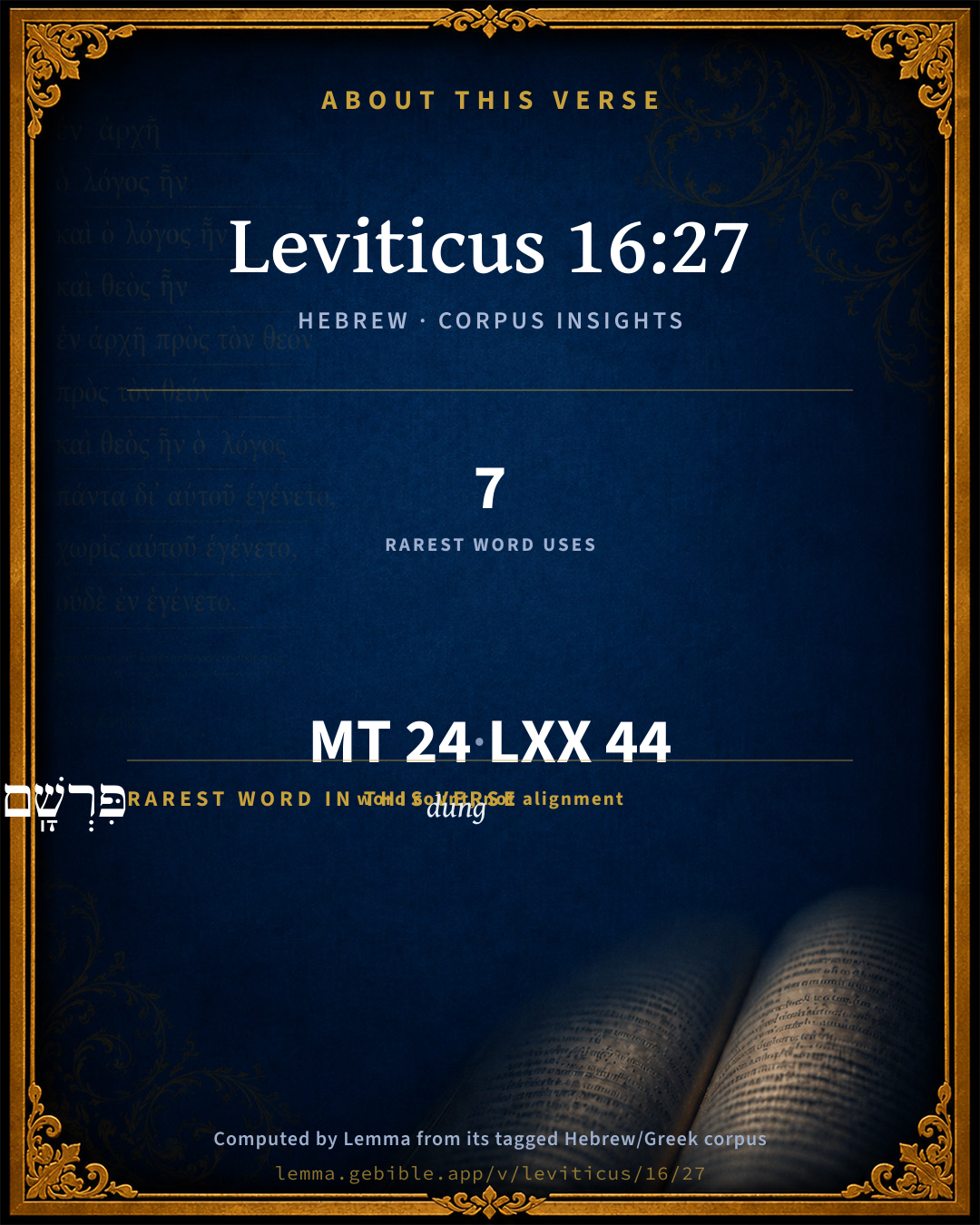
The rarest word here is פִּרְשָֽׁם dung H6569 — appearing just 7 times in the whole Hebrew Bible.

Shared distinctive vocabulary

פִּרְשָֽׁם dung H6569 occurs in 6 verses of the Hebrew Bible. Also found in:

Grammatical profile

  • 4 verbs
  • 12 nouns
  • 1 preposition
  • 7 particles

Verb forms

  • הוּבָ֤א Hophal · Perfect
  • לְכַפֵּ֣ר Piel · Infinitive Construct
  • יוֹצִ֖יא Hiphil · Imperfect
  • וְשָׂרְפ֣וּ Qal · Sequential Perfect

Repetition

A word recurs within this verse — often emphatic in Hebrew:

  • הַֽחַטָּ֜את sin offering H2403 ×2

Hebrew & Septuagint length

In English translation the verse runs 45 words from the Hebrew and 46 from the Septuagint (LXX English) — closely comparable.

A rough comparison of the two English renderings, which tokenize alike — not a word-level alignment.

Word counts can differ between the Hebrew and the Greek without any difference in meaning — e.g. the Hebrew direct-object marker אֵת has no separate Greek word, and Greek often adds the article ὁ.

In the original languages it is 24 Hebrew tokens and 44 Greek tokens — but the two are counted differently (Hebrew bundles its prefixes and suffixes into one token; the Greek is in lemma form), so that isn’t a like-for-like length.

Cross-references

6

Topical passages linked to Leviticus 16:27 in the Treasury of Scripture Knowledge — connected by theme and wording, ordered by reader-vote popularity; previews shown in the World English Bible.

  • Leviticus 4:21 He shall carry forth the bull outside the camp, and burn it as he burned the first bull. It is the sin offering for the assembly.
  • Leviticus 6:30 No sin offering, of which any of the blood is brought into the Tent of Meeting to make atonement in the Holy Place, shall be eaten: it shall be burned with fire.
  • Leviticus 4:11–12 The bull's skin, all its flesh, with its head, and with its legs, its innards, and its dung,
  • Leviticus 8:17 But the bull, and its skin, and its flesh, and its dung, he burned with fire outside the camp; as Yahweh commanded Moses.
  • Matthew 27:31–33 When they had mocked him, they took the robe off of him, and put his clothes on him, and led him away to crucify him.
  • Hebrews 13:11–14 For the bodies of those animals, whose blood is brought into the holy place by the high priest as an offering for sin, are burned outside of the camp.

Cross-references courtesy of OpenBible.info (CC BY 4.0).

Hebrew and Greek witnesses Masoretic Hebrew ↔ Greek Septuagint

The same verse in the two great witnesses to the Old Testament, shown verse-for-verse.

These are two independent witnesses, not word-aligned to each other, and the Septuagint is shown in lemma (dictionary) form.

Hebrew Leviticus 16:27 Masoretic · Westminster Leningrad Codex

וְאֵת֩ פַּ֨ר הַֽחַטָּ֜את וְאֵ֣ת שְׂעִ֣יר הַֽחַטָּ֗את אֲשֶׁ֨ר הוּבָ֤א אֶת דָּמָם֙ לְכַפֵּ֣ר בַּקֹּ֔דֶשׁ יוֹצִ֖יא אֶל מִח֣וּץ לַֽמַּחֲנֶ֑ה וְשָׂרְפ֣וּ בָאֵ֔שׁ אֶת עֹרֹתָ֥ם וְאֶת בְּשָׂרָ֖ם וְאֶת פִּרְשָֽׁם

The bull for the sin offering, and the goat for the sin offering, whose blood was brought in to make atonement in the Holy Place, shall be carried forth outside the camp; and they shall burn their skins, their flesh, and their dung with fire.

World English Bible · Public Domain

Greek LXX Leviticus 16:27 Septuagint · lemma form

καί ὁ μόσχος ὁ περί ὁ ἁμαρτία καί ὁ χίμαρος ὁ περί ὁ ἁμαρτία ὅς ὁ αἷμα εἰςφέρω ἐκἱλάσκομαι ἐν ὁ ἅγιος ἐκφέρω αὐτός ἔξω ὁ παρεμβολή καί κατακαίω αὐτός ἐν πῦρ καί ὁ δέρμα αὐτός καί ὁ κρέας αὐτός καί ὁ κόπρος αὐτός

And the calf for the sin-offering, and the goat for the sin-offering, whose blood was brought in to make atonement in the holy place, they shall carry forth out of the camp, and burn them with fire, even their skins and their flesh and their dung.

LXX2012 (modern English Septuagint) · Public Domain

Hebrew: Westminster Leningrad Codex (CC BY 4.0). Greek: Septuagint (public domain); English from LXX2012 (modern English Septuagint) (Public Domain). How the Septuagint differs from the Hebrew →

Targum (Aramaic paraphrase)

2

The Targum is the ancient Jewish Aramaic paraphrase of the Hebrew Scriptures — an interpretive translation, not the Hebrew text itself. Onkelos (literal) and Pseudo-Jonathan (expansive) render the Torah, and Jonathan the Prophets. Coverage is partial: where no permissively-licensed English translation exists for a verse, only the Aramaic is shown. This is verse-level text, not a word-by-word alignment to the Hebrew.

  1. Targum Onkelos Torah (Genesis–Deuteronomy)
    וְיָת תּוֹרָא דְחַטָאתָא וְיָת צְפִירָא דְחַטָאתָא דִי אִתָּעַל מִדִמְהוֹן לְכַפָּרָא בְקוּדְשָׁא יִתַּפְּקוּן לְמִבָּרָא לְמַשְּׁרִיתָא וְיוֹקְדוּן בְּנוּרָא יָת מַשְׁכֵּיהוֹן וְיָת בִּסְרְהוֹן וְיָת אָכְלֵיהוֹן

    (no public-domain English translation for this verse)

    Targum Onkelos — Aramaic: “Onkelos Genesis” (public domain); “Onkelos Exodus” (public domain); “Onkelos Leviticus” (public domain); “Onkelos Numbers” (public domain); “Onkelos Deuteronomy” (public domain). English: “Sefaria Community Translation” (CC0 1.0 (public-domain dedication)); “J.W. Etheridge. The Targums of Onkelos and Jonathan Ben Uzziel on the Pentateuch. London: Longmans, Green, 1862” (public domain). Text via Sefaria.

  2. Targum Pseudo-Jonathan Torah (Genesis–Deuteronomy)
    וְיַת תּוֹרָא דְחַטָאתָא וְיַת צְפִירָא דְחַטָאתָא דְאִיתְעַל מִן אַדְמֵיהוֹן לְכַפָּרָא בְּקוּדְשָׁא יִתַּפְקוּן בְּאַסְלוּן עַל יְדֵיהוֹן דִּיטְלָא דְכַהֲנַיָא וִיסוֹבָרוֹנוּן לְמִבָּרָא לְמַשְׁרִיתָא וְיוֹקְדוּן בְּנוּרָא יַת מַשְׁכֵיהוֹן וְיַת בִּשְרֵיהוֹן וְיַת רֵיעֵיהוֹן

    But the bullock for the sin offering, and the goat for the sin offering, whose blood was brought into the sanctuary to make atonement, shall be carried away upon carriages by the hands of young men who are priests; and they shall bear them without the camp, and burn them with fire, their skin, their flesh, and their dung.

    Targum Pseudo-Jonathan — Aramaic: “Targum Jonathan on Genesis” (public domain); “Targum Jonathan on Exodus” (public domain); “Targum Jonathan on Leviticus” (public domain); “Targum Jonathan on Numbers” (public domain); “Targum Jonathan on Deuteronomy” (public domain). English: “The Targum of Jonathan ben Uzziel, trans. J. W. Etheridge, London, 1862” (public domain). Text via Sefaria.

Commentary

Notes on Leviticus 16:27 from classic Christian and Jewish commentators (each source and its license shown beneath its notes). The classic Christian expositions comment on the surrounding passage and are grouped to its opening verse, so a note may address several verses; the Jewish commentaries on the Tanakh (Rashi and others) are per-verse, so they appear only where the commentator wrote on this verse.

Lemma curates 59 commentaries, every one of them public domain or Creative Commons licensed, each selected and text-cleaned for this edition rather than reprinted as found. About our sources →

Trapp's Complete Commentary

John Trapp

Lev 16:27 And the bullock [for] the sin offering, and the goat [for] the sin offering, whose blood was brought in to make atonement in the holy [place], shall [one] carry forth without the camp; and they shall burn in the fire their skins, and their flesh, and their dung.

Ver. 27. Without the camp.] See Heb 13:11; Heb 13:14.

John Trapp, A Commentary or Exposition upon All the Books of the Old and New Testament (1647–1656) — public domain. Text from a community e-Sword module.

Tyndale Open Study Notes

Tyndale Open Resources

16:27 For the Day of Atonement, the high priest took the blood of the sin offerings . . . into the Most Holy Place. As a result, the offerings were burned and not eaten (4:3-21).

Tyndale Open Study Notes — © Tyndale Open Resources, licensed CC BY-SA 4.0. Text via the HelloAO Bible API.

Geneva Bible (1599)

Geneva Bible translators

Lev. 6:30; Heb. 15:11

Geneva Bible (1599) marginal notes — public domain. Text via Bolls.life.

Ellicott's Commentary for English Readers

(27) And the bullock.—That is, the bodies of the sin offerings for the priests and the people (see Lev_16:5-6; Lev_16:9; Lev_16:11), whose blood the high priest carried into the Holy of Holies. (See Lev_16:14-15, with Lev_4:11-12.)

Shall one carry forth.—Better shall be carried forth. During the second Temple four men carried the carcases upon two poles to the place set aside outside Jerusalem for burning. (See Lev_4:11.) Hence the ancient Palestinian Targum translates it, “they shall be carried out on poles by the hands of the younger priests.” As has already been remarked, the priest performed this part of the service immediately after the goat was dispatched by the messenger to the wilderness. Whilst the victims were being burned outside the camp the high priest read in the women’s court the appointed lessons for the Day of Atonement (viz., Lev_23:26; Num_29:7-11) in the presence of the congregation, who were all standing, and at the conclusion of the reading pronounced the eight benedictions (1) on the Divine Law, (2) on the public service, (3) on confession, (4) forgiveness of sins, (5) on Jerusalem, (6) on the Temple, (7) on Israel, and (8) on the priesthood.

A Bible Commentary for English Readers, edited by Charles John Ellicott (1878–1897) — public domain. Text from a community e-Sword module.

John Gill's Exposition

And he that burneth them shall wash his clothes, and bathe his flesh in water,.... In forty seahs of water, as the Targum of Jonathan; that is, everyone of those that burnt them, as Aben Ezra observes; for these being sin offerings, and had a connection with the sins of men, for whom they were offered, the persons concerned in the carrying and burning of them were equally defiled, and needed washing, as the man that led and let go the goat into the wilderness:

and afterwards he shall come into the camp; and have the liberty of conversation with men in civil and religious things, but not till evening; so long he was defiled; and according to the Misnah (u) from the time they got without the walls of the court; and after washing and bathing, and when the evening was come, they were clean; and might go where they pleased,

(u) Misn. Yoma, c. 6. sect. 7.0

John Gill's Exposition of the Whole Bible (1746–1763) — public domain (CC PDM 1.0). Text via the HelloAO Bible API.

The Pulpit Commentary

Vers. 27, 28. As the blood of the bullock and the goat which had been offered in the special expiatory sacrifices of the day had been carried within the sanctuary (verses 14, 15), their bodies had to be burnt without the comp. (Lev_4:12) Our Lord being the antitype, not only of Aaron as the Great High Priest, but also of the expiatory sacrifices as the Great Sin Offering, the author of the Epistle to the Hebrews notices that the fact of Christ"s having "suffered without the camp" serves as an indication that his blood had in its atoning effects been carried by him into heaven, the antitype of the holy of holies. (Heb_13:12) The flesh of the other goat, offered as a sin offering, would have been eaten by the priests in the evening, at a sacrificial meal. (Lev_10:17, Lev_10:18)

The Pulpit Commentary (1880–1919), ed. H.D.M. Spence-Jones & Joseph S. Exell — public domain. Text from a community e-Sword module.

Scofield Reference Notes

C. I. Scofield

atonement (See Scofield "Exo 29:33").

The Scofield Reference Bible (1917 edition), notes by C. I. Scofield — public domain. Text from a community e-Sword module.

unfoldingWord translationNotes

Door43 World Missions Community

whose blood was brought

This can be translated in active form. AT: "whose blood Aaron brought" (See: Active or Passive)

must be carried

This can be translated in active form. AT: "someone must carry" (See: Active or Passive)

their hides

"their skins." Here "their" refers to the bull and the goat.

translationWords

cow

blood

flesh

dung

unfoldingWord translationNotes — © Distant Shores Media and the Door43 World Missions Community, licensed CC BY-SA 4.0. Source: git.door43.org/Door43/en_tn.

Rashi

Rabbi Shlomo Yitzchaki (Rashi)

אשר הובא את דמם WHOSE BLOOD WAS BROUGHT into the Heichal and the Innermost (the Holy of Holies).

Rashi on the Tanakh — English translations: “The Judaica Press complete Tanach with Rashi, translated by A. J. Rosenberg” (CC BY 4.0); “Pentateuch with Rashi's commentary by M. Rosenbaum and A.M. Silbermann, 1929-1934” (public domain); “The Metsudah Tanach series, Lakewood, N.J” (CC BY 4.0); and “The Book of Joshua, Metsudah Publications, 1997” (CC BY 4.0). Text via Sefaria.

Ramban (Nachmanides)

Rabbi Moshe ben Nachman (Ramban / Nachmanides)

AND THE BULLOCK OF THE SIN-OFFERING, AND THE GOAT OF THE SIN-OFFERING … HE SHALL CARRY FORTH WITHOUT THE CAMP. In the opinion of Rabbi Abraham ibn Ezra, ‘he’ shall carry forth means Aaron, who has been mentioned in this section, [and he is to do it] by commanding others [to carry them forth without the camp]. The correct interpretation is that it means: yotzi hamotzi (“whoever shall carry them forth, shall carry them forth” without the camp). Similarly, the expression and they shall burn [in the verse before us] means, “and they that burn them, shall burn them.” Scripture states it in the plural, and ‘they’ shall burn, in order to teach us that if many people were engaged in the burning thereof — such as if one brought the fire, another arranged the wood of the pile, and another kindled the fire — only the garments of him who kindled the fire in the bullocks themselves are rendered impure, as soon as the fire takes hold of the greater part of it. That is why Scripture goes back and states it in the singular, and he that burneth them shall wash his clothes.

Ramban (Nachmanides) on the Tanakh — English translation: “Commentary on the Torah by Ramban (Nachmanides). Translated and annotated by Charles B. Chavel. New York, Shilo Pub. House, 1971-1976” (CC BY 4.0). Text via Sefaria.

Lesson kit

Teaching starters — assembled from the data on this page, not authored interpretation. Every prompt links to the verse data it draws on. Edit before teaching.

Leviticus, in the Pentateuch, opens this verse with 24 words (18 distinct Hebrew lemmas). Its most distinctive word is peresh (“dung”). A historical commentator’s framing appears above. Read the whole chapter for the surrounding context.

Discussion questions

  1. What does “dung” (peresh) contribute to the verse as a whole?
  2. Exodus 29:14 shares the word «dung» with this verse. How do the two illuminate each other?
  3. “sin offering” occurs 2× in this one verse. What is the effect of the repetition?
  4. The translations on this page render this verse differently — a whole-verse word diff, not a word-by-word alignment. What might account for the different wordings?
  5. The verb «הוּבָ֤א» is Hophal Perfect. How does its form color the action?
  6. Reading how Trapp's Complete Commentary and Tyndale Open Study Notes read this verse, where do the two commentators agree and where do they part?

Things to notice

Reading settings

Reading text

Shown beneath each verse's original-language words.

Old Testament
Old Testament edition

Read the OT as the Masoretic Hebrew (MT) or the Greek Septuagint (LXX).

English shown for the Greek Septuagint (in the Hebrew ↔ Greek comparison).

Comparing translations? Open the Compare panel on any verse page to stack up to four side by side.