
Numbers 31:23

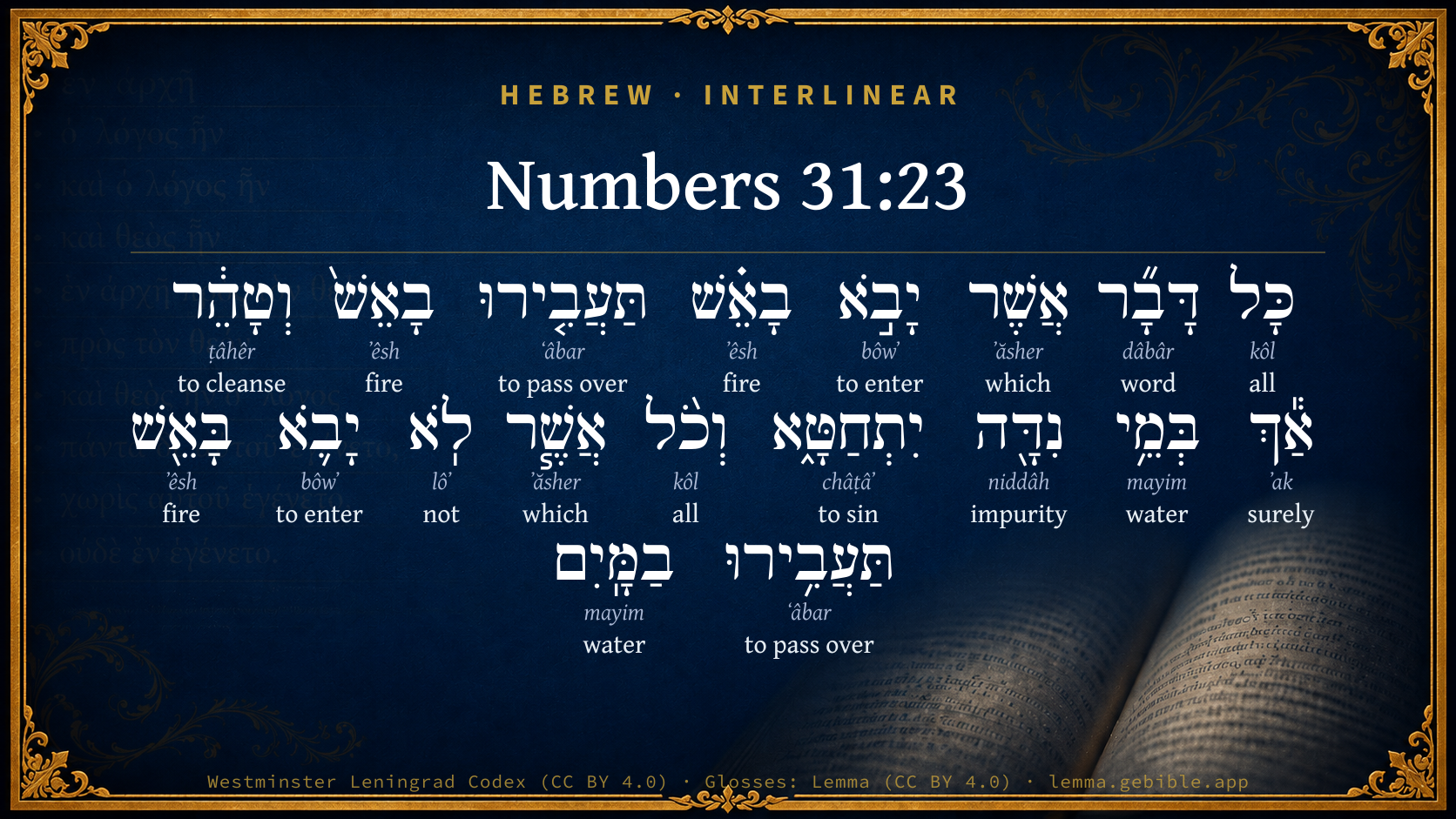
Hebrew (Westminster Leningrad Codex) Numbers 31:23 appears in the Hebrew Old Testament. The text above is from the Westminster Leningrad Codex. Each word links to its Strong’s number, a concise gloss, and parsing drawn from the Open Scriptures Hebrew Bible morphology. Click any word for its full Brown-Driver-Briggs (BDB) entry.
Download image
Cite this verse

Numbers 31:23 (World English Bible). Public Domain. Lemma interlinear Bible study tool, https://lemma.gebible.app/v/numbers/31/23.

Show BibTeX & RIS
BibTeX
RIS
English Translation
everything that may abide the fire, you shall make to go through the fire, and it shall be clean; nevertheless it shall be purified with the water for impurity: and all that doesn't withstand the fire you shall make to go through the water.
World English Bible · Public Domain
Download a study sheet

One document with this verse’s original text, its word-by-word gloss line, the meaning frame, cross-references with their text, attributed commentary, and full source and license credits — printable, and it pastes into notes with its structure intact.

This verse Autodidact and up

Study sheet (.html) Plain text (.txt)

A passage Seminary Student

Up to 50 verses in one chapter. A passage sheet keeps up to 6 commentary sources and 12 cross-references per verse, in the order this page ranks them, and says so on the sheet whenever that leaves anything out. Ask for a single verse and you get the Autodidact verse sheet above.

Everything on this page stays free to read, with no account — the sheet is a download of what is already on screen, not access to it.

Want to remove ads? Support Godless Engineer
Compare translations 3

The same verse in 3 English versions, stacked beneath the original-language interlinear above. Click any original word for its lexicon entry.

Each is an independent rendering of the whole verse — the interlinear is not word-aligned to these translations.

Highlighted words mark where these versions differ — a whole-verse word diff, not a word-by-word alignment.

  • World English Bible Public Domain
    everything that may abide the fire, you shall make to go through the fire, and it shall be clean; nevertheless it shall be purified with the water for impurity: and all that doesn't withstand the fire you shall make to go through the water.
  • King James Version Public Domain
    Every thing that may abide the fire, ye shall make it go through the fire, and it shall be clean: nevertheless it shall be purified with the water of separation: and all that abideth not the fire ye shall make go through the water.
  • unfoldingWord Literal Text CC BY-SA 4.0
    every thing that can come through the fire you shall pass through the fire, and it will become clean. However, it shall be purified with the water of purification, and all that can not come through the fire you shall pass through the water.

unfoldingWord Literal Text — © unfoldingWord, licensed CC BY-SA 4.0. Word-aligned USFM3 via Door43 (git.door43.org/unfoldingWord/en_ult).

Versions to compare (up to 4)

3 of 4 selected

Show all 18 translations

Every available English version of this verse, each an independent rendering of the whole verse.

  • World English Bible Public Domain
    everything that may abide the fire, you shall make to go through the fire, and it shall be clean; nevertheless it shall be purified with the water for impurity: and all that doesn't withstand the fire you shall make to go through the water.
  • Berean Standard Bible Public Domain
    everything that can withstand the fire—must be put through the fire, and it will be clean. But it must still be purified with the water of purification. And everything that cannot withstand the fire must pass through the water.
  • Majority Standard Bible Public Domain
    everything that can withstand the fire—must be put through the fire, and it will be clean. But it must still be purified with the water of purification. And everything that cannot withstand the fire must pass through the water.
  • King James Version Public Domain
    Every thing that may abide the fire, ye shall make it go through the fire, and it shall be clean: nevertheless it shall be purified with the water of separation: and all that abideth not the fire ye shall make go through the water.
  • American Standard Version (1901) Public Domain
    everything that may abide the fire, ye shall make to go through the fire, and it shall be clean; nevertheless it shall be purified with the water for impurity: and all that abideth not the fire ye shall make to go through the water.
  • Revised Version (1885) Public Domain
    every thing that may abide the fire, ye shall make to go through the fire, and it shall be clean; nevertheless it shall be purified with the water of separation: and all that abideth not the fire ye shall make to go through the water.
  • Geneva Bible (1599) Public Domain
    Euen all that may abide the fire, yee shall make it goe through the fire, and it shalbe cleane: yet, it shalbe purified with the water of purification: and all that suffereth not the fire, yee shall cause to passe by the water.
  • Douay-Rheims (1899) Public Domain
    And all that may pass through the fire, shall be purified by fire, but whatsoever cannot abide the fire, shall be sanctified with the water of expiation:
  • Young's Literal Translation Public Domain
    every thing which may go into fire, ye cause to pass over through fire, and it hath been clean; only, with the water of separation it is cleansed, and all that may not go into fire, ye cause to pass over through water;
  • Literal Standard Version CC BY-SA 4.0
    everything which may go into fire, you cause to pass over through fire, and it has been clean; it is surely cleansed with the water of separation; and all that may not go into fire, you cause to pass over through water;
  • Unlocked Literal Bible CC BY-SA 4.0
    and everything that resists fire, you must put it through the fire, and it will become clean. You must then purify those things with the water of cleansing. Whatever cannot go through the fire you must cleanse with that water.
  • unfoldingWord Literal Text CC BY-SA 4.0
    every thing that can come through the fire you shall pass through the fire, and it will become clean. However, it shall be purified with the water of purification, and all that can not come through the fire you shall pass through the water.
  • Darby Bible Public Domain
    everything that passeth through the fire, ye shall make it go through the fire, and it shall be clean; only it shall be purified with the water of separation; and everything that cannot pass through the fire ye shall make go through the water.
  • World Messianic Bible Public Domain
    everything that may withstand the fire, you shall make to go through the fire, and it shall be clean; nevertheless it shall be purified with the water for impurity. All that doesn’t withstand the fire you shall make to go through the water.
  • Webster's Bible Public Domain
    Every thing that may abide the fire, ye shall make it go through the fire, and it shall be clean: nevertheless it shall be purified with the water of separation: and all that abideth not the fire ye shall make go through the water.
  • Free Bible Version CC BY-SA 4.0
    anything that doesn't burn—must be put through fire to make it clean. But it still has to be purified using water of purification. Anything that burns must be put through the water.
  • Bible in Basic English Public Domain
    And anything which may be heated, is to go through the fire and be made clean; but in addition it is to be put in the water of cleaning: and anything which may not go through the fire is to be put in the water.
  • JPS Tanakh (1917) Public Domain
    every thing that may abide the fire, ye shall make to go through the fire, and it shall be clean; nevertheless it shall be purified with the water of sprinkling; and all that abideth not the fire ye shall make to go through the water.

Literal Standard Version (2020), Covenant Press — licensed CC BY-SA 4.0. Text via the HelloAO Bible API (eBible.org). Unlocked Literal Bible (unfoldingWord) — licensed CC BY-SA 4.0. Text via the HelloAO Bible API (eBible.org). unfoldingWord Literal Text — © unfoldingWord, licensed CC BY-SA 4.0. Word-aligned USFM3 via Door43 (git.door43.org/unfoldingWord/en_ult). Free Bible Version, Dr. Jonathan Gallagher — licensed CC BY-SA 4.0. Text via the HelloAO Bible API (eBible.org).

Word by word

More ways to search: Search by grammar → Find every occurrence → Compare this word →

Practice this passage: Drill this verse → Learn its vocabulary →

נִדָּ֖ה
niddâh
H5079
“impurity”
Noun, Common, Feminine, Singular, Absolute
Part of Speech
Noun
Type
Common
Gender
Feminine
Number
Singular
State
Absolute
Full BDB Definition

Origin: from H5074

TWOT: 1302a

impurity, filthiness, menstruous, set apart - impurity - of ceremonial impurity - of menstruation - impure thing (figuratively) - of idolatry, immorality
  1. כָּל kôl H3605 “all of” Noun, Common, Masculine, Singular, Construct
  2. דָּבָ֞ר dâbâr H1697 “word” Noun, Common, Masculine, Singular, Absolute
  3. אֲשֶׁר ʼăsher H834 “which” Particle, Relative
  4. יָבֹ֣א bôwʼ H935 “to enter” Verb, Qal, Imperfect, 3rd Person, Masculine, Singular
  5. בָאֵ֗שׁ ʼêsh H784 “in/at the · fire” Preposition, Determined + Noun, Common, Both, Singular, Absolute
  6. תַּעֲבִ֤ירוּ ʻâbar H5674 “to pass over” Verb, Hiphil, Imperfect, 2nd Person, Masculine, Plural
  7. בָאֵשׁ֙ ʼêsh H784 “in/at the · fire” Preposition, Determined + Noun, Common, Both, Singular, Absolute
  8. וְטָהֵ֔ר ṭâhêr H2891 “and · to cleanse” Conjunction + Verb, Qal, Sequential Perfect, 3rd Person, Masculine, Singular
  9. אַ֕ךְ ʼak H389 “surely” Particle, Accusative
  10. בְּמֵ֥י mayim H4325 “in/at · water(s) of” Preposition + Noun, Common, Masculine, Plural, Construct
  11. יִתְחַטָּ֑א châṭâʼ H2398 “to sin” Verb, Hithpael, Imperfect, 3rd Person, Masculine, Singular
  12. וְכֹ֨ל kôl H3605 “and · all” Conjunction + Noun, Common, Masculine, Singular, Absolute
  13. אֲשֶׁ֧ר ʼăsher H834 “which” Particle, Relative
  14. לֹֽא lôʼ H3808 “not” Particle, Negative
  15. יָבֹ֛א bôwʼ H935 “to enter” Verb, Qal, Imperfect, 3rd Person, Masculine, Singular
  16. בָּאֵ֖שׁ ʼêsh H784 “in/at the · fire” Preposition, Determined + Noun, Common, Both, Singular, Absolute
  17. תַּעֲבִ֥ירוּ ʻâbar H5674 “to pass over” Verb, Hiphil, Imperfect, 2nd Person, Masculine, Plural
  18. בַמָּֽיִם mayim H4325 “in/at the · water(s)” Preposition, Determined + Noun, Common, Masculine, Plural, Absolute

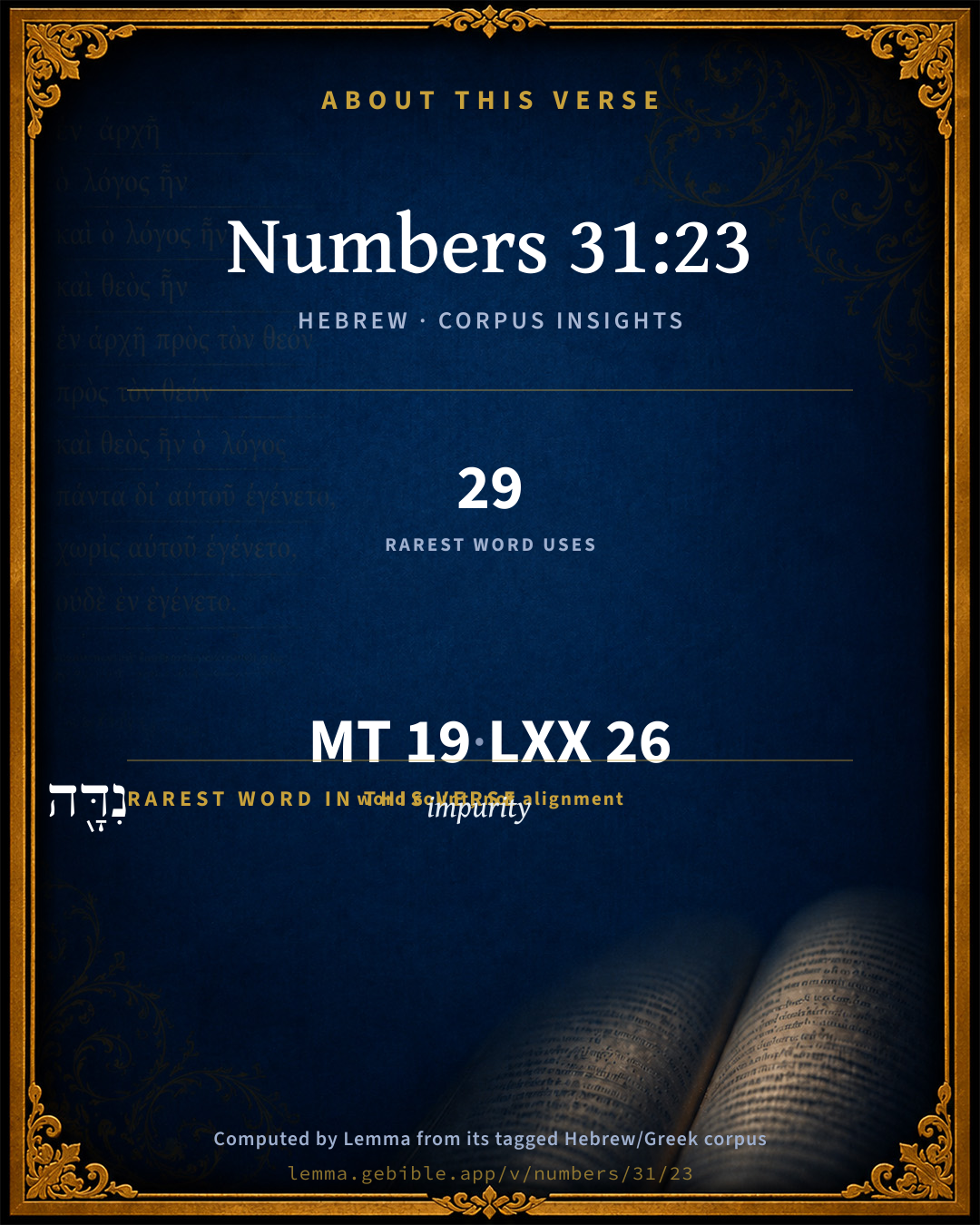
About this verse

These counts appear in no published source. They are computed here, from the morphology-tagged text and Lemma’s own curated glosses. What Lemma adds →

19
words
12
distinct lemmas
Pentateuch
section

Shared distinctive vocabulary

נִדָּ֖ה impurity H5079 occurs in 24 verses of the Hebrew Bible. Also found in:

Grammatical profile

  • 6 verbs
  • 9 nouns
  • 4 particles

Verb forms

  • יָבֹ֣א Qal · Imperfect
  • תַּעֲבִ֤ירוּ Hiphil · Imperfect
  • וְטָהֵ֔ר Qal · Sequential Perfect
  • יִתְחַטָּ֑א Hithpael · Imperfect
  • יָבֹ֛א Qal · Imperfect
  • תַּעֲבִ֥ירוּ Hiphil · Imperfect

Repetition

Words recur within this verse — often emphatic in Hebrew:

  • בָאֵ֗שׁ fire H784 ×3
  • כָּל all H3605 ×2
  • יָבֹ֣א to enter H935 ×2
  • תַּעֲבִ֤ירוּ to pass over H5674 ×2
  • בְּמֵ֥י water H4325 ×2
  • אֲשֶׁר which H834 ×2

Hebrew & Septuagint length

In English translation the verse runs 44 words from the Hebrew and 34 from the Septuagint (LXX English) — closely comparable.

A rough comparison of the two English renderings, which tokenize alike — not a word-level alignment.

Word counts can differ between the Hebrew and the Greek without any difference in meaning — e.g. the Hebrew direct-object marker אֵת has no separate Greek word, and Greek often adds the article ὁ.

In the original languages it is 19 Hebrew tokens and 26 Greek tokens — but the two are counted differently (Hebrew bundles its prefixes and suffixes into one token; the Greek is in lemma form), so that isn’t a like-for-like length.

Cross-references

16

Topical passages linked to Numbers 31:23 in the Treasury of Scripture Knowledge — connected by theme and wording, ordered by reader-vote popularity; previews shown in the World English Bible.

  • Numbers 19:9 A man who is clean shall gather up the ashes of the heifer, and lay them up outside of the camp in a clean place; and it shall be kept for the congregation of the children of Israel for a water for impurity: it is a sin-offering.
  • Numbers 19:17 For the unclean they shall take of the ashes of the burning of the sin-offering; and running water shall be put thereto in a vessel:
  • 1 Corinthians 3:13 each man's work will be revealed. For the Day will declare it, because it is revealed in fire; and the fire itself will test what sort of work each man's work is.
  • Isaiah 43:2 When you pass through the waters, I will be with you; and through the rivers, they shall not overflow you: when you walk through the fire, you shall not be burned, neither shall the flame kindle on you.
  • Matthew 3:11 I indeed baptize you in water for repentance, but he who comes after me is mightier than I, whose shoes I am not worthy to carry. He will baptize you in the Holy Spirit.
  • Leviticus 11:32 On whatever any of them falls when they are dead, it shall be unclean; whether it is any vessel of wood, or clothing, or skin, or sack, whatever vessel it is, with which any work is done, it must be put into water, and it shall be unclean until the evening; then it will be clean.
  • Leviticus 15:17 Every garment, and every skin, whereon the semen is, shall be washed with water, and be unclean until the evening.
  • Numbers 8:7 Thus shall you do to them, to cleanse them: sprinkle the water of cleansing on them, let them shave their whole bodies with a razor, and let them wash their clothes, and cleanse themselves.
  • Zechariah 13:9 I will bring the third part into the fire, And will refine them as silver is refined, And will test them like gold is tested. They will call on my name, and I will hear them. I will say, 'It is my people;' And they will say, 'Yahweh is my God.'"
  • Malachi 2:2–3 If you will not listen, and if you will not lay it to heart, to give glory to my name," says Yahweh of Hosts, "then will I send the curse on you, and I will curse your blessings. Indeed, I have cursed them already, because you do not lay it to heart.
  • Ephesians 5:26 that he might sanctify it, having cleansed it by the washing of water with the word,
  • Titus 3:5–6 not by works of righteousness, which we did ourselves, but according to his mercy, he saved us, through the washing of regeneration and renewing by the Holy Spirit,
  • 1 Peter 1:7 that the proof of your faith, which is more precious than gold that perishes even though it is tested by fire, may be found to result in praise, glory, and honor at the revelation of Jesus Christ--
  • 1 Peter 3:21 This is a symbol of baptism, which now saves you-- not the putting away of the filth of the flesh, but the answer of a good conscience toward God, through the resurrection of Jesus Christ,
  • 1 Peter 4:12 Beloved, don't be astonished at the fiery trial which has come upon you, to test you, as though a strange thing happened to you.
  • Revelation 3:18 I counsel you to buy from me gold refined by fire, that you may become rich; and white garments, that you may clothe yourself, and that the shame of your nakedness may not be revealed; and eye salve to anoint your eyes, that you may see.

Cross-references courtesy of OpenBible.info (CC BY 4.0).

Hebrew and Greek witnesses Masoretic Hebrew ↔ Greek Septuagint

The same verse in the two great witnesses to the Old Testament, shown verse-for-verse.

These are two independent witnesses, not word-aligned to each other, and the Septuagint is shown in lemma (dictionary) form.

Hebrew Numbers 31:23 Masoretic · Westminster Leningrad Codex

כָּל דָּבָ֞ר אֲשֶׁר יָבֹ֣א בָאֵ֗שׁ תַּעֲבִ֤ירוּ בָאֵשׁ֙ וְטָהֵ֔ר אַ֕ךְ בְּמֵ֥י נִדָּ֖ה יִתְחַטָּ֑א וְכֹ֨ל אֲשֶׁ֧ר לֹֽא יָבֹ֛א בָּאֵ֖שׁ תַּעֲבִ֥ירוּ בַמָּֽיִם

everything that may abide the fire, you shall make to go through the fire, and it shall be clean; nevertheless it shall be purified with the water for impurity: and all that doesn't withstand the fire you shall make to go through the water.

World English Bible · Public Domain

Greek LXX Numbers 31:23 Septuagint · lemma form

πᾶς πρᾶγμα ὅς διαἔρχομαι ἐν πῦρ καί καθαρίζω ἀλλά ἤ ὁ ὕδωρ ὁ ἁγνισμός ἁγνίζω καί πᾶς ὅσος ἐάν μή διαπορεύομαι διά πῦρ διαἔρχομαι διά ὕδωρ

every thing that shall pass through the fire shall so be clean, nevertheless it shall be purified with the water of sanctification; and whatever will not pass through the fire shall pass through water.

LXX2012 (modern English Septuagint) · Public Domain

On this verse, Haydock's Catholic Bible Commentary discusses the Septuagint’s reading. Read the note in Commentary ↓

Hebrew: Westminster Leningrad Codex (CC BY 4.0). Greek: Septuagint (public domain); English from LXX2012 (modern English Septuagint) (Public Domain). How the Septuagint differs from the Hebrew →

Targum (Aramaic paraphrase)

2

The Targum is the ancient Jewish Aramaic paraphrase of the Hebrew Scriptures — an interpretive translation, not the Hebrew text itself. Onkelos (literal) and Pseudo-Jonathan (expansive) render the Torah, and Jonathan the Prophets. Coverage is partial: where no permissively-licensed English translation exists for a verse, only the Aramaic is shown. This is verse-level text, not a word-by-word alignment to the Hebrew.

  1. Targum Onkelos Torah (Genesis–Deuteronomy)
    כָּל מִדַעַם דְמִתָּעַל בְּנוּרָא תַּעֲבְרוּנֵיהּ בְּנוּרָא וְיִדְכֵּי בְּרַם בְּמֵי אַדָיוּתָא יִתָּדֵי וְכָל דִי לָא מִתָּעַל בְּנוּרָא תַּעַבְרוּנֵיהּ בְּמַיָא

    (no public-domain English translation for this verse)

    Targum Onkelos — Aramaic: “Onkelos Genesis” (public domain); “Onkelos Exodus” (public domain); “Onkelos Leviticus” (public domain); “Onkelos Numbers” (public domain); “Onkelos Deuteronomy” (public domain). English: “Sefaria Community Translation” (CC0 1.0 (public-domain dedication)); “J.W. Etheridge. The Targums of Onkelos and Jonathan Ben Uzziel on the Pentateuch. London: Longmans, Green, 1862” (public domain). Text via Sefaria.

  2. Targum Pseudo-Jonathan Torah (Genesis–Deuteronomy)
    כָּל מִדַעַם דְאוֹרְחֵיהּ לְמִתַּעֲלָא בְּנוּרָא לְבִיסַיָא קְדֵירָתָא שִׁפּוּדַיָא וְאַסְכְּלָתָא תַּעַבְרוּן בְּנוּרָא וְיִדְכֵּי בָּתַר כֵּן בְּמַיָא דְכַשְׁרִין לְאַדְכָּאָה בְּהוֹן דְוָותָא יִתְדֵי וְכָל דְלָא מִיתָעַל בְּנוּרָא כְּהַנְכָתָא כַּסַיָא קַתּוּנְיָא קוּמְקוּמוּסַיָא תַּעַבְרוּן בְּאַרְבְּעִין סָוִוין דְמוֹי

    every thing whose nature it is to abide the fire, of the pans, pots, spits, and gridirons, you shall make to pass through fire to purify them, and afterward (sprinkle them) with water such as is used to purify the unclean; but whatever will not abide the fire coverlids, cups flagons, and utensils, you shall make to pass through forty sata of water;

    Targum Pseudo-Jonathan — Aramaic: “Targum Jonathan on Genesis” (public domain); “Targum Jonathan on Exodus” (public domain); “Targum Jonathan on Leviticus” (public domain); “Targum Jonathan on Numbers” (public domain); “Targum Jonathan on Deuteronomy” (public domain). English: “The Targum of Jonathan ben Uzziel, trans. J. W. Etheridge, London, 1862” (public domain). Text via Sefaria.

Commentary

Notes on Numbers 31:23 from classic Christian and Jewish commentators (each source and its license shown beneath its notes). The classic Christian expositions comment on the surrounding passage and are grouped to its opening verse, so a note may address several verses; the Jewish commentaries on the Tanakh (Rashi and others) are per-verse, so they appear only where the commentator wrote on this verse.

Lemma curates 59 commentaries, every one of them public domain or Creative Commons licensed, each selected and text-cleaned for this edition rather than reprinted as found. About our sources →

Trapp's Complete Commentary

John Trapp

Num 31:23 Every thing that may abide the fire, ye shall make [it] go through the fire, and it shall be clean: nevertheless it shall be purified with the water of separation: and all that abideth not the fire ye shall make go through the water.

Ver. 23. And all that abideth not the fire.] We must deal with every man, saith one from this text, according to his temper; indulge them what lawfully you may. Quod tamen accipiendum est cum grano salis.

John Trapp, A Commentary or Exposition upon All the Books of the Old and New Testament (1647–1656) — public domain. Text from a community e-Sword module.

Geneva Bible (1599)

Geneva Bible translators

It shall be washed.

The third day and before it be molten.

Geneva Bible (1599) marginal notes — public domain. Text via Bolls.life.

Adam Clarke's Commentary

Verse 23. The water of separation] The water in which the ashes of the red heifer were mingled; See Clarke on Nu 8:7; "Nu 19:2", &c. Garments, whether of cloth or skins, were to be washed. Gold, silver, brass, iron, tin, and lead, to pass through the fire, probably to be melted down.

Adam Clarke's Commentary on the Bible (1810–1826) — public domain. Text from a community e-Sword/MySword module.

The Cambridge Bible for Schools and Colleges

gen. ed. J. J. S. Perowne

23. the water of impurity] Its preparation and use are described in ch. 19.

to go through water] i.e. ordinary pure water, not the ‘water of impurity’ as R.V. suggests. Objects which will stand the fire must pass through it, and then their purification must be completed by the application of the specially prepared mixture. Objects, on the other hand, which cannot stand the fire, must pass through ordinary water instead of fire. It is perhaps implied that their purification must afterwards be completed, as in the former case, by the special mixture.

The Cambridge Bible for Schools and Colleges (gen. ed. J. J. S. Perowne; Cambridge University Press, 1878–1918) — public domain. Text from a community e-Sword module.

John Gill's Exposition

Take the sum of the prey that was taken, both of man and beast,.... The number of the females that were taken captive and spared, and of the cattle, the sheep, oxen, and asses:

thou, and Eleazar the priest, and the chief fathers of the congregation; who were all men of authority and character, and fit to be employed in such service, and of whose capacity and fidelity there could be no doubt.

John Gill's Exposition of the Whole Bible (1746–1763) — public domain (CC PDM 1.0). Text via the HelloAO Bible API.

Haydock's Catholic Bible Commentary

Expiation, with which even the vessels which had been through the fire, were to be purified, or washed, as the Hebrew, Septuagint, &c., observe. (Calmet) --- Moses perhaps gave this ordinance by word of mouth, on this occasion, (Menochius) though something similar be prescribed before, Leviticus vi. 28., xi. 33, and xv. 12.

George Leo Haydock (1774–1849), Haydock's Catholic Family Bible and Commentary, 1859 edition — public domain. Excludes Psalms (Douay-Rheims chapter numbering differs from Protestant) and Deuterocanonical books (Catholic canon only).

The Pulpit Commentary

Ye shall make it go through the fire. This was an addition to the general law of lustration in Nu 19 founded on the obvious fact that water does not cleanse metals, while fire does. The spoils of the Midianites required purification, not only as being tainted with death, but as having been heathen property.

The Pulpit Commentary (1880–1919), ed. H.D.M. Spence-Jones & Joseph S. Exell — public domain. Text from a community e-Sword module.

Rashi

Rabbi Shlomo Yitzchaki (Rashi)

כל דבר אשר יבא באש ANYTHING THAT COMES ON THE FIRE, to boil something in it,

תעבירו באש YE SHALL PASS THROUGH THE FIRE — according to the manner in which it is used so is the manner in which it is cleansed from what has been absorbed: that vessel the use of which is by means of hot water he shall cleanse with hot water, and that which is used for roasted meat, as for instance, a spit and a grill, he shall make it white hot in the flame (Avodah Zarah 75b).

אך מי נדה יתחטא NEVERTHELESS IT SHALL BE PURIFIED WITH THE WATERS OF SPRINKLING — According to its plain sense this purification is to cleanse it from the uncleanness caused by a corpse. He said to them: the vessels require גיעול (the ceremony by which whatever has been absorbed will be given up) to cleanse them from the effect of having contained forbidden food, and also purification to cleanse them from the uncleanness caused by a corpse. But our Rabbis derived from here the law that in order to make them fit for use (to cleanse them entirely) from being forbidden, it (Scripture) made immersion in a ritual bath a requirement for metal vessels, and they explained the words מי נדה which are written here as denoting “waters that are proper for a נדה to immerse herself in”. And how much is that? Forty Seahs (Avodah Zarah 75b).

וכל אשר לא יבא באש AND ALL THAT DOTH NOT COME IN THE FIRE — i.e., everything which is not used on fire, as for instance, cups and flasks which are used with cold articles, and which, therefore, absorb no forbidden food,

תעבירו במים YE SHALL PASS THROUGH WATER — He immerses them and that is sufficient. This refers only to metal utensils (Avodah Zarah 75b).

Rashi on the Tanakh — English translations: “The Judaica Press complete Tanach with Rashi, translated by A. J. Rosenberg” (CC BY 4.0); “Pentateuch with Rashi's commentary by M. Rosenbaum and A.M. Silbermann, 1929-1934” (public domain); “The Metsudah Tanach series, Lakewood, N.J” (CC BY 4.0); and “The Book of Joshua, Metsudah Publications, 1997” (CC BY 4.0). Text via Sefaria.

Ramban (Nachmanides)

Rabbi Moshe ben Nachman (Ramban / Nachmanides)

EVERY THING THAT MAY COME INTO THE FIRE YE SHALL PASS THROUGH THE FIRE AND IT SHALL BE CLEAN. A vessel which touched a human corpse or dead animal does not become purified by fire, since the immersion mentioned in the Torah is always in water. Therefore our Rabbis had to explain that this purification [mentioned here by Scripture] refers to remove from them [the traces of] the forbidden foods which they had absorbed whilst they were in the possession of the non-Jews. This is the true [explanation] without any doubt.

AND ALL THAT COMETH NOT INTO THE FIRE — “anything which is not [normally] used on fire, such as cups, flasks, and pitchers which are used [to contain] cold substances, and [therefore] have not absorbed [any of the traces of forbidden foods] ye shall pass through the water, meaning that it is sufficient to immerse them.” This is Rashi’s language. But it does not appear to me to be correct, for the term ta’aviru (ye shall pass through) does not refer to immersion; for [had this been the case], it would have said “tavi’u (ye shall put it) into water,” which is the expression used in connection with immersion, just as it says, it ‘yuva’ (must be put into) water, and it shall be unclean until the even, and then it shall be clean. Furthermore, even those vessels, which are only used for cold things [of forbidden foods] need purification from [the traces of] their forbidden foods in addition to this immersion [which Rashi mentioned], and how can it be that Scripture [here] does not mention the [method] of purification [for such vessels] as it did with reference to those vessels that come into the fire? And when the Sages deduced [the necessity for] this immersion they did not mention that the source for it was this [part of the] verse [quoted here by Rashi], but interpreted it [on the basis of that part of the verse which says]: “Nevertheless it shall be purified with the waters of ‘niddah’ — waters which are fit for a niddah (a menstruant woman) to immerse herself in.”But the meaning of ye shall pass through the water is that you should wash them and rub them thoroughly in water until you remove the deposit of forbidden foods which has formed on the vessels by being used for such foods, and this [process] constitutes their purification from the forbidden foods. Scripture is thus saying that [in order to purify a vessel from the forbidden food which it has absorbed] you must put into fire those [vessels] which are used on the fire, in exactly the same way that they were used for [cooking] the forbidden foods. Hence if it was used on the flame itself — such as [a vessel of] iron or copper, and also silver or gold — he must make it white-hot in a flame, and if it was used to contain hot substances, such as [a vessel made of] tin or lead, he cleanses it with boiling-hot water; and if it was not used on fire [or for hot substances] but only for cold foodstuffs, he scours it with water until it is properly cleansed, and then it becomes pure. And similarly the Sages said: “He scours them, and immerses them, and they are then pure.” In the language of the Sifre: 158. This language shows that the “passing through water” referred to here, means cleansing of the food deposits, and not, as Rashi explained, merely immersion. “Ye shall pass through the fire — such as knives, because they are [used as spits and] burned by the non-Jews. And all that cometh not into the fire, such as cups, ye shall pass through the water in order to remove the deposits of [the food of] the non-Jews.” And Scripture did not need to mention again [at this second part of the verse, i.e., and all that cometh ‘not’ into the fire], the necessity of immersion [in a ritual pool, which is required after cleansing the vessel before it can be used], because He had already mentioned [in the first part of the verse, concerning vessels that are used in the fire, stating]: nevertheless it shall be purified with the waters of ‘niddah’ [meaning, as explained above, “waters which are fit for ‘a menstruant’ woman to immerse herself in”], and [it is self-understood that] after the traces of forbidden foods have been removed from the vessels they are all alike with respect to the law [requiring] immersion [whether they were used in the fire or not].And I further take into consideration 17:5, who is also of the opinion that the requirement of immersion of vessels is an ordinance of the Rabbis. See also Shulchan Aruch, Yoreh Deiah Chapter 120, for the application of this law nowadays. that this immersion [of all vessels obtained from non-Jews, after they have been cleansed from the traces and absorption of forbidden foods prepared in them], is a law of the Rabbis, and they quoted the verse merely as a Scriptural support [for the Rabbinic ordinance]. And similarly Onkelos translated [the phrase, the waters of ‘niddah’] as meaning “the purification of ‘sprinkling’ of [the water containing] the ashes of the [Red] Heifer” [which was required in order to purify those who had come into contact with a dead body, and thus it does not refer at all to the requirement of immersion. The Rabbis [according to this explanation] only required immersion of metal vessels, because some of them are used on fire, either as a “first vessel” [used directly on the flame], or as a “second vessel” [i.e., those which are not actually used for cooking but into which a boiling substance has been put or poured], and [some metal vessels are used] for cold foodstuffs. But this matter needs further investigation.Now He warned them here to remove from the vessels of the Midianites the [traces and absorptions of the] forbidden foods [which they had absorbed when they were in the possession] of the non-Jews, but He did not tell them this [law] at the beginning — in connection with the vessels of [the Amorite peoples ruled by] Sihon and Og which they also took as spoil, as it is said, Only the cattle we took for a prey unto ourselves, with the spoil of the cities which we had taken. The reason for this is that Sihon and Og were Amorite kings, and their land was part of Israel’s inheritance, and therefore all spoil taken from them was allowed for the Israelites, including foods [usually] forbidden; for it is written, and houses full of all good things, which thou didst not fill, 6:11. and our Rabbis have said: “kadlei, the reading is “katlei of swine,” which Rashi interprets as “dried swine.” See also Ramban on Deuteronomy 6:10. of swine was [hereby especially] permitted for them.” But Midian was not part of their [inheritance], and they [the Israelites] did not capture their land from them; it was only to execute vengeance on them [as they were commanded to do as a punishment for causing the Israelites to sin] that they killed them and took their spoil, and therefore the [usual] prohibition of using their vessels [without removing from them the traces and absorptions of the forbidden foods] applied. Similarly, He [only] commanded them [now] about the law of impurity [conveyed by the dead, saying], And abide ye without the camp seven days etc. [and did not command them about it in the earlier war against Sihon and Og], because in the war against Sihon and Og all Israel participated, and when the [entire] public is involved, impurity is permitted, ], has engendered much discussion among later scholars. See my Hebrew commentary, p. 328. [whereas, as explained above in Verse 6, only a select few, and not the whole people, were sent to execute vengeance on Midian.] But according to the plain meaning of Scripture, He warned them [the twelve thousand men who fought against Midian], “And abide ye without the camp seven days and purify yourselves,” in order that they should not defile [the rest of] the people, but there [in the case of the wars against Sihon and Og] they were all equally impure [since they all went to fight; hence there was no point commanding them to abide without the camp, since they all required purification anyhow].

Ramban (Nachmanides) on the Tanakh — English translation: “Commentary on the Torah by Ramban (Nachmanides). Translated and annotated by Charles B. Chavel. New York, Shilo Pub. House, 1971-1976” (CC BY 4.0). Text via Sefaria.

Lesson kit

Teaching starters — assembled from the data on this page, not authored interpretation. Every prompt links to the verse data it draws on. Edit before teaching.

Numbers, in the Pentateuch, opens this verse with 19 words (12 distinct Hebrew lemmas). Its most distinctive word is niddâh (“impurity”). A historical commentator’s framing appears above. Read the whole chapter for the surrounding context.

Discussion questions

  1. How does “impurity” (niddâh) shape what this verse is saying?
  2. How does Leviticus 12:2, which shares the word «impurity», read alongside this verse?
  3. What does the repetition of “fire” (3× in this one verse) do in this verse?
  4. The translations on this page render this verse differently — a whole-verse word diff, not a word-by-word alignment. What might account for the different wordings?
  5. «יָבֹ֣א» is a Qal Imperfect verb. How does that grammatical form shape the action described?
  6. Compare how Trapp's Complete Commentary and Geneva Bible (1599) read this verse. Where do they agree or differ?

Things to notice

Reading settings

Reading text

Shown beneath each verse's original-language words.

Old Testament
Old Testament edition

Read the OT as the Masoretic Hebrew (MT) or the Greek Septuagint (LXX).

English shown for the Greek Septuagint (in the Hebrew ↔ Greek comparison).

Comparing translations? Open the Compare panel on any verse page to stack up to four side by side.