
Nehemiah 2:3

Hebrew (Westminster Leningrad Codex) Nehemiah 2:3 appears in the Hebrew Old Testament. The text above is from the Westminster Leningrad Codex. Each word links to its Strong’s number, a concise gloss, and parsing drawn from the Open Scriptures Hebrew Bible morphology. Click any word for its full Brown-Driver-Briggs (BDB) entry.
Download image
Cite this verse

Nehemiah 2:3 (World English Bible). Public Domain. Lemma interlinear Bible study tool, https://lemma.gebible.app/v/nehemiah/2/3.

Show BibTeX & RIS
BibTeX
RIS
English Translation
I said to the king, Let the king live forever: why should not my face be sad, when the city, the place of my fathers' tombs, lies waste, and the gates of it are consumed with fire?
World English Bible · Public Domain
Download a study sheet

One document with this verse’s original text, its word-by-word gloss line, the meaning frame, cross-references with their text, attributed commentary, and full source and license credits — printable, and it pastes into notes with its structure intact.

This verse Autodidact and up

Study sheet (.html) Plain text (.txt)

A passage Seminary Student

Up to 50 verses in one chapter. A passage sheet keeps up to 6 commentary sources and 12 cross-references per verse, in the order this page ranks them, and says so on the sheet whenever that leaves anything out. Ask for a single verse and you get the Autodidact verse sheet above.

Everything on this page stays free to read, with no account — the sheet is a download of what is already on screen, not access to it.

Want to remove ads? Support Godless Engineer
Compare translations 3

The same verse in 3 English versions, stacked beneath the original-language interlinear above. Click any original word for its lexicon entry.

Each is an independent rendering of the whole verse — the interlinear is not word-aligned to these translations.

Highlighted words mark where these versions differ — a whole-verse word diff, not a word-by-word alignment.

  • World English Bible Public Domain
    I said to the king, Let the king live forever: why should not my face be sad, when the city, the place of my fathers' tombs, lies waste, and the gates of it are consumed with fire?
  • King James Version Public Domain
    And said unto the king, Let the king live for ever: why should not my countenance be sad, when the city, the place of my fathers' sepulchres, lieth waste, and the gates thereof are consumed with fire?
  • unfoldingWord Literal Text CC BY-SA 4.0
    And I said to the king, “May the king live to eternity! Why should not my face be unpleasant, when the city, the house of the graves of my fathers, is desolate, and its gates have been consumed by fire.”

unfoldingWord Literal Text — © unfoldingWord, licensed CC BY-SA 4.0. Word-aligned USFM3 via Door43 (git.door43.org/unfoldingWord/en_ult).

Versions to compare (up to 4)

3 of 4 selected

Show all 18 translations

Every available English version of this verse, each an independent rendering of the whole verse.

  • World English Bible Public Domain
    I said to the king, Let the king live forever: why should not my face be sad, when the city, the place of my fathers' tombs, lies waste, and the gates of it are consumed with fire?
  • Berean Standard Bible Public Domain
    and replied to the king, “May the king live forever! Why should I not be sad when the city where my fathers are buried lies in ruins, and its gates have been destroyed by fire?”
  • Majority Standard Bible Public Domain
    and replied to the king, “May the king live forever! Why should I not be sad when the city where my fathers are buried lies in ruins, and its gates have been destroyed by fire?”
  • King James Version Public Domain
    And said unto the king, Let the king live for ever: why should not my countenance be sad, when the city, the place of my fathers' sepulchres, lieth waste, and the gates thereof are consumed with fire?
  • American Standard Version (1901) Public Domain
    And I said unto the king, Let the king live for ever: why should not my countenance be sad, when the city, the place of my fathers' sepulchres, lieth waste, and the gates thereof are consumed with fire?
  • Revised Version (1885) Public Domain
    And I said unto the king, Let the king live for ever: why should not my countenance be sad, when the city, the place of my fathers’ sepulchres, lieth waste, and the gates thereof are consumed with fire?
  • Geneva Bible (1599) Public Domain
    And I said to the King, God saue the King for euer: why should not my countenance be sad, when the citie and house of the sepulchres of my fathers lieth waste, and the gates thereof are deuoured with fire?
  • Douay-Rheims (1899) Public Domain
    And I said to the king: O king, live for ever: why should not my countenance be sorrowful, seeing the city of the place of the sepulchres of my fathers is desolate, and the gates thereof are burnt with fire?
  • Young's Literal Translation Public Domain
    and say to the king, `Let the king to the age live! wherefore should not my face be sad, when the city, the place of the graves of my fathers, `is' a waste, and its gates have been consumed with fire?'
  • Literal Standard Version CC BY-SA 4.0
    and say to the king, “Let the king live for all time! Why should my face not be sad, when the city, the place of the graves of my fathers, [is] a desolation, and its gates have been consumed with fire?”
  • Unlocked Literal Bible CC BY-SA 4.0
    I said to the king, “May the king live forever! Why should not my face be sad? The city, the place of my fathers' tombs, lies in ruins, and its gates have been destroyed by fire.”
  • unfoldingWord Literal Text CC BY-SA 4.0
    And I said to the king, “May the king live to eternity! Why should not my face be unpleasant, when the city, the house of the graves of my fathers, is desolate, and its gates have been consumed by fire.”
  • Darby Bible Public Domain
    And I said to the king, Let the king live for ever! Why should not my countenance be sad, when the city, the place of my fathers' sepulchres, lies waste, and its gates are consumed with fire?
  • World Messianic Bible Public Domain
    I said to the king, “Let the king live forever! Why shouldn’t my face be sad, when the city, the place of my fathers’ tombs, lies waste, and its gates have been consumed with fire?”
  • Webster's Bible Public Domain
    And said to the king, Let the king live for ever: why should not my countenance be sad, when the city, the place of my fathers' sepulchers, lieth waste, and its gates are consumed with fire?
  • Free Bible Version CC BY-SA 4.0
    but I replied to the king, “Long live the king! How can I help being sad? The city where my forefathers are buried is in ruins, and its gates have been burned down.”
  • Bible in Basic English Public Domain
    And said to the king, May the king be living for ever: is it not natural for my face to be sad, when the town, the place where the bodies of my fathers are at rest, has been made waste and its doorways burned with fire?
  • JPS Tanakh (1917) Public Domain
    And I said unto the king: 'Let the king live for ever: why should not my countenance be sad, when the city, the place of my fathers' sepulchres, lieth waste, and the gates thereof are consumed with fire?'

Literal Standard Version (2020), Covenant Press — licensed CC BY-SA 4.0. Text via the HelloAO Bible API (eBible.org). Unlocked Literal Bible (unfoldingWord) — licensed CC BY-SA 4.0. Text via the HelloAO Bible API (eBible.org). unfoldingWord Literal Text — © unfoldingWord, licensed CC BY-SA 4.0. Word-aligned USFM3 via Door43 (git.door43.org/unfoldingWord/en_ult). Free Bible Version, Dr. Jonathan Gallagher — licensed CC BY-SA 4.0. Text via the HelloAO Bible API (eBible.org).

Word by word

More ways to search: Search by grammar → Find every occurrence → Compare this word →

Practice this passage: Drill this verse → Learn its vocabulary →

חֲרֵבָ֔ה
chârab
H2717
“in ruins”
Adjective, Adjective, Feminine, Singular, Absolute
Part of Speech
Adjective
Type
Adjective
Gender
Feminine
Number
Singular
State
Absolute
Full BDB Definition

Origin: a primitive root

TWOT: 731 , 732

to be waste, lay waste, make desolate, be desolate, be in ruins - (Qal) to be waste, be desolate - (Niphal) - to be made desolate - desolate (participle) - (Hiphil) to lay waste, make desolate - (Hophal) to be laid waste - to be dry, be dried up - (Qal) to be dried, be dried up - (Pual) to be dried - (Hiphil) to dry up - (Hophal) to be dried up - to attack, smite down, slay, fight
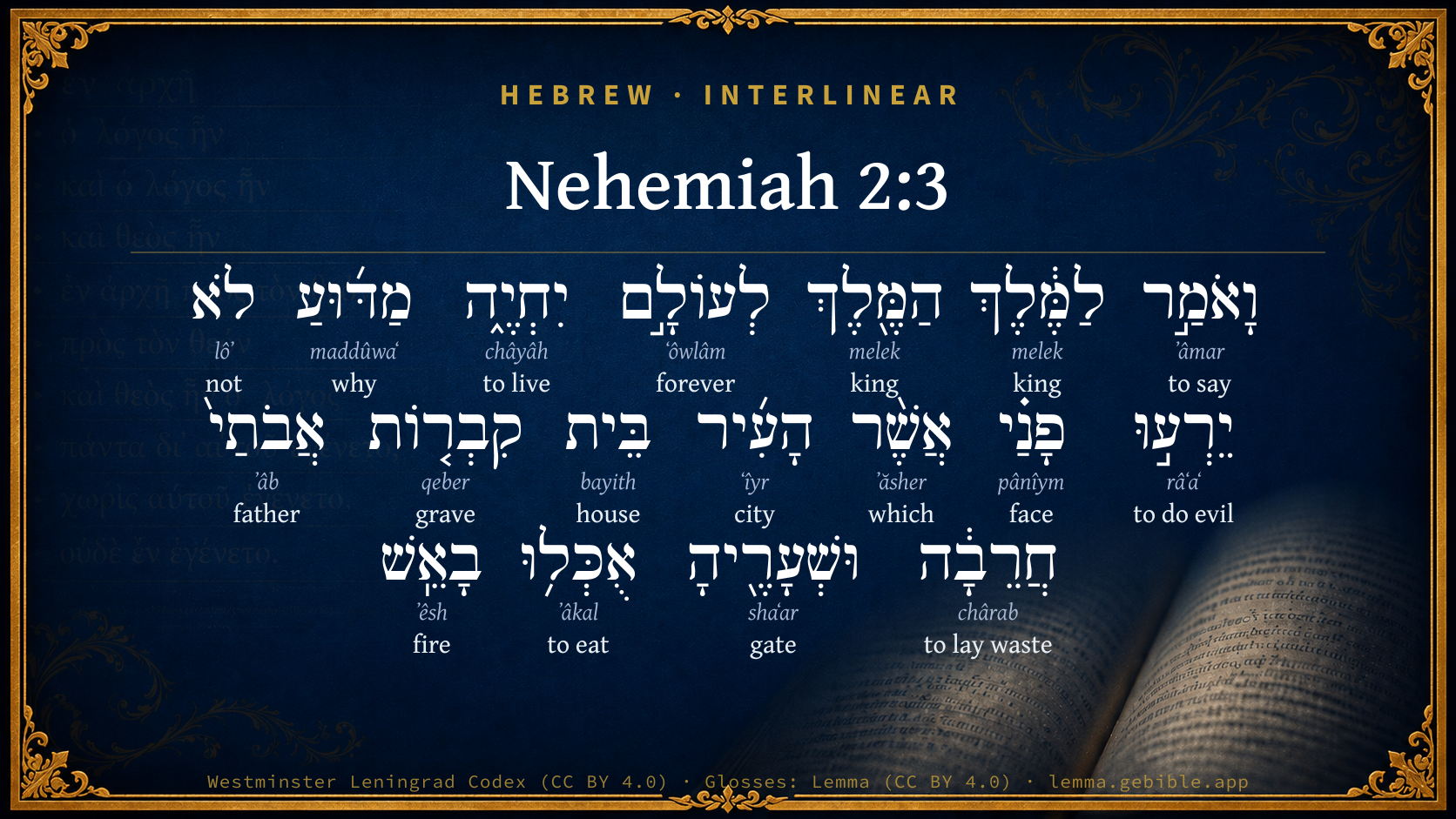
  1. וָאֹמַ֣ר ʼâmar H559 “and · to say” Conjunction + Verb, Qal, Sequential Imperfect, 1st Person, Common, Singular
  2. לַמֶּ֔לֶךְ melek H4428 “to/for the · king” Preposition, Determined + Noun, Common, Masculine, Singular, Absolute
  3. הַמֶּ֖לֶךְ melek H4428 “the · king” Particle, Definite Article + Noun, Common, Masculine, Singular, Absolute
  4. לְעוֹלָ֣ם ʻôwlâm H5769 “to/for · forever” Preposition + Noun, Common, Masculine, Singular, Absolute
  5. יִחְיֶ֑ה châyâh H2421 “to live” Verb, Qal, Imperfect, 3rd Person, Masculine, Singular
  6. מַדּ֜וּעַ maddûwaʻ H4069 “why” Particle, Interrogative
  7. לֹא lôʼ H3808 “not” Particle, Negative
  8. יֵרְע֣וּ râʻaʻ H7489 “to do evil” Verb, Qal, Imperfect, 3rd Person, Masculine, Plural
  9. פָנַ֗י pânîym H6440 “face(s) · my” Noun, Common, Both, Plural, Construct + Suffix, Personal, 1st Person, Common, Singular
  10. אֲשֶׁ֨ר ʼăsher H834 “which” Particle, Relative
  11. הָעִ֜יר ʻîyr H5892 “the · city” Particle, Definite Article + Noun, Common, Feminine, Singular, Absolute
  12. בֵּית bayith H1004 “house of” Noun, Common, Masculine, Singular, Construct
  13. קִבְר֤וֹת qeber H6913 “graves of” Noun, Common, Masculine, Plural, Construct
  14. אֲבֹתַי֙ ʼâb H1 “fathers · my” Noun, Common, Masculine, Plural, Construct + Suffix, Personal, 1st Person, Common, Singular
  15. וּשְׁעָרֶ֖יהָ shaʻar H8179 “and · gates · her” Conjunction + Noun, Common, Masculine, Plural, Construct + Suffix, Personal, 3rd Person, Feminine, Singular
  16. אֻכְּל֥וּ ʼâkal H398 “to eat” Verb, Qal Passive, Perfect, 3rd Person, Common, Plural
  17. בָאֵֽשׁ ʼêsh H784 “in/at the · fire” Preposition, Determined + Noun, Common, Both, Singular, Absolute

About this verse

These counts appear in no published source. They are computed here, from the morphology-tagged text and Lemma’s own curated glosses. What Lemma adds →

18
words
17
distinct lemmas
Historical
section

Shared distinctive vocabulary

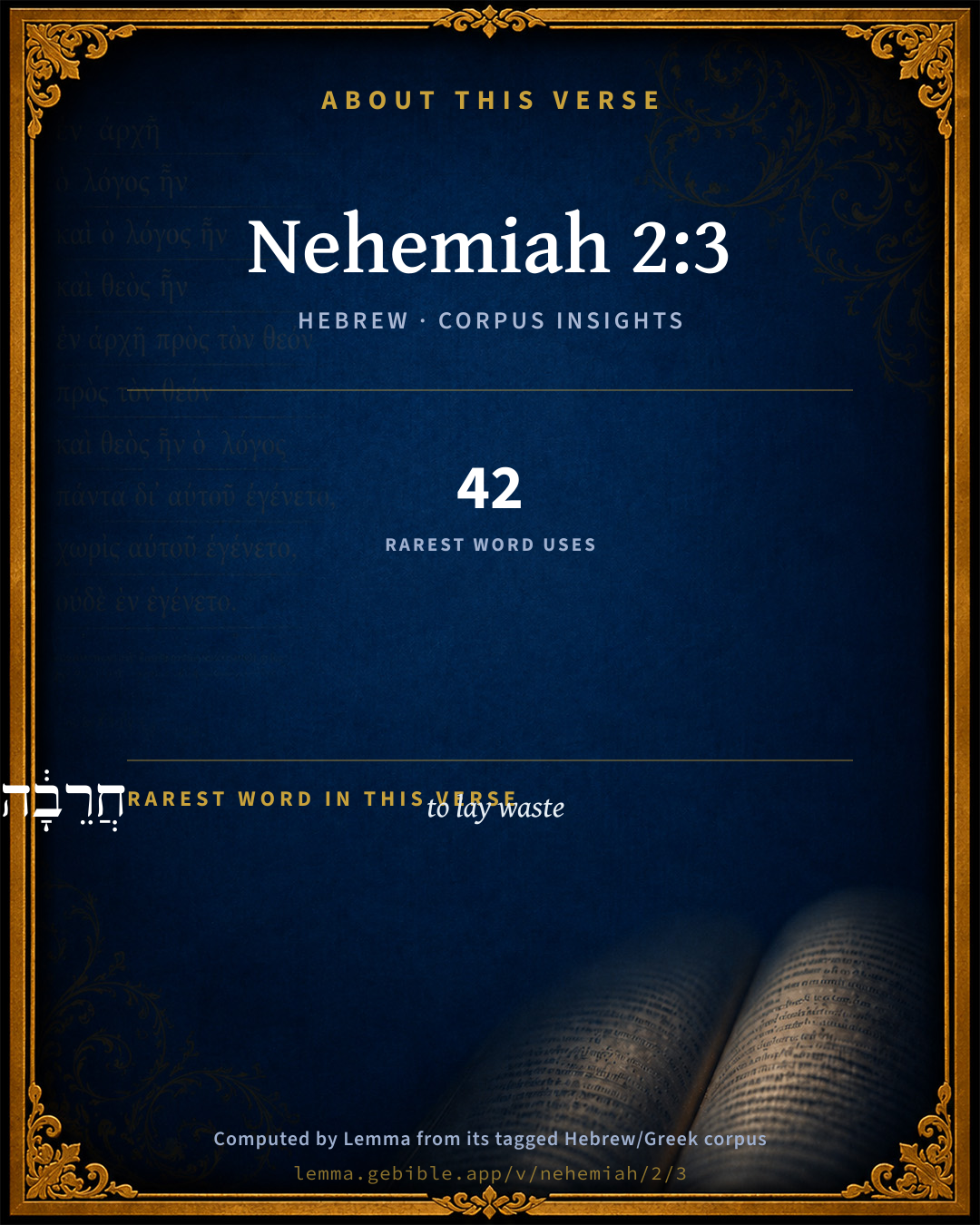
חֲרֵבָ֔ה to lay waste H2717 occurs in 38 verses of the Hebrew Bible. Also found in:

Grammatical profile

  • 4 verbs
  • 10 nouns
  • 1 adjective
  • 3 particles

Verb forms

  • וָאֹמַ֣ר Qal · Sequential Imperfect
  • יִחְיֶ֑ה Qal · Imperfect
  • יֵרְע֣וּ Qal · Imperfect
  • אֻכְּל֥וּ Qal Passive · Perfect

Repetition

A word recurs within this verse — often emphatic in Hebrew:

  • לַמֶּ֔לֶךְ king H4428 ×2

Cross-references

13

Topical passages linked to Nehemiah 2:3 in the Treasury of Scripture Knowledge — connected by theme and wording, ordered by reader-vote popularity; previews shown in the World English Bible.

  • Nehemiah 1:3 They said to me, The remnant who are left of the captivity there in the province are in great affliction and reproach: the wall of Jerusalem also is broken down, and the gates of it are burned with fire.
  • 1 Kings 1:31 Then Bathsheba bowed with her face to the earth, and did obeisance to the king, and said, Let my lord king David live forever.
  • Psalms 137:6 Let my tongue stick to the roof of my mouth if I don't remember you; If I don't prefer Jerusalem above my chief joy.
  • Daniel 2:4 Then spoke the Chaldeans to the king in the Syrian language, O king, live forever: tell your servants the dream, and we will show the interpretation.
  • Daniel 5:10 [Now] the queen by reason of the words of the king and his lords came into the banquet house: the queen spoke and said, O king, live forever; don't let your thoughts trouble you, nor let your face be changed.
  • 2 Chronicles 21:20 Thirty-two years old was he when he began to reign, and he reigned in Jerusalem eight years: and he departed without being desired; and they buried him in the city of David, but not in the tombs of the kings.
  • 2 Chronicles 28:27 Ahaz slept with his fathers, and they buried him in the city, even in Jerusalem; for they didn't bring him into the tombs of the kings of Israel: and Hezekiah his son reigned in his place.
  • 2 Chronicles 32:33 Hezekiah slept with his fathers, and they buried him in the ascent of the tombs of the sons of David: and all Judah and the inhabitants of Jerusalem did him honor at his death. Manasseh his son reigned in his place.
  • Lamentations 2:9 Her gates are sunk into the ground; he has destroyed and broken her bars: Her king and her princes are among the nations where the law is not; Yes, her prophets find no vision from Yahweh.
  • Daniel 6:6 Then these presidents and satraps assembled together to the king, and said thus to him, King Darius, live forever.
  • Daniel 6:21 Then said Daniel to the king, O king, live forever.
  • Psalms 102:14 For your servants take pleasure in her stones, And have pity on her dust.
  • Daniel 3:9 They answered Nebuchadnezzar the king, O king, live for ever.

Cross-references courtesy of OpenBible.info (CC BY 4.0).

Hebrew and Greek witnesses Masoretic Hebrew ↔ Greek Septuagint

The same verse in the two great witnesses to the Old Testament, shown verse-for-verse.

These are two independent witnesses, not word-aligned to each other, and the Septuagint is shown in lemma (dictionary) form.

Hebrew Nehemiah 2:3 Masoretic · Westminster Leningrad Codex

וָאֹמַ֣ר לַמֶּ֔לֶךְ הַמֶּ֖לֶךְ לְעוֹלָ֣ם יִחְיֶ֑ה מַדּ֜וּעַ לֹא יֵרְע֣וּ פָנַ֗י אֲשֶׁ֨ר הָעִ֜יר בֵּית קִבְר֤וֹת אֲבֹתַי֙ חֲרֵבָ֔ה וּשְׁעָרֶ֖יהָ אֻכְּל֥וּ בָאֵֽשׁ

I said to the king, Let the king live forever: why should not my face be sad, when the city, the place of my fathers' tombs, lies waste, and the gates of it are consumed with fire?

World English Bible · Public Domain

Greek LXX Structure differs

The Septuagint has no separate book of Nehemiah. Its Greek text is the second half of Esdras B (2 Esdras), chapters 11–23; Ezra is the first half (1–10).

A verse-for-verse comparison isn’t shown here because the chapters and verses don’t line up. Switch to the LXX edition with the MT / LXX toggle above to read the Greek directly.

Hebrew: Westminster Leningrad Codex (CC BY 4.0). Greek: Septuagint (public domain); English from a public-domain English Septuagint. How the Septuagint differs from the Hebrew →

Commentary

Notes on Nehemiah 2:3 from classic Christian and Jewish commentators (each source and its license shown beneath its notes). The classic Christian expositions comment on the surrounding passage and are grouped to its opening verse, so a note may address several verses; the Jewish commentaries on the Tanakh (Rashi and others) are per-verse, so they appear only where the commentator wrote on this verse.

Lemma curates 59 commentaries, every one of them public domain or Creative Commons licensed, each selected and text-cleaned for this edition rather than reprinted as found. About our sources →

Trapp's Complete Commentary

John Trapp

Neh 2:3 And said unto the king, Let the king live for ever: why should not my countenance be sad, when the city, the place of my fathers’ sepulchres, [lieth] waste, and the gates thereof are consumed with fire?

Ver. 3. And I said unto the king] After he had pulled up his best heart, and recovered his spirits, he declareth unto the king the cause of his sadness. How ready should our tongues be to lay open our cares to the God of all comfort, when we see Nehemiah so quick in the expressions of his sorrow to an uncertain ear.

Let the king live for ever] i.e. Very long. Let him not suspect, by my sadness, that I have any evil intent or treasonable design against him; for I heartily wish his welfare. It was not court holy water (as they call it) wherewith he here besprinkles his prince; it was not counterfeit courtesy; such as was that of Squier the traitor, A.D. 1597, sent by Walpole the Jesuit, to poison the pummel of Queen Elizabeth’s saddle, when she was to ride abroad; which also he did (but without effect), saying cheerfully at the same time, God save the Queen. Saluta libenter greet gladly, is by many practised, from the teeth outward; but by Nehemiah, heartily.

Why should not my countenance be sad?] In time of common calamities there is just cause of a general sadness, "should we then make mirth?" Eze 21:10. The Romans severely punished one that showed himself out of a window with a garland on his head in the time of the Punic war, when it went ill with the commonwealth. Justinus, the good emperor of Constantinople, took the downfall of the city of Antioch by an earthquake so much to heart, that it caused him a grievous fit of sickness, A.D. 527. When Pope Clement and his cardinals were imprisoned by the duke of Bourbon’s men in St Angelo, Caesar in Spain forbade all interludes to be played, &c. In France, the duke of Bourbon was condemned of treason, his name and memorial were accursed, his arms pulled down, his lands and goods confiscated. In England, King Henry was extremely displeased. Cardinal Wolsey wept tenderly, and emptied the land of 288,000 pounds to relieve and ransom the distressed pope.

When the city, the place of my fathers’ sepalchres] A good argument to a heathen, who set great store by (as now the Papists keep great stir about) their burial places; as if one place were holier than another for that purpose: a mere device to pick poor men’s purses.

And the gates thereof are consumed with fire] The Jews at this day, when they build a house, they are, say the Rabbis, to leave one part of it unfinished, and lying rude, in remembrance that Jerusalem and the temple are, at present, desolate (Hist. of Rites of Jews, by Leo Moden.). At least, they use to leave about a yard square of the house unplastered, on which they write in great letters that of the Psalmist, If I forget Jerusalem, then let my right hand forget her cunning, Psa 137:5, or else these words, Zecher Lechorbon, The memory of the desolation.

John Trapp, A Commentary or Exposition upon All the Books of the Old and New Testament (1647–1656) — public domain. Text from a community e-Sword module.

Joseph Benson's Commentary

Neh 2:3. Let the king live for ever — My sadness comes not from any disaffection to the king, for whom my hearty prayers are that he may live for ever, but from another cause. Why should I not be sad, when the place of my fathers’ sepulchres lieth waste? — Which by all nations are esteemed sacred and inviolable. He says not a word for the temple, as he spake before a heathen king, who cared for none of these things. There is a regard due to one’s own country, which ought not to be extinguished by the pleasure or plenty of any other. It is not a weakness to be deeply affected with the distresses, or for the death of our friends and relations, at what distance secret we are from them; nor can any prosperity in another country excuse a man for not being so much afflicted for any calamity that befalls his own as not to entertain mirth and jollity in his heart. Nehemiah was in no mean station when he was cup-bearer to Artaxerxes, and we may very reasonably suppose, from the grace and bounty which that great king showed him, that he might have had any honour or preferment he would have requested in that great and flourishing empire; yet when that great king discerned that there was sorrow of heart in his countenance, and demanded the reason of it, he made no other excuse but, Jerusalem lay waste: and when the king so graciously invited him to ask some favour worthy of his royal bounty, he would require nothing else but permission and power to go and relieve his country. The grievances of the church, but especially its desolations, ought to be a grief to all good people, and will to all that have a concern for God’s honour, and are of a public spirit.

Joseph Benson's Commentary on the Old and New Testaments (1811–1818) — public domain. Text from a community e-Sword module.

Tyndale Open Study Notes

Tyndale Open Resources

2:3 Nehemiah affirmed his loyalty with the customary long live the king (cp. Dan 2:4), yet he did not deny his sadness.

Tyndale Open Study Notes — © Tyndale Open Resources, licensed CC BY-SA 4.0. Text via the HelloAO Bible API.

Adam Clarke's Commentary

Verse 3. Let the king live for ever] Far from wishing ill to my master, I wish him on the contrary to live and prosper for ever. AELIAN, Hist. Var. lib. i. c. 32, uses the same form of speech in reference to Artaxerxes Mnemon, one of the Persian kings, Βασιλευ Αρταξερξη, δι' αιωνος βασιλευοις, "O King Artaxerxes, may you reign for ever," when speaking of the custom of presenting them annually with an offering of earth and water; as if they had said, May you reign for ever over these!

Adam Clarke's Commentary on the Bible (1810–1826) — public domain. Text from a community e-Sword/MySword module.

Ellicott's Commentary for English Readers

(3) Nehemiah’s family was of Jerusalem. He does not as yet betray to the king the deepest desire of his heart, but simply refers to the desecration of his fathers’ sepulchres, an appeal which had great force with the Persians, who respected the tomb.

A Bible Commentary for English Readers, edited by Charles John Ellicott (1878–1897) — public domain. Text from a community e-Sword module.

The Cambridge Bible for Schools and Colleges

gen. ed. J. J. S. Perowne

3. Let the king live for ever] For this formula opening an address to a king see Dan_2:4; Dan_3:9. Cf. 1Ki_1:31.

why should not my countenance be sad?] i.e. how could it be otherwise than sad?

the place of my fathers’ sepulchres] ‘the place,’ literally ‘the house:’ compare 1Sa_25:1; 1Ki_2:34, where Samuel and Joab are said to have been buried each ‘in his own house.’ This is explained by comparing 2Ki_21:18, ‘Manasses … was buried in the garden of his own house,’ with 2Ch_33:20, ‘they buried him (Manasses) in his own house.’ Rich families had their own private places of sepulture (rock-hewn tombs, caves and the like). Nehemiah’s words would be particularly appropriate if he was, as some have supposed, a descendant of the royal house. The tombs of David and the kings of Jerusalem seem to have been cut out of the rock on the S. side of the Ophel hill, cf. Neh_3:16.

consumed] Literally ‘eaten up,’ as in Neh_2:13. The more usual phrase is ‘burned,’ as in Neh_1:3, Neh_2:17.

The Cambridge Bible for Schools and Colleges (gen. ed. J. J. S. Perowne; Cambridge University Press, 1878–1918) — public domain. Text from a community e-Sword module.

John Gill's Exposition

And I said unto the king, let the king live for ever,.... Which some think he said to take off the king's suspicion of his having a design upon his life, though it seems to be a common salutation of the kings in those times, see Dan 6:6,

why should not my countenance be sad, when the city, the place of my fathers' sepulchres, lieth waste, and the gates thereof are consumed with fire? a man's native place, and where his ancestors lie interred, being always reckoned near and dear, the king and his nobles could not object to his being concerned for the desolations thereof.

John Gill's Exposition of the Whole Bible (1746–1763) — public domain (CC PDM 1.0). Text via the HelloAO Bible API.

Albert Barnes' Notes on the Bible

The city ... of my fathers’ sepulchres - We may conclude from this that Nehemiah was of the tribe of Judah, as Eusebius and Jerome say that he was.

Albert Barnes' Notes on the Bible (1834–1885) — public domain. Text from a community e-Sword/MySword module.

Haydock's Catholic Bible Commentary

Live; an usual salutation, Daniel iii. 9., and v. 10. So Ælian (var. i. 32.) says, "O king Artaxerxes, mayst thou reign for ever." --- Father, ver. 5. He knew that the Persians shewed great regard to the dead, (Calmet; Tirinus) whose bodies they sometimes cover with wax, and keep in their house, (Cic.[Cicero?] Tusc. i.; Alex. Genial iii. 2.) or inter. (Herodotus i. 140.)

George Leo Haydock (1774–1849), Haydock's Catholic Family Bible and Commentary, 1859 edition — public domain. Excludes Psalms (Douay-Rheims chapter numbering differs from Protestant) and Deuterocanonical books (Catholic canon only).

Matthew Poole's English Annotations

Let the king live forever: my sadness comes not from any discontent with my own condition, or any disaffection to the king, for whom my hearty prayers are that he may live forever; but from another cause.

The place of my fathers’ sepulchres, which by all nations are esteemed sacred, and inviolable, and honourable. He saith not a word of the temple, or of religion, for he wisely considered that he spake before a heathen king and court, who cared for none of those things.

Matthew Poole's English Annotations on the Holy Bible (1683–1685) — public domain. Text from a community e-Sword/MySword module.

Whedon's Commentary on the Bible

Daniel D. Whedon

3. Let the king live forever — A common form of royal salutation. Compare marginal references.

The city, the place of my fathers’ sepulchres — A touching allusion, calculated to affect the hearts both of the king and the queen. Nehemiah here calls Jerusalem, literally, the house of the graves of his fathers, and hence it has been inferred that he was of the seed of David, whose royal sons were “buried in the city of David,” (1Ki_14:31; 1Ki_15:24, etc.;) so that city was, in fact, the very house of their graves.

Daniel D. Whedon (gen. ed.), Commentary on the Old and New Testaments (1874–1909) — public domain. Text from a community e-Sword module.

The Pulpit Commentary

May the king live for ever. A common form of Oriental compliment, (1Ki_1:31 Dan_2:4 Dan_3:9, etc.) but said now with special intention to conciliate, and meant to express a deep interest in the royal life and person. The city, the place of my fathers" sepulchres. We see by this that Nehemiah"s family must have belonged to the capital. The Persians, like the Jews, had a great respect for the tomb, and regarded its violation with horror. Artaxerxes would naturally sympathise with the wish of his follower to give security to the city where his ancestors were interred. It would seem that the Persians generally at this time (Herod., 1:140), the kings certainly ("Ancient Monarchies," vol. 3. p. 231, second edition), buried their dead. Lieth waste. Nehemiah"s warmth of feeling exaggerates the fact; but he may have been unconscious of the exaggeration. He repeats the phrase to the chief men of Jerusalem after making his survey of the wall (ver. 17).

Sadness, when and how far justifiable.

"Why should not my countenance be sad?

I SADNESS IS OFTEN JUSTIFIABLE, OR EVEN COMMENDABLE.

1. Under great troubles. Stoicism is neither natural nor Christian. Troubles are meant to trouble us. If they do not, they afford no trial to faith and patience, and cannot effect their purpose for discipline and improvement.

2. Under the consciousness of sin. In view of its essential evil as committed against God, his rights, laws, and goodness; its injuriousness to ourselves and to others; its final consequences unless forgiven.

3. In sympathy with the troubles of others. Which makes them our own. Christian fellow, ship includes community of suffering. "If one member suffer, all the members suffer with it.

4. On account of the sins of others. (Psa_119:136, 158 Eze_9:4 Php_3:18)

5. On account of the troubles of the Church. Nehemiah"s sadness was honourable to him.

II YET SADNESS SHOULD NOT BE INCONSOLABLE.

1. It need not. For a sure remedy is furnished in the truths and promises of the gospel, and the ever-available aid of the Holy Spirit.

2. It ought not. For faith and prayer, opening the heart to the Divine consolations, and securing the Divine aid, would turn sadness into peace, if not joy. Those cases are, however, to be excepted where melancholy springs from physical causes, and needs bodily rather than spiritual treatment.

III SADNESS SHOULD NEVER BE PREDOMINANT IN THE CHRISTIAN. For his habitual sadness of spirit, countenance, or speech

1. Dishonours God.

2. Robs himself. Counteracting the design of our religion, everywhere prominent in the New Testament. "That they may have my joy fulfilled in themselves." "In the world ye shall have tribulation, but be of good cheer." "The kingdom of God is... joy in the Holy Ghost." "The fruit of the Spirit is love, joy," etc. "These things write we unto you, that your joy may be full.

3. Hinders Christian service. "The joy of the Lord is your strength.

4. Retards the progress of religion. Discouraging inquirer, and giving occasion to adversaries to speak ill of the religious life.

The Pulpit Commentary (1880–1919), ed. H.D.M. Spence-Jones & Joseph S. Exell — public domain. Text from a community e-Sword module.

John Wesley's Explanatory Notes

Why should, &c. - All the grievances of the church, but especially its desolations, ought to be matter of grief to all good people, to all that have a concern for God's honour, and are of a public spirit.

John Wesley, Explanatory Notes Upon the Whole Bible (1754–1765) — public domain. Text via the GEBible commentary corpus.

unfoldingWord translationNotes

Door43 World Missions Community

May the king live forever

Nehemiah is showing honor to King Artaxerxes. Here "forever" is an exaggeration that refers to a long life. AT: "Long live the king" or "May the king have a long life" (See: Hyperbole and Generalization)

Why should not my face be sad?

Here Nehemiah uses this rhetorical question to tell the king that he has a reason to be sad. This can be written as a statement. AT: "I have very good reasons to be sad." (See: Rhetorical Question)

the place of my fathers' tombs

"the place where my ancestors are buried"

its gates have been destroyed by fire

This can be stated in active form. AT: "fire has destroyed its gates" or "our enemy has burned its gates" (See: Active or Passive)

translationWords

king

life

eternity

face

ancestor

grave

ruin

gate

fire

unfoldingWord translationNotes — © Distant Shores Media and the Door43 World Missions Community, licensed CC BY-SA 4.0. Source: git.door43.org/Door43/en_tn.

Rashi

Rabbi Shlomo Yitzchaki (Rashi)

Why should my countenance not be sad [as translated,] why should my countenance not be sad.

when the city Jerusalem, which is the place of the graves of my forefathers, is laid waste.

Rashi on the Tanakh — English translations: “The Judaica Press complete Tanach with Rashi, translated by A. J. Rosenberg” (CC BY 4.0); “Pentateuch with Rashi's commentary by M. Rosenbaum and A.M. Silbermann, 1929-1934” (public domain); “The Metsudah Tanach series, Lakewood, N.J” (CC BY 4.0); and “The Book of Joshua, Metsudah Publications, 1997” (CC BY 4.0). Text via Sefaria.

Lesson kit

Teaching starters — assembled from the data on this page, not authored interpretation. Every prompt links to the verse data it draws on. Edit before teaching.

Nehemiah, in the Historical, opens this verse with 18 words (17 distinct Hebrew lemmas). Its most distinctive word is chârab (“to lay waste”). A historical commentator’s framing appears above. Read the whole chapter for the surrounding context.

Discussion questions

  1. How does “to lay waste” (chârab) shape what this verse is saying?
  2. Genesis 8:13 shares the word «to lay waste» with this verse. How do the two illuminate each other?
  3. “king” occurs 2× in this one verse. What is the effect of the repetition?
  4. These translations render this verse differently; the difference is in the English rendering, not the original. What questions does that raise?
  5. The verb «וָאֹמַ֣ר» is Qal Sequential Imperfect. How does its form color the action?
  6. Reading how Trapp's Complete Commentary and Joseph Benson's Commentary read this verse, where do the two commentators agree and where do they part?

Things to notice

Reading settings

Reading text

Shown beneath each verse's original-language words.

Old Testament
Old Testament edition

Read the OT as the Masoretic Hebrew (MT) or the Greek Septuagint (LXX).

English shown for the Greek Septuagint (in the Hebrew ↔ Greek comparison).

Comparing translations? Open the Compare panel on any verse page to stack up to four side by side.