
Leviticus 16:12

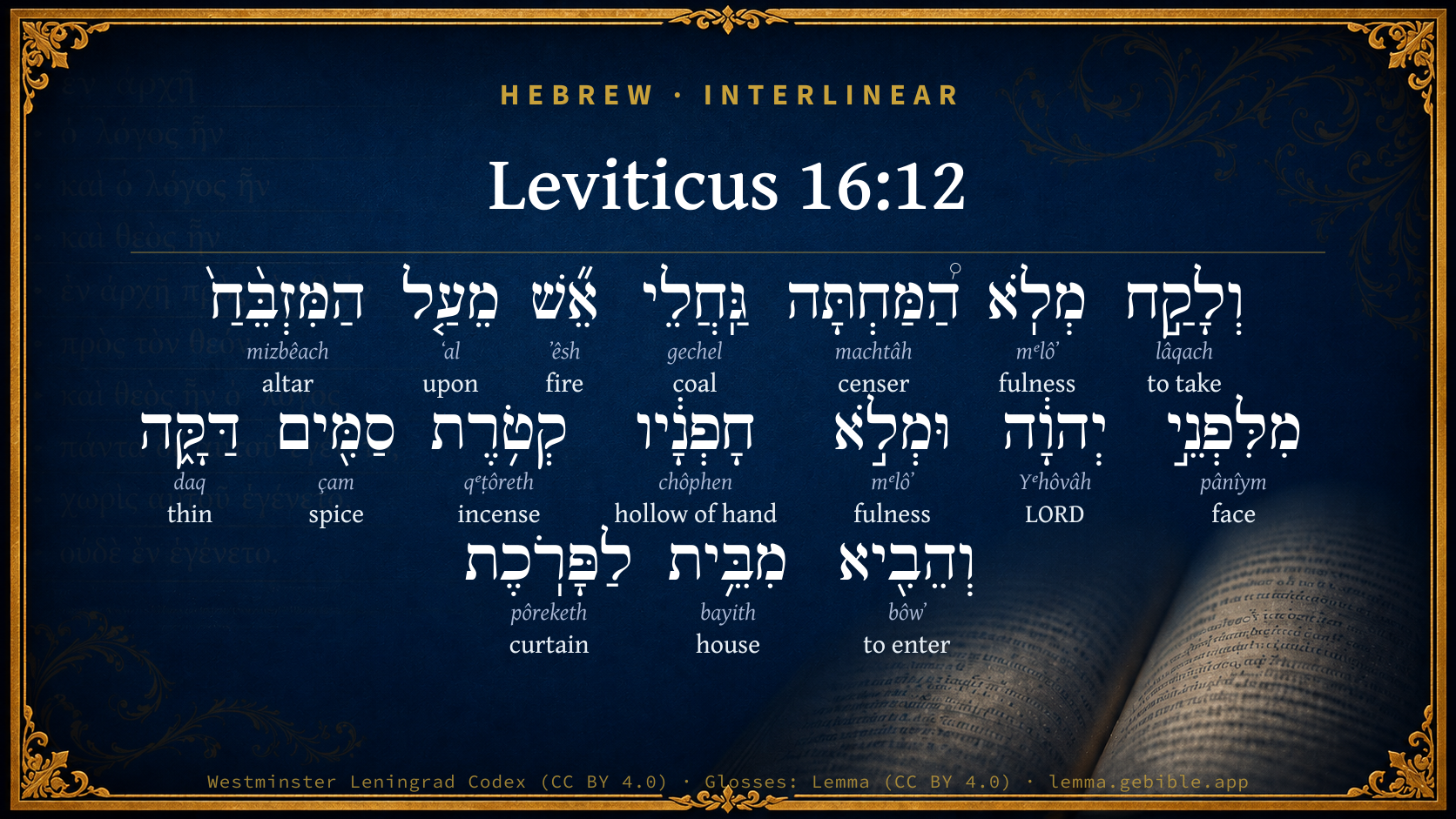
Hebrew (Westminster Leningrad Codex) Leviticus 16:12 appears in the Hebrew Old Testament. The text above is from the Westminster Leningrad Codex. Each word links to its Strong’s number, a concise gloss, and parsing drawn from the Open Scriptures Hebrew Bible morphology. Click any word for its full Brown-Driver-Briggs (BDB) entry.
Download image
Cite this verse

Leviticus 16:12 (World English Bible). Public Domain. Lemma interlinear Bible study tool, https://lemma.gebible.app/v/leviticus/16/12.

Show BibTeX & RIS
BibTeX
RIS
English Translation
He shall take a censer full of coals of fire from off the altar before Yahweh, and two handfuls of sweet incense beaten small, and bring it within the veil:
World English Bible · Public Domain
Highlights
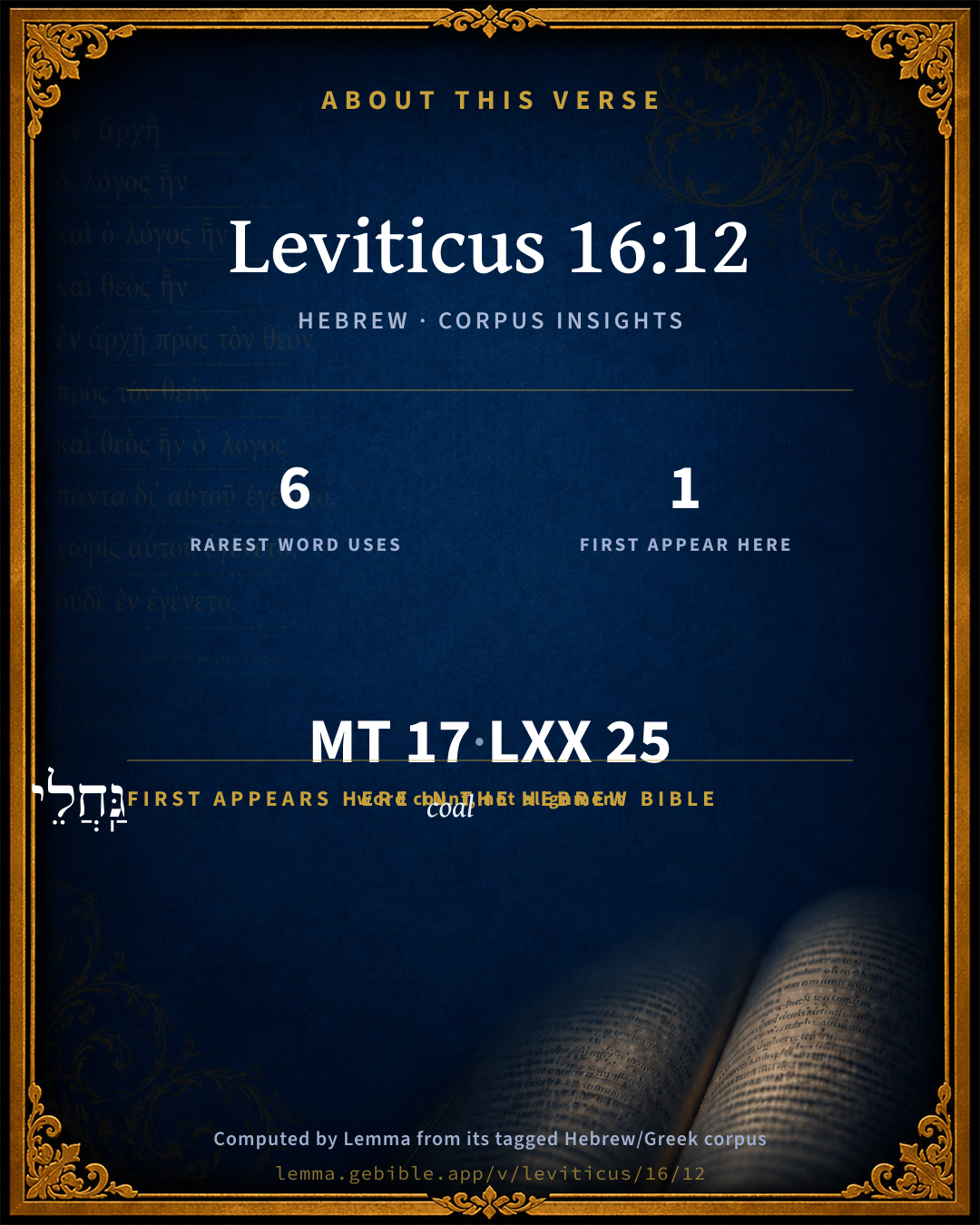
  • 1 first appearance in the Hebrew Bible
Full analysis ↓
Download a study sheet

One document with this verse’s original text, its word-by-word gloss line, the meaning frame, cross-references with their text, attributed commentary, and full source and license credits — printable, and it pastes into notes with its structure intact.

This verse Autodidact and up

Study sheet (.html) Plain text (.txt)

A passage Seminary Student

Up to 50 verses in one chapter. A passage sheet keeps up to 6 commentary sources and 12 cross-references per verse, in the order this page ranks them, and says so on the sheet whenever that leaves anything out. Ask for a single verse and you get the Autodidact verse sheet above.

Everything on this page stays free to read, with no account — the sheet is a download of what is already on screen, not access to it.

Want to remove ads? Support Godless Engineer
Compare translations 3

The same verse in 3 English versions, stacked beneath the original-language interlinear above. Click any original word for its lexicon entry.

Each is an independent rendering of the whole verse — the interlinear is not word-aligned to these translations.

Highlighted words mark where these versions differ — a whole-verse word diff, not a word-by-word alignment.

  • World English Bible Public Domain
    He shall take a censer full of coals of fire from off the altar before Yahweh, and two handfuls of sweet incense beaten small, and bring it within the veil:
  • King James Version Public Domain
    And he shall take a censer full of burning coals of fire from off the altar before the LORD, and his hands full of sweet incense beaten small, and bring it within the vail:
  • unfoldingWord Literal Text CC BY-SA 4.0
    And he shall take the fullness of a censer, coals of fire, from on the altar from before the face of Yahweh, and the fullness of his hands, thin incense of spices, and he shall bring inside of the curtain.

unfoldingWord Literal Text — © unfoldingWord, licensed CC BY-SA 4.0. Word-aligned USFM3 via Door43 (git.door43.org/unfoldingWord/en_ult).

Versions to compare (up to 4)

3 of 4 selected

Show all 18 translations

Every available English version of this verse, each an independent rendering of the whole verse.

  • World English Bible Public Domain
    He shall take a censer full of coals of fire from off the altar before Yahweh, and two handfuls of sweet incense beaten small, and bring it within the veil:
  • Berean Standard Bible Public Domain
    Then he must take a censer full of burning coals from the altar before the LORD, and two handfuls of finely ground fragrant incense, and take them inside the veil.
  • Majority Standard Bible Public Domain
    Then he must take a censer full of burning coals from the altar before the LORD, and two handfuls of finely ground fragrant incense, and take them inside the veil.
  • King James Version Public Domain
    And he shall take a censer full of burning coals of fire from off the altar before the LORD, and his hands full of sweet incense beaten small, and bring it within the vail:
  • American Standard Version (1901) Public Domain
    and he shall take a censer full of coals of fire from off the altar before Jehovah, and his hands full of sweet incense beaten small, and bring it within the veil:
  • Revised Version (1885) Public Domain
    and he shall take a censer full of coals of fire from off the altar before the LORD, and his hands full of sweet incense beaten small, and bring it within the veil:
  • Geneva Bible (1599) Public Domain
    And he shall take a censer full of burning coles from off the altar before the Lord, and his handfull of sweete incense beaten small, and bring it within the vayle,
  • Douay-Rheims (1899) Public Domain
    And taking the censer, which he hath filled with the burning coals of the altar, and taking up with his hand the compounded perfume for incense, he shall go in within the veil into the holy place:
  • Young's Literal Translation Public Domain
    and hath taken the fulness of the censer of burning coals of fire from off the altar, from before Jehovah, and the fulness of his hands of thin spice-perfume, and hath brought `it' within the vail;
  • Literal Standard Version CC BY-SA 4.0
    and has taken the fullness of the censer of burning coals of fire from off the altar, from before YHWH, and the fullness of his hands of thin spice-incense, and has brought [it] within the veil;
  • Unlocked Literal Bible CC BY-SA 4.0
    Aaron must take a censer full of coals of fire from off the altar before Yahweh, with his hands full of finely ground sweet incense, and bring these things inside the curtain.
  • unfoldingWord Literal Text CC BY-SA 4.0
    And he shall take the fullness of a censer, coals of fire, from on the altar from before the face of Yahweh, and the fullness of his hands, thin incense of spices, and he shall bring inside of the curtain.
  • Darby Bible Public Domain
    And he shall take the censer full of burning coals of fire from off the altar before Jehovah, and both his hands full of fragrant incense beaten small, and bring it inside the veil.
  • World Messianic Bible Public Domain
    He shall take a censer full of coals of fire from off the altar before the LORD, and two handfuls of sweet incense beaten small, and bring it within the veil.
  • Webster's Bible Public Domain
    And he shall take a censer full of burning coals of fire from off the altar before the LORD, and his hands full of sweet incense beaten small, and bring it within the vail:
  • Free Bible Version CC BY-SA 4.0
    Then he will fill up an incense burner with burning coals from the altar that is before the Lord, and with his hands full of finely ground sweet-smelling incense, take them behind the veil.
  • Bible in Basic English Public Domain
    And he is to take a vessel full of burning coal from the altar before the Lord and in his hand some sweet perfume crushed small, and take it inside the veil;
  • JPS Tanakh (1917) Public Domain
    And he shall take a censer full of coals of fire from off the altar before the LORD, and his hands full of sweet incense beaten small, and bring it within the veil.

Literal Standard Version (2020), Covenant Press — licensed CC BY-SA 4.0. Text via the HelloAO Bible API (eBible.org). Unlocked Literal Bible (unfoldingWord) — licensed CC BY-SA 4.0. Text via the HelloAO Bible API (eBible.org). unfoldingWord Literal Text — © unfoldingWord, licensed CC BY-SA 4.0. Word-aligned USFM3 via Door43 (git.door43.org/unfoldingWord/en_ult). Free Bible Version, Dr. Jonathan Gallagher — licensed CC BY-SA 4.0. Text via the HelloAO Bible API (eBible.org).

Word by word

More ways to search: Search by grammar → Find every occurrence → Compare this word →

Practice this passage: Drill this verse → Learn its vocabulary →

חָפְנָ֔יו
chôphen
H2651
“handfuls · his”
Noun, Common, Masculine, Dual, Construct + Suffix, Personal, 3rd Person, Masculine, Singular
Part of Speech
Noun
Type
Common
Gender
Masculine
Number
Dual
State
Construct
Full BDB Definition

Origin: from an unused root of uncertain signification

TWOT: 709a

handfuls, hollow of the hand
  1. וְלָקַ֣ח lâqach H3947 “and · to take” Conjunction + Verb, Qal, Sequential Perfect, 3rd Person, Masculine, Singular
  2. מְלֹֽא mᵉlôʼ H4393 “fulness of” Noun, Common, Masculine, Singular, Construct
  3. הַ֠מַּחְתָּה machtâh H4289 “the · censer” Particle, Definite Article + Noun, Common, Feminine, Singular, Absolute
  4. גַּֽחֲלֵי gechel H1513 “coals of” Noun, Common, Both, Plural, Construct
  5. אֵ֞שׁ ʼêsh H784 “fire” Noun, Common, Both, Singular, Absolute
  6. מֵעַ֤ל ʻal H5921 “from · upon” Preposition + Preposition
  7. הַמִּזְבֵּ֨חַ֙ mizbêach H4196 “the · altar” Particle, Definite Article + Noun, Common, Masculine, Singular, Absolute
  8. מִלִּפְנֵ֣י pânîym H6440 “from · to/for · face(s) of” Preposition + Preposition + Noun, Common, Both, Plural, Construct
  9. יְהוָ֔ה Yᵉhôvâh H3068 “LORD” Noun, Proper
  10. וּמְלֹ֣א mᵉlôʼ H4393 “and · fulness of” Conjunction + Noun, Common, Masculine, Singular, Construct
  11. קְטֹ֥רֶת qᵉṭôreth H7004 “incense of” Noun, Common, Feminine, Singular, Construct
  12. סַמִּ֖ים çam H5561 “spices” Noun, Common, Masculine, Plural, Absolute
  13. דַּקָּ֑ה daq H1851 “thin” Adjective, Adjective, Feminine, Singular, Absolute
  14. וְהֵבִ֖יא bôwʼ H935 “and · to enter” Conjunction + Verb, Hiphil, Sequential Perfect, 3rd Person, Masculine, Singular
  15. מִבֵּ֥ית bayith H1004 “from · house of” Preposition + Noun, Common, Masculine, Singular, Construct
  16. לַפָּרֹֽכֶת pôreketh H6532 “to/for the · curtain” Preposition, Determined + Noun, Common, Feminine, Singular, Absolute

About this verse

These counts appear in no published source. They are computed here, from the morphology-tagged text and Lemma’s own curated glosses. What Lemma adds →

17
words
16
distinct lemmas
Pentateuch
section

Notable vocabulary

The rarest word here is חָפְנָ֔יו hollow of hand H2651 — appearing just 6 times in the whole Hebrew Bible.

First appearance in Scripture

This word makes its first canonical appearance in the Hebrew Bible here:

  • גַּֽחֲלֵי coal H1513

Shared distinctive vocabulary

חָפְנָ֔יו hollow of hand H2651 occurs in 6 verses of the Hebrew Bible. Also found in:

Grammatical profile

  • 2 verbs
  • 13 nouns
  • 1 adjective
  • 1 preposition

Verb forms

  • וְלָקַ֣ח Qal · Sequential Perfect
  • וְהֵבִ֖יא Hiphil · Sequential Perfect

Repetition

A word recurs within this verse — often emphatic in Hebrew:

  • מְלֹֽא fulness H4393 ×2

Hebrew & Septuagint length

In English translation the verse runs 30 words from the Hebrew and 36 from the Septuagint (LXX English) — closely comparable.

A rough comparison of the two English renderings, which tokenize alike — not a word-level alignment.

Word counts can differ between the Hebrew and the Greek without any difference in meaning — e.g. the Hebrew direct-object marker אֵת has no separate Greek word, and Greek often adds the article ὁ.

In the original languages it is 17 Hebrew tokens and 25 Greek tokens — but the two are counted differently (Hebrew bundles its prefixes and suffixes into one token; the Greek is in lemma form), so that isn’t a like-for-like length.

Cross-references

10

Topical passages linked to Leviticus 16:12 in the Treasury of Scripture Knowledge — connected by theme and wording, ordered by reader-vote popularity; previews shown in the World English Bible.

  • Exodus 30:34–38 Yahweh said to Moses, "Take to yourself sweet spices, gum resin, and onycha, and galbanum; sweet spices with pure frankincense: of each shall there be an equal weight;
  • Leviticus 10:1 Nadab and Abihu, the sons of Aaron, each took his censer, and put fire in it, and laid incense on it, and offered strange fire before Yahweh, which he had not commanded them.
  • Revelation 8:3–4 Another angel came and stood over the altar, having a golden censer. Much incense was given to him, that he should add it to the prayers of all the saints on the golden altar which was before the throne.
  • Numbers 16:46 Moses said to Aaron, Take your censer, and put fire therein from off the altar, and lay incense thereon, and carry it quickly to the congregation, and make atonement for them: for there is wrath gone out from Yahweh; the plague is begun.
  • Exodus 31:11 the anointing oil, and the incense of sweet spices for the holy place: according to all that I have commanded you they shall do."
  • Numbers 16:18 They took every man his censer, and put fire in them, and laid incense thereon, and stood at the door of the tent of meeting with Moses and Aaron.
  • Isaiah 6:6–7 Then one of the seraphim flew to me, having a live coal in his hand, which he had taken with the tongs from off the altar.
  • Hebrews 9:14 how much more will the blood of Christ, who through the eternal Spirit offered himself without blemish to God, cleanse your conscience from dead works to serve the living God?
  • Exodus 37:29 He made the holy anointing oil and the pure incense of sweet spices, after the art of the perfumer.
  • 1 John 1:7 But if we walk in the light, as he is in the light, we have fellowship with one another, and the blood of Jesus Christ, his Son, cleanses us from all sin.

Cross-references courtesy of OpenBible.info (CC BY 4.0).

Hebrew and Greek witnesses Masoretic Hebrew ↔ Greek Septuagint

The same verse in the two great witnesses to the Old Testament, shown verse-for-verse.

These are two independent witnesses, not word-aligned to each other, and the Septuagint is shown in lemma (dictionary) form.

Hebrew Leviticus 16:12 Masoretic · Westminster Leningrad Codex

וְלָקַ֣ח מְלֹֽא הַ֠מַּחְתָּה גַּֽחֲלֵי אֵ֞שׁ מֵעַ֤ל הַמִּזְבֵּ֨חַ֙ מִלִּפְנֵ֣י יְהוָ֔ה וּמְלֹ֣א חָפְנָ֔יו קְטֹ֥רֶת סַמִּ֖ים דַּקָּ֑ה וְהֵבִ֖יא מִבֵּ֥ית לַפָּרֹֽכֶת

He shall take a censer full of coals of fire from off the altar before Yahweh, and two handfuls of sweet incense beaten small, and bring it within the veil:

World English Bible · Public Domain

Greek LXX Leviticus 16:12 Septuagint · lemma form

καί λαμβάνω ὁ πυρεῖον πλήρης ἄνθραξ πῦρ ἀπό ὁ θυσιαστήριον ὁ ἀπέναντι κύριος καί πίμπλημι ὁ χείρ θυμίαμα σύνθεσις λεπτός καί εἰςφέρω ἔσω ὁ καταπέτασμα

And he shall take his censer full of coals of fire off the altar, which is before the Lord; and he shall fill his hands with fine compound incense, and shall bring it within the veil.

LXX2012 (modern English Septuagint) · Public Domain

Hebrew: Westminster Leningrad Codex (CC BY 4.0). Greek: Septuagint (public domain); English from LXX2012 (modern English Septuagint) (Public Domain). How the Septuagint differs from the Hebrew →

Targum (Aramaic paraphrase)

2

The Targum is the ancient Jewish Aramaic paraphrase of the Hebrew Scriptures — an interpretive translation, not the Hebrew text itself. Onkelos (literal) and Pseudo-Jonathan (expansive) render the Torah, and Jonathan the Prophets. Coverage is partial: where no permissively-licensed English translation exists for a verse, only the Aramaic is shown. This is verse-level text, not a word-by-word alignment to the Hebrew.

  1. Targum Onkelos Torah (Genesis–Deuteronomy)
    וְיִסַב מְלֵי מַחְתִּיתָא גוּמְרִין דְאֶשָׁא מֵעִלַוֵי מַדְבְּחָא מִן קֳדָם יְיָ וּמְלֵי חָפְנוֹהִי קְטוֹרֶת בּוּסְמִין דַקִיקִין וְיָעֵל מִגָיו לְפָרֻכְתָּא

    (no public-domain English translation for this verse)

    Targum Onkelos — Aramaic: “Onkelos Genesis” (public domain); “Onkelos Exodus” (public domain); “Onkelos Leviticus” (public domain); “Onkelos Numbers” (public domain); “Onkelos Deuteronomy” (public domain). English: “Sefaria Community Translation” (CC0 1.0 (public-domain dedication)); “J.W. Etheridge. The Targums of Onkelos and Jonathan Ben Uzziel on the Pentateuch. London: Longmans, Green, 1862” (public domain). Text via Sefaria.

  2. Targum Pseudo-Jonathan Torah (Genesis–Deuteronomy)
    וְיִסַב מְלֵי מַחְתִּיתָא גוּמְרִין לַחֲשַׁן דְאֵישָׁא מֵעִילַוֵי מַדְבְּחָא מִן קֳדָם יְיָ וּמְלֵי חוֹפְנוֹי קְטוֹרֶת בּוּסְמִין כְּתִישִׁין וְיָעֵיל מִן לְגֵיו לְפַרְגוֹדָא

    And he shall take a censer full of coals burning with fire from off the altar from before the Lord, and with his hand full of sweet incense, beaten small, he shall enter within the veil.

    Targum Pseudo-Jonathan — Aramaic: “Targum Jonathan on Genesis” (public domain); “Targum Jonathan on Exodus” (public domain); “Targum Jonathan on Leviticus” (public domain); “Targum Jonathan on Numbers” (public domain); “Targum Jonathan on Deuteronomy” (public domain). English: “The Targum of Jonathan ben Uzziel, trans. J. W. Etheridge, London, 1862” (public domain). Text via Sefaria.

Commentary

Notes on Leviticus 16:12 from classic Christian and Jewish commentators (each source and its license shown beneath its notes). The classic Christian expositions comment on the surrounding passage and are grouped to its opening verse, so a note may address several verses; the Jewish commentaries on the Tanakh (Rashi and others) are per-verse, so they appear only where the commentator wrote on this verse.

Lemma curates 59 commentaries, every one of them public domain or Creative Commons licensed, each selected and text-cleaned for this edition rather than reprinted as found. About our sources →

Trapp's Complete Commentary

John Trapp

Lev 16:12 And he shall take a censer full of burning coals of fire from off the altar before the LORD, and his hands full of sweet incense beaten small, and bring [it] within the vail:

Ver. 12. And bring it within the vail.] So to prepare the way into the holy place. This incense small beaten might prefigure Christ in his agony, praying more earnestly, before he entered with his own blood into the most holy place of heaven.

John Trapp, A Commentary or Exposition upon All the Books of the Old and New Testament (1647–1656) — public domain. Text from a community e-Sword module.

Geneva Bible (1599)

Geneva Bible translators

The Holiest of all.

Geneva Bible (1599) marginal notes — public domain. Text via Bolls.life.

Ellicott's Commentary for English Readers

(12) A censer full of burning coals.—After the bullock was slain, and before its blood was sprinkled, the high priest took the censer, which on this occasion was a golden one, and filled it with brightly glowing coals. These he took off from that part of the ever-burning fire on the altar of burnt offering or brazen altar which was next to the west, towards the Holy of Holies, where the Lord had His dwelling. This is the sense which the canonical law attached to the phrase here “before the Lord.”

And his hands full of sweet incense.—Having provided himself with two handfuls of the finest incense, and holding the censer with the fire in his right hand, and the cup with the incense in his left, he now entered for the first time through the second vail into the Holy of Holies, advanced to the ark of the covenant, and deposited the censer between its two staves. During the second Temple he stepped forward to the stone which was the substitute of the Ark, and placed the censer upon it.

A Bible Commentary for English Readers, edited by Charles John Ellicott (1878–1897) — public domain. Text from a community e-Sword module.

John Gill's Exposition

And he shall take a censer,.... A fire pan, a sort of chafing dish or perfuming pot; this was a golden one, as appears from Heb 9:4; hence Christ, the Angel of God's presence, our interceding High Priest, is said to have such an one, Rev 8:3; and so Josephus says (g), it was a golden one the high priest used on the day of atonement; with which agree the Misnic doctors (h), who say, on other days he took off the coals with a silver one, and poured them into a golden one, but on this day he took them off with a golden one:

full of burning coals of fire from off the altar before the Lord; these were bright lively coals, not smoking and half extinct; and they were taken from off the altar of burnt offering, from the western side of it, as Jarchi says, which was towards the holy of holies, where the Lord had his dwelling: these burning coals denoted the sufferings of Christ, which were properly punishments for the sins he bore, flowed from the wrath of God comparable to fire, were the curses of a fiery law, and equal to the sufferings of the wicked, often expressed by fire; they were many, and very painful and excruciating, though no ways inconsistent with the love of God to him as his Son, for they were endured by him as the surety of his people, and by which he expressed his flaming love and affection for them: he himself is altar, sacrifice, and priest, the altar which sanctifies the gift; and the coals as on the altar, denote the sufferings of Christ as upon him, which he was able to bear; and the taking off the coals signifies the cessation of his sufferings; and the altar, coals, and taking of them off, being before the Lord and in his sight, show that Christ, as a divine Person, is, and always was before him; that his sufferings were ever in view, being appointed and foretold by him, and when endured were grateful to him, a sacrifice of a sweet smelling savour; and that the cessation of them was in his presence, and according to his will; and Christ now is the Lamb in the midst of the throne, as though he had been slain, where, as such, he is always beheld with pleasure and acceptance by the Lord:

and his hands full of sweet incense beaten small; both his hands, as Aben Ezra, two handfuls of this he took and put into a cup: of this sweet incense and its composition, see Exo 30:34; this was small itself, but on the evening of the day of atonement it was put into the mortar again, as Jarchi says, and beaten very small, and so was, as expressed in the Misnah (i), "small of small": this may represent the intercession of Christ our high priest for his people; for as the prayers of the saints are set before the Lord as incense, Psa 141:2; so the intercession and mediation of Christ in favour of the acceptance of their prayers is signified by "much incense", Rev 8:3; and which is always acceptable to God, and may well be expressed by sweet incense: handfuls of it may denote the largeness of his intercession, being for all the elect of God, and for all things for them they stand in need of; and the infinite perfection and virtue of his person, blood, righteousness, and sacrifice, to make his intercession effectual: and being "beaten small" may signify his intercession made for particular persons, and those the meanest, and for particular things of every sort they want; as well as it may point at the fragrance and acceptance of Christ's mediation on such accounts, the incense being more fragrant the smaller it is beaten:

and bring it within the vail: not the incense only, but the burning coals of fire also, the one in one hand, and the other in the other hand; so the Misnah (k); they brought out to him (the high priest) the cup and the censer; he took his handful and put it into the cup, a large one according to its largeness, and a small one according to its smallness, and so was its measure; he took the censer in his right hand, and the cup in his left, and went into the sanctuary, until he came between the two rails which divide between the holy and holy of holies: this was typical of Christ our high priest, who is entered within the vail into the holiest of all, with his blood, righteousness, and sacrifice, where he ever lives to make intercession for us; not that Christ is considered in heaven as in a suffering state, for he is in a most exalted one; but the virtue and efficacy of his sufferings and death always continue, and which he ever improves on the behalf of his people, by interceding for them; and their faith and hope enter within the vail, and deal with him as having suffered for them.

(g) Antiqu. l. 3. c. 8. sect. 3. (h) Misn. Yoma, c. 4. sect. 4. (i) Misn. Yoma, c. 4. sect. 4. (k) lb. c. 5. sect. 1.

John Gill's Exposition of the Whole Bible (1746–1763) — public domain (CC PDM 1.0). Text via the HelloAO Bible API.

Haydock's Catholic Bible Commentary

Censer, which resembled one of our chalices; without any chains, &c., Apocalypse v. 8. (Calmet)

George Leo Haydock (1774–1849), Haydock's Catholic Family Bible and Commentary, 1859 edition — public domain. Excludes Psalms (Douay-Rheims chapter numbering differs from Protestant) and Deuterocanonical books (Catholic canon only).

Matthew Poole's English Annotations

From off the altar, to wit, of burnt-offering, where the fire was always burning, and whence fire was taken for such uses as these.

Incense; of which see Exo 30:34,35,38.

Within the veil, i.e. into the holy of holies, Lev 16:2.

Matthew Poole's English Annotations on the Holy Bible (1683–1685) — public domain. Text from a community e-Sword/MySword module.

Whedon's Commentary on the Bible

Daniel D. Whedon

12. The altar before the Lord — The great or brazen altar.

Sweet incense — Aromatic spices. Since the cloud of sweet incense symbolizes ascending prayer perfumed by the merits of the great Mediator, the Hebrew was taught that after his representative had with all pains purified himself, he must come into the holy presence, not on the ground of right, but as a suppliant imploring mercy.

Beaten small — It was pulverized, that, when thrown into the censer, it might instantly produce a cloud of smoke, to soften the intense brightness of the shekinah between the cherubim.

Within the vail — The holy of holies.

Daniel D. Whedon (gen. ed.), Commentary on the Old and New Testaments (1874–1909) — public domain. Text from a community e-Sword module.

The Pulpit Commentary

Vers. 12, 13. This is the first entry of the high priest into the holy of holies. He takes with him a censer literally, the censer, that is, the censer that he was to use on the occasionfull of burning coals of fire from off the altar; and his hands are full of sweet incense beaten small; his object being to fill the holy of holies with the smoke of the incense which may serve as at least a thin vail between himself and the Presence of the Lord, that he die not. (cf. Exo_33:20, "Thou canst not see my face: for there shall no man see me, and live;" cf. also Gen_32:30 Deu_5:24 Jud_1:6:22 13:22) Here we see taught the lesson of the vision of God, as he is, being impossible to the human faculties. He must be vailed in one way or another. After passing through the outer chamber of the tabernacle, the high priest found himself in the smaller chamber where stood the ark. Immediately he threw the incense on the coals of the censer, until the holy of holies was filled with the smoke, after which, according to later practice, he offered a prayer outside the vail. The following form of prayer, breathing, however, the spirit of ages long subsequent to the tabernacle, or even the first temple, is found in the Talmud: it please thee, O Lord our God, the God of our fathers, that neither this day nor this year any captivity come upon us. Yet if captivity befall us this day or this year, let it be to a place where the Law is cultivated. May it please thee, O Lord our God, the God of our fathers, that want come not upon us this day or this year. But if want visit us this day or this year, let it be due to the liberality of our charitable deeds. May it please thee, O Lord, the God of our fathers, that this year may be a year of cheapness, of fullness, of intercourse and trade; a year with abundance of rain, of sunshine, and of dew; one in which thy people Israel shall not require assistance one from another. And listen not to the prayers of those who are about to set out on a journey (against rain). And as to thy people Israel, may no enemy exalt himself against them. May it please thee, O Lord our God, the God of our fathers, that the houses of the men of Saron (exposed to floods) may not become their graves" (Edersheim, "Temple Service").

The Pulpit Commentary (1880–1919), ed. H.D.M. Spence-Jones & Joseph S. Exell — public domain. Text from a community e-Sword module.

John Wesley's Explanatory Notes

Within the veil - That is, into the holy of holies, ver. 2.

John Wesley, Explanatory Notes Upon the Whole Bible (1754–1765) — public domain. Text via the GEBible commentary corpus.

unfoldingWord translationNotes

Door43 World Missions Community

censer

a container for fire and incense, used by the priests

sweet incense

"sweet-smelling incense." This refers to the smell and not to the taste of the incense.

translationWords

altar

incense

curtain

atonement lid

ark of the covenant

unfoldingWord translationNotes — © Distant Shores Media and the Door43 World Missions Community, licensed CC BY-SA 4.0. Source: git.door43.org/Door43/en_tn.

Rashi

Rabbi Shlomo Yitzchaki (Rashi)

מעל המזבח FROM OFF THE ALTAR — i. e. the outer altar (that was in the fore-court) (Yoma 45b).

מלפני ה׳ FROM BEFORE THE LORD — from that side of the altar which was before the entrance — that is, the west side (cf. Yoma 45b.)

דקה [AND HIS HANDS FULL OF INCENSE OF AROMATICS] FINE — Why is it stated that it shall be fine? Was not all incense fine, for so it is said, (Exodus 30:36) "And thou shall rub some of it very fine” -? But it is intended to teach that it (the incense used on the Day of Atonement) was to be of the very finest powder, for on the Eve of the Day of Atonement it (the ordinary incense) was put again into the mortar in order that it should be again beaten into a finer powder. (Sifra, Acharei Mot, Chapter 3 8-9; Keritot 6b; Yoma 45a).

Rashi on the Tanakh — English translations: “The Judaica Press complete Tanach with Rashi, translated by A. J. Rosenberg” (CC BY 4.0); “Pentateuch with Rashi's commentary by M. Rosenbaum and A.M. Silbermann, 1929-1934” (public domain); “The Metsudah Tanach series, Lakewood, N.J” (CC BY 4.0); and “The Book of Joshua, Metsudah Publications, 1997” (CC BY 4.0). Text via Sefaria.

Lesson kit

Teaching starters — assembled from the data on this page, not authored interpretation. Every prompt links to the verse data it draws on. Edit before teaching.

Leviticus, in the Pentateuch, opens this verse with 17 words (16 distinct Hebrew lemmas). Its most distinctive word is chôphen (“hollow of hand”). A historical commentator’s framing appears above. Read the whole chapter for the surrounding context.

Discussion questions

  1. The word chôphen carries the sense “hollow of hand.” How does it shape the verse?
  2. The word “coal” first appears here in Scripture. What is being introduced at this debut?
  3. Exodus 9:8 shares the word «hollow of hand» with this verse. How do the two illuminate each other?
  4. “fulness” occurs 2× in this one verse. What is the effect of the repetition?
  5. These translations render this verse differently. What is at stake in choosing one wording over another?
  6. The verb «וְלָקַ֣ח» is Qal Sequential Perfect. How does its form color the action?
  7. Reading how Trapp's Complete Commentary and Geneva Bible (1599) read this verse, where do the two commentators agree and where do they part?

Things to notice

Reading settings

Reading text

Shown beneath each verse's original-language words.

Old Testament
Old Testament edition

Read the OT as the Masoretic Hebrew (MT) or the Greek Septuagint (LXX).

English shown for the Greek Septuagint (in the Hebrew ↔ Greek comparison).

Comparing translations? Open the Compare panel on any verse page to stack up to four side by side.