
Numbers 16:18

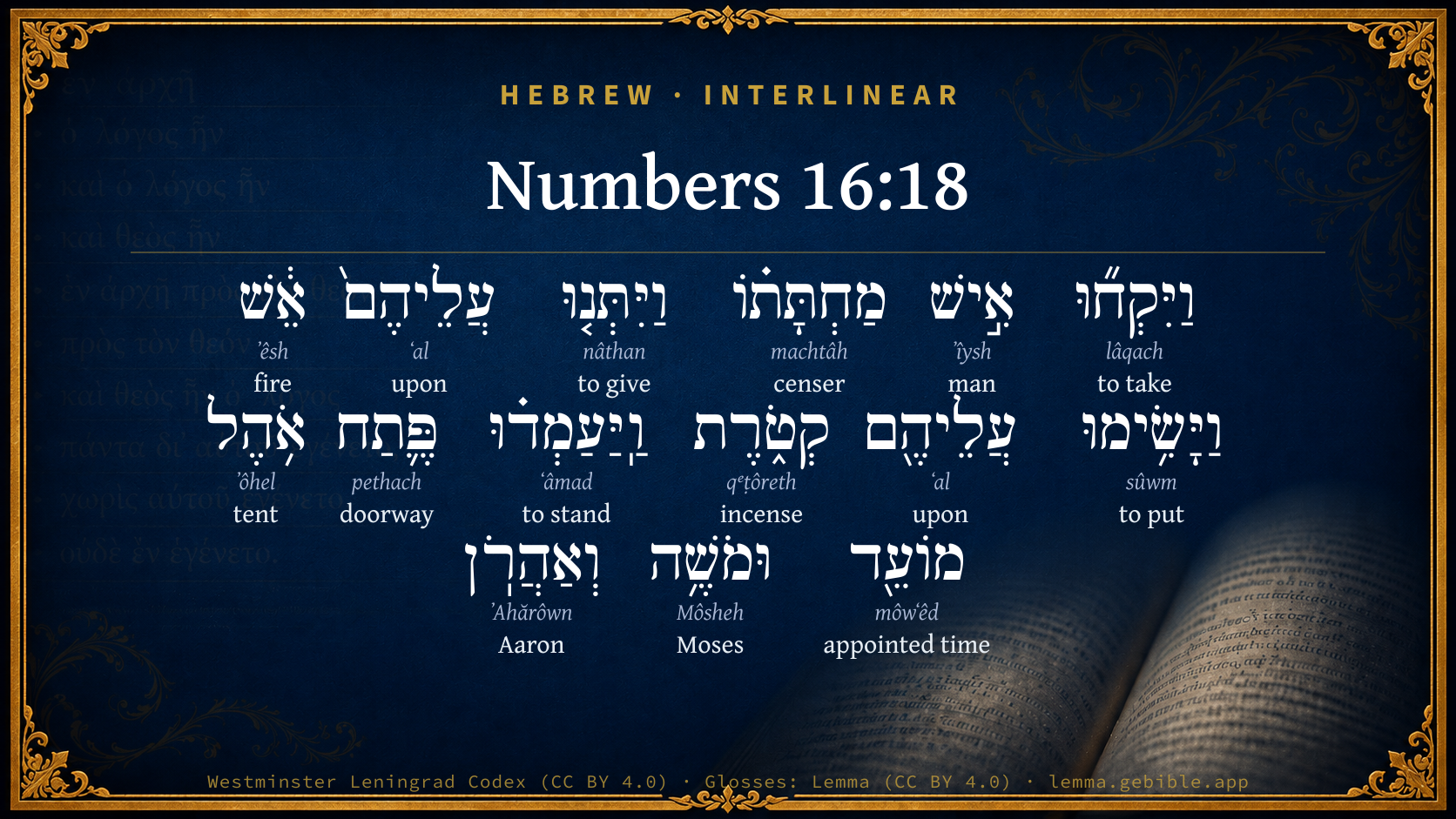
Hebrew (Westminster Leningrad Codex) Numbers 16:18 appears in the Hebrew Old Testament. The text above is from the Westminster Leningrad Codex. Each word links to its Strong’s number, a concise gloss, and parsing drawn from the Open Scriptures Hebrew Bible morphology. Click any word for its full Brown-Driver-Briggs (BDB) entry.
Download image
Cite this verse

Numbers 16:18 (World English Bible). Public Domain. Lemma interlinear Bible study tool, https://lemma.gebible.app/v/numbers/16/18.

Show BibTeX & RIS
BibTeX
RIS
English Translation
They took every man his censer, and put fire in them, and laid incense thereon, and stood at the door of the tent of meeting with Moses and Aaron.
World English Bible · Public Domain
Download a study sheet

One document with this verse’s original text, its word-by-word gloss line, the meaning frame, cross-references with their text, attributed commentary, and full source and license credits — printable, and it pastes into notes with its structure intact.

This verse Autodidact and up

Study sheet (.html) Plain text (.txt)

A passage Seminary Student

Up to 50 verses in one chapter. A passage sheet keeps up to 6 commentary sources and 12 cross-references per verse, in the order this page ranks them, and says so on the sheet whenever that leaves anything out. Ask for a single verse and you get the Autodidact verse sheet above.

Everything on this page stays free to read, with no account — the sheet is a download of what is already on screen, not access to it.

Want to remove ads? Support Godless Engineer
Compare translations 3

The same verse in 3 English versions, stacked beneath the original-language interlinear above. Click any original word for its lexicon entry.

Each is an independent rendering of the whole verse — the interlinear is not word-aligned to these translations.

Highlighted words mark where these versions differ — a whole-verse word diff, not a word-by-word alignment.

  • World English Bible Public Domain
    They took every man his censer, and put fire in them, and laid incense thereon, and stood at the door of the tent of meeting with Moses and Aaron.
  • King James Version Public Domain
    And they took every man his censer, and put fire in them, and laid incense thereon, and stood in the door of the tabernacle of the congregation with Moses and Aaron.
  • unfoldingWord Literal Text CC BY-SA 4.0
    And they took a man his censer, and they put fire on them and set incense on them, and they stood the opening of the tent of meeting, and Moses and Aaron.

unfoldingWord Literal Text — © unfoldingWord, licensed CC BY-SA 4.0. Word-aligned USFM3 via Door43 (git.door43.org/unfoldingWord/en_ult).

Versions to compare (up to 4)

3 of 4 selected

Show all 18 translations

Every available English version of this verse, each an independent rendering of the whole verse.

  • World English Bible Public Domain
    They took every man his censer, and put fire in them, and laid incense thereon, and stood at the door of the tent of meeting with Moses and Aaron.
  • Berean Standard Bible Public Domain
    So each man took his censer, put fire and incense in it, and stood with Moses and Aaron at the entrance to the Tent of Meeting.
  • Majority Standard Bible Public Domain
    So each man took his censer, put fire and incense in it, and stood with Moses and Aaron at the entrance to the Tent of Meeting.
  • King James Version Public Domain
    And they took every man his censer, and put fire in them, and laid incense thereon, and stood in the door of the tabernacle of the congregation with Moses and Aaron.
  • American Standard Version (1901) Public Domain
    And they took every man his censer, and put fire in them, and laid incense thereon, and stood at the door of the tent of meeting with Moses and Aaron.
  • Revised Version (1885) Public Domain
    And they took every man his censer, and put fire in them, and laid incense thereon, and stood at the door of the tent of meeting with Moses and Aaron.
  • Geneva Bible (1599) Public Domain
    So they tooke euery man his censor, and put fire in them, and laide incense thereon, and stoode in the doore of the Tabernacle of the Congregation with Moses and Aaron.
  • Douay-Rheims (1899) Public Domain
    When they had done this, Moses and Aaron standing,
  • Young's Literal Translation Public Domain
    And they take each his censer, and put on them fire, and lay on them perfume, and they stand at the opening of the tent of meeting, with Moses and Aaron.
  • Literal Standard Version CC BY-SA 4.0
    And they each take his censer, and put fire on them, and lay incense on them, and they stand at the opening of the Tent of Meeting with Moses and Aaron.
  • Unlocked Literal Bible CC BY-SA 4.0
    So every man took his censer, put fire in it, laid incense in it, and stood at the entrance to the tent of meeting with Moses and Aaron.
  • unfoldingWord Literal Text CC BY-SA 4.0
    And they took a man his censer, and they put fire on them and set incense on them, and they stood the opening of the tent of meeting, and Moses and Aaron.
  • Darby Bible Public Domain
    And they took each his censer, and put fire on them, and laid incense thereon, and stood before the entrance to the tent of meeting, as well as Moses and Aaron.
  • World Messianic Bible Public Domain
    They each took his censer, and put fire in it, and laid incense on it, and stood at the door of the Tent of Meeting with Moses and Aaron.
  • Webster's Bible Public Domain
    And they took every man his censer, and put fire in them, and laid incense on them, and stood in the door of the tabernacle of the congregation with Moses and Aaron.
  • Free Bible Version CC BY-SA 4.0
    So each one took his incense burner, put incense in it, set it on fire, and stood together with Moses and Aaron at the entrance to the Tent of Meeting.
  • Bible in Basic English Public Domain
    So every man took his vessel and they put fire in them, with spices, and came to the door of the Tent of meeting with Moses and Aaron.
  • JPS Tanakh (1917) Public Domain
    And they took every man his fire-pan, and put fire in them, and laid incense thereon, and stood at the door of the tent of meeting with Moses and Aaron.

Literal Standard Version (2020), Covenant Press — licensed CC BY-SA 4.0. Text via the HelloAO Bible API (eBible.org). Unlocked Literal Bible (unfoldingWord) — licensed CC BY-SA 4.0. Text via the HelloAO Bible API (eBible.org). unfoldingWord Literal Text — © unfoldingWord, licensed CC BY-SA 4.0. Word-aligned USFM3 via Door43 (git.door43.org/unfoldingWord/en_ult). Free Bible Version, Dr. Jonathan Gallagher — licensed CC BY-SA 4.0. Text via the HelloAO Bible API (eBible.org).

Word by word

More ways to search: Search by grammar → Find every occurrence → Compare this word →

Practice this passage: Drill this verse → Learn its vocabulary →

מַחְתָּת֗וֹ
machtâh
H4289
“censer · his”
Noun, Common, Feminine, Singular, Construct + Suffix, Personal, 3rd Person, Masculine, Singular
Part of Speech
Noun
Type
Common
Gender
Feminine
Number
Singular
State
Construct
Full BDB Definition

Origin: the same as H4288 in the sense of removal

TWOT: 777a

fire-holder, censer, firepan, snuff dish, tray - snuff-dish - fire-pans - censer
  1. וַיִּקְח֞וּ lâqach H3947 “and · to take” Conjunction + Verb, Qal, Sequential Imperfect, 3rd Person, Masculine, Plural
  2. אִ֣ישׁ ʼîysh H376 “man” Noun, Common, Masculine, Singular, Absolute
  3. וַיִּתְּנ֤וּ nâthan H5414 “and · to give” Conjunction + Verb, Qal, Sequential Imperfect, 3rd Person, Masculine, Plural
  4. עֲלֵיהֶם֙ ʻal H5921 “upon · them” Preposition + Suffix, Personal, 3rd Person, Masculine, Plural
  5. אֵ֔שׁ ʼêsh H784 “fire” Noun, Common, Both, Singular, Absolute
  6. וַיָּשִׂ֥ימוּ sûwm H7760 “and · to put” Conjunction + Verb, Qal, Sequential Imperfect, 3rd Person, Masculine, Plural
  7. עֲלֵיהֶ֖ם ʻal H5921 “upon · them” Preposition + Suffix, Personal, 3rd Person, Masculine, Plural
  8. קְטֹ֑רֶת qᵉṭôreth H7004 “incense” Noun, Common, Feminine, Singular, Absolute
  9. וַֽיַּעַמְד֗וּ ʻâmad H5975 “and · to stand” Conjunction + Verb, Qal, Sequential Imperfect, 3rd Person, Masculine, Plural
  10. פֶּ֛תַח pethach H6607 “doorway of” Noun, Common, Masculine, Singular, Construct
  11. אֹ֥הֶל ʼôhel H168 “tent of” Noun, Common, Masculine, Singular, Construct
  12. מוֹעֵ֖ד môwʻêd H4150 “appointed time” Noun, Common, Masculine, Singular, Absolute
  13. וּמֹשֶׁ֥ה Môsheh H4872 “and · Moses” Conjunction + Noun, Proper
  14. וְאַהֲרֹֽן ʼAhărôwn H175 “and · Aaron” Conjunction + Noun, Proper

About this verse

These counts appear in no published source. They are computed here, from the morphology-tagged text and Lemma’s own curated glosses. What Lemma adds →

15
words
14
distinct lemmas
Pentateuch
section

Notable vocabulary

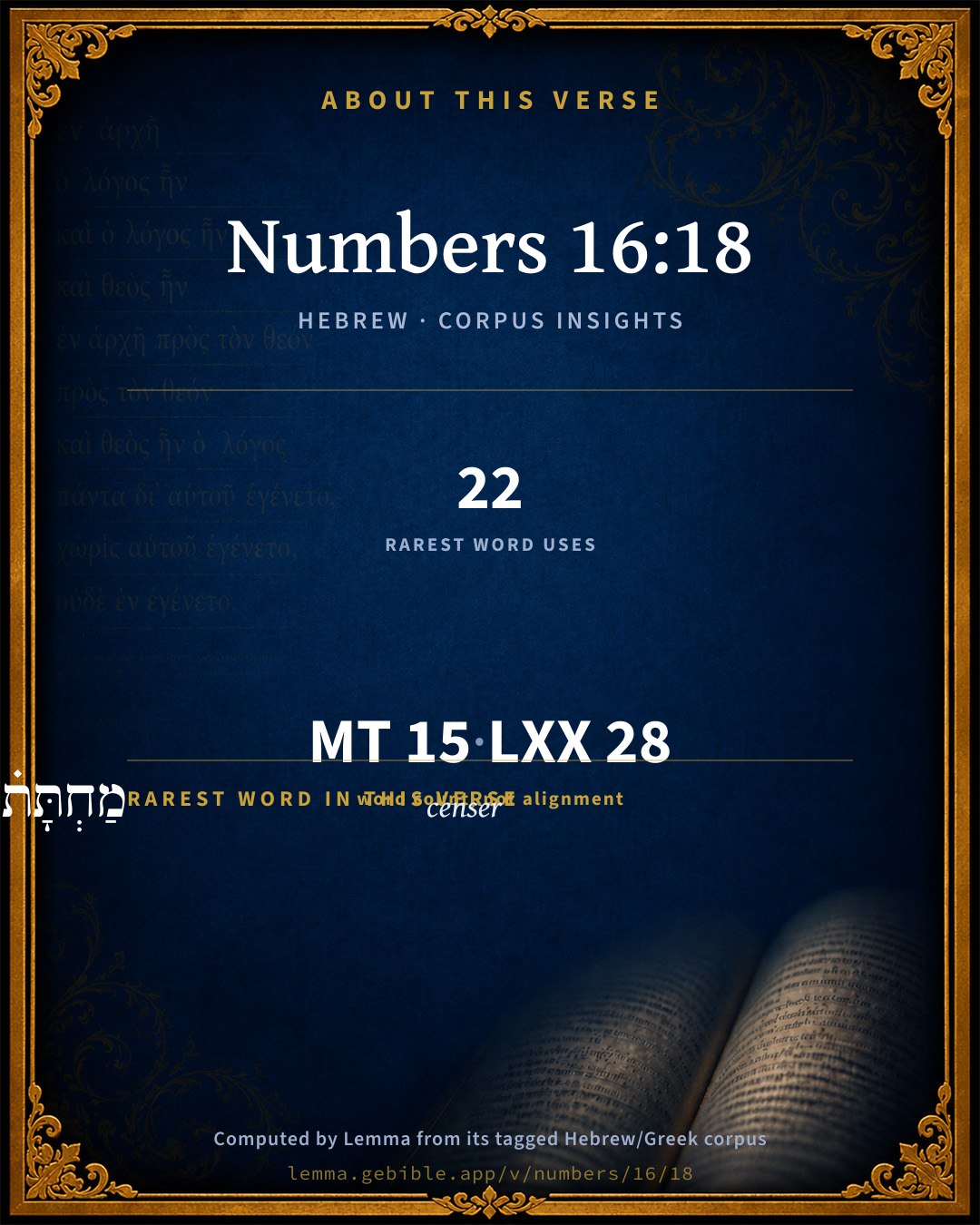
The rarest word here is מַחְתָּת֗וֹ censer H4289 — appearing just 22 times in the whole Hebrew Bible.

Shared distinctive vocabulary

מַחְתָּת֗וֹ censer H4289 occurs in 19 verses of the Hebrew Bible. Also found in:

Grammatical profile

  • 4 verbs
  • 9 nouns
  • 2 prepositions

Verb forms

  • וַיִּקְח֞וּ Qal · Sequential Imperfect
  • וַיִּתְּנ֤וּ Qal · Sequential Imperfect
  • וַיָּשִׂ֥ימוּ Qal · Sequential Imperfect
  • וַֽיַּעַמְד֗וּ Qal · Sequential Imperfect

Repetition

A word recurs within this verse — often emphatic in Hebrew:

  • עֲלֵיהֶם֙ upon H5921 ×2

Hebrew & Septuagint length

In English translation the verse runs 29 words from the Hebrew and 30 from the Septuagint (LXX English) — closely comparable.

A rough comparison of the two English renderings, which tokenize alike — not a word-level alignment.

Word counts can differ between the Hebrew and the Greek without any difference in meaning — e.g. the Hebrew direct-object marker אֵת has no separate Greek word, and Greek often adds the article ὁ.

In the original languages it is 15 Hebrew tokens and 28 Greek tokens — but the two are counted differently (Hebrew bundles its prefixes and suffixes into one token; the Greek is in lemma form), so that isn’t a like-for-like length.

Hebrew and Greek witnesses Masoretic Hebrew ↔ Greek Septuagint

The same verse in the two great witnesses to the Old Testament, shown verse-for-verse.

These are two independent witnesses, not word-aligned to each other, and the Septuagint is shown in lemma (dictionary) form.

Hebrew Numbers 16:18 Masoretic · Westminster Leningrad Codex

וַיִּקְח֞וּ אִ֣ישׁ מַחְתָּת֗וֹ וַיִּתְּנ֤וּ עֲלֵיהֶם֙ אֵ֔שׁ וַיָּשִׂ֥ימוּ עֲלֵיהֶ֖ם קְטֹ֑רֶת וַֽיַּעַמְד֗וּ פֶּ֛תַח אֹ֥הֶל מוֹעֵ֖ד וּמֹשֶׁ֥ה וְאַהֲרֹֽן

They took every man his censer, and put fire in them, and laid incense thereon, and stood at the door of the tent of meeting with Moses and Aaron.

World English Bible · Public Domain

Greek LXX Numbers 16:18 Septuagint · lemma form

καί λαμβάνω ἕκαστος ὁ πυρεῖον αὐτός καί ἐπιτίθημι ἐπί αὐτός πῦρ καί ἐπιβάλλω ἐπί αὐτός θυμίαμα καί ἵστημι παρά ὁ θύρα ὁ σκηνή ὁ μαρτύριον μωυσῆς καί ἀαρών

And each man took his censer, and they put on them fire, and laid incense on them; and Moses and Aaron stood by the doors of the tabernacle of witness.

LXX2012 (modern English Septuagint) · Public Domain

Hebrew: Westminster Leningrad Codex (CC BY 4.0). Greek: Septuagint (public domain); English from LXX2012 (modern English Septuagint) (Public Domain). How the Septuagint differs from the Hebrew →

Targum (Aramaic paraphrase)

2

The Targum is the ancient Jewish Aramaic paraphrase of the Hebrew Scriptures — an interpretive translation, not the Hebrew text itself. Onkelos (literal) and Pseudo-Jonathan (expansive) render the Torah, and Jonathan the Prophets. Coverage is partial: where no permissively-licensed English translation exists for a verse, only the Aramaic is shown. This is verse-level text, not a word-by-word alignment to the Hebrew.

  1. Targum Onkelos Torah (Genesis–Deuteronomy)
    וּנְסִיבוּ גְבַר מַחְתִּיתֵהּ וִיהָבוּ עֲלֵיהוֹן אֵשָׁתָא וְשַׁוִיאוּ עֲלֵיהוֹן קְטֹרֶת בּוּסְמִין וְקָמוּ בִּתְרַע מַשְׁכַּן זִמְנָא וּמשֶׁה וְאַהֲרֹן

    (no public-domain English translation for this verse)

    Targum Onkelos — Aramaic: “Onkelos Genesis” (public domain); “Onkelos Exodus” (public domain); “Onkelos Leviticus” (public domain); “Onkelos Numbers” (public domain); “Onkelos Deuteronomy” (public domain). English: “Sefaria Community Translation” (CC0 1.0 (public-domain dedication)); “J.W. Etheridge. The Targums of Onkelos and Jonathan Ben Uzziel on the Pentateuch. London: Longmans, Green, 1862” (public domain). Text via Sefaria.

  2. Targum Pseudo-Jonathan Torah (Genesis–Deuteronomy)
    וּנְסִיבוּ גְבַר מַחְתְּיָתֵיהּ וִיהָבוּ בְהוֹן אֵישָׁתָא וְשַׁוִיאוּ עֲלֵיהוֹן קְטוֹרֶת בּוּסְמִין וְקָמוּ בִתְרַע מַשְׁכַּן זִמְנָא מִצִיטְרָא חָד וּמשֶׁה וְאַהֲרן מִצִיטְרָא חָד

    And they took every one his censer, and put fire in them and sweet incense with it, and stood at the door of the tabernacle of ordinance on one side; but Mosheh and Aharon on the other side.

    Targum Pseudo-Jonathan — Aramaic: “Targum Jonathan on Genesis” (public domain); “Targum Jonathan on Exodus” (public domain); “Targum Jonathan on Leviticus” (public domain); “Targum Jonathan on Numbers” (public domain); “Targum Jonathan on Deuteronomy” (public domain). English: “The Targum of Jonathan ben Uzziel, trans. J. W. Etheridge, London, 1862” (public domain). Text via Sefaria.

Commentary

Notes on Numbers 16:18 from classic Christian and Jewish commentators (each source and its license shown beneath its notes). The classic Christian expositions comment on the surrounding passage and are grouped to its opening verse, so a note may address several verses; the Jewish commentaries on the Tanakh (Rashi and others) are per-verse, so they appear only where the commentator wrote on this verse.

Lemma curates 59 commentaries, every one of them public domain or Creative Commons licensed, each selected and text-cleaned for this edition rather than reprinted as found. About our sources →

Trapp's Complete Commentary

John Trapp

Num 16:18 And they took every man his censer, and put fire in them, and laid incense thereon, and stood in the door of the tabernacle of the congregation with Moses and Aaron.

Ver. 18. And stood in the door.] Such an impudency had sin oaded in their faces, that they stood stouting it out before the Lord, and made open profession of their wickedness: there was no need to dig to find it out, {Jer 2:34} for they set it, as it were, upon the cliff of the rock. {Eze 24:7}

John Trapp, A Commentary or Exposition upon All the Books of the Old and New Testament (1647–1656) — public domain. Text from a community e-Sword module.

Joseph Benson's Commentary

Num 16:18. They put fire in them — Taken from the altar which stood in that place, for Aaron might not use other fire. And it is likely the remembrance of the death of Nadab and Abihu deterred them from offering any strange fire.

Joseph Benson's Commentary on the Old and New Testaments (1811–1818) — public domain. Text from a community e-Sword module.

Tyndale Open Study Notes

Tyndale Open Resources

16:18-22 At the height of the insurrection, the Lord intervened to save Moses and Aaron, and they interceded for the people.

Tyndale Open Study Notes — © Tyndale Open Resources, licensed CC BY-SA 4.0. Text via the HelloAO Bible API.

John Gill's Exposition

And they took every man his censer, and that fire in them,.... That is, they came the next morning, according to order, prepared with their censers and incense; and they took fire from off the altar of burnt offering, which stood in the court of the tabernacle:

and laid incense thereon: upon the fire in their censers, and so burned it:

and stood in the door of the tabernacle of the congregation; not in the holy place, where the altar of incense was, for that would not hold them; nor indeed in the court of the tabernacle, but at the door of it, or the outside of it, that so they might be seen by all the people who came to be spectators and witnesses of this affair: and they stood

with Moses and Aaron; in a bold and presumptuous manner, as if they were their equals, disputing their authority, and putting themselves upon their trial before the Lord about it: the Targum of Jonathan says, these men stood on one side (of the door of the tabernacle), and Moses and Aaron stood on the other side of it.

John Gill's Exposition of the Whole Bible (1746–1763) — public domain (CC PDM 1.0). Text via the HelloAO Bible API.

Matthew Poole's English Annotations

They could easily make censers in a slight manner, which would suffice for the present purpose. The

fire was taken from the altar which stood in that place, Lev 1:3,5, for Aaron might not use other fire, Lev 10:1. And it is likely the remembrance of the death of Nadab and Abihu deterred them from offering any strange fire.

Matthew Poole's English Annotations on the Holy Bible (1683–1685) — public domain. Text from a community e-Sword/MySword module.

Whedon's Commentary on the Bible

Daniel D. Whedon

18. Laid incense thereon — They did not sprinkle blood, which was a priestly function, but they burned incense, because this was originally a prerogative of the high priest alone. But in the daily service of the second temple inferior priests, chosen by lot, burned incense each morning and evening. Luk_1:9, note. The fact that the insurgents assumed the most sacred function of Aaron is another proof of their revolutionary purpose.

Daniel D. Whedon (gen. ed.), Commentary on the Old and New Testaments (1874–1909) — public domain. Text from a community e-Sword module.

The Pulpit Commentary

Stood in the door of the tabernacle, i.e., at the door of the court, so that they were visible from the space outside.

The Pulpit Commentary (1880–1919), ed. H.D.M. Spence-Jones & Joseph S. Exell — public domain. Text from a community e-Sword module.

John Wesley's Explanatory Notes

Fire - Taken from the altar which stood in that place, for Aaron might not use other fire. And it is likely the rememberance of the death of Nadab and Abihu deterred them from offering any strange fire.

John Wesley, Explanatory Notes Upon the Whole Bible (1754–1765) — public domain. Text via the GEBible commentary corpus.

Keil & Delitzsch

C. F. Keil & F. Delitzsch

The next day the rebels presented themselves with censers before the tabernacle, along with Moses and Aaron; and the whole congregation also assembled there at the instigation of Korah. The Lord then interposed in judgment. Appearing in His glory to the whole congregation (just as in Num 14:10), He said to Moses and Aaron, "Separate yourselves from this congregation; I will destroy them in a moment." By assembling in front of the tabernacle, the whole congregation had made common cause with the rebels. God threatened them, therefore, with sudden destruction. But the two men of God, who ere so despised by the rebellious faction, fell on their faces, interceding with God, and praying, "God, Thou God of the spirits of all flesh! this one man (i.e., Korah, the author of the conspiracy) hath sinned, and wilt Thou be wrathful with all the congregation?" i.e., let Thine anger fall upon the whole congregation. The Creator and Preserver of all beings, who has given and still gives life and breath to all flesh, is God of the spirits of all flesh. As the author of the spirit of life in all perishable flesh, God cannot destroy His own creatures in wrath; this would be opposed to His own paternal love and mercy. In this epithet, as applied to God, therefore, Moses appeals "to the universal blessing of creation. It is of little consequence whether these words are to be understood as relating to all the animal kingdom, or to the human race alone; because Moses simply prayed, that as God was the creator and architect of the world, He would not destroy the men whom He had created, but rather have mercy upon the works of His own hands" (Calvin). The intercession of the prophet Isaiah, in Isa 64:8, is similar to this, though that is founded upon the special relation in which God stood to Israel.

Keil & Delitzsch — Biblical Commentary on the Old Testament (1861–1891) — public domain (CC PDM 1.0). Text via the HelloAO Bible API. (Old Testament only.)

unfoldingWord translationNotes

Door43 World Missions Community

translationWords

fire

tent of meeting

Moses

Aaron

Korah

Yahweh

glory

unfoldingWord translationNotes — © Distant Shores Media and the Door43 World Missions Community, licensed CC BY-SA 4.0. Source: git.door43.org/Door43/en_tn.

Lesson kit

Teaching starters — assembled from the data on this page, not authored interpretation. Every prompt links to the verse data it draws on. Edit before teaching.

Numbers, in the Pentateuch, opens this verse with 15 words (14 distinct Hebrew lemmas). Its most distinctive word is machtâh (“censer”). A historical commentator’s framing appears above. Read the whole chapter for the surrounding context.

Discussion questions

  1. How does “censer” (machtâh) shape what this verse is saying?
  2. Exodus 25:38 shares the word «censer» with this verse. How do the two illuminate each other?
  3. “upon” occurs 2× in this one verse. What is the effect of the repetition?
  4. These translations render this verse differently; the difference is in the English rendering, not the original. What questions does that raise?
  5. The verb «וַיִּקְח֞וּ» is Qal Sequential Imperfect. How does its form color the action?
  6. Reading how Trapp's Complete Commentary and Joseph Benson's Commentary read this verse, where do the two commentators agree and where do they part?

Things to notice

Reading settings

Reading text

Shown beneath each verse's original-language words.

Old Testament
Old Testament edition

Read the OT as the Masoretic Hebrew (MT) or the Greek Septuagint (LXX).

English shown for the Greek Septuagint (in the Hebrew ↔ Greek comparison).

Comparing translations? Open the Compare panel on any verse page to stack up to four side by side.