
Exodus 32:20

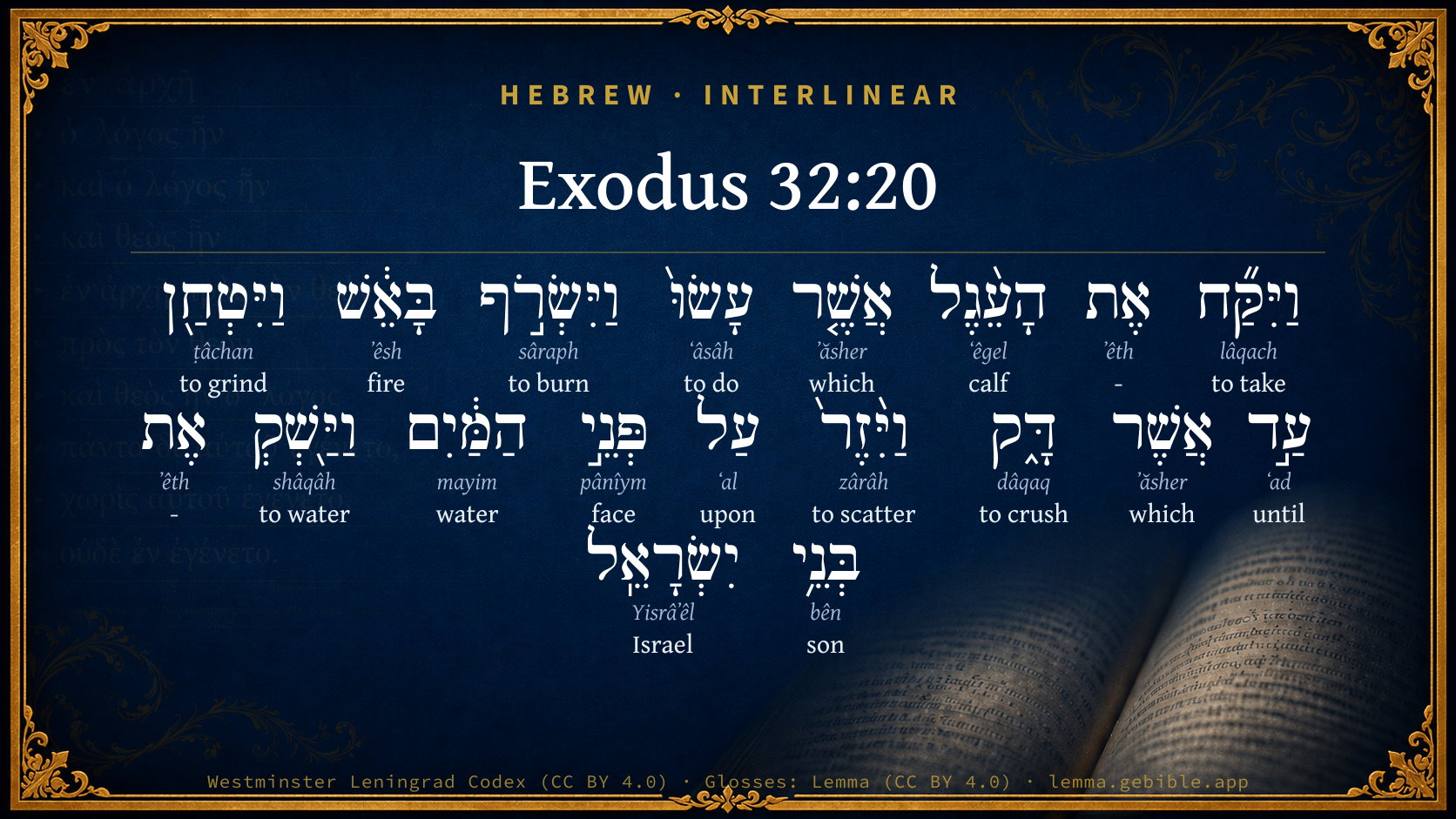
Hebrew (Westminster Leningrad Codex) Exodus 32:20 appears in the Hebrew Old Testament. The text above is from the Westminster Leningrad Codex. Each word links to its Strong’s number, a concise gloss, and parsing drawn from the Open Scriptures Hebrew Bible morphology. Click any word for its full Brown-Driver-Briggs (BDB) entry.
Download image
Cite this verse

Exodus 32:20 (World English Bible). Public Domain. Lemma interlinear Bible study tool, https://lemma.gebible.app/v/exodus/32/20.

Show BibTeX & RIS
BibTeX
RIS
English Translation
He took the calf which they had made, and burnt it with fire, ground it to powder, and scattered it on the water, and made the children of Israel drink of it.
World English Bible · Public Domain
Highlights
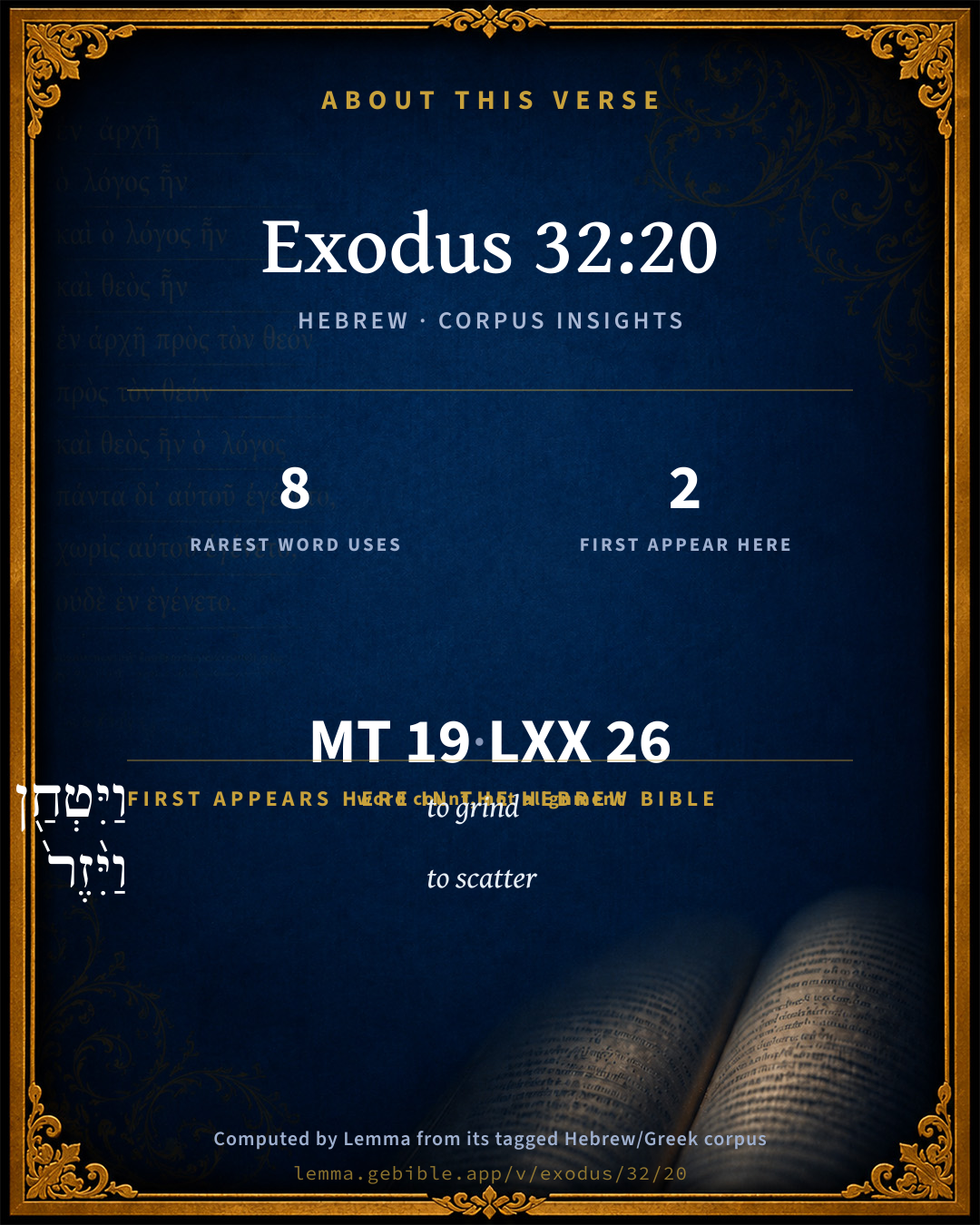
  • 2 first appearances in the Hebrew Bible
Full analysis ↓
Download a study sheet

One document with this verse’s original text, its word-by-word gloss line, the meaning frame, cross-references with their text, attributed commentary, and full source and license credits — printable, and it pastes into notes with its structure intact.

This verse Autodidact and up

Study sheet (.html) Plain text (.txt)

A passage Seminary Student

Up to 50 verses in one chapter. A passage sheet keeps up to 6 commentary sources and 12 cross-references per verse, in the order this page ranks them, and says so on the sheet whenever that leaves anything out. Ask for a single verse and you get the Autodidact verse sheet above.

Everything on this page stays free to read, with no account — the sheet is a download of what is already on screen, not access to it.

Want to remove ads? Support Godless Engineer
Compare translations 3

The same verse in 3 English versions, stacked beneath the original-language interlinear above. Click any original word for its lexicon entry.

Each is an independent rendering of the whole verse — the interlinear is not word-aligned to these translations.

Highlighted words mark where these versions differ — a whole-verse word diff, not a word-by-word alignment.

  • World English Bible Public Domain
    He took the calf which they had made, and burnt it with fire, ground it to powder, and scattered it on the water, and made the children of Israel drink of it.
  • King James Version Public Domain
    And he took the calf which they had made, and burnt it in the fire, and ground it to powder, and strewed it upon the water, and made the children of Israel drink of it.
  • unfoldingWord Literal Text CC BY-SA 4.0
    And he took the calf that they had made and burned in the fire and ground until it was fine and scattered on the face of the water and caused the sons of Israel to drink.

unfoldingWord Literal Text — © unfoldingWord, licensed CC BY-SA 4.0. Word-aligned USFM3 via Door43 (git.door43.org/unfoldingWord/en_ult).

Versions to compare (up to 4)

3 of 4 selected

Show all 18 translations

Every available English version of this verse, each an independent rendering of the whole verse.

  • World English Bible Public Domain
    He took the calf which they had made, and burnt it with fire, ground it to powder, and scattered it on the water, and made the children of Israel drink of it.
  • Berean Standard Bible Public Domain
    Then he took the calf they had made, burned it in the fire, ground it to powder, and scattered the powder over the face of the water. Then he forced the Israelites to drink it.
  • Majority Standard Bible Public Domain
    Then he took the calf they had made, burned it in the fire, ground it to powder, and scattered the powder over the face of the water. Then he forced the Israelites to drink it.
  • King James Version Public Domain
    And he took the calf which they had made, and burnt it in the fire, and ground it to powder, and strewed it upon the water, and made the children of Israel drink of it.
  • American Standard Version (1901) Public Domain
    And he took the calf which they had made, and burnt it with fire, and ground it to powder, and strewed it upon the water, and made the children of Israel drink of it.
  • Revised Version (1885) Public Domain
    And he took the calf which they had made, and burnt it with fire, and ground it to powder, and strewed it upon the water, and made the children of Israel drink of it.
  • Geneva Bible (1599) Public Domain
    After, he tooke the calfe, which they had made, and burned it in the fire, and ground it vnto powder, and strowed it vpon the water, and made the children of Israel drinke of it.
  • Douay-Rheims (1899) Public Domain
    And laying hold of the calf which they had made, he burnt it, and beat it to powder, which he strowed into water, and gave thereof to the children of Israel to drink.
  • Young's Literal Translation Public Domain
    and he taketh the calf which they have made, and burneth `it' with fire, and grindeth until `it is' small, and scattereth on the face of the waters, and causeth the sons of Israel to drink.
  • Literal Standard Version CC BY-SA 4.0
    and he takes the calf which they have made, and burns [it] with fire, and grinds [it] until [it is] small, and scatters [it] on the face of the waters, and causes the sons of Israel to drink.
  • Unlocked Literal Bible CC BY-SA 4.0
    He took the calf that the people had made, burned it, ground it to powder, and poured it into the water. Then he made the people of Israel drink it.
  • unfoldingWord Literal Text CC BY-SA 4.0
    And he took the calf that they had made and burned in the fire and ground until it was fine and scattered on the face of the water and caused the sons of Israel to drink.
  • Darby Bible Public Domain
    And he took the calf that they had made, and burned [it] with fire, and ground it to powder, and strewed [it] on the water, and made the children of Israel drink [it].
  • World Messianic Bible Public Domain
    He took the calf which they had made, and burned it with fire, ground it to powder, and scattered it on the water, and made the children of Israel drink it.
  • Webster's Bible Public Domain
    And he took the calf which they had made, and burnt it in the fire, and ground it to powder, and strewed it upon the water, and made the children of Israel drink of it.
  • Free Bible Version CC BY-SA 4.0
    He took the bull calf and burned it, and ground it into powder. Then he mixed this with water and made the Israelites drink it.
  • Bible in Basic English Public Domain
    And he took the ox which they had made, burning it in the fire and crushing it to powder, and he put it in the water and made the children of Israel take a drink of it.
  • JPS Tanakh (1917) Public Domain
    And he took the calf which they had made, and burnt it with fire, and ground it to powder, and strewed it upon the water, and made the children of Israel drink of it.

Literal Standard Version (2020), Covenant Press — licensed CC BY-SA 4.0. Text via the HelloAO Bible API (eBible.org). Unlocked Literal Bible (unfoldingWord) — licensed CC BY-SA 4.0. Text via the HelloAO Bible API (eBible.org). unfoldingWord Literal Text — © unfoldingWord, licensed CC BY-SA 4.0. Word-aligned USFM3 via Door43 (git.door43.org/unfoldingWord/en_ult). Free Bible Version, Dr. Jonathan Gallagher — licensed CC BY-SA 4.0. Text via the HelloAO Bible API (eBible.org).

Word by word

More ways to search: Search by grammar → Find every occurrence → Compare this word →

Practice this passage: Drill this verse → Learn its vocabulary →

וַיִּטְחַ֖ן
ṭâchan
H2912
“and · to grind”
Conjunction + Verb, Qal, Sequential Imperfect, 3rd Person, Masculine, Singular
Part of Speech
Conjunction + Verb
Stem
Qal
Form
Sequential Imperfect
Person
3rd Person
Gender
Masculine
Number
Singular
Full BDB Definition

Origin: a primitive root

TWOT: 802

(Qal) to grind, crush
  1. וַיִּקַּ֞ח lâqach H3947 “and · to take” Conjunction + Verb, Qal, Sequential Imperfect, 3rd Person, Masculine, Singular
  2. אֶת ʼêth H853 “-” Particle, Direct Object
  3. הָעֵ֨גֶל ʻêgel H5695 “the · calf” Particle, Definite Article + Noun, Common, Masculine, Singular, Absolute
  4. אֲשֶׁ֤ר ʼăsher H834 “which” Particle, Relative
  5. עָשׂוּ֙ ʻâsâh H6213 “to do” Verb, Qal, Perfect, 3rd Person, Common, Plural
  6. וַיִּשְׂרֹ֣ף sâraph H8313 “and · to burn” Conjunction + Verb, Qal, Sequential Imperfect, 3rd Person, Masculine, Singular
  7. בָּאֵ֔שׁ ʼêsh H784 “in/at the · fire” Preposition, Determined + Noun, Common, Both, Singular, Absolute
  8. עַ֣ד ʻad H5704 “until” Preposition
  9. אֲשֶׁר ʼăsher H834 “which” Particle, Relative
  10. דָּ֑ק dâqaq H1854 “to crush” Verb, Qal, Perfect, 3rd Person, Masculine, Singular
  11. וַיִּ֨זֶר֙ zârâh H2219 “and · to scatter” Conjunction + Verb, Qal, Sequential Imperfect, 3rd Person, Masculine, Singular
  12. עַל ʻal H5921 “upon” Preposition
  13. פְּנֵ֣י pânîym H6440 “face(s) of” Noun, Common, Both, Plural, Construct
  14. הַמַּ֔יִם mayim H4325 “the · water(s)” Particle, Definite Article + Noun, Common, Masculine, Plural, Absolute
  15. וַיַּ֖שְׁקְ shâqâh H8248 “and · to water” Conjunction + Verb, Hiphil, Sequential Imperfect, 3rd Person, Masculine, Singular
  16. אֶת ʼêth H853 “-” Particle, Direct Object
  17. בְּנֵ֥י bên H1121 “sons of” Noun, Common, Masculine, Plural, Construct
  18. יִשְׂרָאֵֽל Yisrâʼêl H3478 “Israel” Noun, Proper

About this verse

These counts appear in no published source. They are computed here, from the morphology-tagged text and Lemma’s own curated glosses. What Lemma adds →

19
words
17
distinct lemmas
Pentateuch
section

Notable vocabulary

The rarest word here is וַיִּטְחַ֖ן to grind H2912 — appearing just 8 times in the whole Hebrew Bible.

First appearance in Scripture

These words make their first canonical appearance in the Hebrew Bible here:

  • וַיִּטְחַ֖ן to grind H2912
  • וַיִּ֨זֶר֙ to scatter H2219

Shared distinctive vocabulary

וַיִּטְחַ֖ן to grind H2912 occurs in 8 verses of the Hebrew Bible. Also found in:

Grammatical profile

  • 7 verbs
  • 6 nouns
  • 2 prepositions
  • 4 particles

Verb forms

  • וַיִּקַּ֞ח Qal · Sequential Imperfect
  • עָשׂוּ֙ Qal · Perfect
  • וַיִּשְׂרֹ֣ף Qal · Sequential Imperfect
  • וַיִּטְחַ֖ן Qal · Sequential Imperfect
  • דָּ֑ק Qal · Perfect
  • וַיִּ֨זֶר֙ Qal · Sequential Imperfect
  • וַיַּ֖שְׁקְ Hiphil · Sequential Imperfect

Repetition

A word recurs within this verse — often emphatic in Hebrew:

  • אֲשֶׁ֤ר which H834 ×2

Hebrew & Septuagint length

In English translation the verse runs 32 words from the Hebrew and 33 from the Septuagint (LXX English) — closely comparable.

A rough comparison of the two English renderings, which tokenize alike — not a word-level alignment.

Word counts can differ between the Hebrew and the Greek without any difference in meaning — e.g. the Hebrew direct-object marker אֵת has no separate Greek word, and Greek often adds the article ὁ.

In the original languages it is 19 Hebrew tokens and 26 Greek tokens — but the two are counted differently (Hebrew bundles its prefixes and suffixes into one token; the Greek is in lemma form), so that isn’t a like-for-like length.

Cross-references

7

Topical passages linked to Exodus 32:20 in the Treasury of Scripture Knowledge — connected by theme and wording, ordered by reader-vote popularity; previews shown in the World English Bible.

  • Deuteronomy 9:21 I took your sin, the calf which you had made, and burnt it with fire, and stamped it, grinding it very small, until it was as fine as dust: and I cast the dust of it into the brook that descended out of the mountain.
  • Deuteronomy 7:5 But thus shall you deal with them: you shall break down their altars, and dash in pieces their pillars, and hew down their Asherim, and burn their engraved images with fire.
  • Deuteronomy 7:25 The engraved images of their gods shall you burn with fire: you shall not covet the silver or the gold that is on them, nor take it to you, lest you be snared therein; for it is an abomination to Yahweh your God.
  • 2 Kings 23:6 He brought out the Asherah from the house of Yahweh, outside of Jerusalem, to the brook Kidron, and burned it at the brook Kidron, and beat it to dust, and cast the dust of it on the graves of the common people.
  • 2 Kings 23:15 Moreover the altar that was at Bethel, and the high place which Jeroboam the son of Nebat, who made Israel to sin, had made, even that altar and the high place he broke down; and he burned the high place and beat it to dust, and burned the Asherah.
  • Proverbs 1:31 Therefore they will eat of the fruit of their own way, And be filled with their own schemes.
  • Proverbs 14:14 The unfaithful will be repaid for his own ways; Likewise a good man will be rewarded for his ways.

Cross-references courtesy of OpenBible.info (CC BY 4.0).

Hebrew and Greek witnesses Masoretic Hebrew ↔ Greek Septuagint

The same verse in the two great witnesses to the Old Testament, shown verse-for-verse.

These are two independent witnesses, not word-aligned to each other, and the Septuagint is shown in lemma (dictionary) form.

Hebrew Exodus 32:20 Masoretic · Westminster Leningrad Codex

וַיִּקַּ֞ח אֶת הָעֵ֨גֶל אֲשֶׁ֤ר עָשׂוּ֙ וַיִּשְׂרֹ֣ף בָּאֵ֔שׁ וַיִּטְחַ֖ן עַ֣ד אֲשֶׁר דָּ֑ק וַיִּ֨זֶר֙ עַל פְּנֵ֣י הַמַּ֔יִם וַיַּ֖שְׁקְ אֶת בְּנֵ֥י יִשְׂרָאֵֽל

He took the calf which they had made, and burnt it with fire, ground it to powder, and scattered it on the water, and made the children of Israel drink of it.

World English Bible · Public Domain

Greek LXX Exodus 32:20 Septuagint · lemma form

καί λαμβάνω ὁ μόσχος ὅς ποιέω κατακαίω αὐτός ἐν πῦρ καί καταἀλέω αὐτός λεπτός καί σπείρω αὐτός ἐπί ὁ ὕδωρ καί ποτίζω αὐτός ὁ υἱός ἰσραήλ

And having taken the calf which they made, he consumed it with fire, and ground it very small, and scattered it on the water, and made the children of Israel to drink it.

LXX2012 (modern English Septuagint) · Public Domain

On this verse, Haydock's Catholic Bible Commentary discusses the Septuagint’s reading. Read the note in Commentary ↓

Hebrew: Westminster Leningrad Codex (CC BY 4.0). Greek: Septuagint (public domain); English from LXX2012 (modern English Septuagint) (Public Domain). How the Septuagint differs from the Hebrew →

Targum (Aramaic paraphrase)

2

The Targum is the ancient Jewish Aramaic paraphrase of the Hebrew Scriptures — an interpretive translation, not the Hebrew text itself. Onkelos (literal) and Pseudo-Jonathan (expansive) render the Torah, and Jonathan the Prophets. Coverage is partial: where no permissively-licensed English translation exists for a verse, only the Aramaic is shown. This is verse-level text, not a word-by-word alignment to the Hebrew.

  1. Targum Onkelos Torah (Genesis–Deuteronomy)
    וּנְסֵיב יָת עֶגְלָא דִי עֲבָדוּ וְאוֹקֵד בְּנוּרָא וְשַׁף עַד דַהֲוָה דַקִיק וּזְרָא עַל אַפֵּי מַיָא וְאַשְׁקֵי יָת בְּנֵי יִשְׂרָאֵל:

    (no public-domain English translation for this verse)

    Targum Onkelos — Aramaic: “Onkelos Genesis” (public domain); “Onkelos Exodus” (public domain); “Onkelos Leviticus” (public domain); “Onkelos Numbers” (public domain); “Onkelos Deuteronomy” (public domain). English: “Sefaria Community Translation” (CC0 1.0 (public-domain dedication)); “J.W. Etheridge. The Targums of Onkelos and Jonathan Ben Uzziel on the Pentateuch. London: Longmans, Green, 1862” (public domain). Text via Sefaria.

  2. Targum Pseudo-Jonathan Torah (Genesis–Deuteronomy)
    וּנְסִיב יַת עִיגְלָא דַעֲבָדוּ וְאוֹקֵד בְּנוּרָא וְשַׁף עַד דַּהֲוָה דָּקִיק וְדָרֵי עַל אַנְפֵּי מוֹי דְנַחֲלָא וְאַשְׁקֵי יַת בְּנֵי יִשְרָאֵל וְכָל מַאן דְּיָהַב תַּמָּן כָּל מָאנָא דְדַהֲבָא הֲוָה סִימָא נַפְקָא בְּאַנְפָּא

    And he took the calf which they had made, and burned it in fire, and bruised it into powder, and cast (it) upon the face of the water of the stream, and made the sons of Israel drink; and whoever had given thereto any trinket of gold, the sign of it came forth upon his nostrils.

    Targum Pseudo-Jonathan — Aramaic: “Targum Jonathan on Genesis” (public domain); “Targum Jonathan on Exodus” (public domain); “Targum Jonathan on Leviticus” (public domain); “Targum Jonathan on Numbers” (public domain); “Targum Jonathan on Deuteronomy” (public domain). English: “The Targum of Jonathan ben Uzziel, trans. J. W. Etheridge, London, 1862” (public domain). Text via Sefaria.

Commentary

Notes on Exodus 32:20 from classic Christian and Jewish commentators (each source and its license shown beneath its notes). The classic Christian expositions comment on the surrounding passage and are grouped to its opening verse, so a note may address several verses; the Jewish commentaries on the Tanakh (Rashi and others) are per-verse, so they appear only where the commentator wrote on this verse.

Lemma curates 59 commentaries, every one of them public domain or Creative Commons licensed, each selected and text-cleaned for this edition rather than reprinted as found. About our sources →

Trapp's Complete Commentary

John Trapp

Exo 32:20 And he took the calf which they had made, and burnt [it] in the fire, and ground [it] to powder, and strawed [it] upon the water, and made the children of Israel drink [of it].

Ver. 20. And he took the calf.] We may all wish still as Ferus did, that we had some Moses to take away the evils of our times: Nam non unum tantum vitulum, sed multos habemus, We have not one, but many such calves.

John Trapp, A Commentary or Exposition upon All the Books of the Old and New Testament (1647–1656) — public domain. Text from a community e-Sword module.

Joseph Benson's Commentary

Exo 32:20. He took the calf which they had made — The people were evidently overawed by the presence of Moses, and therefore attempted no resistance while he took away their idol to destroy it. Here we see how much Moses excelled Aaron in courage and zeal for the glory of God, as also in authority among the people. He burned the calf — Melted it down, and then filed it to dust. This speedy reduction of the calf to powder, as well as the materials whereof it was made, inclines one to believe that it was not of any considerable size. He strewed it upon the water — Upon the brook which flowed for them from the rock in Horeb; and he made the children of Israel drink of it — Not that he constrained them to it; but, having no other water to drink, they could not avoid, when thirsty, to drink of that with this mixture. Thus it would be taken notice of throughout the camp, and would appear to all who had the least discernment that an idol is nothing, this being reduced to atoms, and made as mere a nothing as could be.

Joseph Benson's Commentary on the Old and New Testaments (1811–1818) — public domain. Text from a community e-Sword module.

Tyndale Open Study Notes

Tyndale Open Resources

32:20 Passing the gold powder of the image through the bodies of the people effectively rendered it unclean.

Tyndale Open Study Notes — © Tyndale Open Resources, licensed CC BY-SA 4.0. Text via the HelloAO Bible API.

Geneva Bible (1599)

Geneva Bible translators

Partly to despite them of their idolatry, and partly that they should have none occasion to remember it afterward.

Geneva Bible (1599) marginal notes — public domain. Text via Bolls.life.

Jamieson, Fausset & Brown

Robert Jamieson, A. R. Fausset & David Brown

he took the calf which they had made, and burnt it in the fire, &c.--It has been supposed that the gold was dissolved by natron or some chemical substance. But there is no mention of solubility here, or in Deu 9:21; it was "burned in the fire," to cast it into ingots of suitable size for the operations which follow--"grounded to powder"; the powder of malleable metals can be ground so fine as to resemble dust from the wings of a moth or butterfly; and these dust particles will float in water for hours, and in a running stream for days. These operations of grinding were intended to show contempt for such worthless gods, and the Israelites would be made to remember the humiliating lesson by the state of the water they had drunk for a time [NAPIER]. Others think that as the idolatrous festivals were usually ended with great use of sweet wine, the nauseous draught of the gold dust would be a severe punishment (compare Kg2 23:6, Kg2 23:15; Ch2 15:16; Ch2 34:7).

Jamieson, Fausset & Brown — Commentary Critical and Explanatory on the Whole Bible (1871) — public domain (CC PDM 1.0). Text via the HelloAO Bible API.

Adam Clarke's Commentary

Verse 20. He took the calf-and burnt - and ground it to powder, &c.] How truly contemptible must the object of their idolatry appear when they were obliged to drink their god, reduced to powder and strewed on the water! "But," says an objector, "how could gold, the most ductile of all metals, and the most ponderous, be stamped into dust and strewed on water?" In De 9:21, this matter is fully explained. I took, says Moses, your sin, the calf which ye had made, and burnt it with fire, that is, melted it down, probably into ingots, or gross plates, and stamped it, that is, beat into thin laminae, something like our gold leaf, and ground it very small, even until it was as small as dust, which might be very easily done by the action of the hands, when beat into thin plates or leaves, as the original words אכת eccoth and דק dak imply. And I cast the dust thereof into the brook, and being thus lighter than the water, it would readily float, so that they could easily see, in this reduced and useless state, the idol to which they had been lately offering Divine honours, and from which they were vainly expecting protection and defense. No mode of argumentation could have served so forcibly to demonstrate the folly of their conduct, as this method pursued by Moses.

Adam Clarke's Commentary on the Bible (1810–1826) — public domain. Text from a community e-Sword/MySword module.

Ellicott's Commentary for English Readers

(20) He took the calf.—To suppress the idolatry, the first step was to destroy the idol. Moses, who must have rallied to his side at once a certain number of the people, laid hold of the calf, and ordered its immediate destruction. He had it submitted to the action of fire, whereby its form was destroyed, and the material, as it would seem, calcined. This calcined material he reduced to a fine powder by rubbing or pounding, and then had the powder sprinkled on the surface of the stream which supplied the camp with water, that so the people might seem, at any rate, to swallow their own sin. Compare the action of Josiah (2Ki_23:6; 2Ki_23:12). No doubt, the process of destruction took some time. It is not meant that it was completed, but only that it was commenced, before Moses turned to other matters.

A Bible Commentary for English Readers, edited by Charles John Ellicott (1878–1897) — public domain. Text from a community e-Sword module.

The Cambridge Bible for Schools and Colleges

gen. ed. J. J. S. Perowne

20. The people are made to drink their own sin.

burnt it with fire] i.e. either (cf. on v. 4) burnt the wooden core, and ground the gold plating to powder by rolling large stones to and fro over it; or, if it were wholly of gold, reduced it by fire to shapeless lumps of metal, which were then ground to powder similarly.

strewed it upon the water] Deu_9:21 says ‘and I cast the dust thereof into the wâdy that descended out of the mount’—apparently to carry it away, without any mention of the Israelites being made to drink it.

to drink of it] Cf. the curses to be drunk by the suspected wife, Num_5:24.

The Cambridge Bible for Schools and Colleges (gen. ed. J. J. S. Perowne; Cambridge University Press, 1878–1918) — public domain. Text from a community e-Sword module.

John Gill's Exposition

And Moses said unto Aaron,.... Having destroyed the calf, and thereby expressed his abhorrence of their idolatry, he examines the principal persons concerned, and inquires into the cause and reason of it, how it came about; and begins with Aaron, though his own brother, with whom along with Hur he had committed the government of the people during his absence; and therefore was justly accountable for such a transaction, which could not have been without his knowledge and consent: no mention is made of Hur, whether he was dead or no is not certain; the Jewish writers say he was, and that he was killed for reproving the Israelites for their wickedness; and it looks as if he was dead, since he was not in the examination, and we hear of him no more afterwards:

what did this people unto thee, that thou hast brought so great a sin upon them? as idolatry is, than which no sin can be greater, it being not only a breach of the first table of the law, but directly against God, against the very being of God, and his honour and glory; it is a denial of him, and setting up an idol in his room, and giving to that the glory that is only due to his name; and Aaron being the chief magistrate, whose business it was to see that the laws of God were observed, and to restrain the people from sin, and to have been a terror to evil doers; yet falling in with them, and conniving at them, he is charged with bringing sin upon them, or them into that; and is asked what the people had done to him, that he should do this to them, what offence they had given him, what injury they had done him, that he bore them a grudge for it, and took this method to be revenged? for it is suggested, had they used him ever so ill, he could not have requited it in a stronger manner than by leading them into such a sin, the consequence of which must be ruin and destruction, see Gen 20:9 or else Moses inquires of Aaron what methods the people had made use of to prevail upon him to suffer them to do such a piece of wickedness; whether it was by persuasion and artful insinuations, or by threatening to take away his life if he did not comply, or in what manner they had wrought upon his weak side, to induce him to take such a step.

John Gill's Exposition of the Whole Bible (1746–1763) — public domain (CC PDM 1.0). Text via the HelloAO Bible API.

Haydock's Catholic Bible Commentary

Calf. Having manifested his disapprobation of the people’s conduct, in the most signal manner, by breaking the two tables; Moses proceeds to convince them of their stupidity, in adoring what he, in a few minutes, reduces to powder. (Haydock) --- He breaks the calf in pieces, after burning it, and then grinds it to dust in a mill, with files; as the Hebrew, Chaldean, and Septuagint intimate. He throws it, with contempt, into the torrent, which supplied the camp with water, and thus caused the idolaters to swallow their god. (Tirinus) -- Sa assures us, that he saw an alchymist pulverize gold, which Abenezra says is done by means of some herbs, which turn the gold quite black, when it is melted. (Calmet) --- Some use aquafortis for this purpose. (Tirinus) --- But from the account of Moses, (Deuteronomy ix. 21,) it seems fire, and the mille, or file, reduced the gold into the smallest particles, so as to be even potable. Josephus ([Antiquities?] viii. 2,) mentions the gold dust used by the courtiers of Solomon. (Calmet)

George Leo Haydock (1774–1849), Haydock's Catholic Family Bible and Commentary, 1859 edition — public domain. Excludes Psalms (Douay-Rheims chapter numbering differs from Protestant) and Deuterocanonical books (Catholic canon only).

Matthew Poole's English Annotations

Ground it to powder; melted it either into one great mass, or rather into divers little fragments, which afterwards by a the or other instruments he, by the help of many others, might soon grind to powder, or dust of gold.

Strawed it upon the water; upon the brook which came out of the rock Horeb, Exo 17:6.

The children of Israel; not all, which would require a long time, but some in the name of the rest; and most probably either the chief promoters of this idolatrous design, or the chief rulers of the people, who should by their power and authority have restrained the people from this wickedness.

To drink of it; of the water into which that dust was cast; partly to make them ashamed of their madness in worshipping a god which now must be drunk, and cast out into the draught; and partly to fill them with terror and dreadful expectation of some ill effect or curse of God to come upon them, either by this draught, or by other means.

Matthew Poole's English Annotations on the Holy Bible (1683–1685) — public domain. Text from a community e-Sword/MySword module.

Whedon's Commentary on the Bible

Daniel D. Whedon

20. Took… burnt… ground… strewed — “We need not suppose that each incident is here placed in strict order of time. What is related in this verse must have occupied some time, and may have followed the rebuke of Aaron. Moses appears to have thrown the calf into the fire to destroy its form, and then to have pounded or filed the metal to powder, which he cast into the brook. Deu_9:21. He then made the Israelites drink of the water of the brook. The act was, of course, a symbolical one. The idol was brought to nothing, and the people were made to swallow their own sin.” Comp. Mic_7:13-14. — Speaker’s Commentary. In Deu_9:21, Moses says: “I took your sin, the calf which ye had made, and burnt it with fire, and stamped it, and ground it very small, even until it was as small as dust.” Compare the symbolical act of making the people drink of it with the drinking the water of jealousy prescribed for a woman suspected of adultery. Num_5:11-31.

Daniel D. Whedon (gen. ed.), Commentary on the Old and New Testaments (1874–1909) — public domain. Text from a community e-Sword module.

The Pulpit Commentary

MOSES DESTROYS THE GOLDEN CALF. The first vengeance which Moses took was upon the idol. It was probably hollow, and possibly of no great size. He might easily break it to pieces and subject the pieces to the action of fire, whereby they would be calcined, and might then be easily reduced to powder. This powder he caused to be mixed with the stream of the brook that flowed from Sinai, so that the Israelites were obliged to swallow with their drink particles of their own idol. Compare the action of Josiah with respect to the "grove" set up in the temple precincts by Manasseh, (2Ki_23:6) which was not identical, but still was similar. It has been suggested that this portion of the narrative is out of proper chronological order; and this may be so far true that the calcining and mixing with the water were at this point commanded rather than executed; but the destruction of the idol would naturally be the first thing which Moses would take in hand, and provide for, before proceeding to anything else. Only when the "abomination" was removed and. its destruction commenced, would he turn his attention to other points.

Burnt it and ground it to powder. Silver and gold subjected for a short time to a white heat, which may be easily produced by bellows, readily calcine, and are then easily crushed to a fine powder. Silver becomes detonating. I am not aware whether the case is the same with gold also. Strawed iti.e. , "sprinkled it." We need not suppose Moses to have done the whole or even any part himself. It was enough that he directed it to be done. The water . The article shows some particular water to be meant. We learn from Deuteronomy that it was the water of "the brook that descended out of the mount." Made the children of Israel drink of it. The brook being the only water readily accessible, the Israelites, if they drank at all, were compelled to risk swallowing particles of their "god.

Ver. 20. Idolatry condemned by the idol"s weakness and nothingness.

An idol is "nothing in the world" (1Co_8:4) has no power cannot even save itself. Nothing convinces men of the vanity of idolatryso much as to see their idol destroyed We read in Bede that Northmnbria was converted chiefly through the priest Coifi running a tilt at the great idol of the day, and throwing it to the ground (Eccles. Hist. 2:13). Hence the command given "utterly to abolish idols". (Isa_2:18) And what is true of idols proper, is true also, in its measure, of all those substitutes for God which the bulk of men idolise. Riches readily make themselves wings, and vanish, leaving their worshipper a beggar. Wife, mistress, favourite child, lover, erected into an idol, is laid low by death, decays, and crumbles in the grave. Reputation, glory, sought and striven for throughout long years as the one sole good, fades suddenly away before the breath of slander or the caprice of fortune. And when they are gone when the bubble is burst men feel how foolish was their adoration. Their idolatry stands self-condemned by their idol"s weakness and nothingness.

The Pulpit Commentary (1880–1919), ed. H.D.M. Spence-Jones & Joseph S. Exell — public domain. Text from a community e-Sword module.

John Wesley's Explanatory Notes

He burnt the calf - Melted it down, and then filed it to dust; and that the powder to which it was reduced might he taken notice of throughout the camp, he strawed it upon the water which they all drank of. That it might appear that an idol is nothing in the world, he reduced this to atoms, that it might be as near nothing as could be.

John Wesley, Explanatory Notes Upon the Whole Bible (1754–1765) — public domain. Text via the GEBible commentary corpus.

Keil & Delitzsch

C. F. Keil & F. Delitzsch

He then proceeded to the destruction of the idol. "He burned it in (with) fire," by which process the wooden centre was calcined, and the golden coating either entirely or partially melted; and what was left by the fire he ground till it was fine, or, as it is expressed in Deu 9:21, he beat it to pieces, grinding it well (i.e., crushing it with and between stones), till it was as fine as dust.

(Note: There is no necessity to refer to the process of calcining gold, either here or in connection with the destruction of the Asherah by Josiah (Kg2 23:4, Kg2 23:12; Ch2 34:4, Ch2 34:7), apart altogether from the question, whether this chemical mode of reducing the precious metals was known at all to Moses and the Israelites.)

The dust, which consisted of particles of charcoal and gold, he then strewed upon the water," or, according to Deuteronomy, "threw it into the brook which flowed down from the mountain, and made the children of Israel drink," i.e., compelled them to drink the dust that had been thrown in along with the water of the brook. The object of this was certainly not to make them ashamed, by showing them the worthlessness of their god, and humiliating them by such treatment as compelling them to swallow their own god (as Knobel supposes). It was intended rather to set forth in a visible manner both the sin and its consequences. The sin was poured as it were into their bowels along with the water, as a symbolical sign that they would have to bear it and atone for it, just as a woman who was suspected of adultery was obliged to drink the curse-water (Num 5:24).

Keil & Delitzsch — Biblical Commentary on the Old Testament (1861–1891) — public domain (CC PDM 1.0). Text via the HelloAO Bible API. (Old Testament only.)

Rashi

Rabbi Shlomo Yitzchaki (Rashi)

ויזר AND STREWED IT — The verb זרה denotes scattering about, similar to, (Job 18:15) “Brimstone shall be scattered (יזרה) upon his habitation”; (Proverbs 1:17) “Surely in vain the net is strewn (מזורה) [in the sight of any bird]” where this expression is used because people usually bestrew it (the net) with grain and pulse.

וישק את בני ישראל AND HE GAVE THE CHILDREN OF ISRAEL TO DRINK OF IT — He intended to put them to the test as faithless wives were tried (cf. Numbers 5:12—31) (Avodah Zarah 44a). Three different death-penalties were inflicted there: It there were witnesses to the act of idolatry and a legal warning had preceded the deed the offender was put to death by the sword (cf. vv. 27, 28) as was the regulation regarding the inhabitants of an apostate city (Deuteronomy 13:13—18) when there were many (as was the case here; a single idolator, however, was subject to the death by stoning; cf. Deuteronomy 17:2—5). If there were witnesses but there had been no caution, they were destroyed by the plague, as it is said, (v. 35) “And the Lord plagued the people”. In cases where there were neither witnesses nor warning they were punished by dropsy — for the water which Moses gave them to drink put them to the test and if they were guilty their bellies swelled (cf. Yoma 66b).

Rashi on the Tanakh — English translations: “The Judaica Press complete Tanach with Rashi, translated by A. J. Rosenberg” (CC BY 4.0); “Pentateuch with Rashi's commentary by M. Rosenbaum and A.M. Silbermann, 1929-1934” (public domain); “The Metsudah Tanach series, Lakewood, N.J” (CC BY 4.0); and “The Book of Joshua, Metsudah Publications, 1997” (CC BY 4.0). Text via Sefaria.

Ramban (Nachmanides)

Rabbi Moshe ben Nachman (Ramban / Nachmanides)

AND HE STREWED IT UPON THE WATER, AND MADE THE CHILDREN OF ISRAEL DRINK IT. After grinding the golden calf to a fine powder, he scattered it on the surface of the stream which came down from the mountain, and made the people drink of those waters. It is possible that gold burnt in fire does not melt, but instead when placed therein is charred and can be ground to powder, as Rabbi Abraham ibn Ezra mentioned. This powder was light upon the face of the waters, and therefore it floated, and he made them drink of it. Or it may be that he scattered it upon the stream in small quantities, and then drew the water and made them drink it before the gold powder sank in the stream. Or perhaps it was a miraculous event. Thus he wanted to disgrace their deeds by grinding their god to powder and bringing it into their bellies to issue as excrement, something like it is said, Thou shalt put them [i.e., the graven images] far away as one unclean; thou shalt say unto it: ‘get thee hence.’ In the opinion of our Rabbis he also intended to put them to the test in the same way that faithless wives were tried, [so that those guilty of having worshipped the golden calf] would have their bellies swell and their thighs fall away., Verse 27. This is the truth.

Ramban (Nachmanides) on the Tanakh — English translation: “Commentary on the Torah by Ramban (Nachmanides). Translated and annotated by Charles B. Chavel. New York, Shilo Pub. House, 1971-1976” (CC BY 4.0). Text via Sefaria.

Lesson kit

Teaching starters — assembled from the data on this page, not authored interpretation. Every prompt links to the verse data it draws on. Edit before teaching.

Exodus, in the Pentateuch, opens this verse with 19 words (17 distinct Hebrew lemmas). Its most distinctive word is ṭâchan (“to grind”). A historical commentator’s framing appears above. Read the whole chapter for the surrounding context.

Discussion questions

  1. How does “to grind” (ṭâchan) shape what this verse is saying?
  2. 2 words make their first appearance in Scripture here. What does this debut establish?
  3. How does Numbers 11:8, which shares the word «to grind», read alongside this verse?
  4. What does the repetition of “which” (2× in this one verse) do in this verse?
  5. These translations render this verse differently. What is at stake in choosing one wording over another?
  6. «וַיִּקַּ֞ח» is a Qal Sequential Imperfect verb. How does that grammatical form shape the action described?
  7. Compare how Trapp's Complete Commentary and Joseph Benson's Commentary read this verse. Where do they agree or differ?

Things to notice

Reading settings

Reading text

Shown beneath each verse's original-language words.

Old Testament
Old Testament edition

Read the OT as the Masoretic Hebrew (MT) or the Greek Septuagint (LXX).

English shown for the Greek Septuagint (in the Hebrew ↔ Greek comparison).

Comparing translations? Open the Compare panel on any verse page to stack up to four side by side.